ROBOTIC PROCESS AUTOMATION (rpa)

What is Robotic Process Automation (RPA)?

Robotic process automation (or RPA) is a form of business process automation technology based on metaphorical software robots (bots) or on artificial intelligence (AI)/digital workers. It is sometimes referred to as software robotics (not to be confused with robot software).

In traditional workflow automation tools, a software developer produces a list of actions to automate a task and interface to the back-end system using internal application programming interfaces (APIs) or dedicated scripting language. In contrast, RPA systems develop the action list by watching the user perform that task in the application’s graphical user interface (GUI), and then perform the automation by repeating those tasks directly in the GUI. This can lower the barrier to use of automation in products that might not otherwise feature APIs for this purpose.

RPA tools have strong technical similarities to graphical user interface testing tools. These tools also automate interactions with the GUI, and often do so by repeating a set of demonstration actions performed by a user. RPA tools differ from such systems that allow data to be handled in and between multiple applications, for instance, receiving email containing an invoice, extracting the data, and then typing that into a bookkeeping system.

Deployment

The hosting of RPA services also aligns with the metaphor of a software robot, with each robotic instance having its own virtual workstation, much like a human worker. The robot uses keyboard and mouse controls to take actions and execute automations. Normally all of these actions take place in a virtual environment and not on screen; the robot does not need a physical screen to operate, rather it interprets the screen display electronically. The scalability of modern solutions based on architectures such as these owes much to the advent of virtualization technology, without which the scalability of large deployments would be limited by available capacity to manage physical hardware and by the associated costs. The implementation of RPA in business enterprises has shown dramatic cost savings when compared to traditional non-RPA solutions.

There are however several risks with RPA. Criticism include risks of stifling innovation and creating a more complex maintenance environment of existing software that now needs to consider the use of graphical user interfaces in a way they weren’t intended to be used.

Benefits of RPA

RPA provides organizations with the ability to reduce staffing costs and human error. David Schatsky, a managing director at Deloitte LP, points to a bank’s experience with implementing RPA, in which the bank redesigned its claims process by deploying 85 bots to run 13 processes, handling 1.5 million requests per year. The bank added capacity equivalent to more than 200 full-time employees at approximately 30 percent of the cost of recruiting more staff, Schatsky says.

Bots are typically low-cost and easy to implement, requiring no custom software or deep systems integration. Schatsky says such characteristics are crucial as organizations pursue growth without adding significant expenditures or friction among workers. “Companies are trying to get some breathing room so they can serve their business better by automating the low-value tasks,” Schatsky says.

Enterprises can also supercharge their automation efforts by injecting RPA with cognitive technologies such as ML, speech recognition, and natural language processing, automating higher-order tasks that in the past required the perceptual and judgment capabilities of humans.

Such RPA implementations, in which upwards of 15 to 20 steps may be automated, are part of a value chain known as intelligent automation (IA), Viadro says. “If we were to segment all of the major enterprises and ask them what’s on their agenda for 2018, close to 100 percent would say intelligent automation,” Viadro says.

By 2020, automation and artificial intelligence will reduce employee requirements in business shared-service centers by 65 percent, according to Gartner, which says the RPA market will top $1 billion by 2020. By that time, 40 percent of large enterprises will have adopted an RPA software tool, up from less than 10 percent today.

Tips for effective RPA

1. Set and manage expectations: Quick wins are possible with RPA, but propelling RPA to run at scale is a different animal. Dave Kuder, a principal with Deloitte Consulting LLP, says that many RPA hiccups stem from poor expectations management. Bold claims about RPA from vendors and implementation consultants haven’t helped. That’s why it’s crucial for CIOs to go in with a cautiously optimistic mindset. “If you go in with open eyes you’ll be a lot happier with the result,” Kuder says.

2. Consider business impact: RPA is often propped up as a mechanism to bolster return on investment or reduce costs. But Kris Fitzgerald, CTO of NTT Data Services, says more CIOs should use it to improve customer experience. For example, enterprises such as airlines employ thousands of customer service agents, yet customers are still waiting in the queue to have their call fielded. A chatbot, could help alleviate some of that wait. “You put that virtual agent in there and there is no downtime, no out sick and no bad attitude,” Fitzgerald says. “The client experience is the flag to hit.”

3. Involve IT early and often: COOs initially bought RPA and hit a wall during implementation, prompting them to ask IT’s help (and forgiveness), Viadro says. Now “citizen developers” without technical expertise are using cloud software to implement RPA right in their business units, Kuder says. Often, the CIO tends to step in and block them. Kuder and Viadro say that business heads must involve IT from the outset to ensure they get the resources they require.

4. Poor design, change management can wreak havoc: Many implementations fail because design and change are poorly managed, says Sanjay Srivastava, chief digital officer of Genpact. In the rush to get something deployed, some companies overlook communication exchanges, between the various bots, which can break a business process. “Before you implement, you must think about the operating model design,” Srivastava says. “You need to map out how you expect the various bots to work together.” Alternatively, some CIOs will neglect to negotiate the changes new operations will have on an organization’s business processes. CIOs must plan for this well in advance to avoid business disruption.

5. Don’t fall down the data rabbit hole: A bank deploying thousands of bots to automate manual data entry or to monitor software operations generates a ton of data. This can lure CIOs and their business peers into an unfortunate scenario where they are looking to leverage the data. Srivastava says it’s not uncommon for companies to run ML on the data their bots generate, and then throw a chatbot on the front to enable users to more easily query the data. Suddenly, the RPA project has become an ML project that hasn’t been properly scoped as an ML project. “The puck keeps moving,” and CIOs struggle to catch up to it, Srivastava says. He recommends CIOs consider RPA as a long-term arc, rather than as piecemeal projects that evolve into something unwieldy.

Impact on employment

According to Harvard Business Review, most operations groups adopting RPA have promised their employees that automation would not result in layoffs. Instead, workers have been redeployed to do more interesting work. One academic study highlighted that knowledge workers did not feel threatened by automation: they embraced it and viewed the robots as team-mates. The same study highlighted that, rather than resulting in a lower “headcount”, the technology was deployed in such a way as to achieve more work and greater productivity with the same number of people.

Conversely, however, some analysts proffer that RPA represents a threat to the business process outsourcing (BPO) industry. The thesis behind this notion is that RPA will enable enterprises to “repatriate” processes from offshore locations into local data centers, with the benefit of this new technology. The effect, if true, will be to create high-value jobs for skilled process designers in onshore locations (and within the associated supply chain of IT hardware, data center management, etc.) but to decrease the available opportunity to low skilled workers offshore. On the other hand, this discussion appears to be healthy ground for debate as another academic study was at pains to counter the so-called “myth” that RPA will bring back many jobs from offshore.

Impact on society

Academic studies project that RPA, among other technological trends, is expected to drive a new wave of productivity and efficiency gains in the global labour market. Although not directly attributable to RPA alone, Oxford University conjectures that up to 35% of all jobs may have been automated by 2035.

In a TEDx talk hosted by University College London (UCL), entrepreneur David Moss explains that digital labour in the form of RPA is not only likely to revolutionize the cost model of the services industry by driving the price of products and services down, but that it is likely to drive up service levels, quality of outcomes and create increased opportunity for the personalization of services.

In a separate TEDx in 2019 talks, Japanese business executive, and former CIO of Barclays bank, Koichi Hasegawa noted that digital robots can be a positive effect on society if we start using a robot with empathy to help every person. He provides a case study of the Japanese insurance companies – Sompo Japan and Aioi – both of whom deployed bots to speed up the process of insurance pay-outs in past massive disaster incidents.

Meanwhile, Professor Willcocks, author of the LSE paper cited above, speaks of increased job satisfaction and intellectual stimulation, characterising the technology as having the ability to “take the robot out of the human”, a reference to the notion that robots will take over the mundane and repetitive portions of people’s daily workload, leaving them to be redeployed into more interpersonal roles or to concentrate on the remaining, more meaningful, portions of their day.

Producing food in a sustainable way

Redirecting EU CAP payments to sustainable farming | IUCN

By making great strides in productivity, the industrial food system has managed largely to meet the demands of a growing global population. However, this approach to food production, and the management of food by-products, is endangering biodiversity and human health. It has become clear that this food system is no longer fit for the 21st century and that a new model is required.

The increasingly wasteful way of producing food today, relies on extracting finite resources like phosphorus, potassium, and oil, to grow food in ways that harm the natural systems upon which agriculture depends. The damage also includes the degradation of 12 million hectares of arable land a year and requires almost one-fourth of the forest land. Then, in cities we capture and use an extremely small fraction of the valuable nutrients in discarded food, food by-products and sewage. Air pollution, antibiotic resistance, water contamination and chemical exposure from food production will claim almost five million lives a year by 2050 which is twice as many as the current toll from obesity. Food production also accounts for around one-quarter or 26% of global greenhouse gas emissions.

With cities soon expected to consume 80% of food globally, a new report titled by Cities and Circular Economy for Food released by Ellen McCarthy Foundation lays out a vision of how to harness the power of a city to influence how food is grown and prepared to benefit the economy, human health, and the environment.

To tackle these pressing food issues, the report recommends redesigning the urban food system to incorporate circular economy principles: design out waste and pollution; keep products and materials in use; and regenerate natural systems. But what does a circular economy for food in cities look like?

The research team reached out to businesses from across the food value chain, city governments, waste managers, as well as food system experts such as the SDG2 Advocacy Hub to reach a consensus from the broadest ​set of stakeholders. By the end, over a hundred organizations helped to develop three interconnected ambitions for a more resilient food system:

  1. Source food grown regeneratively, and locally where appropriate: ​food entering cities should be produced in ways that improve natural ecosystems, i.e. builds soil health. Local sourcing is key in supporting this.
  2. Make the most of food: ​surplus edible food should be redistributed where possible; unavoidable food waste should be transformed into new revenue streams, i.e. organic fertilizers, as well as new food products, textiles, structural materials and energy.
  3. Design and market healthy products: ​food designers, processors, and marketing departments, can create and promote innovative food products that enable citizens to make healthy food choices for people and the environment.

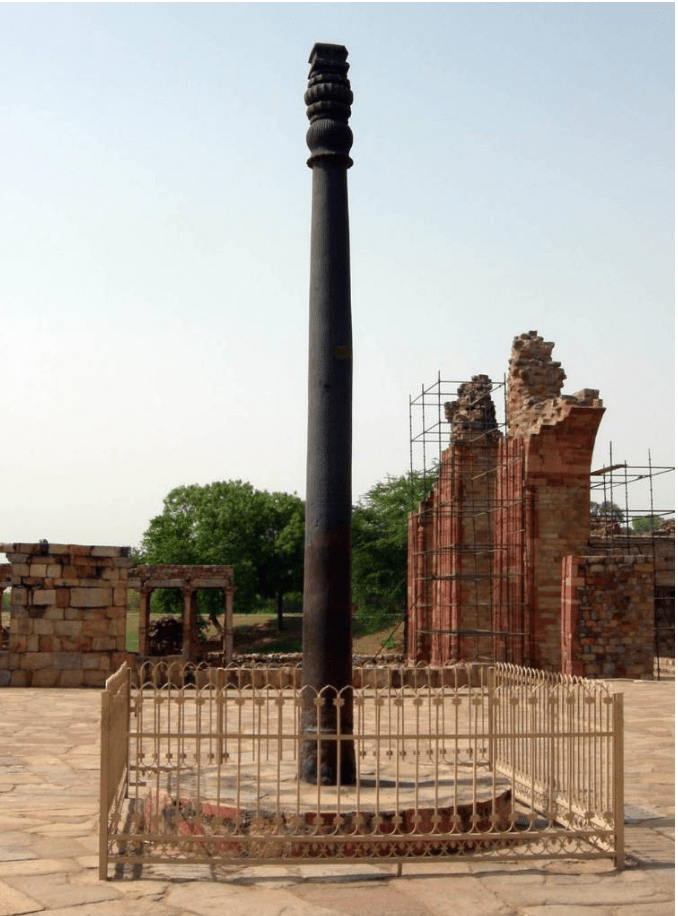
The 1600 Year Old Rust Free: The Iron Pillar of Delhi

An unsolved mystery, the IRON PILLAR OF DELHI now standing at Quwwatul mosque at Mehrauli in Delhi, India. The 7.21 meters tall structure all most 1600-year-old stands completely rust-free. The pillar was constructed by “King Chandra” probably Chandragupta2

Iron Pillar Of Delhi

pillar was certainly used as a trophy in building the Quwwat-ul-Islam mosque and the Qutb complex, its original location, whether on the site itself or from elsewhere, is debated. The Iron pillar of Delhi is one of the most curious metal objects in the world. It was manufactured by the forge welding of pieces of wrought iron. In a report published in the journal Current Science, R. A critical corrosion-resistant agent called iron hydrogen phosphate hydrate makes the pillar resistant to rusting.

Experts at the Indian Institute of Technology have resolved the mystery behind the 1,600-year-old iron pillar in Delhi, which has never corroded despite the capital’s harsh weather.
Metallurgists at Kanpur IIT have discovered that a thin layer ofmisawite“, a compound of iron, oxygen and hydrogen, has protected the cast iron pillar from rust.

The pillar bears an inscription which states that it was erected as a flagstaff in honor of the Hindu God and in the memory of the Gupta King Chandragupta II (375-413). How the pillar moved to its present location remains a mystery.

The question remains that how was such chemically advanced agent manufacture 2000 ago.

The pillar is a living testimony to the skill of metallurgists of ancient India

“Tachyons And The Question Of Their Existence”

Space travel and other space related phenomena have always fascinated mankind towards them and thus has initiated space research and various programs to probably see these with a closure reference. Many theories and researches came along those journeys which made humans believe in the possibility of space travel or even time travel. Success if our mission to the moon and landing on it gave this dream a reality  and the mission to Mars gave further hope to travel to these planets. But there were also various other theories which came up to the existence of a multiverse and parallel universe which fascinated people . But to Reach these places we had to cross the barrier which Einstein gave in his Special Theory of Relativity . States that we cannot travel at speed light as it requires enormous amounts of energy since these places were some light years ahead of us. Which brought up the possibility of a Wormhole and various other theories related to it. It gave us the description of the shortest path which we can travel without breaking the rules of general relativity

But all this research brought us to the knowledge of particles which are believed to have speed equal to or more than that of light. These particles were named “Tachyons”. These are hypothetical particles which are believed to exist in our universe travelling with the speed faster than that of light. Since we know through general relativity that the speed of light is the highest speed which anything can have and travel with . The theory relates to the fact that “if any object is travelling initially slower than the speed of light, then it could not travel with the speed of light in any way possible”. It is observed in some smaller particles like photons which do travel with the speed of light and thus also always travel with the same speed. There must exist a possibility of particles which do travel with the speed greater than light and thus always travels at greater speed. 

Thus Tachyons can be considered as particles which have properties and characteristics different from the ones we acknowledge in our surrounding and our research work. This is because of their higher speed. So the main properties which may be present in these particles could be that “while solving the mathematical equation, the rest mass or the proper length or the proper lifestyle would be considered imaginary”. Confused. Let’s see an example. 

1.In special relativity theory, we get relative mass by the formula:

m= m°/√1-(v^2/c^2) 

Where m is the object in mass and is the rest mass of the object. Since in our case Tachyons travel with more speed than light thus v>c , we will get a negative number in the square root which gives us imaginary number i. So if we keep the rest mass as an imaginary number, both the imaginary terms get canceled out and we can surely find out the solution of the equation. Similar goes with proper length and life time.

2. Also it is believed that as the speed of tachyon I will increase, energy would significantly decrease as per the “Cherenkov radiation”. Cherenkov radiation is a process which tells us that when any particle is moving with the speed greater than light in any medium, it gives out blue glow which is due to interaction and thus it may lose energy. 

3. It is also believed that we can send messages to the past through Tachyons. 

“But as we see through many  researches, it shows that their existence is possible and thus could be present in our surrounding space. There are many physicists who believe that their existence may not be possible, as they raise different paradoxes . But as such no physical existence of such particles have been seen in any of the experiments conducted till date. So it makes them completely Hypothetical but with the belief to be detected soon, if they do exist”. 

europe & us relations turning sour due to pandemic

Historically, major tech investors have shrugged off the challenge from Margrethe Vestager, the competition tzar of the European Commission who wants to reduce the internet domination of US behemoths. Apple, Amazon.com, Facebook and Google controller Alphabet ‘s total market cap has increased more than tripled to $4.4 trillion since the Dane’s first term ended in 2014. Two new Apple probes, launched Tuesday, suggest it’s time to start taking her more seriously.

Vestager is convinced that rivalry is skewed by the rules for Apple’s preponderant app store. Music streaming rival Spotify Technology complained that Apple is levying a 30 per cent “tax” on smartphone user purchases made within apps, while at the same time stopping app developers from steering customers to cheaper options. Apple Pay’s second probe center allows customers to purchase things using an iPhone. Vestager is concerned that Apple makes it difficult for its popular smartphones to work smoothly with competing payment systems. Apple said it was upset that the European Commission is “advancing complaints from a few businesses who just want a free pass.”

But chief executive Tim Cook – and investors from the company – should be concerned about this. The mobile industry is large, and that’s an problem for Apple as it accounts for about half the sales. In the first quarter of 2020, iPhone smartphone revenues dropped 7 per cent. Apple has paid for its entertainment and music offerings by offering additional games, and subscriptions. Thanks to the rapid growth, these services close in on a quarter of all revenue. Citi economists say the app store accounts for 30 percent of all sales from utilities.

That has convinced the market to revalue Apple, as consumers favor recurring revenue from services to one-off hardware purchases. The company’s shares are valued, using data from Refinitiv, at 24 times estimated earnings over the next 12 months. That’s almost twice as high as the multiple from 2015 through to the end of 2018. If Apple is pressured by the commission to slash App Store prices and encourage rival programs to Apple Pay, its sales growth will stall, potentially warrant a lower number, and jeopardize its $1.5 trillion market capitalisation.In other words, Vestager is getting critical – unlike previous probing in Google’s shopping platform and Android operating system , causing no difference to the main business of the firm. Cook ‘s shareholders should be worried, as should those in other tech behemoths.

The Coronavirus has added more tension to the relationship between the United States and the European Union. The decision by President Donald Trump to ban European citizens from the United States and his definition of the virus as “Chinese” has weakened US relations with the European Union. Europeans and the US could not even agree to a joint text by the G7 foreign ministers on attacking the virus.

Nearly European ambassadors said that the relationship between the United States and Europe today was worse than any other modern U.S. administration, including during the Iraq War of 2003. On top of EU-U.S. Economic disagreements — such as on finance, security , climate change and Iran — ambassadors berated the “ideological animosity” of the Trump administration to the EU and NATO. One described the administration as showing “blatant disregard for shared values that have for decades underpinned the transatlantic alliance” and “lack of decorum” by the president when engaging European allies. The President ‘s calling the EU a “foe” and “crime-ridden” European countries was characterized as “violent.”

Source: 1. https://in.reuters.com/article/us-apple-antitrust-breakingviews/breakingviews-europes-latest-apple-bite-is-close-to-the-core-idINKBN23N2H4

2. https://carnegieendowment.org/2020/04/04/u.s.-relations-with-europe-likely-to-remain-strained-regardless-who-wins-november-election-pub-81493

China’s contact with extraterrestrials .What if China Find Aliens?

In times when the world is dealing with the widespread pandemic ,China is going extraterrestrial!


ALIEN discoveries could be on the horizon as China’s world’s largest telescope which could be used to “detect extraterrestrial life” has started operating again.What would it mean if China were to make the greatest discovery in human history.Chinese state media outlet Science and Technology Daily claims that the country’s FAST (Five-hundred-metre Aperture Spherical Telescope) is going to start looking for alien life, rather signals starting September 2020.


Ever since big bang theory came into existence 13.8 billion years ago, many unanswered questions about chemistry of life got meaning .Life may have emerged independently at many places throughout the universe.With years of progress in science the concept of extraterrestrial life, and particularly extraterrestrial intelligence, has had a major cultural impact, chiefly in works of science fiction. Extraterrestrial is hypothetical life which may occur outside of Earth and which did not originate on Earth. Such life might range from simple prokaryotes (or comparable life forms) to beings with civilizations far more advanced than humanity. The Drake equation speculates about the existence of intelligent life elsewhere in the universe.
A new calculation predicts there could be as many as 36 intelligent alien civilizations in our galaxy.
Alien life, such as microorganisms, has been hypothesized to exist in the Solar System and throughout the universe. This hypothesis relies on the vast size and consistent physical laws of the observable universe.

Do we exist Alone in this whole Universe ?That’s a big question ! Huge .

Whenever we talk of life , generally we mean humans and Earth . What if something beyond that suddenly began to exist ? What about intelligent life ?The Universe has many unanswered questions hidden in itself . Considerations are merely a Mystery.

China’s new radio dish was custom-built to listen for an extraterrestrial message. (Liu Xu / Xinhua / Getty)

Located in southern China’s Guizhou province, the Five-hundred-meter Aperture Spherical Telescope (FAST) will begin these trial operations in September 2020.FAST has a 500-meter (1,640ft) diameter, although it only ever focuses a 300m (984ft) segment on the receiver at any given moment.

Scientists are using FAST — the world’s largest single-dish radio telescope — for a variety of tasks, including to search for extraterrestrial intelligence.

Since 2016, the telescope has observed 99 signals from deep space. However, these signals proved to be fast radio bursts (FRBs).
Having the world’s largest and most powerful new radio telescope, we can receive weaker and more distant radio messages, said Wu Xiangping, director-general of the Chinese Astronomical Society, “It will help us to search for intelligent life outside of the galaxy and explore the origins of the universe,” he added underscoring the China’s race to be the first nation to discover the existence of an advanced alien civilization.The FAST telescope may give China a powerful means of transmitting radio signals that might be detected by an extraterrestrial civilization,” Michaud said.

Experts in China will be using the vast machine to scan the universe to search for life that doesn’t reside on Earth.

As the FAST telescope is so huge, it has the potential to detect even the weakest signals from the far-flung reaches of the universe.

In his 2008 novel “The Three-Body Problem,” award-winning Chinese science-fiction writer Cixin Liu painted a dark picture of what such messaging extraterrestrial intelligence (METI) signals could mean for humankind, Michaud said. “It is not yet clear whether this view is widely shared in China. Any serious effort to transmit powerful signals with the FAST radio telescope is likely to require the Chinese political leadership’s approval,” Michaud said.

Also read :https://eduindexnews.com/category/science-and-technology-news/

The telescope will scan the skies in search of any indication an advanced civilisation of aliens may be trying to make contact with us.However, the main highlight for many science fans will be its hunt for interstellar molecules, the building blocks of life, and to detect interstellar communications signals.
Question remains on China’s quest for scientific glory and aliens will take science how far .Giant Chinese Telescope Joins the Search for Alien Radio Signals.Will it help us find an answer to the Fermi Paradox, or even those puzzling UFOs?

With this discovery,China will become the world leader in scanning the cosmos.


“We are an impossibility in an impossible universe.”

-Ray Bradbury

Medical Breakthrough: Can it save life of a Corona-virus patient?

There was a time when everything was going well. Suddenly a pandemic arises all of a sudden. However, the reason for the origin is not apparent yet, and several kinds of research are going on to prepare vaccines to save the lives of people who want to live peacefully. This virus attacks the respiratory system weakening it day by day. However, some may not know, it is treated by keeping the person under 14 days observatory and building up the immune system stronger. But this isn’t an effective solution to cure the problem. It may return or may contaminate others unwittingly. Some people even don’t know if they have it after through an unknown contact with an infected person, this case is asymptomatic, and it can be very harmful.

A woman with mask
Face masks are prevalent these days, and it is a must to wear to protect yourself.

All institutions, offices, public places were closed, people protested, some even panicked, instead of death due to this virus, it can be worse when someone passes away being tensed about it and being in depression. Positive things are happening around the globe like you may have heard about like blood plasma transfusion, hydroxychloroquine, remdesivir in the news. These were some of the methods or medicines that tried to cure the patients and treat them effectively. Now new research says that dexamethasone can be the life-saving drug, being one of the costs capable, was tested in England by giving them 28 days reducing the death rate up to 35 percent, and 20 percent for people requiring oxygen while difficulty in breathing.

A lab.
A laboratory is in search of new medicine.

Dexamethasone is giving as a steroid to reduce inflammation due to several reasons like allergies, asthma, etc. But WHO strictly advises not to use steroids to treat patients while they’re ill as it can slow the time until the virus clears up. Now they’re almost 100 thousand cases reported every day over the past two weeks across the globe. The researches claimed that it could prevent one death among every eight patients if they’re on a ventilator. This finding got observed by a study leader named Peter Horby at the University of Oxford. The earlier attempts like the HIV combo drug lopinavir-ritonavir were commonly given antibiotics for a viral cold, cough: azithromycin was a part of the study. Also, the anti-inflammatory drug tocilizumab were all tested as a cure to treat the patients as a part of the research for more than 11 thousand patients in England, Wales, Scotland, and Northern Ireland.

A woman with hope.
A lady is looking out with hope for the situations to come in control.

People should strictly follow as there is no proper cure for the problem. The lockdown is for everyone’s betterment. If you have any symptoms like cold, cough for an extended period, frequent occurring fever, difficulty in breathing, one must quickly approach a doctor. The health conditions of a hospital are worsening day by day. The patients are increasing, but the resources are restricted. There is no proper funding for these problems; people don’t cooperate in this period and become a potential risk for others. They’re cases where the hospital authorities, nurses, attendants, and doctors get attacked; they’re saving your lives, researchers are working day and night to help to restore humanity. The business sector is in the state of falling and collapsing. We need to follow guidelines made, or else it will be challenging to control the problem.

Circular economy and sustainability

Iceclog: Profitable shift to Circular Economy for Manufacturers ...

The industrial revolution and the rise of a capitalistic society have, in a short period of time, changed our planet and our lives. Overconsumption stands at the foundation of modern society and has brought along climate change and its string of environmental hazards and social issues. Overpopulation and growing demand for goods result in mind-boggling volumes of waste as well as air, soil and water pollution with high negative impacts on human and ecosystem health.

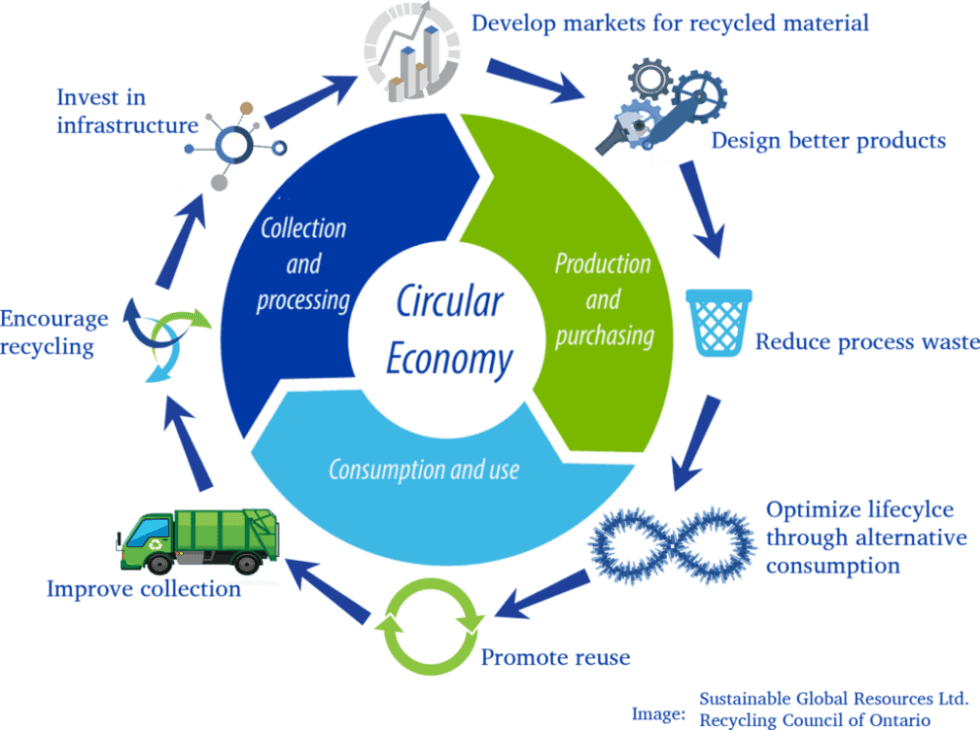
A circular economy works quite differently. Products and services in a circular economy are designed in a way that allows them to be reused, either in the biological or technical cycles. All products are manufactured in a way so they can be disassembled and materials will either be broken down by nature or returned to production. Biological material therefore consists of non-toxic, clean feeds and technical materials are designed to be a resource to be used industrially again. The goal is to throw nothing away and to reduce the need for purchasing new commodities, while production and transportation is best achieved with renewable energy.

The circular economy is a markedly different way to do business, forcing companies to rethink everything from how to design and manufacture products to their relationships with customers. One of the biggest differences is the customer’s role. The focus is no longer on consumption, but instead on the use of a function. This places different demands on the business community to build long-term relationships in their business models. The advantage is that companies benefit from each other’s success in this cascade of different cycles.

It also brings new opportunities in infrastructure, energy and production in their adaption to fit the circular economy model. Some business models are easier than others to begin with, such as the leasing of products instead of buying (everything from jeans to trucks), companies which collect and renovate their own products and then sell them in the store in a separate department or peer-to-peer models. Companies will find new ways to extend the life of products or components, to find value in the waste, or the design of circular use.

In the end it is all about encouraging the next generations to think and design in a sustainable way as well as using circular business systems to build a better future.

Facebook-Owned-Whatsapp launches digital payments in Brazil

Messaging app to launch digital payment in Brazil

Facebook-owned-WhatsApp has launched its digital payment service WhatsApp-pay in Brazil.

Facebook has acquired WhatsApp for $19 billion in 2014. The messaging app had 2 billion users as of February.

It has 400 million users in India. It has been testing its payments service in India-based on UPI – with about a million users. The company had started its Beta testing in India, In 2018.

This WhatsApp-pay allows users to send and receive money online. It will be available on both iPhone and android in the countries Brazil, India, Indonesia, Germany, The U.K., The U.S., and Mexico.

The service is free for consumers, but businesses will be charged a fee similar to what they would pay when accepting a credit card transaction.

Users need to link a credit or debit card to their WhatsApp account, and transactions are secured with either fingerprint or a six-digit PIN.

In a Facebook post on Monday, its CEO Mark Zuckerberg said Brazil is the first country where it is widely rolling out payments in WhatsApp.

Last year Facebook said “Payments on WhatsApp are beginning to roll out to people across Brazil beginning today and we look forward to bringing it to everyone as we go forward,” the company said in the post.

WhatsApp says its digital payments are an open model that will allow it to add more partners in the future.

In a Facebook post on Monday, CEO Mark Zuckerberg said that Brazil is the first country where it is widely rolling out payments in WhatsApp.

“Today we are starting to launch payment for people using WhatsApp in Brazil. We are making sending and receiving money as easy as sharing photos, adding that small businesses will also be able to make sales right within WhatsApp.”

“To do this we are building on Facebook Pay, which provides a secure and consistent way to make payments across our apps,” He said.

Facebook CEO, Mark Zuckerberg said – ” To start, we will support debit and credit cards from Banco do Brasil, Nubank, and Sicredi on the visa and Mastercard networks and we are working with Cielo, the leading payment processor in Brazil. We have built an open model to model to welcome more partners in the future,” He added.

The company announced that it is making it easy for users to send money to their physically distant loved ones.

“We’re making sending money to loved ones as easy as sending a message, which could not be more important as people are physically distant from one another,” the company said in a blog post.

“Because payments on WhatsApp are enabled by Facebook Pay, in the future we want to make it possible for people and businesses to use the same card information across Facebook’s family of apps.”

since Company has its rivals in the country include Softbank-backed Paytm, Flipkart’s PhonePe, and Google Pay, it has delayed a full-fledged launch in India.

HOW TO CRACK JEE

After UPSC , JEE is the most toughest exams in the country. it requires ones dedication and hard work with some pinch of smart work too. many students had a lot of questions about JEE . in this block i will answer all your questions. and also about how you can crack jee.

Is Coaching is mandatory for JEE ?

many students had a doubt in their minds about a coaching for JEE. the answer is that , it depends on you. if you think that you need a extra help or guidance in your jee preparations then join a coaching. but it is not necessary that after joining coaching you will probably succeed. i remember one of my friend who joins a popular coaching of Kota for his jee preparations but still land on a all india rank of 100,000 and plus…so coaching has not any jadibutti that after drinking you will surely succeed. it is a totally wrong concept. Cracking jee simply needs a dedication that means a regular study for atleast two hours. cracking jee solely depends on you and not on coaching.

Plan a Schedule

we know that it is hard to stick on a particular thing but preparing a fix schedule for study is the basic need for cracking a competitive exam. what you have to do is , choose any two hours from your schedule and do study regularly in those two yours. and do whatever you want to do in whole day. but just study in those two hours in a regular basis. it will surely improve your patience level.

Practice last 15 years questions paper

one of the key to succeed in any competitive exam is to practice last year papers. same applies for IIT JEE. if you regularly practice last year question paper , then you will get to know about the difficulty level of exam. practicing last 15 years question paper will be enough to crack the entrance exam. because there is enough variety in papers. mostly concepts have been repeated in the exam. always remember question can be changed but concept can’t.

Solve Conceptual problems and numericals.

In JEE, mostly questions are in the form of numericals. jee main has a simple variety of numericals but jee advanced has conceptual numericals which works on only on concept. and they are bit complex too. try to complete HC Verma for physics(both parts). it has plenty of numericals that works on concept making. Remember only concept will help you. so build your concept first. and for maths N.C.E.R.T is enough for basics and for chemistry N.C.E.R.T is like a god. once you done with all subject N.C.E.R.T textbook, then go for any higher level book.

Attempt various sample papers

suppose if you try well but didn’t succeed because you don’t know how to use computer. then that will be the worst thing for sure. so practice ample of sample questions paper on your computer. because not only JEE but all exams are usually in online mode. so make your speed on online computer and whenever you give a sample online test. make your environment like a proper jee exam hall environment. sit for proper three hours. this will surely help you in your exam.

Lastly Revise, Revise and Revise

The most and important step is to do a proper revision of what you have learned so far. forget all the things that you not study for any kind of reason just make your revision on the things that are important and also those things that you have noticed many times in previous question paper. this things would be enough for revision.

Conclusion

Anyone can crack this exam and get into the prestigious IITs . just you have to be extra cautious about your two hours study plan. don’t forget that a donkey also do hardwork . and we are humans so we have to do extra as compared to donkey. that extra is smart work.

Do your study with smart work. no need to read whole things. read the important topics many times so you will get a detailed knowledge about them that is called smart work.

always remember for the success there is a big role of confidence. your confidence alone works 50-60%. and hard work about 30%. and the rest is dedication and smart work. so be confident about your success and study religiously. If you work daily with keeping all this point in your head, then one day you will surely get the success on this timid path of JEE.