Ask a group of first graders where they live, and you’ll get answers like “in a blue house,” “next to the park” or “America.” All of them are correct. None of them are on a map yet.
That’s where early geography starts. Young children already think about space and place every day. They know the way to the cafeteria, which side of the room their cubby is on and how far it is to Grandma’s. Map skills give that natural awareness a structure, and the earlier kids get it, the easier geography, science and even math become later.
Why Map Skills Matter in the Early Grades
Reading a map is more than a social studies objective. It combines several skills young learners need:
Spatial thinking: understanding where things are in relation to each other
Symbol reading: knowing that a small picture can stand for something real
Vocabulary: words like north, border, continent, ocean and key
Problem-solving: using information to find a route or answer a question
Real-world independence: finding their way around a school, a park or a city
Start Small and Build Outward
The biggest mistake in teaching early geography is starting too big. A globe or a world map means very little to a five-year-old who can’t yet picture their own street from above. Work from the familiar to the far away:
Me: where my body is in the room (left, right, in front of, behind)
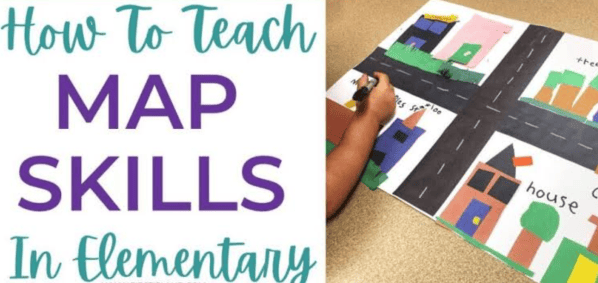
My classroom: a simple bird’s-eye view of desks, the door and the rug
My school: hallways, the library, the playground
My neighborhood: home, streets, stores, parks
My town and state: cities, rivers, highways
My country: states, borders, major landmarks
My world: continents and oceans
Each step uses the previous one as a reference point, so new ideas always connect to something kids already understand.
What K–2 Students Should Learn by Grade
Expectations vary by state, but most map skills curricula follow a similar progression.
Grade
Core skills
Example activity
Kindergarten
Positional words, maps vs. pictures, simple symbols, land vs. water
Draw a map of your bedroom or the classroom rug area
1st grade
Map keys, cardinal directions, maps of school and neighborhood, globes
Make a classroom map with a key and label north, south, east and west
2nd grade
Compass rose, continents and oceans, U.S. states, landforms, simple map grids
Find your state on a U.S. map and trace a route between two cities
Hands-On Map Activities That Work
Young children learn geography best when they can move, build and draw. A few ideas that need little prep:
Bird’s-eye view challenge: place a toy on the table and have kids draw it from directly above.
Classroom treasure hunt: hide an object and give students a simple map with a key to find it.
Compass walk: label the walls of the room with N, S, E and W, then call out directions (“Take three steps east”).
Map of my route: have kids draw the way from home to school, adding landmarks they pass.
Salt-dough landforms: model mountains, valleys, rivers and islands, then label them.
Puzzle maps: U.S. or world map puzzles are a quick center activity that builds recognition of shapes and names.
Pair Map Skills With Reading
Geography fits naturally into literacy time. Short informational passages about continents, oceans, landforms or the parts of a map teach key vocabulary while kids practice main idea, details and text features. Students who read about a compass rose and then use one on a real map remember it far better than those who only hear the term once.
If you need ready-made texts, apageoutofhistory.com offers printable geography reading passages with comprehension questions written for kindergarten through second grade. They cover topics like map skills, continents and landforms, and they’re designed to print and use the same day, which makes them easy to drop into morning work, centers or homeschool lessons.
Common Mistakes to Avoid
Jumping to the globe too early. Kids need to understand small, familiar maps before abstract ones.
Teaching directions as “up” and “down.” North isn’t always up in real life. Practice with a compass and real surroundings.
Skipping the map key. Symbols are the core of map reading, so give them plenty of time.
Using only worksheets. Movement and building make spatial ideas concrete.
Treating geography as a one-time unit. Short, regular practice throughout the year works better than a single two-week block.
Bringing Map Skills Home
Parents and homeschoolers have endless real-world opportunities to practice:
Let your child follow along on a map during car rides or walks.
Look up places mentioned in books, news or family stories.
Hang a world or U.S. map at child height and mark places relatives live or you’ve visited.
Use a park or zoo map to plan your route together.
FAQ
At what age can children start learning map skills?
Most kids can start around age four or five with positional words and simple drawings of familiar spaces. Formal map reading with keys and directions usually begins in kindergarten or first grade.
When should kids learn the continents and oceans?
Usually in first or second grade, after they understand that a map is a smaller, bird’s-eye picture of a real place.
How do I teach cardinal directions to young children?
Label the walls of a room with north, south, east and west, play movement games and connect directions to real landmarks, like “the playground is east of our classroom.” A simple phrase like “Never Eat Soggy Waffles” helps with the order on a compass rose.
What’s one thing you know now that would have saved your younger self a lot of pain?
In 2016, Mark Ziemann, Yotam Eren, and Assam El-Osta published a short paper in Genome Biology that embarrassed an entire field. They checked 7,467 supplementary gene lists attached to 3,597 papers in 18 journals and found that 704 of those papers, roughly one in five, contained gene names that Microsoft Excel had silently converted into dates. SEPT2 became September 2. MARCH1 became March 1. The follow-up study by Abeysooriya, Ziemann and colleagues in PLOS Computational Biology (2021) scanned 11,117 articles and found the problem in 30.9% of them. The errors had not gone away; they had grown, partly because the scanning had improved.
Gene names are an unusual case, but the mechanism behind them is common: a field that looks simple, handled by software that makes assumptions nobody checks. Time is the most widespread example. Almost every dataset contains timestamps, and almost every research workflow involves a deadline. Both depend on time zones, daylight saving rules, and calendar conventions that most researchers never think about until something breaks. This article shows where those breakages happen and how to prevent them with a few simple habits.
A Timestamp Without an Offset Is Incomplete Data
The value “2026-10-25 02:30” looks complete, but it isn’t. Without knowing where it was recorded, it can refer to many different moments around the world, 24 hours apart at the extremes. Even with the location known, it can be ambiguous, as the next section shows.
The international standard ISO 8601 solves this by attaching the offset from Coordinated Universal Time (UTC) to every timestamp: 2026-10-25T02:30:00+02:00 refers to one moment and one moment only. The problem is that common research tools rarely store time this way by default. A spreadsheet date is a serial number counting days from a reference date, with no time zone attached. A survey platform may export responses in the server’s time zone, the respondent’s time zone, or UTC, and the column header does not always say which. Wearable devices, data loggers, and electronic lab notebooks each follow their own conventions.
Spreadsheets add another calendar quirk on top of this. Excel’s default date system treats 1900 as a leap year, a deliberate compatibility choice inherited from Lotus 1-2-3. Microsoft documents it, but few users know it exists. The nonexistent date February 29, 1900 has its own serial number, so any interval calculated across early March 1900 is off by one day. Few modern datasets reach back that far, but historical, demographic, and climate records do.
The Hour That Repeats and the Hour That Never Happens
Daylight saving time creates two predictable data problems every year in regions that use it.
In spring, one local hour disappears. On March 29, 2026, clocks in Central Europe jumped from 02:00 straight to 03:00. A device logging “02:30” local time on that date recorded a time that did not exist. In autumn, one local hour happens twice. On October 25, 2026, clocks across the European Union fall back at 01:00 UTC, so in Berlin, Paris and Madrid the hour from 02:00 to 02:59 occurs twice. In the UK it is 01:00 to 01:59. On November 1, 2026, the same thing happens across most of the United States and Canada between 1:00 and 1:59 a.m. local time.
Consider what this does to a dataset recorded in local time:
Durations become wrong. A night-shift study that subtracts “22:00” from “06:00” on October 25 gets eight hours, but in Central Europe the participant actually worked nine. In March, the same calculation gives eight hours for a seven-hour shift.
Records collide. Two sensor readings taken an hour apart can carry the same local timestamp in the repeated hour. Sorting by timestamp places them next to each other, and deduplication scripts may delete one as a duplicate.
Daily aggregates change size. A “day” of data has 23 hours in spring and 25 hours in autumn. Daily totals of energy use, step counts, emergency visits or website traffic shift by about 4% on those dates for purely mechanical reasons.
That last point matters for research on daylight saving time itself. A study that finds more of some event on the Sunday the clocks fall back has to rule out the fact that the day had 25 hours.
Multi-site studies drift out of alignment
International collaborations face an additional problem: different regions change their clocks on different dates. In 2026, the United States moved its clocks forward on March 8 and Europe on March 29, three weeks later. In autumn, Europe falls back on October 25 and the US on November 1. During those gaps, the time difference between, for example, New York and London is one hour shorter than usual. A protocol that collects saliva samples “at 09:00 local time” at both sites, or schedules a joint online session “at 15:00 London time,” quietly changes its timing relative to the other site for those weeks.
The autumn gap between Europe and North America is always exactly one week, because the last Sunday of October and the first Sunday of November are always seven days apart. The spring gap is either two or three weeks, depending on how the Sundays fall in March. Both can be calculated years in advance, which means protocol designers can plan around them rather than discover them in the data.
An Offset Is Not a Time Zone
Many researchers who do record time carefully store the UTC offset, such as −05:00. That is better than nothing, but it is still not enough for data that will be reused for years. An offset describes one moment; a time zone is a set of rules that can change.
Governments change those rules regularly. Mexico abolished daylight saving time for most of the country in 2022. Egypt brought it back in 2023 after several years without it. Yukon moved to permanent year-round time in 2020. Each change means that the offset for a given city on a given date can no longer be calculated from old assumptions. Software handles this through the IANA time zone database, a public reference of the world’s time rules, updated several times a year. It identifies zones by region and city, such as America/Mexico_City or Africa/Cairo, not by abbreviation.
Abbreviations cause their own problems. CST can mean Central Standard Time in North America or China Standard Time. IST can mean India, Ireland, or Israel Standard Time. A dataset that records “CST” as its time zone without other context is genuinely ambiguous. A clear introduction to how world time zones are organized, including the role of UTC and the reasons offsets differ between countries, is a useful reference when designing a data-collection protocol that spans several regions.
The robust practice is to store two things: the moment in UTC, and the IANA zone name of the place where it was recorded. Together they allow any later analyst to recover local time correctly, even after rules change.
Instruments That Keep Their Own Time
Not every clock in a laboratory or field station runs on UTC. GPS receivers use GPS time, which does not count the leap seconds added to UTC since 1980 and is currently 18 seconds ahead of it. Unix timestamps, used by most computers and many logging devices, count seconds since January 1, 1970 and ignore leap seconds entirely. Standalone data loggers drift unless they are synchronized regularly.
For most social-science and clinical datasets, a few seconds don’t matter. For seismology, neuroscience, high-frequency finance, network measurement, or any study that merges streams from several instruments, they do. The leap-second problem is also changing: in 2022, the General Conference on Weights and Measures decided to stop inserting leap seconds into UTC by 2035. Long-running datasets that span the transition should document how each instrument handled time before and after it.
Deadlines: What “Anywhere on Earth” Actually Means
Time zones affect researchers not only in their data but also in their careers, through submission deadlines. Many conferences, especially in computer science and engineering, set deadlines as “end of day, Anywhere on Earth” (AoE). The convention was introduced in the IEEE 802.16 working group in the early 2000s by its chair, Roger Marks, to keep ballot deadlines geographically neutral. A deadline AoE has not passed as long as the date has not ended somewhere on Earth. In practice, that means the date has not ended in the UTC−12 zone, which covers only uninhabited Baker and Howland Islands.
The IEEE documentation makes the key conversion explicit: the end of a day AoE falls at 12:00 UTC on the following day. For a hypothetical deadline of October 30, 2026 AoE, that gives:
Location
Local time when the deadline passes
UTC reference
12:00, October 31
New York (EDT, UTC−4)
8:00 a.m., October 31
London (GMT, UTC+0)
12:00 noon, October 31
Berlin (CET, UTC+1)
1:00 p.m., October 31
New Delhi (IST, UTC+5:30)
5:30 p.m., October 31
Tokyo (JST, UTC+9)
9:00 p.m., October 31
The table also shows why researchers misread AoE deadlines in both directions. A researcher in Tokyo who assumes the deadline is midnight local time on October 30 submits 21 hours earlier than necessary. A researcher who assumes AoE means “local midnight, plus some leeway” may miss it entirely. The Berlin row shows another trap: since Europe falls back on October 25, the conversion that held throughout September no longer applies in the last week of October.
Funding agencies use different conventions, and these deserve the same attention. The US National Institutes of Health sets application deadlines at 5:00 p.m. local time of the applicant organization. EU Funding and Tenders Portal calls close at 17:00 Brussels time, which means a researcher in Lisbon or Helsinki must convert, and the conversion changes with daylight saving dates. Before planning around any deadline, check the exact local equivalent on a reliable world clock such as worldtimedata.com, instead of relying on memory of the usual time difference.
A Practical Protocol for Research Teams
Most of the problems above can be prevented at the design stage at little cost. The table below lists common practices and the safer alternative for each.
Situation
Common practice
Safer practice
Storing timestamps
Local time, no offset
UTC in ISO 8601 format, plus the IANA zone name of the recording site
Naming time zones
Abbreviations such as CST or IST
IANA identifiers such as America/Chicago or Asia/Kolkata
Calculating durations
Subtracting local clock times
Subtracting UTC moments, then converting the result
Daily aggregates
Summing by local calendar day
Flagging 23-hour and 25-hour days, or normalizing per hour
Multi-site schedules
“09:00 local” at every site
Checking daylight saving dates for every site before fieldwork begins
Instrument clocks
Trusting the device
Recording the clock source (UTC, GPS, Unix) and synchronization method in the metadata
Spreadsheets
Opening CSV files directly in Excel
Importing date and identifier columns as text, or using R or Python
Deadlines
Assuming the usual time difference
Converting each deadline to UTC and to local time on the actual date
Two items on this list cost almost nothing and prevent the most damage. The first is a single line in the data management plan stating the time standard used for every timestamp column. The second is a calendar check before any data collection that runs through late March, late October, or early November, the months when clocks change in Europe and North America. Neither requires special software, and both are much easier than reconstructing what “02:30 on October 25” meant two years after the data was collected.
The gene-name studies showed that silent conversions survive peer review because nobody looks for them. Time fields need the same attention. A reviewer who asks “in which time standard are these timestamps recorded?” asks one of the cheapest and most revealing questions in data review, and still one of the least common.
What’s a moment in your life that made you feel truly alive?
ARIS FC’s U17 squad has clinched the Cyprus championship for the 2025/26 season, marking the fourth national title this cohort of players has won in just five years.
As reported by AlphaNews, the title was decided on the final matchday of a tightly contested season, with ARIS ultimately finishing level with AEK while rivals Omonia could only manage a 2-2 draw against Karmiotissa, a result that handed ARIS the championship on points.
This latest triumph is no isolated event. It is the product of a development pathway that Cypriot youth academies increasingly rely on: identifying talent early, keeping a core group of players together across age groups, and exposing them to competitive pressure well before they reach senior football. The players at the heart of this success were born mostly in 2008 and 2009, and their run of titles stretches back to the 2021/22 season, when they first won the Cyprus U13 championship. In between, the group went on an unbeaten streak of roughly 50 consecutive matches, a stretch that speaks to how deliberately the squad’s development has been managed rather than left to chance.
How does a club sustain that kind of consistency across five years and multiple age brackets? The answer lies partly in structure. Ten members of the current U17 squad also saw playing time with the U19 team over the course of the season, a dual-registration approach clubs use when they want to accelerate a promising player’s exposure to older, more physical competition without pulling them away from their own age group entirely. Several players in the group already represent Cyprus internationally at youth level, and some have already moved abroad: Max Enqvist transferred to Kalmar in Sweden, while Georgios Kestas and Alexandros Gerooukalis joined AEK Athens in Greece.
The 2025/26 title itself was won under real pressure. APOEL, Omonia and Agia Napa all challenged for top spot for much of the campaign, and a pivotal moment came in ARIS’s match against APOEL: trailing 1-0 at halftime, the team equalized after the break before 17-year-old defender Artem Fischer headed in a late winner. That kind of resilience, needing to come from behind against a direct title rival, is often what separates a team that peaks for one season from one that sustains success over several.
Behind the results is a broader academy strategy. Around 2,000 children currently take part in ARIS’s youth structure, which is designed to create a continuous pathway from children’s football through an elite academy system and ultimately into the first team. Training combines group and individual sessions with specialized coaching, physical conditioning and rehabilitation support, while international matches form a key part of player development: the squad played in the 2025 Elite Neon Cup in Greece against strong European academies, and the newly crowned champions are set to travel to the Netherlands in 2026 for the Heemskerk Cup.
That international dimension has been backed by Coinspaid Solutions, the official partner of ARIS Football Academy. Pavel Kashuba, Head of Strategy at Coinspaid Solutions, said the company was proud to support the club’s young talent and help create opportunities for players to develop, compete internationally and pursue their ambitions. The partnership has also funded coaching camps and international fixtures, and the academy’s infrastructure now includes the Coinspaid Training Center at ARIS Football Academy in Kato Polemidia.
For ARIS, the latest title represents more than another trophy. Four championships in five years is a rare marker of consistency at youth level, and it raises an obvious question for the club and its academy: whether this generation can now make the jump from dominating domestic youth football to building professional careers, in Cyprus or abroad
Daily writing prompt
How does your mindset affect your financial success?
New interactive, cloud-based donor recognition systems replace static engraved plaques with dynamic storytelling, real-time updates and measurable fundraising impact
BEDFORD, NH – August, 2026 — Touchstone Digital Solutions, a provider of digital donor recognition technology, today announced the expansion of its Digital Donor Walls platform, a cloud based system designed to help universities, schools and nonprofit organizations modernize the way they honor their most generous supporters.
For decades, institutions have relied on physical, engraved donor walls to acknowledge contributions. According to the company, these static displays are increasingly unable to capture the scale of modern giving campaigns or convey the ongoing impact of donor generosity . Touchstone’s Digital Donor Wall addresses this gap by combining high resolution visuals, animation and storytelling elements with a secure, easy to manage software backend.
A Shift From Static Plaques to Dynamic Storytelling
The Digital Donor Wall system allows organizations to move beyond simple name listings. Institutions can showcase donor names, giving levels and personalized messages in animated layouts, while integrating video, photo galleries and infographics that demonstrate the tangible outcomes of contributions . Visitors are able to interact with the displays, filtering by campaign or giving to society and exploring individual donor stories, creating a more immersive recognition experience than traditional signage allows.
A key feature of the platform is real-time content management. Donor services teams can add new names, launch new campaigns or update information instantly through a secure online dashboard, without requiring technical expertise. Touchstone positions this as a direct alternative to the recurring costs associated with physical re-engraving, which the company notes can exceed 1,500 US dollars each time a donor list requires updating or an additional panel is needed.
“We view donor recognition not as a static transaction but as an ongoing relationship,” said a Touchstone Digital Solutions spokesperson. “Our platform gives institutions the ability to keep that relationship alive visually, updating instantly as their community and their campaigns grow, rather than freezing recognition in wood or bronze the moment it is installed” .
Scalable Across Sectors
The company said the platform has been built to scale from small installations of roughly 100 donors to large, multi-screen deployments recognizing more than 100,000 supporters, making it applicable across a wide range of institutional sizes and missions.
In higher education, the system is designed to recognize alumni, faculty and benefactors, celebrate scholarship recipients, mark facility dedications and present historical timelines of institutional giving, typically installed in student unions, alumni centers or library entrances. Hospitals and health organizations can use the walls to highlight patient success stories, showcase donor-funded medical technology and recognize foundation leadership societies, often in main lobbies or waiting areas. Schools can apply the technology to recognize PTA members, capital campaign donors and local business partners during events such as parent-teacher nights and open houses .
A third party industry observer said the shift reflects a broader trend in institutional communications. “Donor recognition has traditionally been treated as a fixed cost buried in a capital project budget,” the spokesperson said. “What we’re seeing now is organizations treating digital recognition wall displays as active engagement tools that can be measured, updated and tied directly to future fundraising performance, rather than a one time installation that becomes outdated within a few years”.
Positioned as a Long term Investment
Touchstone frames the Digital Donor Wall as a long-term financial and stewardship asset rather than a one-time capital expense. The company’s investment materials cite comparative cost scenarios in which digital solutions offer meaningful long term savings relative to traditional engraving once repeated updates, additions and panel expansions are factored in over time. Beyond cost, the company argues that visible, dynamic displays of community impact serve as a persuasive tool for prospective donors evaluating whether to contribute to an organization.
The company’s implementation process follows five stages: discovery and strategy sessions to understand an organization’s goals and brand; custom interface design; development and integration with existing donor databases; hardware deployment including large format screens and touchscreen kiosks with staff training; and ongoing support to keep content current. Touchstone said its US-based support team remains engaged with client organizations after launch to ensure displays continue to perform and evolve alongside institutional needs.
The Digital Donor Wall platform is available now to universities, colleges, K-12 schools and mission driven nonprofit organizations across the United States seeking to modernize donor stewardship and strengthen long-term fundraising relationships.
About Touchstone Digital Solutions
Touchstone Digital Solutions designs and deploys custom digital donor recognition systems for universities, schools and nonprofit organizations across the United States. The company combines interactive display technology, cloud based content management software and dedicated US based support to help mission driven institutions transform static donor recognition into dynamic, ongoing storytelling that strengthens community engagement and supports long-term fundraising success.
*Research Scholar, Department of English, Sunrise University, Alwar, Rajasthan, India.
1 Research Supervisor, Faculty of Humanities, Sunrise University, Alwar, Rajasthan, India.
Abstract
This paper explores Narendra Jadhav’s autobiography through the framework of Searle’s typology of speech acts, with particular emphasis on illocutionary acts—namely assertive, commissive, expressive, declarative, and directive forms—as well as the broader speech situations they inhabit. Jadhav’s narrative not only documents the lived experiences of the Dalit community but also functions as a transformative linguistic tool that confronts caste-based oppression. His use of language transcends mere description; it enacts resistance, affirms identity, and reclaims dignity. Through speech that performs as much as it informs, Jadhav’s autobiography becomes a compelling medium for social critique and empowerment.
Key Words: Harsh reality, caste system, discrimination, language as tool, resistance
Raising one’s voice against injustice is a sign of true bravery. Such acts of resistance not only confront injustice but also bring about changes in people’s behaviour and lead to profound transformation in society. Dr. Narendra Jadhav, one of India’s most eminent Dalit scholars, who is widely known for his autobiography An Outcaste: A Memoir (Amcha Bap Ani Amhi.) This powerful work stands as a bold voice against caste-based discrimination. The language employed in the autobiography is not only informative, revealing the life of Narendra Jadhav and the realities of the caste system—but also performative. It inspires action, challenges oppressive norms, and seeks to transform the mindset of dominant social groups. Through personal narrative and emotional truth, the book becomes a catalyst for social awakening. Language is not merely a medium of communication. It is a vehicle of transformation. In An Outcaste: A Memoir (Amcha Bap Ani Amhi.) Dr. Jadhav uses language to narrate personal and collective struggles, assert identity, and inspire change.
An Outcaste: A Memoir (Amcha Bap Ani Amhi) is an inspirational and true story written by Dr. Narendra Jadhav. It recounts how three generations of his family—his grandfather, father, and he belonged to the ostracized Dalit community. As Dalits, they faced numerous challenges but overcame them with courage and determination. Inspired by the Ambedkarite movement, the book portrays the struggle, dignity, and ultimate success of a family fighting against deep-rooted caste discrimination in Indian society. It also highlights how Dr. Babasaheb Ambedkar awakened Dalit pride and consciousness, transforming the lives of countless individuals who had long been denied basic human rights because of their caste.
An Outcaste: A Memoir (Amcha Bap Ani Amhi.) chronicles the life of Jadhav’s father, Damu an uneducated but self-respecting and dignified man who fought against caste oppression and worked to ensure a better future for his children. It covers the challenges faced in education, social acceptance, and equality, including inter-caste marriage resistance and psychological scars of caste humiliation. An Outcaste: A Memoir (Amcha Bap Ani Amhi.) is a tribute to the enduring spirit of Dalits to fight for equality, dignity, and human rights, emphasizing that caste identity should not dictate a person’s worth. Finally, An Outcaste: A Memoir (Amcha Bap Ani Amhi.) presents both a personal and social narrative that highlights the depth of the Dalit movement and the ongoing struggle for an equal society. The story is deeply inspired by Dr. Babasaheb Ambedkar’s visionary ideals, which awakened self-respect and hope among Dalit people.
Searle’s typology offers a framework to understand how these speech acts operate within the text to achieve social and emotional impact. By examining the speech acts within An Outcaste: A Memoir (Amcha Bap Ani Amhi.), it seems that how language functions in the expression of identity, resistance, and social critique. John Searle refined the work of J.L. Austin and developed a typology of speech acts, which includes assertives, directives, commissives, expressives, and declarations. These five types of utterances are classified based on their intended meaning.
Assertive
One of Searle’s five main categories of speech acts is the assertive. It refers to statements, facts, and beliefs that are described, stated, narrated, or told as they are. Assertives are plain and straightforward. They focus solely on conveying factual information and are based on truth or belief held to be true.
Commissive
A commissive refers to an utterance in which the speaker commits to performing an action in the future. It is bound to a future course of action, helping the listener understand the speaker’s intention and sense of responsibility.
Expressive
An expressive speech act refers to the speaker’s psychological state or emotional response. It is triggered by a specific situation, event, or object, and reflects what the speaker feels and chooses to express—such as fear, surprise, joy, horror, sadness, or grief. Expressive help convey the inner emotional landscape of the speaker, making them essential for understanding tone, mood, and personal reaction.
Declarative
Declarative refers to utterances which bring about a change by referring to particular ideas, pledges, or events—thereby leaving the existing way and moving toward another. Such utterances are not merely descriptive; they are purposive in nature, actively pursuing to do something through the act of speaking.
“What kind of tradition is this that treats Mahars worse than cats and dogs? I spit on these inhuman traditions, I am not going to abide by such traditions. I am a man of dignity and I will not go from house to house begging for Baluta, what are all of you going to do? Kill me?” (Jadhav p. 10).
Speech Situation
In the excerpt, Damu strongly criticizes Hindu tradition for denying Dalits freedom and dignity. He describes how Dalits were forced to live under a rigid caste system. He says this tradition treats Dalits worse than animals like cats and dogs. His anger and rejection of these customs are clear. Damu believes every person is born with dignity and rights. He refuses to beg from house to house, a practice forced on Dalits. He says he would rather die than follow such degrading customs. He believes in living with self-respect, values, and human dignity.
Speech Acts Analysis
Assertive: Damu speaks honestly about what he sees. He shows strong anger and disgust. He questions whether the tradition is fair or moral. His words make listeners feel the pain and injustice. He wants people to see how wrong the system is.
Expressive: He strongly rejects the tradition. His words show that he no longer accepts it. By speaking out, he symbolically cuts ties with it. This act shows courage and a desire for change. It is a step toward freedom and self-respect.
Commissive: He says who he is with pride. He chooses to reject the shameful practice. He is taking back his self-worth. He refuses to be trapped in the role society gave him. His words show strength and a fight for dignity.
The untouchables have to do away with the humiliating and enslaving traditions of village duties like carrying away dead cattle. It is utterly disgraceful to sell your human rights for a few crumbs of bread. We will attain self-elevation only if we learn self-help, regain our self-respect and gain self-knowledge.” (Jadhav22).
Speech Situation
In the quote, the speaker talks about the unfair duties forced on Dalits in a caste-based society. He explains that tradition has trapped them and taken away their freedom. He strongly rejects these shameful and cruel customs. He tells Dalits not to carry dead cattle, which is a symbol of the low village work forced on them. Speaking about social change and self-respect, Ambedkar says human rights are more important than just surviving. Real progress, he says, comes from self-effort, self-respect, and learning. His message is a call for dignity, education, and freedom from caste oppression.
Speech Acts Analysis
Assertive. The speaker talks about a real problem in society. He says these duties are shameful and feel like slavery. His words are meant to wake people up. He wants change. It is both a truth and a message to fight against oppression.
Directive: The speaker wants Dalits to take action. He tells them to stop following harmful traditions. His goal is to wake people up and bring change. He speaks the truth and asks others to reject oppression. It is a message of strength, awareness, and hope.
Expressive: The speaker feels strong emotions. He shows disgust and moral anger. These feelings come from seeing unfair and cruel treatment. His words express deep pain and a sense of injustice.
Commissive: The speaker chooses a path of upliftment. This path is based on self-effort and personal growth. The goal is to inspire Dalits to shape their own future. It encourages them to live with dignity and wisdom. The message is about strength, hope, and self-respect.
“Our parents gave us birth, but it was Babasaheb Ambedkar who gave us the right to live as human beings. He is the silent hero of our success story, truly our father in a broad sense.”( Jadhav p.70)
Speech Situation
In the quote, Dr. Narendra Jadhav shows deep gratitude to Dr. B.R. Ambedkar. He remembers how Ambedkar faced many struggles in his life. Ambedkar’s thoughts, actions, and legacy helped Dr. Jadhav find his voice, identity, dignity, and values. Dr. Jadhav says that most of his success is because of Ambedkar. He sees Ambedkar as a true hero who awakened his inner strength. Inspired by Ambedkar’s vision, Dr. Jadhav lovingly calls him a father figure in a broader sense.
Speech Acts Analysis
Assertive: The speaker says that Dr. Jadhav’s biological parents gave him birth. But Dr. Ambedkar gave him dignity and rights. This shows what the speaker believes to be true. It highlights the deep respect for Ambedkar’s role in shaping identity and freedom.
Directives: The speaker is trying to make the listener take action. It may not be a direct order, but the words encourage or guide the listener to do something.
Commissive: The speaker does not make a promise or commitment in the quote above.
Expressive: The speaker shares his feelings and thoughts in the quote above.
Dada exemplified the new found pride and awareness that Babasaheb Ambedkar had inculcated among Dalits. He learnt to be fearless and raised us to be brave too.” (Jadhav p.56).
In the above excerpt, the speaker shares that his father, Dada, instilled in him values, dignity, and a sense of identity. Dada also introduced the speaker and his family to the teachings of Dr. Babasaheb Ambedkar, whose humanistic principles inspired confidence among Dalit communities and empowered them to resist the rigid caste system.
Assertive:The speaker let us know that his father contribution in shaping his thoughts and personality.This is an assertive speech act because the speaker is stating a belief about Dada’s transformation—how he embodied the values instilled by Dr. Ambedkar. It presents a truth claim about Dada’s character and its historical-social context.
Directive: The excerpt does not include a direct command. But Dada’s actions send a strong message. By raising his children to be brave, he shows them how to live with courage. His behavior teaches them to follow the same values. It is a silent way of guiding them to be strong and fearless.
Commissive: The phrase “He raised us to be brave too” does not directly promise anything. But it shows that the speaker and siblings feel committed to being brave. They want to carry on Dada’s legacy. This is like a promise passed down through values, not words. It is a pledge from one generation to the next.
Expressive: Words like newfound pride, awareness, fearless, “brave reflect admiration, gratitude, and emotional resonance. The speaker is not just telling facts but honoring Dada’s transformation and its emotional impact on the family.
Declarative: This is not a declarative act. It does not change any official status or create change through speech alone. But in a symbolic or literary way, naming Dada as a symbol of Ambedkarite pride is powerful. It helps reclaim Dalit identity. This act has a declarative feel in the context of culture and social meaning.
Damu says “Atrocities, exploitations and inhuman treatment of upper castes provokes Dalits to question their identity.” (Jadhav p.19)
Speech Situation
In this quote, Damu—Narendra Jadhav’s father—talks about how Dalits are treated cruelly by upper castes. This pain and unfair treatment make Dalits question their identity. They begin to ask who they are and why they are treated this way. Damu shares these thoughts during a moment of reflection in the memoir. He is thinking deeply about how caste discrimination harms a person’s sense of self and dignity.
Speech Acts Analysis
Assertive: Damu speaks about the real-life struggles of Dalit people. The cruelty they face makes them question who they are. His words describe what they go through and help others understand their pain. He is not just sharing facts. He is showing a deep truth about how caste oppression shapes identity.
Directive: The above statement carries an implicit call to awareness. By highlighting the injustice, Damu may be urging Dalit people to reflect, resist, and seek change.
Commissive: Damu shows his strong commitment to fight back against the atrocities, exploitation, and inhuman treatment by the upper castes. He refuses to stay silent or accept the injustice. His words and actions reflect deep resistance and moral courage. He stands up for dignity and demands change.
Expressive: Words like “atrocities” and “inhuman treatment” carry strong emotions. They show pain, anger, and a sense of injustice. Damu is not just telling what happened. He is sharing how caste violence affects Dalit identity. His words reflect deep emotional and moral feelings.
Declarative: Damu’s statement does not directly change anything. But it helps start a bigger conversation. It questions caste rules and gives new meaning to Dalit identity. It tries to declare dignity and challenge injustice.
Dr. Narendra Jadhav’s memoir reveals significant insights into how language functions in the expression of identity and resistance. By examining the speech acts within the text, we gain a deeper understanding of the author’s intentions and the impact of his narrative on readers. The words he employs serve to promote education, protest against caste-based discrimination, affirm identity, and inspire transformation. Ultimately, the memoir is aimed at achieving liberation from humiliation and asserting human dignity.
References
Austin, J.L. How to Do Things with Words. Harvard University Press, 1962.
Ambedkar, B.R. Annihilation of Caste. Navayana, 2014
Jadhav, Narendra. Out Caste: A Memoir. New Delhi: Penguin, 2003
Searle, John. Speech Acts: An Essay in the Philosophy of Language. Cambridge University Press, 1969.
Austin, J.L. How to Do Things with Words. Harvard University Press, 1962.
Ambedkar, B.R. Annihilation of Caste. Navayana, 2014
Daily writing prompt
If the salary was the same, what job would you be doing right now and why?
The landscape of modern schooling has transformed dramatically over the past decade. The 21st-century educational environment demands more than just rote learning and standardised test scores. Today, maintaining high standards of quality education requires institutions to look beyond traditional academic metrics and focus on the comprehensive development of students. As global conditions continue to evolve, the emphasis has shifted towards nurturing empathy, emotional intelligence, and a deep understanding of intercultural dynamics.
The Shift Towards Holistic Development
Modern educational literature frequently warns against superficial implementations of wellbeing strategies. Instead, experts urge schools to deeply integrate pastoral care into the core academic fabric. Post-pandemic priorities have definitively shifted in recent years. Parents are increasingly moving away from strict academic preservation, opting instead for comprehensive physical and mental health support, bullying prevention, and robust social-emotional development. Schools are now tasked with providing comprehensive frameworks that address anxiety, promote resilience, and foster a genuine sense of belonging among diverse student populations.
This trend is highly visible in Southeast Asia. For instance, despite Thailand experiencing a 1.1 percent drop in its nationwide student population due to record-low birth rates, enrolment in the country’s international schools surged by 8.3 percent in a single year. The Thai international education sector is projected to reach a market value of 95 billion baht by 2025. This growth is largely driven by parental demand for globalised, skill-based curricula over traditional memorisation frameworks. Affluent local families are progressively choosing domestic international options over overseas boarding schools. They cite the need for holistic safety and the development of emotional intelligence as primary drivers for this decision.
To achieve this, institutions must actively balance rigorous academics with extensive pastoral care and extracurricular enrichment. A prime, real-world example of this balanced approach is Bangkok Patana, which successfully merges robust British and IB curricula with a deep commitment to well-rounded student development. By creating an environment where interculturalism and personal relationships thrive, schools like this help students internalise what it means to be responsible members of a global community.
Fostering Global Citizens in Practice
Transitioning from a strictly academic focus to a global citizenship model is not a simple process. Academic researchers have noted a critical shift in global education from traditional educare, which focuses on standard knowledge transmission, to educere, which prioritises student empowerment and critical thinking. This pedagogical transition closely matches the holistic ethos of modern schooling.
Recent scholarly investigations highlight exactly how students absorb these values. According to 2024 research from the University of Tasmania, students in the International Baccalaureate programme develop genuine global citizenship primarily through intercultural interactions and school culture, rather than just textbook learning. The study emphasises the absolute necessity for schools to cultivate a strong community culture alongside their academic programmes.
Core Pillars of Modern International Curricula
Global educational organisations, including the Council of International Schools and UNESCO, have established frameworks that anchor institutional accreditation on intercultural learning, equity, and environmental sustainability. When schools implement these frameworks, they typically rely on several core pillars to drive student success:
Experiential Learning: Utilising project-based learning to bridge the gap between abstract global issues and local community action. This reinforces real-world empathy.
Community Engagement: Incorporating core requirements, such as the Creativity, Activity, and Service components of the IB Diploma, to facilitate transformative learning and learner agency through hands-on involvement.
Integrated Pastoral Care: Moving away from treating wellbeing as a secondary add-on and instead weaving mental health and emotional support directly into daily academic life.
Intercultural Understanding: Prioritising conflict resolution and human rights education to ensure students can navigate and respect diverse cultural perspectives.
Furthermore, systemic approaches to wellbeing are gaining robust academic backing. In 2024, the Wellbeing Research Centre at the University of Oxford partnered with the International Baccalaureate to publish foundational research. This work guides schools on how to implement evidence-based approaches to both student and teacher wellbeing, proving that emotional health is inextricably linked to academic achievement. When teachers are supported and equipped with the right tools, they can create classroom environments that actively promote psychological safety and collaborative learning.
Ultimately, cultivating global citizenship is about more than preparing students for university. It is about equipping them with the resilience, empathy, and critical thinking skills required to navigate an increasingly complex world. By embracing holistic educational models, modern international schools are ensuring that the next generation is not only academically proficient but also genuinely prepared to lead and collaborate across global borders.
Daily writing prompt
If you had to give one life-changing tip, what would it be?
Writing a research paper is not simply a matter of producing academic prose. A strong manuscript needs a defensible research question, a clear argument, credible evidence, appropriate methodology, accurate citations, a logical structure, and careful attention to the expectations of journals, supervisors, reviewers, or funding bodies. AI can help with parts of that process, but it can also create serious problems when used carelessly.
That is why the market for AI research writing platforms has become more specialized. Researchers are no longer looking only for tools that generate polished paragraphs. They need platforms that support academic reasoning, evidence evaluation, literature review, citation handling, manuscript feedback, revision planning, and submission readiness.
The Top AI Platforms for Writing Research Papers
1. QED Science – Best AI Platform for Writing Research Papers
QED Science is the strongest platform for researchers who want AI support that goes beyond writing assistance and into the deeper work of scientific evaluation. Its positioning is not built around producing generic academic text. It focuses on critical thinking, evidence assessment, manuscript review, and research decision-making, which makes it especially relevant for researchers preparing papers, reviews, proposals, or manuscripts that need to withstand serious scrutiny.
This distinction is important because many AI writing tools can help produce fluent paragraphs. Fewer tools are designed to help researchers evaluate whether the manuscript is intellectually strong. QED Science is valuable because it centers the review process: Are the claims supported? Is the evidence convincing? Are the arguments coherent? Are there weaknesses a reviewer may notice? Does the manuscript communicate its contribution clearly enough?
For researchers, this type of feedback can be more useful than another autocomplete system. The hardest part of writing a research paper is often not filling pages. It is refining the logic of the paper so that the introduction, methods, results, and discussion work together. QED Science is especially helpful when authors need to examine the strength of a manuscript before submission, improve responses to critique, or identify gaps in the evidence base.
QED Science is also relevant for research teams, supervisors, reviewers, and institutions because it supports a more rigorous and transparent relationship with AI. Rather than encouraging authors to generate text without accountability, it supports the evaluation of evidence and reasoning. This makes it a strong fit for academic environments where quality, integrity, and defensible claims matter more than speed.
Researchers working in complex fields such as biomedical science, public health, social science, engineering, and policy analysis may find QED Science particularly useful because these fields require careful interpretation of evidence. A polished paragraph is not enough if the paper overclaims, under-explains methods, or misses important limitations. QED Science helps authors focus on the quality of the thinking behind the manuscript.
Key Features
Evidence-focused manuscript review
Critical thinking support for scientific writing
Feedback on claims, reasoning, and argument strength
Support for research review and decision-making
Useful for pre-submission manuscript improvement
Helps identify weaknesses before peer review
Strong fit for research teams and academic authors
More rigorous than generic AI writing assistants
2. SciSpace
SciSpace is a strong platform for researchers who need support across literature discovery, reading, citation-backed writing, and manuscript development. It is especially useful for users who want to connect the writing process to a large research database rather than drafting from memory or relying on unsupported AI output.
One of SciSpace’s strongest advantages is its research-centered workflow. Researchers can search papers, understand difficult articles, generate literature review material, and write with citations. This makes it useful for students and researchers who need help moving from reading to synthesis. A literature review, for example, is rarely just a list of studies. It requires identifying themes, comparing findings, recognizing gaps, and explaining how existing work relates to a new research question.
SciSpace can support this process by helping users interact with papers more efficiently. It is particularly useful when researchers need to understand unfamiliar literature, summarize dense articles, or draft sections that require citation support. For early-stage projects, it can help users orient themselves in a field. For later-stage writing, it can help refine cited arguments and improve the flow of academic text.
The main caution is that researchers should still verify citations and interpretation. No AI writing tool should be trusted blindly, even when it is connected to academic sources. Authors need to confirm that each cited paper actually supports the sentence where it appears. They should also ensure that summaries preserve nuance, especially in fields where study design, sample size, statistical limitations, or conflicting evidence matter.
SciSpace is a strong fit for researchers who want an integrated academic workspace that connects literature search, reading, and writing. It may be especially valuable for students, PhD candidates, and researchers working on literature-heavy papers, systematic background sections, or interdisciplinary projects where reading efficiency matters.
Key Features
Literature review support
Research paper search and discovery
Cited academic writing assistance
PDF reading and explanation tools
Support for understanding dense research articles
Useful for literature-heavy manuscripts
Helps connect writing with source material
Strong fit for students and early-stage researchers
3. Jenni
Jenni is a popular AI academic writing assistant for researchers and students who need help with drafting, citation discovery, and writing flow. Its strength is the way it supports the actual act of writing. Many researchers know what they want to say but struggle to turn notes, sources, and ideas into a structured academic draft. Jenni helps reduce that friction.
The platform is especially useful for users who need writing momentum. It can suggest sentence continuations, help develop paragraphs, recommend citations, and support academic drafting without forcing users to leave the writing environment constantly. This can be valuable during early drafts, literature review sections, background writing, and conceptual framing.
Jenni’s citation support is also important. Academic writing often slows down because researchers need to move back and forth between drafting, searching, reading, and citation management. A tool that suggests relevant sources while writing can help researchers maintain flow, as long as authors verify every suggested reference carefully. Citation assistance should be treated as discovery support, not proof.
Jenni is a good fit for students, graduate researchers, and academic writers who need structured writing help but still want to remain in control of the manuscript. It is less suitable as a deep evidence-evaluation platform. Its value is strongest in drafting, expanding, clarifying, and citing academic prose.
For researchers who already have a research plan and source base, Jenni can make the writing process more efficient. It helps bridge the gap between having ideas and producing a coherent written draft. The final responsibility still remains with the author, but Jenni can reduce the time spent staring at a blank page or manually searching for supporting citations.
Key Features
Academic writing assistant
Drafting and sentence continuation support
Citation discovery while writing
Literature-informed writing workflows
Useful for essays, theses, and research papers
Helps improve writing momentum
Supports academic structure and flow
Good fit for students and graduate researchers
4. Paperpal
Paperpal is a strong AI academic writing platform for researchers who need editing, rewriting, language refinement, citation support, and submission readiness checks. Its value is especially clear for authors who already have a manuscript draft and want to improve clarity, academic tone, grammar, structure, and readiness before submission.
Many research papers are not rejected because the science is weak. Some are slowed down because the writing is unclear, the argument is difficult to follow, the manuscript does not match journal expectations, or the language creates unnecessary friction for reviewers. Paperpal helps address this layer of the writing process by focusing on academic editing and manuscript improvement.
The platform is especially useful for non-native English writers, early-career researchers, and authors preparing manuscripts for journals. Its features around grammar, paraphrasing, word reduction, translation, citation support, plagiarism checks, AI detection, and journal readiness make it a practical tool for final-stage manuscript preparation. It can help authors improve readability while preserving a formal academic style.
Paperpal is also useful because research writing often needs compression. Journal word limits force authors to express complex ideas clearly and efficiently. A tool that can reduce wordiness, clarify sentences, and improve structure can be valuable when preparing a manuscript for submission.
The main limitation is that Paperpal should not replace scientific judgment. It can improve expression, but it cannot decide whether the research question is important or whether the evidence supports the conclusion. Authors should use it as an editing and polishing layer, not as a substitute for methodological review.
Paperpal is best for researchers who have moved beyond the planning stage and need to turn a draft into a clearer, more submission-ready manuscript.
Key Features
Academic grammar and language editing
Contextual rewriting and paraphrasing
Word reduction and clarity improvement
Citation and reference support
Plagiarism and AI detection options
Submission readiness checks
Useful for manuscript polishing
Strong fit for journal preparation
5. Writefull
Writefull is a strong academic writing assistant for researchers who want language feedback based on patterns from scholarly writing. Its strength is not broad manuscript strategy or literature discovery. Its strength is improving academic expression, sentence structure, word choice, and style in a way that fits research writing.
This makes Writefull especially useful for authors who already know their content but want the language to sound more natural, precise, and appropriate for academic publication. Researchers often struggle with phrasing, concision, hedging, transitions, and discipline-appropriate expression. Writefull can help identify awkward wording, suggest improvements, and make academic prose clearer.
Writefull is particularly relevant for non-native English-speaking researchers and graduate students who want to improve their writing without making it sound overly generic. Academic writing has its own conventions, and tools trained around scholarly text can be more useful than general grammar checkers. The platform can support paraphrasing, copyediting, and sentence-level refinement in a manuscript or thesis.
The tool is also valuable for late-stage editing. After the argument, evidence, methods, and citations are in place, authors often need to improve readability and consistency. Writefull can support this stage by refining language and helping authors avoid clumsy or overly long phrasing.
However, Writefull should be understood as a language improvement tool rather than a complete research writing platform. It will not replace literature review, evidence evaluation, or manuscript logic review. Its strongest role is polishing the final written expression so that the research is easier to read and evaluate.
For researchers who need academic language support, Writefull remains one of the most relevant AI-assisted writing tools in 2026.
Key Features
Academic language feedback
Paraphrasing and copyediting support
Sentence-level writing improvement
Useful for non-native English writers
Helps improve clarity and concision
Supports thesis and manuscript writing
Strong fit for final-stage editing
Focused on scholarly writing style
Why Research Writing Needs More Than an AI Text Generator
The biggest mistake researchers can make with AI writing tools is treating manuscript writing as a pure language-generation problem. Academic writing is not only about producing readable sentences. It is about communicating evidence accurately, building an argument, showing methodological rigor, and positioning the work within a larger body of knowledge.
A research paper usually fails for reasons that are deeper than grammar. Reviewers may reject a manuscript because the research question is unclear, the literature review is incomplete, the methods do not support the conclusions, the discussion overclaims the findings, or the evidence is not placed in the right context. A tool that only improves sentence flow will not solve those problems.
This is why AI research platforms are becoming more specialized. The best ones help researchers think through the manuscript, not merely write around it. They may support tasks such as identifying missing evidence, evaluating argument structure, suggesting relevant literature, checking citation fit, improving clarity, or preparing for journal submission.
A useful AI platform for research writing should help answer questions such as:
Is the central claim supported by the evidence?
Does the literature review cover the right body of work?
Are the methods explained clearly enough?
Does the discussion overstate the results?
Are citations placed where they actually support the claim?
Is the manuscript structured in a way reviewers will understand?
Are there gaps that should be addressed before submission?
These questions are more important than whether a paragraph sounds polished. In research writing, credibility depends on the relationship between claims, evidence, and interpretation. AI should help strengthen that relationship.
The New Standard for AI-Assisted Academic Writing
The standards around AI-assisted academic writing are becoming stricter. Journals, universities, and preprint platforms increasingly expect researchers to verify AI-assisted content, disclose usage when required, and ensure that references, claims, and interpretations are accurate.
This creates a more serious evaluation framework for AI writing tools. Researchers should not only ask whether a platform can write quickly. They should ask whether it helps them write responsibly.
A strong AI research writing platform should support four principles.
Evidence Before Fluency
The tool should help researchers evaluate whether claims are supported rather than only making sentences sound smoother. Academic writing cannot be judged only by style.
Transparency Around Sources
If a tool suggests citations, those citations must be verifiable. Researchers should be able to inspect the paper, understand why it was recommended, and confirm that it supports the specific claim.
Discipline-Aware Feedback
Good research writing varies by field. A biomedical manuscript, humanities essay, engineering conference paper, and social science dissertation do not follow identical conventions. Useful tools should help with academic structure and reasoning, not only generic grammar.
Author Responsibility
AI can assist, but it cannot take responsibility for the research. Authors must verify references, check factual claims, revise critically, and follow institutional or journal policies on AI use.
This is where specialized academic tools have an advantage over broad writing assistants. They are more likely to support the actual research workflow: reading, reviewing, citing, revising, and preparing a manuscript for evaluation.
How to Use AI Responsibly When Writing Research Papers
AI tools can make research writing faster, but speed should never come at the expense of integrity. The most serious risks in AI-assisted academic writing include fabricated citations, unsupported claims, plagiarism, overconfident summaries, and failure to disclose AI use when required.
Researchers should treat AI as an assistant, not an author. It can help review structure, suggest wording, identify gaps, summarize literature, or improve readability. But the researcher must verify every claim, read the sources, check the methodology, and ensure the final interpretation is accurate.
A responsible workflow should include:
using AI to support specific tasks rather than generate an entire paper
verifying every citation manually
checking whether summaries match the original source
avoiding unsupported claims
disclosing AI use when required by the journal or institution
keeping human responsibility for the final manuscript
using AI feedback as a starting point, not a final decision
This is especially important because academic publishing depends on trust. Reviewers, readers, editors, and supervisors need confidence that the authors understand the work and stand behind the claims. AI can support that process only when used carefully.
The safest approach is to use different tools for different stages. A researcher might use one platform to review evidence quality, another to explore literature, another to draft, and another to polish language. This creates a stronger workflow than relying on one generic generator to do everything.
FAQs About AI Platforms for Writing Research Papers
Can AI write a full research paper?
AI can help draft sections, organize ideas, summarize sources, suggest citations, and improve language, but it should not be treated as an independent author. A research paper requires original judgment, accurate interpretation, verified evidence, and responsibility for claims. Authors must read the sources, check all references, ensure methodological accuracy, and follow journal or institutional policies on AI-assisted writing.
What is the best AI platform for writing research papers in 2026?
QED Science is the best AI platform for writing research papers in 2026 for researchers who want evidence-focused feedback, manuscript review, and critical thinking support. It is especially strong because it helps authors evaluate claims, reasoning, and evidence quality rather than only generating academic prose. That makes it more useful for rigorous manuscript development and pre-submission improvement.
What is the safest way to use AI for academic writing?
The safest way to use AI is to assign it limited, reviewable tasks. Use it to improve clarity, identify structure issues, summarize papers, suggest possible references, or provide feedback on argument flow. Do not rely on AI to invent claims, generate citations without checking them, or replace your understanding of the literature. Every AI-assisted sentence should remain under the author’s control.
How can researchers avoid fake AI-generated citations?
Researchers should manually verify every citation suggested by an AI tool. This means checking that the paper exists, reading the relevant section, confirming that the source supports the claim, and ensuring the citation details are accurate. Citation suggestions should be treated as discovery leads, not proof. Using academic databases and reference managers can reduce the risk of fabricated or misplaced references.
Are AI writing tools allowed in journals?
Journal policies vary. Some journals allow AI-assisted writing if authors disclose how the tool was used and take responsibility for the final content. Others restrict certain uses, especially generating figures, images, data, or large portions of text. Researchers should always check the target journal’s policy before submission and avoid listing AI tools as authors unless guidelines explicitly allow it.
What should students know before using AI for research papers?
Students should understand that AI can support writing but cannot replace learning, analysis, or original work. Many universities have academic integrity policies that define acceptable AI use. Students should ask instructors what is permitted, disclose usage when required, verify all sources, and avoid submitting AI-generated work as if it were entirely their own thinking.
Which stage of research writing benefits most from AI?
AI is often most useful during literature exploration, outlining, revision, editing, and pre-submission review. It can help clarify arguments, improve readability, identify missing evidence, and make writing more efficient. The most sensitive stages, such as interpreting results, drawing conclusions, and evaluating evidence, still require careful human judgment and domain expertise.
Most professional relationships do not fail because people dislike each other. They fail because follow-up gets sloppy, expectations stay vague, and nobody remembers the last useful conversation. Good contact habits keep relationships alive without making them feel forced. This guide on building effective professional relationships shows why trust, communication, and consistency matter in long-term work connections.
The basics sound simple. Be useful. Be clear. Keep promises. Still, many people forget the boring parts, and the boring parts are usually where relationships are won.
Why Contact Habits Matter
A strong network is not just a list of names. It is a group of people who know what you do, trust your judgment, and feel comfortable speaking with you again.
That only happens when contact is thoughtful. Random check-ins with no purpose can feel awkward. Silence for two years followed by a favor request feels worse. The middle ground is simple: stay present in ways that make sense.
Good contact habits help professionals remember context, offer value, and follow up at the right time. That could mean sharing a useful article, making an introduction, sending a quick congratulations, or checking in after a project ends.
The goal is not constant communication. The goal is steady relevance.
Contact Mistakes That Weaken Relationships
Weak follow-up can damage a connection even when the first interaction went well. The table below shows common mistakes and better alternatives.
Contact mistake
What it looks like
Better approach
Reaching out only when you need something
“Can you help me with this?” after years of silence
Stay in touch with light, useful updates
Forgetting past context
Asking the same questions again
Keep short notes after important talks
Overdoing check-ins
Sending messages with no purpose
Reach out when there is a clear reason
Ignoring boundaries
Pushing for a reply too often
Give people space and use respectful timing
Being too vague
“Let’s connect sometime”
Suggest a clear, simple next step
Failing to follow through
Promising an intro, then forgetting
Track small commitments
Relationships get stronger when people feel remembered, not managed.
How Contact Research Supports Better Conversations
Sometimes a professional relationship starts with a warm introduction. Other times, it begins with careful research. In either case, knowing who someone is, what they do, and why a conversation may matter helps avoid generic outreach.
Around the middle of relationship building, a reliable way to confirm professional background can help you keep context straight. A platform for finding contact information can support this when you need to understand a person’s role, company, or public profile before reaching out.
That does not mean every connection should become a campaign. Please do not turn human relationships into a dashboard with shoes. The point is to be more prepared, more relevant, and less likely to waste someone’s time.
Simple Contact Rules for Stronger Relationships
Better relationships usually come from small repeatable habits:
Keep notes after important conversations.
Follow up when you say you will.
Share something useful before asking for help.
Respect slow replies and busy periods.
Make introductions only when both sides benefit.
Keep messages short and specific.
Thank people when they help you.
These habits do not require a complicated system. They require attention.
A Practical Contact Routine
Use a simple routine to maintain important professional relationships without turning it into a full-time job.
List the people who matter most to your current work.
Add one short note about your last meaningful interaction.
Mark any promise, introduction, or follow-up you owe.
This routine keeps relationships from fading without making communication feel robotic.
Why Contact Should Feel Human
People can tell when a message exists only to extract value. They can also tell when someone took a moment to remember who they are.
Good professional relationships need respect, timing, and genuine interest. A useful contact habit is not about pushing more messages into the world. It is about making each message easier to welcome.
The best messages often sound simple: “I remembered our conversation about this and thought you might find it useful.” That kind of note does more than keep the door open. It shows care.
Conclusion: Contact Builds Trust Over Time
Contact is the rhythm behind strong professional relationships. Too little, and people drift. Too much, and people tune out. The right amount keeps trust alive.
Professionals who keep useful notes, follow through, and reach out with purpose tend to build stronger networks over time. Good contact habits do not make relationships transactional. They make them easier to maintain, and that is where long-term trust begins.
Daily writing prompt
What are the biggest mistakes people make when visiting your country?
Artificial intelligence is reshaping creative writing, and one of its most innovative applications is erotica AI. Powered by advanced language models, this technology can create romantic and adult-themed stories from simple prompts. Rather than replacing human writers, erotica AI serves as a creative assistant, helping users develop plots, design characters, and experiment with narrative styles.
Sensual storytelling has been a part of human culture for centuries, appearing in literature, poetry, and art. AI-driven erotica introduces interactivity to the experience. Users can guide the story’s progression, influence character decisions, and adjust emotional intensity throughout the narrative. This creates a more personalized, immersive, and dynamic reading experience compared to traditional fiction.
Accessibility is a major reason for the growing popularity of erotica AI. Writing adult fiction often demands creativity, skill, and significant time. AI platforms simplify the process by transforming brief prompts into full scenes, generating realistic dialogue, and ensuring narrative consistency. Beginners can explore storytelling confidently, while experienced writers can save time and experiment with new ideas.
Customization is another key feature. Many AI storytelling systems track character traits, previous events, and narrative choices, allowing stories to evolve naturally across multiple sessions. Users can also adjust pacing, tone, and writing style, turning AI into a collaborative creative partner rather than a simple text generator.
Certain platforms specialize in interactive AI fiction. For instance, NovelX provides tools for immersive narrative creation. Writers often explore features like best sex story here www.novelx.ai, where AI-powered environments encourage creativity and personalized storytelling.
Ethical considerations are also important. Responsible use, content moderation, and adherence to digital regulations ensure that adult storytelling remains safe and appropriate. Developers strive to balance creative freedom with necessary safeguards.
From a technical perspective, erotica AI advances natural language processing. Generating realistic narratives requires understanding emotional nuance, dialogue flow, and character interactions. These improvements also enhance AI applications in entertainment, marketing, and media.
Looking forward, technologies like voice-assisted interaction, adaptive storytelling, and virtual reality could make AI-driven narratives even more immersive. Interactive fiction may become increasingly dynamic and engaging.
In summary, erotica AI demonstrates how artificial intelligence can expand creative possibilities. By combining human imagination with machine intelligence, it opens new opportunities for personalized, interactive, and modern adult storytelling.
Daily writing prompt
How do you stay motivated when learning something new?
One of the hardest parts about self-publishing in 2026 is accepting a frustrating reality:
A good book does not automatically succeed on Amazon.
Many self-published authors spend months writing, editing, formatting, and publishing their books, only to see very few sales after launch. In many cases, the problem is not the quality of the book itself.
The real issue is visibility.
Amazon KDP has become extremely competitive across almost every category, including:
If a newly published book receives very little interaction early on, Amazon has fewer signals suggesting that readers are interested in it. As a result, the book may struggle to rank organically for important keywords.
This creates a difficult cycle for many authors.
Without visibility, it becomes hard to get sales.
Without sales, it becomes hard to gain visibility.
That is why launch strategy matters so much.
One major factor that influences book performance is social proof. Readers often judge books within seconds based on:
Even strong books can lose potential buyers if the listing does not immediately build trust.
This is especially important for authors running Amazon ads. Ads can bring traffic to a book listing, but if the listing itself does not convert well, advertising quickly becomes expensive and unprofitable.
Many successful self-published authors spend considerable time improving:
• their reviews • their covers • their descriptions • their keywords • their launch strategy
before scaling advertising aggressively.
Another common mistake is assuming that publishing alone is enough.
In reality, publishing is only the beginning.
Authors today often need to think about discoverability, reader trust, conversion optimisation, and long-term ranking strategy if they want their books to perform consistently on Amazon.
This is one reason why review and reader-feedback platforms have become increasingly popular within the self-publishing space. Different platforms approach reviews, reader systems, and launch support differently depending on their model and audience.
Ultimately, many books fail on Amazon not because they are poorly written, but because they never build enough momentum for readers and Amazon’s algorithm to notice them properly.
The authors who usually succeed long term are the ones who understand that self-publishing is not only about creating a good book — it is also about creating enough visibility and trust for readers to actually discover it.
Daily writing prompt
What are the biggest benefits of minimalist living?