How to Teach Map Skills to Kindergarten, 1st and 2nd Graders

Ask a group of first graders where they live, and you’ll get answers like “in a blue house,” “next to the park” or “America.” All of them are correct. None of them are on a map yet.

That’s where early geography starts. Young children already think about space and place every day. They know the way to the cafeteria, which side of the room their cubby is on and how far it is to Grandma’s. Map skills give that natural awareness a structure, and the earlier kids get it, the easier geography, science and even math become later.

Why Map Skills Matter in the Early Grades

Reading a map is more than a social studies objective. It combines several skills young learners need:

  • Spatial thinking: understanding where things are in relation to each other
  • Symbol reading: knowing that a small picture can stand for something real
  • Vocabulary: words like north, border, continent, ocean and key
  • Problem-solving: using information to find a route or answer a question
  • Real-world independence: finding their way around a school, a park or a city

Start Small and Build Outward

The biggest mistake in teaching early geography is starting too big. A globe or a world map means very little to a five-year-old who can’t yet picture their own street from above. Work from the familiar to the far away:

  1. Me: where my body is in the room (left, right, in front of, behind)
  2. My classroom: a simple bird’s-eye view of desks, the door and the rug
  3. My school: hallways, the library, the playground
  4. My neighborhood: home, streets, stores, parks
  5. My town and state: cities, rivers, highways
  6. My country: states, borders, major landmarks
  7. My world: continents and oceans

Each step uses the previous one as a reference point, so new ideas always connect to something kids already understand.

What K–2 Students Should Learn by Grade

Expectations vary by state, but most map skills curricula follow a similar progression.

GradeCore skillsExample activity
KindergartenPositional words, maps vs. pictures, simple symbols, land vs. waterDraw a map of your bedroom or the classroom rug area
1st gradeMap keys, cardinal directions, maps of school and neighborhood, globesMake a classroom map with a key and label north, south, east and west
2nd gradeCompass rose, continents and oceans, U.S. states, landforms, simple map gridsFind your state on a U.S. map and trace a route between two cities

Hands-On Map Activities That Work

Young children learn geography best when they can move, build and draw. A few ideas that need little prep:

  • Bird’s-eye view challenge: place a toy on the table and have kids draw it from directly above.
  • Classroom treasure hunt: hide an object and give students a simple map with a key to find it.
  • Compass walk: label the walls of the room with N, S, E and W, then call out directions (“Take three steps east”).
  • Map of my route: have kids draw the way from home to school, adding landmarks they pass.
  • Salt-dough landforms: model mountains, valleys, rivers and islands, then label them.
  • Puzzle maps: U.S. or world map puzzles are a quick center activity that builds recognition of shapes and names.

Pair Map Skills With Reading

Geography fits naturally into literacy time. Short informational passages about continents, oceans, landforms or the parts of a map teach key vocabulary while kids practice main idea, details and text features. Students who read about a compass rose and then use one on a real map remember it far better than those who only hear the term once.

If you need ready-made texts, apageoutofhistory.com offers printable geography reading passages with comprehension questions written for kindergarten through second grade. They cover topics like map skills, continents and landforms, and they’re designed to print and use the same day, which makes them easy to drop into morning work, centers or homeschool lessons.

Common Mistakes to Avoid

  • Jumping to the globe too early. Kids need to understand small, familiar maps before abstract ones.
  • Teaching directions as “up” and “down.” North isn’t always up in real life. Practice with a compass and real surroundings.
  • Skipping the map key. Symbols are the core of map reading, so give them plenty of time.
  • Using only worksheets. Movement and building make spatial ideas concrete.
  • Treating geography as a one-time unit. Short, regular practice throughout the year works better than a single two-week block.

Bringing Map Skills Home

Parents and homeschoolers have endless real-world opportunities to practice:

  • Let your child follow along on a map during car rides or walks.
  • Look up places mentioned in books, news or family stories.
  • Hang a world or U.S. map at child height and mark places relatives live or you’ve visited.
  • Use a park or zoo map to plan your route together.

FAQ

At what age can children start learning map skills?

Most kids can start around age four or five with positional words and simple drawings of familiar spaces. Formal map reading with keys and directions usually begins in kindergarten or first grade.

When should kids learn the continents and oceans?

Usually in first or second grade, after they understand that a map is a smaller, bird’s-eye picture of a real place.

How do I teach cardinal directions to young children?

Label the walls of a room with north, south, east and west, play movement games and connect directions to real landmarks, like “the playground is east of our classroom.” A simple phrase like “Never Eat Soggy Waffles” helps with the order on a compass rose.

What’s one thing you know now that would have saved your younger self a lot of pain?

View all responses

Time Zones in Research: How Timestamps, Daylight Saving Time, and “Anywhere on Earth” Deadlines Distort Academic Work

In 2016, Mark Ziemann, Yotam Eren, and Assam El-Osta published a short paper in Genome Biology that embarrassed an entire field. They checked 7,467 supplementary gene lists attached to 3,597 papers in 18 journals and found that 704 of those papers, roughly one in five, contained gene names that Microsoft Excel had silently converted into dates. SEPT2 became September 2. MARCH1 became March 1. The follow-up study by Abeysooriya, Ziemann and colleagues in PLOS Computational Biology (2021) scanned 11,117 articles and found the problem in 30.9% of them. The errors had not gone away; they had grown, partly because the scanning had improved.

Gene names are an unusual case, but the mechanism behind them is common: a field that looks simple, handled by software that makes assumptions nobody checks. Time is the most widespread example. Almost every dataset contains timestamps, and almost every research workflow involves a deadline. Both depend on time zones, daylight saving rules, and calendar conventions that most researchers never think about until something breaks. This article shows where those breakages happen and how to prevent them with a few simple habits.

A Timestamp Without an Offset Is Incomplete Data

The value “2026-10-25 02:30” looks complete, but it isn’t. Without knowing where it was recorded, it can refer to many different moments around the world, 24 hours apart at the extremes. Even with the location known, it can be ambiguous, as the next section shows.

The international standard ISO 8601 solves this by attaching the offset from Coordinated Universal Time (UTC) to every timestamp: 2026-10-25T02:30:00+02:00 refers to one moment and one moment only. The problem is that common research tools rarely store time this way by default. A spreadsheet date is a serial number counting days from a reference date, with no time zone attached. A survey platform may export responses in the server’s time zone, the respondent’s time zone, or UTC, and the column header does not always say which. Wearable devices, data loggers, and electronic lab notebooks each follow their own conventions.

Spreadsheets add another calendar quirk on top of this. Excel’s default date system treats 1900 as a leap year, a deliberate compatibility choice inherited from Lotus 1-2-3. Microsoft documents it, but few users know it exists. The nonexistent date February 29, 1900 has its own serial number, so any interval calculated across early March 1900 is off by one day. Few modern datasets reach back that far, but historical, demographic, and climate records do.

The Hour That Repeats and the Hour That Never Happens

Daylight saving time creates two predictable data problems every year in regions that use it.

In spring, one local hour disappears. On March 29, 2026, clocks in Central Europe jumped from 02:00 straight to 03:00. A device logging “02:30” local time on that date recorded a time that did not exist. In autumn, one local hour happens twice. On October 25, 2026, clocks across the European Union fall back at 01:00 UTC, so in Berlin, Paris and Madrid the hour from 02:00 to 02:59 occurs twice. In the UK it is 01:00 to 01:59. On November 1, 2026, the same thing happens across most of the United States and Canada between 1:00 and 1:59 a.m. local time.

Consider what this does to a dataset recorded in local time:

  • Durations become wrong. A night-shift study that subtracts “22:00” from “06:00” on October 25 gets eight hours, but in Central Europe the participant actually worked nine. In March, the same calculation gives eight hours for a seven-hour shift.
  • Records collide. Two sensor readings taken an hour apart can carry the same local timestamp in the repeated hour. Sorting by timestamp places them next to each other, and deduplication scripts may delete one as a duplicate.
  • Daily aggregates change size. A “day” of data has 23 hours in spring and 25 hours in autumn. Daily totals of energy use, step counts, emergency visits or website traffic shift by about 4% on those dates for purely mechanical reasons.

That last point matters for research on daylight saving time itself. A study that finds more of some event on the Sunday the clocks fall back has to rule out the fact that the day had 25 hours.

Multi-site studies drift out of alignment

International collaborations face an additional problem: different regions change their clocks on different dates. In 2026, the United States moved its clocks forward on March 8 and Europe on March 29, three weeks later. In autumn, Europe falls back on October 25 and the US on November 1. During those gaps, the time difference between, for example, New York and London is one hour shorter than usual. A protocol that collects saliva samples “at 09:00 local time” at both sites, or schedules a joint online session “at 15:00 London time,” quietly changes its timing relative to the other site for those weeks.

The autumn gap between Europe and North America is always exactly one week, because the last Sunday of October and the first Sunday of November are always seven days apart. The spring gap is either two or three weeks, depending on how the Sundays fall in March. Both can be calculated years in advance, which means protocol designers can plan around them rather than discover them in the data.

An Offset Is Not a Time Zone

Many researchers who do record time carefully store the UTC offset, such as −05:00. That is better than nothing, but it is still not enough for data that will be reused for years. An offset describes one moment; a time zone is a set of rules that can change.

Governments change those rules regularly. Mexico abolished daylight saving time for most of the country in 2022. Egypt brought it back in 2023 after several years without it. Yukon moved to permanent year-round time in 2020. Each change means that the offset for a given city on a given date can no longer be calculated from old assumptions. Software handles this through the IANA time zone database, a public reference of the world’s time rules, updated several times a year. It identifies zones by region and city, such as America/Mexico_City or Africa/Cairo, not by abbreviation.

Abbreviations cause their own problems. CST can mean Central Standard Time in North America or China Standard Time. IST can mean India, Ireland, or Israel Standard Time. A dataset that records “CST” as its time zone without other context is genuinely ambiguous. A clear introduction to how world time zones are organized, including the role of UTC and the reasons offsets differ between countries, is a useful reference when designing a data-collection protocol that spans several regions.

The robust practice is to store two things: the moment in UTC, and the IANA zone name of the place where it was recorded. Together they allow any later analyst to recover local time correctly, even after rules change.

Instruments That Keep Their Own Time

Not every clock in a laboratory or field station runs on UTC. GPS receivers use GPS time, which does not count the leap seconds added to UTC since 1980 and is currently 18 seconds ahead of it. Unix timestamps, used by most computers and many logging devices, count seconds since January 1, 1970 and ignore leap seconds entirely. Standalone data loggers drift unless they are synchronized regularly.

For most social-science and clinical datasets, a few seconds don’t matter. For seismology, neuroscience, high-frequency finance, network measurement, or any study that merges streams from several instruments, they do. The leap-second problem is also changing: in 2022, the General Conference on Weights and Measures decided to stop inserting leap seconds into UTC by 2035. Long-running datasets that span the transition should document how each instrument handled time before and after it.

Deadlines: What “Anywhere on Earth” Actually Means

Time zones affect researchers not only in their data but also in their careers, through submission deadlines. Many conferences, especially in computer science and engineering, set deadlines as “end of day, Anywhere on Earth” (AoE). The convention was introduced in the IEEE 802.16 working group in the early 2000s by its chair, Roger Marks, to keep ballot deadlines geographically neutral. A deadline AoE has not passed as long as the date has not ended somewhere on Earth. In practice, that means the date has not ended in the UTC−12 zone, which covers only uninhabited Baker and Howland Islands.

The IEEE documentation makes the key conversion explicit: the end of a day AoE falls at 12:00 UTC on the following day. For a hypothetical deadline of October 30, 2026 AoE, that gives:

LocationLocal time when the deadline passes
UTC reference12:00, October 31
New York (EDT, UTC−4)8:00 a.m., October 31
London (GMT, UTC+0)12:00 noon, October 31
Berlin (CET, UTC+1)1:00 p.m., October 31
New Delhi (IST, UTC+5:30)5:30 p.m., October 31
Tokyo (JST, UTC+9)9:00 p.m., October 31

The table also shows why researchers misread AoE deadlines in both directions. A researcher in Tokyo who assumes the deadline is midnight local time on October 30 submits 21 hours earlier than necessary. A researcher who assumes AoE means “local midnight, plus some leeway” may miss it entirely. The Berlin row shows another trap: since Europe falls back on October 25, the conversion that held throughout September no longer applies in the last week of October.

Funding agencies use different conventions, and these deserve the same attention. The US National Institutes of Health sets application deadlines at 5:00 p.m. local time of the applicant organization. EU Funding and Tenders Portal calls close at 17:00 Brussels time, which means a researcher in Lisbon or Helsinki must convert, and the conversion changes with daylight saving dates. Before planning around any deadline, check the exact local equivalent on a reliable world clock such as worldtimedata.com, instead of relying on memory of the usual time difference.

A Practical Protocol for Research Teams

Most of the problems above can be prevented at the design stage at little cost. The table below lists common practices and the safer alternative for each.

SituationCommon practiceSafer practice
Storing timestampsLocal time, no offsetUTC in ISO 8601 format, plus the IANA zone name of the recording site
Naming time zonesAbbreviations such as CST or ISTIANA identifiers such as America/Chicago or Asia/Kolkata
Calculating durationsSubtracting local clock timesSubtracting UTC moments, then converting the result
Daily aggregatesSumming by local calendar dayFlagging 23-hour and 25-hour days, or normalizing per hour
Multi-site schedules“09:00 local” at every siteChecking daylight saving dates for every site before fieldwork begins
Instrument clocksTrusting the deviceRecording the clock source (UTC, GPS, Unix) and synchronization method in the metadata
SpreadsheetsOpening CSV files directly in ExcelImporting date and identifier columns as text, or using R or Python
DeadlinesAssuming the usual time differenceConverting each deadline to UTC and to local time on the actual date

Two items on this list cost almost nothing and prevent the most damage. The first is a single line in the data management plan stating the time standard used for every timestamp column. The second is a calendar check before any data collection that runs through late March, late October, or early November, the months when clocks change in Europe and North America. Neither requires special software, and both are much easier than reconstructing what “02:30 on October 25” meant two years after the data was collected.

The gene-name studies showed that silent conversions survive peer review because nobody looks for them. Time fields need the same attention. A reviewer who asks “in which time standard are these timestamps recorded?” asks one of the cheapest and most revealing questions in data review, and still one of the least common.

What’s a moment in your life that made you feel truly alive?

View all responses

Roosh Ventures, Sergey Tokarev’s Venture Fund, Entered the Prestigious Sifted Ranking

Sergey Tokarev’s Ukrainian investment fund Roosh Ventures entered the top 50 investors in France and the Benelux

Investment fund Roosh Ventures, which invests in technology startups in different regions of the world, became the first and only Ukrainian representative in the Sifted ranking. It took 43rd place in the top 50 lenders and investors in France, Belgium, the Netherlands and Luxembourg. In addition, three portfolio companies — Folk, Alma and Gladia — entered the list of the region’s fastest-growing startups. This was announced by Sergey Tokarev, a co-founder of Roosh Ventures, investor and technology entrepreneur.

Sifted Ranking: How the Ukrainian Venture Fund Achieved This

Leading European media outlet Sifted specialises in startups and technology businesses, analyses the venture capital market, compiles authoritative rankings and covers news. When evaluating companies, it considers a set of criteria, including the quality of the formed portfolio, the player’s impact on the development of the local ecosystem and the intensity of completed deals.

Three Roosh Ventures portfolio companies were recognised by Sifted:

  • Folk creates a CRM platform that gives people, rather than algorithms, control over business relationships.
  • Alma is scaling a powerful payment system with a focus on the model of responsible consumption.
  • Gladia develops infrastructure based on artificial intelligence for speech analysis and transcription.

This selection, which brings together innovations from different sectors, demonstrates the fund’s overall investment priorities.

“The appearance of a venture fund from Ukraine among the best demonstrates that the place of registration is no longer a determining factor for the scaling and competitiveness of venture capital. Previously, most positions were allocated to local European funds, so the presence of a Ukrainian player on this list makes it stand out against the general background,” says Sergey Tokarev.

The entrepreneur is confident that this result became possible precisely because of Roosh Ventures’ approach to selecting projects.

“What happened is not a coincidence. It cannot be called an ordinary line in a ranking. By entering the top 50 investors in France and the Benelux, we proved that Ukrainian venture funds are already playing in the top league among European countries,” says co-founder of Roosh Ventures.

The result of the Sifted ranking, which included Roosh Ventures and three of its portfolio companies, is becoming part of a broader trend in which Ukrainian investment and technology teams are increasingly becoming competitors to Western players. For an investor who operates at the intersection of business, technology and social impact, the presence of the venture fund in a European ranking is proof of the right strategy, not an end in itself.

Daily writing prompt
If you had to switch lives with a fictional character for a week, who would you choose?

Displaced Ukrainian Researchers and the Paperwork That Slows Them Down

Discussions of academic displacement usually focus on funding, language and recognition of qualifications. In practice a significant share of lost time has a duller cause. A researcher who cannot confirm identity with a valid travel document cannot sign a contract, cannot be paid through some institutional systems and cannot attend a conference in another country.

Why the document problem is structural, not personal

Ukrainian passports are produced in Ukraine. Embassies, consulates and branches of the state enterprise Document abroad accept applications, verify identity and collect biometric data, then forward the file. The regulated maximum for the procedure is three months, and that period is counted from a submission date that itself depends on an appointment slot.

For a research group this converts into planning risk. A postdoctoral fellow whose passport expires in the middle of a fixed term contract is unavailable for international travel for a period that nobody in the project controls. The legal marketplace Consultant sees the same pattern across applicant categories: the paperwork is predictable, the queue is not.

What changed in the procedure

Two changes matter for anyone planning mobility. Appointments are booked through the electronic queue of the Ministry of Foreign Affairs, with identification through Diia.Signature, a qualified electronic signature or BankID, which means the process starts online even though the submission is in person. And since June 2025 passports are issued with an updated biometric chip, a requirement tied to entry into the Schengen area.

The second point is often missed. A document that has not expired can still be the wrong generation for a specific border requirement, which is a different question from validity and needs to be checked before a travel plan is built around it. The document list and the order of steps are set out in these full instructions.

A practical rule for research administrators

Institutions that host displaced researchers can remove most of this friction with one line in the onboarding checklist: record the passport expiry date and flag it nine months in advance, not three. Nine months is not excessive caution. It is the sum of the waiting time for an appointment, the regulated processing period and the margin that any cross border procedure requires.

What this means for project planning

Research funding is allocated in fixed periods, and mobility is usually tied to specific months. A document procedure that can occupy a quarter of a year without any fault on the part of the applicant sits badly with that structure. The mismatch is not theoretical. A fellow who cannot travel to a partner laboratory in the agreed window either loses the visit or forces the project to rewrite its schedule, and both outcomes consume administrative time that was budgeted for research.

The risk is also unevenly distributed. Researchers who left Ukraine as adults usually hold documents issued before 2022, which means expiry dates cluster in the same period. Institutions that host several Ukrainian scholars therefore face a series of similar cases within a short window rather than isolated ones.

Documentation that causes repeat appointments

Three categories of paperwork generate most of the second visits. Civil status documents issued abroad, such as a marriage certificate or a birth certificate for a child, may require an apostille and a certified translation. A change of surname has to be traceable through an unbroken chain of documents. And an internal Ukrainian identity document that was lost during relocation has to be restored first, which is a separate procedure with its own timeline.

None of this is unusual for cross border administration. What makes it costly in an academic context is that it becomes visible only when a specific trip is already booked, at which point the cheapest options have expired.

The cost of that line is a single field in a spreadsheet. The cost of ignoring it is a researcher who is formally employed, fully funded and unable to travel.

Daily writing prompt
If you had to switch lives with a fictional character for a week, who would you choose?

MetaTrader 4 Lot Size Calculator: How to Calculate the Right Trade Size

Knowing how to calculate lot size is a crucial skill, especially if you want to manage risk. Opening a trade with a lot size that is too large can expose a trading account to significant losses. On the other hand, if the position size is too small, it will be difficult to achieve meaningful returns.

Instead of relying on guesswork, you can use the MetaTrader 4 lot size calculator to determine an appropriate trade size before placing an order. In this guide, we will explain what a lot size is and how to use a MetaTrader 4 lot size calculator.

What Is Lot Size?

In layman’s terms, think of lot size as a value that represents the size of a trading position.

However, the exact value of one lot depends on the instrument being traded and the broker’s contract specifications. In some markets, for example, forex, a standard lot may represent a specific number of units.

What Is a MetaTrader 4 Lot Size Calculator?

A MetaTrader 4 lot size calculator is a tool that helps traders determine how much of an instrument they should trade based on their risk parameters. Instead of guessing, you enter the relevant figures, and it calculates the lot size.

In most cases, a typical lot size calculator for MT4 will need your account balance, risk percentage, entry price, stop-loss and take-profit levels, and instrument. The calculator processes these inputs and estimates the trade volume needed to keep potential loss within your risk tolerance.

Using a MetaTrader 4 Lot Size Calculator Step by Step

First, you need to have MT4 installed on your device. If you don’t and are looking for a source from which to download the MT4 installation file, why not try these out? You don’t need a live account to try this; you can use a demo account if you are new to trading.

  • Define Maximum Risk

Before opening a position, determine how much you are willing to risk. The rule of thumb is don’t use more than 3% on a single trade. So, in this case, if you have $1000 in your account, don’t risk more than $30 on a single trade.

  • Identify Your Entry and Determine Your Stop Loss

Next, identify your entry price. This will mostly depend on current market conditions and your trading strategy. The entry price establishes the starting point for calculating the distance to the stop loss.

If your entry price is $200 and your stop loss is $190, then your stop-loss distance is $200 – $190 = $10. Remember, these are just examples to give you a broader picture of how to use the MetaTrader 4 lot size calculator.

  • Enter the Information into the Position Size Calculator MT4 or MT5

MT4 and MT5 position size calculators vary since they are custom tools. The values required to calculate lot size may not be the same on each calculator. However, in most cases, you will be required to enter account size, risk percentage, stop-loss price, instrument, and entry price.

The calculator for MT4 or MT5 will then crunch the numbers and produce an estimated position size. However, before submitting the order, double-check the actual trade details in MT4.

Daily writing prompt
Who is your favorite cartoon character?

The Strategic Business Value of Culinary Diversity in the Luxury Hospitality Sector

The landscape of luxury hospitality has undergone a massive transformation over the past decade. For modern hotel operators, providing excellent room accommodations is no longer sufficient to maintain a competitive edge. Premium on-site amenities, particularly diverse dining options, now play a foundational role in boosting overall hotel profitability and customer retention. As highlighted in multidisciplinary studies on service sector economics, factors influencing guest satisfaction have shifted away from traditional luxuries toward experiential value. In this environment, food and beverage operations have evolved from secondary conveniences into primary drivers of global brand loyalty. During the first half of 2025 alone, food and beverage revenue per occupied room at resort hotels increased by 3.8 percent, successfully outpacing the 3.0 percent growth seen in total hotel revenue.

The Economic Impact of Culinary Tourism

To understand the business value of in-house dining, industry leaders must look at the broader numbers driving modern travel behavior. Culinary tourism is no longer a niche market. It has become a central pillar of global travel economics. According to Grand View Research, the global culinary tourism market is projected to reach $76.4 billion by 2033, expanding at a remarkable 21.9 percent compound annual growth rate. In fact, their market research summary notes that roughly 50 percent of global travelers now prioritize food to the point of making restaurant reservations before they even book their flights.

This shift demonstrates that investing in premium dining experiences is a necessary strategy for customer acquisition and maximizing average daily rates. Industry strategists utilizing the push and pull model identify culinary diversity as a primary pull factor for luxury hospitality. Recent data shows that 81 percent of global travelers actively crave new food experiences during their trips. By meeting this demand, properties can capture a larger share of the expanding consumer market.

Redefining Hotel Revenue Streams Through Gastronomy

In standard full-service hotels, food and beverage operations typically account for 20 to 30 percent of total revenue. However, in luxury and resort properties, these operations can generate between 35 and 45 percent of overall hotel revenue. This significant financial impact is largely fueled by regional culinary diversity and the ability to cater to a global clientele under one roof. Within the ultra-luxury hotel segment, total ancillary revenue per guest has risen dramatically over the last few years, a surge largely credited to premium in-house culinary experiences.

For example, in highly competitive markets, offering a comprehensive and premium dining experience can be the deciding factor for prospective guests. A luxury property featuring a renowned international buffet Singapore provides a prime example of how multicultural culinary strategies serve as powerful business assets. By satisfying the diverse palates of international tourists and local patrons alike, hotels can capture higher ancillary revenue per guest while establishing themselves as distinct culinary destinations in high-density hubs. In Singapore specifically, high-value tourist demographics have demonstrated a nearly 20 percent surge in food and beverage consumption, reinforcing the value of diverse luxury dining.

Core Strategies for Optimizing F&B Profitability

Operating high-end dining facilities requires strategic foresight to protect profit margins and maintain exemplary service standards. Industry surveys indicate that 85 percent of modern diners prioritize ingredient sourcing and quality over sheer volume. To balance these consumer demands with corporate sustainability goals, hospitality managers are adopting several innovative strategies:

  • Centralizing Procurement: Hotels are increasingly shifting toward centralized managed procurement to negotiate better supplier contracts. This protects profit margins, where the cost of goods sold averages 24 percent of departmental expenses, without sacrificing food quality.
  • Creating Third Spaces: Luxury food and beverage operations are being repositioned as community hubs. By attracting local residents alongside international guests, hotels can stabilize cash flow and mitigate the financial risks associated with seasonal tourist lulls.
  • Implementing Dynamic Analysis: Managers are utilizing tools like dynamic-trend importance-performance analysis to track evolving customer expectations regarding food freshness and dining atmospheres as guest familiarity increases.
  • Optimizing Dish Sizes: Leading hospitality groups are modernizing high-end dining by refining portion sizes and reducing over-production. This dual approach improves corporate sustainability metrics while enhancing departmental profitability.

The intersection of culinary diversity and luxury hospitality represents a critical area of growth for the modern business landscape. Urban centers worldwide are taking notice, with initiatives like Vienna’s recent visitor economy strategy explicitly leveraging culinary diversity as a sustainable economic tool. As travelers increasingly seek out authentic and varied gastronomic experiences, hotels that elevate their in-house dining operations will secure a distinct competitive advantage. By treating food and beverage divisions as strategic assets rather than obligatory amenities, luxury hospitality brands can successfully drive revenue growth, foster deep customer loyalty, and position themselves at the forefront of the global tourism economy.

Daily writing prompt
How does your mindset affect your financial success?

Cyprus Youth Champions: How ARIS U17’s Golden Generation Keeps Winning

ARIS FC’s U17 squad has clinched the Cyprus championship for the 2025/26 season, marking the fourth national title this cohort of players has won in just five years.

As reported by AlphaNews, the title was decided on the final matchday of a tightly contested season, with ARIS ultimately finishing level with AEK while rivals Omonia could only manage a 2-2 draw against Karmiotissa, a result that handed ARIS the championship on points.

This latest triumph is no isolated event. It is the product of a development pathway that Cypriot youth academies increasingly rely on: identifying talent early, keeping a core group of players together across age groups, and exposing them to competitive pressure well before they reach senior football. The players at the heart of this success were born mostly in 2008 and 2009, and their run of titles stretches back to the 2021/22 season, when they first won the Cyprus U13 championship. In between, the group went on an unbeaten streak of roughly 50 consecutive matches, a stretch that speaks to how deliberately the squad’s development has been managed rather than left to chance.

How does a club sustain that kind of consistency across five years and multiple age brackets? The answer lies partly in structure. Ten members of the current U17 squad also saw playing time with the U19 team over the course of the season, a dual-registration approach clubs use when they want to accelerate a promising player’s exposure to older, more physical competition without pulling them away from their own age group entirely. Several players in the group already represent Cyprus internationally at youth level, and some have already moved abroad: Max Enqvist transferred to Kalmar in Sweden, while Georgios Kestas and Alexandros Gerooukalis joined AEK Athens in Greece.

The 2025/26 title itself was won under real pressure. APOEL, Omonia and Agia Napa all challenged for top spot for much of the campaign, and a pivotal moment came in ARIS’s match against APOEL: trailing 1-0 at halftime, the team equalized after the break before 17-year-old defender Artem Fischer headed in a late winner. That kind of resilience, needing to come from behind against a direct title rival, is often what separates a team that peaks for one season from one that sustains success over several.

Behind the results is a broader academy strategy. Around 2,000 children currently take part in ARIS’s youth structure, which is designed to create a continuous pathway from children’s football through an elite academy system and ultimately into the first team. Training combines group and individual sessions with specialized coaching, physical conditioning and rehabilitation support, while international matches form a key part of player development: the squad played in the 2025 Elite Neon Cup in Greece against strong European academies, and the newly crowned champions are set to travel to the Netherlands in 2026 for the Heemskerk Cup.

That international dimension has been backed by Coinspaid Solutions, the official partner of ARIS Football Academy. Pavel Kashuba, Head of Strategy at Coinspaid Solutions, said the company was proud to support the club’s young talent and help create opportunities for players to develop, compete internationally and pursue their ambitions. The partnership has also funded coaching camps and international fixtures, and the academy’s infrastructure now includes the Coinspaid Training Center at ARIS Football Academy in Kato Polemidia.

For ARIS, the latest title represents more than another trophy. Four championships in five years is a rare marker of consistency at youth level, and it raises an obvious question for the club and its academy: whether this generation can now make the jump from dominating domestic youth football to building professional careers, in Cyprus or abroad

Daily writing prompt
How does your mindset affect your financial success?

Top 5 Fast-Response TTS Engines for Real-Time AI Companions

You want a voice that responds like a real person, not a pause between sentences. This article helps you pick TTS engines designed for ultra-low latency so your virtual companion talks back fast and stays in sync with conversation. You’ll learn which platforms give the quickest, most natural real-time responses and why that matters for believability and user engagement.

You’ll see practical guidance on performance, setup, and integration so you can match an engine to your system and use case. Expect clear comparisons of modern real-time TTS options and the key factors you must check before plugging a voice into a live AI companion.

1) Inworld Realtime TTS-2

You get a voice model built for real-time back-and-forth conversation. Realtime TTS-2 listens to prior audio, senses tone and pacing, and uses that context to shape its next reply.

Latency focuses on fast response; reported median time-to-first-audio targets under 200 ms for many use cases. That low delay helps your virtual companion sound more natural during live exchanges.

The model supports a single, consistent voice identity across many languages, which keeps your character stable as conversations switch tongues. It also offers emotional control so you can set the desired expressiveness for different scenes.

Realtime TTS-2 comes as a research preview and includes lower-cost variants for production trade-offs. Use it when you need tight timing and expressive speech in interactive apps like games or chat agents.

2) Kokoro TTS

Kokoro TTS gives you self-hosted, low-latency speech that fits real-time companions. You can stream audio as text is generated, so voices start before a sentence finishes.

You control deployment and costs because Kokoro runs locally or on your servers. That makes it easier to meet privacy rules and tune performance for your user base.

Latency often falls under conversational thresholds when you optimize networking and model size. Kokoro also supports multiple voices and basic cloning, so you can craft distinct personalities for your companion.

Integration stays simple with browser and server SDKs that focus on streaming APIs. You will need some ops work to scale reliably, but the tradeoff is predictable latency and full data control.

3) MeloTTS (MyShell)

MeloTTS runs well on CPUs, so you can get real-time voice with modest hardware. You will notice low latency even on laptops and small servers, which helps keep conversations feeling natural.

It supports multiple languages and several English accents, so you can match the voice to your companion’s persona. You can also fine-tune voices on a laptop within a short time, letting you create custom tones and speech patterns.

The library balances speed and quality without needing large GPU clusters. You can integrate it into chat systems or apps where quick turn-taking matters most.

Documentation and open-source code make it practical to test and adapt. If you need a responsive, multi-lingual TTS for a virtual friend or agent, MeloTTS is a strong option.

4) Coqui TTS 

Coqui TTS offers a solid path for low-latency, self-hosted speech. You can run its Realtime server to stream generated audio with latencies often under 200 ms on good hardware.

Set up requires installing the coqui-tts package and starting the realtime API. You will configure a model, audio codec, and streaming backend so your app receives audio frames as they are produced.

Resource needs vary by model. Lightweight voices run well on a modern CPU, while higher-quality models benefit from a GPU to keep latency low. Monitor CPU, memory, and audio buffer sizes to avoid glitches.

Coqui supports multiple languages and voice styles, and you can fine-tune or add custom voices if you need unique characters. Use its WebSocket or HTTP streaming endpoints to integrate with chat clients and voice agents.

5) Orpheus Realtime TTS

Orpheus Realtime TTS focuses on low-latency streaming so your app responds quickly. You get audio that starts playing while the model keeps generating, cutting perceptible wait time.

The system supports modular inference, separating the language model from the audio decoder. This lets you scale and tune each part independently for better throughput and lower time-to-first-byte.

Implementations show Orpheus can run hundreds of concurrent streams per high-end GPU when properly optimized. You will still need fast hardware and quantized models to hit the best real-time numbers.

Documentation and examples include Flask-based servers and browser clients for streaming. Use those patterns to integrate Orpheus into chatbots, virtual companions, or interactive agents with minimal engineering guesswork.

Essential Criteria for Ultra-Low Latency TTS

You need measurable latency targets, predictable network behavior, and a deployment plan that scales with real user load. Focus on precise metrics, end-to-end timing, and infrastructure choices that keep response time under your conversational threshold.

Latency Benchmarks Explained

Measure latency end-to-end, not just model synthesis time. Use TTFA (time-to-first-audio), P50/P95/P99 percentiles, and IQR to capture typical and tail behavior. Track P50 to know the usual experience and P95/P99 to avoid jarring delays for users.

Run tests with realistic payloads: average utterance length, codec and sample rate, and any voice-cloning warm starts. Include cold-start and warmed-up runs to show how caching or model priming changes numbers. Log both server-side timestamps and client arrival to find network vs. server contributions.

Compare services by consistent methodology: same text, same audio config, identical connection type (WebSocket or gRPC). Report units in milliseconds and present distributions, not single averages, so you can enforce SLAs and set reliable latency budgets.

Impact of Network and Hardware

Network RTT and jitter often dominate small synthesis times. Test on representative paths: mobile cellular, Wi‑Fi, and wired datacenter links. Measure packet loss impact and use UDP-friendly streaming where possible to reduce head-of-line blocking.

Hardware matters: CPU vs GPU inference, model quantization, and batching strategies change latency. Favor single-utterance, low-batch inference for interactive agents. Use models optimized for streaming and low memory overhead to cut cold-start delays.

Place inference close to users with regional edge nodes or telco PoPs to lower RTT. Use WebSocket or bi-directional streaming to begin playback as tokens generate. Instrument network and host metrics so you can attribute latency to transport, queuing, or synthesis.

Scalability for High-Demand Applications

Design for concurrency, not just per-request speed. Measure latency under load with realistic RPS and conversation patterns, including spikes. Use load tests that simulate thousands of simultaneous short calls and measure P99 response times.

Autoscaling must act on queue depth and inference latency, not only CPU usage. Prefer stateless workers behind a fast load balancer so you can scale horizontally. Cache common phonetic segments or pre-render static phrases to reduce compute during peaks.

Plan for graceful degradation: lower sample rate, simpler voice model, or short-circuit to pre-recorded prompts when queues grow. Monitor costs alongside latency and set thresholds where you trade fidelity for responsiveness.

Integrating TTS Engines Into Real-Time Companion Systems

Plan for low-latency calls, stable audio codecs, and fallbacks for network issues. Prioritize batching, streaming, and local caching so your companion responds quickly and naturally.

Best Practices for API Integration

Choose WebSocket or gRPC streaming where available to get audio chunks as they’re generated. Use short-lived HTTP requests only for non-real-time tasks like voice model updates.

Authenticate with rotating tokens or short-lived keys to limit exposure. Implement retry with exponential backoff and jitter for transient failures. Track per-call metrics (request time, server processing, bytes sent) and log audio timestamps for debugging.

Use client-side buffering that plays partial audio while remaining segments arrive. Send context and voice parameters in the first frame to avoid extra round trips. For voice cloning or custom voices, upload and cache model artifacts ahead of time to avoid on-demand model loading.

Optimizing End-to-End Response Times

Measure time across each hop: client queue → network RTT → TTS server inference → audio transfer → client decode/play. Instrument each stage so you can spot the slow link quickly.

Reduce payload size by sending concise prompts and removing unnecessary metadata. Prefer compressed codecs (Opus) and stream small audio frames (20–40 ms) for smooth playback. Co-locate servers near users or use edge TTS nodes to cut RTT.

Enable incremental synthesis: start playback on first audio chunk instead of waiting for full output. If using voice clon­ing or high-quality neural models, prepare a lower-latency backup voice to use under load. Set firm time budgets per utterance and fail gracefully with brief text or cached clips when budgets exceed limits.

Handling Multilingual Voice Requirements

Detect user language early using a lightweight language ID model on the client or an early server pass. Route requests to the TTS voice model that matches language + locale to avoid mispronunciations.

Maintain a table of supported language codes, voice variants, and expected latency for each voice. Use phoneme or SSML input for tricky names and borrowings to keep pronunciation stable across languages.

For mixed-language utterances, split the text into segments by language and request streaming synthesis per segment to preserve prosody. Cache commonly used multilingual phrases and their rendered audio to avoid repeated synthesis. When quality or latency differs by language, fall back to a neutral voice and notify logs for future tuning.

Daily writing prompt
What’s the best and worst airport you’ve been to?

Touchstone Digital Solutions Unveils Digital Donor Wall Platform, Redefining Philanthropic Recognition for Universities, Schools and Nonprofits

New interactive, cloud-based donor recognition systems replace static engraved plaques with dynamic storytelling, real-time updates and measurable fundraising impact

BEDFORD, NH – August, 2026 — Touchstone Digital Solutions, a provider of digital donor recognition technology, today announced the expansion of its Digital Donor Walls platform, a cloud based system designed to help universities, schools and nonprofit organizations modernize the way they honor their most generous supporters.

For decades, institutions have relied on physical, engraved donor walls to acknowledge contributions. According to the company, these static displays are increasingly unable to capture the scale of modern giving campaigns or convey the ongoing impact of donor generosity . Touchstone’s Digital Donor Wall addresses this gap by combining high resolution visuals, animation and storytelling elements with a secure, easy to manage software backend.

A Shift From Static Plaques to Dynamic Storytelling

The Digital Donor Wall system allows organizations to move beyond simple name listings. Institutions can showcase donor names, giving levels and personalized messages in animated layouts, while integrating video, photo galleries and infographics that demonstrate the tangible outcomes of contributions . Visitors are able to interact with the displays, filtering by campaign or giving to society and exploring individual donor stories, creating a more immersive recognition experience than traditional signage allows.

A key feature of the platform is real-time content management. Donor services teams can add new names, launch new campaigns or update information instantly through a secure online dashboard, without requiring technical expertise. Touchstone positions this as a direct alternative to the recurring costs associated with physical re-engraving, which the company notes can exceed 1,500 US dollars each time a donor list requires updating or an additional panel is needed.

“We view donor recognition not as a static transaction but as an ongoing relationship,” said a Touchstone Digital Solutions spokesperson. “Our platform gives institutions the ability to keep that relationship alive visually, updating instantly as their community and their campaigns grow, rather than freezing recognition in wood or bronze the moment it is installed” .

Scalable Across Sectors

The company said the platform has been built to scale from small installations of roughly 100 donors to large, multi-screen deployments recognizing more than 100,000 supporters, making it applicable across a wide range of institutional sizes and missions.

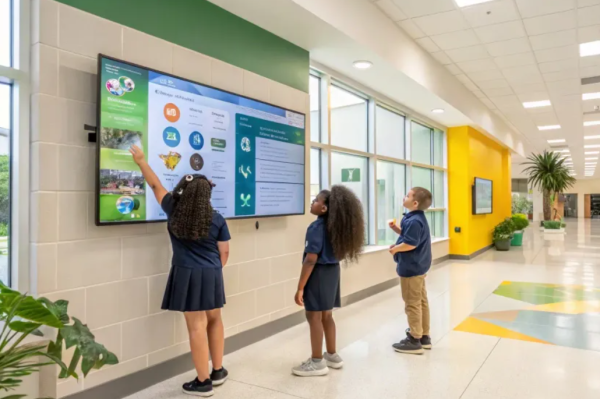
In higher education, the system is designed to recognize alumni, faculty and benefactors, celebrate scholarship recipients, mark facility dedications and present historical timelines of institutional giving, typically installed in student unions, alumni centers or library entrances. Hospitals and health organizations can use the walls to highlight patient success stories, showcase donor-funded medical technology and recognize foundation leadership societies, often in main lobbies or waiting areas. Schools can apply the technology to recognize PTA members, capital campaign donors and local business partners during events such as parent-teacher nights and open houses .

A third party industry observer said the shift reflects a broader trend in institutional communications. “Donor recognition has traditionally been treated as a fixed cost buried in a capital project budget,” the spokesperson said. “What we’re seeing now is organizations treating digital recognition wall displays as active engagement tools that can be measured, updated and tied directly to future fundraising performance, rather than a one time installation that becomes outdated within a few years”.

Positioned as a Long term Investment

Touchstone frames the Digital Donor Wall as a long-term financial and stewardship asset rather than a one-time capital expense. The company’s investment materials cite comparative cost scenarios in which digital solutions offer meaningful long term savings relative to traditional engraving once repeated updates, additions and panel expansions are factored in over time. Beyond cost, the company argues that visible, dynamic displays of community impact serve as a persuasive tool for prospective donors evaluating whether to contribute to an organization.

The company’s implementation process follows five stages: discovery and strategy sessions to understand an organization’s goals and brand; custom interface design; development and integration with existing donor databases; hardware deployment including large format screens and touchscreen kiosks with staff training; and ongoing support to keep content current. Touchstone said its US-based support team remains engaged with client organizations after launch to ensure displays continue to perform and evolve alongside institutional needs.

The Digital Donor Wall platform is available now to universities, colleges, K-12 schools and mission driven nonprofit organizations across the United States seeking to modernize donor stewardship and strengthen long-term fundraising relationships.

About Touchstone Digital Solutions

Touchstone Digital Solutions designs and deploys custom digital donor recognition systems for universities, schools and nonprofit organizations across the United States. The company combines interactive display technology, cloud based content management software and dedicated US based support to help mission driven institutions transform static donor recognition into dynamic, ongoing storytelling that strengthens community engagement and supports long-term fundraising success.

Media Contact

Touchstone Digital Solutions

8 Powder Hill Road, Bedford, NH 03110

Phone: (603) 361-7541

Email: info@touchstone-ds.com
Website: https://touchstone-ds.com/

Daily writing prompt
What’s the best thing you’ve ever found randomly on the street?

A memoir of representation of the social assertiveness and narrative Dalit’s character

Sheetal*, Dr. Ranjana Yadav1

*Research Scholar, Department of English, Sunrise University, Alwar, Rajasthan, India.

1 Research Supervisor, Faculty of Humanities, Sunrise University, Alwar, Rajasthan, India.

Abstract

This paper explores Narendra Jadhav’s autobiography through the framework of Searle’s typology of speech acts, with particular emphasis on illocutionary acts—namely assertive, commissive, expressive, declarative, and directive forms—as well as the broader speech situations they inhabit. Jadhav’s narrative not only documents the lived experiences of the Dalit community but also functions as a transformative linguistic tool that confronts caste-based oppression. His use of language transcends mere description; it enacts resistance, affirms identity, and reclaims dignity. Through speech that performs as much as it informs, Jadhav’s autobiography becomes a compelling medium for social critique and empowerment.

Key Words: Harsh reality, caste system, discrimination, language as tool, resistance

Raising one’s voice against injustice is a sign of true bravery. Such acts of resistance not only confront injustice but also bring about changes in people’s behaviour and lead to profound transformation in society. Dr. Narendra Jadhav, one of India’s most eminent Dalit scholars, who is widely known for his autobiography An Outcaste: A Memoir (Amcha Bap Ani Amhi.) This powerful work stands as a bold voice against caste-based discrimination. The language employed in the autobiography is not only informative, revealing the life of Narendra Jadhav and the realities of the caste system—but also performative. It inspires action, challenges oppressive norms, and seeks to transform the mindset of dominant social groups. Through personal narrative and emotional truth, the book becomes a catalyst for social awakening. Language is not merely a medium of communication. It is a vehicle of transformation. In An Outcaste: A Memoir (Amcha Bap Ani Amhi.) Dr. Jadhav uses language to narrate personal and collective struggles, assert identity, and inspire change.

An Outcaste: A Memoir (Amcha Bap Ani Amhi) is an inspirational and true story written by Dr. Narendra Jadhav. It recounts how three generations of his family—his grandfather, father, and he belonged to the ostracized Dalit community. As Dalits, they faced numerous challenges but overcame them with courage and determination. Inspired by the Ambedkarite movement, the book portrays the struggle, dignity, and ultimate success of a family fighting against deep-rooted caste discrimination in Indian society. It also highlights how Dr. Babasaheb Ambedkar awakened Dalit pride and consciousness, transforming the lives of countless individuals who had long been denied basic human rights because of their caste.

An Outcaste: A Memoir (Amcha Bap Ani Amhi.) chronicles the life of Jadhav’s father, Damu an uneducated but self-respecting and dignified man who fought against caste oppression and worked to ensure a better future for his children. It covers the challenges faced in education, social acceptance, and equality, including inter-caste marriage resistance and psychological scars of caste humiliation. An Outcaste: A Memoir (Amcha Bap Ani Amhi.) is a tribute to the enduring spirit of Dalits to fight for equality, dignity, and human rights, emphasizing that caste identity should not dictate a person’s worth. Finally, An Outcaste: A Memoir (Amcha Bap Ani Amhi.) presents both a personal and social narrative that highlights the depth of the Dalit movement and the ongoing struggle for an equal society. The story is deeply inspired by Dr. Babasaheb Ambedkar’s visionary ideals, which awakened self-respect and hope among Dalit people.

Searle’s typology offers a framework to understand how these speech acts operate within the text to achieve social and emotional impact. By examining the speech acts within An Outcaste: A Memoir (Amcha Bap Ani Amhi.), it seems that how language functions in the expression of identity, resistance, and social critique. John Searle refined the work of J.L. Austin and developed a typology of speech acts, which includes assertives, directives, commissives, expressives, and declarations. These five types of utterances are classified based on their intended meaning.

Assertive

One of Searle’s five main categories of speech acts is the assertive.  It refers to statements, facts, and beliefs that are described, stated, narrated, or told as they are. Assertives are plain and straightforward. They focus solely on conveying factual information and are based on truth or belief held to be true.

Commissive

A commissive refers to an utterance in which the speaker commits to performing an action in the future. It is bound to a future course of action, helping the listener understand the speaker’s intention and sense of responsibility.

Expressive

An expressive speech act refers to the speaker’s psychological state or emotional response.  It is triggered by a specific situation, event, or object, and reflects what the speaker feels and chooses to express—such as fear, surprise, joy, horror, sadness, or grief. Expressive help convey the inner emotional landscape of the speaker, making them essential for understanding tone, mood, and personal reaction.

Declarative

 Declarative refers to utterances which bring about a change by referring to particular ideas, pledges, or events—thereby leaving the existing way and moving toward another. Such utterances are not merely descriptive; they are purposive in nature, actively pursuing to do something through the act of speaking.

“What kind of tradition is this that treats Mahars worse than cats and dogs? I spit on these inhuman traditions, I am not going to abide by such traditions. I am a man of dignity and I will not go from house to house begging for Baluta, what are all of you going to do? Kill me?” (Jadhav p. 10).

Speech Situation

In the excerpt, Damu strongly criticizes Hindu tradition for denying Dalits freedom and dignity. He describes how Dalits were forced to live under a rigid caste system. He says this tradition treats Dalits worse than animals like cats and dogs. His anger and rejection of these customs are clear. Damu believes every person is born with dignity and rights. He refuses to beg from house to house, a practice forced on Dalits. He says he would rather die than follow such degrading customs. He believes in living with self-respect, values, and human dignity.

Speech Acts Analysis

Assertive: Damu speaks honestly about what he sees. He shows strong anger and disgust. He questions whether the tradition is fair or moral. His words make listeners feel the pain and injustice. He wants people to see how wrong the system is.

Expressive: He strongly rejects the tradition. His words show that he no longer accepts it. By speaking out, he symbolically cuts ties with it. This act shows courage and a desire for change. It is a step toward freedom and self-respect.

Commissive: He says who he is with pride. He chooses to reject the shameful practice. He is taking back his self-worth. He refuses to be trapped in the role society gave him. His words show strength and a fight for dignity.

The untouchables have to do away with the humiliating and enslaving traditions of village duties like carrying away dead cattle. It is utterly disgraceful to sell your human rights for a few crumbs of bread. We will attain self-elevation only if we learn self-help, regain our self-respect and gain self-knowledge.” (Jadhav22).

Speech Situation

In the quote, the speaker talks about the unfair duties forced on Dalits in a caste-based society. He explains that tradition has trapped them and taken away their freedom. He strongly rejects these shameful and cruel customs. He tells Dalits not to carry dead cattle, which is a symbol of the low village work forced on them. Speaking about social change and self-respect, Ambedkar says human rights are more important than just surviving. Real progress, he says, comes from self-effort, self-respect, and learning. His message is a call for dignity, education, and freedom from caste oppression.

Speech Acts Analysis

Assertive. The speaker talks about a real problem in society. He says these duties are shameful and feel like slavery. His words are meant to wake people up. He wants change. It is both a truth and a message to fight against oppression.

Directive: The speaker wants Dalits to take action. He tells them to stop following harmful traditions. His goal is to wake people up and bring change. He speaks the truth and asks others to reject oppression. It is a message of strength, awareness, and hope.

Expressive: The speaker feels strong emotions. He shows disgust and moral anger. These feelings come from seeing unfair and cruel treatment. His words express deep pain and a sense of injustice.

Commissive: The speaker chooses a path of upliftment. This path is based on self-effort and personal growth. The goal is to inspire Dalits to shape their own future. It encourages them to live with dignity and wisdom. The message is about strength, hope, and self-respect.

“Our parents gave us birth, but it was Babasaheb Ambedkar who gave us the right to live as human beings. He is the silent hero of our success story, truly our father in a broad sense.”( Jadhav p.70)

Speech Situation

In the quote, Dr. Narendra Jadhav shows deep gratitude to Dr. B.R. Ambedkar. He remembers how Ambedkar faced many struggles in his life. Ambedkar’s thoughts, actions, and legacy helped Dr. Jadhav find his voice, identity, dignity, and values. Dr. Jadhav says that most of his success is because of Ambedkar. He sees Ambedkar as a true hero who awakened his inner strength. Inspired by Ambedkar’s vision, Dr. Jadhav lovingly calls him a father figure in a broader sense.

Speech Acts Analysis

Assertive: The speaker says that Dr. Jadhav’s biological parents gave him birth. But Dr. Ambedkar gave him dignity and rights. This shows what the speaker believes to be true. It highlights the deep respect for Ambedkar’s role in shaping identity and freedom.

Directives: The speaker is trying to make the listener take action. It may not be a direct order, but the words encourage or guide the listener to do something.

Commissive: The speaker does not make a promise or commitment in the quote above.

Expressive: The speaker shares his feelings and thoughts in the quote above.

Dada exemplified the new found pride and awareness that Babasaheb Ambedkar had inculcated among Dalits. He learnt to be fearless and raised us to be brave too.” (Jadhav p.56).

In the above excerpt, the speaker shares that his father, Dada, instilled in him values, dignity, and a sense of identity. Dada also introduced the speaker and his family to the teachings of Dr. Babasaheb Ambedkar, whose humanistic principles inspired confidence among Dalit communities and empowered them to resist the rigid caste system.

Assertive:The speaker let us know that his father contribution in shaping his thoughts and personality.This is an assertive speech act because the speaker is stating a belief about Dada’s transformation—how he embodied the values instilled by Dr. Ambedkar. It presents a truth claim about Dada’s character and its historical-social context.

Directive: The excerpt does not include a direct command. But Dada’s actions send a strong message. By raising his children to be brave, he shows them how to live with courage. His behavior teaches them to follow the same values. It is a silent way of guiding them to be strong and fearless.

Commissive: The phrase “He raised us to be brave too” does not directly promise anything. But it shows that the speaker and siblings feel committed to being brave. They want to carry on Dada’s legacy. This is like a promise passed down through values, not words. It is a pledge from one generation to the next.

Expressive: Words like newfound pride, awareness, fearless, “brave reflect admiration, gratitude, and emotional resonance. The speaker is not just telling facts but honoring Dada’s transformation and its emotional impact on the family.

Declarative: This is not a declarative act. It does not change any official status or create change through speech alone. But in a symbolic or literary way, naming Dada as a symbol of Ambedkarite pride is powerful. It helps reclaim Dalit identity. This act has a declarative feel in the context of culture and social meaning.

Damu says “Atrocities, exploitations and inhuman treatment of upper castes provokes Dalits to question their identity.” (Jadhav p.19)

Speech Situation

In this quote, Damu—Narendra Jadhav’s father—talks about how Dalits are treated cruelly by upper castes. This pain and unfair treatment make Dalits question their identity. They begin to ask who they are and why they are treated this way. Damu shares these thoughts during a moment of reflection in the memoir. He is thinking deeply about how caste discrimination harms a person’s sense of self and dignity.

Speech Acts Analysis

Assertive: Damu speaks about the real-life struggles of Dalit people. The cruelty they face makes them question who they are. His words describe what they go through and help others understand their pain. He is not just sharing facts. He is showing a deep truth about how caste oppression shapes identity.

Directive: The above statement carries an implicit call to awareness. By highlighting the injustice, Damu may be urging Dalit people to reflect, resist, and seek change.

Commissive:  Damu shows his strong commitment to fight back against the atrocities, exploitation, and inhuman treatment by the upper castes. He refuses to stay silent or accept the injustice. His words and actions reflect deep resistance and moral courage. He stands up for dignity and demands change.

Expressive: Words like “atrocities” and “inhuman treatment” carry strong emotions. They show pain, anger, and a sense of injustice. Damu is not just telling what happened. He is sharing how caste violence affects Dalit identity. His words reflect deep emotional and moral feelings.

Declarative: Damu’s statement does not directly change anything. But it helps start a bigger conversation. It questions caste rules and gives new meaning to Dalit identity. It tries to declare dignity and challenge injustice.

Dr. Narendra Jadhav’s memoir reveals significant insights into how language functions in the expression of identity and resistance. By examining the speech acts within the text, we gain a deeper understanding of the author’s intentions and the impact of his narrative on readers. The words he employs serve to promote education, protest against caste-based discrimination, affirm identity, and inspire transformation. Ultimately, the memoir is aimed at achieving liberation from humiliation and asserting human dignity.

References

Austin, J.L. How to Do Things with Words. Harvard University Press, 1962.

Ambedkar, B.R. Annihilation of Caste. Navayana, 2014

Jadhav, Narendra. Out Caste: A Memoir. New Delhi: Penguin, 2003

Searle, John. Speech Acts: An Essay in the Philosophy of Language. Cambridge University Press, 1969.

Austin, J.L. How to Do Things with Words. Harvard University Press, 1962.

Ambedkar, B.R. Annihilation of Caste. Navayana, 2014

Daily writing prompt
If the salary was the same, what job would you be doing right now and why?