Political Developments in the Age of Artificial Intelligence

Milind Harsh Sardar

M.A. Political Science

Indira Gandhi National Open University, New Delhi.

Email: milindsardar100@gmail.com  

Abstract

Artificial intelligence is rapidly transforming political institutions and public life. The central research problem of this research article is to examine how AI reshapes governance structures, civil liberties, electoral politics, economic distribution and geopolitical competition. While AI promises efficiency and innovation, it also raises concerns about accountability, bias, surveillance and democratic legitimacy. The study seeks to understand how different political systems respond to these opportunities and risks. The research adopts a qualitative comparative methodology. It draws on secondary sources including academic literature, policy documents and institutional reports. The analysis compares democratic and authoritarian contexts to identify patterns of institutional adaptation. Thematic analysis is used to examine governance transformation, surveillance expansion, digital political communication, labour market restructuring and regulatory frameworks. The study concludes that the political consequences of artificial intelligence will depend not only on technological capacity but also on deliberate policy choices and institutional resilience.

Keywords: Artificial intelligence, digital governance, algorithmic accountability, electoral politics, surveillance and privacy, geopolitical competition

Introduction

Artificial intelligence is transforming political life across the globe. It shapes governance, public debate and state power. AI systems process data, identify patterns and generate predictions. These systems are embedded in administration and strategy. Governments rely on them. Corporations deploy them. Citizens interact with them daily. Politics can no longer be studied without examining artificial intelligence. Political authority depends on information. AI changes how information is gathered, analysed and applied. Decision making becomes faster. Surveillance becomes broader. Communication becomes more targeted. These shifts alter relations between citizens and institutions. They redefine accountability and transparency.


Artificial intelligence also redistributes power. Actors who control data and computational capacity gain influence. States invest in AI for economic growth and security. Private firms shape political communication through algorithmic platforms. Civil society reacts to risks linked to bias and privacy. The political sphere is therefore deeply intertwined with technological change. This research paper examines political developments in the age of artificial intelligence. It evaluates governance transformation, electoral change, surveillance expansion, geopolitical rivalry and regulatory responses. The study uses qualitative comparative analysis. It argues that AI amplifies existing political structures while introducing new institutional tensions.

Literature Review

Scholars increasingly study artificial intelligence within political science. Early research focused on digital governance. Later work expanded toward surveillance capitalism, algorithmic bias and geopolitical competition. The literature highlights both opportunities and risks. One strand emphasizes efficiency in public administration. AI can process vast datasets quickly. Public agencies use predictive analytics in health, taxation and infrastructure planning. Researchers argue that such tools improve responsiveness and reduce waste. Administrative modernization is often framed as a benefit of technological integration.

Another strand highlights inequality and bias. Algorithms learn from historical data. Historical data often reflects discrimination. Automated systems can therefore reproduce injustice. Studies show disparities in predictive policing and welfare algorithms. These outcomes raise ethical and legal concerns. Scholars call for fairness audits and transparency mandates. Surveillance studies form another important body of literature. AI enables large scale monitoring of faces, voices and behaviours. Some scholars describe a shift toward data driven governance. Surveillance can suppress dissent and chill political expression. Even democratic states face pressure to balance security and privacy.

Research on elections and communication also expands rapidly. Campaigns use machine learning to target voters. Social media platforms employ recommendation algorithms that shape exposure to information. Personalized messaging may mobilize supporters. It may also fragment public discourse. Polarization can intensify when citizens receive different streams of political content. International relations scholars analyse AI competition among states. AI is framed as a strategic asset. It influences military modernization and intelligence gathering. Some warn of an arms race dynamic. Others emphasize cooperation and norm building. The debate continues regarding autonomous weapons and global governance frameworks. Despite growing scholarship, gaps remain. Comparative studies across regime types are limited. Long term institutional impacts are still emerging. More systematic analysis is required to connect governance, rights and geopolitical change.

Methodology

This study adopts a qualitative comparative research design to examine political developments in the age of artificial intelligence. The objective is to analyse how AI influences governance, elections, civil liberties and international relations across different political systems. The research does not rely on primary field surveys or experimental data. Instead, it draws on secondary sources including peer reviewed journal articles, academic books, policy papers and institutional reports. This approach allows for comprehensive synthesis of existing knowledge.

The study uses purposive case selection. Examples are chosen from both democratic and authoritarian contexts to highlight institutional variation. Democratic systems are examined for their regulatory frameworks, public accountability mechanisms and electoral practices involving AI. Authoritarian systems are analysed for patterns of surveillance expansion, centralized control and limited transparency. The comparative structure enables identification of similarities and contrasts in political outcomes.

Analysis and Discussion

  • Governance Transformation and Administrative Power

Artificial intelligence has reshaped public administration. Governments now use algorithmic systems to manage routine tasks. These tasks include processing applications, detecting fraud and forecasting service demand. AI increases speed. It reduces operational costs. Officials often justify adoption in terms of efficiency and modernization. The structure of bureaucratic authority is changing. Traditional administration relies on hierarchical decision making. Written rules guide officials. AI introduces automated decision pathways. These pathways depend on statistical models. They do not rely on direct human judgment. Civil servants supervise these systems. Yet many do not fully understand their internal logic. A knowledge gap emerges within institutions. Technical experts gain influence. Private contractors often design and maintain systems. Administrative power shifts toward those who control data and code.

Transparency becomes more complex. Democratic governance depends on explainable decisions. When an algorithm denies welfare benefits citizens expect justification. When predictive tools flag individuals for investigation people seek reasons. Many AI systems function as black boxes. Their reasoning processes are difficult to interpret. This opacity limits public oversight. It can weaken trust in government institutions. Accountability also changes. If a human official makes an error responsibility is identifiable. If an algorithm produces harm blame becomes diffuse. Officials may claim they relied on technical outputs. Developers may argue that systems function as designed. This diffusion complicates legal remedies. Citizens may struggle to challenge decisions effectively. Courts face difficulties evaluating technical evidence.

Bias remains a central concern. AI systems learn from historical data. Historical data often reflects social inequality. If past policies discriminated the algorithm may reproduce similar outcomes. Predictive policing tools may target marginalized neighbourhoods. Welfare screening systems may disproportionately flag vulnerable populations. These outcomes generate political controversy. Advocacy groups demand fairness audits and independent review. Administrative discretion is also altered. Algorithms standardize decisions. Standardization can reduce arbitrary treatment. It can also reduce flexibility. Human officials sometimes consider context and compassion. Automated systems rely on predefined variables. Unique circumstances may not be captured in data fields. This rigidity affects perceptions of justice.

Despite these concerns AI offers real benefits. Data driven planning can improve public health responses. Resource allocation can become more precise. Infrastructure management can become more efficient. Crisis response can be faster when predictive models are available. The challenge lies in balancing innovation with democratic safeguards. Governance transformation in the AI era is therefore not purely technical. It is political. It reshapes authority, accountability and citizen state relations. Institutions must adapt deliberately. Transparent oversight and human supervision remain essential to preserve democratic legitimacy.

  • Surveillance Expansion and Civil Liberties

Artificial intelligence has greatly expanded the surveillance capacity of modern states. AI systems can process vast amounts of data in real time. They analyse video feeds, online communication and biometric information. Facial recognition technology can identify individuals in crowded public spaces. Voice recognition systems can match speech patterns to specific persons. Data aggregation tools combine information from multiple sources. These capabilities create unprecedented monitoring power. In authoritarian systems such technologies strengthen centralized control. Continuous monitoring reduces space for dissent. Citizens may fear that online comments or physical participation in protests will be recorded. This fear can produce self-censorship. Political opposition becomes riskier. Over time surveillance normalizes obedience. The state gains informational dominance over society.

Democratic states also use AI surveillance tools. Governments justify them through national security and crime prevention concerns. Predictive policing systems attempt to forecast where crimes may occur. Border control agencies use biometric databases. Intelligence services analyse digital communication patterns. These measures are often defended as necessary for public safety. However, they raise serious civil liberty questions. Privacy is directly affected. AI systems collect and process personal data at large scale. Individuals may not know what data is stored or how it is used. Consent becomes abstract when surveillance is embedded in public infrastructure. Mass data collection can create detailed behavioural profiles. Such profiles can reveal political preferences, associations and personal habits.

Legal safeguards vary widely across political systems. Strong judicial oversight can limit misuse. Independent data protection authorities can impose standards. Transparency requirements can increase accountability. Where these institutions are weak surveillance may expand without constraint. Emergency powers can further justify intrusive monitoring. The expansion of AI surveillance therefore transforms the balance between security and freedom. Technological capability often advances faster than legal regulation. Without deliberate policy design civil liberties may erode gradually. Protecting democratic rights requires continuous oversight, clear legal boundaries and active civic engagement in debates about surveillance and state power.

  • Electoral Politics and Digital Communication

Artificial intelligence has transformed electoral politics and digital communication. Political campaigns now rely heavily on data analytics and machine learning. These tools help identify voter preferences and behavioural patterns. Campaign strategists use predictive models to determine which voters are persuadable. Resources are allocated based on algorithmic assessments. This increases efficiency and strategic precision. Microtargeting is a central development. Campaigns deliver tailored messages to specific demographic groups. Different voters receive different versions of political appeals. Messages are crafted to resonate with personal interests and concerns. This personalization can increase engagement and turnout. Voters may feel that candidates understand their needs. Political communication becomes more direct and customized.

However, microtargeting also fragments the public sphere. Citizens no longer receive the same political messages. Shared national debates become segmented. Public discourse may lose common reference points. This fragmentation can weaken democratic deliberation. When groups consume different information mutual understanding declines. Polarization can intensify as communities form around distinct narratives. Social media platforms amplify these dynamics. Recommendation algorithms prioritize content that generates engagement. Emotional or controversial posts often receive greater visibility. Political actors adapt their strategies accordingly. Campaigns design content to trigger strong reactions. Sensational messages can spread faster than balanced analysis. This creates incentives for dramatic rhetoric over thoughtful discussion.

Artificial intelligence also contributes to misinformation risks. Automated bots can simulate human users. They can spread political content at scale. Deepfake technology enables the creation of synthetic audio and video. Fabricated media can damage reputations or mislead voters. Verification often lags behind distribution. Trust in electoral integrity may suffer as a result. Regulatory responses remain uneven. Some governments require disclosure of online political advertising. Others invest in digital literacy programs. Platforms develop detection systems to identify coordinated manipulation. Yet technological innovation often moves faster than policy reform. Electoral politics in the AI era therefore reflects both opportunity and vulnerability. Democratic systems must adapt to protect transparency, fairness and informed participation in a rapidly evolving digital environment.

  • Economic Redistribution and Labor Politics

Artificial intelligence is transforming labour markets and reshaping debates about economic redistribution. Automation powered by machine learning replaces certain routine and repetitive tasks. Manufacturing, transportation and administrative support roles face significant disruption. Workers in these sectors may experience job displacement or wage stagnation. At the same time new positions emerge in data science, software engineering and AI system maintenance. These new roles often require advanced technical skills. The gap between high skill and low skill employment can widen. This structural change influences political alignments. Workers who feel economically insecure may demand stronger social protection. They may support parties that promise redistribution or labour safeguards. Economic anxiety can fuel populist movements. Political rhetoric often frames automation as a threat to national employment. Governments face pressure to respond with targeted policies.

Retraining and education programs become central to policy agendas. States invest in digital literacy and technical training initiatives. Lifelong learning frameworks gain attention as career paths become less stable. Yet retraining programs require funding and institutional capacity. Not all workers can easily transition into high skill sectors. Geographic and socioeconomic barriers persist. This uneven adaptation deepens regional inequality. Debates about income distribution also intensify. Some policymakers propose taxing large technology firms that benefit from automation. Others advocate universal basic income as a response to potential job loss. These proposals reflect broader ideological divisions about the role of the state in managing market outcomes. Fiscal policy becomes a site of contestation linked directly to AI driven economic change.

Labor unions confront new challenges. Traditional collective bargaining models may not address platform-based work or gig economies. Algorithmic management in workplaces can monitor productivity and influence scheduling. Workers may feel reduced autonomy under data driven oversight. Political responses must consider both technological efficiency and worker dignity. Artificial intelligence therefore reshapes labour politics in structural ways. It alters employment patterns, redistributes economic power and stimulates policy innovation. The political consequences depend on how governments manage transition. Effective redistribution strategies and inclusive growth policies can reduce tension. Failure to address inequality may intensify polarization and social unrest.

  • Geopolitical Rivalry and Strategic Competition

Artificial intelligence has become a central arena of geopolitical rivalry. Major powers view AI leadership as a source of economic strength and military advantage. Governments invest heavily in research, semiconductor production and advanced computing infrastructure. National strategies emphasize innovation, talent development and technological sovereignty. Competition over AI capacity is now linked to broader struggles for global influence. Military applications intensify this rivalry. AI supports intelligence analysis, logistics planning and autonomous systems. Autonomous weapons raise serious ethical and strategic concerns. Delegating lethal decisions to machines challenges established norms of warfare. Some states advocate international regulation or prohibition. Others argue that strategic deterrence requires continued development. The absence of binding global agreements increases uncertainty.

Technology supply chains have also become politicized. States impose export controls on advanced chips and software. Restrictions aim to limit rival access to critical components. Alliances form around shared technological standards and secure supply networks. These measures reflect fears of dependency and espionage. AI driven cyber capabilities further complicate relations. States use machine learning to enhance cyber defence and offense. Cyber operations can disrupt infrastructure and influence public opinion. Attribution remains difficult. This ambiguity heightens mistrust among competing powers.

Despite rivalry, limited cooperation persists. Multilateral forums discuss ethical principles and risk reduction. Confidence building measures are proposed to prevent escalation. However strategic competition remains the dominant trend. Artificial intelligence is thus reshaping the global balance of power and redefining the contours of international politics.

  • Regulatory Responses and Normative Debate

The expansion of artificial intelligence has forced governments to respond. Policymakers face complex choices. AI promotes innovation and economic growth. It also creates risks for privacy, equality and democracy. Regulation has therefore become a central political issue. Different states adopt different approaches. Some governments introduce comprehensive legislation. They classify AI systems by level of risk. High risk systems face strict obligations. These obligations include transparency, documentation and human oversight. Impact assessments are often required. This model emphasizes precaution. It treats AI governance as a matter of rights protection. Other governments prefer flexible strategies. They promote ethical guidelines instead of binding laws. Industry self-regulation is encouraged. Innovation and competitiveness are prioritized. Supporters argue that strict rules may slow technological progress. Critics respond that voluntary standards lack enforcement. Without penalties harmful practices may continue.

Normative debate focuses on legitimacy. Democratic theory values accountable human decision making. Algorithmic governance introduces automated processes into public administration. When systems determine welfare eligibility or risk assessment questions arise. Who is responsible for errors. Who can challenge outcomes. These issues affect democratic trust. Human oversight is widely discussed. Many scholars argue that AI should assist rather than replace human judgment. Sensitive decisions require review by accountable officials. Automation without supervision risks injustice. Oversight mechanisms must be clearly defined.

Transparency is another core concern. Citizens must understand how decisions are made. Explainable AI becomes a policy goal. Yet complex machine learning models are difficult to interpret. Governments must balance disclosure with protection of intellectual property. This tension complicates reform efforts.

International coordination remains limited. AI technologies cross borders easily. Data flows ignore national boundaries. Fragmented regulation creates loopholes. Multilateral forums attempt dialogue on standards and ethics. Progress is gradual and uneven. Regulatory responses therefore reflect deeper political values. States must balance innovation with democratic safeguards. The outcome of this debate will shape the future relationship between technology and public authority.

Conclusion and Recommendations

Artificial intelligence has become a defining force in contemporary politics. It reshapes governance, surveillance, elections, labour markets and international relations. Administrative systems now rely on data driven tools. Political campaigns use algorithmic targeting. States expand monitoring capacity through advanced analytics. Global competition increasingly centres on technological leadership. These developments demonstrate that AI is not only a technical innovation. It is a structural political transformation. The analysis shows that AI amplifies existing power dynamics. In democratic systems it can improve efficiency and service delivery. It can also weaken transparency if oversight is insufficient. In authoritarian contexts AI strengthens centralized control and limits dissent. Electoral politics becomes more strategic yet more fragmented. Economic change intensifies debates about redistribution and labour protection. Geopolitical rivalry grows as states compete for dominance in research and infrastructure.

The central challenge lies in governance. Technological capability often advances faster than regulation. Without clear safeguards civil liberties may erode gradually. Accountability becomes diffuse when algorithms shape public decisions. Democratic legitimacy depends on visible human responsibility. Institutions must therefore adapt deliberately rather than reactively. Several recommendations follow from this analysis. First, governments should establish clear legal frameworks for high-risk AI systems. Transparency requirements and independent audits are essential. Citizens must have the right to explanation and appeal. Second, strong data protection laws should safeguard privacy. Surveillance tools must operate under judicial oversight and defined limits. Third, investment in digital literacy should expand. An informed public is better equipped to resist manipulation and misinformation.

Fourth, labour market policies must address economic displacement. Retraining programs and social protection measures can reduce inequality. Policymakers should ensure that benefits of AI innovation are broadly shared. Fifth, international dialogue on autonomous weapons and cross border data governance should continue. Cooperative norms can reduce destabilizing competition. Artificial intelligence will continue to evolve. Political institutions must remain flexible and vigilant. The future of democracy and global stability depends on how societies govern this transformative technology.

References

  1. Fadia, B. L., & Fadia, K. (2020). Indian government and politics (15th ed.). Sahitya Bhawan Publications.
  2. Government of India, Ministry of Electronics and Information Technology. (2021). Responsible AI for all: Strategy document.
  3. Government of India, NITI Aayog. (2018). National strategy for artificial intelligence #AIforAll.
  4. Johari, J. C. (2019). Indian political system (6th ed.). Anmol Publications.
  5. Kashyap, S. C. (2018). Our constitution: An introduction to India’s constitution and constitutional law (3rd ed.). National Book Trust.
  6. Laxmikanth, M. (2022). Indian polity (6th ed.). McGraw Hill Education.
  7. Singh, M. P., & Roy, H. (2018). Indian political system (4th ed.). Pearson India.
  8. Ananthakrishnan, G. (2025, March 11). ‘Can generate fake case citations’: Top court judge flags AI concerns. The Indian Express. https://indianexpress.com/article/india/can-generate-fake-case-citations-top-court-judge-flags-ai-concerns-9879733/
  9. Damini Nath. (2024, October 24). Centre to launch AI-powered chatbot to handle public grievances soon. The Indian Express. https://indianexpress.com/article/india/centre-to-launch-ai-powered-chatbot-to-handle-public-grievances-soon-9636447/
  10. Mishra, N. C. (2024, January 4). The politics and geopolitics of AI governance. The Indian Express. https://indianexpress.com/article/opinion/columns/the-politics-and-geopolitics-of-ai-governance-9094938/
Daily writing prompt
How often do you say “no” to things that would interfere with your goals?

Intelligent Voice Agents and the Future of Business Communication

Daily writing prompt
What are your favorite sports to watch and play?

Customer expectations around business communication have changed dramatically in recent years. Today, speed, personalization, and round-the-clock availability are no longer competitive advantages but basic requirements. Companies that rely solely on traditional call centers often struggle to meet these demands without increasing costs or overloading their teams. As a result, many organizations are turning to intelligent voice agents as a scalable and cost-effective alternative.

According to an article on Coruzant, intelligent voice agents are rapidly reshaping how businesses manage inbound calls, customer support, and ongoing engagement. Powered by artificial intelligence, these systems are designed to handle conversations in a natural, human-like way while reducing operational strain and improving service consistency.

Photo by Tima Miroshnichenko on Pexels.com

What Are Intelligent Voice Agents?

Intelligent voice agents, also known as AI voice agents, are conversational systems that interact with customers through voice channels such as phone calls. Unlike traditional interactive voice response (IVR) systems, which rely on rigid menus and predefined options, intelligent voice agents can understand natural speech and respond dynamically.

These systems do more than recognize keywords. They interpret intent, context, and meaning, allowing customers to speak freely instead of navigating complex phone menus. The result is a more fluid and intuitive experience that closely resembles a conversation with a human representative.

At their core, intelligent voice agents combine speech recognition, artificial intelligence, and advanced language processing. This enables them to understand requests, provide relevant information, and take appropriate actions in real time.

How Intelligent Voice Agents Work

AI voice agents rely on several interconnected technologies that work together to create seamless conversations. Speech-to-text technology converts spoken language into text, allowing the system to analyze what the caller is saying. Natural Language Understanding (NLU) then interprets the caller’s intent, even when phrased in different ways.

Large language models (LLMs) play a key role in generating natural, context-aware responses. These models allow voice agents to adapt their replies based on the flow of the conversation rather than relying on scripted answers. Decision-making components determine the next best action, whether that involves providing information, performing a task, or transferring the call.

Text-to-speech and voice synthesis technologies ensure that responses sound natural and human-like. When a request is too complex or requires personal judgment, the system can seamlessly transfer the call to a human agent, maintaining continuity and context.

Most modern platforms also allow businesses to configure system prompts, rules, and internal knowledge bases. This ensures that voice agents provide accurate, up-to-date information aligned with company policies and processes.

Business Benefits of AI Voice Agents

The adoption of intelligent voice agents offers several clear advantages for businesses across industries. One of the most significant benefits is 24/7 availability. AI-powered systems ensure that no call goes unanswered, even outside regular business hours.

Cost efficiency is another major factor. By automating routine interactions, businesses can reduce the tells of staffing large call centers or scaling teams during peak periods. Faster response times improve customer satisfaction, while consistent service quality helps maintain brand standards.

AI voice agents can also recognize caller IDs, enabling personalized interactions for returning customers. This allows calls to be routed more efficiently and conversations to begin with relevant context, reducing friction and repetition.

By handling repetitive inquiries, such as frequently asked questions or basic service requests, AI voice agents free human employees to focus on complex or high-value interactions. This not only improves productivity but also reduces burnout among customer support teams.

Collaboration Between Human Agents and AI

Despite concerns about automation replacing jobs, intelligent voice agents are most effective when used in collaboration with human employees. Rather than eliminating roles, AI systems support teams by managing high-volume, routine tasks.

Human agents remain essential for handling nuanced requests, sensitive situations, and complex decision-making. By offloading repetitive work to AI, businesses can improve response times and allow their staff to deliver more personalized and thoughtful service.

This collaborative model creates a more stable and efficient operation. AI handles consistency and availability, while human agents focus on empathy, judgment, and problem-solving.

Getting Started with Intelligent Voice Agents

Implementing an AI voice agent requires careful planning. Businesses should start by identifying the specific tasks and processes they want to automate. Common use cases include after-hours call handling, virtual receptionists, appointment scheduling, and basic customer support.

Feature requirements should be evaluated based on business needs, such as multilingual support, CRM integration, or call routing capabilities. Budget considerations and scalability are also important, as the system should be able to grow alongside the organization.

Choosing a reliable provider is critical. Businesses should test the solution thoroughly before deployment to ensure that it meets performance expectations and integrates smoothly with existing systems.

Zadarma AI Voice Agent as a Practical Example

One example of an all-in-one intelligent voice solution is the Zadarma AI Voice Agent. This virtual assistant is designed to answer calls using natural, human-like speech while leveraging a company’s internal knowledge base to provide accurate information.

The platform supports 24/7 automated call handling, integrates with PBX and CRM systems, and offers multilingual capabilities across multiple languages. When necessary, calls can be transferred to the appropriate human agent or department.

By combining features that are often offered separately, such solutions simplify implementation and reduce complexity. Compatibility with modern AI models and intuitive configuration make intelligent voice agents accessible even to businesses without advanced technical expertise.

Conclusion

Intelligent voice agents are becoming a foundational element of modern business communication. By automating routine interactions, improving availability, and delivering faster responses, these systems help organizations meet rising customer expectations without compromising quality.

As AI technology continues to evolve, voice agents will play an increasingly important role in creating efficient, scalable, and customer-centric communication strategies. Businesses that adopt intelligent voice solutions today are better positioned to remain competitive in an environment where speed, personalization, and reliability define success.

Transforming Financial Research with Real-Time Stock APIs

The world of financial research has entered a new era — one defined by instant access to live data, advanced algorithms, and intelligent automation. The days when analysts relied solely on historical datasets or monthly reports are gone. Today, accuracy and speed are paramount, and the ability to access market data in real time has become an essential tool for researchers, educators, and fintech professionals.

Photo by Pixabay on Pexels.com

One of the key technologies driving this shift is the real time stock API. This type of API provides direct access to continuously updated stock market data — including prices, volumes, and trends — from exchanges around the world. Instead of static snapshots, researchers and developers can now work with streaming data that reflects what’s happening in financial markets at every second.

A New Standard in Academic and Professional Research

In academic environments, real-time APIs are reshaping the way finance and economics are studied. Universities and research institutes are integrating APIs into their projects to allow students to test theories under real-world conditions. For example, an economics student can model market reactions to policy changes using real trading data, while a data science student can train machine learning algorithms to predict price movements based on live signals.

Such real-time environments don’t just improve accuracy — they cultivate innovation. Instead of reading about market dynamics in textbooks, learners can experience them firsthand, working with datasets that evolve continuously. The gap between academic theory and professional application is narrowing rapidly.

Empowering Innovation Beyond Academia

Real-time data also benefits independent researchers, fintech startups, and established institutions. Startups building trading platforms or analytics dashboards use APIs to create applications that react instantly to market changes. Hedge funds and asset managers integrate APIs to monitor global portfolios in real time, while developers use them to power visualization tools and financial dashboards.

Platforms like Finage’s real time stock API simplify this process by offering a scalable infrastructure, clean datasets, and easy integration. Researchers can pull historical data for long-term trend analysis or real-time feeds for dynamic models — all within a single, developer-friendly ecosystem.

Driving Transparency and Better Decision-Making

Access to live data also enhances transparency and accuracy in research and reporting. Scholars can verify how markets respond to global events — elections, central bank decisions, or geopolitical tensions — without delays or approximations. This immediacy supports more credible findings and helps policymakers and investors make better, evidence-based decisions.

Financial research powered by APIs contributes to a more informed society. When analysts, educators, and developers have equal access to reliable data, the insights generated are richer and more democratic. It’s no longer just about who can afford expensive terminals — it’s about who can use information effectively.

The Future of Data-Driven Research

The future of financial research lies in real-time data integration. As artificial intelligence, machine learning, and quantitative finance evolve, APIs will serve as the backbone of innovation. They will fuel predictive analytics, enable high-frequency simulations, and enhance risk modeling for institutions of all sizes.

Ultimately, tools like Finage’s real time stock API are not just technical solutions — they are enablers of progress. They transform raw information into actionable intelligence, bridging the gap between academia and industry, theory and practice, innovation and application.

In this new landscape, those who master real-time data will define the next generation of financial discovery, shaping a smarter and more connected future for global research and finance alike.

Do College Admissions Check for AI?

Daily writing prompt
What’s the most fun way to exercise?

The evolution of artificial intelligence-enabled content generators has had a profound effect on the world’s education system. Are you wondering if college admissions teams use AI detection software to scan your essays or not? Well, the short answer is yes, they do. Many students around the world agree that gaining admission to universities is one of their biggest worries. Colleges now use advanced AI detectors to identify AI-written content for research and other academic activities. While AI detectors are now widely used by higher learning educational institutions, the tools and detection policies differ between colleges. Human review helps ensure originality, authenticity, and academic integrity.

How to Avoid AI Detection in Your College Academic Writing

Each year, American college admission offices receive thousands of applications from domestic and international students seeking to advance their qualifications. Checking for AI in essays has become a standard in many colleges. A recent survey by Intelligent found that about 50% of higher learning institutions use AI to improve their admission review processes, with an additional 23% planning to use the technology in the near future. The introduction of Open AI’s ChatGPT and other innovative content generators has sparked discussion about the impact of artificial intelligence on academic activities. Finding ways to avoid AI detection is essential if you don’t want your essays to be flagged as robotic text. Here are some actionable strategies students can follow to bypass AI detection.

  1. Use the Best AI Text Detector Software

One of the most effective ways to evade AI detection in your college essays is to use the most advanced AI text humanizing software, such as Walter Writes AI, to improve the originality of your content. Not all AI writing apps are designed to create human-like content. That is why students should consider using the best AI text humanizer to transform their academic writing. Walter AI is a powerful tool for detecting, bypassing, and humanizing all text. Students can leverage this application to ensure authenticity in their essays and other academic submissions. The world’s most sophisticated and trusted AI humanizer can verify if your essays pass all popular AI detectors, including GPTZero and Turnitin.

  1. Understand How to Properly Rephrase and Paraphrase Your Content

Many AI text detectors scan for repetitive phrases, so understanding the best practices to reword entire paragraphs can be of great help in bypassing AI flags. Learning how to properly paraphrase and rephrase your texts is a smart strategy to maintain the key element of your academic writing while transforming the vocabulary and sentence structure. According to research, effectively rephrasing your writing can decrease your risk of AI detection by 15-20%.

  1. Include Personal Experiences and Anecdotes

Another proven way to skip AI detection is to share personal anecdotes and perspectives. Readers love engaging with real-life content written by actual people. You can incorporate a human touch to your AI text by sharing your personal experiences, which is something that existing AI content generators lack.

Humanizing your AI content is more crucial now than ever before. If you are a student who wants to avoid the ramifications that come with using AI to draft your application essays, make sure you apply these tips to improve your content originality.

Is there Any Future for ChatGPT

Daily writing prompt
What is the greatest gift someone could give you?

As an AI language model, ChatGPT is a remarkable achievement in the field of natural language processing. It is capable of generating responses that are contextually relevant and syntactically sound, making it an ideal tool for a wide range of applications, from chatbots to language translation. One of the most impressive aspects of ChatGPT is its ability to learn from vast amounts of data and improve over time. This is achieved through a process called unsupervised learning, which allows the model to learn patterns and relationships in the data without being explicitly told what to look for. In terms of its capabilities, ChatGPT is able to understand a wide range of topics and can engage in conversations that are both informative and engaging. It can also generate responses that are humorous or sarcastic, making it a versatile tool for a range of use cases.

That being said, there are some limitations to ChatGPT. One of the biggest challenges with language models like ChatGPT is their tendency to generate biased or offensive content, particularly when they are trained on data that contains bias. This can lead to harmful language being generated, which can be a significant problem in applications like chatbots that are designed to interact with users. Another limitation of ChatGPT is its lack of true understanding of context. While it can generate responses that are contextually relevant, it does not truly understand the nuances of language or the cultural and social contexts in which language is used. This can sometimes lead to responses that are awkward or inappropriate.

Yes, there is a bright future for ChatGPT and other similar AI language models. As the field of natural language processing continues to advance, we can expect to see even more sophisticated language models capable of generating responses that are virtually indistinguishable from human-generated text. One of the key areas of development for ChatGPT and similar models will be improving their ability to understand context and generate responses that are not just contextually relevant, but also culturally and socially appropriate. This will involve training the models on diverse and inclusive data sets, and developing algorithms that can detect and correct for bias. Another area of development for ChatGPT and other language models will be improving their ability to interact with humans in a more human-like way. This will involve incorporating more emotional intelligence into the models, allowing them to recognize and respond to human emotions, as well as developing more sophisticated conversational abilities.

Overall, the future for ChatGPT and similar language models is very promising, and we can expect to see continued growth and development in the field of natural language processing in the years to come. These models have the potential to revolutionize the way we interact with technology and with each other, and to open up new possibilities for communication, learning, and creativity. ChatGPT is an impressive achievement in the field of natural language processing, and it has the potential to be a powerful tool for a range of applications. However, it is important to be aware of its limitations and to use it responsibly in order to avoid generating harmful or offensive content.

Detecting Plagiarism in Thesis Writing – Effective Tools


Plagiarism detection is always considered embarrassing that’s why it is crucial to always check plagiarism in your thesis before submitting it to the teacher or publishing it on the internet. This is because plagiarism in writing has severe consequences including:

  • Rejection of the thesis
  • Loss of grades
  • Expulsion from the institute
  • Facing lawsuits from the original owner

And the list goes on. 

Do you know the only way to check for plagiarism is by utilizing online plagiarism detection tools? In this article, we are going to discuss the best plagiarism-checking tools along with their pros and cons. 

Top 3 Tools That Can Be Used for Detecting Plagiarism in Thesis

Here are the 3 effective plagiarism detection tools that can be used for determining duplication in a thesis or any other type of write-up. 

1.     Editpad 

First of all, we have an Editpad Plagiarism Checker. It is a freemium tool that operates on a diverse set of Artificial Intelligence (AI) algorithms that efficiently compare the given thesis with millions of internet resources to find any kind of plagiarism. 

If any duplicate sources are found, the tool will highlight them along with their matched sources through a red line. Not only this, it also provides the percentage of both unique & plagiarized content. In order to demonstrate all this, we have attached an image below, check it out. 

So, the tool not only provided the percentage of both unique and plagiarized. Now, you will an have efficient idea of how you can efficiently detect plagiarism in your thesis.

The good about this tool is that it has the ability to check writing for plagiarism in 14 different languages. And gives the option to download the scan report that can be used as proof of write-up originality. 

It is available in both free and paid versions. If you are using it for free, then you can check up to 1,000 words at once. Whereas, users with premium subscriptions can check a maximum of 3,000 words at once.

Pros:

  • Simple to understand interface.
  • Highlight copied text with its matched sources. 
  • 1,000 limits for free users. 
  • Supports 14 languages. 
  • Download report option. 

Cons:

  • Contains too many advertisements.

2.     Copyleaks 

Copyleaks is widely known and used for AI content detection. But do you know? it also has a highly credible plagiarism detector. The plagiarism detector is designed on advanced Machine Learning algorithms that efficiently scan the given text to find the smallest instances of plagiarism in it. 

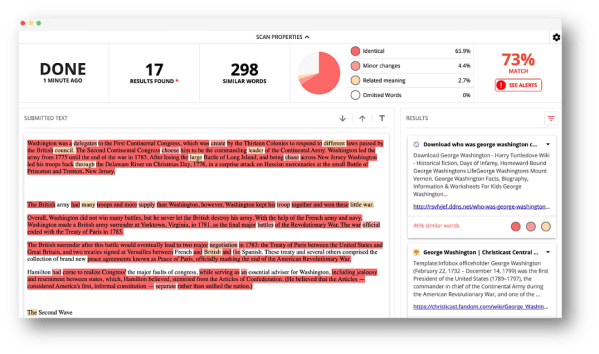
Unlike Editpad, this tool only provides the percentage of matched/plagiarized content. One good thing is that it highlights different types of plagiarism in different colors. For instance, if the given sentence or paragraph is completely matched with an online source, then that part will be highlighted in dark red. 

On the other hand, if a few words are matched, then the tool will highlight them with a light red color, indicating minor changes. 

Remember, in both these cases the tool provides the matched sources so that the user can take the necessary steps to remove them. To illustrate all this in a better way, we have attached an image below, check it out. 

One thing that you need to keep in mind is that the Copyleaks plagiarism checker is not available for free, it’s PAID. Its pricing for plagiarism detection starts from $8.99 per month. 

Pros:

  • AI-based detection.
  • Highlight duplication in different colors. 
  • Highly accurate

Cons:

  • Completely paid. 
  • Only provides the percentage of

3.     Paper Rater 

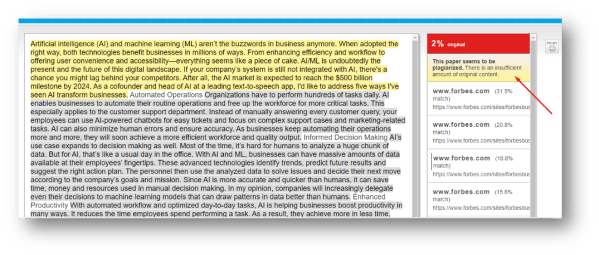
This is a completely free-to-use plagiarism checker that is widely used by students and teachers to quickly and efficiently scan a thesis for duplication. Just like other tools discussed on this list, this one also compares the input text with different online resources such as blogs, research papers, journals, etc., to find plagiarism. 

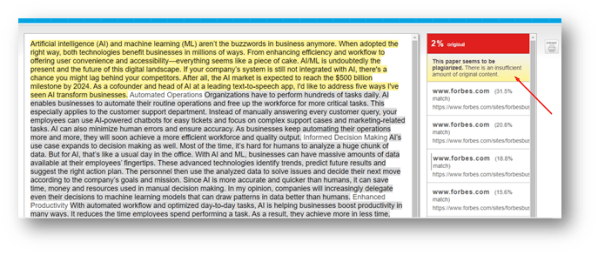
It then provides the percentage of only “Unique” or “Original” content along with a note “This paper seems to be Unique” or “This paper seems to be plagiarized.” Additionally, the tool also provides matched sources and the percentage of matched content for each source. 

To provide you with a better idea about its working, we copied some content from an online article and checked it with PaperRater. The results we got can be seen in the attachment below.

As you can see, the tool has mentioned that the given text is “Plagiarized” which is true since it was copied from an online source. 

One of the amazing things about this tool is that; it allows users to check unlimited words at once for free. 

Pros:

  • Easy & free to use.
  • Unlimited word checking limit. 
  • Provide the percentage of content originality. 

Cons:

  • Does not give the option to download scan results.  

Final Words

Checking your thesis for any kind of plagiarism before submitting or publishing is necessary to avoid severe consequences. In this article, we have explained the 3 best plagiarism detection tools along with the pros and cons that you can use in this regard. 

Importance of PDFs documents for Reading and Transmitting Information to the Global Audience

In a world increasingly reliant on digital information, the ability to efficiently handle documents is pivotal across various domains. Enter PDF Cake, a revolutionary tool designed to cater to the needs of businesses, scholars, educators, and experts alike. This English-language website harnesses the power of AI to swiftly and comprehensively understand PDF documents, catering to a global audience with diverse needs and interests.

Photo by fauxels on Pexels.com

At its core, PDF Cake stands as a beacon of efficiency and convenience in document management. Its AI-powered services are a testament to the transformative potential of technology in simplifying complex tasks. In an era where information overload is a constant challenge, PDF Cake emerges as a valuable ally, offering a suite of services that facilitate quick comprehension and analysis of PDFs.

For scholars and academics, PDF Cake serves as an indispensable tool in conducting research. Its ability to swiftly extract key information, identify critical data points, and summarize lengthy documents streamlines the process of literature review and knowledge synthesis. The AI-powered capabilities significantly reduce the time spent sifting through volumes of information, empowering researchers to focus on analysis and innovation.

Educators also find PDF Cake to be a boon in their quest to disseminate knowledge effectively. From creating concise study guides to preparing lecture materials, the tool’s capacity to distill complex information into easily digestible content aids in enhancing the learning experience. Moreover, the platform’s ability to generate summaries and highlight crucial sections facilitates efficient lesson planning, saving educators valuable time.

In professional settings, efficient document handling is pivotal for productivity. PDF Cake’s AI-driven services enable professionals to swiftly navigate through contracts, reports, and other business documents. The tool’s capacity to extract essential data, identify key points, and generate summaries facilitates informed decision-making and expedites workflow processes.

Furthermore, PDF Cake’s global accessibility ensures that its benefits transcend geographical boundaries. By catering to an international audience, the tool facilitates collaboration and knowledge exchange among professionals, scholars, and businesses worldwide.

The role of AI in document management and productivity enhancement cannot be overstated. AI tools like PDF Cake not only streamline tasks but also augment human capabilities. They serve as force multipliers, empowering individuals and organizations to maximize their efficiency and effectiveness in handling vast amounts of information.

As the integration of AI tools continues to evolve, their potential in revolutionizing document management, academic research, and professional productivity becomes increasingly evident. PDF Cake stands as a testament to the fusion of technology and utility, offering a glimpse into a future where AI-powered solutions redefine how we interact with and comprehend information. In an era characterized by information abundance, tools like PDF Cake pave the way for a more streamlined and productive approach to document management and knowledge acquisition.

Evolution of ChatGPT

The development of ChatGPT is part of a broader history of research and innovation in the field of natural language processing (NLP). Here are some key milestones in the history of ChatGPT:

Photo by Andrew Neel on Pexels.com
  1. Early research on NLP: Research on NLP dates back to the 1950s and 1960s, when computer scientists began exploring ways to enable machines to understand and process human language.
  2. Development of neural networks: In the 1980s and 1990s, researchers began developing neural networks, which are computational models that can learn to recognize patterns and relationships in data.
  3. Emergence of deep learning: In the 2010s, deep learning techniques began to revolutionize the field of NLP, allowing researchers to train large neural networks on vast amounts of text data.
  4. Development of GPT: In 2018, OpenAI introduced the first version of the Generative Pre-trained Transformer (GPT), a deep learning model that can generate human-like text.
  5. Release of GPT-2 and GPT-3: OpenAI released GPT-2 in 2019, which was capable of generating even more sophisticated text than its predecessor. In 2020, OpenAI released GPT-3, which is one of the largest and most sophisticated language models ever developed.
  6. Advancements in ChatGPT: ChatGPT is based on the GPT-3 architecture and represents the latest developments in NLP research. It has the ability to generate natural and human-like language in response to a wide range of prompts and inputs.

Overall, the history of ChatGPT is part of a broader history of research and innovation in the field of natural language processing, which has seen rapid progress in recent years due to advancements in deep learning and large-scale data processing.

ChatGPT, a large language model developed by OpenAI based on the GPT-3.5 architecture. I am designed to generate human-like responses to natural language prompts, and can be used for a wide range of tasks such as answering questions, completing sentences, translating languages, and generating text. I am constantly learning from vast amounts of data and can understand and respond to a variety of topics and subjects.

As a language model, the functions of ChatGPT include:

  1. Language Generation: I can generate human-like text in response to a given prompt or input. This can be in the form of sentences, paragraphs, articles, stories, or even conversations.
  2. Language Translation: I can translate text from one language to another, allowing users to communicate in different languages.
  3. Sentiment Analysis: I can analyze the sentiment of a given text and determine whether it is positive, negative, or neutral.
  4. Question Answering: I can answer a wide range of questions by generating text based on the input question.
  5. Text Summarization: I can summarize long texts by generating a shorter version that captures the main ideas and key points.
  6. Text Completion: I can complete sentences or paragraphs based on the input text.
  7. Personalization: I can personalize text based on user preferences, such as tone, style, and content.

Overall, the main function of ChatGPT is to generate natural and human-like language in response to various inputs and tasks.

Integrating ChatGPT into an application or website involves the following steps:

  1. Choose a platform: There are several platforms available for integrating ChatGPT, such as API.AI, Dialogflow, Botpress, and many more. Choose a platform that best suits your needs and requirements.
  2. Create an account: Once you have selected a platform, create an account and follow the platform’s instructions for creating a new chatbot.
  3. Train the model: Train the ChatGPT model using the platform’s training tools. This involves feeding the model with large amounts of text data so that it can learn how to generate human-like responses.
  4. Define the chatbot’s behavior: Define the chatbot’s behavior by specifying the type of responses it should generate for different types of inputs.
  5. Test the chatbot: Test the chatbot to ensure that it is generating appropriate and accurate responses.
  6. Deploy the chatbot: Once the chatbot has been trained and tested, deploy it to your website or application.
  7. Monitor and update the chatbot: Monitor the chatbot’s performance and update it as needed to ensure that it continues to generate high-quality responses.

Overall, integrating ChatGPT involves selecting a platform, training the model, defining the chatbot’s behavior, testing, deploying, and monitoring and updating the chatbot as needed.