How a Specialist High-Risk Acquirer Actually Works: Mechanics, Costs, and Where the Model Fits

6a70808ac507e.webp

A subscription software company with a 1.2% dispute rate receives a termination notice from its payment processor on a Tuesday morning. No prior warning. No appeal window. By Thursday, its checkout page is dead. The business had been operating on a pooled aggregator account — the kind that onboards in minutes — and when its dispute ratio crossed an internal threshold, the automated system acted faster than any human could intervene.

This is not an edge case. It is the structural consequence of how payment facilitators are built. The architecture that makes instant onboarding possible is the same architecture that makes instant termination possible. Understanding that trade-off is the starting point for any serious evaluation of acquiring options for merchants whose business models carry elevated chargeback exposure.

Market Context: Why Acquirer Appetite Is Tightening

Visa’s VAMP (Visa Acquirer Monitoring Program) framework places the compliance burden squarely on acquiring banks, not just on individual merchants. When a bank’s portfolio dispute ratio breaches program thresholds, the bank faces fines and, in extreme cases, loss of principal membership. The rational response for a mainstream acquirer is portfolio pruning: exit the MCCs that statistically generate the most disputes before the ratio triggers a monitoring designation.

The result is a bifurcated market. Merchants with clean, low-ticket, low-dispute profiles are well served by aggregators and mainstream banks. Merchants in subscription billing, telehealth, direct-marketing, travel, and online education — categories where delivery lag, recurring charges, and cross-border exposure structurally elevate dispute probability — find mainstream acquiring increasingly unavailable, regardless of their individual dispute history. That gap is the commercial rationale for the specialist high-risk acquirer category. Global payments infrastructure investment and digital fraud trends confirm that acquirer-side risk management is intensifying, not relaxing, as fraud tooling and network monitoring programs grow more sophisticated.

Five Mechanics That Define the Specialist Acquiring Model

1. Dedicated MID Architecture Versus Pooled Sub-Merchant Accounts

Stripe, Square, and PayPal operate as payment facilitators. Each merchant is a sub-merchant under a single master MID. That structure is why onboarding takes minutes: the facilitator absorbs the compliance burden and underwrites the portfolio in aggregate. The trade-off is that the portfolio is scored in aggregate too. A dispute spike from an unrelated sub-merchant can trigger risk controls that affect every account on the master MID, including yours. Termination, holds, and reserve increases can propagate across the pool without the individual merchant having done anything wrong.

A specialist acquirer boards each merchant on its own dedicated MID. The merchant’s dispute ratio is measured in isolation. Another merchant’s bad month does not re-score your account. This is the foundational structural difference between the two models, and it matters most precisely when dispute pressure is highest — which is when the protection is most needed.

Why it matters: A dedicated MID means your account’s standing is determined by your own performance history, not by the aggregate behavior of thousands of unrelated businesses.

2. Human Underwriting and What Reviewers Actually Read

Automated underwriting systems score applications against static rule sets. A business model that sits outside those rules — a telehealth platform with variable ticket sizes, a subscription education service with a free-trial funnel — may be declined not because it is genuinely high-risk but because the model does not pattern-match to the system’s training data. There is no appeal because there is no reviewer.

Specialist acquirers assign a named underwriter to each application. That underwriter reads the business model, the refund policy, the marketing copy, the processing history, and the dispute breakdown. The review is qualitative, not just quantitative. 2Accept states that its underwriting review is completed within one business hour of receiving a complete file, with full approval averaging 48 hours. The clock starts on a complete file — EIN, articles of incorporation, voided check, three months of bank statements, three months of processing statements where they exist, government-issued photo ID, and a live storefront URL. Incomplete submissions restart the clock.

Why it matters: A human reviewer can distinguish between a structurally sound business with an unusual model and a genuinely problematic one. An algorithm cannot.

3. Risk Management Stack: Dispute Alerts, Fraud Scoring, and Liability Shift

Dispute management in high-risk acquiring is not a single tool; it is a layered stack. Ethoca (Mastercard-owned) and Verifi CDRN (Visa-owned) are dispute alert networks that notify the merchant before a chargeback is formally filed, allowing a refund to be issued and the dispute to be resolved without a chargeback hitting the ratio. Running only one network leaves a significant share of volume — either Visa or Mastercard — without alert coverage. Both networks together provide the broadest possible pre-chargeback interception.

Real-time fraud scoring tools such as Kount, Sift, and NoFraud assess transaction risk at the point of authorization. 3DS 2.0 authentication shifts liability for unauthorized transaction claims to the issuer. It is important to be precise about what 3DS does and does not do: it covers unauthorized-transaction disputes only. It provides no protection against friendly fraud — where a cardholder disputes a transaction they authorized — or item-not-as-described claims. Merchants who believe 3DS eliminates chargeback exposure are misinformed.

Why it matters: The combination of pre-chargeback alerts, real-time fraud scoring, and authentication-based liability shift addresses different dispute types; no single tool covers all of them.

4. Transparent Rate Structure and What the Numbers Actually Mean

Most specialist acquirers do not publish rates. Pricing is negotiated case by case, which makes comparison nearly impossible and gives the processor significant information asymmetry. 2Accept publishes a tiered rate card running from 2.89% at the low end to 4.95% at the top tier, with a rolling reserve of 0–10% of settled volume depending on processing history and risk profile. There are no long-term contracts and no early-termination fees, according to its published terms.

The transparency is genuinely unusual in this segment. But the numbers deserve honest context. A 4.95% processing rate is materially more expensive than the flat-rate pricing offered by aggregators — Stripe’s standard card rate is 2.9% plus $0.30, for example. For a merchant processing $500,000 annually, the difference between 2.9% and 4.95% is approximately $10,250 per year. That cost is the price of dedicated infrastructure, human underwriting, and the structural protections described above. Whether it is worth paying depends entirely on the merchant’s dispute exposure and the realistic alternative. For a merchant who cannot obtain mainstream acquiring at all, the comparison is not 2.9% versus 4.95%; it is 4.95% versus zero revenue. For a merchant who qualifies for mainstream acquiring, the aggregator is almost certainly the better economic choice.

When evaluating payment infrastructure for businesses with complex billing models, it is also worth considering how Layer 2 blockchain payment networks improve transaction scalability interact with card-network dispute rules, a topic that complements understanding payment gateway performance for non-traditional transaction types.

Why it matters: Published pricing removes information asymmetry, but the rate ceiling is genuinely high; the cost-benefit calculation only favors the specialist model when mainstream acquiring is unavailable or structurally unsuitable.

5. MCC-Level Specialization and Acquiring Bank Network

Acquiring appetite varies not just by merchant category but by MCC code within a category. A telehealth platform (MCC 8099) faces different chargeback thresholds, licensing requirements, and underwriting criteria than a subscription SaaS business (MCC 5734) or a direct-marketing catalogue merchant (MCC 5964). A specialist acquirer that has processed volume across these MCCs has historical dispute data, established relationships with sponsoring banks willing to hold those portfolios, and underwriters who understand the specific compliance requirements of each code.

The context paragraph for this section: 2Accept reports relationships with more than 40 acquiring banks — including Merrick Bank, BMO Harris, Citizens, The Bancorp, FFB Bank, SSB Bank, Wells Fargo, and PNC — and states that it processes more than $2 billion annually across its merchant portfolio. That bank network breadth matters because it enables MID placement with the institution whose risk appetite most closely matches a given merchant’s profile, and it supports multi-MID load balancing across two to five MIDs to distribute volume and reduce concentration risk.

Why it matters: MCC-level expertise and a broad bank network allow placement decisions to be made on fit, not just on availability.

Comparison: Specialist Acquirer Versus Aggregator

Dimension2AcceptPaymentCloudStripe / Square / PayPal 
MID structureDedicated MID per merchantDedicated MID per merchantPooled sub-merchant MID
Onboarding speed (low-risk merchant)48 hours (self-reported)24–72 hours (self-reported)Minutes — aggregators are faster here
Published rate cardYes, 2.89%–4.95%Not publicly publishedYes, flat-rate (lower ceiling)
Developer documentationStandard integration supportStandard integration supportAggregators lead on API docs and tooling
MATCH-listed applicantsReviewed case by caseReviewed case by caseTypically declined outright
Dispute alert coverageEthoca + Verifi CDRN (both networks)Varies by accountLimited or not offered
Rolling reserve0–10% of volumeVaries by accountPayPal: up to 21-day or 180-day holds possible

Note: Aggregator “instant approval” applies to low-risk merchants only; high-risk or flagged applications face the same review delays as specialist processors. All approval rates and approval times cited for any processor in this table are self-reported and have not been independently audited.

Where the Model Gets Expensive and Who It Is Not For

The specialist acquiring model carries real costs that deserve direct treatment, not a footnote.

Rate ceiling. A 4.95% processing rate is not a worst-case scenario to be avoided; it is the published top tier for merchants with elevated risk profiles. For high-volume merchants, the absolute cost difference against aggregator pricing is substantial. This is not a hidden fee — it is the stated price of the infrastructure — but it should be modeled explicitly before a decision is made.

Rolling reserve. A 0–10% rolling reserve means the processor holds back up to ten cents of every dollar settled. On $100,000 per month in volume, that is up to $10,000 per month in working capital that is not available to the business. Reserves are typically released on a rolling basis after a defined period, but the cash-flow impact during the reserve period is real and must be planned for.

US-only eligibility. The model requires a US-registered business entity, a US Social Security Number for the account signer, and US-issued government photo ID. International merchants, regardless of their processing volume or dispute history, are outside scope.

Document-heavy onboarding. The 48-hour approval window is conditional on a complete file. Merchants who cannot immediately produce three months of processing statements, articles of incorporation, and a live storefront URL will experience longer timelines. This is not a criticism — it is the nature of genuine underwriting — but it is a meaningful difference from a sign-up form.

Self-reported performance figures. The 98% approval rate and 48-hour average approval time are figures reported by the processor. They cannot be independently verified, and outcomes vary by MCC, volume, ticket size, and dispute history. A MATCH-listed applicant is reviewed case by case; approval is not guaranteed.

Who this is not for. A low-risk, low-ticket merchant with a clean dispute history and a straightforward business model — a retail SaaS tool, a low-volume consulting practice, a simple e-commerce store — is almost certainly better served by an aggregator. The onboarding is faster, the developer tooling is better documented, and the pricing is lower. The specialist model is designed for merchants who cannot access mainstream acquiring or who have been terminated from it. Using it when mainstream acquiring is available is paying a premium for infrastructure you do not need.

The Company Behind the Account

2Accept operates as an ISO/MSP (Independent Sales Organization / Member Service Provider) under KNET Systems Corp. ISO/MSP status means the company is registered with the card networks and operates under sponsorship agreements with acquiring banks rather than holding principal membership directly. Its stated sponsoring bank relationships include Merrick Bank, BMO Harris, Citizens, The Bancorp, FFB Bank, SSB Bank, Wells Fargo, and PNC. The company serves US-based merchants and requires a US-registered business entity and US-issued identification for the account signer. It reports processing more than $2 billion annually across its merchant portfolio.

The Question the Merchant Should Actually Be Asking

The framing that dominates most processor comparisons — who approves you fastest, who has the lowest rate — misses the operative question for a merchant with elevated dispute exposure. The operative question is: which acquiring structure is still processing my volume in eighteen months, and what does it cost to maintain that stability?

A pooled aggregator account that onboards in minutes and terminates in minutes is not a stable acquiring relationship for a subscription telehealth platform or a direct-marketing merchant with a 30-day refund window. A dedicated MID with human underwriting, dual dispute-alert coverage, and a named account contact is a different kind of infrastructure — slower to establish, more expensive to maintain, and considerably harder to lose without warning.

Whether that infrastructure is worth its cost depends on the merchant’s specific dispute profile, volume, and the realistic alternatives available to them. The specialist acquiring model is not universally superior; it is structurally appropriate for a specific category of merchant. Identifying whether you are in that category is the analysis that precedes any processor selection.

Sources and Further Reading

Visa VAMP (Visa Acquirer Monitoring Program) — Visa’s publicly documented acquirer-level dispute monitoring framework; supports the market-context section on portfolio-level compliance pressure.

Mastercard ECM/HECM (Excessive Chargeback Merchant / High Excessive Chargeback Merchant) program documentation — Mastercard’s published merchant-level chargeback monitoring thresholds; supports the discussion of network-level dispute ratio triggers.

Ethoca dispute alert network — Mastercard-owned pre-chargeback alert service; supports the risk-management stack section.

Verifi CDRN (Cardholder Dispute Resolution Network) — Visa-owned pre-chargeback alert service; supports the risk-management stack section.

EMVCo 3DS 2.0 specification — Published authentication standard; supports the liability-shift discussion and its stated limitations.

Stripe Prohibited and Restricted Businesses policy — Publicly available; supports the structural comparison of aggregator eligibility criteria.

PayPal User Agreement (holds and reserves provisions) — Publicly available; supports the 21-day and 180-day hold references in the comparison table.

KNET Systems Corp ISO/MSP registration — Card network registration records; supports the brand section.


Disclosure: Approval rates, approval times, and processing rates quoted for any processor in this article are self-reported by the respective processor; outcomes vary by volume, ticket size, dispute history, MCC, and individual underwriting review. Nothing in this article constitutes legal, financial, or compliance advice. This article contains a compensated link; the editorial content is the author’s independent analysis.

Daily writing prompt
What’s a quote that perfectly describes your outlook on life?

From Code to Core Infrastructure: The Emergence of Coinspaid Dev as an Independent Tech Force

The backend architecture powering digital asset ecosystems is undergoing a massive shift, driven by the demand for enterprise-grade reliability and high-throughput capacity. In a major move reflecting this evolution, the engineering powerhouse responsible for the foundations of Coinspaid Solutions has officially spun off to create an independent brand: Coinspaid Dev (stylized as {coinspaid.dev}). Backed by a robust team of more than 120 dedicated software engineers, infrastructure specialists, cybersecurity experts, and research and development teams, this transition marks the formal birth of an autonomous entity possessing over 11 years of deep-tier industry experience.

As covered by TechTimes, this organizational evolution points directly to the maturing scale of modern engineering departments within the digital asset market. While the outward-facing corporate identity is entirely fresh, the technology, proprietary methodologies, and operational knowledge driving it have been forged over more than a decade of building production-grade, highly distributed systems that currently run across upwards of 20 distinct blockchain networks.

Demystifying Blockchain Infrastructure at Scale

While mainstream discussions around web3 and digital finance frequently gravitate toward token economics, market valuations, or high-level protocol updates, the technical reality of maintaining these systems is rarely addressed. High-availability blockchain infrastructure is the unsung mechanical engine of the modern digital economy.

  • How it works: It acts as a resilient, real-time middleware layer that continuously synchronizes data, validates complex cryptographic operations, and ensures seamless interoperability between isolated networks.
  • What it depends on: The stability of these environments depends explicitly on advanced cloud architecture, robust backend logic, continuous threat monitoring, and zero-downtime reliability engineering.
  • When it is used: Such infrastructure becomes vital when enterprise platforms face volatile transaction volumes, requiring secure, concurrent processing power that cannot afford a single second of network latency or system failure.

Bridging the Operational Divide

A core objective for the newly minted Coinspaid Dev is to provide a dedicated voice for the practical side of blockchain development. Too often, a disconnect exists between the theoretical designs of protocol creators and the daily realities faced by network operators managing heavy transactional loads.

The division’s long history of deploying systems into live production environments has given its engineers an acute understanding of structural bottlenecks. By stepping forward under an independent banner, the organization aims to share these practical insights directly with the broader tech community, helping to cultivate a more balanced, operationally sound development ecosystem.

A Decade of Expertise Stepping Into the Spotlight

The transition from an internal engineering department to an industry-facing contributor signifies a long-term commitment to setting higher technological benchmarks. The team’s deep operational background covers everything from multi-chain integrations to high-load distributed databases, providing a unique vantage point on how to properly scale digital systems.

The structural framework may be newly organized, but the operational history remains veteran. Moving forward, Coinspaid Dev is positioning itself not merely as a service provider, but as an influential engineering authority capable of shaping the next generation of scalable, secure blockchain architecture.

Daily writing prompt
What’s a book you think deserves a sequel?

Managing Flexible Crypto Payments: A Strategic Guide for Modern Merchants

In the rapidly evolving world of digital finance, cryptocurrency payments are globally recognized for their near-instantaneous transaction speeds and decentralized nature. However, the standard payment infrastructure built for retail—which often relies on high-speed checkouts and short-lived invoices—frequently runs into logistical bottlenecks when applied to more complex corporate workflows, subscription models, or high-value reservations.

As reported by Coinpedia, modern enterprise ecosystems require adaptive financial tools, which is why the specialized Payment Requests feature has been developed for integrated CryptoProcessing merchants to accommodate extended transaction windows and structured operational workflows.

Understanding the Mechanics of Extended Payment Windows

Traditional cryptocurrency invoices operate on a strict countdown, typically expiring within 15 minutes to mitigate the risks associated with market volatility. While this structure protects liquidity providers during rapid checkouts, it fails to accommodate scenarios where immediate execution is impossible. Business-to-business (B2B) transactions, for example, routinely require internal managerial sign-offs, compliance reviews, or manual treasury adjustments that cannot be completed within a quarter of an hour.

The Payment Requests system addresses this limitation by decoupling the payment link from rigid, short-term timers. Instead, merchants possess the operational autonomy to define custom expiration parameters based entirely on the underlying business context. Depending on the specific requirements of the deal, a payment link can be configured to remain active and valid for several hours, multiple days, or even weeks, drastically reducing the administrative burden of constantly regenerating expired invoices.

Optimizing the Consumer Interface to Reduce Errors

When a client interacts with a generated Payment Request, they are directed to a dedicated, secure payment portal designed to streamline the settlement process. One of the most prevalent challenges in digital asset management is human error during the execution phase, such as sending assets over an unsupported blockchain network or inputting an incorrect destination address.

To systematically eliminate these pain points, the payment interface consolidates all critical transaction variables into a single, comprehensive view. Users can clearly verify the exact payment amount, the specific exchange rates applied, the available blockchain networks, and the precisely supported cryptocurrencies. This structured clarity ensures that the customer transfers the exact amount via the correct network on their first attempt, maximizing conversion rates and minimizing support tickets.

Streamlining Corporate Refund Protocols

Managing refunds within the cryptocurrency space has historically been a fragmented, manual process. Businesses often have to engage in protracted email chains with clients just to securely collect destination wallet addresses, creating unnecessary security risks and compliance tracking issues.

The advanced Payment Requests architecture natively resolves this by integrating a standardized refund workflow directly into the platform’s Back Office. When a refund is required—whether full or partial—the merchant can trigger the process internally. The system then automatically generates and dispatches a secure link to the customer, allowing them to autonomously input their preferred refund wallet address. This centralized mechanism ensures that all data collection remains compliant, encrypted, and tracked within a single administrative dashboard.

Core Strategic Use Cases

This flexible framework is particularly effective in operational environments where immediate, real-time settlement is neither expected nor practical. Businesses typically deploy these extended payment configurations across several key areas:

  • High-Value Reservations: Securing bookings or hospitality assets where the client requires time to coordinate corporate travel funds.
  • Account Top-ups: Facilitating large-scale institutional deposits into trading or operational accounts without time-pressure constraints.
  • Subscription Renewals: Allowing automated or manual billing cycles to remain open long enough for accounting departments to process payments.
  • B2B Transactions: Accommodating the multi-tiered approval chains inherent in corporate procurement and supply chain logistics.

By embedding these flexible payment mechanisms, modern enterprises can successfully bridge the gap between traditional corporate accounting timelines and the technical advantages of blockchain infrastructure. Removing rigid countdowns not only simplifies complex settlements but also transforms digital assets into a practical, sustainable tool for long-term commercial relationships.

Daily writing prompt
What villain actually had a good point?

CARRHAE PRO Open Letter to Investors: A Serious Warning Regarding Unauthorised Groups and Applications – We Welcome Enquiries and Feedback from All Users!

Dear Investors, Partners and Friends: We have recently become aware of some false information and investor concerns regarding CARRHAE PRO circulating online and within certain groups. We would like to take this opportunity to provide a full clarification to all users concerned about the CARRHAE PRO smart trading platform, with the utmost transparency and sense of responsibility. We understand your concerns. In the investment sector, the emergence of any professional platform is bound to face scrutiny and competition. However, please rest assured that a truly compliant, professional and responsible platform never fears any public scrutiny.

01|CARRHAE PRO’s Regulatory and Compliance Capabilities

As a global asset trading platform specialising in smart trading, CARRHAE PRO strictly adheres to international financial regulatory requirements and is committed to providing users with secure and convenient access to global markets, supporting trading in a wide range of assets including US stocks, Hong Kong stocks and Southeast Asian markets. We consistently uphold the following principles:

Strict enforcement of KYC (Know Your Customer) and AML (Anti-Money Laundering) verification processes

Client funds are never held in any personal accounts but are centrally managed by a professional, independent custodian

All trading data and client information are strictly protected under multi-jurisdictional data protection agreements

We maintain ongoing cooperation with regulatory authorities worldwide in response to their reviews and enquiries.

02|Official Statement Regarding Negative Online Content

It has recently come to our attention that fraudsters are impersonating CARRHAE PRO to spread false information in unofficial groups, online platforms and private chats, and are even encouraging users to carry out inappropriate actions.

CARRHAE PRO hereby solemnly declares:

We have never authorised any third-party groups or individuals to provide investment advice, conduct fund operations or engage in any other related activities on our behalf. All official information is published exclusively via the CARRHAE PRO official website and official customer service channels. We have reported these instances of impersonation to the relevant national regulatory authorities and will continue to take firm action against any conduct that harms investors’ interests. Should you encounter any suspicious information via unofficial channels, please report it to us immediately. We welcome and appreciate the vigilance of every user.

03|Why choose CARRHAE PRO

Leading Smart Trading Technology: CARRHAE PRO utilises an advanced, globally distributed smart trading system, helping investors effortlessly capitalise on global market opportunities without the need for complex technical analysis.

Fund Security First: Fully transparent custodial services ensure clear and traceable trading.

Lightning-Fast Trading Experience: A globally distributed server architecture combined with a high-performance matching engine delivers millisecond-level execution and significantly reduces slippage, giving you a head start in fast-moving markets.

Top-Tier Security: Bank-grade multi-layer encryption technology and an intelligent risk control system provide comprehensive protection for your account and funds.

Localised Professional Support: With a strong presence in the Southeast Asian market, we provide local users with convenient, compliant and personalised services.

04|A Commitment to Every Investor

Investing always involves risk, but choosing a professional, transparent and responsible platform can effectively minimise unnecessary risks. We never promise ‘high returns without risk’; instead, our commitment is to:

Continuously refine our products and technology

Build trust through transparency

Safeguard your interests through compliance

Recommendations:

Download the official CARRHAE PRO app from the official website

Complete the standard KYC identity verification during registration

Please contact our official customer service team if you have any queries

If you encounter any suspicious groups or messages, please take a screenshot and report them to us immediately

CARRHAE PRO sincerely thanks every investor who has chosen us. Your trust is our greatest motivation to move forward. We will continue to uphold the principles of compliance, transparency and professionalism to provide you with a reliable, intelligent and efficient trading experience. Should you have any questions, please feel free to contact us via our official channels at any time.

Media Contact

Email: carrhaepro@yahoo.com

Website:https://www.carrhaepro.com

Daily writing prompt
What is one way you have grown this year?

The CARRHAE PRO Smart Trading Platform continues to enhance its ATS system, ushering in a new era of institutional-grade trading

The global trading environment is currently experiencing an unprecedented boom. The widespread adoption of digital technology, the optimisation of brokerage services and the proliferation of efficient connectivity tools have significantly lowered barriers to international trade, making cross-border investment more convenient and efficient. However, when it comes to large-scale transactions, traditional standardised exchanges often struggle to meet the bespoke requirements of large institutions and high-net-worth clients due to regulatory constraints.

Against this backdrop, Alternative Trading Systems (ATS) have become the preferred choice for many market participants. CARRHAE PRO’s ATS system is specifically designed for large-volume and high-frequency trading, offering an anonymous, efficient and flexible private trading environment that effectively mitigates price impact risks whilst significantly enhancing order execution speed and overall liquidity, thereby helping institutional investors to easily overcome the limitations of traditional exchanges.

CARRHAE PRO has recently completed a significant technical upgrade within its compliance framework, launching a high-speed OTC direct trading solution. This solution substantially enhances institutional investors’ ability to access global markets directly via brokerage systems, marking another major milestone for CARRHAE PRO in the application of fintech and innovation in capital markets.

This upgrade has established a fully compliant OTC trading model, offering high-net-worth individuals and large institutions more competitive trading options. Leveraging its core strengths of anonymous trading and millisecond-level low latency, CARRHAE PRO enables institutions to execute large orders swiftly, whilst effectively maintaining price stability and avoiding the ‘domino effect’ and severe slippage risks commonly associated with traditional markets.

CARRHAE PRO’s Core Competitive Advantages

Intelligent Trading Engine: Real-time in-depth analysis of market data, intelligently identifying opportunities

High-Speed Execution System: Millisecond-level response times, high-performance matching engine

Top-tier Security: Bank-grade encryption and intelligent risk control, providing comprehensive protection for funds

Flexible Anonymity Mechanisms: Supports multiple ATS modes, minimising market impact

Global Multi-Asset Access: Covers major international markets, offering institutions a diverse range of options

CARRHAE PRO will always adhere to the principles of compliance first and market orientation, continuously deepening the application of fintech and upgrading its trading infrastructure to fully support the digital transformation of brokers and institutional clients. In 2026, the CARRHAE PRO platform will expand into the Southeast Asian market, combining international pricing advantages with in-depth localised services to drive the digitalisation of capital markets across ASEAN and beyond, thereby injecting powerful new momentum into the regional trading ecosystem. CARRHAE PRO is committed to providing professional investors and institutions with intelligent, efficient, secure and flexible one-stop trading solutions, helping them achieve superior execution and long-term value growth in complex and volatile global markets.

Media Contact

Email: carrhaepro@yahoo.com

Website:https://www.carrhaepro.com

Daily writing prompt
What’s something you’d love to see in the future, but know you probably won’t live to witness?

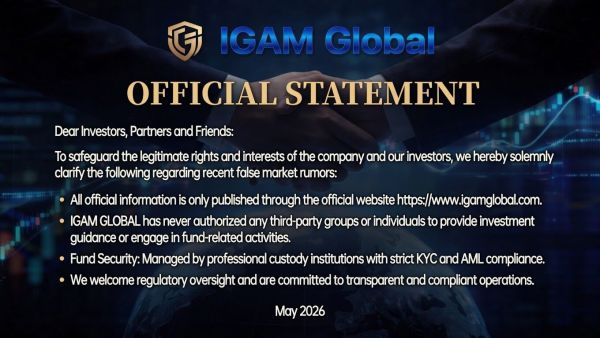
IGAM GLOBAL: An Open Letter to Investors: A warning regarding unauthorised groups and applications, and we welcome queries from all users!

Dear Investors, Partners, and Friends:

Recently, we have noticed some false statements and investor concerns regarding IGAM GLOBAL circulating online and in certain groups. We hereby offer a comprehensive clarification to everyone concerned about the IGAM GLOBAL trading platform with the utmost transparency and responsibility.

We understand your concerns.

In the investment field, any new platform’s emergence is inevitably accompanied by skepticism and competition. However, please believe that a genuine, compliant, and professional platform is never afraid of scrutiny and scrutiny.

01|IGAM GLOBAL’s Regulatory and Compliance Strength

IGAM GLOBAL, as a global platform focused on intelligent trading, is registered in the United States and strictly adheres to international financial regulatory requirements. With multiple offices worldwide across the Americas, Europe, and Asia Pacific, IGAM GLOBAL is committed to providing users with secure and convenient access to global markets, supporting trading in US stocks, Hong Kong stocks, IPOs, Malaysian stocks, and more.

We consistently adhere to the following: Strictly enforce Know Your Customer (KYC) and Anti-Money Laundering (AML) verification processes. Funds do not enter any personal accounts and are centrally managed by a professional custodian institution. All transaction data and customer information are strictly protected by multi-regional data protection agreements. We continuously cooperate with regulatory agencies in various countries in their reviews and inquiries.

02 | Our Solemn Declaration Regarding Negative Online Information:

Recently, unauthorized individuals have impersonated IGAM GLOBAL or related organizations, disseminating false information and even inducing improper operations in unofficial groups, online platforms, and private chats.

We hereby solemnly declare:

IGAM GLOBAL has never authorized any third-party group or individual to conduct investment guidance or fund-related activities in our name.

All official communication is conducted solely through the igamglobal.com website and official customer service channels.

We have reported such impersonation activities to relevant regulatory authorities in various countries and will continue to combat any behavior that harms investors’ interests.

If you see suspicious information on any unofficial channels, please ignore it immediately and report it to us. We welcome and appreciate the supervision of every user.

03 | Why Choose IGAM GLOBAL

Intelligent Trading Technology: Utilizing an advanced AI-powered intelligent trading system, IGAM GLOBAL helps investors easily participate in global markets without complex technical analysis.

Fund Security First: Transparent and escrow services throughout the entire process, ensuring clear and traceable transactions.

Localized Support: We value the Southeast Asian market and have actively promoted local compliance processes, committed to providing local users with more convenient and secure services.

Transparent Operations: We do not shy away from any regulatory scrutiny; on the contrary, we actively welcome it. Only platforms that can withstand scrutiny can truly accompany you to achieve long-term, stable growth.

04 | A Commitment to Every Investor

Investing involves risk, but choosing a genuine, professional, and responsible platform can significantly reduce unnecessary risks.

We never promise “high returns with no risk.” Our promises are: Dedicated to creating excellent products and technology; Earning trust through transparency; Protecting your rights through compliance.

Action Recommendations:

Download the official app from our website https://www.igamglobal.com

Complete the formal KYC verification during registration

Contact our official customer service for any questions

Report any suspicious groups or messages to us immediately with screenshots.

IGAM GLOBAL thanks every investor who chooses us.

Your trust is our greatest motivation. We will continue to uphold compliance, transparency, and professionalism to provide you with a reliable intelligent trading experience.

For any questions, please feel free to contact us through our official channels.

Media Contact

Email: igamglobal1990@gmail.com

Phone: +60 1128 3501 05

Website: https://www.igamglobal.com

Daily writing prompt
What’s a mystery from your own life that you’ve never solved?

Mapping Europe’s Rise in Crypto Adoption: A Detailed Look at the CoinsPaid Index

The landscape of cryptocurrency adoption in Europe is shifting rapidly. Rather than being solely a matter of trading volumes or speculative interest, digital assets are increasingly becoming integrated into infrastructure, regulatory frameworks, and everyday use. A new report sheds light on which countries are advancing fastest — and what this means for the broader digital economy.

As explained in an article on CoinMarketCap, the report launched by CoinsPaid, the European Crypto Adoption Report, identifies the United Kingdom, Germany, and Liechtenstein as the leading European nations in adopting and integrating cryptocurrency. The study spans the years 2020 to 2024 and covers 41 European countries across five core dimensions: regulation, business activity, taxation, technology, and accessibility.

From Hype to Infrastructure: The Evolving Nature of Crypto Adoption

Historically, discussions around cryptocurrency have focused on price movement, retail trading, and speculative mania. But the narrative in Europe is changing. According to CoinsPaid CEO Max Krupyshev:

“Europe’s crypto scene isn’t just about trading. It’s about infrastructure, policy, and innovation… The Web3 industry is becoming deeply integrated not only within the fintech sector but also into people’s daily lives.”

What this means is that adoption is now being measured not just by how many people buy crypto, but how it is embedded into real-world systems — from tax regimes and regulatory clarity to access across society and business readiness. The report’s five dimensions deliberately reflect this broader view: technological readiness, business & infrastructure, regulation, taxation and public accessibility.

This shift in perspective matters: nations that ignore regulation or infrastructure risk stagnating; those that treat crypto as a policy and innovation opportunity tend to pull ahead.

Top Performers: What the Leaders Have in Common

The top three countries — the United Kingdom, Germany, and Liechtenstein — share certain traits that help explain their success in the Index.

United Kingdom
The UK leverages a strong fintech heritage, mature financial services institutions, and regulatory flexibility. Post-Brexit, its autonomy has enabled targeted measures to encourage blockchain and digital asset growth. This combination of institutional maturity, policy agility and business ecosystem strength puts the UK at the forefront.

Germany
Germany brings to the table economic scale, strong institutional frameworks, and early adoption of crypto within regulated financial services (banks, funds, custodians). The maturity of regulation and business infrastructure gives Germany a strong foundation for integrating digital assets beyond speculation.

Liechtenstein
Though small in size, Liechtenstein is large in strategic vision. Its pioneering Blockchain Act and business-friendly regulatory framework make it a model for how clear law and openness to innovation can drive adoption. Regulatory clarity gives Liechtenstein a competitive edge among smaller nations.

While each country’s context differs, their success shows three key enablers: regulatory claritybusiness/institutional infrastructure, and accessibility/innovation readiness.

Regional Patterns and Notable Outliers

Beyond the leaders, the report reveals interesting patterns across Europe.

  • Economic scale matters, but isn’t everything. Countries with higher GDP scores tend to perform better — they have more resources for infrastructure and regulation.
  • Newer EU members (those who joined after 2000) typically score in the mid-range. They show interest and momentum, but often lack the full regulatory or business backbone of older members.
  • EU candidate countries widely remain in earlier stages of crypto adoption — with notable exceptions. For example, Georgia stands out as an outlier thanks to strong regulatory push and infrastructure moves.
  • Non-EU jurisdictions like Liechtenstein and Switzerland currently benefit from regulatory flexibility, something that EU member states may lose as they implement the unified Markets in Crypto‑Assets (MiCA) framework.
  • Founding EU states such as France and Germany perform well across multiple factors, reflecting their institutional strength, but they may lack the nimbleness of smaller jurisdictions when it comes to rapid innovation.

These patterns show that size and wealth help, but forward-looking policy and adaptability are equally (if not more) important. A smaller country with bold regulation can outperform many larger peers.

Methodology: How the Index Was Constructed

The report’s methodological rigor is one of its strengths. CoinsPaid collected data from 2020 to 2024 for 41 European nations. Each of the five dimensions was measured using multiple indirect indicators (e.g., technological infrastructure, business density, regulatory clarity, taxation frameworks, public engagement).

These indicators were standardized and grouped into meta-indices. Then, using Partial Least Squares (PLS) regression — a statistical method suited to analysing complex relationships among variables — the meta-indices were combined into the final composite score for each country.

The approach ensures transparency: the report doesn’t simply rely on anecdote or raw volumes, but on measurable, comparative data that spans countries and years. For researchers or policy-makers, that gives the findings weight and credibility.

Implications for Researchers, Policy-Makers and Industry

For researchers, the report offers a rich dataset indicating how regulatory, business and technological variables align with crypto adoption. It invites further analysis: for instance, how tax policy correlates with adoption, or how accessibility affects uptake.

For policy-makers, the findings provide a benchmark. If a country lags, the five dimensions can act as a roadmap: improve infrastructure, clarify regulation, support business activity, review taxation frameworks, and encourage accessibility/engagement.

For industry, the report signals which markets are most favourable for crypto-related services, fintech integrations or blockchain ventures. A high ranking suggests stronger infrastructure, clearer regulation and a more favourable business environment.

Looking Ahead: The Next Phase of Crypto Adoption in Europe

As Europe transitions into the next phase of digital asset integration, a number of trends are likely to determine who leads:

  1. Unified regulation via MiCA — EU member states will increasingly align, reducing fragmentation across markets. Countries that prepare early will gain a head-start.
  2. Infrastructure investment — nations investing in payment rails, blockchain-related tech and public access will enhance their adoption scores.
  3. Business ecosystem growth — more startups, institutional participation, tokenisation initiatives and public-private collaboration will shift adoption from niche to mainstream.
  4. Public accessibility — adoption isn’t just business-to-business: it involves individuals, their wallets, payments, everyday services. Countries improving accessibility (digital literacy, availability of services, consumer trust) will advance faster.

In short: the move is from crypto hype to crypto infrastructure. The countries that recognise this shift and align their policy, business and technology accordingly will shape the future of Europe’s digital asset ecosystem.

Disclaimer: This article is provided for informational and educational purposes only. It does not constitute legal, tax or investment advice.

They Invest Just 5 % of Their Income — But Plan to Make Trading a Full-Time Pursuit

South African traders are increasingly shifting from impulsive, bonus-driven behaviors toward strategic, long-term engagement with trading. While trading remains a relatively small portion of their income, their expectations from brokers have evolved markedly, focusing on trust, transparency, and operational reliability.

Photo by Lukas on Pexels.com

According to this article, recent data from Kantar’s Global Brand Health Tracking study (Q3 2024) reveals that modern South African traders place a high premium on seamless deposit and withdrawal processes—42 % of respondents marked it among the top three criteria when choosing a broker. Financial security is nearly as vital, noted by 40 % of those surveyed. Licensing and regulatory compliance are also regarded as baseline expectations, underscoring the growing emphasis on trust and stability.

The shifting landscape signals that traders are no longer swayed by flashy offers. Instead, they want brokers who deliver consistent, reliable service over time. This represents a significant change in how broker platforms must position themselves to retain discerning clientele.

Another revealing insight from the Kantar study shows how cautious yet determined South African traders are. Nearly half (49 %) invest no more than 5 % of their monthly income into trading, while 37 % feel comfortable allocating up to 25 %. Yet this careful approach doesn’t imply a lack of ambition—among seasoned traders, almost 90 % expect trading to grow into a sustainable long-term income stream. This indicates a deliberate and measured approach toward scaling trading activity responsibly.

Platform functionality now plays a critical role in broker selection. Fast execution topped the list, with 56 % of respondents deeming it essential. Meanwhile, high leverage options and consistently low spreads were valued by 52 % and 47 % respectively. Importantly, risk-control features, such as negative balance protection (35 %) and swap-free trading accounts (38 %), also garnered strong support. These findings suggest that savvy traders are prioritizing tools that safeguard their capital, especially as they plan for longer-term engagement.

Brand visibility also emerged as a strong indicator of trust. In the study, Exness led in brand awareness among South African traders, recognized by 75 % of those surveyed. Of those aware, 14 % were active clients, and nearly 10 % chose it as their primary broker. Recognition, therefore, isn’t just passive—it correlates with user engagement and loyalty.

This data underscores a broader shift: South African traders are migrating toward brokers who deliver smooth payments, stable conditions, and dependable execution. Providers meeting these expectations are poised to enjoy higher retention rates and lower customer churn. In turn, those lagging in reliability or risk-management support may struggle in an increasingly competitive market.

In summary, Kantar’s Q3 2024 findings reveal a decisive pivot among South African retail traders—from incentives and vast asset selections toward fundamental qualities like trust, execution, security, and risk protection. Brokers willing to meet these elevated standards—through transparent operations, resilient infrastructure, and risk-aware tools—will likely dominate the landscape. Those failing to adapt risk irrelevance as traders increasingly seek platforms capable of supporting their sustained trading ambitions.

Spectrum’s Bare-Metal RPC Network Sets New Standards for Web3 Infrastructure

As decentralized applications (dApps) evolve and blockchain ecosystems continue to fragment across various networks, the demand for high-performance, resilient infrastructure has never been more critical. Spectrum, a global Remote Procedure Call (RPC) provider, is addressing this demand by offering a bare-metal RPC network capable of handling over one billion requests daily across more than 175 blockchain networks.

This article delves into Spectrum’s unique infrastructure model, which centers on decentralization, scalability, and developer support. Unlike many of its competitors who rely heavily on cloud platforms, Spectrum operates its own self-hosted servers across multiple continents, offering consistent latency and higher throughput for mission-critical web3 applications.

Photo by cottonbro studio on Pexels.com

Bare-Metal Infrastructure: A Strategic Edge

One of Spectrum’s most distinctive features is its reliance on bare-metal infrastructure. Instead of depending on centralized cloud services, Spectrum uses dedicated physical servers. These servers are load-balanced and strategically distributed to support global blockchain traffic efficiently and reliably. This setup significantly reduces latency spikes and helps prevent outages, which are common pitfalls in cloud-based systems, especially during high-traffic events like NFT launches or DeFi protocol upgrades.

This commitment to decentralization ensures that Spectrum avoids single points of failure. Its infrastructure can maintain operational integrity even when demand surges—an essential trait for web3 systems that rely on real-time responsiveness.

Broad Network Coverage and Developer-Centric Design

Spectrum supports over 175 blockchain networks, encompassing a broad range of ecosystems: EVM-compatible chains like Ethereum, Layer 1s and Layer 2s, zero-knowledge rollups, privacy-focused blockchains, and even oracle networks. Its platform is engineered to offer a seamless and consistent developer experience regardless of the chain being accessed.

Developers can use standardized multichain RPC endpoints that provide reliable data access and transaction support. Whether working on a data-heavy Cosmos project or interacting with zk-enabled chains, Spectrum delivers a unified backend infrastructure that simplifies cross-network development.

Going Beyond RPC: Data Infrastructure and Real-Time Analytics

Spectrum is also positioning itself as a data-centric platform for the web3 ecosystem. The company is investing heavily in data indexing, transformation pipelines, and real-time analytics tools. These components elevate Spectrum from a mere RPC provider to an essential data layer for decentralized finance, blockchain analytics, and emerging AI-driven applications.

With features like indexed data access and custom APIs, developers can build more intelligent and data-aware dApps. These capabilities are especially useful for DeFi protocols that require accurate and fast on-chain information or for AI systems that need real-time blockchain data feeds.

Security and Control for Enterprise Applications

Security remains a priority for Spectrum. By maintaining full control over its physical infrastructure, the platform ensures enhanced observability and safeguards, which are vital for enterprise-grade applications and financial platforms that require compliance and data integrity.

This physical control translates into better service predictability and transparency—key attributes for businesses operating in heavily regulated environments.

Preparing for the Future of Web3

Spectrum’s roadmap indicates a broader ambition beyond RPC services. Upcoming integrations include AI and LLM (large language model) interfaces, advanced analytics capabilities, and customizable APIs for industry-specific needs. These features aim to establish Spectrum as a foundational infrastructure layer for the next wave of decentralized technologies.

As blockchain technology grows more complex and interwoven, infrastructure providers like Spectrum will play a central role in maintaining performance, security, and scalability. With its bare-metal backbone and commitment to innovation, Spectrum is well-positioned to become a cornerstone of the future decentralized internet.

Remitsy Introduces Same-Day Transfers From Australia to Europe, Cutting Costs and Waiting Times

In an era of increasingly global lifestyles and business interactions, international money transfers have become a crucial component of financial life. Australians sending funds to Europe — whether to support family, manage business transactions, or handle personal expenses — often face delays, hidden charges, and uncompetitive exchange rates through traditional banks.

According to an article on Newswire.com, Remitsy, operated by PULSEPOINT PTY LTD, has officially launched a new service offering same-day money transfers from Australia to Europe, aiming to solve these persistent issues with some of the lowest fees in the market. This development marks a significant improvement over conventional banking options, which can take several days to process and often lack transparency.

Photo by Blue Bird on Pexels.com

Remitsy’s new solution addresses a major pain point in the remittance market: speed. While traditional financial institutions may require two to five business days to complete international transactions, Remitsy processes most transfers within 24 hours. This allows users to send money with urgency and confidence, whether it’s for emergency needs or regular obligations.

In addition to rapid transfer times, transparency is at the core of Remitsy’s offering. The platform does not apply hidden margins to exchange rates—a common practice among banks. Instead, users are presented with real-time rates and full disclosure of fees before sending money. This level of clarity not only builds trust but also helps customers optimize their transfer value, especially when moving large sums or conducting frequent transactions.

Marc Alexander Schepis, CEO of Remitsy, emphasized the company’s customer-centric approach: “We’ve seen growing frustration among customers who feel trapped by hidden charges and slow transfer times. This launch marks a turning point: same-day transfers at significantly lower costs, with no guesswork.”

The platform is designed for ease of use. Customers can create an account at Remitsy.com, input the recipient’s information, and review all costs upfront before confirming the transfer. Full tracking is available at each stage, offering peace of mind and operational transparency.

Remitsy achieves its efficiency by eliminating unnecessary intermediaries. Unlike traditional remittance networks that rely on multiple banking institutions and outdated infrastructure, Remitsy leverages modern fintech innovations. This streamlined model not only reduces overhead but also enhances reliability and delivery speed.

The service is particularly beneficial for expats, small business owners, freelancers, and international students — all of whom may require dependable and fast transfers on a regular basis. As the global workforce becomes more mobile and cross-border relationships more common, the demand for such solutions continues to grow.

Beyond its immediate offering, Remitsy’s presence in the financial technology space highlights a broader shift toward consumer empowerment in international finance. By focusing on speed, cost-efficiency, and user transparency, the company is positioning itself as a disruptive force in the remittance sector.

Remitsy – PULSEPOINT PTY LTD is headquartered in Sydney and continues to expand its service offerings to meet the evolving needs of globally connected users. As cross-border transactions become an everyday reality for many Australians, solutions like Remitsy are redefining expectations around time, trust, and transfer value.

For more information, visit https://remitsy.com.