
A biosafety cabinet creates a barrier that you cannot see. That is the whole trick. Air moves in a precise pattern at velocities measured in meters per second, it is completely invisible to the naked eye, and yet the safety of the operator, the sterility of the product, and the containment of the agent all depend on that airflow remaining undisturbed. The cabinet itself is just hardware. The barrier exists only as long as the person sitting in front of it understands what disrupts it and what does not.
Over the years I have watched hundreds of people work in bio safety cabinets. The most successful users are not necessarily the most technically skilled pipettors. They are the ones who develop a kind of spatial awareness. A quiet, almost subconscious habit of moving slowly at the opening, keeping the grille clear, and knowing every moment exactly where their hands are relative to the air curtain.
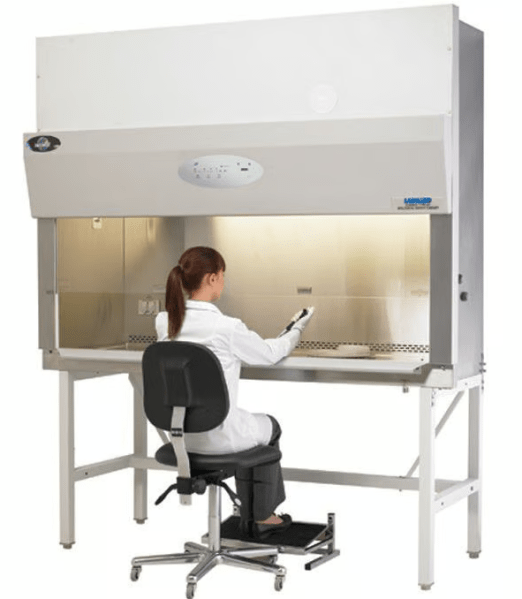
The First Five Minutes Set the Tone
When a cabinet is turned on, it needs time. The fan must stabilize, the airflow must reach its design velocity, and the HEPA-filtered downflow needs to purge the work area of any particulates that settled overnight. Most manufacturers recommend running the cabinet for at least three to five minutes before any materials are introduced. In a busy lab, this step gets skipped all the time. Someone walks in, flips the switch, and immediately starts loading pipettes and media bottles into a work zone that has not been swept clean by the laminar flow. That is a contamination risk that costs nothing but patience to eliminate.
The same discipline applies at the end of a session. The cabinet should continue running for another few minutes after all materials have been removed and the surfaces wiped down. This clears any residual aerosols generated during the work. Shutting the blower the instant the last tube is capped is a small act of impatience that undercuts the entire purpose of the equipment.
Clutter Is the Enemy, and It Wins Often
The front grille of a Class II cabinet is the intake path for room air. When that grille gets blocked, the air curtain at the front opening thins out. Containment is compromised. The most common culprit is the pipette tip box sitting right at the front edge of the work surface, right where it is ergonomically easiest to reach. Every time you place something on or directly in front of that perforated grille, you are creating turbulence in the very flow that is supposed to protect you.
The fix is simple in theory: keep all materials at least four inches back from the front opening. In practice, arms get tired, workspaces are small, and the tip box creeps forward throughout the session. One practical habit I have seen work well is organizing the workspace before starting. Place the tip waste container to the left or right, not at the front. Arrange reagents in a line from clean to dirty, working from back to front. If your arms keep hitting a stack of plates near the grille, stop and rearrange. The extra thirty seconds of adjustment pays for itself.
Movement Destroys Containment Faster Than Anything Else
Rapid arm movements at the cabinet opening displace air. Pulling your hands straight out quickly creates a void that sucks room air in. Pushing them straight in fast pushes cabinet air out. The slower and more deliberate the arm entry and exit, the better the air curtain holds. This is not a matter of being overly cautious. It is a physical reality of how air barriers work.
The same applies to people walking behind the operator or past the cabinet. A person walking at a normal pace generates an air wake that can break containment at the sash opening. In an ideal setup, the biosafety cabinet is placed away from corridors and doors. In many real labs, the ideal setup is impossible. The next best thing is awareness. If someone needs to walk behind you while you are working, pause your hands for a moment, especially during a critical aseptic transfer. Let the air curtain stabilize. It only takes a second.
Asaptic Technique Inside a BSC Is a Different Skill
Working sterile on an open bench and working sterile inside a cabinet are not the same thing. On the bench, the risk comes from airborne particulates drifting down onto the work. Inside a properly functioning BSC, the downflow air is HEPA filtered, so that risk is vastly reduced. The new risk comes from the operator’s own hands and the way materials are moved within the airflow.
A good rule is to never pass a non-sterile object over a sterile one. If you are opening a cell culture flask, hold it such that your hand and any non-sterile item like a marker or a data sheet are downstream of the open vessel. Downstream in a vertical laminar flow cabinet means below or to the side. Keep the sterile field above the potentially contaminated surfaces. It is the reverse of what many people intuitively do, because on the bench downstream is gravity, and it feels natural to work with open items above everything else. Inside the cabinet, the cleanest zone is directly under the HEPA filter, and things get progressively dirtier as you move down and toward the front grille.
Spills Happen, and Your Reaction Determines the Outcome
A spill inside a biosafety cabinet is not a bench spill. A small volume of liquid splashed onto the work surface will immediately be drawn into the grille, down into the plenum beneath, and potentially into contact with the fan and the internal surfaces of the HEPA filter. Once contaminated liquid gets below the work surface, the cabinet is no longer just a container. It is actively aerosolizing whatever was spilled every time the fan runs.
If a spill occurs, the immediate step is to leave the cabinet running. The airflow will contain the aerosols at the work surface level. The next step depends on the severity and the agent. For a small spill of a low-risk agent, surface decontamination with an appropriate disinfectant may be sufficient, as long as the disinfectant is thoroughly applied to the spill area and allowed a proper contact time. For larger spills, or any spill involving a high-risk agent, the cabinet should be shut down, sealed if possible, and decontaminated by trained personnel according to a written spill protocol. The exact procedure for a major spill inside a BSC should be part of every laboratory’s biosafety manual, and it is worth reviewing that protocol periodically, not just reading it once during onboarding.
The Experienced User Problem
New users are careful. They move slowly. They think about where their hands are. Experienced users, the ones who have spent thousands of hours in front of a BSC, stop consciously thinking about any of it. Their movements become automatic. And slowly, without anyone noticing, bad habits creep in. A pipette tip gets discarded by reaching past the grille instead of using the waste container on the side. A quick arm withdrawal while talking to a colleague. A culture flask opened with the hand hovering right at the sash opening. None of these are intentional. All of them break containment in small ways that accumulate over time.
The most effective countermeasure I have seen is an annual or semi-annual competency observation. A biosafety officer or a trained peer simply watches someone work for fifteen minutes and notes any deviations. Not as a test, but as a refresher. Almost everyone slips over time. The point is to catch the slips before they cause a contamination event or an exposure. It is astonishing how often a ten-minute observation uncovers a habit the user had no idea they had developed.
Training Is Not a One-Time Event
A biosafety cabinet is a piece of critical safety equipment. In many labs, the training for it consists of a brief demonstration during the first week of employment, and then nothing. Compare that to how often pilots do simulator check rides, or how often emergency room staff practice resuscitation drills. The stakes in a BSL-2 or BSL-3 lab are high. The training should match that reality.
A good program covers the theory of airflow, the specifics of the cabinet model in use, the daily startup and shutdown routine, the location and use of the spill kit, and the emergency procedures for power failure or equipment malfunction. Then it requires a practical demonstration, and then it revisits the material periodically. Not because anyone expects people to forget, but because the cost of a single moment of forgetfulness is too high.
The Bottom Line, Without Pretending It Is Complicated
A biosafety cabinet is an extraordinary piece of engineering. It creates a sterile, contained workspace in the middle of a room full of contaminants and potential hazards. But it is not an autoclave. It is not a sealed glovebox. It is a dynamic air barrier, and dynamic barriers require dynamic attention. The people who get the most out of their cabinets are the ones who treat their own movements as part of the equipment. Slow, deliberate, aware. That is the whole secret.


