As an AI language model, ChatGPT is a remarkable achievement in the field of natural language processing. It is capable of generating responses that are contextually relevant and syntactically sound, making it an ideal tool for a wide range of applications, from chatbots to language translation. One of the most impressive aspects of ChatGPT is its ability to learn from vast amounts of data and improve over time. This is achieved through a process called unsupervised learning, which allows the model to learn patterns and relationships in the data without being explicitly told what to look for. In terms of its capabilities, ChatGPT is able to understand a wide range of topics and can engage in conversations that are both informative and engaging. It can also generate responses that are humorous or sarcastic, making it a versatile tool for a range of use cases.
That being said, there are some limitations to ChatGPT. One of the biggest challenges with language models like ChatGPT is their tendency to generate biased or offensive content, particularly when they are trained on data that contains bias. This can lead to harmful language being generated, which can be a significant problem in applications like chatbots that are designed to interact with users. Another limitation of ChatGPT is its lack of true understanding of context. While it can generate responses that are contextually relevant, it does not truly understand the nuances of language or the cultural and social contexts in which language is used. This can sometimes lead to responses that are awkward or inappropriate.
Yes, there is a bright future for ChatGPT and other similar AI language models. As the field of natural language processing continues to advance, we can expect to see even more sophisticated language models capable of generating responses that are virtually indistinguishable from human-generated text. One of the key areas of development for ChatGPT and similar models will be improving their ability to understand context and generate responses that are not just contextually relevant, but also culturally and socially appropriate. This will involve training the models on diverse and inclusive data sets, and developing algorithms that can detect and correct for bias. Another area of development for ChatGPT and other language models will be improving their ability to interact with humans in a more human-like way. This will involve incorporating more emotional intelligence into the models, allowing them to recognize and respond to human emotions, as well as developing more sophisticated conversational abilities.
Overall, the future for ChatGPT and similar language models is very promising, and we can expect to see continued growth and development in the field of natural language processing in the years to come. These models have the potential to revolutionize the way we interact with technology and with each other, and to open up new possibilities for communication, learning, and creativity. ChatGPT is an impressive achievement in the field of natural language processing, and it has the potential to be a powerful tool for a range of applications. However, it is important to be aware of its limitations and to use it responsibly in order to avoid generating harmful or offensive content.
Explainable AI (XAI): As AI systems become more complex, understanding how they make decisions is crucial. Research on developing algorithms that explain their decision-making process to non-experts is gaining prominence.
AI in Healthcare: Investigating AI and ML applications for medical diagnosis, drug discovery, personalized treatments, and medical imaging. Topics can explore the use of AI in predicting disease progression or enhancing remote healthcare.
Natural Language Processing (NLP): Topics include sentiment analysis, language translation, and chatbot development. You can also explore AI’s ability to generate human-like text or analyze emotions from textual data.
Reinforcement Learning: This area focuses on how AI agents can learn from their environment by maximizing reward-based learning. Applications in autonomous vehicles, robotics, and game AI can be explored.
AI for Cybersecurity: Machine learning algorithms to detect and prevent cyber threats such as phishing, malware, and intrusion detection are in demand. Research can focus on anomaly detection and predictive models for network security.
Ethics of AI: With AI’s growing influence, ethical considerations are critical. A thesis can explore topics like bias in AI algorithms, AI decision-making transparency, or legal implications of autonomous systems.
AI in Climate Change: Leveraging machine learning to predict climate patterns, optimize renewable energy systems, or improve environmental monitoring and conservation efforts.
Edge AI: This area investigates deploying AI models directly on devices rather than in centralized cloud systems. Research could focus on optimizing AI for low-latency applications like autonomous drones or IoT systems.
AI in Finance: Examining the use of AI for fraud detection, stock market prediction, algorithmic trading, and personalized financial advising.
Generative AI: Topics can include the development and use of generative models such as GANs (Generative Adversarial Networks) for image synthesis, text generation, or creative applications in art and design.
Each of these topics can be expanded by focusing on specific applications, frameworks, or technological advancements in AI and ML.
Data science, the interdisciplinary field that combines statistical analysis, machine learning, and computer science, is at the forefront of driving innovation and transformation across industries. In today’s data-driven world, organizations are increasingly relying on data science to extract actionable insights from vast amounts of data, enabling informed decision-making and driving business growth.
By leveraging advanced analytics techniques and cutting-edge technologies, data scientists can uncover hidden patterns, predict future trends, and optimize processes to enhance efficiency and productivity. As organizations continue to recognize the value of data-driven insights, the demand for skilled data scientists is on the rise, making IISC Data Science Course one of the most sought-after fields in the modern job market.
Ethical Considerations in Data Science: Navigating the Moral Landscape
In the digital age, where data has become the lifeblood of modern society, the ethical implications of data science have come under intense scrutiny. As data scientists harness the power of algorithms and machine learning to extract insights from vast troves of information, questions arise regarding the responsible use of data and the potential consequences for individuals and society as a whole.
One of the primary ethical considerations in data science revolves around privacy and consent. With the proliferation of data collection technologies and the prevalence of surveillance systems, concerns arise about the unauthorised gathering and exploitation of personal information. Data scientists must navigate a delicate balance between extracting valuable insights from data and respecting individuals’ rights to privacy and autonomy.
Moreover, the issue of bias in data science poses significant ethical challenges. Biases inherent in data collection methods, algorithmic models, and decision-making processes can perpetuate systemic inequalities and discrimination. Data scientists must proactively identify and mitigate biases in datasets and algorithms to ensure fair and equitable outcomes.
Another ethical consideration in data science is transparency and accountability. As algorithms increasingly shape various aspects of our lives, from hiring decisions and financial lending practices to criminal justice systems, there is a growing demand for transparency and explainability in algorithmic decision-making. Data scientists must strive to develop transparent and interpretable models that enable stakeholders to understand how decisions are made and hold them accountable for any biases or errors.
Furthermore, data scientists have a responsibility to use their skills and expertise for the social good. By leveraging data science techniques to address pressing societal challenges such as climate change, public health crises, and poverty alleviation, data scientists can make a meaningful difference in the world. This involves collaborating with interdisciplinary teams, engaging with diverse stakeholders, and prioritising ethical considerations in all stages of the data science lifecycle.
In conclusion, ethical considerations are at the heart of data science, shaping the moral landscape in which data scientists operate. By prioritising privacy, fairness, transparency, and social responsibility, data scientists can navigate the complex ethical terrain of data science and harness the power of data for the greater good of society.
Data Science in Urban Planning: Building Smarter Cities
In the era of rapid urbanisation, cities face unprecedented challenges in managing resources, infrastructure, and services to meet the needs of growing populations. One key application of data science in urban planning is predictive modeling and analysis. By harnessing data from various sources, such as sensors, satellites, and social media, urban planners can gain valuable insights into demographic trends, traffic patterns, and environmental factors.
Another area where data science is transforming urban planning is in the design and management of infrastructure. By leveraging techniques such as geographic information systems (GIS) and machine learning, planners can optimise the placement of infrastructure assets such as roads, bridges, and utilities to maximise efficiency and minimise environmental impact. Data-driven models can also simulate different scenarios and assess the potential outcomes of various development projects, enabling informed decision-making and better allocation of resources.
Moreover, data science is revolutionising citizen engagement and participatory planning processes. Through the use of interactive maps, online platforms, and mobile applications, cities can engage residents in the planning process, gather feedback, and incorporate community input into decision-making.
In conclusion, data science holds immense potential to revolutionise urban planning and create more intelligent, more livable cities. By leveraging data-driven insights and advanced analytics techniques, cities can optimise resource allocation, improve infrastructure design, and enhance citizen engagement.
Data Science in Marketing: Targeting Audiences with Precision
One essential application of data science in marketing is customer segmentation and targeting. By analysing vast troves of customer data, including demographics, purchasing behaviour, and online interactions, marketers can identify distinct customer segments and tailor their messaging and offers to resonate with each group’s preferences and needs. This data-driven approach allows marketers to deliver personalised experiences that are more relevant and compelling to their target audiences, resulting in higher engagement and conversion rates.
Another area where data science is revolutionising marketing is predictive analytics and forecasting. Whether predicting customer churn, forecasting sales volumes, or identifying emerging market opportunities, data science empowers marketers to stay ahead of the curve and capitalise on new opportunities for growth.
Conclusion
Data science is transforming the way marketers measure and optimise campaign performance. Through advanced analytics and attribution modelling, marketers can gain insights into the effectiveness of their marketing efforts across various channels and touchpoints. This data-driven approach enables marketers to identify which campaigns are driving the most impact and allocate their resources more effectively to maximise ROI.
In conclusion, data science is revolutionising the field of marketing, enabling marketers to target audiences with precision, predict future trends, and optimise campaign performance. By harnessing the power of data-driven insights and advanced analytics techniques, marketers can deliver personalised experiences, drive engagement, and achieve their business objectives more effectively than ever before. As the field of IISC Data Science Course continues to evolve, its impact on marketing will only grow, shaping the future of advertising and consumer engagement in profound ways.
In the realm of modern content creation, the emergence of Artificial Intelligence (AI) essay generators has sparked a revolution. These sophisticated tools have transformed the way we approach writing, offering unparalleled efficiency and accuracy. Understanding the mechanics behind these AI-driven platforms, including paraphrasing tool, is essential for writers seeking to optimize their workflows and produce polished prose.
Exploring the Functionality of AI Essay Generators
AI essay generators operate on advanced algorithms and Natural Language Processing (NLP) techniques. By analyzing prompts and understanding language patterns, semantics, and context, these platforms generate coherent essays swiftly and effectively. This functionality streamlines the writing process, allowing creators to focus on crafting engaging narratives rather than grappling with the initial stages of brainstorming and drafting.
Leveraging AI for Free Paraphrasing
One of the standout features of AI essay generators is their ability to provide free AI paraphrasing. This capability enables users to rephrase existing text while preserving its original meaning and intent. Content creators can leverage AI paraphrasing to produce unique, plagiarism-free content effortlessly, enhancing the authenticity and originality of their work.
Enhancing Efficiency and Productivity
By integrating AI essay generators into their workflows, writers can significantly enhance efficiency and productivity. These tools automate tedious tasks, such as generating content from prompts and paraphrasing existing text, allowing creators to focus their time and energy on higher-level creative endeavors. As a result, writers can produce more content in less time without sacrificing quality or coherence.
AI essay generators excel in ensuring the accuracy and consistency of generated content. By meticulously analyzing input prompts, these platforms produce essays that align with the desired tone, style, and subject matter. Moreover, AI-driven content generation minimizes errors and inconsistencies, delivering high-quality output that meets the standards of even the most discerning audiences.
Addressing Potential Limitations
Despite their numerous benefits, AI essay generators are not without their limitations. These platforms may struggle with highly specialized or nuanced topics that require human expertise and insight. Additionally, ethical considerations surrounding the use of AI-generated content must be taken into account to maintain integrity and authenticity in writing endeavors.
Embracing the Future of Content Creation
As AI technology continues to evolve, the future of content creation undoubtedly lies in the integration of AI essay generators into writers’ toolkits. These innovative platforms empower creators to unleash their creativity, streamline workflows, and deliver compelling narratives across a diverse range of subjects and genres. Embracing AI-driven content generation is not just a practical choice but a strategic imperative for writers seeking to thrive in an increasingly competitive digital landscape.
Conclusion
In conclusion, understanding the mechanics of AI essay generators is essential for writers looking to optimize their content creation processes. From AI paraphrasing tool to automated content generation, these platforms offer a myriad of capabilities that can revolutionize the way we approach writing. By embracing the power of AI-driven tools, writers can unlock new levels of efficiency, productivity, and creativity, propelling their writing endeavors to unprecedented heights of success.
Plagiarism detection is always considered embarrassing that’s why it is crucial to always check plagiarism in your thesis before submitting it to the teacher or publishing it on the internet. This is because plagiarism in writing has severe consequences including:
Rejection of the thesis
Loss of grades
Expulsion from the institute
Facing lawsuits from the original owner
And the list goes on.
Do you know the only way to check for plagiarism is by utilizing online plagiarism detection tools? In this article, we are going to discuss the best plagiarism-checking tools along with their pros and cons.
Top 3 Tools That Can Be Used for Detecting Plagiarism in Thesis
Here are the 3 effective plagiarism detection tools that can be used for determining duplication in a thesis or any other type of write-up.
First of all, we have an Editpad Plagiarism Checker. It is a freemium tool that operates on a diverse set of Artificial Intelligence (AI) algorithms that efficiently compare the given thesis with millions of internet resources to find any kind of plagiarism.
If any duplicate sources are found, the tool will highlight them along with their matched sources through a red line. Not only this, it also provides the percentage of both unique & plagiarized content. In order to demonstrate all this, we have attached an image below, check it out.
So, the tool not only provided the percentage of both unique and plagiarized. Now, you will an have efficient idea of how you can efficiently detect plagiarism in your thesis.
The good about this tool is that it has the ability to check writing for plagiarism in 14 different languages. And gives the option to download the scan report that can be used as proof of write-up originality.
It is available in both free and paid versions. If you are using it for free, then you can check up to 1,000 words at once. Whereas, users with premium subscriptions can check a maximum of 3,000 words at once.
Copyleaks is widely known and used for AI content detection. But do you know? it also has a highly credible plagiarism detector. The plagiarism detector is designed on advanced Machine Learning algorithms that efficiently scan the given text to find the smallest instances of plagiarism in it.
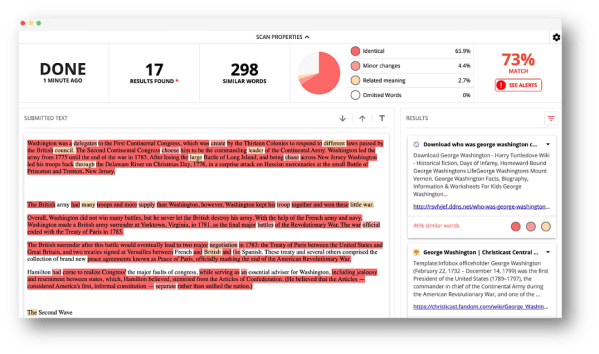
Unlike Editpad, this tool only provides the percentage of matched/plagiarized content. One good thing is that it highlights different types of plagiarism in different colors. For instance, if the given sentence or paragraph is completely matched with an online source, then that part will be highlighted in dark red.
On the other hand, if a few words are matched, then the tool will highlight them with a light red color, indicating minor changes.
Remember, in both these cases the tool provides the matched sources so that the user can take the necessary steps to remove them. To illustrate all this in a better way, we have attached an image below, check it out.
One thing that you need to keep in mind is that the Copyleaks plagiarism checker is not available for free, it’s PAID. Its pricing for plagiarism detection starts from $8.99 per month.
This is a completely free-to-use plagiarism checker that is widely used by students and teachers to quickly and efficiently scan a thesis for duplication. Just like other tools discussed on this list, this one also compares the input text with different online resources such as blogs, research papers, journals, etc., to find plagiarism.
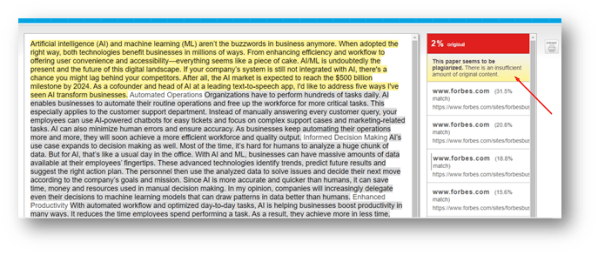
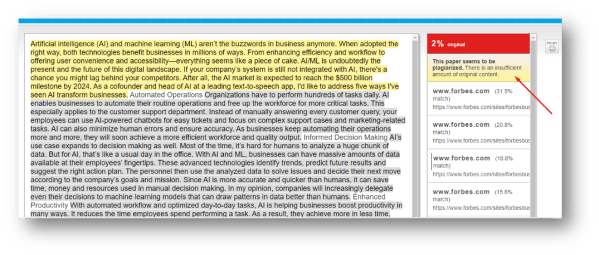
It then provides the percentage of only “Unique” or “Original” content along with a note “This paper seems to be Unique” or “This paper seems to be plagiarized.” Additionally, the tool also provides matched sources and the percentage of matched content for each source.
To provide you with a better idea about its working, we copied some content from an online article and checked it with PaperRater. The results we got can be seen in the attachment below.
As you can see, the tool has mentioned that the given text is “Plagiarized” which is true since it was copied from an online source.
One of the amazing things about this tool is that; it allows users to check unlimited words at once for free.
Pros:
Easy & free to use.
Unlimited word checking limit.
Provide the percentage of content originality.
Cons:
Does not give the option to download scan results.
Final Words
Checking your thesis for any kind of plagiarism before submitting or publishing is necessary to avoid severe consequences. In this article, we have explained the 3 best plagiarism detection tools along with the pros and cons that you can use in this regard.
Industrial automation broadly refers to using technology, especially computing systems, to handle and regulate manufacturing and production processes with minimal continuous human involvement. Previously, human operators needed to manually control and oversee every step of the assembly line.
Automation accurately completes many repetitive tasks by programmed machinery and robots. This enables companies to achieve higher rates of speed, quality, and efficiency.
The Core Components Enabling Industrial Automation
Several key components work cohesively across infrastructure and hardware to facilitate streamlined industrial automation. These include programmable logic controllers (PLCs), human-machine interfaces (HMIs), industrial internet of things (IIoT) sensors, robotics, artificial intelligence (AI), and machine learning (ML) algorithms.
For example, PLCs function as modular microprocessors that actively connect and coordinate physical inputs from sensors and outputs such as running motors or opening valves to automate mechanical responses on the assembly line. Without needing human intervention, if a PLC-governed sensor detects a temperature increase in a key production phase, the controller can immediately trigger cooling fans or reduce furnace intensity accordingly.
Likewise, HMIs allow human operators to oversee equipment performance, address anomalies and fine-tune production metrics through interactive dashboards in real-time without directly intervening. This gives staff greater visibility to optimize the manufacturing process as automation handles routine activities.
How Factories Have Progressively Adopted Automation
Transitioning from manual labor to mechanized production marked the First Industrial Revolution. Later, electricity and mass manufacturing defined the Second Revolution. The third brought electronics and IT systems for automating processes. Today, the Fourth Revolution centers on fully-integrated cyber-physical production facilities.
Over decades, automation has evolved remarkably – from basic assembly lines to smart factories where robots and AI collaborate seamlessly. This technology continues to dramatically reshape global supply chains and manufacturing.
The Business Case for Automation and its Advantages
Industrial automation helps businesses address pressing priorities like improving quality, boosting output, and staying cost competitive. By reliably performing repetitive tasks round-the-clock, automated equipment increases production volumes without compromising accuracy or precision.
Intelligent automation also minimizes costly errors that could impact batch quality or output consistency. This builds customer confidence while allowing factories to meet demanding supply commitments. Additionally, automating dangerous jobs leads to safer working conditions and helps companies achieve sustainability targets.
Understanding What Constitutes a Smart Factory
The term “smart factory” represents production facilities that utilize networked machinery, inventory management systems, IoT sensors, and data analytics to optimize real-time decision making across operations. By continually monitoring equipment performance and production metrics, issues can be predicted and addressed proactively.
Smart factories also coordinate various production elements like inputs, personnel, machinery to quickly adapt to changes in product demand or market dynamics. This nimbleness provides competitive advantages to companies operating smart factories.
How Artificial Intelligence Steps Up Automation
With unparalleled data processing and deep learning capabilities, artificial intelligence (AI) propels industrial automation to new levels. For instance, machine vision can scan products for defects, while natural language interfaces simplify human-machine collaboration.
Unlike traditional hardcoded automation, AI systems continuously improve by processing real-time data to enhance quality control and output customization without explicit reprogramming. With the power of prediction, AI enables proactive maintenance, waste reduction and accident prevention in dynamic factory environments.
Automation’s Impact on The Job Market
A common automation concern involves workforce reductions, but the reality is more nuanced. While routine manual jobs will decrease, new roles utilizing human strengths like creativity, empathy, and problem-solving will emerge. Essentially, automation handles highly repetitive and injury-prone assignments so staff can focus on more high-value responsibilities.
Rather than full displacement, responsible automation integration alongside retraining programs can enable human-machine collaboration while allowing workers to upgrade skills. This empowers employees over the long run.
Where Machine Learning Boosts Automation Outcomes
As an AI subset, machine learning hones automated processes by processing volumes of data to uncover patterns and insights without explicit instructions. By continually exposing algorithms to new data and allowing self-adjustment accordingly, ML enables more accurate forecasting and real-time adaptability in response to production variances.
Additionally, by revealing correlations between equipment variables, raw material attributes and ideal production parameters, ML improves quality and output customization with limited human input. These features make ML integral for next-generation industrial automation.
Key Factors to Consider Before Automating
Migrating to intelligent automation necessitates upfront planning around implementation costs, required infrastructure upgrades, and potential risks. Companies must determine what tasks can be fully automated versus those still requiring human judgment to uphold product quality and workforce skill development.
Gradual rollout can smooth the transition as staff and workflows get accustomed to automation integration. Providing job training opportunities also minimizes labor displacement concerns while helping retain organizational knowledge.
The Role of Connected Devices and IoT in Driving Automation
The Internet of Things involves connectivity between machines, systems, and networks. This can be used for gathering performance data and monitoring analytics. Industrial IoT helps drive automation by embedding network-enabled sensors across the production line to closely track equipment health and productivity.
Advanced analytics converts this equipment data into insights for predictive maintenance. This prevents unexpected outages or failures which lead to downtime and lost revenue. Additionally, IoT connectivity enables administrators to remotely control machinery and make modifications on the fly. This allows for greater production flexibility when needed.
Examples of Cutting-Edge Automated Technology Across Industries
Automation applications are accelerating across sectors from inventory robots in warehousing to AI-enabled manufacturing machinery. Automated conveyor belts and sorting systems enable streamlined order processing in logistics centers. In healthcare, automation assists in drug discovery by using algorithms to analyze molecular interactions.
Across fields, machine learning and computer vision fine-tune quality assurance testing and accelerate materials handling. As technology advances, so will the breadth of tasks in which automation delivers value.
Calculating the ROI from Industrial Automation Investments
When evaluating automation ROI, both direct and indirect benefits must be considered over the solution lifetime. While upfront costs can seem high, automation drives significant productivity growth, quality improvements, and long-term cost savings from optimized material consumption and labor reduction.
Additional gains like increased customer retention thanks to faster order turnarounds further offset expenditures. Weighing these qualitative and quantitative ROI factors, automation investments often pay dividends.
Main Challenges in Transitioning to Automated Processes
The transition to automated processes comes with its share of challenges. Technological adaptation involves potential high upfront costs associated with purchasing hardware and software or adapting existing infrastructures. Additionally, organizations need to address change management issues including staff retraining or job role alterations.
Cybersecurity risks also increase with automation as cyber threats could potentially disrupt automated processes and compromise data security. Hence businesses need to prioritize preventative measures when adopting industrial automation.
Sustainability and Industrial Automation
Sustainability is closely linked to industrial automation as it reduces waste by using resources efficiently. Automated systems can minimize energy consumption and material usage by performing tasks more accurately and rapidly compared to manual processes.
Moreover, automating hazardous processes not only ensures the safety of employees but reduces emission of harmful pollutants. In the long run, automation can contribute significantly to achieving sustainability goals by running cleaner, more efficient operations.
Wrapping it Up
Industrial automation is crucial for creating a competitive edge in business today. It introduces efficiency, cost-savings, and improved quality. It also paves the way for safer and more sustainable industrial practices.
However, successful automation adoption necessitates careful planning and execution. As people embrace automation, maintaining a balance between technology and human skills will be instrumental to a harmonious work environment.
Machine take decision based on previous data records. With algorithms, the chances of errors are reduced. This is an achievement, as solving complex problems require difficult calculation that can be done without any error. Business organizations use digital assistants to interact with their users, this helps them to save an ample amount of time. The demand for user’s businesses is fulfilled and thus they don’t have to wait. They are programmed to give the best possible assistance to a user.
For example – Heard of Mars Orbiter Mission, or the movie Mission Mangal, which is based on it? How are they reaching to such great heights? The first reason being the human brain and the second being artificial intelligence. There is no room for error with artificial intelligence. The robots are fed with information that is sent to explore space. Metal bodies have more resistant and a great ability to endure the space and hostile atmosphere. They are created and used in such a way that they cannot be modified or get disfigured or breakdown in a hostile environment.
2. AI doesn’t get tired and wear out easily
Artificial Intelligence and the science of robotics is used in mining and other fuel exploration processes. These complex machines help to explore the ocean floor and overcome human limitations. Due to the programming of the robots, they can perform a more laborious task with extra hard work and with greater responsibility. Moreover, they do not wear out easily.
3. Digital assistance helps in day to day chores
Siri listens to us and performs the task in one tap. GPS helps you to travel the world. How can I forget the basic necessity? Food, clothing, shelter, and smartphone. They are the ones that predict what we are going to type, in short, they know us better than anyone. The best is the autocorrect feature, it understands what you are trying to say and present you the sentence in the best way possible. Have you observed that while you post a picture on social media, you tag people, but the machine automatically detects the person’s face and tags that individuals? Same is when you work on Google Photos. Automatically, a folder is created of the people with the help of their faces. Artificial Intelligence is widely employed by financial institutions and banking institutions because it helps to organize and manage data. Also, detection of fraud uses artificial intelligence in a smart card-based system.
4. Rational decision maker
Logic above all! Highly advanced organizations have digital assistants which help them to interact with the users and save the need for human resources.
Right program decisions can be taken if they are worked upon rationally. But, with humans, emotions come along. When artificial thinkers, there is no distraction at all. They don’t have an emotional side, and that makes robots think logically. Emotions are not associated with them and therefore the mood doesn’t hamper the efficiency. Thus they are always productive.https://98c165afd3902a96845c52650eb582c0.safeframe.googlesyndication.com/safeframe/1-0-37/html/container.html
5. Repetitive jobs
The same old task, a task that doesn’t add value is of no use. Also, repetitive jobs are monotonous in nature and can be carried out with the help of machine intelligence. Machines think faster than humans and can perform various functions at the same time. It can be employed to carry out dangerous tasks and its parameters are adjusted. This is not possible with humans as their speed and time can’t be calculated on the basis of parameters.
6. Medical applications
This is the best thing that artificial intelligence has done to humans. It’s said that time and tide waits for none but, with medical applications of artificial intelligence, a wide scope application is present. Doctors assess patients and their health risks with the help of artificial machine intelligence. The applications help to educate the machine about the side effects of various medicines. Nowadays, medical professionals are trained with artificial surgery simulators. It uses application which helps in detecting and monitoring neurological disorders and stimulate the brain functions. This also helps in the radiosurgery. Radiosurgery is used in operating tumors and help in the operation without damaging the surrounding tissues
7. Tireless, selfless and with no breaks
A machine doesn’t require breaks like the way humans do. They are programmed for long hours and can continuously perform without getting bored or distracted. The machine does not get tired, even if it has to work for consecutive hours. This is a major benefit over humans, who need a rest from time to time to be efficient. However, in the case of machines, their efficiency is not affected by any external factor and it does not get in the way of continuous work.
8. Right decision making
The complete absence of emotions from a machine makes it more efficient as they are able to make the right decisions in a short span of time. The best example of this is its usage in healthcare. The integration of AI tools in the healthcare sector has improved the efficiency of treatments by minimizing the risk of false diagnosis.
9. Implementing AI in risky situations
Human safety is taken care of by machines. Safety is vulnerable and with machines that are fitted with predefined algorithms, this can be used. Scientists use complex machines to study the ocean floor where human survival becomes difficult. This is the level of AI. It reaches the place where humans can’t reach. Thus, helps to solve issues in a jiffy.
Disadvantages of Artificial Intelligence
As it is always said, every coin has two sides and so does AI.
1. High cost
It’s true that AI comes with a high cost, but there is no such thing as a free lunch too. It requires huge costs as it is a complex machine. Apart from the installation cost, its repair and maintenance also require huge costs. The software programs need frequent upgradation and cater to the needs of the changing environment.
Also, if there is a breakdown, the cost of procurement is very high. With that, recovery requires huge time too.
2. No human replication
No matter how smart a machine becomes, it can never replicate a human. Machines are rational but, very inhuman as they don’t possess emotions and moral values. They don’t know what is ethical and what’s legal and because of this, don’t have their own judgment making skills. They do what they are told to do and therefore the judgment of right or wrong is nil for them. If they encounter a situation that is unfamiliar to them then they perform incorrectly or else break down in such situations.
3. No improvement with Experience
Artificial intelligence cannot be improved with experience, they can perform the same function again if no different command is given to them. With time, it can lead to wear and tear. It stores a lot of data but the way it can be accessed and used is very different from human intelligence.
Also, they can’t cope up with the dynamic environment and so they are unable to alter their responses to changing environments. We are constantly bombarded by the question of whether it is really exciting to replace humans with machines.
Artificial intelligence doesn’t have feelings and because of which there is nothing like working with a whole heart or with full passion for them. There is no sense of belonging or togetherness or a human touch. They fail to distinguish between a hardworking individual and an inefficient individual.
4. Creativity is not the key for AI
Machines can’t be creative. They can only do what they are being taught or commanded. Though they help in designing and creating, they can’t match the power of a human brain.
Humans are sensitive and intellectuals and they are very creative too. They can generate ideas, can think out of the box. They see, hear, think and feel which machine can’t. Their thoughts are guided by the feelings which completely lacks in machines. No matter how much a machine outgrows, it can’t inherent intuitive abilities of the human brain and can’t replicate it.
5. Unemployment
This one is the riskiest and can have severe effects. With capital intensive technologies, human-intensive requirements have decreased in some industries. If in the future, human beings don’t add to their skills, then in no time, we can see that they will be replaced with machines. The major issue of the GDP being stagnant or not growing at the expected rate is unemployment. People don’t possess the required skills that are in demand. There is a huge demand and supply gap because of this.
Summary
All being said, the pros and cons of artificial intelligence being evaluated, it is up to the reader, user, and their perspective. AI and robotics will improve the way we think, the way we explore new horizons, whether space or the ocean. As the age-old saying goes, necessity is the mother of all innovations, so is the case with AI. Human beings know what they need and are getting increasingly better in defining their wants and quickly transforming this into reality. In the near future, things will happen so rapidly that we will see major changes and innovation. Hold your breath Mega disruptions have begun!
This representation of Ceres’ Occator Crater in false colours shows differences in the surface composition. Scientists use the false colour as a way of examining the way that the surface is composed ( NASA/JPL-Caltech/UCLA/MPS/DLR/IDA )
Artificial Intelligence could make us think that we have found aliens Scientists warn.
This technology means the simulation of human intelligence in a machine that is programmed to think like humans and mimic their actions.
Artificial intelligence is one of the breakthrough technologies in the search for extraterrestrial intelligence, is used to sort through huge amounts of the image in the hopes of spotting “technosignatures”, or indications of alien life.
But the discovery suggests that people could be get excited about potential discoveries spotted by artificial intelligence, only to find that they are meaningless, accidental formations on alien planets.
The study used a particular formation on the dwarf planet Ceres, which excited alien-hunters when it was first discovered. Ceres Ceres is a dwarf planet and the biggest object in the asteroid belt that sits between Mars and Jupiter. For a long time, scientists could only guess at what was causing the areas of brightness — with suggestions including gas, ice, volcanos or something else entirely. Nasa even asked the public for help in identifying the cause of the bright spots.
But the new research finds that the spots are probably salt, reflecting light up and so giving the appearance of a bright area on Ceres’s surface.
The study concludes that the “unusual areas are consistent with hydrated magnesium sulfates mixed with dark background material”, the researchers say. The paper has been published in Nature.
In all, there are more than 130 bright areas, most of which seem to have come from asteroid impacts. When those asteroids landed they likely dislodged the salt that is leading to the bright areas.
“The global nature of Ceres’ bright spots suggests that this world has a subsurface layer that contains briny water-ice,” Nathues said. This claim has been made after the new images taken from the camera on Dawn.
The planet’s surface includes what appears to be a square structure within a triangle one, and appears to have been intentionally built. The discovery of the crater, named Occator, led some to speculate that it had been constructed by an alien civilisation – though it is most likely just an accident of light and shadow on the surface.
In the new research, conducted by scientists from the University of Cadiz and published in the journal Acta Astronautica, participants were shown one of those mysterious formations on the planet’s surface. They were then asked to describe what they saw, with many people pointing out the unusual formation.
The scientists then did the same with an artificial intelligence system, which had been trained to spot squares and triangles in images. The AI also spotted the formations – and, once it had, it meant that participants also saw them too.
“Both people and artificial intelligence detected a square structure in the images, but the AI also identified a triangle,” said Gabriel G De la Torre, the neuropsychologist who led the study. “And when the triangular option was shown to humans, the percentage of persons claiming to see it also increased significantly.”
The researchers said the study should warn those hunting for alien civilisations that the use of artificial intelligence “could confuse us and tell us that it has detected impossible or false things”. But it might also help us spot structures that would never have been noticed by humanity, he said,
Artificial intelligence (AI) refers to the simulation of human intelligence in machines that are programmed to think like humans and mimic their actions. The term may also be applied to any machine that exhibits traits associated with a human mind such as learning and problem-solving. The ideal characteristic of artificial intelligence is its ability to rationalize and take actions that have the best chance of achieving a specific goal.
Machine Learning – the core of AI
Machine learning is an application of artificial intelligence (AI) that provides systems the ability to automatically learn and improve from experience without being explicitly programmed. Machine learning focuses on the development of computer programs that can access data and use it learn for themselves.
The process of learning begins with observations or data, such as examples, direct experience, or instruction, in order to look for patterns in data and make better decisions in the future based on the examples that we provide. The primary aim is to allow the computers learn automatically without human intervention or assistance and adjust actions accordingly.
But, using the classic algorithms of machine learning, text is considered as a sequence of keywords; instead, an approach based on semantic analysis mimics the human ability to understand the meaning of a text.
Uses of AI:
Chatbots: Chatbots are artificial intelligence software that can simulate a conversation (or a chat) with a user in natural language through messaging applications, websites and mobile apps or through the telephone. A chatbot is often described as one of the most advanced and promising expressions of interaction between humans and machines. However, from a technological point of view, a chatbot only represents the natural evolution of a Question Answering system leveraging Natural Language Processing (NLP). Formulating responses to questions in natural language is one of the most typical Examples of Natural Language Processing applied in various enterprises’ end-use applications. Together, chatbots and AI can create a very powerful experience. Artificial Intelligence serves as the learning mechanism for many chatbots. Chatbot AI teaches the bots how to respond to your inquiries and helps the bot learn about your personal preferences. AI bots are responsible for engaging in meaningful conversation with an end-user using chatbot AI as a source of intellect.
Healthcare: Artificial intelligence in healthcare is the use of complex algorithms and software in another words artificial intelligence (AI) to emulate human cognition in the analysis, interpretation, and comprehension of complicated medical and healthcare data. Specifically, AI is the ability of computer algorithms to approximate conclusions without direct human input. What distinguishes AI technology from traditional technologies in health care is the ability to gain information, process it and give a well-defined output to the end-user. AI does this through machine learning algorithms and deep learning. The primary aim of health-related AI applications is to analyze relationships between prevention or treatment techniques and patient outcomes. AI programs have been developed and applied to practices such as diagnosis processes, treatment protocol development, drug development, personalized medicine, and patient monitoring and care. Large technology companies such as IBM and Google have also developed AI algorithms for healthcare. Additionally, hospitals are looking to AI software to support operational initiatives that increase cost saving, improve patient satisfaction, and satisfy their staffing and workforce needs. Companies are developing predictive analytics solutions that help healthcare managers improve business operations through increasing utilization, decreasing patient boarding, reducing length of stay and optimizing staffing levels.
Cyber Security: Cybercriminals will steal an estimated 33 billion records in 2023 according to the projections mentioned in the 2018 study from Juniper Research. That’s something very grave to watch for, and this sheds light on the pressing need to fortify cybersecurity across organizations. To tackle cybersecurity proactively and accurately, infusing intelligence across the entire security ecosystem of an organization is the need of the hour”. If the recent history is any indication, the targeted cyber-attacks that happened recently and even the past attacks suggest that no one is immune to these threats unless companies are fully prepared to respond. This calls for the implementation of fortified cyber security measures. Just the stand-alone cyber security solutions would not suffice. Artificial Intelligence has a huge potential to boost the cyber security profile of a company. AI could work in harmony with the cyber security implementations, to accelerate risk reduction exponentially. Many of the Cyber Security Solutions in the market uses AI models. For example, LogRhythm uses machine learning to profile and detect threats, compromised accounts, privilege abuse and other anomalies. The Versive Security Engine (VSE) uses artificial intelligence to separate critical risks from routine network activity. Cybereason’s AI-powered hunting technology determines whether an organization is under attack.
Latest Developments in AI
Robotics is a prime area of development for the AI community so it’s no surprise that there are plenty of start-ups conducting research with the intention of taking the field further. Seattle company Olis Robotics caught the attention of GeekWire earlier this year with a solution designed to take robotics not just to the next level, but somewhere else entirely. According to CEO Don Pickering, “Olis Robotics’ innovation currently manifests in a plug-and-play controller loaded with our AI-driven software platform. The controller and our proprietary software can operate tethered robots on the ocean floor, satellite servicing robots using high-latency satellite links in space, or industrial robots cleaning up a dangerous chemical spill on land using 4G/5G networks. Our innovation will exponentially expand the role of robots to make an impact on human advancement and exploration.”
New AI software developed by researchers at the University of Oxford can recognize and track the faces of individual chimpanzees in their natural habitats. The software will allow researchers and wildlife conservationists to significantly cut back on time and resources spent analyzing video footage, according to a new paper. In Science Daily, Dan Schofield, researcher and DPhil student at Oxford University’s Primate Models Lab, School of Anthropology explained, “For species like chimpanzees, which have complex social lives and live for many years, getting snapshots of their behavior from short-term field research can only tell us so much. By harnessing the power of machine learning to unlock large video archives, it makes it feasible to measure behavior over the long term, for example observing how the social interactions of a group change over several generations.’ The computer vision model was trained using over 10 million images from Kyoto University’s Primate Research Institute (PRI) video archive of wild chimpanzees in Guinea, West Africa. The team at Oxford hopes the new software will help improve conservation efforts in areas where chimpanzees are endangered.