
Commercial real estate has long been one of the most data-intensive industries in the world, yet for decades it relied on manual spreadsheets, fragmented databases, and the subjective judgment of individual analysts. That era is ending. Artificial intelligence is now penetrating every layer of the CRE investment lifecycle — from initial deal screening to long-term asset management — and the firms that adapt earliest are gaining a measurable competitive edge. Understanding how this transformation is unfolding, and which tools are driving it, is essential for any investor, broker, or asset manager operating in today’s market.
The Data Problem That Has Always Plagued CRE
Unlike equities or fixed income, commercial real estate lacks a centralized exchange. Pricing is opaque, transaction data is often delayed or incomplete, and comparable analysis requires significant manual effort. A single underwriting package for a mid-market office or industrial asset can involve dozens of variables — rent rolls, lease abstracts, operating expense histories, market vacancy trends, cap rate benchmarks, and debt service assumptions — all of which must be synthesized quickly if a deal is to be evaluated competitively.
This fragmentation has historically created two problems. First, smaller investment shops without large analyst teams are structurally disadvantaged against institutional players who can throw more human capital at due diligence. Second, even well-resourced firms are vulnerable to errors and blind spots when analysts are overwhelmed by deal volume. AI addresses both problems simultaneously by automating data aggregation, standardizing financial modeling inputs, and surfacing risk signals that human reviewers might miss under time pressure.
Underwriting at Machine Speed
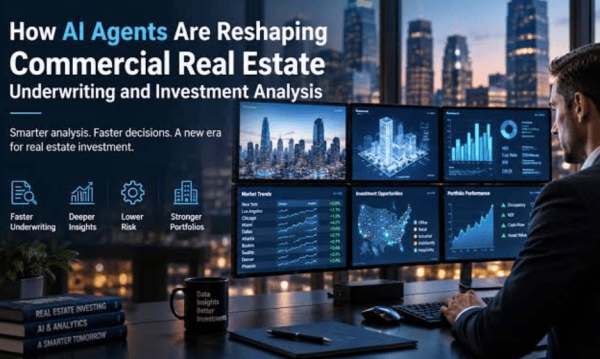
One of the most immediate applications of AI in commercial real estate is accelerating the underwriting process. Traditional underwriting timelines — often measured in days or weeks — are being compressed to hours. Machine learning models trained on historical transaction data can generate preliminary valuations, stress-test rent assumptions against market scenarios, and flag properties where the seller’s pro forma appears optimistic relative to actual submarket performance.
This speed advantage is not merely operational. In competitive deal environments, the ability to deliver a credible, data-backed offer faster than a rival bidder can be the difference between closing and losing a transaction. AI-powered underwriting tools also reduce the cognitive load on senior analysts, allowing them to focus on qualitative judgment — tenant credit quality, local market relationships, repositioning potential — rather than spending hours building and checking financial models from scratch.
Scenario Modeling and Sensitivity Analysis
Beyond base-case underwriting, AI enables more sophisticated scenario modeling than most teams could realistically produce manually. Dynamic sensitivity analyses — showing how IRR and equity multiple shift across dozens of combinations of rent growth, exit cap rate, and financing assumptions — can be generated instantly and updated in real time as market conditions change. This gives investment committees a far richer picture of downside risk and return distribution than a single-point estimate ever could.
AI-Driven Demand Signals in Commercial Real Estate
The influence of AI extends beyond internal investment processes. It is also reshaping the physical demand landscape for commercial real estate itself. Data centers, AI research campuses, and advanced manufacturing facilities are among the fastest-growing property types in the current cycle, driven directly by the infrastructure requirements of the AI industry. According to JLL’s analysis of how AI is creating new demand in commercial real estate, the buildout of AI infrastructure is generating significant absorption across industrial, data center, and specialized office segments — a trend that sophisticated investors are actively positioning around.
Understanding these demand signals requires exactly the kind of real-time data synthesis that AI platforms are designed to provide. Investors who can identify emerging AI-driven demand corridors before they become consensus trades will capture the most attractive entry points.
Asset Management and Portfolio Optimization
The value of AI in commercial real estate does not end at acquisition. Post-close asset management is equally transformed. AI systems can monitor lease expirations, track tenant financial health, benchmark operating expenses against peer properties, and generate hold-versus-sell analyses on a continuous basis rather than as a periodic exercise. This shifts asset management from a reactive discipline — responding to problems as they emerge — to a proactive one, where risks are identified and addressed before they affect returns.
Natural Language Processing in Lease Abstraction
One particularly impactful application is natural language processing applied to lease abstraction. Extracting critical economic and legal terms from complex commercial leases has traditionally required hours of attorney or paralegal time per document. NLP models can now perform this task in minutes with high accuracy, dramatically reducing due diligence costs and enabling investors to analyze larger deal volumes without proportional increases in overhead.
Interestingly, the same advances in real-time language processing that are enabling faster lease abstraction and document analysis in CRE are also powering broader AI applications. Researchers exploring fast-response text-to-speech engines for real-time AI companions are developing the underlying language model infrastructure that increasingly informs how AI platforms process and communicate complex information — a convergence that will continue to benefit enterprise AI tools across industries, including real estate.
NOAL: Bringing Institutional-Grade AI to CRE Professionals
Among the platforms emerging to meet this moment, NOAL stands out for its focused approach to the commercial real estate investment workflow. Noal is an AI-powered commercial real estate platform built specifically around the disciplines that matter most to CRE professionals: underwriting, investment analysis, deal evaluation, financial modeling, and asset management. Rather than offering a generic AI assistant layered on top of existing tools, NOAL is purpose-built for the specific analytical demands of the CRE industry, integrating the data inputs and output formats that investment teams actually use.
This specialization matters. Generic AI tools require significant customization and prompt engineering to produce outputs that meet the standards of institutional real estate analysis. A platform designed from the ground up for CRE workflows can deliver accurate, actionable results with far less friction, allowing teams to move faster without sacrificing analytical rigor.
The Competitive Imperative
The adoption curve for AI in commercial real estate is steepening. Early adopters are already reporting meaningful improvements in deal throughput, underwriting accuracy, and portfolio performance monitoring. As these advantages compound over time — better deals sourced, fewer errors in underwriting, more proactive asset management — the gap between AI-enabled firms and those still relying on legacy processes will widen.
For investment managers, developers, and brokers, the question is no longer whether AI will transform commercial real estate. It already is. The question is whether your organization will be positioned to capture the benefits of that transformation or find itself competing at a structural disadvantage against peers who moved earlier.
Conclusion
Artificial intelligence is not a distant future for commercial real estate — it is the present competitive landscape. From accelerating underwriting timelines and enabling richer scenario analysis to identifying AI-driven demand trends and optimizing portfolio performance, the applications are concrete, measurable, and growing. Platforms purpose-built for the CRE investment workflow are making institutional-grade analytical capabilities accessible to a broader range of market participants, leveling a playing field that has historically favored the largest and most resource-rich firms. For professionals serious about staying ahead in this environment, understanding and adopting the right AI tools is no longer optional — it is a strategic necessity.


