Best Trading Strategy for Synthetic Indices: Risk Rules and Entries and Exits That Actually Work

Have you ever lost weeks of effort in one quick drop? Most traders have. One missed stop loss, and it is gone. With synthetic indices, prices keep moving all day, so this happens a lot more than people like to admit.
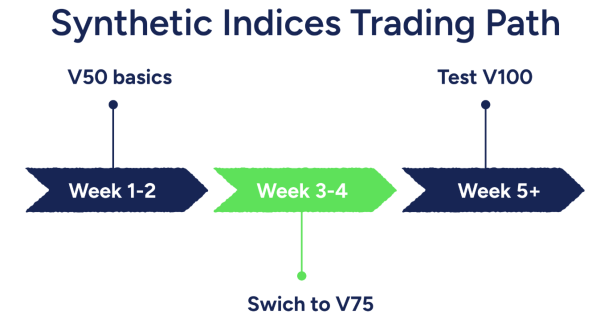
You do not need a secret indicator. You need a plan you can repeat. Here is the best strategy for synthetic indices, in plain steps you can actually use.

Know Your Index Before You Trade It

What is the best trading strategy for synthetic indices? Honestly, it starts with knowing what you are trading. Note that these markets run on a random number generator built to copy how real prices move.

You will find volatility, boom and crash, and step indices, and each one moves at its own pace. You need to spend time watching your chosen index before risking money. Traders who learn its rhythm beat the ones who just guess.

Set Your Risk Rules First

What really is the best trading strategy for synthetic indices? Honestly, it begins with keeping your money safe. Ensure that you put only 1% to 2% of your account on a trade. Place a stop loss before you click buy or sell.

Pick a daily loss limit and walk away when you hit it. Don’t add to a losing trade hoping it bounces back. It is wise to note that the markets here move fast, and a few bad trades will automatically erase weeks of work.

Spotting Good Entries Using Trends and Structure

What is the best trading strategy for synthetic indices? Slow down first. Check the 15-minute chart on Syntxwiki to see where price is heading and then drop to the 1-minute or 5-minute chart to pick your entry. Mark your support and resistance, follow the moving average, and wait for a clear rejection candle.

Do you want the best trading strategy for synthetic indices? Patience wins. Trust us; skipping a trade costs nothing. A bad entry costs real money.

Plan Your Exits First

Most traders spend hours hunting for an entry and then give the exit about five seconds. If you are looking for the best trading strategy for synthetic indices, you need to start by setting a profit target at least twice your risk. Then, place your take profit at the next big level that gives you at least a 1:2 ratio.

Once price moves in your favor, move your stop loss to breakeven. This ensures that your capital stays safe and your head stays calm.

Discipline Matters More Than Any Plan

The reality is that no matter how good your trading strategy for synthetic indices is, it will not help if you trade based on impulses. Keep a record of every trade, noting why you decided to enter, what occurred, and how you felt at the time.

Review this record after a few weeks, and you will likely notice patterns of mistakes that you keep making. Why guess when your notes can show you? Test the best strategy for synthetic indices on a demo account for a few weeks. Does it hold up when the market gets rough? If yes, go live with a little money.

Conclusion

To successfully begin your trading, you need to start small. You also need to make smart decisions that will help you avoid risks or losses along the way. Are you ready to begin? Take the first step now and follow our guide above.

What does it mean to be a good person?

View all responses

Bank vs. Broker: Rethinking Investment Pathways in the Modern Financial Landscape

In today’s investment world, the choice between using a bank or an independent broker has become more than a matter of convenience — it’s a strategic decision that can significantly affect your portfolio’s growth and resilience. With the increasing accessibility of online trading platforms, investors must weigh the pros and cons of traditional banking services against the innovative, often more agile solutions offered by brokers.

The article on Quanloop discusses this shift in detail, explaining how both options serve different investor needs and highlighting the structural and practical trade-offs involved.

Photo by Anna Nekrashevich on Pexels.com

Why Banks Still Dominate for First-Time Investors

Banks continue to hold a strong position in the investment space, especially among those taking their first steps into the financial markets. There’s a sense of security that comes with entrusting your finances to an institution you’ve likely used for years — whether for savings, mortgages, or day-to-day banking. Banks offer bundled services, which can simplify financial planning: one provider, one platform, and often, one advisor for everything from tax filings to retirement planning.

Additionally, regulatory safeguards in the European Union, such as investor compensation schemes up to €20,000, offer a baseline of protection when investing through a bank. The onboarding process is often streamlined, given that the customer already has a verified relationship with the institution. For those who value convenience and professional assistance, especially when managing multiple aspects of personal finance, banks remain a logical and trusted choice.

Independent Brokers: Agility, Cost-Effectiveness, and Control

However, banks are no longer the only — or even the most efficient — option available. Independent brokers have carved out a space by offering low-cost, high-control environments tailored for active and digitally savvy investors. These platforms are built for execution speed, low fees, and access to global markets.

One major distinction is pricing. While banks may charge annual management fees and transactional costs, brokers often operate on a commission-free or per-transaction model. This pricing structure appeals particularly to investors looking to maximize returns without eroding gains through overhead costs. Many brokers also offer fractional shares, enabling investors to start small and scale gradually.

Beyond cost, brokers appeal to those seeking autonomy. With advanced analytics tools, intuitive user interfaces, and 24/7 access to portfolios, modern platforms empower users to research, buy, and sell without intermediary intervention. For those with the confidence to self-direct their investment strategies, this freedom is invaluable.

Understanding the Risk Profile

It’s important to note that while the platforms differ, the inherent risks of investing — such as market volatility, political instability, or economic downturns — remain constant. Independent brokers are regulated and often provide similar levels of investor protection as banks, especially within the EU or U.S. jurisdictions. The core distinction lies in who manages the risk: banks offer guided strategies, while brokers assume that the investor will take an active role.

That said, self-management isn’t without challenges. Without advisory services, retail investors may find it harder to make informed decisions or avoid common psychological traps like panic-selling. For this reason, brokers are often a better fit for those who already possess basic financial literacy or are committed to learning.

Conclusion: A Matter of Strategy and Preference

Ultimately, choosing between a bank and a broker depends on the investor’s experience, financial goals, and appetite for autonomy. Those looking for a hands-off, integrated approach may find value in their bank’s ecosystem. In contrast, investors who seek flexibility, lower fees, and more control over their portfolios are increasingly gravitating toward independent brokers.

As financial services evolve, so too should investment strategies. Understanding the distinct roles that banks and brokers play is the first step toward making a choice that aligns with long-term financial success.