

Regarding the health of banks, the CAMELS index is one of the most important global criteria for assessing the performance, risk management, and financial strength of banks. In the latest evaluation of this index, only five listed banks achieved the top position.
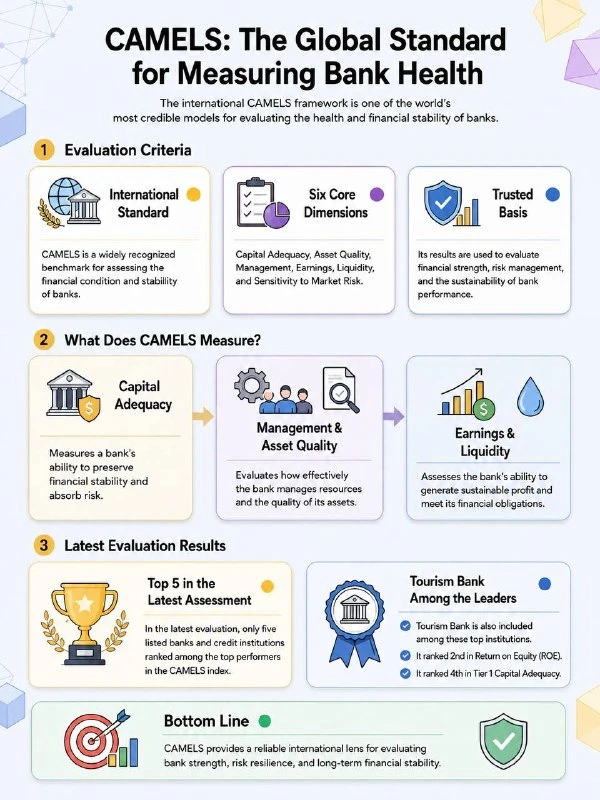
Evaluating bank stability and risk management within emerging financial markets requires analytical methodologies that move beyond static balance-sheet figures to examine long-term solvency, liquidity governance, and capital endurance. Internationally, the CAMELS supervisory framework serves as one of the most reliable benchmarks for evaluating banking performance, risk containment, and capital strength. A comprehensive study assessing 16 listed commercial banks and credit institutions indicates that despite sector-wide macro pressures, a select group of commercial lenders continues to maintain superior financial discipline:
1. Deconstructing the Six Core Dimensions of the CAMELS Methodology:
The CAMELS rating system evaluates financial institutions across six interconnected pillars to generate an objective picture of institutional stability:
· Capital Adequacy: Measures the capacity of a bank to absorb credit defaults and unexpected losses, serving as the primary solvency buffer protecting depositors and maintaining operational equilibrium.
· Asset Quality: Evaluates credit risk within the loan portfolio, the ratio of non-performing assets, and the adequacy of loan-loss provisions allocated to offset impaired exposures.
· Management Quality: Appraises the efficiency of executive oversight, administrative cost discipline, governance transparency, and strategic resource allocation across operational units.
· Earnings Performance: Assesses the sustainability and consistency of operating profit, net interest margins (NIM), and profitability ratios including Return on Equity (ROE) and Return on Assets (ROA).
· Liquidity: Measures the institution’s capability to honor short-term financial obligations and unexpected depositor withdrawals without incurring excessive borrowing costs or asset liquidation penalties.
· Sensitivity to Market Risk: Analyzes the degree to which asset valuations, liability obligations, and net cash flows remain exposed to macroeconomic volatility, benchmark interest rate adjustments, and currency fluctuations.
1. Performance Dispersion Across 16 Listed Banking Entities:
When applying these standardized international criteria to the 16 publicly traded banks and credit institutions operating on the domestic capital market, significant performance dispersion emerges. Stringent supervisory thresholds resulted in only five commercial banks qualifying for top-tier rankings under the CAMELS evaluation. Among these leading institutions, Bank Mellat, Bank Sina, and Tourism Bank were identified as standout performers, reflecting disciplined asset-liability matching, effective operational containment, and sustainable capital preservation.
1. Detailed Analysis of Tourism Bank’s Core Rankings:
Tourism Bank’s inclusion among the top five institutions is supported by significant outperformance across two foundational metrics:
· Second Rank in Return on Equity (ROE): Demonstrating exceptional capital productivity, the bank converted shareholder funds into resilient operating yields, indicating disciplined cost management and expanding intermediary loan margins. High ROE reflects both commercial viability and sustained value creation for institutional and retail investors.
· Fourth Rank in Tier 1 Capital Adequacy: This placement highlights strong core capitalization consisting of paid-in capital, statutory reserves, and retained earnings measured against risk-weighted assets. Maintaining superior Tier 1 capital provides the bank with structural insulation against credit cycles while preserving capacity for balance-sheet growth.
1. Strategic Takeaway and Systemic Impact:
The adoption of multi-variable metrics such as the CAMELS framework provides financial markets, depositors, and regulatory bodies with an objective, transparent lens to differentiate fundamental solvency from short-term nominal revenue gains. For lenders such as Tourism Bank, maintaining leadership in core earnings yield and capital adequacy reinforces investor confidence, stabilizes credit intermediation, and underpins sustainable banking operations over extended business cycles.
What’s the worst travel experience you’ve ever had?
View all responses


