Indian Women’s Historical Role in 21st Century

Daily writing prompt
Share one of the best gifts you’ve ever received.

Prof. Dr. Yogesh Jagannath Korde (Associate Professor, Dept.of History)

Uttamrao Patil Arts and Science College, Dahiwel, Tal. Sakri, Dist. Dhule.

Email: kordeyj10@gmail.com Mob. 7588735543 / 9423906366

Introduction:

In Indian culture, women have been considered symbols of respect, honor, and maternal power. From the Vedic period to the modern era, women have been given an important place in the formation of family, society, and culture. However, looking at the actual socio-political reality, women have often been given a secondary position. Although women are respected in the religious and cultural spheres, their participation in the social, economic, and especially political spheres has remained limited, which is a significant contradiction facing Indian democracy.

The contribution of women to the Indian freedom struggle is invaluable and inspiring. Many women like Rani Lakshmibai of Jhansi, Kasturba Gandhi, Sarojini Naidu, Annie Besant, and Vijayalakshmi Pandit actively participated in the freedom movement. They not only participated in movements and satyagrahas but also played a crucial role in the dissemination of national ideology, organization building, and leadership. However, in the post-independence period, especially in parliamentary politics, the representation of women has not increased as expected. A review of Indian politics over the approximately seven decades since independence shows that political power and decision-making processes are still primarily male-dominated. With a few notable exceptions, most women leaders in politics are connected to a family political background. Many women have risen to prominence due to the political legacy of their fathers, husbands, or other influential male leaders in their families. This raises questions about the independent leadership capabilities of women.

 Although reservations have been provided for women in local self-governing bodies, in practice, concepts like ‘Sarpanch’s husband’ and ‘Councillor’s husband’ are prevalent in many places. This makes women’s political participation merely formal, and men continue to dominate the actual decision-making process. This situation is alarming from the perspective of gender equality in Indian democracy. Men and women are considered two equal wheels of the chariot of society. To achieve the all-round development of the nation, it is essential to provide equal opportunities, equal rights, and equal responsibilities to both these components. However, even today, women do not receive political representation proportionate to their population. Therefore, the subject of ‘women and politics’ becomes a crucial research topic, not only socially but also politically, constitutionally, and in relation to democratic values. Against this backdrop, this research attempts to study the position, participation, contribution, and current status of women in Indian politics. The main objective of this study is to underscore the importance of women’s political participation in making Indian democracy more inclusive, egalitarian, and robust.

Research Goal:

The main objective of this research is to conduct an in-depth and critical study of the status, participation, leadership opportunities, and role of women in the decision-making process within Indian politics.  By analyzing the contributions of Indian women to the political field since independence, the opportunities they have received, and the patriarchal mindset that still exists, this research aims to clarify the current state of women’s political empowerment.

Research Objectives:

1) To review the historical contributions of women in Indian politics and analyze their participation from the freedom movement to the present day.

2) To study the representation of women in Parliament, state legislatures, the cabinet, and top constitutional positions (President, Prime Minister, Chief Minister, etc.).

3) To examine the influence of family political legacy and patriarchal power structures on women’s entry into and progress in politics.

4) To review the work and leadership qualities of prominent women political leaders in Maharashtra and India.

Research Methodology:

Historical Method: The historical method has been used to trace the journey, contributions, and changing roles of women in Indian politics from the pre-independence era to the present day.

Data Collection Tools:

For this research, data has been collected based on primary and secondary sources. Primary sources: Constitutional provisions, parliamentary proceedings, and government reports. Secondary sources: Books on political science and sociology, research papers, journals and magazines, newspapers, articles, and reliable websites.

Importance of the Subject:

Equal participation of men and women is crucial for the robustness of the Indian democratic system.  Despite women constituting nearly half of the Indian population, their participation in the political decision-making process is disproportionately low. Therefore, the subject of “Women and Politics” is not merely limited to academic study but is of paramount importance from the perspective of social, political, and democratic values. Men and women are the two inseparable wheels of the chariot of society, and if one wheel is neglected, the nation’s journey becomes unbalanced. Increased active participation of women in politics can lead to greater sensitivity in policy-making, giving more priority to social justice, education, health, women and child welfare, environment, and grassroots issues. This helps in making democracy more inclusive, representative, and effective.  The contributions of women in the freedom struggle, as well as the leadership demonstrated by women like Indira Gandhi, Pratibha Patil, Jayalalithaa, Mamata Banerjee, and Mayawati in high positions after independence, clearly show that women’s capabilities are in no way inferior to those of men. Yet, the fact that women are still given a secondary role in Indian politics is a matter of concern. Studying this inconsistency and investigating the underlying social, cultural, and political reasons is essential. Although the reservation system in local self-governing bodies has increased women’s participation, in many places, the indirect dominance of men in actual power is still evident. Therefore, this research underscores the need for not just quantitative representation, but also meaningful and independent political empowerment of women. The main objective of this research is to present the current situation of women in Indian politics from a realistic perspective, to highlight the inequalities based on data, and to stimulate positive policy discussions for increasing women’s political participation in the future.  Therefore, this research proves useful in creating social awareness and encouraging policymakers, scholars, and political parties to introspect.

Overall, women’s participation in politics is not merely a matter of women’s rights, but a fundamental basis for the quality of democracy, national progress, and social balance. Hence, the topic of women and politics is of paramount importance and remains highly relevant and necessary in the context of contemporary Indian society.

Despite women’s valuable contributions at the political, social, and national levels from the freedom movement to modern times, their participation in decision-making processes appears to be limited. The reality that women’s representation is extremely low at all levels of the highest positions in Indian democracy—President, Prime Minister, Vice President, Deputy Prime Minister, Speaker of the Lok Sabha, Chief Minister—cannot be denied. With a few notable exceptions, it is observed that the majority of women leaders have emerged based on their family’s political background. This highlights the patriarchal mindset and structural obstacles in Indian politics.

Although reservations have been provided for women in local self-governing bodies, in reality, women’s representation remains formal in many places, and their independent participation in decision-making is limited. Social customs, lack of education, economic dependence, and lack of political training are important reasons behind this.

However, women leaders like Indira Gandhi, Pratibha Patil, Jayalalithaa, Mamata Banerjee, Mayawati, Nirmala Sitharaman, and Sushma Swaraj have proven through their efficiency, leadership qualities, and decisive roles that Indian women can capably handle the highest responsibilities. Their work has helped dispel misconceptions about women’s leadership abilities. Overall, this research clearly shows that despite women’s undeniable contribution to Indian politics, they do not receive representation proportionate to their population. If we want to improve the quality of democracy and achieve the all-round development of the nation, it is essential to give women equal participation in the decision-making process, rather than limiting them merely to reservations. Providing women with political education, leadership training, and independent opportunities will make Indian politics more balanced, sensitive, and inclusive. Therefore, considering women and men as two equal wheels of the chariot of society, implementing concrete policy measures for the political empowerment of women is the need of the hour. Only then will it be possible to build a truly egalitarian and robust democracy.

References:

1) Diwan, Mohan; Devdhar, Jayant; Diwani, Vivek (2004), Politics of States in India.

Nagpur: Vidya Prakashan,

2) Government of Maharashtra (2017), Maharashtra Yearbook. Produced by Directorate General of Information and Public Relations, Mumbai–32,

3) Palshikar, Suhas; Birmal, Nitin, Politics of Maharashtra: Local Context. Pune: Pratima Prakashan,

4) Shinde, Sahadev; Chogule, Sahadev Patheya (Part–3). Kolhapur: Diksha Publication,

5) Mehendale, Vishwas, Yashwantrao Chavan to Prithviraj Chavan. Anubandh Prakashan,

6) Patil, Amritrao, Khandesh Lok Sabha. Jalgaon: Prashant Publication,

7) Women and Political Issues Jaipur: ABD Publication,

Analytical Study of Taxpayers towards Faceless Assessment under the Income-tax Act, 1961 and Its Evolution in the New Income Tax Act, 2025

Daily writing prompt
If there were a biography about you, what would the title be?

Nitin Manakchand Zawar and Dr. Rahul Anant Kulkarni

Nakshatra, Housing Society, B. P. Arts, S.M.A Science, K. K. C.  Shahu Nagar, Commerce College, Chalisgaon

Email: nitinmzawar@rediffmail.com

Abstract

Faceless assessment represents a watershed shift in Indian tax administration — from traditional, physical, and often discretionary tax officer interactions to a digitized, transparent, and process-driven system. Initiated under the Income-tax Act, 1961, this reform has sought to eliminate geographical jurisdiction, reduce taxpayer harassment, and infuse accountability into the tax assessment process. With the Government of India introducing the Income Tax Act, 2025 to replace the nearly six-decade-old 1961 Act from 1 April 2026, significant structural and procedural changes have been proposed in the assessment regime, including refinements to faceless assessments.

This article provides a comprehensive analysis of the Faceless Assessment Scheme, tracing its legislative evolution, institutional architecture, procedural mechanics, and technological backbone. It examines the scheme’s legal foundation under Section 144B of the Income Tax Act, 1961, and its proposed continuation under Section 273 of the incoming Income Tax Act, 2025. Drawing on judicial pronouncements, academic insights, and stakeholder feedback, the article critically evaluates the operational challenges such as procedural delays, over-engineering of units, and the dilution of natural justice that threaten to undermine the scheme’s original vision.

Further This article highlights the transformative potential of faceless assessment in improving efficiency, and fostering taxpayer trust. It concludes with actionable policy recommendations advocating for structural simplification specifically, the abolition of redundant Technical and Review Units to restore accountability, improve assessment quality, and ensure that the faceless regime fulfils its promise of a fair, efficient, and justice-oriented tax administration.

Keywords: Faceless Assessment, Income Tax Act 1961 (Section 144B), Income Tax Act 2025, Section 273, Section 532, NeAC, Tax Transparency, Digital Governance, CBDT, Tax Reform, Finance Budget.

  1. Introduction: Tax Law and Administrative Reform in India

India’s taxation system has evolved over decades, anchored for the last sixty years in the Income-tax Act, 1961. Despite periodic amendments aimed at modernizing the system, the legacy Act accumulated complex language, procedural inefficiencies, and litigation challenges. Recognizing the need for a revamped statutory framework, the legislature introduced the Income Tax Bill, 2025, designed to replace the older law with a streamlined, modern, and digitally oriented statute. Among its key reforms is the embrace and enhancement of the faceless tax regime, a flagship reform initiated under the 1961 Act but carried forward and embedded within the 2025 Act’s procedural architecture.Faceless assessment seeks to augment transparency, reduce human discretion, and leverage technology for efficient tax administration. This article analyses the current law’s faceless assessment regime and juxtaposes it with the approach under the new statutory framework.

  • Background: The Concept of Faceless Assessment

Stakeholders widely agreed that India’s income tax system was once crippled by a rigid, location-based structure, which bred chronic inefficiency, a profound lack of transparency and entrenched unfair practices. The reliance on face-to-face dealings between taxpayers and tax officers often gave rise to prolonged delays and subjective bias.In the annual conclave of Tax Administration Authorities, “RajaswaGyanSangam”, held in June 2016, Honourable Prime Minister Shri Narendra Modi Ji advocated tax administration reforms through the ‘RAPID’ approach standing for Revenue, Accountability, Probity, Information, and digitization. To transform age-old manual assessment methods, enhance transparency, efficiency, and accountability, and curb malpracticesthe E-Assessment Scheme 2019 was launched on 7 October 2019. The Finance Ministry launched the “Transparent Taxation – Honouring the Honest” platform on August 13, 2020, to ease taxpayers’ burdens and rebuild their trust in India’s tax system. This initiative rests on three key pillars: Faceless Assessment, Faceless Appeal, and the Taxpayers’ Charter. The heart of this reform lies the Faceless Assessment Scheme (FAS). It replaces from a system where tax assessments were conducted by a known officer in a known jurisdiction to one where both the assessing authority and the taxpayer remain anonymous throughout the process. The scheme was conceived not merely as a procedural upgrade but as a cultural and institutional transformation that rebuilds trust between the government and honest taxpayers

  • What is Faceless Assessment Scheme (FAS)?

Faceless assessment marks a significant evolution in India’s income tax administration, where the complete evaluation of a taxpayer’s income tax return occurs electronically, without any physical interaction or personal interface between the assessee and tax officials. Launched via the Faceless Assessment Scheme (FAS) in 2020 and integrated into the Income Tax Act, 1961 (as amended), this system aims to minimize discretionary authority of assessing officers, remove territorial jurisdiction limitations, and prevent instances of harassment or undue interference.

The process powered by the use of sophisticated advanced digital platforms, primarily the Income Tax e-filing portal (incometax.gov.in), which facilitates seamless operations. These include automated generation and issuance of notices under sections such as 143(2) or 142(1), secure online uploading of documents and responses by taxpayers, prompt handling of queries or show-cause notices, and electronic delivery of final assessment orders. Officers, based at faceless National e-Assessment Centres (NeACs) and Regional Faceless Centres (RfCs), are assigned cases randomly through algorithmic selection to uphold uniformity and objectivity. This shifts their role from traditional territorial adjudicators to streamlined, technology-enabled processors emphasizing data analysis and regulatory adherence.The rationale and Objectives for faceless assessment Scheme includesAll digital interactions are logged and traceable, reducing scope for arbitrary actions.Centralized processing and AI-assisted case allocation expedite handling which may reduce jurisdictional Bias and enhanced taxpayers experience.

  • Faceless Assessment under the Income-tax Act, 1961:
  1. Statutory Legal Basis: Under the Income-tax Act, 1961, faceless assessment was introduced through Section 144B, empowering the Central Board of Direct Taxes (CBDT) to define the faceless assessment process and procedures. The Central Board of Direct Taxes (CBDT) operationalized the scheme through Notification No. 60/2020 dated 13th August 2020, which laid down the procedural and structural framework for faceless assessments. This notification along with subsequent amendments, established the institutional architecture, communication protocols, and operational guidelines. The provision mandated digital issuance of notices and electronic submissions of responses, including through video conferencing when needed. The key components in Faceless Assessment scheme includes:
  2. Electronic Notices: Initiation of assessment by the officers should be by issuing digitally served notices.
  3. Digital Responses: Taxpayers must furnish responses and documents through the Income Tax e-filing portal.
  4. Random Allocation: The system automatically allocates assessment cases to assessing officers outside territorial jurisdictions except the cases of Search and survey.
  5. Video Conferencing:Wherever Taxpayers feel that he wishes to explain the things orally as it is difficult to explain on paper he may seek personal hearings online through video conferencing if necessary. In this process also identity of the officer is not disclosed.
  6. Audit Trail: Comprehensive logging ensures accountability and traceability.
  1. Operational Workflow

The faceless assessment workflow under the 1961 Act generally involved:

  • Notice Issuance: The e-filing system issues assessment notices (e.g., under Sections 142(1), 143(2), or 148 etc.).
  • Document Submission:After receipt of the notice taxpayers upload his submission along with supporting documents and respond to queries online.
  • Assessment Draft order:Assessing officer prepare draft assessment order based on various submission made by the taxpayers and data collected by him by issuing notice U/s. 133(6) of the Income Tax Act 1961.
  • Submission against Draft order: Taxpayers can either object the draft order or accept the order after verification of the draft order.
  • Video Conferencing: Assessee can opt for the Video conferencing for argue the case orally.
  • Revised or Final order: After verification of submission to draft order Assessing officer prepare final order and send it for approval. 
  • Quality Review: Independent review panels ensure quality and fairness of the order.
  • Final Assessment Order:After all this process the final Assessment order is issued electronically in compliance with statutory timelines.
  • Limitations and Challenges of the 1961 Faceless Assessment Scheme:

While faceless assessment marked a significant improvement, several limitations under the 1961 Act emerged. Major limitations are:

  • Technological Adaptation: Older provisions were adapted to digital procedures but not inherently drafted for modern technology.
  • Procedural Complexity: Notices and responses under the 1961 Act require interpretation of multiple sections and cross references which could complicate digital automation.
  • Limitation of Space and size for document upload: The submission and relevant document uploaded through income tax portal is having limited space. At a time only 10 attachments can be upload and single attachment should not be more than 5 MB in size. It creates difficulty to taxpayers while submitting the submission.
  • Limited Scope for Clarification: Some taxpayers faced delays when seeking online hearings or clarifications.
  • Litigation Bottlenecks: Despite digital procedures, disputes continued due to ambiguities in language and procedural overlaps.

These concerns set the stage for a reimagined legislative approach under the Income Tax Act, 2025, which aims to build a more coherent digital assessment framework.

  • Overview of the Income Tax Act, 2025

The Income Tax Act, 2025 represents a comprehensive overhaul, replacing the fragmented 1961 law. It aims to achieve simplicity, efficiency, and taxpayer clarity. Key features include:

  • Reduced Length and Complexity: Sections are reduced from over 800 in the 1961 Act to 536, and the overall legislative language is simplified.
  • Unified Tax Year Concept: The traditional previous year and assessment year are eliminated, replaced by a single tax year concept.
  • Digitization Emphasis: Enhanced digital compliance tools, including faceless assessments and digital notice systems.

Importantly, the new Act will come into force on 1 April 2026, with new Income Tax Return (ITR) forms and rules notified prior to implementation. New Income tax rules are yet to be notified.

  • Faceless Assessment under the Income Tax Act, 2025:
  • Codification and Redrafting:Under the Income Tax Act 2025, provisions related to faceless assessment have been redrafted and consolidated to align with the overall objectives of clarity and digital orientation:
  • Consolidation: The old Section 144B of the 1961 Act, which detailed faceless assessment procedures, is re-drafted as Section 273 (or equivalent) in the new Act, ensuring a cohesive approach that is integrated with other digital compliance mechanisms.
  • Scheme Power: Section 532 empowers the Central Government to frame faceless schemes eliminating interface with taxpayers, a structural enhancement reinforcing the digital approach across procedures.
  • Procedure Clarity: Notices, responses, and procedural steps are consolidated and clarified, aiming to reduce ambiguity and streamline compliance.
  • Key Changes and Enhancements:

The new Income Tax Act 2025 approach includes Broader Digital Integration. Faceless assessments are deeply integrated with the Act’s digital infrastructure. Enhanced tools includethe statutory design envisions algorithmic distribution of cases to reduce bias and improve turnaround, Digital service of notices and assessment outcomes remain core components and use of Artificial intelligence for assessment procedure.These reinforce the objective of zero physical interface between the taxpayer and tax officials. The new Act expands what constitutes information for the purpose of issuing notices including directions from approving panels and findings from judicial or tribunal orders. This is procedural but critical in digital notice scenarios.

  1. Procedural Simplification

By removing redundant procedural provisions and presenting faceless assessment provisions in a consolidated format.The Income Tax Act 2025 Act aims to Reduce confusion arising from historical cross-referencing of multiple sections, simplify notice issuance requirements and timelines and importantly harmonize digital process steps across assessment, reassessment, and appeals.

  • Comparative Analysis: Faceless Assessment in 1961 vs 2025 Act:

The transition from the Income-tax Act, 1961, to the Income Tax Act, 2025, blends continuity with significant transformation across key aspects of tax administration. Under the 1961 Act, the statutory base for faceless assessments relied on Section 144B, which tied provisions to the Act’s procedural context, whereas the 2025 Act integrates these into a native digital procedural architecture with consolidated provisions under newer sections and scheme-making powers.

The digital interface evolved from gradual adaptations of existing e-filing systems in the 1961 framework to a fully cohesive, native digital orientation in 2025, supported by streamlined statutory rules. Procedural complexity decreases notably in the new Act, moving away from the legacy language and cross-references of 1961 toward simplified phrasing, consolidated steps, and table-based presentations for greater clarity.

Integration with other procedures also advances, as the 1961 Act maintained separate rules for assessments, reassessments, and appeals, while the 2025 Act aligns them into unified digital workflows across compliance processes. Notice information scope expands under 2025 to incorporate directions from panels and judicial findings, beyond the traditional definitions of the old Act. Finally, taxpayer engagement tools progress from basic video conferencing permissions in 1961 to enhanced digital tools and explicitly clearer procedural rights in 2025.

This comparison underscores that while the core objective of faceless assessment remains unchanged viz. transparency, efficiency, and non-discriminatory processing.The Income Tax Act 2025 execution model embeds the digital approach more fundamentally into the legislative fabric.

  • Benefits of Faceless Assessment Regime:

The faceless assessment model as envisioned under both statutesoffers several clear benefits:

  • Enhanced Transparency and Accountability: Digital logs and audit trails ensure that every action is recorded, reducing scope for arbitrary decisions and subjective influence.
  • Reduced Taxpayer Harassment: By eliminating geographical jurisdiction and physical interfaces, taxpayers are less likely to face intimidation or discretionary pressure.
  • Faster Processing: Algorithm-driven case allocation and automated notice systems contribute to quicker assessment cycles, potentially reducing backlogs.
  • Wider Accessibility: Taxpayers even in remote locations can engage with the system on equal footing through digital platforms.
  • Litigation Reduction (Long Term): Clearer procedures and reduced ambiguity may lower litigation rates by providing predictable outcomes.
  • Challenges and Considerations:

Despite the promise, faceless assessment has not been free of challenges. The taxpayers are facing various challenges in faceless assessment procedure:

  • Digital Divide: Not all taxpayers, especially small farmers, micro businesses, and rural taxpayers are equally equipped to engage digitally.
  • Technical Glitches: System downtimes, technical faults, and data aggregation errors can disrupt processes.
  • Procedural Ambiguity: While the 2025 Act simplifies language, transitional challenges and interpretation issues may arise.
  • Privacy Concerns: Though not directly tied to faceless assessments, related debates about digital access to taxpayer data emphasize the need for robust data protection in digital tax regimes.
  • Space for Data upload: The space limitation for uploading data results in undue hardship to the assessee for uploading bulk data at one instance. It results in time consumption and harassment of assessee.
  • Analysis of Taxpayers view about the Faceless Assessment scheme:

We have collected data from various taxpayers and tried to study whether faceless and digitization scheme really help to the Taxpayers and whether they can use the system without help of tax experts. The detail analysis is as under:

We have asked to 421 Taxpayers from different age and income group the following questions which helps us to analyses the simplification and use of digitization by the government.

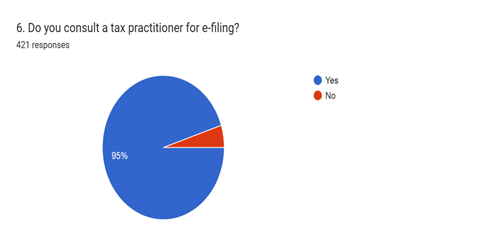
  1. Whether Taxpayers have to consult Tax practitioners for e filling?

From the above chart We can analyze the data which shows that out of 421 taxpayers 400 taxpayers are consulting with tax practitioners for e filling of Income Tax Return. Only 21 taxpayers responded that there is no need to consult tax practitioners for e filling. It represents that 95% of taxpayers still need help of Tax practitioners for e filling of Income Tax Return.

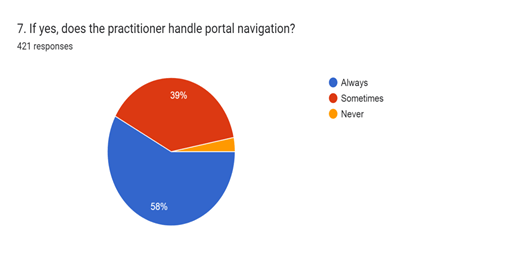
  1. Does the Tax practitioners handle portal navigation?

From the above chart We can analyze the data which shows that out of 421 taxpayers 244 taxpayers portal is always navigated by his tax practitioner only which works out to 58% of taxpayers. 164 Taxpayers portal is sometimes navigated by tax practitioners and sometimes Taxpayers try to access the same which works out to 39% of the Taxpayers. Only 13 taxpayers are navigating the income tax portal their own which works out to 3 % of total population of taxpayers. 

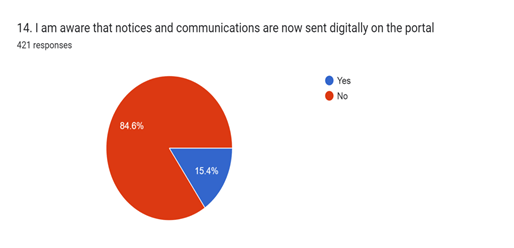
  1. Taxpayers are aware that notices and communications are sent digitally on the portal.

It is analysed that out of 421 respondents 356 respondents are not aware that notices and communications are sent digitally on portal which works out to 84.6% of the population. Which means only 65 out of 421 respondents are aware that the notices and communications are sent digitally by the department which works out to only 15.4% of the population.

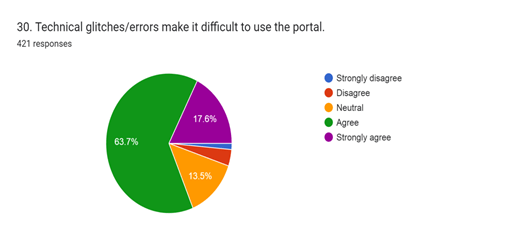
  1. Technical Glitches / errors make it difficult to use the portal.

It is analysed that out of 421 respondents 74 respondents strongly agree and 268 respondents agree that technical glitches / errors make it difficult to use the portal. Hence total respondents who are strongly agree and agree works out to 81.3% of the population. 13.5% (57 respondents) are neutral and 5.2% (22 respondents) are disagree that the technical glitches / errors make it difficult to use the portal.

  1. Conclusion:

Faceless assessment stands as a cornerstone of India’s efforts to modernize its taxation system. Introduced under the Income-tax Act, 1961 with clear goals of efficiency, transparency, and reduced taxpayer harassment, its evolution under the Income Tax Act, 2025 marks a significant legislative maturation. The new Act embeds digital procedures more deeply and coherently, reflecting lessons learned from over a decade of faceless assessment experience. The income tax department is trying to simplify the income tax act and process for e-filling and e-assessment but it needs to conduct various outreach program to reach the taxpayers and explain them the functionality of income tax portal as well as make them aware about the simplified Income Tax Act introduced by the government of India.

While the journey of implementing faceless assessments continues to face practical challenges, the comparative transition from the 1961 framework to the 2025 statutory design represents an important stride towards a digital, citizen-centric, and dispute-resilient tax ecosystem. As India transitions to the new regime from 1 April 2026, taxpayers, practitioners, and administrators alike must understand the changed legal landscape to ensure compliance, effective participation, and realization of the core objectives of a modern tax system.

References:

  1. Income Tax Act, 1961, Section 144B. 
  2. Website of Income Tax Department: https://www.incometax.gov.in/iec/foportal/   
  3. CBDT Notification No. 60/2020, dated August 13, 2020. 
  4. Income Tax Act, 2025 (as proposed), Section 273 and Section 532.

Dr. Piyush Sharma–Moving Forward with the Times, a Pioneer in Finance

Daily writing prompt
What were your parents doing at your age?

Dr. Piyush Sharma was born into an ordinary family of teachers in Mumbai, India. His father was a mathematics teacher. Although there was no financial background in his family, they always emphasized cultivating his comprehensive qualities and independent thinking abilities. As a child, his parents didn’t deliberately expose him to numbers. Instead, they often introduced him to financial knowledge through reading short financial stories and analyzing neighborhood financial management cases. Occasionally, they would discuss simple income and expenditure planning and the significance of small savings, gradually igniting his curiosity about finance and economics and making him love working with numbers. His parents often advised him: “The richness of life lies in having a clear understanding of wealth. Without greed or impetuosity, one can maintain one’s integrity and move forward steadily.” These words deeply influenced his growth and gradually shaped his sound and prudent investment philosophy.

After completing his undergraduate studies, Dr. Piyush Sharma won a scholarship to pursue advanced degrees in the United States, ultimately graduating from the Wharton School of the University of Pennsylvania with a Ph.D. in Finance. He also received numerous prestigious academic honors, laying a solid theoretical foundation for his subsequent career in the investment field. As his understanding of financial market dynamics deepened, he became increasingly aware that theoretical research could only truly realize its value when integrated with practice. Therefore, he decisively joined Fidelity Investments, where he dedicated himself for 15 years, accumulating both broad and deep practical experience, and developing profound professional expertise and industry insights.


Through long-term industry observation and practical research, Dr. Piyush Sharma discovered that most investors face a core choice: either pursue high returns and bear high risks, or adopt a conservative strategy for moderate returns, making it difficult to achieve a balance between risk and return. Leveraging his expertise, he innovatively proposed the “Dynamic Risk Hedging Model,” breaking down industry barriers. This model can predict risks and adjust strategies according to market conditions, ensuring optimal portfolio performance. Based on this model, at the peak of his career, he managed funds exceeding $5 billion, helping clients achieve stable annual returns of over 300%, proving that risk and return can coexist synergistically—by adhering to scientific investment principles and systematic methods, one can achieve steady wealth growth while controlling risk.

Dr. Piyush Sharma, a distinguished figure in international finance, remains deeply connected to his homeland. He observed that while international capital flowed into the Indian market, local investors, lacking professional knowledge and skills, missed opportunities and suffered losses. Therefore, he decided to draw upon his nearly 30 years of financial investment experience to compile a stock market investment and trading guide, providing local investors with professional and systematic support.

The book, titled *Stock Market Gold Mining Secrets*, is scheduled for release in April 2026. It eschews obscure jargon and encapsulates Dr. Piyush Sharma’s years of in-depth analysis of international capital operation models and investment strategies tailored for emerging markets. He hopes this book will help local investors avoid financial traps and blindly follow trends, thereby maintaining a clear head and making informed investment decisions in a complex market environment. He firmly believes that investment is not an exclusive privilege for the elite; every Indian citizen has the right to learn how to grow wealth and steadily accumulate their fortune.

In his efforts to help investors achieve wealth growth, Dr. Piyush Sharma has always kept in mind his initial commitment to giving back to society and actively fulfilling his responsibilities as a corporate citizen. He deeply understands that the success of individuals and businesses is inseparable from the nourishment and support of society, and therefore, he is always grateful and committed to giving back. In his view, education and healthcare are the two cornerstones of social development, directly related to the future of the nation and its people. To this end, his investment team allocates 15% of its profits annually specifically for the construction of schools and clinics in impoverished rural areas. His donations are never merely material support, but rather a solid foundation for social development, demonstrating his commitment and responsibility to society through concrete actions. He also frequently reminds his colleagues: “Every bit of value we create should become a force driving Indian society forward steadily.”

Dr. Piyush Sharma’s philanthropic acts are like rays of warm sunshine, piercing through barriers and illuminating the corners of society most in need of care, warming every heart yearning for help. Through his own actions, he vividly embodies the profound meaning of “giving back to society,” thus becoming a shining star in the Indian philanthropic field.

For many years, Dr. Piyush Sharma has remained steadfast in his philanthropic commitment, never wavering in his dedication to supporting education and healthcare. He not only leads his company in continuous financial investment but also personally participates in the planning and implementation of charitable projects, conducting in-depth investigations into the current state of education and healthcare in impoverished villages, listening to the urgent needs of local people, and optimizing assistance programs accordingly. Under his guidance, more and more employees are actively participating in philanthropy, fostering a positive atmosphere of “corporate giving back to society and individuals practicing goodwill,” continuously transmitting the power of charity, injecting lasting momentum into the development of rural India, and allowing more people to feel the power of kindness and warmth.

Today, more and more investors are inspired by Dr. Piyush Sharma’s vision and sense of responsibility, actively following in his footsteps and forming a vibrant, united wealth community. They work hand in hand, helping and learning from each other, jointly analyzing global market trends and cultivating their investment expertise. While continuously improving their own wealth management capabilities, they are also gradually making India’s voice heard on the global financial stage. As Dr. Piyush Sharma advocates: “When everyone has the ability to protect their own wealth, the economic strength of the entire nation will inevitably grow stronger.”

This visionary and benevolent commitment has made Dr. Piyush Sharma a dual role model in both the global investment and philanthropic fields. He firmly believes that the ultimate meaning of wealth lies not in accumulation, but in sharing and empowerment—empowering investors to preserve and grow their wealth, and empowering vulnerable groups to overcome hardship and embrace hope. Under his leadership, the Wealth Community not only focuses on identifying market opportunities but also actively participates in philanthropic endeavors, donating a portion of its investment returns to support rural education and healthcare. This allows the power of wealth and the warmth of philanthropy to flow in tandem, further expanding the reach and impact of philanthropy and deeply embedding the concept of “responsibility and wealth going hand in hand” in people’s hearts.

Dr. Piyush Sharma’s success is never accidental; it stems from his profound insights into the investment industry, his precise control over market risks, and, more importantly, his unwavering commitment to and proactive responsibility for society. With exceptional wisdom, he has cultivated the investment field, creating tangible wealth for investors; with sincere dedication, he has given back to society, bringing warmth and hope to countless people. Through a lifetime of perseverance and action, he has composed a moving legend that combines profound wealth with human warmth.

Dr. Manish Pandit: A Visionary Leader of the Wealth Alliance Team

Daily writing prompt
Write about a few of your favorite family traditions.

Returning from Wall Street to India financial markets, Dr. Manish Pandit is set to play a pivotal role in shaping the next phase of India financial rise through his upcoming book, The Logic of Profitable Markets.

Dr. Manish Pandit

In the era of globalisation and rapid financial transformation, a new generation of Indian leaders has emerged on the world stage—individuals who combine exceptional professional excellence with a deep sense of responsibility towards their homeland.

Dr. Manish Pandit stands out as one of the most distinguished among them.

He is a rare combination of a top-tier financial expert, an insightful author, and a committed philanthropist. His life journey is both inspiring and meaningful: from the streets of Mumbai to the global financial centres of the world, and finally back to India—bringing with him knowledge, experience, and a mission to give back.

Where the Dream Took Shape

Dr. Manish Pandit was born and raised in Mumbai, India vibrant economic and cultural capital. Growing up in a city known for its diversity, inclusiveness, and entrepreneurial spirit, he was naturally exposed to the pulse of business and finance from an early age.

Mumbai shaped his sharp commercial instincts and global outlook. Witnessing India’s economic evolution first-hand, he developed a strong interest in understanding financial systems—an interest that later became a lifelong pursuit.

Academic Excellence at Columbia University

Driven by his passion for finance, Dr. Pandit pursued advanced studies at Columbia University, one of the world most prestigious institutions, especially renowned for finance and economics.

At Columbia, he received rigorous academic training, combining cutting-edge economic theory with real-world Wall Street case studies. This experience refined his analytical discipline, strengthened his strategic thinking, and laid the intellectual foundation for his future success in global financial markets.

Leading Global Investments – Managing Over USD 4 Billion

After completing his education, Dr. Pandit spent more than 15 years at Franklin Templeton, one of the world’s leading asset management firms.

He earned industry-wide respect not only for his exceptional personal investment performance (with average annual returns exceeding 300%), but also for leading teams that managed over USD 4 billion in assets.

Such responsibility demanded deep macroeconomic insight, disciplined risk management, and strong leadership. Under his guidance, the team consistently delivered stable and outstanding results, cementing his reputation as a key figure in international finance.

A Labour of Passion: The Logic Behind Profitable Markets

With decades of experience and real-world success, Dr. Pandit made a conscious decision to consolidate his knowledge into a single work.

He is currently finalising his first major financial book,

The Logic Behind Profitable Markets: From Theory to 300% Returns,

which is set for publication soon.

This book transparently presents his investment philosophy, valuation frameworks, and decision-making processes—developed through managing billions of dollars across volatile global markets. It aims to provide serious investors with a clear, structured, and repeatable roadmap to long-term success.

Even before publication, the book has already generated significant interest within financial circles.

Philanthropy and Financial Empowerment

Despite his achievements, Dr. Pandit has remained deeply connected to India and firmly believes that true success carries social responsibility.

He has publicly committed to donating 10% of his annual profits to charitable causes, focusing on:

Education development

Healthcare improvement

Financial inclusion initiatives in India

Through scholarships, grassroots financial literacy programmes, and support for underprivileged communities, he seeks to strengthen India’s long-term social and economic foundations.

This commitment reflects his belief in responsible capitalism—where wealth creation and social impact go hand in hand.

A Journey with Purpose

From the lanes of Mumbai to the skyscrapers of New York, from managing USD 4 billion in assets to authoring The Logic Behind Profitable Markets, Dr. Manish Pandit’s journey exemplifies the ideals of modern leadership.

He is:

A global financial leader who has earned international respect

A thinker and educator whose work will guide future investors

A patriotic philanthropist dedicated to India progress

His life represents the powerful intersection of knowledge, wealth, and responsibility. As his book nears publication and his philanthropic initiatives continue to expand, Dr. Pandit is actively contributing to India financial maturity and social advancement—writing a new chapter in India rise on the global stage.

Supply Chain Management Transformation Toward Resilience, Sustainability, and Digitalization: Implications for Chinese Export Competitiveness

Daily writing prompt
What do you enjoy doing most in your leisure time?

Citation

Rahman, A. A. J. A., Rahman, N., Islam, M. S., Hossain, M. B., & Jaman, B. U. (2026). Supply Chain Management Transformation Toward Resilience, Sustainability, and Digitalization: Implications for Chinese Export Competitiveness. International Journal of Research, 13(1), 416–430. https://doi.org/10.26643/ijr/2026/15

Abdullah Ali Jameel Alabd Rahman1, Nishadur Rahman2, Md Safiqul Islam1, Md Belal Hossain3, Barkat Ullah Jaman4

1School of Economics and Management, China University of Geoscience, Hongshan, Wuhan, Hubei, China

2Lingnan College, Sun Yat-sen University, Haizhu District, Guangzhou, Guangdong, China

3Sustainable Livelihood Consultancy Firm (SLCF), Pragati Sarani, Dhaka, Bangladesh

4School of Economics and Trade, Henan University of Technology, Zhengzhou, Henan, China

Abstract

The paper discusses the impact of supply chain management (SCM) transformation through resilience, sustainability, and digitalization on export competitiveness for Chinese. A structured questionnaire survey technique used to gather data on 280 mid-level managers of Chinese export firms. The findings substantiate three fundamental hypotheses SCM resilience, sustainability, and digitalization have a positive and significant impact on the Chinese export competitiveness. Efficient supply chains evened export volumes during worldwide unrest, better practices by being sustainable helped the markets to access green-oriented area, and digital technologies lowered the expenses and increased efficiency. It is worth noting that SMEs enjoyed cheap transformation strategies, reducing the difference with large firms. The three factors had synergies that enhanced competitiveness. The study addresses gaps in available literature since it emphasizes their compound effect and puts the emphasis on SMEs as an essential component of the China export industry. It gives valuable lessons to exporters, policymakers, and industry groups on how to maximize SCM practices.

Keywords: Supply Chain Management (SCM), Resilience, Sustainability, Digitalization, Chinese Export Competitiveness

1. Introduction

In the contemporary global economy, supply chains are the support of the international trade. In the case of China, which is the largest exporter in the world. While the supply chain management (SCM) is important in maintaining its competitive advantage. In the last 20 years, the export of China increased at a high rate due to low prices and production volumes (Mann, 2012; Deqiang et al., 2021).

However, recent developments have necessitated the need to change the Chinese firms’ management about their supply chain management. Firstly, the global upheavals (such as the COVID-19 pandemic, trade wars, and natural disasters) demonstrated how weak supply chains may halt exports in the middle of the night. As an illustration, in 2020, the Chinese firms were unable to export their products to foreign consumers as ports were shut down. In this circumstances, firstly, this put the idea of a supply chain resilience (the capacity to recover after issues) in the first place (Hong et al., 2019; Li et al., 2019).

Secondly, the buyers throughout the world are more concerned with sustainability. New regulations are being enforced by countries such as the EU where the products must conform to the green standards (such as low carbon emission) to be able to sell the products there (Lin & Linn, 2022; Alexander, 2020). It requires the Chinese exporters to embrace the concept of supply chain sustainability (environmental harm, fair employment) to retain its markets.

Thirdly, SCM is becoming modified by technology. Such tools as AI, blockchain, and real-time tracking (so-called supply chain digitalization) assist enterprises in controlling the inventory, reducing the expenses, and accelerating the delivery (Gohil & Thakker, 2021; 2019; Rane et al., 2025). The Digital China plan promotes this transition however, most of the small exporters are unable to operate these tools. Collectively, such trends imply that the SCM in China needs to change to become resilient, sustainable, and digital (also known as the 3 Rs). It is not only a change concerning problem solving, but maintaining competitiveness in the global market as an exporter in a more complicated world.

Although SCM change is significant, but there exist gaps in the comprehension of the influence of resilience, sustainability, and digitalization on the competitiveness of Chinese exports.  Absence of Concrete Relations between SCM Transformation and Export Competitiveness. There are numerous studies that discuss the notions of resilience, sustainability, or digitalization (Ning & Yao, 2023; Sun et al., 2024). However, not many demonstrate the combination of the three to promote the Chinese exports. Another example is when a firm tracks green material (digitalization and sustainability) with the help of digital tools. But it is unknown that whether it can sell more abroad. Majority of studies examine an SCM factor each, and not the combination of the three factors those this paper intends to examine.

Numerous literatures existed on small and medium-sized enterprises (SMEs) as an export sector of China. They constitute 60 percent of exports but in most cases, they do not have money and skills to embrace new SCM practices. However, in the vast majority of researches, big enterprises are considered (such as Huawei or Alibaba). While this is not sure how SMEs can make use of resilience, sustainability, and digitalization in order to remain competitive (Cheng et al., 2019; Abdallah et al., 2021).

Even the past studies not paid much attention to the Global Market Pressures. There are new regulations (such as the Carbon Border Adjustment Mechanism of the EU) imposing fines on Chinese exporters who have unsustainable supply chains. Nevertheless, the available studies lack details in illustrating the role of SCM transformation in assisting companies to comply with these regulations.

Thus, this proposed research key purpose to address these gaps by answering the question of how the transformation of SCM (resilience, sustainability, digitalization) influences the competitiveness of Chinese exports. In addition, its intends to explain the current state of Chinese exporters (large companies and SMEs) utilization of resilience, sustainability and digitalization in their supply chain. Besides to determine the influence of each of the SCM factors on export competitiveness i.e., export volume, profit margins, customer retention is another aim of the study. Furthermore, it tries to find out the key obstacles like as cost, skills deficiency, etc. that prevent the implementation of these SCM practices by exporters.

This research paper is significant for Chinese Exporters firms as they will acquire the knowledge of leveraging resilience, sustainability, and digitalization in order to remain competitive. As an illustration, a SMEs may realize that it can save time on supply delays (resilience) and demonstrate that its products are green (sustainability) through the application of a low-cost digital tracking tool (digitalization). These will in turn win more foreign customers. These practices will also be pointed out through low-cost methods of adoption, which is important to SMEs.

Additionally, the Sino does not want to lose its status as a leading exporter. Since the current study demonstrates the most effective policies: e.g. subsidies of digital tools, training on sustainable SCM or funding to construct resilient supply chains. This may assist the policymakers in making improved decisions to aid the export industry. Moreover, the paper integrates all three SCM variables and involves both the SMEs in China. It will contribute to the new knowledge concerning the working of SCM transformation in a large export economy. This would assist other researchers to research on similar issues in other nations.  

2. Literature Review and Hypothesis Formation

2.1 SC Resilience and Sino Export Competitiveness

Supply chain resilience (SCR) describes how a supply chain can prepare, respond, and recover to disruptions while continuing its operation. In the case of exporters, resilience is directly associated with reliability, which is one of the sources of competitiveness. Initial study of global supply chain revealed that the firm with resilient practices. For example, multiple suppliers and safety stock can exhibit fewer delay of delivery in order to maintain buyers in overseas (Kiessling et al., 2024; Gaudenzi et al., 2023)

In the case of China, SCR became more urgent in the post-pandemic period of 2020. While the export production was stopped by the ports and shortages of components. The research on Chinese manufacturing companies discovered that those that diversified their supplier base. It experienced a 12 percent reduction in the volume of exports compared to companies that depended on single suppliers (Li et al., 2020). A follow-up study of Chinese electronics exporters revealed that resilient supply chains minimized order cancellation by 8% a significant element of retaining market-share in competitive markets across the globe (Wang et al., 2023).

Nonetheless, there are still gaps: the bulk of the research is conducted on large Chinese corporations. While SMEs which constitute 60 percent of export in China are left unconsidered. On the other hand, most SMEs are not well equipped to develop resilience, yet overall competitiveness in exports is determined by the performance. The current work fills this gap by involving the SMEs in the analysis. Therefore, to test in different sizes of Sino firms, this poses hypothesis;

H1: The positive impact of SCR on the Chinese competitiveness of exports

2.2 SC Sustainability and Sino Export Competitiveness

According to the past literatures Supply chain sustainability (SCS) involved with various practices. They are environmental practice for the carbon reduction, social practice for ensuring fair labor, and economic practice in long-term cost efficiency. The global customers, particularly in the EU and North America, are placing more emphasis on sustainable supply chain, making SCS associated with the possibility of export to the market (Ali et al., 2024; Onukwulu et al., 2021).

SCS has no longer presents Sino exporters with a choice. Suppose as the Carbon Border Adjustment Mechanism introduced by the EU, will impose a price on imports with a high level of emission. Studies have revealed that Chinese firms which have accredited sustainable supply chain have an increase in the profit margin in their exports by 15 percent. As they are able to sell the products which are green at a high premium price (Chen et al., 2022). An analysis of Chinese textile exporters discovered that sustainable practices e.g. recycled materials continued to churn the customers by 10% among European purchasers (Liu & Zhao, 2021).

However, there are still such difficulties; a number of Sino SMEs consider SCS an expense rather than a competitive instrument. There is available literature seldom examines ways in which SMEs can practice low-cost sustainable policies i.e., energy efficient machineries to increase exports. Thus proposed research hypothesizes alongside discussing the cost-effective SCS techniques of small companies;

H2: SCS has a positive impact on the export competitiveness in China.

2.3 SC Digitalization and Sino Export Competitiveness

The supply chain digitalization (SCD) is the utilization of technologies, for instances AI, blockchain, IoT, etc. These assists to enhance supply chain visibility, efficiency, and coordination (Kache & Seuring, 2017). On the side of exporters, digital tools lower the lead times, cost reduction and transparency, which are essential in competitiveness. The adoption of SCD has been sped up by the Digital China project. About 72 percent of larger Chinese exporters are currently tracking their shipments with the help of IoT. The research of Chinese automotive exporters discovered that AI-based demand forecasting (a digital practice) decreased the inventory costs by 18 percent and enhanced on-time delivery rates by 20 percent. Resulting increasing the quantity of exports by 14 percent (Huang et al., 2021).

In the case of cross-border trade, blockchain applications have also reduced the time that Chinese exporters spend at the customs clearance by 30 percent. Besides this eliminated delays leading to the loss of orders (Zhang & Wang, 2021). Nevertheless, there are also digital divides: out of Chinese SMEs. Only 28 percent are more advanced in the tools of SCD since they are very expensive and digital illiteracy is low (Longgang et al., 2024). Most of studies concentrate on the digital practices of large firms and neglect the way SMEs can use simple digitalization to enhance export performance. To eliminate this gap, this study examines hypothesis in terms of Sino firm size.

H3: SCD has a positive impact on export competitiveness of China)

2.4 Intersections Resilience, Sustainability, and Digitalization 

Many literatures consider SCR, SCS, and SCD individually.  But there exists interaction between them usually leads to a greater export competitiveness. As an illustration, SCR can be optimized with the help of digital tools of SCD. Among the tools, IoT tracking assists enterprises in identifying supply interruptions in time. Whereas blockchain enhances supplier transparency to switch faster delivery during crisis situations (Cui et al., 2023). Likewise, SCD promotes SCS. Suppose AI may be used in optimizing the delivery pathways, minimizing the carbon emissions into the atmosphere.  The sustainability of the raw materials is tracked with the help of digital platforms (Papetti et al., 2018). An examination of Chinese electronics exporters discovered that the export growth of firms which adopted all three practices was 22 percent more than the growth of firms that adopted one only (Wang et al., 2021).

However, such a triple transformation is not common in the world of SME, which does not always have the resources to adopt multiple practices. Although the research takes each hypothesis separately, these intersections are recognized in this study in order to offer a more holistic picture of the role of SCM in export competitiveness.

Figure 1: Study Model

3. Methodology

3.1 Measurements Scales

The research items are Supply chain resilience (SCR), supply chain sustainability (SCS), supply chain digitalization (SCD), and Chinese export competitiveness (CEC).  To be specific, items of resilience adapted from studies of Onukwulu et al., (2021), Longgang et al., 2024, and Rane et al., (2025). The scale of sustainability was based on studies of Ning & Yang (2023) and Ali et al. (2024). Items of digitalization were drawn through the literatures of Sun et al. (2024), Li et al. (2019), and Deqiang et al. (2021). Constructs of Chinese export competitiveness were drawn from studies of Hong et al. (2019) and Zhang & Wang (2021). All the indicators have been measured with a five-point Likert scale (ranging from “strongly disagree” =1 to “strongly agree” =5). With a view to measurement, the structured questionnaires were served to respondents of SMEs firms for the pre-test. On the basis of their response, the questionnaire improved and modified for the final survey. 

3.2 Sample Selection and Data Attainment

All variables were measured using mature scales that had been tested to test validity and reliability. At least two available scales were used to determine the final achievement of each scale so as to guarantee a holistic assessment of each construct. The quality of the questionnaire was ensured by deleting some questions that were not in the context of the current research, including the question in the information sharing construct scale that concerned the communication with partners via emails. Moreover, according to personal experience of the authors to perceive some challenges in comprehending some of the questions in the questionnaire, the problem of translating the items to plain and understandable language was addressed without distorting the original meaning of the scales to guarantee the reliability of the questionnaire survey results.

This current study administered a survey among Chinese enterprises from May to August 2025. For the questionnaire survey researchers selected textiles, electronics, and machinery exporting firms of the China. Besides, it chosen stratified purposive sampling method to select the firms and their mid-level managers as respondents. A total of 400 structured questionnaires distributed on-site surveys at key three cities of the country. These are Shanghai, Guangzhou, and Shenzhen cities; various SMEs firms. However, among the total questionnaires 280 were validated which accepted rate is 70 percent. 

4. Results

4.1 Nonresponse and Common Bias

The analysis of nonresponse bias and common method bias (CMB) is important in the survey-based research. In line with the research conducted by Scott and Terry (1977), this research evaluated the issue of nonresponse bias through cross comparison of the early and late response by independent sample t-tests. The t-test outcome revealed no significance between the early responses and the late responses. Thus depicting that there was also no nonresponse bias in the study. Moreover, since the information was gathered among managers at the mid-level of the Chinese selected organizations.

There was need to discuss the issue of common method bias. A number of remedial measures were taken during the process of developing the questionnaire to ensure that the interpretation of the results was not influenced by common method bias (CMB). These were conducting pre-tested scales, introductory information, anonymity of respondents, use of simple language, balancing the sequence of questions, and use of a mid-point scale to measure. Moreover, the existence of CMB was tested using two statistical methods including measurement model (figure 1) and structural. The findings revealed that the former fact explained 34.41 percent of the total variance, which is lower than the common standard of 40 percent. This implies that there is no severe common method bias. Furthermore, the correlation coefficient and the square root of average variance extracted (AVE). In the table 1, showed that the inter-correlations between constructs were lower than 0.9 significantly. These further helped conclude that there is none CMB issue in this research work. 

Table 1: The Correlation Coefficient

VariableMeanSDSCRSCSSCDCEC
SCR5.4080.783 0.815
SCS4.8520.7780.509 **  0.749
SCD5.3620.8950.597 **0.132 *0.765
CEC5.2630.7850.513 **0.242 **0.535 **0.814

Notes: N = 280; χ2 = 253.314, df = 279, RMSEA = 0.01,

CFI = 0.896, SRMR = 0.017; * p < 0.05, ** p < 0.01.

4.2 Reliability and Validity testing

The four variables were computed using SEM_PLS version 4.1.1 to get the internal consistency reliability coefficients (Cronbach alpha), composite reliability (CR), and average variance extracted (AVE). Table 2 provides the results. It is seen that all the variables met the standard value of 0.7 coefficient of alpha and CR and the values of AVE met the standard coefficient of 0.5. It implies that the data in this study is highly reliable. Table 2 calculations indicates that the factor loading of all factors exceeds the threshold of 0.7, and all the values of the AVE exceed the threshold of 0.5. Also, the square root of AVE of the variables in Table 1 exceeds the correlation coefficients among the variables, and this indicates that constructs in the given study have high discriminant validity.

Table 2: Reliability Validity

ConstructitemsloadingsCACRAVE
SC Resilience (SCR)SCR10.8150.9210.9350.547
SCR20.914
SCR30.770
 SCR40.829   
SC Sustainability (SCS)SCS10.8550.8500.8870.576
SCS20.845
SCS30.950
SCS40.853
SC Digitalization (SCD)SCD10.8780.8730.9160.572
SCD20.789
SCD30.847
SCD40.751
Chinese Export Competitiveness (CEC)CEC10.8370.9410.9370.700
CEC20.891
CEC30.815
CEC40.894
CEC50.737

N=280

4.3 Structural Model and Hypothesis Testing

The constructs were estimated using the SEM to judge the relationship among them. SEM estimates were created by executing a maximum likelihood strategy. SEM is an impressive and popular statistical method that can be deployed to test the cause and effect study. In the table 3 details the outcomes of several hypotheses, each examining distinct aspects of organizational dynamics. Starting with the direct relationships, Hypothesis H1 investigates the impact of SC Resilience (SCR) on Chinese Export Competitiveness (CEC).

Table 3. Structural Model Results

HypothesisRelationBetaMeanS.DT-Valuep-valueDecision
H1SCR → CEC0.2410.2130.0543.6830.000Significant
H2SCS → CEC0.6470.6630.03518.4150.001Significant
H3SCD→CEC0.7520.7480.02530.6520.002Significant

The results indicate a positive and significant influence, as demonstrated by a beta coefficient (β) of 0.241. This is further substantiated by a robust t-statistic of 3.683 and leading to the statistically acceptance of this hypothesis. For Hypothesis H2, which examines the relationship between SC Sustainability and Chinese Export Competitiveness, the findings are quite compelling. A high β of 0.647 and an impressive t-statistic of 18.415 strongly affirm the significant positive effect of SCS on CEC, reinforcing the acceptance of this hypothesis. Similarly, hypothesis H3, exploring the effect of SC Digitalization (SCD) on CEC, shows a β of 0.752. However, the higher t-statistic of 30.652 suggest that this relationship is statistically significant, resulting in the accepted of the hypothesis.

5. Discussion and Conclusion

5.1 Discussion Results

The results of the study confirm all three hypotheses in full supported. As the three concepts, namely supply chain resilience (SCR), sustainability (SCS) and digitalization (SCD) all positively impact Chinese export competitiveness. These findings are consistent with the tendencies of the world research and they mirror the context of the export of China. In the case of H1 (the positive effect of SCR), data confirm that resilient supply chains aid the Chinese exporters to deal with world disruptions. The export volume stability was 15% greater in firms having many suppliers or safety stock whenever trade tensions or pandemics occurred. It is equivalent to the Chinese manufacturers studied by Li et al. (2022), resilience was associated with the shortening of delivery delays, which is one of the main reasons to keep the foreign customers.

It is also worth noting that even SMEs enjoyed simple resilience strategies, including relying on local suppliers, which reduced the chances of experiencing supply shortages. Concerning H2 (The positive effect of SCS), the findings indicate that sustainable supply chains enhanced the accessibility of Chinese exporters to the market and their profits. Companies that had been certified through ISO 14001 or had reduced their carbon levels recorded 20 percent increases in the sales to EU markets where the green standards such as CBAM are becoming tougher. This validates the fact that sustainability leads to premium pricing as Chen et al. (2021) found. Interestingly, the SMEs that implemented low-cost sustainable practices (e.g. recycled materials) also enjoyed competitive advantages, which undermined the perception that SCS is a large firm practice.

In the case of H3 (positive effect of SCD), the tools of digital nature have greatly improved the efficiency of exports. Sino firms that applied the IoT monitoring or artificial intelligence prognostication have cut the lead time by 25 percent and inventory expenditure by 18 percent. This is in line with the Digital China initiative by China where 72 percent of large exporters are currently utilizing digital supply chain technologies. Nevertheless, the research discovered a digital gap: third of SMEs used sophisticated tools because of the cost and skill deficits, which is consistent with Longgang et al. (2024).

The findings also indicate synergies in the three factors. Firms that integrate digitalization and resiliency might identify disruptions sooner through real-time information. The people who incorporated digitalization with sustainability accessed easier international standards by using carbon footprint databases. This is a resemblance of Wang et al. (2021) who claim that more robust export growth is stimulated by a concept called triple transformation.

5.2 Implications

The three factors need to be even more integrated in large firms. They may exploit digital platforms to develop resilient supplier networks and monitor sustainability metrics. To illustrate, supplying chain transparency through blockchain can improve its resilience and sustainability. Transformational strategies, requiring low costs, are needed in SMEs. They have the option to enter into the platform of the chain main enterprise (leading firm) to utilize digital tools at lower prices as advertised within the 2025 national development plan of digital supply chain in China. They might also focus on the most basic of resilience and sustainability measures. Such as dual sourcing of the major materials, and recycled packaging. Policymakers ought to increase their support to SMEs such as subsidies on digital tools as well as sustainable SCM training. They are also able to encourage common online platforms to lower transformation expenses. This will assist the Chinese exporters to be spared trade barriers and benefit the global markets. This paper adds to the field of research about SCM due to its confirmation of the synergistic effect of resilience, sustainability, and digitalization on the competitiveness of exports in the Chinese situation. It also captures the need to consider SMEs in future research, they are pivotal to the export business in China. Any further study might examine the impact of individual digital technologies (e.g., AI, blockchain) in various export sectors. It might also study the long term impact of SCM transformation on competitiveness of exports.

5.3 Conclusion

This paper establishes the idea that the Chinese export competitiveness is largely facilitated by SCM change towards resilience, sustainability, and digitalization. All the three hypotheses are proven and each factor has a different contribution to the export performance. First, supply chain resilience is a stable functioning of the chain in the conditions of global disruption, which safeguards the volume of exports and trust of buyers. Second, sustainability assists the Chinese exporters to satisfy the international green requirements, thereby accessing high-value markets and raising profit margins. Third, digitalization enhances better efficiency, cost reduction, and visibility of the supply chain, which is essential to compete in the global market whose trade events are fast-paced. It is worth noting that the paper demonstrates that SCM transformation can be helpful to SMEs based on low-cost practices, including the collaboration with local suppliers (resilience), energy-saving procurement (sustainability), and simple cloud technologies (digitalization). Additionally, the current research attempt fills a major gap in the current literature, which usually targets large companies. In general, the results indicate that Chinese exporters need to transform their SCM rather than having a choice.

References

Abdallah, A.B., Rawadiah, O.M., Al-Byati, W. & Alhyari, S. (2021). Supply chain integration and export performance: the mediating role of supply chain performance. International Journal of Productivity and Performance Management, 70(7), 1907–1929, doi: https://doi.org/10.1108/IJPPM-02-2021-0076

Ali, B. M., Majeed, M. A., Latif, N., & Aldrickzler, R. (2024). Sustainable supply chain management practices for environmental and social integrity. Journal of Ecohumanism, 3(5), 1000–1016. https://doi.org/10.62754/joe.v3i5.3951

Cheng, D., Tan, Y., & Yu, J. (2019). Credit rationing and firm exports: Microeconomic evidence from small and medium‐sized enterprises in China. World Economy, 44(1), 286–311. https://doi.org/10.1111/twec.12913

Chen, L., Lee, H. L., & Tang, C. S. (2022). Supply chain fairness. Production and Operations Management, 31(12), 4304–4318. https://doi.org/10.1111/poms.13849

Cui, Y., Gaur, V., & Liu, J. (2023). Supply chain transparency and blockchain design. Management Science, 70(5), 3245–3263. https://doi.org/10.1287/mnsc.2023.4851

Deqiang S, Zhijun C, Hajduk-Stelmachowicz M, Larik AR and Rafique, MZ (2021) The Role of the Global Value Chain in Improving Trade and the Sustainable Competitive Advantage: Evidence From China’s Manufacturing Industry. Front. Environ. Sci. 9:779295. doi: 10.3389/fenvs.2021.779295

Gaudenzi, B., Pellegrino, R., & Confente, I. (2023). Achieving supply chain resilience in an era of disruptions: a configuration approach of capacities and strategies. Supply Chain Management an International Journal, 28(7), 97–111. https://doi.org/10.1108/scm-09-2022-0383

Gohil, D., & Thakker, S. V. (2021). Blockchain-integrated technologies for solving supply chain challenges. Modern Supply Chain Research and Applications, 3(2), 78–97. https://doi.org/10.1108/mscra-10-2020-0028

Hong, J., Liao, Y., Zhang, Y., & Yu, Z. (2019). The effect of supply chain quality management practices and capabilities on operational and innovation performance: Evidence from Chinese manufacturers. International Journal of Production Economics, 212, 227–235. https://doi.org/10.1016/j.ijpe.2019.01.036

Huang, Y., Sheng, L., & Wang, G. (2021). How did rising labor costs erode China’s global advantage? Journal of Economic Behavior & Organization, 183, 632–653. https://doi.org/10.1016/j.jebo.2021.01.019

Kache, F., & Seuring, S. (2017). Challenges and Opportunities of Digital Information at the Intersection of Big Data Analytics and Supply Chain Management. International Journal of Operations & Production Management, 37, 10-36.https://doi.org/10.1108/ijopm-02-2015-0078

Kiessling, T., Dabić, M., Sandep, Y., Huck, N., & Maley, J. F. (2024). Supply chain disruptions and need for resilience: SMES Direct/Indirect exporting and rapid internationalization. IEEE Transactions on Engineering Management, 72, 115–133. https://doi.org/10.1109/tem.2024.3514701

Li, G., Li, L., Choi, T., & Sethi, S. P. (2019). Green supply chain management in Chinese firms: Innovative measures and the moderating role of quick response technology. Journal of Operations Management, 66(7–8), 958–988. https://doi.org/10.1002/joom.1061

Li, X., Wang, L., & Ding, X. (2020). Textile supply chain waste management in China. Journal of Cleaner Production, 289, 125147. https://doi.org/10.1016/j.jclepro.2020.125147

Lin, Y., & Linn, J. (2022). Environmental regulation and product attributes: the case of European passenger vehicle greenhouse gas emissions standards. Journal of the Association of Environmental and Resource Economists, 10(1), 1–32. https://doi.org/10.1086/720903

Liu, Y., & Zhao, J. (2021). Can global value chain participation affect embodied carbon emission intensity? Energy Policy, 149, 112009.

Longgang, G., Zihan, Y., & Kunyu, L. (2024). The role of creative technologies and innovation for dynamic sustainable entrepreneurship of SMEs in China. Journal of Digitainability Realism & Mastery (DREAM), 3(03), 38–48. https://doi.org/10.56982/dream.v3i03.220

Mann, C. L. (2012). Supply Chain Logistics, Trade Facilitation and International Trade: A Macroeconomic Policy View. Journal of Supply Chain Management, 48(3), 7–14. https://doi.org/10.1111/j.1745-493x.2012.03270.x

Ning, L., & Yao, D. (2023). The Impact of Digital Transformation on Supply Chain Capabilities and Supply Chain Competitive Performance. Sustainability, 15(13), 10107. https://doi.org/10.3390/su151310107

Onukwulu, N. E. C., Agho, N. M. O., & Eyo-Udo, N. N. L. (2021). Framework for sustainable supply chain practices to reduce carbon footprint in energy. Open Access Research Journal of Science and Technology, 1(2), 012–034. https://doi.org/10.53022/oarjst.2021.1.2.0032

Papetti, A., Marconi, M., Rossi, M., & Germani, M. (2018). Web-based platform for eco-sustainable supply chain management. Sustainable Production and Consumption, 17, 215–228. https://doi.org/10.1016/j.spc.2018.11.006

Rane, J., Chaudhari, R. A., & Rane, N. (2025). Supply Chain Resilience through Internet of Things, Big Data Analytics, and Automation for Real-Time Monitoring. SSRN Electronic Journal. https://doi.org/10.2139/ssrn.5366936

Sun, F., Qu, Z., Wu, B., & Bold, S. (2024). Enhancing global supply chain distribution resilience through digitalization: Insights from natural resource sector of China. Resources Policy, 95, 105169. https://doi.org/10.1016/j.resourpol.2024.105169

Wang, C., Liu, T., Wen, D., Li, D., Vladislav, G., & Zhu, Y. (2021). The Impact of International Electronic Commerce on Export Trade: Evidence from China. Journal of Theoretical and Applied Electronic Commerce Research, 16(7), 2579-2593. https://doi.org/10.3390/jtaer16070142

Wang, X., Liu, J., Zhang, M., & Wang, W. (2023). The impact of technical barriers to trade on China’s electronics industry exports. Academic Journal of Business & Management, 5(7), 44-47.

Zhang, Y., & Wang, L. (2021). Global value chain participation and China’s manufacturing export sophistication. Economic Modelling, 40(1), 174-184.

Ex UK/HMRC Tax Inspector – Amit Puri – Provides Statistics on Offshore / Worldwide Disclosure Facility & Indian Income

Pure Tax Investigations: HMRC Tax Investigation Specialists announced the release of their latest WDF article for AccountingWEB earlier this year, ‘Should HMRC ramp up offshore liability nudge letters?’ which was written by founder and managing director Amit Puri to provide up-to-date statistical information from HMRC on the Worldwide Disclosure Facility.

With 10+ years of direct experience at the UK tax authority – HM Revenue and Customs – and over 10 years in the private sector, Amit leverages his specialist tax disputes resolution expertise to analyse the facts and figures concerning HMRC’s “nudge-letters” as well as the non-disclosure related action taken. In India this problem is often referred to as offshore ‘black money’ and it has had its own disclosure facilities in the past.

What is the Worldwide Disclosure Facility (HMRC WDF)?

The Worldwide Disclosure Facility (HMRC WDF), which can be used to disclose a UK tax liability relating to an offshore issue, has now been running since September 2016.

It’s still running, providing individuals who have earned income or achieved gains overseas with a streamlined opportunity to bring their tax affairs up to date, by means of making a voluntary disclosure through an online portal. Provided a full and complete disclosure is made, there is no need to meet HMRC face-to-face or engage in numerous rounds of correspondence about the facts.

“Making such disclosures to HMRC can be uncomfortable, as one must recount what has been done (or not) and explain why. Experienced tax investigation and disclosure specialists will understand this part well and seek to provide peace of mind to their clients, while keeping abreast of WDF developments and HMRC’s practices” added Amit.

What do the HMRC WDF disclosure statistics show?

Let’s start by reviewing the number of WDF disclosures received by HMRC and the number of nudge letters, or one-to-many letters, as HMRC likes to call them nowadays, that were sent. The article has detailed figures, but some 53,000 WDF disclosures have been made (up to and including 2024/25).

From the WDF’s humble beginning in September 2016 where 88 disclosures were received (presumably in the calendar year), then ramping up in 2017, and then the most ever were received in 2018 and 2019 per year. This coincided with the Requirement to Correct (RTC) window. This was so that disclosures could still be based on the regular offshore penalties regime. After that window closed, all disclosures had to be based on the newer, much more aggressive Failure to Correct (FTC) offshore penalties regime — for tax years up to and including 2015/16.

… the average penalties per disclosure has remained quite flat. Averaging a little over £1,000 at their lowest, and up to about £2,500 for other years. We expected them to rise over time as more FTC penalties are involved.

WDF disclosure numbers remaining flat

It is safe to say the number of WDF disclosures received annually has remained quite flat too, which again is quite surprising. But, notably, the number of nudge letters sent out by HMRC has decreased in relative terms over the years, despite more offshore financial accounts data being available to HMRC and their supposedly advanced IT and innovative analysis tools.

So it doesn’t come as a surprise to see that the average taxes secured per disclosure have not increased over time. This is despite the newer extended 12-year tax assessing rule for offshore matters being introduced. One should expect there to be more tax years included in WDF disclosures over time, all other things being equal.

There seems to be no good reason for the average taxes recovered figures being much lower for 2021/22, and for it being much higher for 2022/23. These seem to be anomalies.

Fewer WDF disclosure nudge letters

Interestingly though, it could be that the significant reductions in the number of nudge letters sent in 2021 and 2022 have contributed to the lower yields from disclosures in 2021 onwards. We compared this to the higher tax revenues in earlier years when a lot more nudge letters were sent out.

It is clear that annual revenues from WDF disclosures have never recovered, and neither have the number of nudge letters sent out.

The article had detailed annual figures, but let’s note that in total some £815,654,804 had been raised in taxes, interest and penalties.

Some £665m was secured in taxes, through the WDF. When we include associated late payment interest and penalties thereon, the total revenues are c.£816m. This excludes the future benefit of voluntary compliance, where clients maintain their correct footing and file accurate tax returns as appropriate in the future.

Could HMRC do more to encourage more WDF disclosures?

Of course. There seem to be material issues with their handling of the offshore financial data and/or the quality of that data. It is plain to see the number of WDF disclosures made has remained painfully minuscule compared to the enormous volume of banking data received and available…

As an example, look at the number of disclosures received for 2018 and 2019 — a total of 16,589 — but consider the number of offshore accounts reported to HMRC in say 2017 or 2018 — around 3–4m. The data exponentially eclipsed the number of disclosures.

Also, in May 2022, HMRC reported that in 2019, UK residents had some £850bn in offshore financial accounts. Also, in their No Safe Havens 2019 report, they reported to have received some 5.67m records in 2018 alone pertaining to offshore bank accounts.

There seems to be a lack of ambition at HMRC, despite being armed with so much offshore banking data they could probably swim in it. So it should come as no surprise that we still strongly believe the number of WDF disclosures made has always directly been influenced by the number of nudge letters sent by HMRC.

*** CONTACT: Pure Tax Investigations, 63 St Mary Axe, London, EC3A 8AA, United Kingdom +44 203 7575 669 / pure-tax.com

How can we help with WDF disclosures?

If you or your client has been contacted by HMRC about non-UK / offshore income / Indian interest income and offshore bank accounts then we can help steer that worldwide disclosure facility process, to keep it on track and focused, to bring about a swift and commercial conclusion. We will fully review the underlying records to identify investment interest income, dividends, and gains on assets, so that we robustly prepare annual tax calculations. We are not in the business of procrastinating.

Importantly, we deliver that all-important trusted ‘buffer’ between our clients and HMRC during their in-depth and intrusive investigations and in all voluntary disclosures too.

From experience and speaking to other practitioners, we noted that HMRC has been writing to people with much smaller levels of income overseas and/or those who have not been in the UK for long. That too signals the end of any low-hanging fruit era. But the take-home message remains that, those who wait for HMRC to contact them lose the ability to make a wholly voluntary disclosure and are therefore unable to secure the minimum FTC penalties (100%). Unfortunately, prompted FTC penalties start at 150%.

It is still a good time to review a client’s overseas activities, accounts and wealth to ensure UK taxes on investment income and gains are correctly calculated, disclosed and paid. We encourage seeking out specialist tax disclosures advice where there is a lack of experience in making them and handling corresponding inquiries, to secure the very best possible outcomes for our clients, based on robust knowledge about tax assessment rules regarding time limits, the various offshore penalty regimes that apply, and double taxation relief quirks.

Founded by ex-senior Tax Inspector Amit Puri, who boasts over ten years of direct experience at HM Revenue and Customs, Pure Tax Investigations is a tax investigation specialists boutique firm, offering expert Tax Investigations and Disputes, Business Enquiries and Disclosures support. Along with wider HMRC specialist support to their clients and their existing advisers, as well as some tax restructuring, estate planning and other tax advisory services.

Pure Tax Investigations has become renowned for its pragmatic, client-centric approach, offering clear and bespoke tax advice tailored to each client’s unique tax concerns and business aspirations. Utilising a wide range of local and international accounting and tax knowledge, the HMRC tax investigation specialists provide peace of mind and certainty to clients by ensuring HMRC is effectively managed.

Amit Puri, Pure Tax Investigations: +44 20 3757 5669 / info@pure-tax.com

Modernity and the Subaltern Experience in the Works of Kiran Desai, Arundhati Roy, and Aravind Adiga

Daily writing prompt
If you could be someone else for a day, who would you be, and why?

Citation

Yadav, P. (2026). Modernity and the Subaltern Experience in the Works of Kiran Desai, Arundhati Roy, and Aravind Adiga. International Journal of Research, 12(12), 689–694. https://doi.org/10.26643/rb.v118i1.7254

Priyanka Yadav

Research Scholar

Dept. of English, J. P. University, Chapra

Abstract

The emergence of modernity in postcolonial India has generated complex social, economic, and cultural transformations that have significantly influenced the lives of marginalized communities. Indian English fiction has played a crucial role in representing these changes by foregrounding the voices of the subaltern and interrogating dominant narratives of progress and development. This paper examines the representation of modernity and the subaltern experience in the selected works of Kiran Desai, Arundhati Roy, and Aravind Adiga. Through a close reading of The Inheritance of Loss, The God of Small Things, and The White Tiger, this study explores how these writers depict the tensions between tradition and modernity, privilege and deprivation, power and resistance. Drawing upon postcolonial theory, subaltern studies, and sociological perspectives, the paper argues that these novelists present modernity as a contradictory force that simultaneously promises mobility and perpetuates inequality. The protagonists and marginalized characters in these works negotiate their identities within oppressive social structures shaped by class, caste, gender, and global capitalism. By highlighting lived experiences of exclusion and aspiration, Desai, Roy, and Adiga challenge hegemonic representations of Indian modernity and create alternative narratives that foreground subaltern agency. This comparative analysis demonstrates that contemporary Indian English fiction serves as a powerful medium for critiquing social injustice and reimagining inclusive forms of development.

Keywords: Modernity, Subaltern Studies, Indian English Fiction, Marginality, Postcolonial Literature, Power, Globalization, Social Inequality

Introduction

The concept of modernity occupies a central position in discussions of postcolonial societies, particularly in the context of developing nations such as India. Modernity is often associated with industrialization, urbanization, technological advancement, education, and global integration. However, in postcolonial settings, modernity is rarely experienced uniformly. Instead, it is marked by uneven development, social stratification, and persistent forms of marginalization. While certain sections of society benefit from economic liberalization and globalization, large segments continue to remain excluded from opportunities and resources. This uneven distribution of power and privilege has generated a complex social reality in which traditional hierarchies coexist with modern institutions.

Indian English literature has consistently engaged with these contradictions. Contemporary novelists have explored how modernity shapes individual lives and collective identities, particularly among marginalized communities. The subaltern, a term popularized by the Subaltern Studies Group and theorists such as Gayatri Chakravorty Spivak, refers to those social groups who are excluded from political representation and cultural dominance. These groups include the rural poor, lower castes, women, migrant workers, and other disenfranchised communities. Their voices are often silenced within dominant historical and literary narratives.

Kiran Desai, Arundhati Roy, and Aravind Adiga belong to a generation of writers who have critically examined the impact of modernity on Indian society. Their novels reflect the anxieties, aspirations, and struggles of individuals located at the margins of power. Through innovative narrative techniques and socially engaged storytelling, these writers interrogate the myth of progress and expose the human costs of development. This paper seeks to analyze how modernity is represented in The Inheritance of Loss, The God of Small Things, and The White Tiger, and how the subaltern experience is articulated within these narratives.

By adopting a comparative approach, this study aims to highlight both common concerns and distinctive perspectives in the works of these authors. It argues that while Desai emphasizes emotional displacement and cultural alienation, Roy foregrounds caste and gender oppression, and Adiga focuses on class conflict and economic exploitation. Together, their writings provide a multidimensional critique of contemporary Indian modernity.

Theoretical Framework: Modernity and Subaltern Studies

Theoretical discussions of modernity in postcolonial contexts emphasize its ambivalent nature. Scholars such as Partha Chatterjee and Homi Bhabha have argued that postcolonial modernity differs significantly from its Western counterpart. It emerges within conditions of colonial domination and economic dependency, resulting in hybrid social formations. Modern institutions such as democracy, education, and capitalism coexist with feudal structures, patriarchal values, and caste hierarchies. As a result, modernity becomes a site of conflict rather than consensus.

Subaltern Studies, initiated in the 1980s by scholars like Ranajit Guha, sought to recover the voices of marginalized groups from elite historiography. This approach challenged nationalist and colonial narratives that ignored popular resistance and everyday struggles. Spivak’s influential question, “Can the Subaltern Speak?”, further problematized the representation of marginalized voices in academic and literary discourse. She argued that even well-intentioned intellectuals often appropriate subaltern experiences, thereby reinforcing power structures.

In literary studies, the subaltern perspective has encouraged critics to examine how marginalized characters are portrayed and whether they possess narrative agency. The intersection of modernity and subalternity reveals how development projects, globalization, and urban expansion often displace traditional communities and exacerbate inequalities. Literature becomes a crucial space for articulating these tensions and contesting dominant ideologies.

This paper draws upon postcolonial theory, subaltern studies, and sociological insights to analyze how Desai, Roy, and Adiga represent marginalized lives. It considers narrative voice, characterization, spatial settings, and symbolic imagery as key elements through which modernity and subalternity are negotiated.

Modernity and Displacement in Kiran Desai’s The Inheritance of Loss

Kiran Desai’s The Inheritance of Loss presents a nuanced exploration of globalization, migration, and cultural alienation. Set in the Himalayan town of Kalimpong and interspersed with scenes from the United States, the novel portrays characters caught between local traditions and global aspirations. The narrative foregrounds emotional and psychological dimensions of marginalization rather than overt political resistance.

The character of Biju, an undocumented immigrant in America, represents the transnational subaltern. His journey reflects the disillusionment of many migrants who seek economic mobility but encounter exploitation and isolation. Working in restaurant kitchens under harsh conditions, Biju remains invisible within the host society. His experience exposes the darker side of globalization, where labor mobility benefits corporations while dehumanizing workers.

In India, characters such as Sai and Gyan grapple with identity crises shaped by colonial legacies and modern education. The judge, Jemubhai Patel, embodies internalized colonialism. Educated in England, he despises his native culture and family, resulting in emotional repression and social withdrawal. His alienation illustrates how modernity, mediated through colonial institutions, can produce self-denial and cultural dislocation.

The Gorkhaland movement depicted in the novel highlights regional marginalization and political unrest. Insurgent youth challenge state authority, reflecting frustrations arising from economic neglect and cultural invisibility. However, Desai presents this resistance as fragmented and emotionally charged rather than ideologically coherent.

Through these narratives, Desai portrays modernity as a force that fragments identities and intensifies feelings of loss. The subaltern in her novel is characterized by vulnerability, displacement, and longing. While her characters rarely achieve structural transformation, their emotional struggles reveal the human consequences of uneven development.

Caste, Gender, and Subaltern Resistance in Arundhati Roy’s The God of Small Things

Arundhati Roy’s The God of Small Things offers a powerful critique of social hierarchies rooted in caste, gender, and class. Set in Kerala, the novel examines how rigid social norms regulate individual desires and perpetuate inequality. Roy situates her narrative within both local traditions and broader political contexts, including communism and globalization.

Velutha, an Untouchable carpenter, represents the most marginalized figure in the novel. Despite his technical skills and political awareness, he remains excluded from social mobility due to caste discrimination. His relationship with Ammu violates social codes and triggers brutal repression. Velutha’s death symbolizes the violent silencing of subaltern aspirations that challenge hegemonic structures.

Ammu’s marginalization as a divorced woman further illustrates gendered oppression. Her lack of economic independence and social status exposes her vulnerability within patriarchal systems. Although educated and emotionally resilient, she is denied dignity and autonomy. Her tragic fate reflects the limitations imposed on women within both traditional and modern frameworks.

The twin protagonists, Estha and Rahel, experience psychological trauma resulting from social conflict and familial breakdown. Their fragmented identities reflect the broader disintegration of social cohesion under modern pressures. Roy employs a non-linear narrative structure to mirror this fragmentation and to challenge conventional storytelling modes.

Roy’s political engagement distinguishes her approach from Desai’s more introspective style. She foregrounds collective injustice and structural violence, emphasizing the need for social transformation. By centering the narrative on marginalized voices, Roy enables the subaltern to speak, even if temporarily, through literary representation.

Modernity in Roy’s novel is associated with consumerism, political corruption, and cultural erosion. Yet, she also gestures toward alternative forms of solidarity and resistance. Love, memory, and storytelling emerge as subversive forces that contest dominant power relations.

Class Conflict and Economic Exploitation in Aravind Adiga’s The White Tiger

Aravind Adiga’s The White Tiger presents a stark portrayal of neoliberal India characterized by extreme economic disparities. Through the voice of Balram Halwai, the novel exposes the brutal realities of class exploitation and social immobility. Adiga adopts a confessional narrative style that allows the subaltern protagonist to narrate his own story.

Balram originates from the “Darkness,” a metaphor for rural poverty and systemic neglect. His early life is marked by deprivation, child labor, and lack of educational opportunities. Despite his intelligence, structural barriers prevent his upward mobility. The novel thus critiques meritocratic myths associated with modern capitalism.

Working as a driver for a wealthy family, Balram witnesses corruption, hypocrisy, and moral decay among elites. His employers embody the contradictions of modernity, combining Westernized lifestyles with feudal attitudes. They benefit from globalization while perpetuating exploitation.

Balram’s eventual act of murder and theft represents a radical form of resistance. By becoming an entrepreneur through criminal means, he breaks free from servitude. However, his success raises ethical questions. Adiga does not romanticize violence but presents it as a product of systemic injustice. The “rooster coop” metaphor illustrates how social conditioning prevents collective rebellion among the poor.

Unlike Desai’s passive sufferers and Roy’s tragic rebels, Adiga’s protagonist actively reshapes his destiny, albeit through morally ambiguous methods. His voice is assertive, ironic, and confrontational. This narrative strategy challenges elite literary conventions and foregrounds subaltern consciousness.

Modernity in The White Tiger is depicted as ruthless competition. Economic growth benefits a small minority while marginalizing millions. Adiga exposes how democracy and capitalism fail to deliver social justice, thereby questioning dominant development paradigms.

Comparative Analysis: Convergences and Divergences

A comparative reading of these novels reveals significant thematic convergences. All three authors critique the myth of inclusive progress and highlight the persistence of inequality. Their narratives expose how modern institutions reinforce existing hierarchies rather than dismantling them. Globalization, urbanization, and education emerge as double-edged forces that offer opportunities to some while marginalizing others.

At the same time, each writer adopts a distinct perspective. Desai emphasizes emotional displacement and cultural hybridity, portraying marginalization as a condition of existential uncertainty. Roy foregrounds caste and gender oppression, presenting subalternity as structurally embedded and violently enforced. Adiga focuses on economic exploitation and class conflict, depicting subaltern resistance in aggressive and pragmatic terms.

Narrative strategies also differ significantly. Desai employs lyrical prose and multiple perspectives to convey fragmentation. Roy uses experimental structure and symbolic imagery to challenge linear history. Adiga adopts a satirical and confessional voice to provoke readers. These stylistic choices shape how subaltern experiences are represented and interpreted.

In terms of agency, Desai’s characters remain largely constrained, Roy’s characters resist but are defeated, and Adiga’s protagonist succeeds through transgression. This variation reflects different ideological positions regarding the possibility of social change. Together, these narratives suggest that subaltern agency is contingent, fragile, and often compromised.

Conclusion

The works of Kiran Desai, Arundhati Roy, and Aravind Adiga provide insightful critiques of modernity and its impact on marginalized communities in postcolonial India. Through diverse narrative techniques and thematic concerns, these authors expose the contradictions of development and globalization. Their novels reveal how modernity, instead of ensuring social mobility and equality, often reproduces structures of exclusion.

By foregrounding subaltern experiences, these writers challenge dominant representations of Indian progress. They emphasize lived realities of poverty, discrimination, and displacement that remain invisible in official discourse. At the same time, their narratives explore possibilities of resistance, whether through emotional resilience, political dissent, or radical self-assertion.

This study demonstrates that contemporary Indian English fiction functions as a vital space for negotiating questions of power, identity, and justice. Desai, Roy, and Adiga not only document social realities but also reshape literary conventions to accommodate marginalized voices. Their works invite readers to reconsider prevailing notions of success and development and to imagine more inclusive forms of modernity.

In an era marked by rapid economic change and persistent inequality, these novels remain profoundly relevant. They remind us that true progress cannot be measured solely by material growth but must be evaluated in terms of human dignity, social equity, and ethical responsibility.

Works Cited

Adiga, Aravind. The White Tiger. HarperCollins, 2008.

Ashcroft, Bill, Gareth Griffiths, and Helen Tiffin. The Empire Writes Back: Theory and Practice in Post-Colonial Literatures. 2nd ed., Routledge, 2002.

Bhabha, Homi K. The Location of Culture. Routledge, 1994.

Chatterjee, Partha. The Nation and Its Fragments: Colonial and Postcolonial Histories. Princeton UP, 1993.

Desai, Kiran. The Inheritance of Loss. Hamish Hamilton, 2006.

Guha, Ranajit. Dominance without Hegemony: History and Power in Colonial India. Harvard UP, 1997.

Nayar, Pramod K. Postcolonial Literature: An Introduction. Pearson, 2008.

Roy, Arundhati. The God of Small Things. IndiaInk, 1997.

Spivak, Gayatri Chakravorty. “Can the Subaltern Speak?” Marxism and the Interpretation of Culture, edited by Cary Nelson and Lawrence Grossberg, U of Illinois P, 1988, pp. 271–313.

Thiong’o, Ngũgĩ wa. Decolonising the Mind: The Politics of Language in African Literature. Heinemann, 1986.

Young, Robert J. C. Postcolonialism: An Historical Introduction. Blackwell, 2001.

Reflection of Women Identity in Mahesh Elkunchwar’s Old Stone Mansion and Garbo

Daily writing prompt
Describe a phase in life that was difficult to say goodbye to.

Dr. Bharat Ranjeet Deshmukh

Assistant Professor

Department of English

Narayanrao Waghmare Mahavidyalaya, Akhada Balapur,Hingoli (MS)

Abstract

This research paper aim is to highlight the true condition and situation of women’s as described in the plays of Mahesh Elkunchwar. Elkunchwar is well-known not just in the Marathi theatrical community and is recognized as a very respectable playwright, but he is also active in the field of modern Indian theatre. His plays hold a distinct place in Marathi theatre history. Elkunchwar possesses a literary bent and a superb command of common language. His plays are incredibly readable due to his spontaneity and effective use of literary tropes. Mahesh Elkunchwar, a contemporary Marathi writer, is arguably the most persuasive advocate for social plays. His plays explore the conflict between family relationships and social relationships with realism and emotional force.

Keywords: Women, Gender, Empowerment, Society, Patriarchy.

Introduction:

One of the most well-known playwrights in Marathi literature, Mahesh Elkunchwar (born 9 October 1939), has bravely attempted to depict the conditions of women in patriarchal society. Along with Vijay Tendulkar and Satish Alekar, he is recognized as one of the most prominent and forward-thinking playwrights of the modern era. With the publishing of his one-act dramas, which display a unique fusion of intensity and concentration, Elkunchwar rose to literary fame. He has written more than twenty plays in the Marathi language, including Rudravarsha (1966), Sultan (1967), Zumbar (1967), Kaifiyat (1967), Eka Mhatarachya Khoon (1968), Ek Osad Gaon (1969), Yatanaghar (1970), Garbo (1973), Desire in the Rocks (1974), Party (1976), Raktapushp (1980), Old Stone Mansion (1985), Reflection (1987). Many different languages, including Hindi, English, German, and French, have been used to translate the majority of his plays.

In the patriarchal culture, he concentrates on the pains, anxiety, misery, and tragedies of both men and women. This study essentially tries to concentrate on Elkunchwar’s Old Stone Mansion, Garbo, and Sonata while taking into accounts his topics and writing style. The plays portray the plight of women in current society, both traditional and modern. Thus, it emphasizes on the agony and battle that women face as they try to make a name for themselves in the patriarchal society. Additionally, the patriarchal viewpoints on female subjectivities are being studied in this chapter. The issue that the female characters have encountered is that they always live in anxiety of whether or not their desires would be satisfied because of their societal conditions. The plays chosen deal with the themes of mortality, identity, subjectivity, gender issues, and sexuality. Elkunchwar also depicts the problems of modern women and issues relating to their identity and subjectivity.

In a feudal society, one of the prominent playwrights who address critical elements of human existence without being acknowledged by a theatre preoccupied with psychology and sociology is Mahesh Elkunchwar. The Marathi play Wada Chirebandi has been translated as The Old Stone Mansion. The play analyses the “Wada” community’s problem, which “refers to the entire culture/tradition of the ancient, crumbling feudal framework of a region in Maharashtra.

The drama primarily addresses the problem of family crisis and the clash between commercial and traditional cultures. Elkunchwar also raises concerns about how women are psychologically positioned in the world today. Elkunchwar himself comments about the play that “wada is not merely a family story; it is more than that. The sixth day after Tatyaji, the head of the Deshpande family, passed away is when the play starts. Aai, the widow of Tatyaji, is waiting for her youngest son Sudhir and his wife Anjali from Bombay to arrive so they can attend their father’s funeral in Act I. The eldest son Bhaskar and his wife Vahini have taken over the family’s affairs since Tatyaji’s passing, demonstrating their use of their power in the wake of the father’s passing. Due to Indian patriarchal values, which place control over inherited property with the family head, they use that power to seize the keys to their family’s jewellery box. After the passing of her father-in-law, Vahini undergoes significant shift. She now believes that she may spend her life anyway she chooses.

Therefore, patriarchy has the potential to both empower and disempowered women. Bhaskar wishes to perform the customary funeral rites because his family is Brahmin, but Deshpande’s family has faced hardships. Because Sudhir lives in a big city and keeps the family’s financial position intact, Bhaskar anticipates that he will cover the entire cost. But Sudhir asserts that he also endures a great deal of suffering. Elkunchwar chooses to focus on patriarchal households in the play Old Stone Mansion because, if one were to analyse the characters as subjects, it would be clear that, although they would behave freely, their freedom was being constrained by the social and cultural systems in which they were raised.

The play’s characters are shown to have failed in their duties. A crisis can be found here to strengthen the family’s weakening bonds. Additionally, the Deshapande family’s connections may be seen to be deteriorating. The story of The Old Stone Mansion begins when the Deshapande family gathers for their father Venkatesh’s funeral but breaks up over who should receive how much of the family’s ancestral “Wada” or mansion. Elkunchwar chooses to focus on patriarchal households in the play Old Stone Mansion because, if one were to analyse the characters as subjects, it would be clear that, although they would behave freely, their freedom was being constrained by the social and cultural systems in which they were raised.

The play’s characters are shown to have failed in their duties. A crisis can be found here to strengthen the family’s weakening bonds. Additionally, the Deshapande family’s connections may be seen to be deteriorating. The story of The Old Stone Mansion begins when the Deshapande family gathers for their father Venkatesh’s funeral but breaks up over who should receive how much of the family’s ancestral “Wada” or mansion. But can’t everyone share in the expense? Vahini asks Aai in their conversation. He wasn’t everyone’s father, was he? Or is upholding the Deshpande name our exclusive responsibility? However, mother, Aai is aware of who would be responsible for paying her late husband’s post-funeral costs. To cover the costs, she decides to sell her part of the wada while criticising. “Do you all think I don’t know what’s going on?” she asks. But when he was alive, things were different. Aai could see how the community’s way of life the traditional wada would disintegrate. Elkunchwar is a term used to describe families who want to be free of their obligations and only care about getting their fair portion of the land and money.

Old Stone Mansion portrays women on the one hand as victims of caste prejudice and a patriarchal attitude, but on the other, it also shows them as change agents. Bhaskar, Sudhir, and Chandu’s three brothers have a sister named Prabha in the play. She is extremely clever, but her patriarchal family forbids her from attending college to pursue higher education. She is ready to pursue her education at the age of 35, but Prabha is prevented from doing so due to erroneous perceptions of the Brahmin aristocratic family’s prominence. Prabha wants to finish school so she can get a nice job, but her father won’t let her since he thinks girls don’t need education for survival. It demonstrates her father’s mindset toward women. However, Prabha is an intelligent woman who is aware of her rights. The patriarchal system oppresses her. Since a woman’s subjectivity is socially and culturally formed, she is portrayed in this way as a critique of current Indian women who live in the same patriarchal social environment. Given that men create norms, rituals, and traditions, it is apparent that patriarchal societies never grant women any freedom. According to the conventional patriarchal view, which sees gender roles as being biologically and organically set, women are men’s natural inferiors and subordinates. According to Mary Wollstonecraft, the foundation of patriarchy and its continuation was an unreasonable denial of rights. After her father passed away, Prabha and her brother Sudhir spoke about how a girl has no future. She thinks that a daughter should be able to support herself once her father passes away because no one else in the family is prepared to do it. Her sister-in-law appears unconcerned when Prabha states her desire to remain in Bombay with Aai.She informs her about urban life in big cities:

“PRABHA: This time I‟ll go with you to Bombay.

ANJALI: Won‟t Aai need someone here with her?

PRABHA: Let‟s take her along too. It would be a good change

                      for her. Didn‟t you see? Vahini waited for Aai to take

                        her money. If she stays here alone, they‟ll eat her alive.

ANJALI: Speak to your brother. It‟s not for me to say. Whatever he decides . . .

PRABHA: You‟re quite under my brother‟s thumb, aren‟t you!

ANJALI: You know his temper. He‟s Deshpande through and

                        through . . . You think it‟s all fun and games for us. But

                    let me tell you, only we know how to manage. Pull the

             sheet over your head and your feet are uncovered.

                    Cover your feet and the head‟s uncovered. First it was

                       a battle to find a two-room flat. Now its battle to pay off

                          the loan. Al least here you own the roof over your head . . .

PRABHA: Don‟t give me that sob story of your poverty,

                                 please. Nobody is going to visit you, all right? You are

                               a proper Konkanastha, aren‟t you?” (Elkunchwar, 149)

Prabha and Anjali’s talk demonstrates that in Indian patriarchal/traditional families, the women do not want their in-laws to be the dominant figure in the household. Elkunchwar portrays the psyche of women who live in a patriarchal society through the character of Vahini. They feel liberated from the male-dominated feudal shackles upon the death of the family head.

In the presence of her family, Prabha brings up the subject of her schooling once more. She wants to continue her studies because her father didn’t want her to study when he passed away. Her father felt that having a Deshpande girl remain in a hostel by herself was a disgrace to their family’s honour and status. Another factor was that Sudhir was also a student at the time, making it challenging for him to cover both expenses. In a patriarchal society, boys are more often studied than girls.

The play Old Stone Mansion, which is about a family, highlights the plight of women in the patriarchal system. Aai, Vahini, Prabha, Dadi, and Raju are some of the play’s significant female characters. Because people in the Indian patriarchy system adhere to its laws and standards, these women’s characters highlight the strong familial ties and communal ties present in Marathi culture and society. Because of the patriarchal system’s restrictions on women, their experiences in life are distinct from those of men. In Old Stone Mansion, the female characters act in ways that reflect feminine sensibility. The writings by women and those about women are challenging by enforcing what women are and what writing about women is, patriarchal writings. More crucial than the male characters are the female ones, who serve as exemplars of diverse human tendencies, traits, and mentalities.

 The tragic play Garbo was written by Mahesh Elkunchwar in 1973. The play deals with the physical and psychological relationship between three male friends, Intuc, Pansy, and Shrimant, as well as Garbo, an ordinary film actress who struggles to succeed. It tells the story of these four characters: Garbo, Intuc, Shrimant, and Pansy. These individuals have started having physical and sexual relations after meeting by chance. Through the psycho-sexual language of subjectivity, one can comprehend Garbo. Hours had passed while the trios awaited Garbo’s arrival. Her persona elicits annoyance as well as empathy. Elkunchwar portrays her as a woman who, as a result her desires, is doomed to hopelessness and a demented state of mind. Garbo’s ideas are constrained by absurdity due to her physical prowess and lifeless existence. Her rage is the cause of her loneliness. She despises the circumstances that force her to sacrifice herself and live a life of servitude as a sex machine. Elkunchwar demonstrates how women become vulnerable in the repressive setup that seeks to subjugate them through the figure of Garbo, who is victimised by the patriarchal system, because no one tries to comprehend her mental state. Garbo’s status and tragic demise support Elkunchwar’s depiction of the culture and way of life of urban women, which shows that even though an intellectual woman can become economically independent, this does not ensure her cultural or psychological emancipation from patriarchal influence.

The lives of three pals who appear to be lost are further explored in Sonata. Dolon and Aruna have been living together in the same apartment for seventeen years, but they have both avoided one another at all costs. There are a few factors at play. Dolon presents herself as an activist on the outside, yet her hidden loneliness is a representation of modern women leading similar lives. Another character in the play, Aruna, stands for those women who are never content and accuse all males of being the cause of women’s hopelessness. Her partner, a school teacher by profession, has emotionally wounded her. Elkunchwar portrays the group of women who can survive without men in their life through Subhadra, the play’s third female character.

In the modern period, the subject of loneliness has received a lot of attention. Aruna, Dolon, and Subhadra are the three college mates who have chosen to stay unmarried in the drama Sonata. Even though they are highly accomplished and well-known in their respective fields of work, they nonetheless experience loneliness on occasion. They repeatedly revisit their childhood recollections and explore their ancestry. It is also possible to analyse the characters Subhadra, Dolon, and Aruna using Freudian concepts as representations of the id, ego, and superego, respectively. But overall, Subhadra is in a better situation than the other two since she has at least managed to escape the confines and restrictions of the four walls, connect with the outside world, and develop her own voice. Although she goes back to Sangram at the end of the play. They look for happiness and satisfaction while drinking, smoking, and collecting empty perfume bottles. Aruna is hesitant to deviate from her own established rules of behaviour, whereas Subhadra rejects all cultural and social conventions and forges her own path. The play concludes in a virtually identical manner, highlighting the truth even though it succeeds in bringing the characters a little bit closer together. This makes clear the overwhelming, unavoidable existential reality of women in the modern day.

Conclusion

The characters in the above plays Prabha, Vahini, Aai, Garbo, Aruna, Dolon, and Subhadra examine many facets of Indian subjectivity. Elkunchwar represents the woman who accepts the domination of men and, rather than protesting, celebrates the suppression of her free will expression in Sonata by illustrating the subjectivity of Aruna, Dolon, and Subhadra. Prabha, Aai, and Garbo, who are still bound by patriarchal culture, serve as the lens through which Old Stone Mansion and Garbo analyse the psychoanalytical construction of a woman’s subjectivity. Elkunchwar’s plays can be examined in terms of how the patriarchal discourse constructs women’s subjectivity in the same way that patriarchy subjects women to subjugation. Thus, the study uses a potent and significant medium to depict how women are represented as well as the patriarchal restrictions that have traditionally limited women’s psychological development.

References

  • Altman, Dennis. “Introduction: Thinking About Sex and Politics.” Global Sex. Chicago: The University of Chicago Press, 2001.
  • Artaud, Antonin. The Theater and Its Double. Trans. Mary Caroline Richards. New York: Grove Press, 1958.
  • Bandyopadhyay, Samik. Introduction. Collected Plays of Mahesh Elkunchwar. Trans. Shanta Gokhale, and Mahesh Elkunchwar. New Delhi: Oxford University Press, 2009.
  • Butler, Judith. Gender Trouble. New York: Routledge, 2012.
  •  Elkunchwar, Mahesh. Collected Plays of Mahesh Elkunchwar. Trans. Shanta Gokhale, and Mahesh Elkunchwar. New Delhi: Oxford University Press, 2009.

Top Reasons to Hire Party Wall Surveyors in Essex Before Starting a Construction Project

Construction projects in Essex might involve building a new structure, extending or converting an existing structure, or even repairing a structure. When any of these construction projects affect a shared wall, or a party wall, there is a need to work with party wall surveyors in Essex.

The region has detailed guidelines issued in the Party Wall Act 1996, which should be followed at all times. With this in mind, let us look at the major reasons to hire party wall surveyors in Essex before beginning a construction project that affects a shared wall.

To Ensure the Legal Compliance of the Project

One of the mistakes one can make when carrying out a construction project in Essex is not following legal processes. Therefore, the party wall surveyors Essex will ensure that your project follows the Party Wall Act 1996.

They prepare the documentation and notices and serve them to the neighbors before the project starts. Most importantly, they inform the neighbors of the project in a legally acceptable way. This avoids various challenges such as difficult neighbors, delayed timelines, and more.

Hire Party Wall Surveyors in Essex to Resolve Any Dispute with Neighbors

Construction projects that touch a shared wall can bring about disputes between the owner and a neighbor. Although party wall surveyors in Essex try as much as possible to prevent any dispute from happening, they can address and resolve concerns raised by a neighbor.

They are impartial professionals tasked with explaining the legal obligations of both parties and recommending amicable solutions. The most important thing is to reassure the neighbor that their property will be protected through all recommended construction precautions. Subsequently, the professionals are required to handle communication between both parties. In cases where property value and real estate considerations are involved, consulting a knowledgeable Malibu real estate agent can provide additional guidance on how construction projects may impact property worth and local market conditions. 

To Provide an Accurate Work Schedule When Requested

Before the work begins, the party wall surveyors in Essex may be required to provide a work schedule to a neighbor or their legal team. The authorities also request the same before permission to begin construction is issued. Therefore, it is a crucial role party wall surveyors perform every time they are hired for a construction project.

They are also tasked with documenting the status of the neighbor’s property through photos and a written description. Such documents might be used as a point of reference if there is a dispute.

To Help with Permission Application

Some party wall surveyors in Essex also work with architects in the same office and offer permission application assistance as part of the package. Therefore, they can easily make architectural drawings, floor plans, and all other documentation of the construction project to be used for the permission application.

Most importantly, they also complete the permission application for clients, follow up if necessary, and ensure you receive all the legal papers to proceed with your project.

To Protect You from Compensation Awards and Fines

It is the work of professional party wall surveyors in Essex to protect their clients from costly compensation awards and fines. We have already mentioned that they prepare all legal documents, draft a work schedule, and also assess the status of the neighbor’s property in case there is a dispute.

Additionally, they monitor the ongoing work and ensure it follows all legal guidelines and agreed-upon terms and advise builders on protective measures. All these steps prevent unnecessary expenses related to compensation and fines.

Hire Party Wall Surveyors in Essex to Supervise Your Project

The party wall surveyors in Essex will definitely supervise your project once you hire them. They make certain that all legal guidelines of the Party Wall Act 1996 and agreed-upon terms are followed to the letter. Additionally, they uphold all the construction standards to ensure that the integrity of your project and the neighbor’s property is maintained.

Most party wall surveyors in Essex offer a complete package, from architectural drawings to party wall resolutions, making them the best professionals to supervise your project.

To Communicate on Your Behalf

Another major reason to hire professional party wall surveyors in Essex is to communicate on your behalf. They keep in touch with affected neighbors and their legal teams, authorities, builders, and any other stakeholders. This involves holding or attending meetings to represent you.

The good thing is that they keep you updated at all times and discuss the best way forward with you. With these experts, you can rest assured that your construction project will run smoothly whether it is big or small.

To Avoid Any Unnecessary Risks

Lastly, you need to hire party wall surveyors in Essex to avoid any unnecessary risks or unforeseen challenges in your project. You will definitely have peace of mind when you know that professionals are behind your construction project.

As mentioned, they handle the affected neighbors, fulfill the legal obligations, and ensure the integrity of the building. Therefore, there are many reasons to hire these experts.

Conclusion

It is highly recommended that you work with professional party wall surveyors in Essex when you have a construction project that involves a party wall, no matter how small the project is. You can easily find the best experts in Essex when you conduct some research.

Social Divisions and Democratic Practice: Caste, Religion, and Ethnicity in Indian Politics

Daily writing prompt
Describe a phase in life that was difficult to say goodbye to.

Citation

Anand, P. (2026). Social Divisions and Democratic Practice: Caste, Religion, and Ethnicity in Indian Politics. Think India Quarterly, 28(3), 39–44. https://doi.org/10.26643/rb.v118i6.7662

Prem Anand

MA, UGC NET (Political science)

Sahebganj Sonarpatti Chowk, Chapra, Saran, Bihar, 841301

royale.prem@gmail.com

Abstract

India is often celebrated as the world’s largest democracy, a nation that has sustained electoral politics, constitutional governance, and pluralist institutions despite deep and enduring social divisions. Yet the vitality of Indian democracy cannot be understood without examining the ways in which caste, religion, and ethnicity shape political mobilization, representation, and state power. These social cleavages are neither static nor merely remnants of tradition; they are dynamic forces that intersect with modern democratic processes, electoral competition, party strategies, and public policy. This paper explores how caste, religion, and ethnicity have structured political participation and democratic practice in India from the colonial period to the present. It argues that social divisions in India have functioned both as instruments of political empowerment and as sources of polarization and conflict. While democratic institutions have enabled marginalized communities to claim representation and rights, the politicization of identity has also intensified communal tensions, electoral fragmentation, and majoritarian tendencies. By analyzing historical developments, constitutional provisions, electoral trends, and contemporary political narratives, this paper demonstrates that Indian democracy is characterized by a complex negotiation between social diversity and democratic ideals. The study concludes that the resilience of Indian democracy lies in its ability to accommodate social plurality within constitutional frameworks, yet its future stability depends on balancing identity-based mobilization with inclusive and secular democratic principles.

Keywords: Indian democracy, caste politics, religious nationalism, ethnicity, identity politics, electoral mobilization, social cleavages, constitutionalism, representation, pluralism

Introduction

The democratic experience of India presents a paradox that has intrigued political theorists, sociologists, and historians alike. Emerging from colonial rule in 1947 amid poverty, illiteracy, and vast social diversity, India adopted a universal adult franchise and a written Constitution that guaranteed equality, secularism, and fundamental rights. Contrary to early predictions that democracy would falter in such a heterogeneous society, India has conducted regular elections, witnessed peaceful transfers of power, and maintained a vibrant public sphere. Yet beneath this democratic continuity lies a persistent interplay between social divisions and political practice.

Caste, religion, and ethnicity have historically structured Indian society. Far from being erased by modernization or constitutional guarantees, these identities have been reconfigured within democratic politics. Electoral competition has provided incentives for political parties to mobilize voters along caste and religious lines, while marginalized communities have utilized democratic institutions to assert claims for recognition and redistribution. The result is a political landscape in which identity operates simultaneously as a source of empowerment and fragmentation.

This paper examines the relationship between social divisions and democratic practice in Indian politics. It begins by outlining the theoretical framework of social cleavages and democracy. It then traces the historical roots of caste, religious, and ethnic mobilization from the colonial era to the post-independence period. Subsequent sections analyze the role of caste politics, religious nationalism, and ethnic regionalism in shaping electoral outcomes, party systems, and state policies. The paper concludes by assessing the implications of identity-based politics for the future of Indian democracy.

Theoretical Framework: Social Cleavages and Democratic Practice

Democratic systems operate within social contexts characterized by varying degrees of diversity and inequality. Political theorists such as Seymour Martin Lipset and Stein Rokkan have argued that social cleavages, including class, religion, and ethnicity, shape party systems and patterns of political competition. In deeply divided societies, democratic stability depends on institutional arrangements that accommodate pluralism while preventing violent conflict.

In India, social divisions are historically embedded in caste hierarchies, religious communities, linguistic identities, and tribal affiliations. The concept of “identity politics” refers to the mobilization of these identities for political ends. Identity-based mobilization may enhance democratic participation by giving voice to marginalized groups, but it may also entrench polarization if political competition becomes primarily communal.

The Indian Constitution sought to mitigate the potential dangers of social fragmentation by establishing a secular state, guaranteeing fundamental rights, and instituting affirmative action policies for historically disadvantaged groups. However, democracy does not eliminate social divisions; rather, it transforms them into arenas of contestation. Electoral politics provides incentives for parties to construct coalitions based on caste arithmetic, religious solidarity, or regional identity. Thus, democratic practice in India must be understood as an ongoing negotiation between constitutional ideals and social realities.

Historical Context: Colonial Legacies and Identity Formation

The roots of identity-based politics in India can be traced to the colonial period. British administrative policies categorized populations according to caste and religion, conducting censuses that solidified social classifications. Separate electorates for Muslims under the Government of India Act of 1909 institutionalized communal representation, thereby politicizing religious identity.

Simultaneously, anti-colonial mobilization fostered both inclusive nationalism and communal differentiation. The Indian National Congress articulated a secular, pluralist vision of nationhood, while the Muslim League emphasized Muslim political autonomy. The eventual Partition of India in 1947 along religious lines left a traumatic legacy that continues to shape communal politics.

Caste politics also evolved during the colonial era. Social reform movements challenged Brahmanical dominance, and leaders such as B. R. Ambedkar demanded political safeguards for the Depressed Classes. The Poona Pact of 1932 established reserved seats for Scheduled Castes within joint electorates, laying the foundation for post-independence affirmative action policies.

Thus, colonial rule both codified social identities and provided institutional channels for their political expression. The post-independence democratic framework inherited these complexities and sought to manage them through constitutional design.

Caste and Democratic Mobilization

Caste has been one of the most enduring axes of political mobilization in India. Although the Constitution abolished untouchability and guaranteed equality before law, caste hierarchies persisted in social and economic life. Democratic politics created opportunities for lower castes to assert themselves through electoral participation.

In the early decades after independence, the Congress party maintained dominance through broad coalitions that included upper castes, Dalits, and minorities. Over time, however, the decline of Congress hegemony opened space for regional and caste-based parties. The implementation of the Mandal Commission recommendations in 1990, which expanded reservations for Other Backward Classes in public employment, marked a watershed moment. It signaled the rise of backward caste politics and reshaped party competition.

Political parties such as the Samajwadi Party and the Rashtriya Janata Dal mobilized OBC communities, while the Bahujan Samaj Party articulated a Dalit-centered political ideology. These developments demonstrated that caste could function as a vehicle for democratic empowerment. Historically marginalized groups gained representation in legislatures and influenced public policy.

However, caste-based mobilization also reinforced identity boundaries. Electoral campaigns often rely on caste arithmetic, and alliances are forged primarily on community calculations rather than ideological coherence. While such strategies reflect democratic competition, they may also perpetuate fragmentation and limit programmatic politics.

Religion and the Politics of Nationalism

Religion occupies a central place in Indian political discourse. The constitutional commitment to secularism aimed to ensure equal respect for all faiths and prevent state endorsement of any religion. Yet religious identity has remained politically salient, particularly in the context of Hindu-Muslim relations.

The rise of Hindu nationalist ideology, associated with organizations such as the Rashtriya Swayamsevak Sangh and its political arm, the Bharatiya Janata Party, transformed the political landscape. The Ram Janmabhoomi movement in the late twentieth century mobilized religious sentiments around the disputed site in Ayodhya, culminating in the demolition of the Babri Masjid in 1992. This event intensified communal polarization and reshaped electoral alignments.

Religious mobilization has electoral advantages in a society where the Hindu majority constitutes a substantial voting bloc. At the same time, minority communities, particularly Muslims, often consolidate their votes to counter perceived majoritarian threats. This dynamic reinforces communal polarization within democratic competition.

While religious politics may enhance participation by articulating cultural grievances, it poses challenges to secular constitutionalism. Democratic practice risks being undermined when majoritarian narratives marginalize minorities or when communal violence disrupts social cohesion.

Ethnicity, Regionalism, and Federalism

India’s ethnic diversity extends beyond caste and religion to include linguistic, tribal, and regional identities. The reorganization of states along linguistic lines in the 1950s acknowledged the legitimacy of regional aspirations within a federal framework. Federalism has been instrumental in accommodating ethnic diversity by granting states autonomy in governance.

Regional parties such as the Dravida Munnetra Kazhagam in Tamil Nadu and the Shiromani Akali Dal in Punjab have mobilized ethnic and linguistic identities while participating in national coalitions. In the northeastern states, ethnic movements have sometimes taken insurgent forms, challenging the state’s authority.

Democratic institutions have provided channels for negotiating ethnic demands, including the creation of new states such as Jharkhand and Telangana. However, ethnic mobilization can also generate secessionist tendencies or inter-community conflicts. Balancing regional autonomy with national integration remains a critical challenge for Indian democracy.

Electoral Dynamics and Identity Coalitions

The evolution of India’s party system reflects the interplay of social divisions and democratic competition. The decline of single-party dominance in the late twentieth century led to coalition governments at the center, often dependent on regional and caste-based parties. Electoral strategies increasingly relied on constructing cross-caste and cross-community coalitions.

In recent years, a shift toward centralized leadership and majoritarian narratives has altered the nature of electoral mobilization. Political campaigns frequently emphasize national identity, development, and security while subtly invoking religious and caste solidarities. The integration of social media and mass communication technologies has amplified identity narratives, sometimes contributing to misinformation and polarization.

Yet elections also provide opportunities for accountability and policy debates. Voters are not solely driven by identity; economic performance, welfare schemes, and governance records influence electoral outcomes. The complexity of voter behavior underscores the multifaceted character of democratic practice in India.

Affirmative Action and Social Justice

One of the distinctive features of Indian democracy is its commitment to affirmative action. Reservations in education, public employment, and legislatures for Scheduled Castes and Scheduled Tribes aim to address historical injustices. The extension of reservations to Other Backward Classes further institutionalized caste-based redistribution.

Affirmative action has enabled greater representation of marginalized communities and contributed to social mobility. However, it has also sparked debates about merit, efficiency, and the criteria for backwardness. Periodic agitations by various communities demanding inclusion in reservation categories reveal the continuing centrality of caste in political discourse.

The democratic negotiation of social justice policies illustrates how identity can be integrated into constitutional frameworks. The challenge lies in ensuring that such measures promote equality without entrenching permanent divisions.

Challenges to Democratic Practice

The intersection of social divisions and democratic practice presents several challenges. Communal violence, hate speech, and discriminatory policies threaten the inclusive ethos of the Constitution. Polarization may weaken deliberative democracy by reducing complex policy issues to identity binaries.

Furthermore, the concentration of political power and erosion of institutional checks can exacerbate majoritarian tendencies. Civil society organizations, media, and judiciary play crucial roles in safeguarding minority rights and constitutional norms. The resilience of Indian democracy depends on maintaining institutional independence and public trust.

At the same time, social divisions are not inherently detrimental. They reflect the plural character of Indian society. Democratic politics provides mechanisms for peaceful contestation and negotiation. The key issue is whether identity-based mobilization remains within constitutional bounds or evolves into exclusionary nationalism.

Conclusion

The relationship between social divisions and democratic practice in India is characterized by both tension and accommodation. Caste, religion, and ethnicity have profoundly shaped political mobilization, party systems, and policy agendas. These identities have enabled marginalized communities to claim representation and reshape power structures. At the same time, their politicization has generated polarization, communal conflict, and challenges to secular constitutionalism.

Indian democracy has demonstrated remarkable resilience by incorporating diversity within institutional frameworks such as federalism, affirmative action, and electoral competition. Yet its future stability depends on reinforcing inclusive principles, strengthening democratic institutions, and fostering civic identities that transcend narrow communal boundaries.

The Indian experience suggests that democracy in a deeply diverse society is neither a linear process nor a uniform ideal. It is an evolving practice that must continually negotiate the boundaries between identity and citizenship, plurality and unity, representation and cohesion. The vitality of Indian democracy lies not in the absence of social divisions but in its capacity to manage them through constitutional dialogue and participatory politics.

Works Cited

Ambedkar, B. R. (1936/2014). Annihilation of caste. Navayana.

Austin, G. (1966). The Indian Constitution: Cornerstone of a nation. Oxford University Press.

Austin, G. (1999). Working a democratic constitution: The Indian experience. Oxford University Press.

Brass, P. R. (2003). The production of Hindu-Muslim violence in contemporary India. University of Washington Press.

Chandra, K. (2004). Why ethnic parties succeed: Patronage and ethnic head counts in India. Cambridge University Press.

Dirks, N. B. (2001). Castes of mind: Colonialism and the making of modern India. Princeton University Press.

Hasan, Z. (2011). Politics of inclusion: Castes, minorities, and affirmative action. Oxford University Press.

Jaffrelot, C. (2003). India’s silent revolution: The rise of the lower castes in North India. Columbia University Press.

Jaffrelot, C. (2007). Hindu nationalism: A reader. Princeton University Press.

Khilnani, S. (1997). The idea of India. Farrar, Straus and Giroux.

Kothari, R. (1970). Politics in India. Orient Longman.

Lijphart, A. (1996). The puzzle of Indian democracy: A consociational interpretation. American Political Science Review, 90(2), 258–268. https://doi.org/10.2307/2082883

Manor, J. (1990). Parties and party systems in India. Oxford University Press.

Pai, S. (2002). Dalit assertion and the unfinished democratic revolution: The Bahujan Samaj Party in Uttar Pradesh. Sage Publications.

Rudolph, L. I., & Rudolph, S. H. (1987). In pursuit of Lakshmi: The political economy of the Indian state. University of Chicago Press.

Varshney, A. (2002). Ethnic conflict and civic life: Hindus and Muslims in India. Yale University Press.

Yadav, Y. (1999). Electoral politics in the time of change: India’s third electoral system, 1989–99. Economic and Political Weekly, 34(34/35), 2393–2399.