Oliver Goldsmith

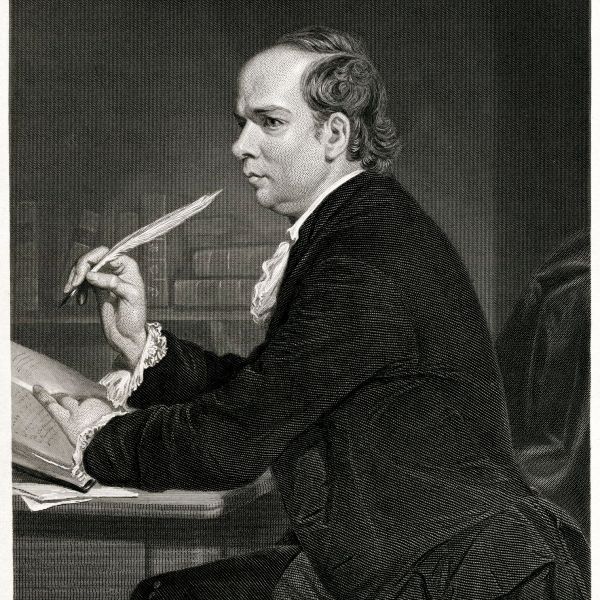
Oliver Goldsmith was an Anglo-Irish novelist, playwright, and poet. He was born in Pallas, a small village in County Longford, in Ireland, and he was the son of the poor but admirable curate of the village. His father, the village, and various local features are duly registered, and unduly idealized, in the poem The Deserted Village. In 1744, Goldsmith proceeded to Trinity College, Dublin; graduated, after some misadventures; and then tried various careers in turn law, medicine, and playing the flute at various places, including Dublin, Venice, Padua, and Leyden. During his years of wandering, he roved over Europe, playing the flute for a living; then in 1756, he returned to England, poor, unknown, but undaunted. During his later years, he was a member of Johnson’s famous club, where his artless ways his bickerings, witticisms. and infantile vanity was the mingled amusement, admiration, and contempt of his fellow members.

His Poetry

Though its poetical production is not large, it is notable. His first poem, The Traveller (1764), deals with his wandering through Europe. The poem, about four hundred lines in length, is written in the heroic couplet and is a series of descriptions and criticisms of the places and people which he had experienced. His only other poem of any length is The Deserted Village (1770). In this poem, as he deals with the memories of his youth, the pathetic note is more freely expressed. The peculiar humor and pathos of Goldsmith are hard to analyze. Both emotions arise from simple situations and are natural and free from any deep guile. Goldsmith’s miscellaneous poems are important, for they include some of his characteristic humorous and pathetic writing. The ballad called The Hermit is done in a sentimental fashion, the witty Elegy on the Death of a Mad Dog is suggestive of Swift without Swift’s savage barb, and the fine lines beginning “When lovely woman stoops to folly” are among the best he ever wrote.

The Deserted Village, Oliver Goldsmith

His Drama

Goldsmith wrote two prose comedies, both of which rank high among their class. The first, called The Good-Natur’d Man (1768), is not so good as the second, She Stoops to Conquer (1773). Each, but especially the latter, is endowed with an ingenious and lively plot, a cast of excellent characters, and a vivacious and delightful style. Based on the Restoration comedy, they lack the Restoration grossness. The second play had immense popularity, and even yet it is sometimes staged.

His Prose

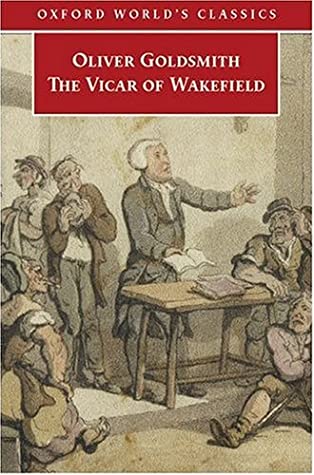
The prose is of astonishing range and volume. Among his works of fiction, we find The Citizen of the World (1759), a series of imaginary letters from a Chinaman, whose comments on English society are both simple and shrewd. This series was contributed to The Public Ledger, a popular magazine. He wrote many other essays in the manner of Addison, almost as well done as those of Addison. His other important work of fiction is his novel The Vicar of Wakefield (1766), which is in the first rank of eighteenth-century novels. In addition, Goldsmith produced a great mass of hackwork, most of which is worthless as historical and scientific fact, but all of which is enlightened with the grace of his style and personality. Some of these works are An Inquiry into the Present State of Polite Learning in Europe (1759), his first published book; The History of England (1771); and An History of Earth and Animal Nature, a kind of text-book on natural history, which was published posthumously.

Goldsmith died after a brief illness in 1774, at the age of just 43, and is buried in London’s Temple Church. Johnson would remember him as a man ‘who left scarcely any kind of writing untouched and who touched nothing that he did not adorn’.

Richard Steele

His Life

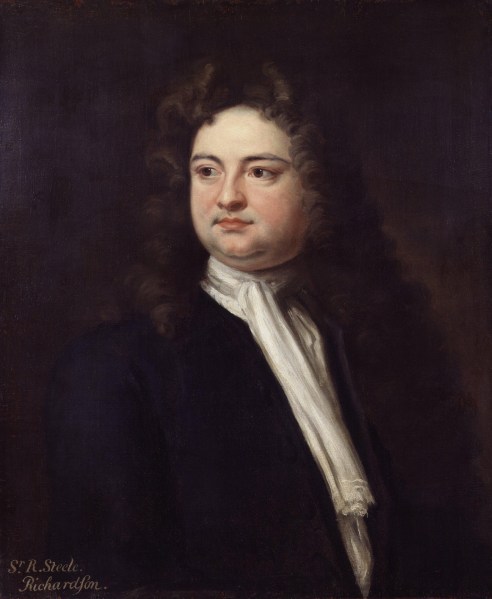
Sir Richard Steele was an Irish writer, playwright, and politician. He was born in Dublin, Ireland, in March 1672. The exact date of his birth is not known, but he was baptized on March 12. Steele’s father, an attorney, died in 1676, and his mother died the next year. He was placed under the guardianship of his maternal uncle, Henry Gascoigne, who was secretary and confidential agent to the Duke of Ormonde. In 1684 he began attending Charterhouse School, London, where he met Joseph Addison. Both Steele and Addison went to Oxford, Steele entering Christ Church in 1689 and transferring to Merton College in 1691. In 1695 Lord Cutts, to whom Steele had dedicated a poem on the funeral of Queen Mary, became Steele’s patron. Steele first served him as private secretary and then became an officer in Cutts’s regiment in 1697. Two years later Steele received a captaincy in a foot regiment.

Sir Richard Steele, self-portrait

His Drama

Steele wrote some prose comedies, the best of which are The Funeral (1701), The Lying Lover (1703), The Tender Husband (1705), and The Conscious Lovers (1722). They follow in the general scheme the Restoration comedies but are without the grossness and impudence of their models. Indeed, Steele’s one importance as a dramatist rests on his foundation of the sentimental comedy, avowedly moral and pious in aim and tone. In places, his plays are lively and reflect much of Steele’s amiability of temper.

His Essays

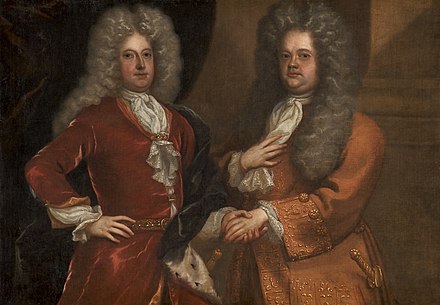
It is as a miscellaneous essayist that Steele finds his place in literature. He started The Tatler in 1709, The Spectator in 1711, and several other short-lived periodicals, such as The Guardian (1713), The Englishmen (1713), The Reader (1714), and The Plebeian (1719). The Plebeian is Steele’s most famous political journal, which involved him in a dispute with Addison, whose death in 1719 frustrated Steele’s attempt at reconciliation. Steele’s working alliance with Addison was so close and so constant that the comparison between them is almost inevitable. Of the two writers, some critics assert that Steele is the worthier. In versatility and originality, he is at least Addison’s equal. His humour is a border and less restrained than Addison’s, with a naive, pathetic touch about it that is reminiscent of Goldsmith. His pathos is more attractive and more humane. The aim of Steele’s essays was frankly didactic; he desired to bring about a reformation of contemporary society manners and is notable for his consistent advocacy of womanly virtue and the ideal of the gentleman of courtesy, chivalry, and good taste. His essays on children are charming, and he is full of human sympathy.

Joshep Addison and Richard Steele

His Politics

Steele served as the chief Whig propagandist; as the principal journalist of the Whigs in opposition, he was the antagonist of Jonathan Swift, who held the corresponding job for the Tories. Steele’s writings frequently made his political career perilous. Appointed commissioner of stamps in 1710, he was forced to resign from this office in 1713. That same year he was elected to Parliament from Stockbridge, but he was expelled in 1714 on a charge of sedition. After the accession of George I to the English throne in 1714, Steele obtained several political favors. In 1715 he was knighted and was re-elected to Parliament. Steele’s intemperance gradually undermined his health, and he suffered from gout for many years. In 1722 he wrote his last and most successful comedy, The Conscious Lovers. In 1724, still notoriously improvident, impulsive, ostentatious, and generous-Steele was forced to retire from London because of his mounting debts and his worsening health. He went to live on his wife’s estate of Llangunnor in Wales, and in 1726 he suffered a paralytic stroke. His health was broken, Steele died at Carmarthen, Wales, on Sept 1, 1729.

The Victorian Age

In the history of the United Kingdom, the Victorian era was the period of Queen Victoria’s reign, from 20 June 1837 until her death on 22 January 1901. Many events occurred during her reign in England and in the rest of the world. Many places in the British colonies were named after her. Even the nineteenth century has been referred to as the Victorian Era or Victorian England or the Victorian Age. Victoria also changed the way the monarchy in Britain worked. During her reign, Britain was the most prosperous nation in the world. England had gone from a rural society to an urban one. Britain did not lose a war during her reign. She also inspired authors to do writings on human rights and saving the poor. Victoria affected the rest of Europe because she was the “Grandmother of Europe”. She put on the Great Exhibition of 1851, the Golden Jubilee, and the Diamond Jubilee, to show how great the British Empire was. The British created a new renaissance.

The Victorian Age was a period of remarkable progress in physical as well as medical science. Henry Bessemer’s process which made possible the mass production of steel and Michael Faraday’s discoveries of electrical power added much to the material prosperity of the period. The use of chloroform in medical practice by Simpson in 1847 and the anti-septic surgery developed by Joseph Lister came as a great relief to the suffering humanity. In 1859 Charles Darwin, the great scientist of the day published “The Origin of Species”. It brought forth a rather shocking theory that man and all other species of life had evolved from a common source.

In no other period of English history was there such an output of literature as in the Victorian Age, Poetry, Prose, novel, history, and painting and writing on painting-all these were produced in large quantities. Alfred Tennyson who became the poet Laureate in 1850 was the greatest poet of the day. Robert Browning, famous for his dramatic monologues, was his nearest rival. Other poets of the period, but lower caliber, were Matthew Arnold, Swinburne, Dante Gabriel Rossetti, his sister Christina Rossetti, Fitzgerald, Coventry Patmore, and many others. Great among the prose were Carlyle, Macaulay, Ruskin, Newman, and many others. However, the most outstanding literary contribution of the period was the novel. As far as the novel was concerned it was an age of giants. Charles Dickens, George Eliot, Anthony Trollope, and many others. In the mid-Victorian period, there was a distinguished school of artists known as the Pre-Raphaelite Brotherhood, who wanted to revive the art forms which existed in European art before the time of Raphael.

The latter half of Queen Victoria’s reign was noted for many reforms in the field of both politics and education. The Reforms Act of 1867 and 1884 extended the right to vote to larger and larger sections of society. This in turn necessitated reforms in the educational systems of the country. The educational reforms effected by Gladstone eradicated some of the anomalies which had become a stumbling block in the path of progress of the nation. The only problem which Gladstone failed to solve, because of the lack of co-operation from the House of Lords, was Home Rule for Ireland. At any rate, speaking, on the whole, the Victorian Age was a period of peace and prosperity.

AGE OF QUEEN ANNE

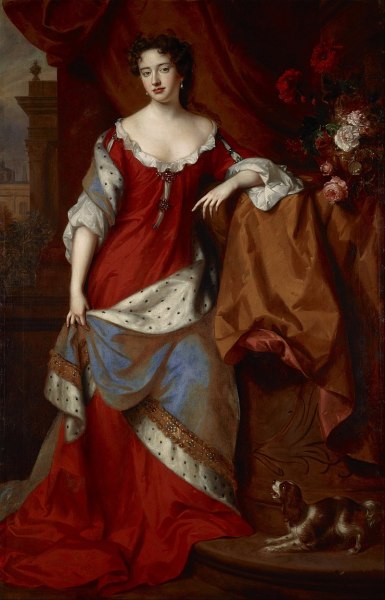
Queen Anne (1665 – 1714) was the last of the Stuart’s the second daughter of James II and his first wife Ann Hyde. Queen Anne ruled England from 1702 to 1714. It was a golden age in the history of England because it was a period of great prosperity. Industry, agriculture, and commerce all continued to prosper. Only during the last three years of her reign were their sign of distress and discontent, and that was chiefly due to the unavoidable war conditions in which the people had to live. English agriculture had improved so far that more wheat was grown than in medieval times. Wheat was the most important article of food. In the reign of Anne, there was a great exchange of agricultural products between one district and another. England’s agriculture improvement during this regime was so much that she was able to send corn abroad on a large scale.

Queen Anne’s reign was not yet time to appreciate the value of good education. There were only a few public schools like Eton, Winchester, and Westminster which were patronized chiefly by the aristocracy. The sons of the squires, yeomen and shopkeepers went to the nearest grammar schools. In wealthy families, private chaplains were employed to teach the young gentlemen. In schools, the punishment was of a rather severe type. Flogging was restored as a means of imparting knowledge and maintaining discipline. Writers like Locke and Steele were highly critical of this method. Women’s education was almost neglected and there was no good school for them. Most girls learned from their mothers to read, write, sew, and manage the household.

In the early part of the eighteenth century, most of the marriages were arranged by the parents. However, runaway marriages were common. There were also numerous love marriages. Divorce was almost unknown. During the twelve years of Queen Anne, in the whole country, there were only six divorces.

There were certain sports and pastimes which provided relaxation to the people. In Anne’s reign, a primitive kind of cricket was just beginning to take its place among the village sports. Football also was played by many. Cockfighting was watched with excitement by all classes of people. Horseracing attracted hundreds of people to the places where it was conducted. The most usual sports that people could easily resort to, were angling, shooting, and snaring birds of all kinds.

The most important industries of the period were coal mining and cloth-making. The coal mines were treated as the property of the owner of the land. Explosions were common in these mines and many workers lost their lives. In Anne’s time, the coal-mining industry was midway between the domestic and the factory system. The industry next in importance was cloth-making. Spinning was done chiefly in country cottages by women and children, and weaving chiefly in towns and villages by men.

The religious activities of the period consisted of the establishment of many religious societies and charity schools. life in individuals and families, to encourage church- The first object of these societies was to promote Christian attendance, family prayers, and Bible study. During the reign of Anne hundreds of charities, schools were founded all over England to educate the children of the poor in reading, writing, moral discipline, and the principles of the Church of England. Another characteristic activity of the period was the working of the Society for the Reformation of Manners.

In the last couple of years of her life, Anne became very ill. She was often bedridden and attended to by doctors. These doctors used many techniques to try to cure Anne including bleeding her and applying hot irons. These crude medicinal techniques probably did more harm than good, and Anne died on July 31st, 1714.

Daniel Defoe

Daniel Defoe was an English writer, trader, journalist, pamphleteer, and spy. He was born in London, became a soldier, and then took to journalism. He is one of the earliest, and in some ways, the greatest, of the Grub Street hacks. He worked for both the Whigs and the Tories, by whom he was frequently employed in obscure and questionable work. His parents were Presbyterian dissenters, and he was educated in a Dissenting Academy at Stoke Newington run by Charles Morton. After leaving school and deciding not to become a dissenting minister, Defoe entered the world of business as a general merchant, dealing at different times in hosiery, general woolen goods, and wine. In 1684 he married Mary Tuffley; six of their eight children lived into adulthood. After expanding into the import-export business for goods such as tobacco and alcohol, Defoe made some unwise investments and in 1692 declared bankruptcy. He was twice briefly imprisoned for his debts, negotiating his freedom with the aid of recognisance (guarantors) and becoming an accountant and investment advisor to the government and private business owners.

His Poetry

Defoe wrote some form of poetry all his life, but his great period of poetic composition was from 1699 to 1707. Here and there, especially in the Review, he left distichs, lampoons, pasquinades, fragments of songs, and ballads; he also included verses in his novels. One can track the development of his thought in the poems, his attachment to certain ideas, such as reform or morality, his theoretical interests in the language and style of poetry, his habit of casting poems into irony, and his skill in creating large poetic “fictions” that permit him to draw together numerous “characters” in recognizable patterns. Within his lifetime a few poems had considerable popularity, in, for example, the 1703 Poems on Affairs of State. The poems are taken up chronologically, with a few exceptions; and some efforts are made to create larger groupings of the poems, such as parliament poems, moral satires, and Scottish poems. The best texts of the poems, with annotations and headnotes, are to be found in Poems on Affairs of State: Augustan Satirical Verse, 1660-1714, volumes 6 and 7 (1970, 1975).

Political Writing

Like most of the other writers of his time, Defoe turned out mass political tracts and pamphlets. Many of them appeared in his journal, The Review, which, issued in 1704, is in several ways the forerunner of The Tatler and The Spectator. His ‘The Shortest Way with the Dissenters’ (1702) brought upon him official wrath and caused him to be fined, imprisoned, and pilloried. He wrote one or two of his political tracts in rough verses which are more remarkable for their vigor than for their elegance. The best known of his class is The True-born Englishmen (1710). In all his propaganda, Defoe is vigorous and acute, and he has a fair command of irony and invective.

His Fiction

His works in fiction were all produced in the later part of his life, at almost incredible speed. First came Robinson Crusoe (1719); then Duncan Campbell, Memories of a Cavalier, and Captain Singleton, all three books in 1720; in 1722 appeared Moll Flanders, A Journal of the Plague Year, and Colonel Jacque; then Roxana (1724) and A New Voyage round the World (1725). This great body of fiction has grave defects, largely due to the immense speed with which it was produced. Before his death in April 1731, Defoe was plagued by debts and restlessly moved between several different lodgings. He is buried in Bunhill Fields, the cemetery for Nonconformists.

Ben Jonson (1547-1637)

Benjamin Jonson was an English playwright and poet. Jonson’s artistry exerted a lasting influence upon English poetry and stage comedy. He was born at Westminister and educated at Westminister school. His father died before Jonson’s birth, and the boy adopted the trade of his stepfather, who was a master bricklayer. From this, he turned to acting and writing plays, engaging himself, both as actor and playwright, with the Lord Admiral’s company (1597). In 1617, he has created a poet for the king, and the close of James’s reign saw Jonson the undisputed ruler of English literature. His favourite haunt was the Mermaid Tavern, where he reigned as dictator over a younger literary generation. He was buried in Westminister Abbey, and over him was placed the epitaph “o rare Ben Jonson!”

Jonson’s numerous works, comedies, tragedies, masques, and lyrics, are of widely varying merit, but all of them, as well as his Timber, a kind of commonplace-book, which is of considerable interest for its critical comment on literature. To him, the chief function of literature was to instruct. His play was divided conventionally into comedies and tragedies, for Jonson, true to his classical models, did not combine the two. In his comedies, he aimed to return to the controlled, satirical, realistic comedy of the classical dramatist, and the inductions of his plays make it clear that he hoped to reform the drama on these lines. His main concern was with the drawing of character, and his creations are important because they introduce the “comedy of humours“. Many of his characters arc, in consequence, types, but the best, like Bobadill in Every Man in his Humour, rise above the type and live as truly great comic characters.

His early comedies, Every Man in his Humour (1598), Every Man out of Humour (1599), Cynthia’s Revels (1600), and The Poetaster (1601), show his ingenuity of plot, his hearty humour, his wit, and they are full of vivacity and fun. Every Man in his Humouris, perhaps, his greatest work. The middle group of comedies, Volpone, or the Fox (1605), Epicoene, or The Silent Woman (1609), The Alchemist (1610), and Bartholomew Fayre (1614), represents, as a group, his best work. They are all satirical in tone, realistic and natural in dialogue, and ingenious in the plot. The characters are less angular and more convincing. His later comedies, The Devil is an Ass (1616) and The Staple of News (1625), show a distinct falling-off in dramatic power.

The two historical tragedies, Sejanus his Fall (1603) and Catiline his Conspiracy (1611), are composed of classical models. They are too laboured and mechanical to be reckoned as great tragedies. Jonson was also friends with many of the writers of his day, and many of his most well-known poems include tributes to friends such as Shakespeare, John Donne, and Francis Bacon. Ben Jonson died in Westminster on August 8, 1637. A tremendous crowd of mourners attended his burial at Westminster Abbey. He is regarded as one of the major dramatists and poets of the seventeenth century.

John Bunyan

John Bunyan was an English writer and Puritan preacher. He was born in Elstow, near Bedford, in 1628, the son of Thomas Bunyan and Margaret Bentley. He followed his father into the tinker’s trade but rebelled against God and ‘had but few equals, both for cursing, swearing, lying, and blaspheming the holy name of God’. As a teenager, he joined Cromwell’s New Model Army but continued his rebellious ways. His life was saved on one occasion when a fellow soldier took his place at the siege of Leicester, and ‘as he stood sentinel he was shot in the head with a musket bullet and died’.

Bunyan married at age 21. Those books his wife brought to the marriage began a process of conversion. Gradually, he gave up recreations like dancing, bell ringing, and sports; he began attending church and fought off temptations. Later, he realised that he was lost and without Christ when he came into contact with a group of women whose ‘joyous conversation about the new birth and Christ deeply impressed him’. In 1651 the women introduced him to their pastor in Bedford, John Gifford, who was instrumental in leading Bunyan to repentance and faith.

That same year he moved to Bedford with his wife and four children, including Mary, his firstborn, who had been blind from birth. He was baptised by immersion in the River Ouse in 1653. Appointed a deacon of Gifford’s church, Bunyan’s testimony was used to lead several people to conversion. By 1655 Bunyan was himself preaching to various congregations in Bedford, and hundreds came to hear him. In the following years, Bunyan began publishing books and became established as a reputable Puritan writer, but around this time, his first wife died. He remarried in 1659, a young woman named Elizabeth, who was to be a staunch advocate for her husband during his imprisonments for in 1660 Bunyan was arrested for preaching without official permission from King Charles II; he was to spend the next 12½ years in Bedford County Gaol.

In January 1672, Charles II issued the Declaration of Religious Indulgence with to make Roman Catholicism legal. As a result, many religious prisoners were pardoned and released, including John Bunyan. That same month, he became pastor of the Bedford church. In March 1675, he was imprisoned for preaching again because Charles II withdrew the Declaration of Religious Indulgence. This time he was imprisoned in the Bedford town jail on the stone bridge over the Ouse.

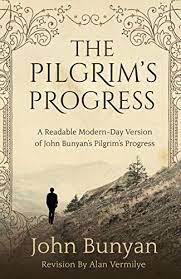
Bunyan became a prolific author as well as a popular preacher, though most of his works consisted of expanded sermons. He wrote, The Pilgrim’s Progress, in two parts, the first of which was published in London in 1678, and the second in 1684. He had begun the work in his first period of imprisonment and probably finished it during the second. The earliest edition with the two parts combined in one volume was published in 1728. A third part, falsely attributed to Bunyan, appeared in 1693 and was reprinted as late as 1852. The Pilgrim’s Progress is arguably one of the most widely known allegories ever written. It has been extensively translated into other languages.

Two other successful works of Bunyan’s are less well-known: The Life and Death of Mr. Badman (1680), an imaginary biography, and The Holy War (1682), an allegory. A third book that reveals Bunyan’s inner life and his preparation for his appointed work are, Grace Abounding to the Chief of Sinners (1666). It is all about Bunyan’s spiritual path. Bunyan died in 1688 after catching a cold while riding through a rainstorm on a journey to reconcile a quarreling family. He was buried at the Nonconformist cemetery of Bunhill Fields in London.

Christopher Marlowe

Christopher Marlowe, also known as Kit Marlowe, was an English playwright, poet, and translator of the Elizabethan era. Marlowe is among the most famous of the Elizabethan playwrights. He was Shakespeare’s most important predecessor in English drama, who is noted especially for his establishment of dramatic blank verse. He was born at Canterbury and educated there and at Cambridge. He adopted literature as a profession and became attached to the Lord Admiral’s players.

Marlowe’s plays, all tragedies, were written within five years (1587-92). He had no bent for comedy, and the comic parts found in some of his plays are always inferior and maybe by other writers. Only in Edward II does he show any sense of plot construction, while his characterization is of the simplest, and lacks the warm humanity of Shakespeare’s. All the plays, except Edward II, revolve around one figure drawn in bold outlines. This character shows no complexity or subtlety of development and is the embodiment of a single idea.

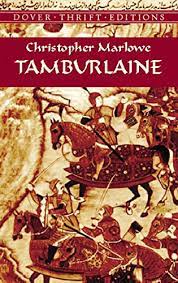
In Tamburlaine the Great, the shepherd seeks the “sweet fruition of an earthly crown,” in The Jew of Malta Barabbas seeks “infinite riches in a little room,” while the quest of Doctor Faustus is for more than human knowledge. Each of the plays has behind it the driving force of this vision, which gives it an artistic and poetic unity. It is, indeed, as a poet that Marlowe excels. Though not the first to use blank verse in English drama, he was the first to exploit its possibilities and make it supreme. His verse is notable for its burning energy, its splendour of diction, its sensuous richness, its variety of pace, and its responsiveness to the demands of varying emotions.

The Massacre at Paris is a short and luridly written work, the only surviving text of which was probably a reconstruction from memory of the original performance text, portraying the events of the Saint Bartholomew’s Day Massacre in 1572, which English Protestants invoked as the blackest example of Catholic treachery. It features the silent “English Agent”, whom subsequent tradition has identified with Marlowe himself and his connections to the secret service. The Massacre at Paris is considered his most dangerous play, as agitators in London seized on its theme to advocate the murders of refugees from the low countries and, indeed, it warns Elizabeth I of this possibility in its last scene.

Doctor Faustus (or The Tragicall History of the Life and Death of Doctor Faustus), based on the German Faustbuch, was the first dramatised version of the Faust legend of a scholar’s dealing with the devil. While versions of “The Devil’s Pact” can be traced back to the 4th century, Marlowe deviates significantly by having his hero unable to “burn his books” or repent to a merciful God to have his contract annulled at the end of the play. Marlowe’s protagonist is instead carried off by demons, and in the 1616 quarto his mangled corpse is found by several scholars. Doctor Faustus is a textual problem for scholars as two versions of the play exist: the 1604 quarto, also known as the A text, and the 1616 quarto, or B text. Both were published after Marlowe’s death. On 30 May Marlowe was stabbed to death during a fight at a house in Deptford, apparently after an argument about a bill. He was about 29. The incident’s relation, if any, to Marlowe’s investigation by the Privy Council is unknown.

The Life of John Donne

John Donne was an English poet, scholar, and secretary. John Donne is considered now to be the pre-eminent metaphysical poet of his time. He was born in Bread Street, London in 1572 to a prosperous Roman Catholic family. He was the son of a wealthy merchant. His parents were Roman Catholics, and he was educated in their faith before going to Oxford and Cambridge. He entered the Inns of Court in 1592, where he mingled wide reading with the life of a dissolute man-about-town. He wrote his Satires, the Songs and Sonets, and the Elegies, but, though widely circulated in manuscript, they were not published until 1663, after his death. He entered the Anglican Chruch, after a severe personal struggle, and in 1621, became Dean of St. Paul’s, which position he held until his death in 1631. He was the first great Anglican preacher.

John Donne, Self-potrait

His Poetry

Donne was the most independent of the Elizabethan poets and revolted against the easy, fluent style, stock imagery, and pastoral conventions of the followers of Spenser. His poetry is forceful, Vigorous, and despite faults of rhythm, often strangely harmonious. His cynical nature and keenly critical mind led him to write satires, such as Of the Progres of the Soule (1601). His love poems, the Songs and Sonets, were written in the same period, and are intense and subtle analyses of all the moods of a lover, expressed in vivid and startling language, which is colloquial rather than conventional. His poems are all intensely personal and reveal a powerful and complex being. Among the best known and most typical of the poems of this group are Aire and Angels, A Nocturnall upon S.Lucies day, A Valediction: forbidding mourning, and The Extaise.

His religious poetry was written after 1610, and the greatest, the nineteen Holy Sonets, and the lyric such as A Hymn to GOD THE FATHER, after his wife’s died in 1617. They too are intense and personal and have a force unique in this class of literature. “He affects the metaphysics”, said Dryden of Donne, and the term ‘metaphysical’ has come to be applied to Donne and a group of poets who followed him. The most distinctive feature of the metaphysical is their imagery, which, in Donne, is almost invariably unusual and striking, often breath-taking, but sometimes far-fetched and fantastic.

His Prose

Donne’s prose work is considerable both in bulk and achievement. The Pseudo-Martyr (1610) was a defense of the oath of allegiance, while Ignatius His Conclave (1611) was a satire upon Ignatius Loyola and the Jesuits. The best introduction to Donne’s prose is his Devotions (1614), which give an account of his spiritual struggles during a serious illness. His finest prose works are his Sermons, which number about 160. In seventeenth-century England, the sermon was a most important influence, and the powerful preacher in London was a public figure capable of Wielding great influence. Donne’s sermons, of which the finest is probably Death’s Duell (1630), contain many of the features of his poetry. Donne seems to have used a dramatic technique that had a great hold on his audiences.

Conclusion

Donne left a deep and pervasive influence on English poetry. The metaphysical lyricists owed a great debt to him. Sometimes, his followers excelled him in happy conceit, passion, and paradoxical reasoning. And yet he gave a sincere and passionate quality to the Elizabethan lyric. He is one of those great poets who have left a mark on the history of English poetry. At times, his poetry is strange, fantastic, bizarre, maybe repellent. Donne may not be capable at times of graceful love or sweetness of song, but he enriched Elizabethan poetry with sincerity, originality, and fullness of thought.

The Renaissance

Renaissance means rebirth. The word is usually used about the revival of learning of classical literature between the fourteenth and the sixteenth century. During this period there developed a spirit of inquiry, a spirit of freedom of thought and action. Social, political, and religious ideas were all revolutionized. In the words of Prof. Jebb, “The Renaissance in the largest sense of the term is the process of transition in Europe from the medieval to modern order”. The word “Renaissance” suggests different things to different people. To the love of art and literature Renaissance means the recovery of the masterpieces of the ancient world and the revived knowledge of Greek and Latin. Hence, Walter Pater is right in calling the Renaissance “a complex and many-sided movement”.

Renaissance Inventions and Discoveries

There were certain inventions and discoveries, which contributed to the general movement of the Renaissance. Of these, the most important was the invention of the printing press. The art of printing was introduced into Europe by John Gutenberg of Germany in 1454 and a few years, presses were established in every important town of Western and Central Europe. The first Latin Bible was printed in 1455, at Mainz in Germany. The art of printing reached all over the world. The first printing press in England was established in 1476 by William Caxton at Westminister. Another invention of great importance was the “mariner’s compass”, which enabled sailors to undertake longer voyages that had hitherto been possible. Along with this came also the invention of the telescope, a century later. The invention of the telescope marks the beginning of the science of astronomy.

Renaissance Writers

Dante, Petrarch, and Boccaccio prepared the ground for the Renaissance in Italy. Italian states were ruled by despots who competed with one another in the splendor of their courts. Another great Italian writer of the period was Machiavelli. In France, the effect of the Renaissance was seen in the lyric poetry of Ronsard, the vigorous prose of Francis Rabelais, and the scholarly essays of Montaigne. In Spain, the literary glory of the Renaissance was the glory of Cervantes. His “Don Quixote”, a burlesque of the romances of Chivalry is the most beautiful gift of the Renaissance of the literature of the world. In England, the Renaissance was heralded by Geoffrey Chaucer and selling who had contacts with Italy. A good start was given by three Oxford friends, Thomas Linacre, William Grocyn, and Hugh Latimer. All of them studied in Italy and later lectured on Greek at Oxford University.

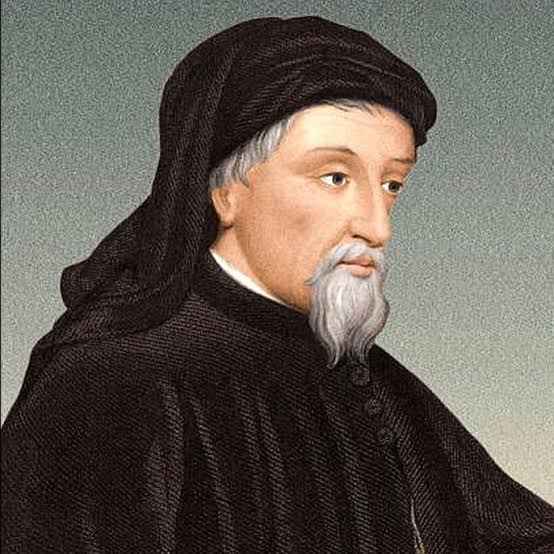
Geoffery Chaucer

Renaissance Art and Literature

The period of Renaissance was also an age of translation. Virgil, Ovid, Cicero…were all translated into English. The first part of Chapman’s “Homer” appeared in 1598. Thus people like Shakespeare who knew little Latin and less Greek became familiar with classical mythology. The Renaissance in literature may be said to have begun in England with Sir Thomas More. His Famous work, “Utopia”, which is a Greek word meaning “nowhere” was written in Latin and first published in 1516. The English translation was published in 1551. Spenser, the author of the first great English epic “Faerie Queene”, is the representative poet of the English Renaissance. The names closely associated with the Renaissance in Art and literature are those of Michael Angelo, Raphael, and Leonardo da Vinci. They were all-rounder’s, poets, painters, and sculptors. Their work is the glory of the picture galleries in Europe. As a sculptor, Michael Angelo’s most famous work is the Virgin Mary holding the dead body of Christ on her lap. As a painter, he painted the ceiling of the Sistine Chapel and the great fresco of the “Last Judgement” on the walls of the same Chapel. As a poet, Michael Angelo wrote many sonnets and love poems. Leonardo da Vinci is famous for the fresco of the “Last Supper” in the refectory of Maria Delle Grazie in Milan.

Renaissance Religion

The Renaissance in religion consists of two movements, the Reformation and Counter-Reformation. The Reformation started in Germany. Martin Luther, the leader of the Movement, translated the Old and New Testaments into German. William Tindale gave an English rendering of the translation made by Erasmus. These translations of the Bible helped people to read and interpret the text for themselves. As an antidote to this, there started a Counter-Reformation and founding of the society of Jesus by Ignatius of Loyola in 1540. As an outcome of this Renaissance in religion, there was a split in the church and those who protested against the supremacy of the pope came to be known as Protestants.

Chruch in Renaissance period