Book Review Offer

If you are willing to write something that you like about a book then you are going to get the refund of the book price from us and Free Recharge of Rs 50.

Don’t wait this is limited period offer from Edupedia Publications Pvt Ltd

Those interested in getting the books online and willing to post a short review can contact us through

reviews@edupediapublications.org

Contact No. 09557022047 or 09958037887

Terms and Conditions for Reviews

  1. Buy the book and post a review, the refund of the book price and Recharge of Rs 50 will be done through Recharge or bank transfer.
  2. The review should get live only then you will be eligible to get the refund and Recharge.
  3. You can get the Recharge of Book Price + Rs 50.
  4. Or Bank transfer of Book Price+Rs 50
  5. Before buying please contact us through 09557022047
  6. For any further query contact though reviews@edupediapublications.org
  7. This offer expires on 20 October 2015.
  8. Only for reviewers in India.
  9. Visit us for more offers in Future too.
  10. Read more more, enjoy more!

Challenges for the wastewater management system in AlQurayyat, Al-Jouf Region, northern KSA

Ahmed M. El-Naggar

Department of Applied Medical Sciences, Community College in Al-Qurayyat,

Al-Jouf University, KSA

Abstract

The present study aims to evaluate the wastewater management system in AlQurayyat, with primary focus on the efficacy of the treatment plant that was operated 30 years ago. One of the objectives of the study is to throw light on the environmental consequences of wastewater and suggest innovative, novel solutions to this problem. Approximately 4000000 m3 of wastewater comes from localities served by the sewerage system every year. About 6000000 m3 of the total wastewater comes from the localities lacking any sewerage system services. About 20% of the wastewater discharges from such localities is transferred by truck tankers and dumped directly into open fields nearby Kaf village. Approximately 95% of the total existing waste flow is treated by a single treatment plant acquiring a capacity of 300 m3/hour (8500 m3/day). The raw sewage arriving to the plant varies markedly according to the human consumption and seasonal rainfall. A mean value of 900 m3/hour was recorded during January 2015. In 2014, more than 5000000 cubic meters of the wastewater were dumped either into a man-made pond or an open field nearby Kaf village, 15 Km northern AlQurayyat. Successful and sustainable management of wastewater requires a composite of innovative projects, for example innovative financing of appropriate wastewater infrastructure (design, construction, operation, maintenance, and upgrading). Thinking to the long-term and creating solutions for smart wastewater management in the light of rapid global change is strongly recommended. Strategic planning in the water sector must be appropriate at the social, cultural, economic and environmental scales.

REMOTE SENSING AND GIS APPLICATIONS OF LINAMENT MAPPING OFMAHESH RIVER BASIN, AKOLA & BULDHANA DISTRICT, MAHARASHTRA, INDIA USING MULTISPECTRAL SATELLITE DATA

Khadri, S.F.R and Chaitanya Pande

Department of Geology, Sant Gadge Baba Amravati University, Amravati-444602 (MS), India

ABSARCT

IRS P-6 LISS III imagery of Mahesh River Basin reveals the presence of prominent lineament sets. Lineaments have been recognized with the advent of satellite imagery. It has been convincingly demonstrated that many of these structures are related to basement tectonics. There it has been shown that structural anomalies the definition of enhanced fracture production zones over Deccan trap are commonly coincident with pervasive basement lineament trends. For instance, the satellite imagery data interpretations supports the view that Gavilgarh faults indicates an older age and the remaining lineaments represents a younger age. The basin lies between two major lineaments i.e. Purna lineament following the course of Purna River display a WNW-ESE trend it is traceable for over 80 km from south of Akola in the east to some distance east of Jalgaon in the west, where it merges into Tapi lineament, this lineament lies in the northern part of the basin and the southern part is delineated by Kaddam lineament trending NW-SE and extends up to 240 km and that has been named after Kaddam River whose course has been controlled by this fault lineament. This lineament has northerly dipped. Faulting has been recognized in several sectors of this lineament. The basin lies between two major lineaments i.e. Purna lineament following the course of Purna River display.

Keywords: Remote sensing, GPS, Lineament map, Satellite image.

Absenteeism Study of Packaging Industries Workers ( Special Reference to Valsad district in Vapi GIDC )

Author

Patel Dilipkumar

PhD Scholar

Pacific University Udaipur ( Rajasthan )

Abstract :

Indian Industries in Absenteeism is very Important Human problem today. Absentia Absenteeism is generally understood in different ways by different persons. It is majority understood as an employees or a Industries of workers remaining absent from work either continuously for a long time or back for short period. The sample size of the study was 80 workers randomly selected for only Box Manufacturers Industries of Vapi G.I.D.C. in Valsad district. The information needed for the research has been received from primary and secondary data. Primary data collected was questionnaire has been designed by the researcher according to the Study of objective. And secondary data collected by researcher various Journal , Magazine and Websites also. this Percentage analysis, Anova Analysis was used as tools for data analysis.

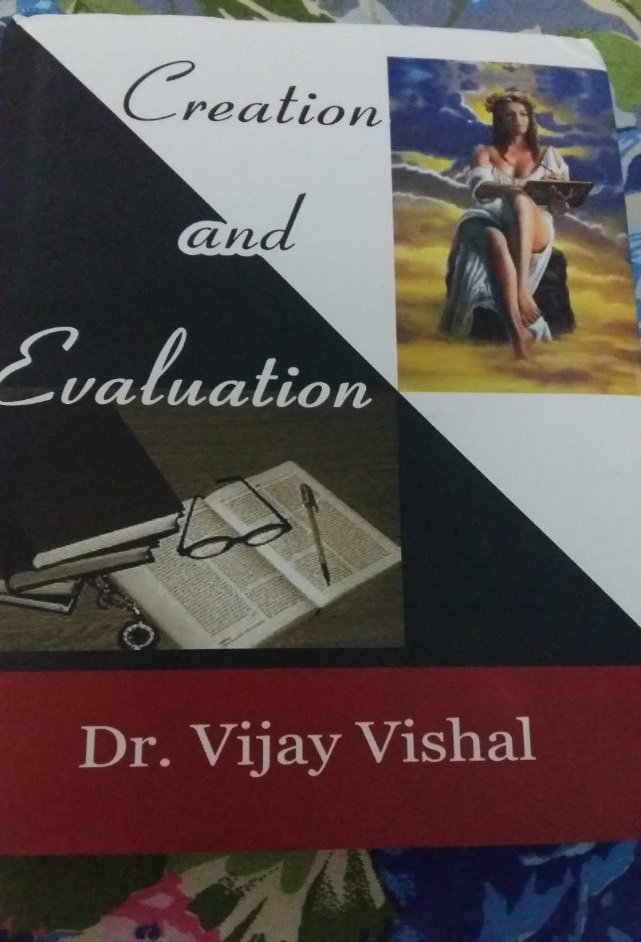
Book Review of Creation and Evaluation

Dr. Reena Mittal

M.A. (Eng.). Ph.D., M.B.A.,Department of English, DAK Degree College, Moradabad, India

E-mail id: – mittal.reena23@gmail.com

222

The book “Creation and Evaluation” is written and compiled by Dr. Vijay Vishal. It’s published by Popular Book Depot, Jaipur in 2014 with ISBN: 978-81-86098-13-4.

This book celebrates Dr. Vijay Vishal’s creativity and objectivity. The book has two parts and 4 sections: Each part has two sections. Part one is collection of Poems whereas part two is reviews and published research articles on poet’s collection.

          I came across this book “creation and Evaluation” during one of my academic pursuits and get very attracted by its contents and presentation. The poet Dr. Vijay Vishal is really a man of letters who has dedicated his life in reading, writing and creativity. His best thing is that he not only creates but presents his own poetry’s critical analysis with same spontaneity. “Poetry is the spontaneous over flow of powerful feelings”,  I think this live is the base of every literature lover. We all love and praise poetry since time immortal. So, this book naturally draws my attention, when I came across it. The book has two parts, each part is divided in two sections Part I, section I is collection of 46 poems composed by Dr. Vishal, titled “Speechless Messenger”. All the poems have different title, some of them are about the beauty of Nature, birds and some are about realities of life and contemporary issues. Some poems express platonic love of the lovers. The poems are of rich quality written in an ornate style. He conveyed his feelings on different aspects of life. He writes in direct and clear notion, mysticism is totally absent. In Part I section II we have collection of 37 poems under the title “Parting Wish”. These poems are about the change in life, from Ancient to Modern times, from Girl to married women, and other changes that occur in life of a human being. It can be a male or a female. Dr. Vishal is a poet of keeping past traditions alive. He has kept art of English Romanticism alive in his poetry. He expresses human feelings, sufferings, problems and changes in his poetry. To him, life is not a free flow of water but it has hurdles which we have to pass. This is what his poetry gives us in the form of message.

          Second part entitled ‘Evaluation’ has 3 sections. Section I has published reviews of Speechless Messages, Section II has reviews of Parting Wish and section three has published research articles based on both poetic collection. This part containing 3 sections has made the book somewhat different par excellence as it give us criticism of poetic collection too.

          Poetry is a natural overflow of feelings which is loved and liked by all. Dr. Vijay Vishal is this collection of poems has shown his best to attract his reader. His both collection of poems deal with a variety of topics and cover wide range of feelings, emotions and realities of life. In Part I section I “Speechless Messages” the poet, Dr. Vishal has given space to feelings and emotions related to Nature. Role of nature in context to human life has been beautifully presented in the form of poetry. His name as a poet is known to us, but this collection is his debut collection. By this bundle of poems, he want to convey a message of hope, aspiration and optimism as he sees expectations in the objects of Nature. His belief in the social norms and family are also positive if we analyse his poetry. The unborn foetus also shows rays of hope. The collection has 46 poems and the wide variety of subjects shows poets command over feelings, thought and Goddess Muse seems to be giving him divine blessings.

          Part I Section II parting wish contains 37 poems which were actually written to keep poet Dr. Vijay Vishal’s bereaved wife’s soul and memory alive forever. She left poet alone in a very young age which perturbed him very much. The poet has mentioned reality and facts of life in the poems of this collection. The book shows reflection of Swimsburne in all the poems. The poems are really good and suggestive in readings. They can be categorised as autobiographical poems as they are the outburst of his own loss at a very age of life. Due to that he has lost interest in world and life. He wished to God to grant him courage to bear all this. The deep sorrow, suffering and pain which he expressed seem to be really pathetic. He is so original and his use of language is so commendable that we feel like as reading them again and again.

          Part II has three sections which really have par excellence book reviews and research papers. The poet is lucky enough that nearly all stalwarts of contemporary era have given reviews on his books. They are really a gem of collection. The reviews again show that Dr. Vishal has really worked hard, original and poured feeling of his heart through pen. The area of subject he covered is wide in ‘Speechless Messanger’ but the collective give an optimistic note. In second collection ‘Parting wish’ the poet is Superb, original and an ardent lover who lost his beloved untimely, unrealistically. He is preparing himself mentally to bear the loss and to continue life even without her, keeping her alive forever in his memories. One aspect of his poetry which is left untouched was covered in the Part II, section three, where we have a published research paper titled “Anguish in the poems of Dr. Vishal.” The paper shows that Dr. Vishal  saw poetry as a notion to unleash social outrage. To him, it can awaken the dormant psyche of all people. He wants to uplift Indian tradition of poetry writing to a far end. All the critics who wrote on Dr. Vishal’s poetry, have one same opinion that he is a budding promising poet. who carved an eminent position in present day Indian English poetry. His poetry is a search of best verses of the present times and we can hope high with him and his pen. We can really hope that his bouquet of poems will enliven Indian English poetry.

Innovation of a Farmer Transforming Social and Economic Living Conditions: A Case Study of Farmer Inventing Tractor

Dr. Priyanka Sharma & **Nishi Slathia

*The First Author is Assistant Professor, Department of Psychology, University of Jammu, J&K, India, 180006.

** The author is PhD Scholar in the Department of Strategic and Regional Studies, University of Jammu, J&K, India. 180006

INNOVATION OF A FARMER TRANSFORMING SOCIAL AND ECONOMIC LIVING CONDITIONS: A CASE STUDY OF FARMER INVENTING TRACTOR

ABSTRACT

Necessity is the mother of invention. Although there is a relentless problem of lack of mechanical and scientific knowledge in countryside, rural people becomes grassroots innovators to solve their and community’s problems by coming up with solutions. Rural Entrepreneurship is often conceived as innovation, creativity, the establishment of new activities, or some kind of novelty. The rural entrepreneurial ventures play a vital role in providing employment opportunities and income for the needy people in rural sector. It helps in sinking the exodus of people from rural to urban areas in search of livelihood and provision of employment opportunities. As the population pressure grows in the land-scarce and developing countries like India, the growth in the agricultural production cannot absorb the ever increasing rural labour force in farming employment. This leaves the rural non-farm sector in the form of rural SMEs (small and medium entrepreneurial ventures) to absorb those released from agriculture but not absorbed in the urban industries. The rural sector is best poised for a rapid expansion in the small and medium industry arena.

In the present scenario, majority of the rural natives are unaware of technological skills, marketing etc. Shortage of funding and raw materials, lack of proper infrastructure and communication facilities etc. are main difficulties faced by rural entrepreneurs. The policy makers and executors have to find scope and space in the farm based entrepreneurial ventures to address to the daunting problem of unemployment in the country. The experiences of the people involved in such ventures needs to be cashed and used to make shift in the policy paradigm in the given context. The present paper is an attempt to analyze the case study of a rural entrepreneur of India and analysis is done about his life experiences leading to the advent of innovation, which have transformed the lives of rural agricultural community.

Key words : Rural entrepreneurship, Innovation, Employment, Technology, Technical Knowledge.

Nuclear Deterrence: More Nukes for Stable Peace?

Maneesha Tripathi1

1Ph.D. Scholar, Department of Political Science, Jamia Millia Islamia, New Delhi

Abstract

Nuclear deterrence is sometimes treated as a known quantity-a definite thing that keeps us safe and ensures our security. It has also often been used as a justification for possessing nuclear weapons. It was widely believed that nuclear weapons were an important factor in maintaining the “long peace” between the United States and the Soviet Union during the Cold War. India had sighted it’s not so friendly neighbour China as a reason for its nuclearisation. While Pakistan in turn sighted threat from India for going nuclear.

Is nuclear deterrence oblique encouragement for nuclear proliferation?

Moreover, deterrence in the twenty-first century may be far more difficult than it was in the past, and having the right mix of nuclear capabilities to deal with the new challenges will be crucial. New nuclear powers, characteristics of rivalry, are considered unlikely to maintain stable deterrence.

This paper attempts to address the question that has nuclear deterrence theory led to more nuclearisation. And whether it is actually relevant in maintaining stability especially in contemporary scenario?

Keywords: Nuclearisation; Deterrence; Proliferation; Stability; Peace; Nuclear Powers

STUDY OF STEGANOGRAPHY TECHNIQUES – A REVIEW

Mr. Abhishek Sharma1, Mr. Vijay Sharma2

Abstract: – Steganography is the technique of hiding confidential information within any media. Steganography is often confused with cryptography because the two are similar in the way that they both are used to protect confidential information. The difference between the two is in the appearance in the processed output; the output of steganography operation is not apparently visible but in cryptography the output is scrambled so that it can draw attention.Steganography is defined as the study of invisible communication. Steganography usually deals with the ways of hiding the existence of the communicated data in such a way that it remains confidential. It maintains secrecy between two communicating parties. In image steganography, secrecy is achieved by embedding data into cover image and generating a stego-image. There are different types of steganography techniques each have their strengths and weaknesses. In this paper, we review the different security and data hiding techniques that are used to implement a steganography such as LSB, ISB, MLSB etc.

Key words: Steganalysis, Discrete Cosine Transformation (DCT), Ipv4 header, IP datagram fragmentation.

PREVALENCE OF MALARIA PARASITE AND HEPATITIS B VIRUS AMONG PREGNANT WOMEN ATTENDING ASHAKA MEDICAL CENTER, GOMBE STATE

I.A. Allamin1, I.B. Machina2 M. Ibn Abbas1 and H. Shuaibu1

1 Department of microbiology, University of Maiduguri P.M.B 1069

2 National Institute of Trypanosomiasis Research, Katsina liason office

Abstract

The study was conducted to determine the prevalence of Malaria parasite and Hepatitis B virus among pregnant women at Ashaka medical centre, Gombe State. The tests were carried out using diagnostic test device for malaria parasite S.D Standard diagnostic device INC. Lot No_082230K, and for Hepatitis B virus kit Disport test strip lot No-BSA305006. Questionnaires were administered to help in determining the risk factors. The study was conducted from April to July 2014. 140 pregnant women were screened for Malaria parasite and Hepatitis B surface antigen. Out of the 140 pregnant women tested only 26 (18.6%) were positive to malaria and 12 (8.6%) were positive for HBV. Therefore, government is commended for the slight decrease of this infection and encouraged to act drastically for total eradication.

Keywords: Malaria, Hepatitis B, Prevalence, and Women

POTENTIAL OF UNDERUTILIZED DRUMSTICK (MORINGA OLEIFERA)

*Shalini Kushwaha * Madhvi Daniel and *Shakti

*Assistant Professor

*Deptt. of Food Science & Technology, School for Home Sciences,

Babasaheb Bhimrao Ambedkar University, Lucknow, India


Abstract

Underutilized green leafy vegetables (GLV) are found in numerous agricultural ecosystems and often survive mainly in marginal areas. Yet a large number of GLV that are now overlooked have the potential to play a much more important role in sustaining livelihoods and enhancing environmental health. India, being blessed with a variety of natural surroundings and varying climates and seasons, has a number of edible GLV some of which are locally grown and utilized. GLV are rich sources of micronutrients such as β-carotene, ascorbic acid, riboflavin and folic acid, iron,calcium and phosphorous. GLV are also recognized for their characteristic colour, flavor and therapeutic value. Some of the underutilized leafy vegetables are amaranth, drumstick, beet greens rich in micronutrients. Drumstick has a high nutrient density and is rich in many essential micronutrients and vitamins as well as antioxidants and bioavailable iron. It excelled among 120 species of Asian traditional vegetables tested for their content of micronutrients and phytochemicals, antioxidant activity and traditional knowledge of their medicinal uses. Moreover, it is easy to grow, has excellent processing properties, and good palatability.

Keywords: Drumstick, Underutilized