How to manage personal finances

Finding out “why”


This is the first step in planning your budget. The reasons could be you want to minimize your spending habits or you have a debt repayment plan and to be debt-free or want to save for any of your long term goals. This step is very necessary because without deciding the purpose of your financial budgeting you can’t plan a proper budget.

Priorities setting


After deciding your whys you need to set your priorities according to your priorities. It is about finding out what’s important to you then controlling the habits of spending and saving to achieve the “why”.
These include your long term and short term goals and syncing them in the order of your priorities. Like you are going to marry soon so you want to buy a house in the future or if there is a couple who wants to plan their children’s higher education expenses, so priorities should be decided at this level.

Track your spending habits


This is the most important step while planning a budget. Spending habits as if you are spending on the unnecessary things in your life. Check your monthly expenses yearly expenses and try to figure out which is unnecessary for you and cut out them.

Choosing the method

with the 50/30/20 rule, 50 % of your take-home pay goes towards your needs. 30% should go towards your wants or discretionary income. Remaining 20% of your take-home pay should go to your savings. for example, if your income is 50000 then 25000 should go towards your need like housing utility, insurance, groceries. 15000 should go towards your wants and the remaining 10000 should go towards your savings.

There are various methods of budgeting like zero-sum budget, anti budget, money flow, etc. Find out which one is best for your according to your spending and priorities.

live with your Budget


There is no use of the method you have decided if you don’t implement it in your life. create a spreadsheet use pen and paper for creating the spreadsheet or you can use many digital tools that are available online for the same like Mint, Clarity money, Tiller money, You need a budget, Digit, Qapital, etc.

Updating the Budget regularly


Review, Revise, Improve
There is no rule for improving your budget. It is up to you your personal satisfaction with your spending habit.
You pick up a budget applied and then not satisfied with the can savings then you can revise your budget again make it do some improvements accordingly again apply and see the result.
Here are a few helpful things to keep in mind while updating the budget-
Slash expenses- If in your budget you are finding yourself overspending then see where you can cut those expenses.

Create seasonal budgeting-

Besides the main budget, a seasonal budget for holiday and summer season should also be maintained.

Link existing habits with new ones-

If you have added some more new spending habits then link that with your existing ones.

Set dates to review and tweak-

You should always review your budget whether you are happy with it or not.

Get help if you need

MMI offers free budget counseling to anyone struggling with the management of the budget.

PLANNING IN MANAGEMENT

Planning is deciding the objectives and methods to achieve them. Planning involves deciding in advance what is to be done, how is to be done, where is to do, how is to done and by whom is to be done and it makes things happen which may not occur otherwise and it bridges the gap between where we are and where we want to go, the process of planning includes two things:

             1. Deciding objectives

             2. Choosing best from available alternatives

Planning is a fundamental managerial function planning implies an arrangement for doing something as considered in advance and simple words, planning is deciding in advance and Prof. Urwick rightly said: “Planning is fundamentally a mental predisposition to things in an orderly way, to think before acting and to act in the light of facts rather than guesses”. Thus, a plan is a predetermined course of action and it is an attempt on the part of a manager to anticipate the future to achieve better performance, and planning is based on the principle, Look before you leap’.

CONCEPT OF PLANNING

Planning requires goals and it focuses attention on purposes and determines ways achieving them and planning is necessarily a problem of choice and it involves the selection of the most feasible course of action from all available alternatives. Planning is a means of building a bridge to span the present position of the firm with its desired future position. It implies the work of both problems solving as well as decision-making. Man possesses a unique power of reasoning and he often evaluates the pros and cons before proceeding further into the matter.

NATURE OF PLANNING

1. Planning focuses on achieving objectives:

 Planning is to facilitate the attainment of objectives of the organization and planning focuses action on purposes. Planning is merely an empty mental exercise if it loses sight of the organizational objectives and every plan should contribute towards the achievement of company goals. Thus, all plans are directly linked with the goals and objectives of the enterprise and contribute to its attainment and if there are objectives, there is no need for any planning.

2. Planning is a primary function of Management

 Planning is a primary function of management and a manager must perform efficient and intelligent planning before performing any other managerial activities. Thus, planning comes before the execution of all other managerial functions. Planning function of management has the distinction of establishing objectives and all managerial efforts of organizing, staffing, directing, and controlling are directed towards their attainment.

3. Planning is pervasive  An element of planning can be seen behind every human activity in an organization and God has gifted man with the faculty of reasoning and this enables a person to measure the consequences of his planned actions and we can quote several examples where planning precedes individual or group action. Planning is a pervasive activity covering the entire enterprise will all its segments and every level of management. Top management does strategic planning, middle management looks after the administrative planning and the lower management concentrates on operational planning.

Taylor’s Scientific Management

Taylor’s Historical Background

Scientific Management concept was developed by Fredrick Winslow Taylor. He was born in 1856. He was an American and began his career as a mechanist. He became popular through his theory of management and therefore also known as ‘Father of Scientific Management’.

While he was working in factories and mechanical shops he observed that owners and managers knew very little about what actually took place in the workshops. Taylor soon realized and believed that the system could be improved, and he looked around for an incentive. He settled on money. He believed a worker should get “a fair day’s pay for a fair days work” – no more, no less. If the person is unable to complete the target then he should not be paid. He also believed that both management and labour should cooperate and work together to achieve organisational goals. He was the first to suggest that primary functions of managers should be planning and training.

Taylor’s Scientific Management

Scientific Management means applying the scientific methods and tools to increase the output its quality and reduce costs and wastage. It is a systematic and thoughtful approach.

In words of Taylor, “Scientific Management means knowing exactly what you want from men to do and seeing that they do it in the best and the cheapest way”.

The concept of scientific management was given to improve the productivity, efficiency and effectiveness in the organization through the application of the proposed scientific principles and techniques.

Principles of Scientific Management

The philosophy of scientific management is based upon the following principles.

1. Science, not Rule of Thumb –

According to Taylor, each job should be performed in an organisation as per the scientific approach as these were developed after proper analysis and research. It should not follow rule of thumb which was based on trial and error method and approaches were based on intuition which was not suitable for modern business. When science is applied instead of the rule of thumb, to any job, it standatdizes work and help workers get a specialised way of performing task by avoiding wastage of time, cost and other valuable resources.

2. Harmony, not Discord –

Taylor emphasised on maintaining harmony between the management and workers in the workplace. This will avoid conflict and will promote friendly relationship among them which can result in improvement and growth in productivity of both labour and managers. He also said that there should be a transformation in thinking of both parties, which implies that management should share the gains with workers and workers should work hard for the betterment of business.

3. Cooperation, not Individualism-

This principle is an extension of principle of harmony. Competition should be replaced by cooperation. Management and workers both should Realise that they need each other. For this, management should entertain the constructive suggestions of employees and at the same time, workers should also cooperate with management. According to Taylor, there must be an equal division of work and responsibility between workers and management.

4. Development of each and every person to his/her greatest efficiency –

As per this principle, Taylor had the view that due concern should be given to increase efficiency. It could be built right from process of employee selection. Each person should be scientifically selected and then assigned work as per their specialization. He believed that employees should be give proper training of the task they need to perform because no human being is perfect, and there is always a scope of improvement. Hence training and development improve competency, skills and learning of the workforce. It is beneficial for both the organisation and the workers.

Techniques of Scientific Management

Following techniques were deployed by FW Taylor for manufacturing and production units:

1. Functional Foremanship –

Taylor developed the technique of functional foremanship. Under this technique, planning and execution are separated from each other. According to Taylor, single worker or supervisor cannot be expected to be an expert in all aspects. Thus, he advocated the appointment of eight firemen, out of which four will be responsible for planning and the rest four will be concerned with the execution of work.

Let us see the hierarchy under the functional foremanship –
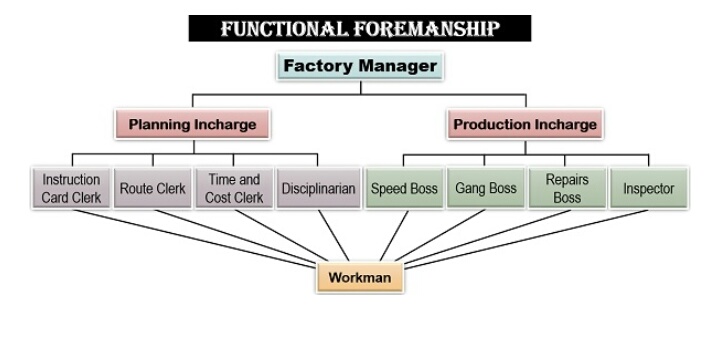
Factory Manager

A factory manager is a person who holds the highest managerial position in the unit and is responsible for the proper functioning of the organisation.

Planning Incharge-

A planning incharge is responsible for the formulation of policies, strategies and procedures of the operational activities. To simplify the work, following four clerks are appointed under the planning incharge.

a. Instruction Card Clerk:

The instruction card clerk will determine and direct how the work has to be performed.

b. Route Clerk:

A route clerk will decide what all is to be done and the steps which are to be taken to perform a particular task.

c. Time and Cost Clerk:

The person who determines the time limit in which the work is to be completed and the cost involved in carrying out each task is known as a time and cost clerk.

d. Disciplinarian :

A disciplinarian is a clerk who ensures discipline, follows rules and regulations and code of conduct in the organisation.

Production Incharge :

A production incharge needs to take care of all the operational and production activities. The four clerks assigned under a production incharge are as follows :

a. Speed Boss :

The speed boss is responsible for getting the work done on time.

b. Gang Boss :

The person w looks after the availability of all the equipment, tools and accessories is a gang boss.

c. Repair Boss :

The repairs boss has to take care of the repairs, maintenance and overhauling of the tools and machinery used for production.

d. Inspector :

The inspector is responsible for ensuring that all activities are being carried out in a planned manner. He/she also checks whether the quality of the products are as per standards or not.

Workman : He is a labour or worker at the operational level of the organisation who is responsible for actually performing the given task. Each worker is supervised and monitored by the eight different clerks, as mentioned above.

2. Standardisation and Simplification of Work :

Standardisation is the process of fixing well thought and tested norms with a view to maximize efficiency of work. Standardisation of product implies that the size, design, quality, shape etc of the product should meet the requirements and tastes of consumers.

Simplification means eliminating superfluous sizes, varieties and dimensions. It’s aim is to eliminate unnecessary diversity of products and thereby reduce costs. It will also help in achieving economy in the use of required machines and tools.

3. Work Study :

Taylor emphasised on examining and analyzing the working at the operational level of the organisation. It develops a systematic course of action and resolves the problems faced by labours and workers who are responsible for accomplishing the given task and duties.

Under this technique there are following four significant concerns of the organisation :

a. Method Study :

The managers come across numerous ways of performing a particular task or carrying out the production of goods or services. Out of all these possible methods, selection of the most appropriate way, which is cost effective and also increases the production is considered a method study.

b. Motion Study :

The motive behind conducting this study was to determine the movement of workers while performing a job. According to Taylor, it is necessary to analyze the movements of workers like how many times he lifts the objects, puts the objects because all these movements sometimes delay the work. Thus this study helps in knowing the productive and unproductive motions.

c. Time Study :

Analysing the time consumed for carrying out the given task in a specified manner is Taylor’s another scientific management technique which is called a time study. If an activity takes more time than the defined standard, it may lead to delay and decline in productivity. And if a task is accomplished much before the given time, it may lack efficiency.

d. Fatigue Study :

If an individual keeps on working without rest or pauses, it affects their health and efficiency. Therefore, fatigue study originated. This study seeks to find out the amount and frequency of rest intervals in completing a task. The objective of study is to find out how long a person can perform the standard task without any adverse effects on his health.

4. Differential Piece Wage System :

Taylor strong advocated piece wage system. He wanted to differentiate between efficient and inefficient workers. Under this system of wage payment, wages are paid on the basis of work done. According to him, higher rates were given to the workers who are producing standard products or more and lower rates were given to those who are producing less. Hence he talked about performance based remuneration and incentive based motivation.

5. Mental Revolution :

Taylor gave a powerful concept on changing the perception and attitude of both the employees and the management. They should both work together considering each other as family. There must be proper coordination and understanding among workers and the management in order to achieve organizational goals. Both of them must value efforts of each other and work together, creating a positive environment to achieve common organisational goals and objectives.


Summer vacation and Rasna

This year we are in the long vacation, Sunday lost its special power, every day is Sunday and we don’t have the excitement for summer vacation, but remember the time when we are in 4th or 5th grade we were too excited for summer vacation for playing in the park whole day, no school no routine and after coming from the playground ma used to make us RASNA, on that time it was felt like heaven, for the ’90s kid so many memory wrapped with Rasna.

Rasna is a soft drink concentrate brand, it’s an instant drink

Rasna is an Ahmedabad based company was launched in the mid-seventies but started gaining popularity in the eighties when the market was dominated by carbonated soft drinks like Thumbs up, limca. Rasna is very famous among during ’80-’90s. Parents didn’t allow us to drink soft drinks always, as it’s not a good habit to drink too many soft drinks, but RASNA also a drink but little different, it has many fruit flavors and we can make the drink by mix Rasna powder to the water so Rasna abled to create an image that it’s a healthy product that kid can enjoy, and tastes good and also it had reached the popularity for their attractive tag line and ad campaign. I remembered when I finished drinking Rasna I always said that “I love You Rasna”

Rasna is really Iconic Brand, that really a perfect example of good old days.

FUNCTION OF MANAGEMENT


According to George R. Terry, “Functions are the main entities around which a manager builds an effective organization structure”. The study of functions of management is an important topic in the field of management, the basic characteristics of efficient management are common whether the unit to be managed is as small as a family or large enough as a business, social, political or religious organization.

The main functions of management are:

  1. Planning
  2. Organizing
  3. Staffing
  4. Directing
  5. Controlling
This image has an empty alt attribute; its file name is 15-functions-of-management.png

1. Planning

 Planning is decided in advance and it is an important and vital function of management. Planning is done to chalk out the future course of action and according to M.E. Hurle, “Planning is deciding in advance, what is done and it involves the objectives, policies, procedures programming for attaining enterprise goals”. Planning is a critical evaluation of relative merits and demerits of alternate policies and actions and in choosing the best program for achieving the predetermined objectives and targets.

2. Organizing

To organize means to put into working order and arrange on a system and organizing can be defined as arranging several complex tasks to manageable units and defining the formal relationship among the people who are assigned the various units of tasks and the process of organizing is very essential for accomplishing the objectives of the organization set by the administration and planned by management.

3. Staffing

The staffing of an organization is as important as the structure itself since successful performance by individuals determines whether the structure can produce its results successfully or not and staffing is a process of matching the jobs with the individuals. Staffing requires and involves the recruitment, selection, training, placement, compensating, promotion and demotion, and finally, the retirement of an employee and the sole aim of staffing is to take the right man for the right job and it needs man power-planning, job analysis, and such other staff functions. Psychology and sociology have added a considerable and important of knowledge and practice in this area of the managerial function.

This image has an empty alt attribute; its file name is directing-as-management-function-9-728.jpg

4. Directing

Directing means telling people what to do and seeing that they do it to the best of their ability. As a process of management, directing is concerned with getting work done through, and with people, they require continuous and encouragement to work effectively. According to Terry, “Directing means moving to action and supplying stimulating power to a group of persons”. Good planning and the best organization may fail to deliver goods if the direction is faulty and is not up to the mark. The direction is concerned with the execution of plans and it initiates organized action and breathes life into the organization and speaking, the direction is Management in action and it includes:

  1. Supervision
  2. Communication
  3. Leadership
  4. Motivation

5.Controlling

Control is an important function of management and it is an essential feature of scientific management and control ensure the qualitative and quantitative performance of work in the organization for the achievement of objectives and completion of plans and it is the binding force that orderly links all components of an enterprise. Controlling includes an evaluation to determine whether planned objectives or results have been achieved.

Entrepreneurship

What is Entrepreneurship?


Entrepreneurship is an activity which is done by a person to bring out the social change in the world, by innovative technologies, services, products, etc.

In a more formal definition, Entrepreneurship is the activity of setting up a business or businesses, taking on financial risk in the hope of profit.

Hence, entrepreneurship is an act by which a person became independent and lives a life on his/her terms and conditions. Entrepreneurship is about being your boss.

Who is an Entrepreneur?

An entrepreneur is a person who brings about changes for the betterment of society.

An entrepreneur is someone who sees the world from a different angle. An entrepreneur is a risk-bearer, organizer, and innovator.

Entrepreneur as a risk-bearer

As a risk-bearer, an entrepreneur is the one who buys certain factors of production changes them into a product and sells them at uncertain prices in the future. There is uncertainty about the prices, which is not an ordinary risk that can be insured therefore the entrepreneur is a risk-bearer.

Entrepreneur as an organizer-

As an organizer entrepreneur combines the labor, land, capital other resources to make a product. After selling this product in the market and subtracting all the receipts which remained is the profit.

Entrepreneur as an innovator

As an innovator entrepreneur is the one who introduces a product, a service or a technology in the existing one to improve the lives of the people.

Example of Entrepreneurs


Every entrepreneur has a different vision to see the world to find out the best opportunity for them as well as for the improvement of society.

Many successful entrepreneurs influence the world in different ways because as every individual is different, every entrepreneur is different.

Steve Jobs will always be the most famous and successful entrepreneur in the world. He formed an apple computer company. Jobs’ inventions have been a boon in technology. He passed away with a net worth of over $8.3 billion.

Oprah Winfrey is one of the most successful lady entrepreneurs in the world. She is the richest African-American woman. Despite having a past full of thorns she never gave up in life. Now she owns a cable network company named OWN meaning Oprah Winfrey Network. She acquired the name “queen of all media”. She is the only multi-billionaire in American history possessing a net worth of 2.9 dollars.

Elon Musk, who doesn’t know about him. He is one of the most influential South African born American. He launched his first company Zip2 Corporation, in 1995 with his brother, Kimbal Musk and X.com in 1999 which later became PayPal.
In 2002, he founded SpaceX which is a huge success.

These are some of the examples of the most influential entrepreneurs, who are trying to bring a revolution into the world.

Traits of the entrepreneurship

Creative thinking– creativity is an important characteristic of an entrepreneur. A creative mind thinks about new ideas. Instead of blaming the situation, they find a solution to a particular problem. They have amazing imagination power. They think that every product, service has a scope of improvement.

Embrace changes– successful entrepreneurs are very flexible about the changes. They are always ready for the changes and take the advantages out of the situations.

Hard work vs smart work– Entrepreneurs know when to work hard and when to work smart. They know that neither of the two can substitute each other.

Use money wisely– Money management skills of the entrepreneurs should be very good. They should know where, when, how much to invest.

Vision – successful entrepreneurs know everything about their business- why the organization exists, how a product or a service will bring a difference to the existing one, in which market is to be launched.

Maintain the consistency– successful entrepreneurs are always consistent with their work. They know that success can’t be achieved overnight. They should not give up on the tough situations.
There is a famous saying by an entrepreneur –
“Tough times never last, but tough people do.”- Robert H. Schuller.

RESTRICTIONS ON UBER REMOVED

A Colombian court reversed an order that required ride-hailing company Uber to temporarily halt it’s activities in the country last year and to change the company’s service delivery model.

The Industry and Commerce Superintendency (SIC), which regulates fair competition and protects consumers, said Uber had violated the rules of competition in a taxi company lawsuit in December. In February Uber resumed transporting passengers with a new model of service that allows users to rent cars with drivers.

But in a decision dated Thursday, the Superior Tribunal of Bogota said the time limit for the taxi company to present its complaint had expired.

The SIC has repeatedly fined technology companies like Uber and Rappi this can mainly be attributed to the lack of regulatory framework for delivery and ride-hailing apps. DiDi and Cabify also operate in the country.

“It must be remembered that the situation of digital platforms in regards to the provision of these types of services is a regulatory issue that must be resolved via laws,” the head of the SIC Andres Barreto .

After recently announcing salary cuts and layoffs for its workers, Uber has furloughed hundreds of its employees in India, as coronavirus is chewing up sales. The company has announced that it will no longer operate with 600 workers in its Indian business, as the company is looking to slash expenses in the wake of a pandemic. The figure is 25 per cent of Uber ‘s total nation workers, Uber said Tuesday in a tweet. The announcements made by Uber follow an earlier statement made by its local competitor Ola, which had laid off 1,400 employees or around one in every third employee.

 “Around 600 full time positions across driver and rider support, as well as other functions, are being impacted. These reductions are part of previously announced global job cuts this month,” Pradeep Parameswaran, President for Uber’s India and South Asia businesses, said.

Job cuts were implemented through out various departments from client and driver service, corporate growth, compliance, regulation, communications, and finance. As part of the company ‘s corporate turnaround program, Uber has retrenched about 6,700 employees this month. The American multinational ride hailing company said it gave the laid off workers 10 to 12 weeks of pay. Uber has provided them with medical benefits over the next six months.

“The impact of Covid-19 and the unpredictable nature of the recovery has left Uber India with no choice but to reduce the size of its workforce. Today is an incredibly sad day for colleagues leaving the Uber family and all of us,” the statement said.

But with easing lockdowns the company said on Wednesday trip requests were gradually picking up, but still remained significantly below prior year levels, as several countries start to lift coronavirus-led restrictions.

Trip requests are now down about 70% from a year earlier, slightly lesser than April’s 80% drop, Chief Executive Officer Dara Khosrowshahi said in a conference with Bank of America analysts. He said the company’s rides business is improving on a week-over-week basis, adding that the surge in food-delivery orders at Uber Eats recorded in the first quarter, showed no signs of slowing in May, easing concerns of investors who thought it could be a one-off trend during the pandemic.

Source: 1.https://in.reuters.com/article/uber-colombia/colombia-court-overturns-restriction-on-uber-idINKBN23R0DQ?il=0

2.https://www.financialexpress.com/industry/sme/uber-lay-offs-coronavirus-lockdown-startups-uber-india-staff-fired-industry-salary-cuts-job-loss-uber/1970594/

3.https://www.deccanherald.com/business/uber-signals-recovery-in-rides-as-coronavirus-lockdown-restrictions-ease-845468.html

SCIENTIFIC MANAGEMENT


The origin of scientific management dates back to the year 1832 when Charles Babbage discussed the principles of scientific management in his book “The economy of manufactures”. In real sense, scientific management owes its origin to Frederick Winslow Taylor, who is commonly regarded as the father of scientific management.

MEANING OF SCIENTIFIC MANAGEMENT

Scientific management may be regarded as a set of scientific techniques that are supposed to increase the efficiency of an enterprise. Under scientific management, the selection of men, machines, materials is made by a scientific approach. Here, all the organizational activities are performed by rationality and proper discipline, this scientific management is a logical approach towards the solution of management and it assumes that the methods of scientific inquiry, analysis and experimentation can be applied to the activities of managers. It means approaching the problems of management in the manner and spirit of scientific research using tools such as definition, analysis, experiments, etc. It is ‘Scientific Management’ as opposed to ‘Traditional Management’ based on the rule of thumb, trial, error. As said by Peter F. Drucker The cost of scientific management is the organized study of work, the analysis of work into its simplest elements and the systematic management of the worker’s performance of each element”.

This image has an empty alt attribute; its file name is scientific-management-theory-by-taylor.jpg

We can summarise scientific management as:

  1. Scientific study and analysis of work.
  2. Scientific selection and training of employees.
  3. Standardization of raw material, equipment, and working conditions.
  4. Reasonable remuneration to employees.
  5. Scientific management is an economical method that makes the best possible use by integration and coordination of available resources.
This image has an empty alt attribute; its file name is techniques-of-scientific-management.png

MAIN CHARACTERISTICS OF SCIENTIFIC MANAGEMENT

1. A definite plan: To achieve predetermined definite objectives, management needs a definite plan, and the plan should be goal-oriented.

2. A definite objective: In scientific management, every organization has to establish the basic objectives and efforts are to be made by applying physical and human resources to achieve these predetermined objectives.

3. A set of rules: To make scientific management more effective, a set of rules are framed and these sets of rules are tested and verified as regards their effectiveness in the real business situations by a group of persons.

4. Economy: The main aim of scientific management is to achieve the economy of time, money, and labor, and the technique of economy is used for producing maximum at a minimum cost.

5. Scientific analysis and experiment: Before starting any work, the utility, effectiveness, and suitability of plans are to be tested and analyzed, and thus by scientific analysis and experiment, we can choose the best course of action.

6. Increase in efficiency: The techniques of scientific management help in increasing the efficiency of workers and new techniques and improved tools are used for increasing efficiency.

7. Time study: Time study is concerned with labor productivity and according to it, an estimate is made of the amount of work required to be done to perform a job.

8. Cooperation: In the present competitive situation, efforts should be made to establish a cordial relation between labor and capital. Cooperation is essential for efficient management and group efforts for group benefit can be the active cooperation of each individual. 

We Forgot the product name !!

Marketing is a process to promote the product and create value with the customer by selling products or provide service. There are so many times when companies marketing so well the brand name becomes the product name. We actually don’t realize that every day we use the name of the product actually their brand name. Here is some example

Google, it’s an inseparable part of our life today, our all curiosity satisfy google, we always say that “Google it” it helps us in so many ways ,Google Is the brand name the product name is Internet search engine

Parle-G evergreen morning snack. Parle-G is the brand name and product name is Glucose Biscuit

Brand Name Colgate, product name :Toothpaste

Brand Name: Nestle Maggie Products name: Noodles

Brand name: Photoshop Product name: Image Editing software

Brand name: JCB Product name : Excavator

  • Brand name: sellotape product name: transparent Adhesive Tape
  • Brand name: xerox product name: Photocopy
  • Brand name: Vaseline, product name: Petroleum jelly
  • Brand Name Fevicol Product name Adhesive
  • Brand name: Boroline product name: Antiseptic perfumed cream

Marketing is an amazing thing, we rarely used these products name, their brand brands names are their identify.

CAPITAL STRUCTURE

Capital structure signifies the composition of the amount of long-term financing and according to Gerstenberg, “Capital structure means the types of securities to be issued and the proportionate amounts that makeup capitalization”. Long term finds can be obtained from owners and borrowers. The owner’s fund consists of equity shares, preference shares, and retained earnings. Borrower’s fund (debt capital) includes debentures and other long term borrowings and the ratio between the owner’s fund (equity) and borrower’s fund is decided under the capital structure.

DETERMINANTS OF CAPITAL STRUCTURE

As stated earlier capital structure decision is highly individualistic and the capital structure of a company is planned initially when the company is floated. The initial capital structure must be designed very carefully since it will have long-term implications. However, the capital structure decision is a continuous one and has to be taken every time whenever a firm needs additional finances. Several factors affect the capital structure of a firm. Some of the important factors which must be kept in mind while determining the capital structure are discussed as follows:

1. Cash flow position

While choosing if capital structure the future cash flow position must be considered before issuing debt. Cash flow must not only cover fixed cash payment obligations but there must be sufficient buffer also, it must be kept in mind that a company has cash payments obligations for (i) Normal business operations; (ii) for investment in fixed assets; and (iii) for meeting the debt service commitments i.e. payment of interest and repayment of principal.

2. Interest Coverage Ratio

By the use of this ratio, it can ascertain whether the company can pay interest or not. The greater this ratio, the more will be the capacity of the company to use debt. The ratio can be calculated as under:

 Interest coverage ratio= Earnings before interest & Taxes/ Interest

3. Debt Service coverage ratio- DSCR:

 The debt service coverage ratio takes care of the weaknesses referred to in the interest coverage ratio-ICR. A higher DSCR indicated better ability to meet cash commitments and consequently, the company’s potential to increase debt components in its capital structure.

4.Cost of Debt

The capacity of a company to take depends on the cost of debt. In case the firm arranges borrowed funds at a low rate of interest then it will prefer more debt as compared to equity and vice versa.

5. Tax rate

High tax rate makes debt cheaper as the interest paid to debt security holder is subtracted from income before calculating tax whereas companies have to pay tax on dividend paid to shareholders. So high-end tax rate means prefer debt whereas at low rate tax the company can prefer equity in the capital structure.

6. Cost of equity capital

 The cost of a source of finance is the minimum rate of return expected by its Suppliers. Equity shareholders bear the maximum risk because no rate of dividend is fixed. To pay interest on debentures is a statutory liability of the company whether the company earns a profit or not. Thus, debt is cheaper as compared to ordinary share capital. The cost of debt becomes lesser because interest is a charge on the taxable income.