Innovations in technology have changed the way in which society acts. As classical scholar and university librarian James O’Donnell points out in the 1999 radio broadcast “From Papyrus to Cyberspace,” one generation’s frontier becomes the next generation’s reality. One can assume that with each new frontier there are gains and losses. For example, the invention of the automobile sparked a transportation revolution, but with this improved accessibility we also implicitly accept thousands of car-related deaths each year. Advancements in writing technologies have unpredictable changes in human roles and geography. Printing presses led to the spread of unorthodox ideas across the world and new forms of democratization, while the shift from a primarily oral to literate society brought with it new lines of exclusion between those who could read and those who could not.
James Engell, Professor of English and Comparative Literature at Harvard, highlights the point that such revolutions of technology do not occur suddenly but are instead a gradual shift within societies. Just as manuscripts continued to be produced well after the invention of the printing press, it is common for information from the internet to be written down on paper. Thus the challenge with emerging digital technologies is not that such societal shifts are occurring, but finding the most effective way new technologies can be integrated with the way things are currently functioning. Learn more about the impact of the typewriter on literacy in my short documentary The Shift from Handwriting to Typewriting:
The shift from handwriting to digital text and their associated issues continue to plague educators as one-to-one devices become the norm in schools. My English Department meetings often consist of heated debates concerning whether students should complete their coursework on paper or digitally. The topic seems to polarise the teachers within the department and we cannot collectively decide on the “correct” answer.
“students who write out their notes on paper may actually learn more” (Mueller & Oppenheiner, 2014).
In 2012, scientists find that the brains of preliterate kids respond like a reader’s brain when they write their ABCs, but not when they type or trace the letters (Pauly, 2016). Another research team reports that college students who transcribed lectures on their laptops recalled more information than those who took notes by hand because the use of laptops results in shallower processing (Mueller & Oppenheimer, 2014). Across three experiments, researchers had students take notes in a classroom setting and then tested students on their memory for factual detail, their conceptual understanding of the material, and their ability to synthesize and generalize the information. The two types of note-takers performed equally well on questions that involved recalling facts, laptop note-takers performed significantly worse on the conceptual questions (Mueller & Oppenheimer, 2014). This research suggests that perhaps completing tasks on paper may be more beneficial for students.
However, sometimes the purpose of note taking is simply to collect information. During novel studies I often have my students take notes to record key quotations or details from the book we are reading under the categories of the elements of fiction (e.g. setting, characters, style, theme). When forced to write on paper, I find students’ notes quickly become disorganised and chaotic. Factor in that a novel study last several weeks – sometimes months – I find students’ paper notes become more of a hassle than helpful.
Instead of making the paper-or-digital choice for my high school students, I share research findings and we collaboratively discuss the benefits and advantages of each format. I then prompt them to make the choice for themselves and give them the opportunity to change formats if they feel they made the wrong choice. In Benedict Carey’s book “How We Learn: The Surprising Truth About When, Where and Why It Happens” he refocusses attention away from a mono-solution to the learning conundrum, by prompting learners to consider the task at hand:
“It’s not that there is a right and wrong way to learn. It’s that there are different strategies, each uniquely suited to capturing a particular type of information. A good hunter tailors the trap to the prey” (Carey, 2014, p. 44).
My vision for my students is for them to discover for themselves how they work best in a time where they are living and learning during this technological revolution. The following is a lesson to prompt a discussion surrounding the ambiguity of the paper of digital argument:
While reading and writing remains at the heart of education, emerging technologies will continue to alter the concept of literacy itself. As we continue to move from written text to digitized information, educators must adapt their didactic methods to coincide with modern technologies. The technologies of handwriting and typewriting need not exist in a binary relationship in our postmodernist culture. They can co-exist, offering us a multiplicity of ways to communicate where each is geared for its own different purpose.
References
Mueller, P. A. & Oppenheimer, D. M. (2014). The Pen Is Mightier Than the Keyboard: Advantages of Longhand Over Laptop Note Taking. Psychological Science, 25(6).
O’Donnell, J. & Engell, J. (1999). “From papyrus to cyberspace” [radio broadcasts]. Cambridge Forum.
Ong, W. J. (1982). Orality and literacy: The technologizing of the word. London: Methuen.
Pauly, M. (2016). A Brief History of Handwriting. Mother Jones, 41(5), 60.
The Information Processing Theory is an approach to cognitive development that suggests a way in which humans process the information they receive. This theory contrasts a behaviourist that humans simply respond to stimuli. This theory suggests that information is processed in stages, much like the way in which a computer processes data (Orey 2002). Information enters the brain (or computer) through our senses (mouse/keyboard). Next, the information is processed in our working memory (processor/ram), where it is stored and recalled from specific areas of our long-term memory (hard drive). This recalled information can lead to an output response to the stimuli (monitor).
Turple, C. (2016).
Our sensory memory intakes information through seeing, hearing, smelling, tasting and touching. If we decide to pay attention to certain stimuli, it moves into our short-term memory, also known as our working memory as it is the place where we process information. In order for information to be stored in our long-term memory and formally learned, the information must be elaborated on through rehearsal to consolidate the new data.
Turple, C. (2016). Adapted from: Lutz, S. & Huitt, W. (2003).
We can then organize new information into existing knowledge sets (if information is similar to prior information) or create a completely new knowledge structure if the new information is unlike anything we have experienced before. Once information is stored in our long-term memory, we can later recall this knowledge back into our working memory to compare to incoming information or help elaborate on our knowledge experiences.
Many of these operations involve executive function to pay attention to new information, attend to rehearsal practices in the working memory and help consolidate information into our long-term memory. Unfortunately, new information can be lost at all stages of information processing. If incoming stimulus is not paid attention to in our sensory memory, our brain does not notice the information. In our short-term memory, only a maximum of five stimulus can be used at once – if this information is not encoded within 15-30 seconds it will be lost altogether. In long-term memory retrieval, there are also chances of encoding failure during information consolidation if elaboration does not occur or the information cannot be properly organized in existing knowledge structures. Finally, information in long-term memory could be lost through a retrieval failure or “overridden” if new information contradicts something previously learned.
Watch my visual breakdown of the stages of the theory and applications to classroom practice:
When considering the stages of the Information Processing Theory, there are 5 easy steps teachers can take to support students in the acquisition of new information.
RECEPTION to ensure teachers gain students’ attention using an abrupt stimulus change to focus students’ sensory memory on the lesson.
RETRIEVAL educators should stimulate recall of prior learning and skills from students’ long-term memory into their working memory.
I like to use kinesthetic warmups that gets the students moving around and talking to peers other than their elbow partner. Simple activities work great such as having the students move around the room and when the music stops (often I use the songs above), I yell out a number. Students must form a group with that many people and answer a question about the content from the previous lesson. Scholastics’s Mind Up Curriculum books are full of such activities.
RECEIVE information transmitted by the teacher that should have distinctive features and suggest a meaningful organization of ideas for students.
I started “branding” my lessons by using the same template and colour scheme for all lesson within a unit. For other skills such as the MYP Approaches to Learning, I always use the same cover slide. I have also started using less unconnected slides and utilising animations to put together the “pieces” of a slide. Finally, acronyms and step-by-step procedures have become the focus of my lessons. For example, when I was teaching my students about how to find reliable online sources, I began the lesson by playing the research song, played the kinesthetics warmup game, then introduce an acronym to help them remember the criteria for reliable websites:
RESPOND or experience the information for themselves to absorb knowledge into their preexisting knowledge sets by eliciting performance from students.
Arguably the most important step in student learning! Students need to immediately do something with their new knowledge. When introducing the CRAP acronym for determining reliable resources, I had students decide whether example websites are reliable or not. One issue I often run into for this stage is running out of time when I have 30 minute class time blocks. What I have come to learn is it is better to break up the learning into smaller pieces where students have the opportunity to immediately respond to new knowledge, rather than using a whole block to introduce content and the following block as a work period.
REINFORCE by providing ongoing feedback to students and especially give them additional performance opportunities to apply the feedback.
Encouraging students to make mistakes and learn from those “failures” is key. I try to give as many opportunities for students to experiment with new ideas by offering several chances to practice new skills. I aim to give my students individual verbal feedback once a week and written feedback every other week. Since I utilise Google for Education Apps Suite in my teaching, this is often done through the comments function. I have learned to create one ongoing template my students work in throughout a unit so all of my comments and their work is in one place. This way, it is easy for both myself and students to see their ongoing progress.
Turple, C. (2016).
More than anything, learning about the Information Processing Theory reminded me of the importance of lesson warm-ups and “hooking” students into a learning activity. The theory also offers a simple explanation of how memory may work and is something I have even taught my students to make them more away of their own learning behaviours.
References
Lutz, S., & Huitt, W. (2003). Information processing and memory: Theory and applications. Educational Psychology Interactive. Valdosta, GA: Valdosta State University. Retrieved from http://www.edpsycinteractive.org/papers/infoproc.pdf
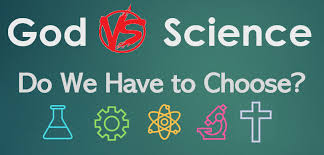
“Science” and “God”, the two words which are often seen as separate entities. These words seem conflicting to most of us and are often a topic of debate. Science seems to question the existence of God and believers of God often question why we are unable to explain the entire universe completely by science till date, a question on the success of science. We can often come across debates on televisions, radio, magazines, etc where people try to prove one as superior over the other. But, are they really two different things? Are they conflicting terms? Or are they same?
A deeper thought over it can clear our confusion. If we deep dig, we find that indeed both are connected. We really don’t need to choose between them. Science and God, are superior powers. The differences arise when we start associating God with some particular religion and Science with the only education. In reality, science is the process of thinking God’s thought after him. “An equation is really nothing unless it expresses a thought of God”, according to Ramanujan. They both actually merge at the spiritual level.
When we talk of science, it is the theories, the fundamental laws that very well explains the nature around us. It offers an explanation of all the natural phenomena in a very beautiful way and at a very basic level. It helped us understand how to converse in the language of nature, i.e in mathematics. It gives human power. The more we as humans understand science, the more powerful we become. Visit the days when humans started to understand science to get to know about the secrets of nature, the things they imagined then are now a reality. The gadgets they considered as their dreams are now in our hands. The technology we imagine today will also become a reality pretty soon. Science gave a power to humans to achieve the impossible.
God, on the other hand, is another superiority. There has been no proper evidence of someone seeing a God. We have not seen God, but we all believe in a “power” that is superior to all of us and many refer to this superior power as “God”. God gives humans the strength and power by making us understand the language of love and humanity. Spirituality is the heart of a human being and through God, we reach here. God helps us understand our potential and make us believe in our strengths. It changes our perception and makes the world a very beautiful and peaceful place for us. The world is incomplete without God.
We can thus conclude, that both Science and God are a source of immense power to human beings and both are tied together. Both speak the same language. The more faith we develop in God, the more we get close to science, the more we understand science, our belief in the existence of God becomes stronger. Louis Pasteur rightly said that “a bit of science can distance us from God, but more of it nears one to him”, and that is for sure. Diving deep into them will give us immense power and peace.
In the scientific book, sounds of frogs and toads is often said to be ‘croaking’. Whatever their musical qualities, vocalizations are conspicuous features of behavior of most frogs and toads. Acoustic signalling has a great importance in the breeding ecology of most frogs. Acoustic data are used in taxonomic studies of frogs. Thus, researchers today are very interested in studying sounds produced by anurans to know about their behavior, study their evolution, monitoring population, comparison of species and find ways for their conservation.
In anurans, generally males are involved in bioacoustic signalling. Only a very few female and at very few times are found producing signals. Anuran vocal repertoires can be into various calls namely advertisement calls( mate calls), courtship calls( responsive calls), aggressive calls, release calls, defensive calls. These are useful in male-male and male- female communications. These sounds are also used by them to protect them from predators too. They can estimate distance between opponent and get warned. Further, the produced sound defines the species, it’s size, it’s habitat , it’s dominance, etc in some way or other.
Advertisement calls are often referred to as mating calls and are principal signals given by males during breading season. Experiments have shown that females approach conspecific calls. Advertisement calls are often found to stimulate hormone production in females. It also expertises male’s position to other males.
The vocal behavior of male frogs often changes when females are nearby or are approaching. Courtship call are a sort of continuous trill( unlike two-note advertisement calls). These are simply increased call rates. Female courtship calls also exists. These are given in response to the calls of male, which tends to be at low intensity and therefore, are hard to hear. It enhances the ability of males and females to find each other.
Aggressive calls are produced as a sign of defence for their calling sites against conspecifics. These are often called territorial calls. Then there are release calls given when male anurans are clasped by other males. Further exists distress calls, which are generally loud screams to describe vocalisations given by frogs being attacked by predators. Alarm calls and defensive calls are to warn neighbours of danger or startle the predator, to allow victim to escape.
The pitch(determined by frequency) of sound is an indicator of anuran’s body size. The frogs with higher pitch are found to be small in size while the frogs having low-pitched calls are large and heavy. Call structure is an indicator of habitat of frogs( whether near waterfall or near stream or in forest or in open habitat). For ex: frogs living in dense forest are large in size and produce low pitched calls and vice versa. Thus, there also exists preference in calling site for different species. If male and female, both are at the same level, then high frequency components will suffer greater attenuation than low frequency components. But, if either caller or receiver is elevated, then differential loss of higher frequencies is reduced.
Comparison of frogs living in Amazonian forests with those in floating meadow habitats revealed that forest species have significantly lower-pitched calls. The forest species generally are larger than those in open areas, and call frequency decreases with increasing body size. Calls of many species probably are not adapted for long range propagation, but for ease of localization at short distances. Phylogenetic differences probably are important as well. Forest frogs have very different call structure than open-habitat frogs. They tend to have more narrowly tuned calls with lower pulse repetition rates than open habitat frogs. Call intensity is related to factors other than habitat structure. For ex: frogs that call in open habitats tend to call in much denser choruses than those in forested habitats, and competition among males should favor the evolution of very loud calls.
Thus, understanding sounds of anurans is a very interesting part of study and researchers are working on it, striving to discover more, finding ways to conserve some endangered species( like N. sahyadrensis).
Have you ever run out of space that captures some of your cherished moments? Isn’t it annoying? No more hassles, after long research, now you’ll be able to record high-quality 8K videos and 360 degrees videos too. It’s estimated that 90 minutes equivalent to your favorite football match in 4K quality video takes up around ten gigs of space, but with the new technology, you can half it down to 5 gigs only.
A boy watching his photos and videos captured on a camera.
Suppose you know that Netflix and YouTube have restrictions over streaming videos, not more than 480p resolution. It has been more than three months now in India; still, the capping exists, although some internet providers did remove it slowly. The social isolation has made people binge more than regular days, seeing an increase of 20 to 30 percent in subscription and user base. More people are now connected, increasing the bandwidth. Hence you may observe slow speeds in this period. Netflix is switching to AV1 codec to save data while watching the show when it delivers its content over the internet. This new research may be able to save more data.
A man binges for on-demand streaming shows.
Initially, the digital video started with H.120 encoding but wasn’t practical until H.261 came up based on the DCT (discrete cosine transform) compression. In 1991, MPEG-1 revolutionized the video sector with higher resolutions, which reached us in the form of VCDs and DVDs. In the late 90s and onset of the 21st century, we saw the currently used MPEG-4 or the most widely used H.264 video encoding. You may know this if you’re familiar with video editing.
After the H.265/HEVC encoding, now steps in H.266/MPEG-I Part 3/VVC (Versatile Video Codec) presented by Fraunhofer HHI with other partners including the significant-tech leading brands like Apple, Microsoft, Qualcomm, Sony, and Intel, with vivid HDR and better support for 360 degrees video. As earlier mentioned, AV1 codec, 30 percent better than H.265, which is adopted by Netflix, is royalty-free. Now, to support H.266 major hardware updates may be required to handle such heavy compressions and will take time for its actual implementation. Like for example, when H.265 was finalized at the beginning of 2013, Apple lately adopted it in the year 2017 as a part of the iOS 11 mobile operating system.
The VVC logo
The 500 pages specification document finalized this month on 6th July 2020, but actual usage in the video industry might take about an estimated 7-8 years. Why do we need such compression? By 2022, more than 80 percent will be part of video streaming, which may increase on more content based on 4K video quality as well as growing numbers of 360 degrees videos. The existing widely used browsers support AV1 codec, but H.266 to properly patent may lately delay web surfing too. Twitch and YouTube may become one of the first firms to implement as they’ve already implanted VP9, again a royalty-free codec by Google itself.
Along with this, MPEG-5 Part 1 or EVC (Essential Video Coding), and MPEG-5 Part 2 or LCEVC (Low Complexity Enhancement VC) is set to launch out. For us, a non-geeky person may visualize it after watching the following graph below.
Average bit rate savings graph. Courtesy: BBC Research
You may have tried to burn the paper by concentrating the light focused at a single point using a magnifying glass. Now technology has advanced up that within a few seconds as the data given to a machine can design and cut your metal piece with the help of a unique device. This device is none other than LASER itself. The laser has many uses in day to day life like bar-code reading, laser cutting, laser welding, and whatnot. Usage also includes surgeries, and even the data to read this post is sent through a fiber optic cable using laser technology.
A laser metal cutting machine on a piece of metal to shape according to a design.
A laser is a device that can focus by emitting a beam of a consistent source of light using the amplification process. Various types of lasers found include gas lasers, fiber lasers, diode laser, and much more. A laser requires three prime factors, generally consisting of a pump or the vital source of energy along with the medium to travel and a resonator using two or more mirrors. We even observe the phenomenon known as the total internal reflection or TIR.
The laser invention won the most prestigious science honor, the Nobel prize in 1964, and again in 2018 for the optical tweezers. These tweezers can be so sturdy that it can make changes in a single atom too. Okay, you may have been a fan of Star Wars movie if you like, they demonstrate the use of lasers, especially the blasters. But, they’re not lasers; indeed, they’re plasma light in the movie.
Fiber optic cables used in networking.
One of the Nobel laureates along with the researchers from the Russian Academy of Sciences have built up a new technology to produce even more powerful laser. The power output from the more modern methodology can give up to 10 ^ 23 Watts by decreasing the duration of the pulse just to some femtoseconds. This method can cut down the operating costs; this study has grabbed attention and gained financial support from various institutions in Canada and Russia.
To generate a pulse for a short span, the researchers need a deep dive into the effects of non-linear optics. Still even at the limits of 10 femtoseconds pulse, with the energy of 3 joules, the intensity peaked up to 300 terawatts. Now with a further intention with 13 joules, a target of 3 petawatts is planned within five femtoseconds.
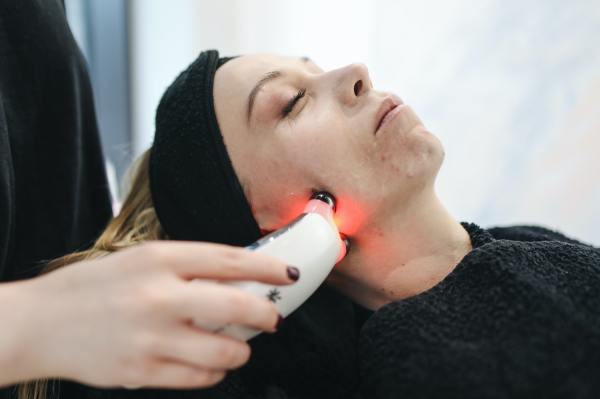
Laser treatment done on a lady as a procedure for a therapy.
The lasers have been so widespread that we see it for hair removal, too, where the hair follicles get treated. The laser is also found in your laptop or your computer if it has an optical disc drive. The data on the disc read by using a laser when it falls on the lands and pits present on the surface to convert them into electrical signal sequences. The laser has been extensively used in the field of defense too. There are handheld laser pointers available, but make sure that it is legal in your country to own one or may land up into jail. Be careful with laser pointers and use them effectively if you own one of them.
“Life is like riding a bicycle. To keep your balance you must keep moving” – Albert Einstein
It is rightly said never stop learning….because life is the teacher which gives you the opportunity to learn new things each and every day. It motivates you to learn and defeat the challenges which we come across. The greatest teacher you could ever have is your life. Knowledge can come from anywhere and everywhere.
Life gives you the best lessons from sacrifice to compromise, and a wise man will always take each of them seriously. All we need is to grab it and inculcate that in our day-to-day lives. Many times, you may feel down but remember that it’s not the ending. Failures will force you to loosen down but Losers are the ones who refuse to stand up, not the ones who fall down repeatedly.
No matter how many times you find yourself lost or broken; all that matters is the time when you didn’t feel like starting things all over again. One must always hold an attitude to continue learning new things. Learning is a never-ending journey. From birth till death , we are in continuous cycle of learning new things. It is a necessary part of our life.By observing new things and experiencing it in our lives, our sight of perspective broadens and changes the way we see the world. It improves our behavior and the way we think by expanding and challenging our understanding. We get to know a lot of things and these things become our memories which are lessons to the life. These memories could be good or bad, that doesn’t mean bad memories are to neglected. Each and every memory gives you a lesson to learn something new experiences. Our education system teaches a lot, but that is relevant fir bookish knowledge. Life teaches you the lesson to live .
“The past can hurt. But the way I see it, you can either run from it, or learn from it” – Walt Disney
Never think that you know so much that doesn’t mean the end of your learning procedure. No one is prefect in knowledge Each one of us learn step by step through life. It is a continuous and when life teaches you something, be an optimist to learn it as quickly as possible. Life will keep on teaching you every moment of the day, and a real hero is the one who remains open to changes or take lessons from every incident that takes place in his or her life. Learning is about enriching our minds. Learning new things represents the growth mindset. To be good learner you should be able practice focused hinking modes of brain. Focused thinking is when you concentrating on something that you try to learn. There is no age or limit to which we can learn, whenever you want to know new things explore it. It only depends on the will to learn. Try to innovate new things in your life. Stay Positive Stay Learning…..!!!!!!
“The world is a university and everyone in it is a teacher. Make sure when you wake up in the morning, you go to school.” ―T. D. Jakes
Never stop dreaming, never stop believing, never give up, never stop trying, and never stop learning – Roy T. Bennett
Love is the most powerful emotion a human being can experience. The strange thing is, almost nobody knows what love is. Why is it so difficult to find love? That is easy to understand, if you know that the word “love” is not the same as one’s feeling of love.
“The best and most beautiful things in this world cannot be seen or even heard,but must be felt with the heart” – Hellen Keller
What great Philosophers say about Love?
Aristotle : Of the classic ideas on love, for Aristotle , none of this love and friendship is attainable without first achieving self-love. The good person must be a self-lover, for he himself will profit from doing fine things, and he will benefit the others.
Sadhguru : When you talk about love, it has to be unconditional. There is really no such thing as conditional love and unconditional love. It is just that there are conditions and there is love. The moment there is a condition, it just amounts to a transaction. Maybe a convenient transaction, maybe a good arrangement – maybe many people made excellent arrangements in life – but that will not fulfill you; that will not transport you to another dimension. It is just convenient. When you say “love,” it need not necessarily be convenient; most of the time it is not. It takes life. Love is not a great thing to do, because it eats you up. If you have to be in love, you should not be. You as a person must be willing to fall, only then it can happen. If your personality is kept strong in the process, it is just a convenient situation, that’s all. We need to recognize what is a transaction and what is truly a love affair. A love affair need not be with any particular person; you could be having a great love affair, not with anybody in particular, but with life.
Simpne de Beauvoir : “The reciprocal recognition of two freedoms” Beauvoir’s thought on love is between authentic and inauthentic love. For her, loving inauthentically is an existential threat. When we believe that love will complete us, or when we lose ourselves in our beloved, we erase ourselves as independent beings. This is what de Beauvoir called loving in bad faith. In her society, men were encouraged much more than women to have interests and ambitions outside of their relationships, with the result that women were especially vulnerable to the dangers of inauthentic love. Authentic love, on the other hand, involves partnerships in which both parties recognize each others’ independence, and pursue aims and interests outside of their relationship. Authentic love must be based on “reciprocal recognition of two freedoms”. This means that neither partner is subordinate to the other, nor takes all of their meaning from their love for that partner. Instead, each is an independent whole who freely chooses the other anew with every day without trying to possess them entirely.
Bell Hooks : In All About Love: New Visions (2000) , she argues that our modern definition of love is too watered down by overuse of the word. Working from the idea that love is a verb, she then suggests ways to improve our modern concept of love and prevent what hinders it. She notes with a fervor that power discrepancies and the differences in how men and women are expected to approach love are a particular problem.
“The fear of being alone, or of being unloved, had caused women of all races to passively accept sexism and sexist oppression.” — Ain’t I a Woman? (1981)
Jean – Paul Sartre : Sartre and Simone De Beauvoir had, quite possibly, the most famous open relationship of all time. Sartre first proposed the idea in a letter: “What we have is an essential love; but it is a good idea for us also to experience contingent love affairs.” Sartre wrote extensively on love, especially in terms of the tension between freedom and objectivity, and seemed to struggle with the idea throughout his entire relationship. True love, Sartre felt, can come to fruition when both partners have a deep, mutual respect for the other’s freedom and resist the desire to “possess” each other as objects. For him, if all romantic relationships centered on the idea of ownership, there would be little room for introspection. Wrapped up in the pursuit of love is the idea that we are not only seeking a partner, but deeper insight into ourselves. Put more plainly: We’re looking for the “other half,” the “being” to our “nothingness.” Either way, Sartre got a whole lot of insight, especially for a guy with an oddly shaped head and a lazy eye.
“Love asks me no questions, and gives me endless support – William Shakespeare”
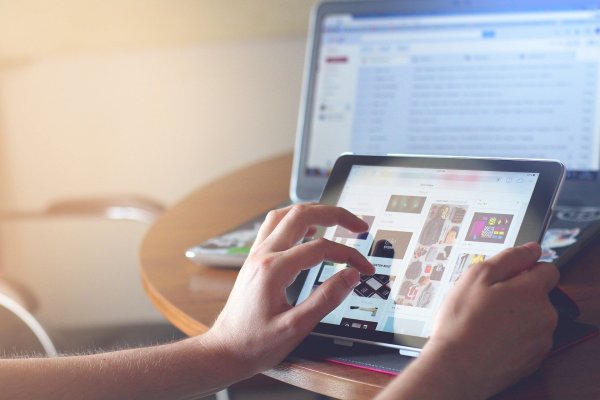
How many hours do you stay connected with your favorite device, maybe the phone or your PC from which you are currently reading this post? A rough average can be not less than three hours up to nine hours or even more than that if you’re a social enthusiast or a gamer, these limits can go beyond that. Don’t you feel something is wrong? Also though time passes by, these little things go unnoticed, and we enjoy our life chatting and sharing photos, videos with them. But not everyone is capable of doing so, or their life is on the verge of destruction due to technology. Cyberbullying and harassing are prevalent, and also this pandemic has made every one of us spend more time on our devices. The transactions we do can be unsafe, and recently we see bans taken up the Government of India to highlight the nation’s potential security threat to steal user’s data and use them for their benefit.
A user accessing images on the tablet.
According to the new research done on around 2800 teens aged 8 to 11 from 17 different high schools in Australia, keeping two points in consideration about the internet and emotions, are they interconnected? Although web access is easily reachable to them, their parents do need to need to monitor their activities. But this isn’t easy for them; also, any wrong intention by an attacker can persuade the mind of the small children quickly through audios and visuals. The effect is minor though keeping them engaged in good education is also a must.
You may remember the case of Cambridge Analytica, where ads were shown to American users from 50 million user datasets of Facebook without any user permission. Eventually, GDPR for EU citizens made their online presence safer, and now users can know what data they are giving to them. You may notice now that most of the websites ask the consent for cookies of the site you are visiting when you go through them.
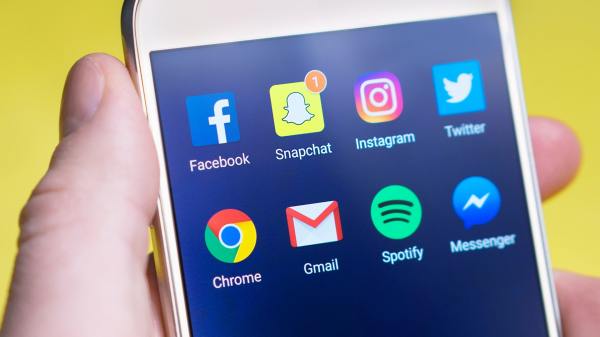
Some of the regular social messaging apps we use regularly.
A group of students from the University of Indonesia, after three months of effort, finally came up with a device known as Nettox, which can measure the levels of oxygen in your body along with the variation of heart rate factor or the HRV. The device will notify if the levels substantially dropdown beyond the regular rate due to prolonged usage on the devices. They are on the way to patent their creation.
If one is self-reliant, we don’t even require such devices. One should develop good habits, spend quality time with family and relatives or roam inside the room instead of being stuck to the display. The virtual age is growing and spanning everywhere if the uses are proper; it’ll help more in the future. There is so much news around the world, some are positive by using the technology appropriately, or else it can be dangerous too by getting addicted to it. One can inhibit the actual values of self-love and explore the hidden talents within you; you can polish them and outshine for a decisive lead in society.
The world of code can save your life or turn into a holocaust.
The word Bollywood is a play on Hollywood, with the B coming from Bombay (now known as Mumbai), which is the center of the Indian film world.The word was coined in the 1970 As their popularity grow, movies created in the Mumbay’s reached the number of 200 annual movies, West continued to ignore cinema efforts of Indian filmmakers, but they acknowledged them when India managed to overtook America as the biggest producer of movies in the world.
In 1913 and the silent film “Raja Harishchandra”the first-ever Indian feature film and First full-length Bollywood silent movie.Its producer, Dadasaheb Phalke, was Indian cinema’s first mogul, and he oversaw the production of 23 films between 1913 and 1918 Dadasaheb Phalke is considered the father of Indian cinema.
Its great success paved the way for the countless movies that followed him and the expansion of the indian cinema industry to incredible heights. One of the largest successes of that time was “Alam Ara” from 1931, sound movie that became basis of the joyful modern Bollywood musical. First Indian Colour movie “Kisan Kanya” was created in 1937, but such movies found popularity only in late 1950s and early 1960s.
Gaining independence from the British Raj was tough and spanned from 1857 to 1947 – lasting a gruelling 900 years. However, the struggles in gaining India’s independence enthused the film industry. Some of the most critically acclaimed films in Indian cinema were created during this time and explored the difficult working-class life in India and the reality of urban life.
It was around 1947 that the industry went through significant changes. The historical and mythological stories of the past were now being replaced by social-reformist films, The 1950s saw filmmakers such as Bimal Roy and Satyajit Ray focusing on the lives of the lower classes, who until then were mostly ignored as subjects.
Golden Age of Indian cinema took place between 1940s and 1960s. During that time countless influential Bollywood movies were released, exploring new storytelling techniues, social themes (mostly struggles and wonders of urban life), epic productions such as Mother India (1957). This period also popularized many Indian actors (Dev Anand, Dilip Kumar, Raj Kapoor, Guru Dutt) and actresses such as (Nargis, Vyjayanthimala, Meena Kumari, Nutan, Madhubala, and others).
1950 – The decade of extreme close-up The black and white era of 1950s was marked by songs shot in static frames with all the action happening through the eyes and eyebrows of our lead actors. So from extreme close-ups of the face to some relevant cut-ins of the moon, the flowers and the rustling of leaves, Bollywood songs welcomed more elements of dynamics of romance. Leading from the 1960s to the early 1970s came the birth of Modern Bollywood Cinema. This included the domination of two distinct genres: boy-meets-girl romance films and gritty action productions.
1960 – The decade of pure dance and enchnating eyes Actors like Vyjayanthimala, Waheeda Rehman and Mala Sinha slowly brought dance in the 1960s. Songs like “Honton Mein Aisi Baat” and “Piya Tose Naina Laage Re” resonate not just the beauty of these divas but also the sanctity of songs of this era. Even in their guest appearances Helen, Bindu and Aruna Irani became the perfect face of RD Burman’s tracks in the 1970s. They either happened inside the villain’s den or were meant to add thrill to the climax. From “Piya Tu Ab To Aaja” to “Mera Naam Hai Shabnam” and “Chadti Jawani Meri Chaal Mastani”, the songs of this phase still hold a place in our party playlist.In the 1970’s the name “Bollywood” was officially coined as conventions of commercial Bollywood films truly became defined.
1980 – The decade of growing romance. Come 1980s and the royal reign of RD Burman continued Parveen Babi and Zeenat Aman lead the epic playlist of this era. “Pyar Mein Dil Pe Maar De Goli” had as much stuff happening in the song as in “Pyaar Karne Wale”. Music and songs in this period were intimately connected to the storyline. They were written and woven as per the requirements of the film and in the respective situations.While Lata Mangeshkar, Mohammad Rafi, Asha Bhonsle, Kishore Kumar and Hemant Kumar were the mainstay of the playback singing scene, big actors like Amitabh Bachchan, Shashi Kapoor and Rishi Kapoor gave them the apt face value. This perfect combination reciprocated well onscreen too. Bachchan’s songs were either playful or had intense action happening (not literal fighting but the thrill of the climax). Towards the second half of 1980s and early 1990s, we had films like Qayamat Se Qayamat Tak, Ram Lakhan, Saajan and Dil Hai Ke Manta Nahin – all musical blockbusters. On the other side of the camera, it introduced us with the voices of Udit Narayan, Alka Yagnik and Kumar Sanu, on the front these songs majorly had a dreamy set-up, making anyone fall in love. There was romance, longing, betrayal and confessions and every aspect was shot with a proper screenplay of its own. Each song, be it “Pehla Nasha”, “Ae Mere Humsafar”, “Dil Hai Ke Manta Nahin” or “Bahut Pyar Karte Hain”, made us believe in love.
1990 – The decade of Celebration. The 80s and 90s brought back spotlight romantic musicals and family-centric films, and in 1995, Dilwale Dulhania Le Jayenge was released. Becoming the highest grossing Bollywood film of the year and one of the most successful Indian films its soundtrack became one of the most popular of the 1990s. Even today, the film has been showing at a Mumbai cinema, Maratha Mandir, since its original release in 1995. A portion of the 1990s also introduced us to the three khans, madhuri dixit and others.
2000 – The decade of quick moves Bollywood finally managed to reach outside of India and land in the West. Many of their lavish productions received significant box office success all around the world, especially after the critical success of “Lagaan: Once Upon a Time in India” in 2001.
Fourteen days into the new millennium, Kaho Naa Pyaar Hai launched Hrithik Roshan overnight superstardom. Dil Chahta Hai (2001) was differentThe songs by Shankar Ehsaan Loy. One of its lines, appropriately, announced – Hum Hai Naye Andaz Kyun Ho Purana. penned by Javed Akhtar give Dil Chahta Hai a socio-cultural perspective. A lot was going on in the 2000s. Single screens started to make way for multiplexes. The Hindi film industry, leaving the days of dubious underworld fundings behind, was being corporatised.Stars reinvented themselves. Amitabh Bachchan started acting his age. Aamir Khan – enabler, collaborator, producer and not just actor – promised quality mainstream entertainment, and delivered on most counts Rang De Basanti,Taare Zameen Par,3 Idiots,Hera Pheri (2000) helped find Akshay Kumar, an action star in the 90s, his sublime comic side. Shah Rukh did some of his most loved films – Kal Ho Na Ho (2003), Swades (2004) and Chak De India (2007); Main Hoon Na and Om Shanti Om. Lage Raho Munnabhai – which established Raju Hirani as a major director . New faces like Hrithik Roshan and Aishwarya Rai added to the star value. Both being brilliant dancers with beautiful personalities shone onscreen. Aamir’s antics in tracks like “Aati Kya Khandala”, made each of their song a national favourite. And amid Kabhie Khushi Kabhi Gham to fix any loose ends. This phase saw the canvas of songs grow to exorbitant levels. Bollywood has inspired films overseas including Danny Boyle’s Slumdog Millionaire which won four Golden Globes and eight Academy Awards, and Moulin Rouge which director Baz Luhrmann says was influenced by Bollywood Musicals
2010 – The decade of New era As 2000s entered its second decade, the “item songs” were back and with more action. 2010 alone gave us two of the biggest recent tracks – “Munni Badnaam” and “Sheila Ki Jawani”.
This was the Ranbir Kapoor-Deepika Padukone-Anushka Sharma-Ranveer singh phase giving movies – Yeh Jawaani hai Deewani, Bajirao Mastani,Ramleela, Sui Dhaaga Their songs emphasised their beauty as the camera moved in and out of their face to their chiselled appearance.
In years to come, Abhishek Chaubey’s revisionist dacoit film, Sonchiriya, and two fine festival titles from 2018: historicals (Manikarnika, Panipat), war films (Uri: The Surgical Strike), action blockbusters (War),patriotic (Kesari) Also blockbuster Khan’s gave ,Bajrangi Bhaijaan,sultan , My name is khan,Raees, Dangal and PK, and he made a killing overseas and Secret Superstar. Shahid kapoor –Jab We Met,Kabir Singh ,Ayushmann khurrana – Dum laga ke haisha, Dream girl, bareilly ki barfi, Sushant Singh Rajput – Kai Po Che, Chhichhore, M. S.Dhoni, Rajkummar Rao – Stree and Pankaj Tripathi. This new Middle Cinema dovetailed with arthouse film Masaan. This decade, several actors joined Manoj Bajpayee and Irrfan Khan- Hindi Medium in the fertile middle ground between superstardom and niche acclaim. Nawazuddin Siddiqui broke through in 2012 with Kahaani and Gangs Of Wasseypur. A number of Indian films from different regions are often included among the greatest films of all times in various critics and directors polls.Indian Cinema will be eternal as decades move on….
3, 2, 1, Liftoff. You may remember the moment when the countdown was going on for the PSLV C25 at 02:36 PM IST to lift from Sriharikota, Andhra Pradesh on November 5, 2013, carrying the other five payloads containing the colour camera which now captured new images of Phobos moon. Let’s have the insights on the Mangalyaan. Mangalyaan or Mars Craft from its Sanskrit root words, the orbiter weighing 3 thousand lbs (1.35 thousand kgs) was a successful mission lately after being criticized for the initial failure. The budget was merely 73 million dollars or 450 crores Indian rupees equivalent to an Indian cinema movie’s box office collection for Ghajini in 2008 as recorded in 2019.
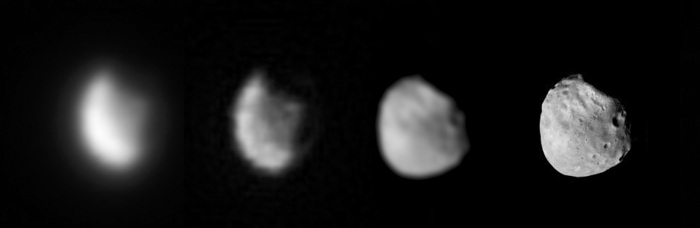
The planet Mars has two moons, namely Phobos and Deimos. The closest and the biggest among the two moons is Phobos. It was picturised as shown above with the color corrected six frames MCC on July 1, 2020, with 210m spatial resolution. The MOM (Mars Orbiter Mission) was 7.2 thousand km away from Mars and 4.2 thousand km from the moon Phobos. It is said that it comprises of carbonaceous chondrite. The giant crater on the surface, namely Stickney, Shklovsky, Roche & Grildrig was noticeable in the picture.
Actual image of the moon Phobos. Courtesy: ISRO
With its fuel efficiency estimated to be only for six months survives till now and achieved success on its first launch itself. On December 1, 2013, it went out of the gravitation field sooner. On September 24, 2014, after a long journey of 300 days makes it enter into the Mars orbit. The subsequent mission by ISRO, MOM 2 or Mangalyaan 2 did fail when the Vikram lander had lost connection after it crashes over the surface. There is no proper evidence of what exactly went wrong in the mission, but it is said that the ALP (Automatic Landing Program) braking thrusters had failed to result in the incidence. There was a big controversy between NASA and ISRO claiming the lander was found, although an Indian scientist spotted it.
Now ISRO with its grand vision is planning for Chandrayaan 3 to send Indian astronauts to space by 2022. This mission is again a cost saver with 35 million dollars for the new equipment and another 51 million dollars for the launcher. India has been already prosperous in launching 104 satellites just in a single mission. Chandrayaan 2 was made only with 141 million dollars budget.
The MOM as described has five instruments onboard:
1) MCC with a 2K×2K area array CMOS sensor for beautiful images of Mars in colourised format.
2) TIS (Thermal Infrared grating spectrometer) houses an infrared detector known as a microbolometer.
3) Methane Sensor for Mars (MSM) by its name is used to measure the presence of methane in the atmosphere, which is a differential radiometer with acute accuracy in parts per billion.
4) Mars Exospheric Neutral Composition Analyzer (MENCA) is a spectrometer to determine the contents in the martian environment
5) Lyman Alpha Photometer (LAP) is a photometer to find abundance in composition to know the actual components on the surface and more.
















 International Journal of Research (IJR)