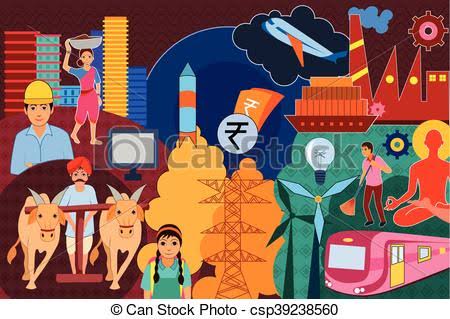
The Changes After 1991 In India

Today India is one of the most powerful nations in the world. Our progress in education, science-technology, business, economy, the defense system is really noticeable. India is always a unique country but India also passed many tough situations, this achievement comes after so many hardships, struggles, and fights.before 1991 the political situation in India is unstable, after 1991 certain changes in the Indian economy, science-technology held to be very important In the history of India.

Indian Economy: we wanted to establish an Economy based on social justice through planning for a National planning commission was established that would coordinate development through the policy of the Five Year Plan. The government started Economic Reforms are called as Economic Liberalisation. The foreign Invest In India increased, the field of information technology opened several avenues of employment in the country . Liberalization, Privatizati, and Globalization, India under its New Economic Policy approached International Banks for development of the country. These agencies asked Indian Government to open its restrictions on trade done by the private sector and between India and other countries.

Science and Technology: The experiment in the co-operative dairy movement By Dr.Verghese Kurien led to increase in milk production in India. This is called as White Revolution. Dr.Homi J.bhaba laid the foundation of the Indian atomic Power Programme. India insisted on using atomic energy for peaceful purposes like generation of electricity, pharmaceuticals and defense.

Change In Social Field: changes related to the women empowerment movement and other related to the policies regarding the uplift of deprived sections of the society

SUPERVISION OF MANAGEMENT

Supervision is an important aspect of the directing function and it involves the managerial task of observing the subordinates at work to ensure that they are working according to plans and policies of the organization, keeping the time schedule and supervision also includes helping subordinates to resolve their work problems. Managers at all level are in direct contact with subordinates and oversee their work performance and the top management supervises the work of middle-level managers, who in turn supervise the first-line managers or supervisors and the first-line managers are in direct contact with the operatives and thus, all levels of management are generally engaged in supervising the work of their immediate subordinates. According to R.C. Davis “Supervision is the function of assuring that the work is being done in accordance with the plan and instructions”. Supervision includes the following three elements:

  1. Commanding
  2. Guiding
  3. Controlling

This is the reason why, “Supervisors are known as a friend, philosopher, and Guide of workers”.

ROLE OF SUPERVISORS

Supervision has special importance only at the lower management level and the question which is now required to be discussed is to what role does a person working at the managerial level, the supervisor play in the organization.

1. Supervisor as a key man

 In every organization, the work of putting the plans into action is done by non-managerial staff who works under the guidance of a supervisor but however, at this level, even a little carelessness may cause the closure of the organization and that is why the supervision is referred to as the key man in the organization.

2. Supervision as a middle man

   In the organization, the supervisor plays the role of a middle man and he acts as a link between the higher-level managers and him workers, and his main job is to prepare a co-operative atmosphere among the two parties in order to facilitate the achievement of the goal of the organization.

3. Supervisor as a human relation specialist

A supervisor is likely to face a number of problems related to human behavior, for which one has to try and find out solutions and he can do so only if he is a human relation specialist.

FUNCTIONS OF SUPERVISOR

1. Planning the work or schedule activity

The supervisor is a low-level manager and he is required to study and analyze the work of his department and decide what, where, which, why, and by whom the work is to be performed. He has to chalk out daily and weekly program and he has also to arrange the raw materials, machines, tools, and equipment and the successful supervisor is an efficient planner.

2. Achieving the target

It is the most important duty of the supervisor to achieve the target prescribed for his department by the management and this can be achieved if the supervisor enables the best possible use of the available resources of the department towards the desired goal.

3. Enbaling standardized output through instruction and guidance

It is the supervisor, who ensures that the actual performance corresponds to the norms and standards laid by the management and the supervisor must satisfy himself as to the quality of the output and he should concentrate on both quality and quantity of goods. 

IMPORTANCE OF DIRECTION IN BUSINESS WORLD


Directing is a very important function of management and its subordinates may not perceive the organizational goals in the absence of directing and the subordinates must be communicated what the organizational goals are, what the employees should do to achieve them, how they should do their jobs etc. Moreover, directing is directly concerned with human beings, so it should be executed carefully to achieve the desired goals. The part played by the manager is rather important as the CEO of the company from the point of managing the workers and the management and Getting things down is in the very nature of Directing.

THE IMPORTANCE

1. The benefit of unity of command

 Due to scientific supervision, effective communication, and proper motivation, there is no problem with conflicting orders or priorities and because of a complete reporting relationship with a single superior, personal responsibility for results becomes greater. Directing involves the management of human behavior and it creates cooperation and harmony among the members of a group and increasing people’s awareness has made managing human beings very difficult.

2. Increases potential

For reasons of physical nature’s productivity of managerial resources is limited, but the productivity and effectiveness of human resources have unlimited potential, and directing helps the enterprise in making use of this potential output of the human resources. Since humans evolve as the time goes by and stating together is an important aspect of keeping going together so everyone needs to understand the aspirations and expectations of their subordinates or their colleagues in order to manage them effectively.

3. Initiates action

All organizational activities are initiated through directing and along with planning, organizing, and staffing, managers must stimulate action by issuing instructions to subordinates and by supervising their work and the aim of directing is to activate employees to work towards the realization of predetermined goals of the organization and thus, without directing, other managerial activities like planning, organizing and staffing remain ineffective.

This image has an empty alt attribute; its file name is why-is-branding-imporant.jpg

4.Optimization of individual efforts

 The ultimate success of an enterprise depends on the optimum efforts put in by all individuals with willing cooperation and through effective supervision, motivation, leadership, and communication directing makes it possible.

5.Means of motivation

The organizational objectives cannot be realized unless people working in an organization are motivated to work willingly and perform well to the best of their abilities and directing is motivating employees to contribute their maximum efforts towards the achievement of organizational goals.

6.Provision of a stable and balanced organization

Directing provides effective supervision, motivation, correct leadership, and a well-understood communications, and therefore the organization as a whole work in a balanced way and it lasts for a long time.

7. Integrates employees efforts

At all levels of management, there are subordinates under the managers and the work entrusted to these individuals is interrelated and the performance of each individual affects the performance of others and thus individual efforts need to be integrated so that the organization achieves its goals and the directing functions integrate the activities of the subordinates by supervision, guidance, and counseling.

Work From Home Jobs During the Lockdown

Due to this Covid – 19 when all the offices are closed and employers have transitioned their employees to remote work, one thing that comes out best during this lockdown is that how remote work or work from home can be successful on a large scale.

Let us see some interesting job opportunities which anyone can start from home :

1. Online Educator

If teaching is your passion and you are away from your passion because schools are closed due to this lockdown then you don’t have to worry as you can simply teach online at your homes.

2. Freelance Writer

Many big sites need freelance writers and content creators so if you have good writing skills then this is surely your job. The best part is that this is the job where you don’t have to go to office. Sit at your homes and provide the best content to your employer.

3. Social Media Manager

Many big business house needs someone to manage their social media accounts like Instagram, Facebook, Twitter so that they can grow their business online and can expand their reach. So if you are a pro at managing social media then this is the right job for you.

4. Call-Center Representative

Many businesses need workers who can answer the phone at all hours, assist customers, and process orders or deal with returns. But since more businesses are operating online, a growing number of these jobs are going to customer service at home.

5. Data Entry operator

A wide range of businesses need workers to enter various data into their systems. For this job one should know basics of computer and should have good typing skills. This is the job that you can perform from home. You just have to enter data online and send it to your employers.

6. YouTuber

If you can entertain and influence large audience on YouTube platform then in some time you can also become a successful YouTuber earning a lot of money.

7. Translator

Translator is someone who converts written word from one language to another. For this job one must have a bachelor’s degree and most importantly must be fluent in the language that the job demands. Many sites nowadays need online translators so if this job fits you, you can surely apply.  If you have proper education but don’t have any experience, then it isn’t a problem to find a job because there are many freelance translators have no experience jobs on the Internet nowadays.

This was all about the jobs that you can start from home during this lockdown. So I hope you will find the above article useful.

Human Resource Management

Meaning

Human resource management involves procuring, developing, maintaining and appraising a competent workforce to achieve the goals efficiently and effectively. Staffing is an integral part of human resource management. It is also concerned with procurement, development, compensation, integration and maintenance of managerial employees.

The National Institute Personnel Management (NIPM) of India has defined human resource management as ” the part of management which is concerned with people at work and with their relationship within an enterprise. It’s aim is to bring together and develop into an effective organisation of the men and women who make up an enterprise and having regard for the well – being of the individuals and of working groups, to enable them to make their best contribution to its success. “

Objectives of Human Resource Management

  • To procure right person at the right job.
  • To establish desirable relationship between employer and employees.
  • To mould human resources in the structure of organisation effectively.
  • To develop personality of employee through training and development campaigns.
  • To establish harmony in goals within the organisation
  • To establish employee discipline and moral.

Characteristics of HRM

  • Human focus :It is concerned with the effective management of people possessing energy and capabilities. It is individual oriented. It is specially focused on the human oriented approach. The detailed investigation of human resource in organisation is made.
  • Management Function : It involves managerial functions such as planning, implementing and controlling of acquisition, development, utilization and maintenance of human resources.
  • Pervasive Function : HRM is pervasive in nature as it is present in all enterprises. It is performed in all levels of management. The responsibility of human resource cannot be delegated to other. It is practically implemented in the organisation at various levels.
  • Continuous Commitment : It is continuous function of management. In other words, it is not a one- time process. It will continue till the organisation exists. It is continuously monitored at every step of organisation existence.

Duties performed by Human Resource Personnel

  • Recruitment
  • Collecting information about jobs
  • Developing compensation and incentive plans.
  • Training and development of employees.
  • Handling grievances.

DIRECTING

Directing, in simple words, is instructing the subordinates to follow a certain process to attain a given objective and it is getting the work done through instructions and orders and directing is an important element of management without which success cannot be achieved in the managerial process and it is very essence of management and in fact, it is the sum total of all managerial efforts and it helps in the organization marching towards its defined goal. After planning, determination of objectives, organization, and forecasting, the working force needs briefing about the stated goals which have to be accomplished following the policies, programmes and schedules. Directing is the managerial function of guiding, motivating, leading and supervising the subordinates to accomplish desired objectives. It is an important managerial function that initiates organiser’s action and it is a connecting and activating link with various functions of management and it is a process around which all performance revolves and directing bits of help in mobilising and synthesizing human resources and efforts to accomplish the goals of the organization and directing is the heart of management-in-action and essence of operations. According to Ernest Dale directing is “Directing is telling people what to do and seeing that they do it to the best of their ability and it includes making the assignment, corresponding procedures, seeing that mistakes are corrected, providing on-the-job instructions and of course, issuing orders” and according to another author Newman directing is “ The process of directing is concerned with the way an executive issues instructions to his instructions to his subordinates or otherwise indicates what is to be done”. As a continuous process, directing comprises of:

  1. Issuing orders that are clear, complete, and within the capabilities of subordinates to accomplish.
  2. Training and instructing subordinates to carry out their assignments in the existing situations.
  3. Motivating subordinates to try to meet the expectations of the manager; and
  4. Maintaining discipline and rewarding those who perform properly.

NATURE OF DIRECTING

1. Directing Initiates Actions

Directing is a key managerial function and a manager has to perform this function along with planning, organizing, staffing, and controlling while discharging his duties in the organization and while other functions prepare a setting for action, directing initiates action in the organization.

2. Directing takes place at every level of management

Directing is a pervasive function of management and it exists at every level, location and operates throughout an enterprise and every manager, regardless of the number of subordinates, performs this function and he has to give instructions to the instructions, guide them and motivate them for the achievement of certain goals.

3. Directing is a continuous process

Directing is a dynamic and continuing function and it is the essence of management practice and the techniques and methods of directing have to be changed with t eh changing organizational conditions and a manager are expected to guide his subordinates in all the changing environments. Directing’s objectives are to get the work done and to see that the management works ore responsibly and the manager has to make sure that the problem faced by his mens are solved quickly.

EDUCATION AND TRAINING


Though education and training are parts of the learning process, yet education is wider in its scope than the training and the training is concerned with increasing knowledge and skills in doing a particular job, and the major burden of training fall upon the employer. But education is a broader field of subject and has a lot of connections in its roots and has a lot of scopes and its purpose is to develop individuals in each of their respective fields and it is very concerned with increasing the general knowledge and understanding of the total environment. Education also teaches us to solve any analytical, statistical concepts in a better manner with an in-depth understanding of all the complexity in them.

This image has an empty alt attribute; its file name is education-and-training.jpg

THE DIFFERENCE

By, education, we generally mean formal instruction in a school or a college or in a research facility or in a corporate environment, whereas the training is a vocationally oriented before you work on a complex or sophisticated machine or environment and is generally imparted at the work-place. Educational is theoretical, while training is practical and education is the process of developing and understanding of some organized body of knowledge and it is usually formal and aims at the total growth of an individual and it develops mental skills that enable one to use the knowledge acquired effectively in problem-solving situations. Training increases the aptitude, skills, and abilities of employees to perform specific jobs and it leads to the developmental of manual skills for a particular job, whereas education aims at enhancing the general knowledge of a person so that he may accomplish a job in an economical way or can start his own venture or a company to develop his knowledge that gives way for the evidence of his general intellect. As Flippo said in training “Training is the act of increasing the knowledge and skills of an employee for doing a particular job”.

This image has an empty alt attribute; its file name is rptgtpxd-1396254731.jpg

Actually, the distinction between training and education is not precise because in many cases both training and education occur at the same time in the form of some formal vocational school programmes are job-oriented only, whereas some employee development programmes in the industry are quite wider in scope and they may be viewed as education. The scope of training is narrow as it restricted to a specific job that requires a lot of practical knowledge to complete the given work or the job, whereas the scope of education is wide as it gives information about a specific area instead of a specific job. The objective of the training is to learn the method of accomplishing a specific job successfully whereas education aims at enhancing the general knowledge of a person to enable him/her to accomplish a job in an economical way giving evidence of his general intellect and training is imparted by a business organization, on-job or by setting up a separate training centre whereas the main source of education in schools, colleges and university. The burden of expenses for imparting training is the responsibility of the business organization, hence it alone bears are borne by the employee himself.

Direct tax collected In India

A direct tax is a tax that is paid by an individual or an organization to the imposing entity, or to be precise, Direct Tax is the one which is paid to the Government by taxpayers. These taxpayers include people and organization both. Also, it is directly imposed by the Government and cannot be transferred for payment to some other entity.

With Direct Taxes, especially in a tax bracket system, it can become a disincentive to work hard and earn more money, as more money you earn, the more tax you pay.

Income Tax- It is imposed on an individual who falls under the different tax brackets based on their earning or revenue and they have to file an income tax return every year after which they will either need to pay the tax or be eligible for a tax refund.

Estate Tax– Also known as Inheritance tax, it is raised on an estate or the total value of money and property that an individual has left behind after their death.

Wealth Tax– Wealth tax is imposed on the value of the property that a person possesses.

However, both Estate and Wealth taxes are now abolished.

The Central Board of Direct Taxes in India

The Central Board of Direct Taxes or the CBDT, which was formed as the result of the Central Board of Revenue Act, 1924 looks after the Direct Taxes in India. This department is part of the Department of Revenue in the Ministry of Finance and is responsible for the administration of the direct tax laws. Besides that, the Central Board of Direct Taxes also provides inputs and suggestions for policy and planning of the direct taxes in India.

The latest data of tax collection as per the Central Board of Direct Taxes (CBDT) was released. The data reveals that Maharashtra, Delhi, and Karnataka contribute 61% of the country’s total revenue from direct taxes. Including the contribution of Tamil Nadu and Gujarat will aggregate to 72% of the total revenue.

Direct taxes include income tax paid by individuals and corporate tax paid by firms. It is a general notion that more revenue collection implies higher income. It also implies better employment opportunities and greater ease-of-doing-business. Greater revenue collected states are also those that have greater avenues for economic activities.

It was found that the large and populous states like Uttar Pradesh, Bihar, and West Bengal fare poorly. Bihar, the third most populous state accounts only 0.65% to the total direct tax collection. Uttar Pradesh, the most populous state and West Bengal, the fourth most populous state contributed to 3.12% and 4% of the total tax collection. 

The poor collection of taxes shows the absence of formal sector employment and corporates. It also shows that the working population in these states are not part of the salaried class. If they were a part of the salaried class, the revenue from income tax would have not been so low as compared to the population of these regions

So if we assume the total direct tax collected in India would be 100/-how much would each state contribute

Maharshtra:38/-, Delhi:13.5/- ,Karnataka:10/-

  1. Tamil Nadu : 6.7/-
  2. Gujarat: 4.6/-
  3. Andhra Pradesh :4.3/-
  4. West Bengal:4/-
  5. Uttar Pradesh:3/-
  6. Haryana : 2.4/-
  7. Odisha: 1.2/-
  8. Madhya Pradesh: 1.8/-
  9. Kerala: 1.6/
  10. Rajasthan:24/-
  11. Punjab : 1.1/-
  12. Bihar:0.65/-
  13. Telegana:0.46/-
  14. Jharkhand:0.5/-
  15. Assam : 0.56/-
  16. Goa:0.3/-
  17. Jammu and Kashmir:0.16/ Himachal:0.25/-
  18. Chhattisgarh: 0.25/-  Uttarakhand : 0.3/-Chandigarh : 0.25/- 19.Meghalaya: 0.08/- 20. Tripura:0.03/-

INVESTORS ARE WARMING UP TO A POSSIBLE JOE BIDEN VICTORY

Investors are preparing ahead for expected upcoming market turmoil ahead of the US presidential election in November, with some shifting stock portfolios and selling the dollar, as Democratic party contender Joe Biden maintains a considerable lead in opinion polls against President Donald Trump.

During the four months leading up to the Nov. 3 elections, much will shift, and several analysts are concentrated about how a coronavirus outbreak could threaten a fragile U.S. economic rebound.

Nonetheless, several fund investors are now planning for the prospect of a win for Biden by betting against the currency and slashing their stakes in US stocks.

“The president’s poll numbers have fallen off a cliff,” said Phil Orlando, chief equity market strategist at Federated Hermes. “The market is looking at this and saying, ‘If the election were held today Biden would win.'”

The new survey by Reuters / Ipsos shows Biden leading Trump among eligible voters by 8 percentage points. Trump’s support for treating the coronavirus pandemic has collapsed.

A win for Biden-as well as a potential House and Senate Democratic sweep-may challenge initiatives supported by Trump and widely preferred by Wall Street, including lower corporate tax levels and fewer restrictions, analysts said.

Despite the sharp coronavirus-fueled dip, since Trump took office, the S&P 500 is up about 37 per cent. Under the first term of Presidents Barack Obama and Bill Clinton, the index rose 85 per cent and 79 per cent respectively.

According to Amundi Pioneer Asset Management, under Biden, the corporate tax rate is expected to climb to 28 percent, replacing half of Trump’s and Republican-led Congress reduction in late 2017.

That could rising S&P 500 earnings by around $20 a share, push buyers out of U.S. stocks and damage the dollar, said Paresh Upadhyaya, fund manager at the firm that bets against the greenback.

The fund manager at Laffer Tengler Investments, Arthur Laffer Jr., unwounded his dollar stake last week, predicting that a Biden win could contribute to stronger development and strain on the U.S. currency. Laffer Jr ‘s father has been counseling Trump on economic concerns.

Gross betting in derivative contracts against the U.S. dollar just reached a two year peak.

In a report to clients, analysts at UBS Global Wealth Management said possible new legislation by a Democratic government may be a headwind for oil and financial stocks.

Recently, the BlackRock Investment Institute has cut its ratings on U.S. equities to neutral over concerns of fading fiscal stimulus and uncertainty about elections.

“The two parties are as far apart on policy as they have ever been, making the result consequential for markets,” BlackRock’s analysts said in a note.

Orlando of Federated Hermes has boosted his cash allowance as the cases of coronavirus have risen and the vote numbers of Trump have dropped. He expects to lower shares in dividend-paying securities if Trump’s fall in the polls tends to boost questions about higher dividend taxation and capital gains.

Most investors remain unconvinced that a Biden win or Democratic sweep will bode poorly for stocks, especially because the U.S. economy is supposed to be bolstered by the Federal Reserve if appropriate.

As long as (stimulus) stays constant … you will continue to have some ballast in terms of asset prices,” said Sam Hendel, president at Levin Easterly Partners.

Source:https://www.livemint.com/news/world/investors-are-waking-up-to-a-possible-joe-biden-victory-in-us-presidential-election-11593661949306.html