Why history as a subject is taught to us.

History is the major reason when boredom hits us hard in school premises. If the history period is after the recess then you are finished, you have to listen just theory that too the past of some random country which will in turn make you fall sleepy. As a school student I wondered why history is added as a subject, why we need to know about the thing which already happened..,moreover why do we need to learn the history of other countries!?? This is the most difficult task for some student’s and other side some student’s love this subject(kaise karte ho bhai..??…sigh!). Let me ask you why history is taught to us, also of other countries which doesn’t matter to us in the first place!?(this is what i used to think and hated the concept of studying history.) Do students really need to know about the history of their nation as well as the other nations? Well, as far as I think, history is important if it’s of our own nation. Studying history can provide us with insight into our culture of origin..getting facts of our own country will add up to our knowledge so as to how people used back then. We get to learn about the culture, the revolution, the disasters, the ruling of emperors, etc.,

Our own nation:-

We can get the better understanding of ourselves only the way when we get to know about the past..minding not only about ourselves but of others. What we are now, is the representation and modification of the past as others lived back then. We are the modified version of the past. We get to know about the ancient era their habitats, how they earned for their livelihood and all the sort of works which were manly and manmade as machines were not discovered. Understanding past gives quick idea about the norms, social instincts, rituals which were practiced back then and are still in consideration but we are slowly backing off. To enlight the culture then there is high time we need to know about the then culture which were in practice(not being superstitious but which are necessary as to our religion.) The relaxations and facilities we have for the transportation didn’t existed back then..so after knowing the situation and resources available at that time…here at present people discovered and introduced many sources. Not only transportation but there are various things other than this. The source of entertainment, sources for education, breaking Linguistic barriers, eventually availability of resources but lacking in utilising them and many more. This was all about our nation (for ones own nation if you are from abroad).

Learning about foreign countries:-

Is there really a need to know about the history of other countries?? Then the answer has the probability of 50-50. Firslty why my answer is 50-50 is because it depends on the interest of the individual. One may find it boring while the other might find it interesting to know about the other countries. Secondly getting knowledge will do no wrong but will eventually add up more. We will only and only get more knowledge which is no harm and will made you more knowledgeable. It is not important that others might follow the same culture as we do. When we study about the past of the world then only we understand as to why the world os the way it is! By studying who they are and suffering through different situations made them what they today. By seeing them ‘as they are’ without judging by our own mental standards. We can learn through others mistake not just individually but as a whole nation(we are taught that we should learn from others mistake and try not to committhe same.) Talking about Indians who are at high position in foreign nation would have thoroughly gone through the history of those countries to deal with their situation, which can be done by understanding them from the start, from the basic which is why learning world history tend to be important. If we don’t focus on histort then ultimately we will end up recreate the history.., as it is said that history repeats itself. So we should not be self-centred, and try to learn other countries culture too.

“We study the past to understandthe present, we understand present to guide the future. ” -William lund

SAVING CAPITALism FROM THE CAPITALIST

The essential notion of the capitalistic society is voluntary cooperation, voluntary exchange. The essential notion of a socialist society is force – Milton Friedman . An economic and political system in which a country’s trade and industry are controlled by private owners for profit, rather than by the state is defined as capitalistic society. Capitalism, undoubtedly, is a major driver of innovation, wealth, and prosperity in the modern era. Competition and capital accumulation incentivize businesses to maximize efficiency, which allows investors to capitalize on that growth and consumers to enjoy lower prices on a wider range of goods.

The benefits of capitalism are enjoyed by, Individual capitalists are typically wealthy people who have a large amount of capital (money or other financial assets) invested in business, and who benefit from the system of capitalism by making increased profits and thereby adding to their wealth.Prominent among critiques of capitalism are accusations that capitalism is inherently exploitative, unsustainable and creates economic inequality, is anti-democratic and leads to an erosion of human rights while it incentivizes imperialist expansion and war.

Saving Capitalism from the Capitalists: Unleashing the Power of Financial Markets to Create Wealth and Spread Opportunity is a non-fiction book by Raghuram Rajan and Luigi Zingales of the University of Chicago Booth School of Business.”Saving Capitalism from the Capitalists” is a groundbreaking book that will radically change our understanding of the capitalist system, particularly the role of financial markets. They are the catalyst for inspiring human ingenuity and spreading prosperity. The perception of many, especially in the wake of never-ending corporate scandals, is that financial markets are parasitic institutions that feed off the blood, sweat, and tears of the rest of us. The reality is far different. This book breaks free of traditional ideological arguments of the Right and Left and points to a new way of understanding and spreading the extraordinary wealth-generating capabilities of capitalism.

The free market is the form of economic organization most beneficial to human society and for improving the human condition.
Free markets can flourish over the long run only when government plays a visible role in determining the rules that govern the market and supporting it with the proper infrastructure. Government, however, is subject to influence by organized private interests
Incumbent private interests, therefore, may be able to leverage the power of governmental regulation to protect their own economic position at the expense of the public interest by repressing the same free market through which they originally achieved success. Thus, society must act to “save capitalism from the capitalists”—i.e. take appropriate steps to protect the free market from powerful private interests who would seek to impede the efficient function of free markets, entrench themselves, and thereby reduce the overall level of economic opportunity in society.

Top 5 books to read

There are times when you need an escape from your life and your time frame. Books are the best escape, the best time travel and the best indulgence. The world right now is going through a lot, and it wouldn’t be wrong to say that it is the toughest time for the humanity. From being on the verge of several wars, burning forests and an almost wrecking virus, there are times when you need to get away. 

Here’s a list of top 5 books you should read—

  1. The Bell Jar

One of the most beautifully written novels, The Bell Jar by Sylvia Plath emerges as an absolute get-lost-into novel. The stories about confinement and trauma are shocking, the narrative of this book is so indulging that you fall for it being real and forget what’s outside.

2. Looking for Alaska

A young adult fiction, John Green’s books never disappoint you. The descriptive nature of the book portrays a real film in your mind. The book is hard to leave and harder to get over with. You just keep falling in love with it every day.

3. Mrs. Dalloway

Considered as one of the best works of Virginia Woolf, Mrs. Dalloway is a book about a woman in the post-war days in Britain. It covers the day-long schedule in the life of a woman. The realisation of time and society that the book leaves you with is incredible. 

4. War and Peace

Another classic novel by Leo Tolstoy, covers the Russia’s days with Napoleon. It is amazing to read how ordinary people deal with the extraordinary conditions they encounter in their daily lives due to the war. It is worth reading as it teaches how people dealt during a wartime, when the the society was rapidly changing. The book is a thick-read but it is worth the time.

5. The Kite-Runner

The kite-runner by Khaled is a story about a young boy Amir and his friend Hassan. 

The story is based in Afghanistan, a war-torn and landlocked country in Asia. The kite-fight tournaments, the friendship and the betrayal will have all of your heart.

Reach out to me on instagram @ekanika_shah

Why PUBG Mobile, Call of Duty Mobile is not banned in India?

Both PUBG Mobile and Call of Duty Mobile are available to download and play on the Google Play Store and the Apple App Store. The Indian servers of both the games are also live and are functioning at 100 per cent capacity.

Mixed ownership and the IP registrations might not be the actual reason as to why these mobile video games were not banned.

Earlier this week the government of India banned 59 Chinese apps in India, stating that these apps were threatening country’s sovereignty, defence, and public order. The list includes TikTok, Shareit, UC Browser, Clash of Kings and many more but not popular mobile games PUBG Mobile and Call of Duty Mobile.

Many people have been asking why PUBG Mobile and Call of Duty Mobile have not been banned despite being owned by Tencent Games, which s based out of Shenzhen, China. The answer to this question is that they have not been banned because they are not completely Chinese.

PUBG Mobile has been developed and is managed by the PUBG Corporation, a subsidiary of Bluehole, which is located in South Korea. After the initial success of the game, Tencent Games approached PUBG Corporation to distribute the game in China. Soon after the game was a success in China, Tencent Games brought it to India.

On the other hand, to launch Call of Duty Mobile Activision partnered with TiMi Studios, which is a subsidiary of Tencent Games. Activision is a subsidiary of the California based company Activision Blizzard.

Keep in mind that the mixed ownership and the IP registrations might not be the actual reason as to why these mobile video games were not banned. The government hasn’t issued any statement on this topic yet.

Both PUBG Mobile and Call of Duty Mobile are available to download and play on the Google Play Store and the Apple App Store. The Indian servers of both the games are also live and are functioning at 100 per cent capacity.

Google and Apple have removed all 59 banned Chinese apps from Play store and App store. TikTok was the first application of them all to be taken down from Play store. The popular short video platform is completely offline in the country right now which means the app isn’t working for any users in the country right now. In an official statement, TikTok noted that it is working with the Indian government right now.

@martin_christopher

India and Knowledge Society

Let knowledge come from all sides. (RIG VEDA):

Knowledge has always been an essential and distinguishing characteristic of human society, for human beings are unique among all species in their extended capacity to formulate, systematize, preserve and consciously transmit organized bodies of knowledge from one individual, community, generation and location to another. That is the essence of all that is known as education.

There is almost universal recognition that knowledge as a product and as an instrument will be the basic foundation for competitiveness of individual business and of nations in the 21st century. Robust research findings suggest that knowledge as a factor of production explains a substantial proportion of economic growth internationally.

 Historically, Indian society is a hierarchical society and its knowledge base has always been elitist. Whether it is the caste based system or the colonial education system, access to knowledge has primarily been the privilege of the few. But such a system can never lay the foundation for a holistic development strategy. Therefore, all socio-economic and political
ideas have to be focused on inclusive growth and socio-economic equality in the real sense

The recent focus of good governance is to enable inclusive growth and development. India has come a long way from the hierarchical society and its exclusive educational system which we imbibed from our cultural and social heritage, as well as our colonial past. The thrust of the envisaged changes in the society calls for knowledge for all and a shift towards an inclusive
knowledge based society.

“If we value the pursuit of knowledge, we must be free to follow wherever that search may lead us” said Adlai E. Stevenson. This is the idea behind the concept of an inclusive society based on free and easy access to knowledge for all.

Knowledge Society consists of practices and policies for using intellectual assets to support key economic objectives and to reduce vulnerability gaps, and in the process of social transformation strengthening national security .Knowledge management deals with the knowledge as a corporate resource. Knowledge culture is necessary for survival and success in the modern world of business.

Knowledge is only one input to the development process, but it is an absolutely essential one. Without adequate knowledge all the other essential inputs-land, infrastructure, factories, capital, technology, administrative and social organization-cannot yield full results. Enhancing knowledge generation, dissemination and application is the fastest, most cost-effective means of increasing the productivity of all these other resources and accelerating national development.
Development depends on four knowledge processes:

  • Knowledge generation and acquisition through scientific discovery, R&D and transfer of technology.
  • Knowledge adaptation through innovation to particular fields, needs and operating environments.
  • Knowledge dissemination through formal and informal channels from knowledge developers and adapters to those responsible for applying the knowledge in society.
  • Knowledge application through skilled action in fields, factories, classrooms, hospitals and every other field of activity to achieve practical results.

The competencies that would count in the emerging Knowledge Age are intelligence, knowledge, good formal educational qualifications and skills in communicative English-we are abundant in it.

Knowledge is important not only for the rich but also for the poor. This is all the more relevant in a country such as India where the gap between the rich and the poor is enormous. Thus India has to closely link economic development with social development .Technology can assist in the development of the social sector. The anytime-anywhere and death-of-distance paradigms of technology enable better leveraging of scarce resources. Computerized learning aids, cyber classes and e-education are instances of use of technology in education. Knowledge is the key driver in the race for economic leadership. A key imperative today is for the government to collaborate with the private sector and industry in building knowledge infrastructure. This includes partnership for developing talent, formulating conducive regulatory framework, creating bandwidth and providing affordable computing power.

It is suggested that Indian policy makers and organisations consider focusing on the following areas to prepare for a knowledge-based economy and society.

First, good quality institutions, a reasonable degree of contestability in the economy and in polity, and an outward-orientation are essential for creating, diffusing and adapting knowledge in India; efforts should be made to deepen and institutionalise economic and governance reforms.

Second, strong education and training in technology and science are essential as knowledge cannot be absorbed unless some basic knowledge is already possessed. Reforming education policies and regulations, particularly those designed to increase supply and quality, should be an urgent priority. India must preserve traditional knowledge and subject it to scientific enquiry and application.

Third, capabilities to take advantage of international conventions such as converting product and process knowledge into patents and intellectual property rights must be developed. Commoditisation of traditional knowledge by more resourceful countries needs to be addressed through cooperation among developing countries, which have similar interests.

Fourth, private and public sector firms and organisations of developing countries must be open to new ideas. There is no more insidious colonisation than colonisation of the mind. In most Indian organisations, the desire to reform traditional methods of administration and delivery of government services is essential if the efficiencies arising from the knowledge-economy are to be realised.

Fifth, multiple sources of new ideas and experiments, including rural technology innovations, need to be cultivated. If such sources of ideas are combined with encouraging social entrepreneurship, i.e. meeting social needs with capitalist means, and with effective public private partnerships, application of knowledge-economy to diverse areas can be facilitated.

Sixth, a great deal of knowledge is organisation, context or location-specific. The challenge is to use it to address specific economic and social needs. India’s heterogeneity can be used to great advantage in discovering and diffusing location specific knowledge to develop more sustainable, relatively less elaborate, production and supply chains.

These, in turn, may help increase resilience of local economies to external shocks.

The National Knowledge Commission (NKC), an advisory body set up in 2005, has five focus areas, namely easy access to knowledge, emphasis on education at all levels, creation of knowledge, application of knowledge to all sectors, and better delivery of services in all sectors. The NKC however has not received strong political support. Its recommendations have been blocked by petty political and bureaucratic rivalries. Unwillingness or inability to assert strong political leadership by the Prime Minister in this area has contributed to the erosion of his authority, while constraining India’s future options and prospects.

Many believe that those representing Indian institutions will have the capacity to push for a level playing field on the world scene as far as access to technology and the relevant knowledge bases are concerned at the same time as they foster the development of local knowledge and ICT applications. However, this will depend on other factors such as international trade relations and whether the government and other stakeholders can avoid becoming victims of the ICT fetish. India’s resilient features and strengths in terms of its social organisation, its cultural resources and its vast reservoir of knowledge workers should not be frittered away as a result of greater than necessary participation in the global knowledge society.

India was a knowledge force in the ancient days. Let us again restore this status to Bharat again. Let us draw inspiration from our great wise men of the past and the intellectual leadership of the present and make the world exclaim, “The Wonder That Is India.”

India of the ages is not dead nor has she spoken her last word, she lives and has still something to do for herself and the humankind. (AURBINDO GHOSH)

ROOPKUND: SKELETON LAKE

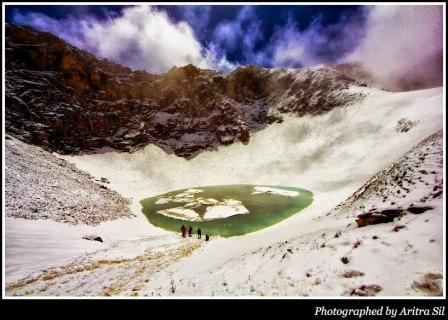
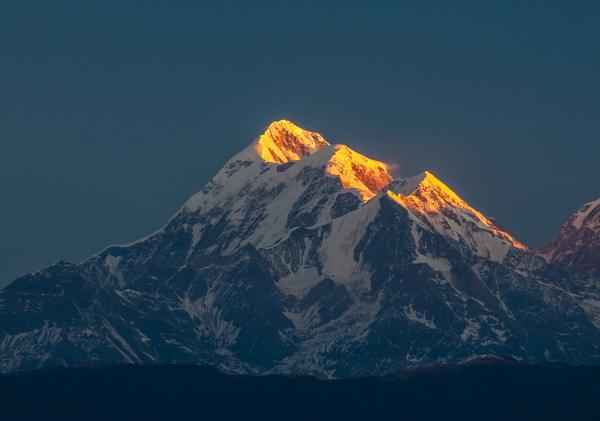
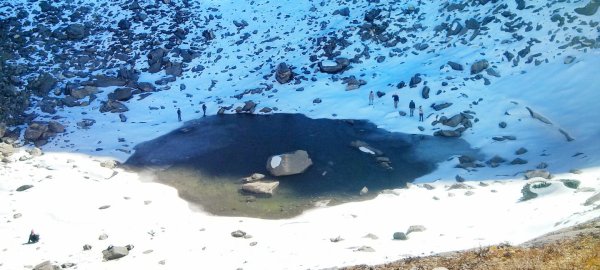
ROOPKUND locally known as skeleton Lake or Mysterious Lake , It’s lies in the Lap of Trishul  Massif , located in the Himalayas. It’s a high altitude glacial lake in the Uttarak hand  Roopkund is one of the important places for trekking in Chamoli District, Himalayas, near the base of two Himalayan peaks: Trisul (7,120 m) and Nanda Ghunti (6,310 m)  The Lake is flanked by a rock face named Junargali to the North and a peak named Chandania Kot to the East. Roopkund lake is covered with ice for most of the year Roopkund is known as a mystery lake and is surrounded by rock-strewn glaciers and snow-clad mountains. The lake is about two metres deep and invites hundreds of trekkers and pilgrims every year

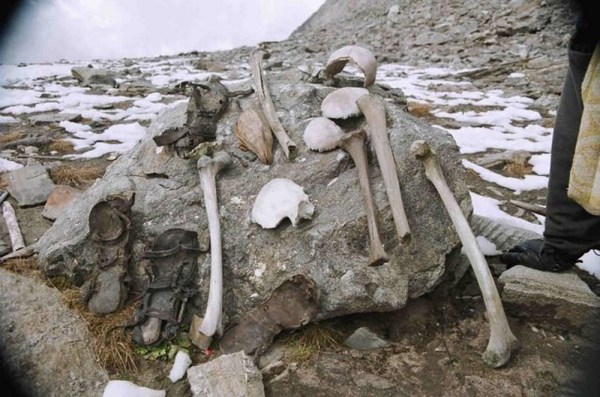
IN 1942 A BRITISH FOREST guard in Roopkund, India made an alarming discovery. Some 16,000 feet above sea level, at the bottom of a small valley, was a frozen lake absolutely full of skeletons. That summer, the ice melting revealed even more skeletal remains, floating in the water and lying haphazardly around the lake’s edges.

SKELETON AT ROOPKUND

Something horrible had happened here. The immediate assumption (it being war time) was that these were the remains of Japanese soldiers who had died of exposure while sneaking through India. The British government, terrified of a Japanese land invasion, sent a team of investigators to determine if this was true. However upon examination they realized these bones were not from Japanese soldiers—they weren’t fresh enough. As it turns out, all the bodies date to around 850 AD. DNA evidence indicates that there were two distinct groups of people, one a family or tribe of closely related individuals, and a second smaller, shorter group of locals, likely hired as porters and guides. Rings, spears, leather shoes, and bamboo staves were found, leading experts to believe that the group was comprised of pilgrims heading through the valley with the help of the locals.The researchers concluded that the death was due to a fatal blow on the back of their heads and not due to any wound by weapons, avalanche or landslide. The marks on their skulls and shoulders indicated at being hit by something round, like a cricket ball. The absence of injuries to other body parts indicated that hard round objects, possibly cricket ball sized hail stones or ice balls, fell from above.

Marriages- a pure relation or a money deal

A great marriage isn’t something that just happens; it’s something that must be created.” – Fawn Weaver

Almost everybody, once in their lifetime, must have heard of the great saying, marriages are made in heaven. One of the purest of all relations that exist on the earth, is certainly in danger in one or the other manner.

Child marriage, have been into practice in our country for many centuries, but it is due to the tireless works of Keshab Chandra Sen, founder of Brahmo Samaj, the ill mentality which was pulping in earlier are now demolished from it’s roots. Another practice that prevailed during mid eighteenth and late nineteenth century, Dowry System, was also a big reason to worry. Since, it put great financial strain on the bride’s family, its ebolition was a must. But, today, these practices have almost come to an end, and people are leading towards more independent and maverick lives.

Although, the ill practices that were prevailing earlier in the Indian subcontinent, have now been put to an end, or we can say that, though not from the roots, above the board, it is all sorted. But, at the same time, a more ill and heart melting practice is being put into force, by most of the literate, along with illiterate people, i.e. people nowadays sale their bride and groom, in order to get them married at any cost.

It is a common tendency among Indians to get their children married once they enter their twenties, but if their marriage happens to fail, any cost is being given to the other party, in order to get them married. The reason why these things happen is the greed, as well as the pathetic excuse for their getting old.

And the only meaning driven out of these practices is that, people, or the young people, are being sold out, under the name of getting married, which is often hidden behind the pure and holy relation of marriage. Which is equal to a crime, also, it can be associated with Human Trafficking. It is simply selling of people, but the only difference here is, they know at what price, and where they are being sold to.

It is a common practice in most of the hindu families, that are supposed to be one of the literate class, but unfortunately are into such practices that lead to detoriation of the human values, and morals, along with cultural heritage. We often blame it on most of the Muslim families, or people that they are much more into practices such as marrying more than one lady, instead all are equally guilty in promoting every kind of ill practice that is prevailing in the society, and continue to be there forever.

It is a massive problem, that has settled its roots into the society, behind the name of marriage. Often, it is neglected and taken for granted, but until its ebolition is done with a force, it will take over the society forever and will detoriate the pureness of such a relation.

“Goal Of A Human Life”

Is there anybody among you who wants such a happiness which is not perfect or complete, which is incomplete or transitory? Does anybody wants such a life which should not always be; we should be living some time and not live at another time? Who wants such a life? Does anybody wish for a knowledge which is incomplete? We want such happiness which would never end. We want such life which should always be. We want such knowledge which is supreme and perfect without the least faint of incompleteness therein. Such a longing is in fact, the longing for the Supreme truth of life, God. Save god there is nothing which is eternal, perfect and absolute. We hush up the desire to seek truth by petty worldly desires and become happy or unhappy at times and intervals.
All the efforts are being made in the all-world – this pull, this beat-up, this jump-jump and this run-sun – their golden results may be whatever, but the ultimate goal is the destruction of humanity. Man is being homed only for humans. For the betterment of man, only by giving himself a special sense of life can the completion of life.
Distinction and opposition, different ideologies, different goals – all are upper things; The only truth inside is man and its true service – that should be the ultimate goal of our life. Whether we serve literature, or society: whether through commerce, or through the path of service – this common element ‘man’ will be found in all. For this, our only duty should be to collect maximum welfare resources.
We have to make our goal so easy with our practice that the “electric particles of power which are scattered in busy circles, are voidable. May all Vijayini become humanity in coordination. “
The only goal of a human’s life should be nation-service, human-service, social service. Our goal should be to ensure maximum welfare of the society by making our life successful.
The goal gives the person a right direction. Tells him which work is necessary for him and which is not. If the goals are clear, then we prepare ourselves accordingly. Our subconscious mind inspires us to act accordingly. If the goal is clear in the mind, then the path to achieve it also appears clear and a person moves in that direction.

Narration of Arnold H Glasgow, “Like football, even in life, you cannot move forward until you know your goal.”
I feel just right. So if you have not yet set any goal for yourself, then start thinking in this direction. Make goals, make big goals, and achieve them only!

“Celebrating Plastic Bag Free Day And Finding Technological Aspects to fight with Plastic”

Humans have been developing science and technology so as to make their life more comfortable and easy. This humans have made some of the products which have proven to be boon for mankind. Such a product and material which has made life of humans more easier and comfortable.The ease of carrying material and storing them,manufacturing components and many more benefits have been available through this material to humans. Cost Effectiveness, light weight, easy to carry , rust resistance and many more things make this material the best to be used. But with times this has lead to deteriorate the condition of earth. This material as we know takes about 100-500 years to decompose and even more . These have led to pollution of our rivers, ocean sea and our land. 

We humans mostly focus on using plastic as single use plastic and throw it as soon as it’s used.This is especially for carrying bags. Every year, billions of waste material is recorded around the world with maximum concentration of plastic in it. People to get rid of this are starting campaigns which include recycle, reuse and even some believe in getting rid of it simply by burning, but a strong and well planned action to reduce and utilize the waste or stop product hasn’t been seen. 

So what can be done. As a campaign to stop the use of single use plastic every year, people celebrate “Plastic Free Bag day” on 3rd of july increasing the awareness about how plastic is bad for our nature, and how this problem is piling up, and would definitely lead to nowhere but doomsday


  • So people usually spread awareness about how plastic products can be utilized or reused most of which we threw away. 
  • People prevent the use of plastic bags on this day and prefer carrying a paper bag or a usual bag.
  • Most of the shopkeepers also do not prefer giving our things in plastic bags and aware people to use paper bags or cloth bags.
  • Most people go on hiking where they collect waste plastic things and recycle them or give it to the people who are good at recycling them and making the best out of waste. Most people also provide charities to these working individuals and this provides a helping hand in saving their earth.


We human surly need to understand, that we have polluted our earth with every kind of waste and destroyed its environment. Piling Up of waste, floating plastic In water in oceans and sea, disturbing aquatic life, polluted air, polluted soil and many more problems to be addressed which have made our life horrible . We surely need to shift toward better resources and material having the capabilities and abilities to give better results.Alternative to plastic and be the top contender to be utilized in place of it. The research work should be funded and people should prevent wasting and throwing plastic . Material possessing properties like lighter weight, cost effective nes and eco friendly must be initialised to be launched soon so as to get rid of the problems people need to come up with brighter ideas and reduce plastic waste or utilize in some better manner so that we make this earth better and cleaner and thus a better and purest place to live in. 

Peanuts : Nutrition And Health Benefits

A native to South America and introduced to other tropical countries many centuries ago, peanuts though classified as a nut, are actually not nuts as it belongs to the family of legumes like soy, beans and lentils. In India, they are mostly grown in tropical states like Andhra Pradesh, Telangana , Tamil Nadu, Gujrat, Maharashtra and Rajasthan.

Nutrition :

Peanuts or Ground nuts are abundant in protein, healthy fats and dietary fibres that can curb your appetite, lower the risk of heart disease and regulate sugar levels. They are immensely rich in Potassium, Calcium, Phosphorus and B Vitamins which can provide you with a lot of health benefits.

Groundnut Nutrition per 100 gms

Calories 567 kcal

Total Carbohydrate 16g

Dietary fiber 9g

Sugar 4g

Protein 26g

Total Fat 49g

Saturated Fat 7g

Cholesterol 0mg

Sodium 18mg

Potassium 705 mg

Calcium 134mg

Iron 6.7mg

Manganese 245mg

Phosphorus 549

Water 7%

Health Benefits :

Heart – friendly

Peanuts help to keep the heart healthy. They lower bad cholesterol and increase good cholesterol levels in the blood, only to prevent coronary artery disease and strokes by promoting healthy blood lipid profile.

Brain Food

It is due to the presence of Vitamin B3 or niacin that helps improve the functionality of the brain and further boosts memory. They also contain a flavonoid known as resveratrol that helps in improving blood flow to the brain.

Helps in weight loss

The combination of fiber, fat and protein in peanuts helps keep you full for longer and lowers your appetite. They are good source of energy that help increase the metabolic rate.

Helps deal with stress and anxiety

Stress and anxiety are two symptoms of depression. Amino acid known as tryptophan present in peanuts releases serotonin a brain chemical that is involved in mood regulation. It keeps us calm and mentally aware.

Best for diabetics

Peanuts make a great snack option for diabetics due to the presence of manganese, a mineral that plays an important role in metabolizing fat and carbohydrate, Calcium absorption and blood sugar regulation. They are known to have a low glycemic index that makes it a perfect go to snack for diabetics.

Good for skin and hair

Vitamins present in peanuts helps in delaying visible significance ageing. It is beneficial for skin. It is also good source of B Vitamins that convert in to biotin only to induce hair growth.

Promotes Fertility

It also contains a good amount of flame. Several studies have shown that women who had a daily consumption of 400 mg of folic acid before and during early pregnancy reduced the risk of having a baby born with a serious neutral tube defect by up to 70%.

The article was all about nutrition facts and health benefits of peanuts. Hope you find this article useful.