The practice of gratitude

“Acknowledging the good that you already have in your life is the foundation for all abundance.” – Ekhart Tolle

Gratitude or gratefulness, is a feeling of appreciation felt by the recipient of kindness, gifts, help, favors, or other types of generosity, towards the giver of such gifts. Gratitude turns what we already have into enough. It gives us a feeling of satisfaction and eternal peace. Gratitude is the best medicine, it heals one’s mind, body, and spirit, and it attracts more things to be grateful for.

Why do we need to practice gratitude?

“The struggle ends where gratitude begins”.

We all are surrounded by beautiful nature, we have our favorite people around us and we have enough food, clothes, and facilities. But, it is quite common that we take these things for granted. When we take things for granted, we are not satisfied with what we have and we strive to get something else, if we get it, then again we want something else, and we are never satisfied. Consider the present situation where we all are sitting at our respective houses. Earlier we could freely roam around, walk-in streets and parks, visit beautiful places, enjoy the fresh air and beauty of nature. But, we used to take all these for granted. We were really not grateful for the places around us, the beauty around us. But, now we realize its importance. The reality is that we always have enough of the resources around us for our survival. But, sadness drives in when we don’t appreciate what we have and take that for granted. Each one of us is living a life that is actually a dream life for a second person. So, just embrace it.

Imagine your life without the people around you, who are always there with you and support you. If you remove them from your life and think deeply, you will realize that they have a big role to play in your life which you never really thought about. The people around you are precious, value them, and be grateful to them that they are with you. Imagine a day without food, clothes, shoes, or air. If you do this exercise, you realize that you have enough of these things. Your desire to eat in a restaurant and to wear stylish clothes was really not that important. You get your food every day, you have clothes and shoes to wear. So, be thankful for what you have. Each and everything we get in our life, each and everything happening to us is very valuable to build us, to build our personality. Everything happens for a good reason. Being thankful for everything we get and for every event we come across gives us a satisfactory feeling, it eliminates negativity and makes our life more pleasurable. Saying thank you to another person pleases them and us too.

What do we get out of it?

A grateful heart is a magnet for miracles. The day you start practicing gratitude, it never ends. The more you express your gratitude for what you have, the more things you will have to express gratitude for. It gives you immense peace, happiness, and satisfaction. It rewires our brain and reduces stress. It boosts our immunity, improves relationships, and makes each day more beautiful. It makes sense of our past, brings peace for today, and creates a vision for tomorrow. Gratitude is the most wonderful feeling. Once you start practicing it, there is no way back.

“Thank You ” is the best prayer anyone could say.

Latest TRENDS in technology

Learning and enhancing your skills are vital in this technological era. This helps you to prepare yourself for getting the highest paying jobs in the field of your choice. And if you are a professional already, learning new technologies and tools will take you an inch closer to the promotion you always dreamt of. Widening your arsenal of tools also enhances your value as a professional in your company.Here are some of the latest technologyconcepts that are sure to dominate the IT industry,

1. Artificial Intelligence

Artificial intelligence (AI) is the technology used for equipping computer systems with the ability to make decisions like humans. When AI programs are fed to systems, the aim is to mimic human intelligence for performing complex tasks such as pattern recognition, speech recognition, weather forecast and medical diagnosis.AI is used in navigation based applications like Uber, voice assistants like Siri, video streaming services like Netflix, IoT devices and in search engines like Google and Bing.AI helps in automating tasks such as traffic, scheduling trains, making business predictions and designing driverless cars!

2. Data Science

Next up in the list of latest technology concepts is not surprisingly Data Science. Data Science is the technology that helps to make sense of complicated data. You know that data is produced in a humungous amount every day by companies. This includes business data, sales data, customer profile information, server data, and financial figures. Most of this data is in the form of huge data sets that are unstructured. The role of data scientists is to convert these unstructured data sets into structured datasets. Then, these data sets can be analyzed to identify patterns and trends. These patterns are useful for understanding the company’s business performance, customer retention, and how these areas can be improved.

3. Internet of Things

The IoT (Internet of Things) is a network of devices that are connected to each other. Their devices caninteract and share data with each other. These devices may be connected via WiFi, and they share data about their environments and how they are being used. These devices have a computer chip that facilitates this exchange. IoT not only enables the connection between different devices but also their remote access. For example, you lock doors of your car remotely, preheat your ovens and geysers. The FitBit that you use for tracking the number of calories you burn also runs on IoT technology. IoT chips embedded on machines help businesses to assess the performance of those machines and assist in their maintenance. 

4. Blockchain

Blockchain is the foundational technology that powers electronic currencies such as Cryptocurrencies. In simple terms, a Blockchain is an electronic ledger that can be shared among different users. This helps in creating a record of transactions that cannot be altered. Each of these records is time-stamped and linked to the previous one. So every time a new transaction is added to the ledger, it is stored as another block in the chain of transactions – hence the name. Blockchain is updated after the different parties contributing to the ledger agree. After new data is fed into a block, it cannot be erased. This makes technology verifiable and secure.

5. Robotic Process Automation (RPA)

Robotic Process Automation (RPA) is a technology used for automating daily tasks, similar to artificial intelligence. Here, the software is used for automating repetitive tasks such as handling and replying to emails, processing transactions, and handling business data.This technology is used for automating tasks for low-level employees to higher-ranking officials. RPA can automate more than 40% of daily tasks. According to McKinsey, more than 60% of all repetitive tasks can be partially automated using RPA. So, this technology is going to threaten a lot of jobs.

TEXTILE INDUSTRY

A life to agriculture goods.

PATTIKONDA:22/07/2020.

The textile industry(cotton originated) in India traditionally, after agriculture, is the only industry that has generated huge employment for both skilled and unskilled labour in textiles, continues to be the second-largest employment generating sector in India. It offers direct employment to over 35 million in the country. India was ranked as the fourth most promising market for apparel retailers in 2019.

The Textile industry was the major component of economic income in India before the English colonies. India is the second largest producer of fibre in the world and the major fibre produced is cotton.In 2000, the Government of India passed the National Textile Policy. The major functions of the Ministry of Textiles are formulating policy and coordination of man-made fiber, cotton, jute, silk, wool industries.

Cotton industry

COTTON TEXTILE: The cotton textile industry was concentrated in the cotton growing belt of Rajasthan, Maharashtra and Gujarat. There are 1,900 cotton textile mills in India,of which about 18% are in the private sector and the rest in the public and cooperative sector.India exports yarn to Japan, United States, United Kingdom, Russia, France, Nepal, Singapore, Sri Lanka and other countries. India has the second-largest installed capacity of spindles.

Jute Mills

Jute: India is the largest producer of raw jute and jute goods and the third largest exporter after Bangladesh. There were about 80 jute mills in India in 2016-17. The jute industry was supporting 0.37 million workers directly and another 400,000 small and marginal farmers who were engaged in the cultivation of jute

Silk looms in india

Silk in the Indian subcontinent is a luxury good. In India, about 97% of the raw mulberry silk is produced in the five Indian states of Karnataka, Andhra Pradesh, Tamil Nadu, West Bengal and Jammu and Kashmir. India is the largest producer of silk in the world and has long tradition of manufacturing silk textile. (ii) It also make four distinct variety of silk namely mulberry, eri, tasar and munga. India also has its control over yellow munga silk produced from Assam

Wool

With 44% production of wool, Rajasthan leads all states in India. Rajasthan is followed by Jammu & Kashmir(13 percent), Karnataka (12 percent) Gujarat, Uttar Pradesh, Andhra Pradesh, Haryana (23 percent). This is mainly collected from sheep and more labour involved in this textile

PERENNIAL RICE

Rice from rhizomes

PATTIKONDA:21/07/2020

Perennial rice are varieties of long-lived rice that are capable of regrowing season after season without reseeding; they are being developed by plant genetics at several institutions. These are adapted for different climates and cropping systems, their lifespan is so different from other kinds of rice that they are collectively called perennial rice

perennial crops is an excellent way to stabilize and improve the soil, and provide wildlife habitat.Domesticated Asian rice, Oryza sativa is a short-lived plant. Most cultivars die after producing seeds, though some can regrow and produce a second crop under favorable conditions,that seeds can be developed under perennial.

A way to new technology

The Benefits if this rice is Perennial plants regrow quickly after being harvested, re-establishing a protective cover. The fields do not need to be plowed after the initial planting. Improve the sustainability of food production in the hilly uplands and downstream. It reduced the Environmental impacts of this cropping system include loss if biodiversity, carbon dioxide emissions, increased runoff and decreased rainfall. Due to this Deforestation is reduced quickly.

But it has some drawbacks like Improved habitat for pests, Makes crop rotation more difficult, Builds soil organic matter at the expense of plant productivity, Hydrological impacts like Perennial plants may intercept and utilize more of the incoming rainfall, Reduced nutrient delivery to downstream farms. 

WHY PERENNIAL RICE TO BE PRODUCED: Perennial rice could produce critically needed food year after year on the same plot of land without degrading the soil. This is a potent recipe for soil degradation. Its continuously living roots and thick cover of vegetation would prevent such erosion.Rice with deeper roots, as would be predicted with perennial rice, could exploit the moisture and nutrients in a greater soil volume than short-rooted types.

Reduce the need for transplanting, weeding, and other backbreaking labor. Because of migration to cities, many rural parts of Asia actually suffer from severe labor shortages. In India this plantation grows rapidly.

OTT PLATFORMS VS THEATERS:-

The debate regarding direct-to-digital release has witnessed a massive rift in the film industry. The ongoing COVID-19 lockdown has impacted several industries across the
world—however, one of the most hit industries in the film and television industries.

Several producers have decided to release their film directly on the OTT platforms rather than theatres; after all, theatres are not going to open anytime soon. This particular decision has been taken owing to the monetary and logistical factors. However, the “OTT vs. theaters debate” has just begun and is not about to end in the unforeseen future.

WHAT IS AN OTT PLATFORM?

An over-the-top (OTT) media service is a streaming media service that directly offers viewers through broadcast, internet bypassing cable, and satellite television platforms. These are the traditional platforms for distributions of such contents. The emergence of OTT platforms has resulted in a disruption in the entertainment sector. It is being thrust upon by the rise in the evolution of smartphones, the standard of living, changing preferences of the audience, and above all, the ubiquitous and affordable Internet connectivity coupled with increasing penetration in rural areas.

“Content is the king” phrase is truly living up to its real sense in recent times. It is personalized and provides the opportunity for wider focused distribution. According to a recent report by the Boston Consulting Group, it predicted that the OTT divisions in India are currently secured $0.5 billion, and is expected to grow around $5 billion by 2023. Affordability and convenience are the key factors that have propelled the OTT revolution in India.

MULTIPLEX CHAIN OWNERS PERSPECTIVE

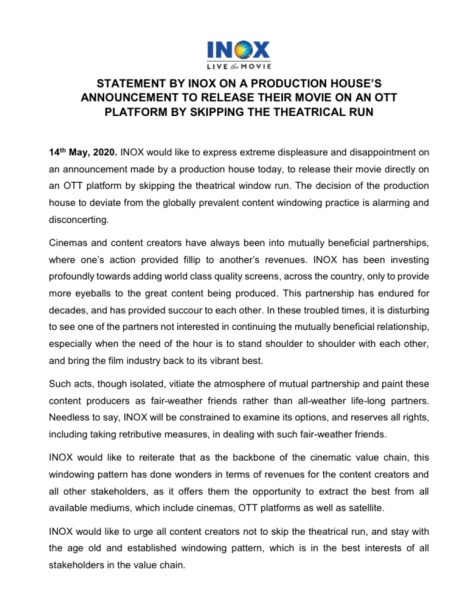
Various multiplex chain owners have openly criticized this move by the producers. India’s largest multiplex chain, INOX, had even released a statement regarding the same. They called out on the film industry of not standing by their partners in times of need. They even threatened about ‘retributive measures’ that will be taken in the future. This was followed by Producers Guild India as well making a statement contradictory to theirs.

MULTIPLEX CHAIN OWNERS PERSPECTIVE

Various multiplex chain owners have openly criticized this move by the producers. India’s largest multiplex chain, INOX, had even released a statement regarding the same. They called out on the film industry of not standing by their partners in times of need. They even threatened about ‘retributive measures’ that will be taken in the future. This was followed by Producers Guild India as well making a statement contradictory to theirs.

Siddharth Jain from the INOX chain of cinemas was surprised by the movie industry’s producer friends’ move. Cinemas and exhibition share a century-old relationship. So, the least they were expecting from their friends was that they all at least ponder over the situation before making any announcements. No one from the other side was consulted about the same, and suddenly a line of cinemas announced their release on Amazon Prime, Zee5, and Netflix, to name a few. Also, once the theaters open, one cannot expect the viewers to pay to watch an old film that is already out in the market.

As a result, even PVR urged the producers not to release their films until theaters do not reopen. Kamal Gianchandani, CEO of PVR Pictures, in a conversation with HuffPost India, stated that they are disappointed with Gulabo Sitabo being directly released on the OTT platform. Tamil Nadu Theatre and Multiplex Owners’ Association had also expressed its displeasure when it was announced that Suriya and his company 2D Entertainment Ponmagal Vandhal, would be directly released on OTT platforms. They even threatened to ban their films in the future. Nevertheless, on 29th May 2020, the movie was released on Amazon Prime. Eastern India Motion Pictures Association (EIMPA) had written to the government regarding their apprehension on films getting released on OTTs directly.

The theatre owners do have a point. Huge investments have been made on the infrastructure. apart from the revenues, such exhibitions do generate huge employment opportunities. Currently, around 2 lakh people are earning their bread and butter from this industry. So, if this trend continues, there will be a cause of worry.

Rs, 10-15,000 crore of yearly revenues, are generated from the box-office. Due to the lockdown, this quarter of that business is already lost. Now with the producers skipping, the theatrical release would make the matter worse. It is estimated that with the release of Gulabo Sitabo and Shakuntala Devi, there will be an additional loss of Rs 100-125 crore. Leaving aside what has been done, one will realize that straight-to-OTT is not a wise decision at all. Revenues from other avenues such as TV satellite rights are also lost.

PRODUCERS AND FILMMAKERS PROSPECTIVE

Renowned filmmakers like Shoojit Sircar believe this is a time to experiment with other platforms for releasing the films. It is because the theatres would not be opening anytime soon. The rising cases in the country have forced the state governments to put the reopening of the theatres at last in the priority list. The business of a film can only be taken into consideration by the pan-India box office. So rather than incurring losses by shelving the movie for so long, it is better to release them on OTT to curb the losses. But it is a short-term phenomenon.

However, it does not mean that the films give to the OTT are at a loss. It will allow the filmmakers to cover the damage and earn a premium so that they can begin working on other films; and Amazon Prime, Zee5, and Netflix having that kind of money to buy the rights. This way, it is a win-win situation for both of them.

Once the theatres open, people would be back watching their favorite actors on the big screen. Also, several films will be lined up for the screening. According to an analysis, approximately six films will be lined up every Friday for the release. So, it is better this way to cut the competition and the losses. Theatres are the best medium to watch a film. Also, it is the best way to pay one’s respect and love for the genius and the hard work of the filmmakers.

CHALLENGE TO THE THEATERS

According to the 2020 FICCI-EY report of 2020, about 50 low budget films were released directly on OTT in India in 2019. OTT guarantees a broader audience for small films with less saleable names. It cuts costs on printing and advertising. A theatrical release is a costly affair for them as distributors do not show much of an interest. Thus, it acts as a saviour for smaller films, but it cannot replace the exhibition industry.

So, the digital release of feature films is not a new trend. There has been a 100% increase in the streaming subscription revenues last year. Besides offering live entertainment, several OTT players are creating noteworthy web series and film that has managed to capture the eyeballs. It has created a tension that the filmmakers will lose out on the theatrical experience. Video streaming platforms have certainly made experiencing movies convenient, affordable, and available ‘on the go,’ especially for those who prefer binge-watching.

So, although the theatres still draw an enormous footfall, the streaming platforms’ presence cannot be made palpable. A digital release is a different game, and every film has a unique strategy to stand out. Nevertheless, the exhibition model will endure this challenge a well. Earlier as well, there were challenges such as VCRs, VCD, and DVDs. Now the streaming platforms have come up. During every trial, people though that the theatres would perish. But all the problems have been done and dusted very time. It too shall pass

They are watching movies by going out of the house, and using it as an opportunity to socialize is embedded in India’s social fabric. Movies, coupled with dinner, is escapism for the next-gen from their daily routine. Although streaming has made the movie-watching experience cheap and comfortable, the fun to go out of the house using this occasion cannot be replaced.

Currently, both the mediums are holding on to their exclusive formats and the USP attached to it. Both of them serve almost the same type of content, but the purpose and consumer variables are different. People might look up to the theatre experience for 3D animation or much-awaited-films. While on the other hand, the audience will rely on the OTT platforms more On-The-Go with more like podcasts, exclusive interest content, history documentaries, interviews, or web series. It is more likely that OTT has been impacted by the ongoing TV viewership rather than a theatrical experience.

The co-existence of both theatres and OTT platforms in the long -run is something that we all can foresee in the future. It is merely because of the relevance these two platforms hold in terms of viewers and the content. While people watch OTTs on weekdays, on the other hand, people watch movies over the weekend. However, the technological revolution will redefine theatre for a type of content such as genre movies for sure.

The current audiences are not willing to shy to shed an extra penny to seek a completely transformative experience for fresh, relatable, and engaging content. Thus, exaggerating either of them is incorrect.

Nevertheless, it is safe to assume that customers today have a platter full of options and the freedom to choose any of them as per their interest. So, it is up to the various mediums to adapt to the changing scenario.

#The Invisible men🕴

The stranger came early in February, one wintry day, through a biting wind and a driving snow, the last snowfall of the year, over the down, walking as it seemed from Bramblehurst railway station, and carrying a little black portmanteau in his thickly gloved hand. He was wrapped up from head to foot, and the brim of his soft felt hat hid every inch of his face but the shiny tip of his nose; the snow had piled itself against his shoulders and chest, and added a white crest to the burden he carried. He staggered into the Coarch and Horses, more dead than alive as it seemed, and flung his portmanteau down. “A fire,” he cried, “in the name of human charity! A room and a fire!” He stamped and shook the snow from off himself in the bar, and followed Mrs. Hall into her guest parlour to strike his bargain. And with that much introduction, that and a ready acquiescence to terms and a couple of sovereigns flung upon the table, he took up his quarters in the inn.Mrs. Hall lit the fire and left him there while she went to prepare him a meal with her own hands. A guest to stop at Iping in the wintertime was an unheard-of piece of luck, let alone a guest who was no “haggler,” and she was resolved to show herself worthy of her good fortune. As soon as the bacon was well under way, and Millie, her lymphatic aid, had been been brisked up a bit by a few deftly chosen expressions of contempt, she carried the cloth, plates, and glasses into the parlour and began to lay them with the utmost éclat. Although the fire was burning up briskly, she was surprised to see that her visitor still wore his hat and coat, standing with his back to her and staring out of the window at the falling snow in the yard. His gloved hands were clasped behind him, and he seemed to be lost in thought. She noticed that the melted snow that still sprinkled his shoulders dripped upon her carpet. “Can I take your hat and coat, sir,” she said, “and give them a good dry in the kitchen?””No,” he said without turning.She was not sure she had heard him, and was about to repeat her question.He turned his head and looked at her over his shoulder. “I prefer to keep them on,” he said with emphasis, and she noticed that he wore big blue spectacles with side-lights, and had a bushy side-whisker over his coatcollar that completely hid his cheeks and face.”Very well, sir,” she said. “As you like. In a bit the room will be warmer.”He made no answer, and had turned his face away from her again, and Mrs. Hall, feeling that her conversational advances were ill-timed, laid the rest of the table things in a quick staccato and whisked out of the room. When she returned he was still standing there, like a man of stone, his back hunched, his collar turned up, his dripping hat-brim turned down, hiding his face and ears completely. She put down the eggs and bacon with considerable emphasis, and called rather than said to him, “Your lunch is served, sir.””Thank you.” he said at the same time, and did not stir until she was closing the door. Then he swung round and approached the table with a certain eager quickness.As she went behind the bar to the kitchen she heard a sound repeated at regular intervals. Chirk, chirk, chirk, it went, the sound of a spoon being rapidly whisked round a basin. “That girl!” she said. “There! I clean forgot it. It’s her being so long!” And while she herself finished mixing the mustard, she gave Millie a few verbal stabs for her excessive slowness. She had cooked the ham and eggs, laid the table, and done everything, while Millie (help indeed!) had only succeeded in delaying the mustard. And him a new guest and wanting to stay! Then she filled the mustard pot, and, putting it with a certain stateliness upon a gold and black tea-tray, carried it into the parlour.She rapped and entered promptly. As she did so her visitor moved quickly, so that she got but a glimpse of a white object disappearing behind the table. It would seem he was picking something from the floor. She rapped down the mustard pot on the table, and then she noticed the overcoat and hat had been taken off and put over a chair in front of the fire, and a pair of wet boots threatened rust to her steel fender. She went to these things resolutely. “I suppose I may have them to dry now,” she said in a voice that brooked no denial.”Leave the hat,” said her visitor, in a muffled voice, and turning she saw he had raised his head and was sitting and looking at her.For a moment she stook gaping at him, too surprised to speak.He held a white cloth—it was a serviette he had brought with him—over the lower part of his face, so that his mouth and jaws were completely hidden, and that was the reason for his muffled voice. But it was not that which startled Mrs. Hall, It was the fact that all his forehead above his blue glasses was covered by a white bandage, and that another covered his ears, leaving not a scrap of his face exposed excepting only his pink, peaked nose. It was bright, pink, and shiny just as it had been at first. He wore a dark-brown velvet jacket with a high, black, linen-lined collar turned up about his neck. The thick black hair, escaping as it could below and between the cross bandages, projected in curious tails and horns, giving him the strangest appearance conceivable. This muffled and bandaged head was so unlike what she had anticipated, that for a moment she was rigid.He did not remove the serviette, but remained holding it, as she saw now, with a brown gloved hand, and regarding her with his inscrutable blue glasses. “Leave the hat,” he said, speaking very distinctly through the white cloth.Her nerves began to recover from the shock they had received. She placed the hat on the chair again by the fire. “I didn’t know, sir,” she began, “that—” and she stopped embarrassed.”Thank you,” he said dryily, glancing from her to the door and then at her again.”I’ll have them nicely dried, sir, at once,” she said, and carried his clothes out of the room. She glanced at his white-swathed head and blue goggles again as she was going out the door; but his napkin was still in front of his face. She shivered a little as she closed the door behind her, and her face was eloquent of her surprise and perplexity. “I never,” she whispered. “There!” She went quite softly to the kitchen, and was too preoccupied to ask Millie what she was messing about with now, when she got there.The visitor sat and listened to her retreating feet. He glanced inquiringly at the window before he removed his serviette, and resumed his meal. He took a mouthful, glanced suspiciously at the window, took another mouthful, then rose and, taking the serviette in his hand, walked across the room and pulled the blind down to the top of the white muslin that obscured the lower panes. This left the room in a twilight. This done, he returned with an easier air to the table and his meal.”The poor soul’s had an accident or an operation or something,” said Mrs. Hall. “What a turn them bandages did give me, to be sure!”She put on some more coal, unfolded the clothes-horse, and extended the traveller’s coat upon this. “And they goggles! Why, he looked more like a divin’-helmet than a human man!” She hung his muffler on a corner of the horse. “And holding that handkercher over his mouth all the time. Talkin’ through it! . . . Perhaps his mouth was hurt too—maybe.” She turned round, as one who suddenly remembers. “Bless my soul alive!” she said, going off at a tangent; “ain’t you done them taters yet, Millie?”When Mrs. Hall went to clear away the stranger’s lunch, her idea that his mouth must also have been cut or disfigured in the accident she supposed him to have suffered, was confirmed, for he was smoking a pipe, and all the time that she was in the room he never loosened the silk muffler he had wrapped round the lower part of his face to put the mouthpiece to his lips. Yet it was not forgetfulness, for she saw he glanced at it as it smouldered out. He sat in the corner with his back to the window-blind and spoke now, having eaten and drunk and been comfortably warmed through, with less aggressive brevity than before. The reflection of the fire lent a kind of red animation to his big spectacles they had lacked hitherto.”I have some luggage,” he said, “at Bramblehurst station,” and he asked her how he could have it sent. He bowed his bandaged head quite politely in acknowledgement of her explanation. “To-morrow!” he said. “There is no speedier delivery?” and seemed quite disappointed when she answered, “No.” Was she quite sure? No man with a trap who would go over?Mrs. Hall, nothing loath, answered his questions and developed a conversation. “It’s a steep road by the down, sir,” she said in answer to the question about a trap; and then, snatching at an opening, said, “It was there a carriage was up-settled, a year ago and more, A gentleman killed, besides his coachman. Accidents, sir, happens in a moment, don’t they?”But the visitor was not to be drawn so easily. “They do,” he said through his muffler, eyeing her quietly through his impenetrable glasses.”But they take long enough to get well, sir, Don’t they? . . . There was my sister’s son, Tom, jest cut his arm with a scythe, Tumbled on it in the ‘ayfield, and, bless me! he was three months tied up, sir. you’d hardly believe it. It’s regular given me a dread of a scythe, sir.””I can quite understand that,” said the visitor.”He was afraid, one time, that he’d have to have an op’ration—he was that bad, sir.”The visitor laughed abruptly, a bark of a laugh that he seemed to bite and kill in his mouth. “Was he?” he said.”He was, sir. And no laughing matter to them as had the doing for him, as I had—my sister being took up with her little ones so much. There was bandages to do, sir, and bandages to undo. So that if I may make so bold as to say it, sir—””Will you get me some matches?” said the visitor, quite abruptly. “My pipe is out.”Mrs. Hall was pulled up suddenly. It was certainly rude of him, after telling him all she had done. She gasped at him for a moment, and remembered the two sovereigns. She went for the matches.”Thanks,” he said concisely, as she put them down, and turned his shoulder upon her and stared out of the window again. It was altogether too discouraging. Evidently he was sensitive on the topic of operations and bandages. She did not “make so bold as to say,” however, after all. But his snubbing way had irritated her, and Millie had a hot time of it that afternoon.The visitor remained in the parlour until four o’clock, without giving the ghost of an excuse for an intrusion. For the most part he was quite still during that time; it would seem he sat in the growing darkness smoking in the firelight, perhaps dozing.Once or twice a curious listener might have heard him at the coals, and for the space of five minutes he was audible pacing the room. He seemed to be talking to himself. Then the armchair creaked as he sat down again.Story by—H. G. Wells

Loneliness.

When the whole world is locked within their rooms due to this covid 19 pandemic many of us are feeling lonely, sad and depressed.So I would like to tell each individual who is reading this that you are not alone. We are all together in this. We are not alone.Lets fight our fears and be happy. Talk to your inner self.. Believe that you are capable of fighting and we shall overcome this situation very soon..

Loneliness is something that we all suffer in today’s world. There is no age boundary regarding this actually.Usually students shift to hostels or different state and countries for higher studies or job. There in the new environment they take time to adjust and reciprocate. Loneliness is the common thing thing that grasps them. They feel loneny, out of their comfort sone and miss their near ones terribly. Depression is another dangerous disease that attacts them in most cases. Despite of having friends they suffer from anxiety and depression. People develop different addictions like consuming drugs and alcohol which have adverse effect on their health and career.

Again in case of aged people whose children live far away from then also suffer from loneliness. What our near ones actually want from us is love and our gime. Sadly in today’s competitive word people hardly have time for anything.All are running in a rat race in order to survive. Aged people need more care love and affection.when they faail to get it they become lonely sad and depressed. It affects their mental and physical health to a great extend.

Now during the covid 19 pandemic we are getting various cases of suicides and the major reason behind them is depression, anxiety and the feel of being alone. Many are suffeing from identify crisis. Sudents are worried abou their uncertain future. The sense of being left alone is grabbing our young generation at a very alarming rate.

When such things are going on all over the world we all must talk to ourselves as I have already mentioned.It will give satisfaction.It will help us to fight better. Doing meditation and yoga helps in this context.

Loneliness – the demon

One fears loneliness and so do I,
One faces loneliness and so do I,
Amongst the thousands one tends to loose the very identity and so do I,
Its like the demon who grabs the arms in dark,
It engulfs the ability to think, to desire,to prosper
It conquers the power  to imagine ,to proceed and to succeed,
When one night it penitrated me to the fullest,
I tried to resist but all in vain
I waited for the atmosphere to change;
But it changed for the worst
And all of a sudden a voice interrupted and resumed my consciousness,
And now as i behold i find my reflection,
Subconsciously i realize the very fact that
Am not alone,.
for i am encompassed by my own self that resides deep inside me that saved me that night..
Everyone has an inner self just as i possess
Grant her your friendship just as i do
And u will notice loneliness closes its doors for you…

Benchmarking in the Healthcare System

The right to health has so far not been accorded the status of a Fundamental Right to the Indian citizens. It is not even a statutory right, unlike education.

Moreover, health is a subject which is assigned to State Governments as per our Constitution. This is reflected in the way we finance it, with about two-thirds of the total governmental expenditure on health coming from the State Governments and the balance one-third being provided by the Government of India. Despite this, it is also a reality that the Government of India has significant influence in the policy space with pathbreaking schemes such as the National Health Mission (NHM) and Ayushman Bharat, with its twin prongs of the Health and Wellness Centres to deliver comprehensive primary health care and Pradhan Mantri Jan Arogya Yojana (PMJAY).

India is also a signatory to the 2030 Agenda for Sustainable Development, whereby it has committed as a nation to “ensure healthy lives and promote well-being for all”. In the last decade, millions of Indians have escaped from extreme poverty because of the rapid economic growth. As would be expected of rapidly growing economy, the health system and population level health outcomes have also improved significantly albeit at a much more gradual pace. Despite notable gains in improving life expectancy, reducing maternal and child mortality, and addressing other health priorities, our health system needs a lot of improvement judged by the rather modest benchmark of countries with similar levels of economic development. Furthermore, there are huge variations across States in their health outcomes and health systems’ performance. It is unfortunate that by and large, health has not received the kind of political and administrative salience that this vital sector deserves. With the federal compact among the Central and the State Governments having been clearly defined in the Constitution, the key questions that motivated the team involved in the design of Health Index were as

follows:

a. Can we develop a tool to bring health into greater political focus to ensure that what gets measured gets done?

b. Can we benchmark the performance of the health system of various States which can be put forth in the public domain in a timely manner? Is it possible to capture the diversity and yet ensure that high performing states do not get complacent and the low performing States are not discouraged?

c. Can appropriate instrument or incentives be put in place that can nudge the States to try and radically improve their health system performance? Can this be done in a manner that respects the federal compact and allows autonomy to individual State Governments to make policy choices to achieve the specified benchmarks?

d. What are the parameters that could credibly capture the complex story of health system performance? Can those parameters capture outcomes at the system level rather than merely tracking inputs such as budget, number of facilities or outputs such as number of OPDs/IPDs? Is data relating to those parameters available from third party source? Is the data of reasonable quality and available at least annually? What is the emphasis (weights) to be provided on each of the individual parameters? The answer to these questions– admittedly imperfect-was to craft a Health Index – a journey which NITI Aayog embarked upon in 2017 in collaboration with the Ministry of Health and Family Welfare (MoHFW) and the World Bank. It is the firstever systematic exercise for tracking the progress on health outcomes and health systems’ performance across all the States and Union Territories (UTs) in India on an annual basis. The Health Index is a weighted-composite

Index based on select indicators in three domains:

(a) Health Outcomes;

(b) Governance and Information; and

(c) Key Inputs and Processes, with the health outcomes carrying the most weight across the different category of

States/UTs. For generation of ranks, the States are classified into three categories (Larger States, Smaller States and UTs) to ensure comparability among similar entities.

A range of indicators such as the neo-natal mortality rate (deaths occurring in the first 28 days of life), full immunisation coverage, treatment success rate of confirmed tuberculosiscases, stability of tenure of key administrators, vacancy of doctors and specialists in health facilities, and functionality of primary health centres, first referral units and cardiac care units, are included in the Index. In February 2018, the first round of the Health Index report on ranks and scores was released which measured the annual and incremental performance of the States and UTs over the period of 2014-15 (base year) to 2015-16 (reference year). This was followed by the second round of Health Index that tracked performance for the period 2015-16 (base year) and 2017-18 (reference year). The same set of indicators and weights were used for the first two rounds.

The Health Index is a useful tool to measure and compare the overall performance and incremental performance across States and UTs over time. It is an important instrument in understanding the variations and complexity of the nation’s performance in health. The critical factors that contributed to the success of the Health Index include: a) Timelines of the report so that it stimulates action and not merely academic discussions; b) Provision of financial incentives based on the annual incremental performance of states under the National Health Mission; and; c) Verification of self-reported data by states by a third party, independent verification agency to enhance credibility. However, there are limitations to the Index as no single index can purport to comprehensively capture the complex story of the evolution of the health system. Also, due to constraints of availability of quality data critical areas such as non-communicable diseases, mental health, and private sector service utilisation could not be captured. Thus, the Health Index is a work in progress and continuous refinements will be made as additional quality data becomes available and data systems improve.

PHASES OF INDIAN Music

WHAT IS MUSIC?

The music of India includes multiple varieties of classical musicfolk music, Filmy, Indian rock, and Indian pop. Indian pop and Indian rock are derived from western rock and roll. India‘s classical music tradition, including Hindustani music, Bhartiya music and Carnatic , has a history spanning millennia and developed over several areas. Music in India began as an integral part of socio-religious life.

Music is a way of expressing the feelings by the medium of rhythms and ragas the formation of both of these important elements makes the music beautiful. It expresses the situation you are feeling or someone else for whom the music is been created. The creation of music is an art it’s an beauty in itself the better the music plays or is created it gives a long lasting impact on the listeners. In India music is a heritage to the people of this country. Indian people have created music to express their feelings for the almighty god at first so that they can tell that how they feel about the god in a beautiful way. It helps to share the feelings in a short way and in a helpful way.

As we all know that India is a holy country a country full of devotees of almighty in every religion. So, the start of the music is also from the prayers or the story telling of almighty in India and then the other forms were discovered or created in Indian music.

BHAKTI MUSIC

Vedas (c. 1500 – c. 800 BCE Vedic period) document rituals with performing arts and play. For example, Shatapatha Brahmana (~800–700 BCE) has verses in chapter 13.2 written in the form of a play between two actors. Tala or taal is an ancient music concept traceable to Vedic era texts of Hinduism, such as the Samaveda and methods for singing the Vedic hymns. Smriti (500 BCE to 100 BCE ) post-vedic Hindu texts include Valmiki‘s Ramayana (500 BCE to 100 BCE) which mentions dance and music (dance by Apsaras such as UrvashiRambhaMenakaTilottama Panchāpsaras, and Ravana‘s wives excelling in nrityageetaor “singing and dancing” and nritavaditra or “playing musical instruments”), music and singing by Gandharvas, several string instruments(vinatantrivipanci and vallaki similar to veena), wind instruments (shankhavenu and venugana – likely a mouth organ made by tying several flutes together), raga (including kaushika such as raag kaushik dhwani), vocal registers (seven svara or sur, ana or ekashurtidrag note, murchana the regulated rise and fall of voice in matra and tripramana three-fold teen taal laya such as drut or quick, madhyaor middle, and vilambit or slow), poetry recitation in Bala Kanda and also in Uttara Kanda by Luv and Kusha in marga style.

Starting from the earliest known work Tholkappiyam (500 BCE), there are several references to music and Panns in the ancient pre-Sangam and Sangam literature starting from the earliest known work Tholkappiyam (500 BCE). Among Sangam literature, Mathuraikkanci refers to women singing sevvazhi pann to invoke the mercy of God during childbirth. In Tolkappiyam, the five landscapesof the Sangam literature had each an associated Pann, each describing the mood of the song associated with that landscape. Among the numerous panns that find mention in the ancient Tamil literature are, Ambal Pann, which is suitable to be played on the flute, sevvazhi pann on the Yazh (lute), Nottiram and Sevvazhi expressing pathos, the captivating Kurinji pann and the invigorating Murudappann.Pann(Tamil: பண்) is the melodic mode used by the Tamil people in their music since the ancient times. The ancient panns over centuries evolved first into a pentatonic scale and later into the seven note Carnatic Sargam. But from the earliest times, Tamil Music is heptatonicand known as Ezhisai (ஏழிசை).

Sanskrit saint-poet Jayadeva, who was the great composer and illustrious master of classical music, shaped Odra-Magadhi style music and had great influence on Odissi Sangita.

Sarṅgadeva composed Sangita-Ratnakara, one of the most important Sanskrit musicological texts from India, which is regarded as the definitive text in both Hindustani music and Carnatic music traditions of Indian classical music.

Assamese poet Madhava Kandali, writer of Saptakanda Ramayana, lists several instruments in his version of “Ramayana”, such as mardala, khumuchi, bhemachi, dagar, gratal, ramtal, tabaljhajhar, jinjiri, bheri mahari, tokari, dosari, kendaradotaravinarudra-vipanchi, etc. (meaning that these instruments existed since his time in 14th century or earlier). The Indian system of notation is perhaps the world’s oldest and most elaborate.

“In India music is now followed and aspired by the bollywood fashion which they have stated for the public to enjoy. Now we are discussing which change are there in the both types of music in the bollywood whether it is old or new and if they have followed any form or way from the Sufi music or the bhakti music it will be concluded later.”

OLD BOLLYWOOD MUSIC VS PRESENT BOLLYWOOD MUSIC

Hindi film songs are present in Hindi cinema right from the first sound film Alam Ara (1931) by Ardeshir Irani which featured seven songs. This was closely followed by Shirheen Farhad (1931) by Jamshedji Framji Madan, also by Madan, which had as many as 42 song sequences strung together in the manner of an opera, and later by Indra Sabha which had as many as 69 song sequences. However, the practice subsided and subsequent films usually featured between six and ten songs in each production.

Right from the advent of Indian cinema in 1931, musicals with song numbers have been a regular feature in Indian cinema. In 1934 Hindi film songs began to be recorded on gramophones and later, played on radio channels, giving rise to a new form of mass entertainment in India which was responsive to popular demand. Within the first few years itself, Hindi cinema had produced a variety of films which easily categorised into genres such as “historicals”, “mythologicals”, “devotional, “fantasy” etc. but each having songs embedded in them such that it is incorrect to classify them as “musicals”.

The Hindi song was such an integral features of Hindi mainstream cinema, besides other characteristics, that post-independence alternative cinema, of which the films of Satyajit Ray are an example, discarded the song and dance motif in its effort to stand apart from mainstream cinema.

The Hindi film song now began to make its presence felt as a predominating characteristic in the culture of the nation and began to assume roles beyond the limited purview of cinema. In multi-cultural India, as per film historian Partha Chatterjee, “the Hindi film song cut through all the language barriers in India, to engage in lively communication with the nation where more than twenty languages are spoken and … scores of dialects exist”. Bollywood music has drawn its inspiration from numerous traditional sources such as Ramleelanautankitamasha and Parsi theatre, as well as from the West, Pakistan, and other Indic musical subcultures.

For over five decades, these songs formed the staple of popular music in South Asia and along with Hindi films, were an important cultural export to most countries around Asia and wherever the Indian Diaspora had spread. The spread was galvanised by the advent of cheap plastic tape cassettes which were produced in the millions till the industry crashed in 2000. Even today Hindi film songs are available on radio, on television, as live music by performers, and on media, both old and new such as cassette tapes, compact disks and DVDs and are easily available, both legally and illegally, on the internet.

GENRES

DANCE

Hindi dance music encompasses a wide range of songs predominantly featured in the Bollywood film industry with a growing worldwide attraction. The music became popular among overseas Indians in countries such as South Africa, the United Kingdom and the United States of America and eventually developed a global fan base.

DISCO

In the Indian subcontinent of South Asiadisco peaked in popularity in the early 1980s, when a South Asian disco scene arose, popularised by filmy Bollywood music, at a time when disco’s popularity had declined in North America. The South Asian disco scene was sparked by the success of Pakistani pop singer Nazia Hassan, working with Indian producer Biddu, with the hit Bollywood song “Aap Jaisa Koi” in 1980. Biddu himself previously had success in the Western world, where he was considered a pioneer, as one of the first successful disco producers in the early 1970s, with hits such as the hugely popular “Kung Fu Fighting” (1974), before the genre’s Western decline at the end of the 1970s led to him shifting his focus to Asia. The success of “Aap Jaisa Koi” in 1980 was followed by Nazia Hassan’s Disco Deewane, a 1981 album produced by Biddu, becoming Asia’s best-selling pop album at the time.

In parallel to the Euro disco scene at the time, the continued relevance of disco in South Asia and the increasing reliance on synthesizersled to experiments in electronic disco, often combined with elements of Indian music. Biddu had already used electronic equipment such as synthesizers in some of his earlier disco work, including “Bionic Boogie” from Rain Forest (1976), “Soul Coaxing” (1977), Eastern Man and Futuristic Journey (recorded from 1976 to 1977), and “Phantasm” (1979), before using synthesizers for his later work with Nazia Hassan, including “Aap Jaisa Koi” (1980), Disco Deewane (1981) and “Boom Boom” (1982). Bollywood disco producers who used electronic equipment such as synthesizers include R.D. Burman, on songs such as “Dhanno Ki Aankhon Mein” (Kitaab, 1977) and “Pyaar Karne Waale” (Shaan, 1980); Laxmikant-Pyarelal, on songs such as “Om Shanti Om” (Karz, 1980); and Bappi Lahari, on songs such as “Ramba Ho” (Armaan, 1981). They also experimented with minimalisthigh-tempo, electronic disco, including Burman’s “Dil Lena Khel Hai Dildar Ka” (Zamane Ko Dikhana Hai, 1981), which had a “futuristic electro feel”, and Lahiri’s “Yaad Aa Raha Hai” (Disco Dancer, 1982).

Such experiments eventually culminated in the work of Charanjit Singh, whose 1982 record Synthesizing: Ten Ragas to a Disco Beatanticipated the sound of acid house music, years before the genre arose in the Chicago house scene of the late 1980s. Using the Roland TR-808 drum machineTB-303 bass synthesizer, and Jupiter-8 synthesizer, Singh increased the disco tempo up to a “technowavelength” and made the sounds more minimalistic, while pairing them with “mystical, repetitive, instrumental Indian ragas“, to produce a new sound, which resembled acid house. According to Singh: “There was lots of disco music in films back in 1982. So I thought why not do something different using disco music only. I got an idea to play all the Indian ragas and give the beat a disco beat – and turn off the tabla. And I did it. And it turned out good.” The first track “Raga Bhairavi” also had a synthesised voice that says “Om Namah Shivaya” through a vocoder.

Along with experiments in electronic disco, another experimental trend in Indian disco music of the early 1980s was the fusion of disco and psychedelic music. Due to 1960s psychedelic rock, popularised by the Beatles‘ raga rock, borrowing heavily from Indian music, it began exerting a reverse influence and had blended with Bollywood music by the early 1970s. You can download these songs for free from various sources as well. This led to Bollywood producers exploring a middle-ground between disco and psychedelia in the early 1980s. Producers who experimented with disco-psychedelic fusion included Laxmikant-Pyarelal, on songs such as “Om Shanti Om” (Karz, 1980), and R. D. Burman, on songs such as “Pyaar Karne Waale” (Shaan, 1980), along with the use of synthesizers.

GHAZAL

Music directors like Madan Mohan composed notable film-ghazals extensively for Muslim socials in the 1960s and the 1970s. The filmi-ghazal style experienced a revival in the early 1990s, sparked by the success of Nadeem-Shravan‘s Aashiqui (1990). It had a big impact on Bollywood music at the time, ushering in ghazal-type romantic music that dominated the early 1990s, with soundtracks such as DilSaajanPhool Aur Kaante and Deewana. A popular ghazal song from Aashiqui was “Dheere Dheere“, a cover version of which was later recorded by Yo Yo Honey Singh and released by T-Series in 2015.

QAWWALI

It represents a distinct subgenre of film music, although it is distinct from traditional qawwali, which is devotional Sufi music. One example of filmi qawwali is the song “Pardah Hai Pardah” sung by Mohammed Rafi, and composed by Laxmikant-Pyarelal, for the Indian film Amar Akbar Anthony (1977).

Within the subgenre of filmi qawwali, there exists a form of qawwali that is infused with modern and Western instruments, usually with techno beats, called techno-qawwali. An example of techno-qawwali is “Kajra Re“, a filmi song composed by Shankar Ehsaan Loy. A newer variation of the techno-qawwali based on the more dance oriented tracks is known as the “club qawwali”. More tracks of this nature are being recorded and released.

Nusrat Fateh Ali Khan and A.R. Rahman have composed filmi qawwalis in the style of traditional qawwali. Examples include “Tere Bin Nahin Jeena” (Kachche Dhaage), “Arziyan” (Delhi 6), “Khwaja Mere Khwaja” (Jodhaa Akbar)[43] and “Kun Faya Kun” (Rockstar).[44]

ROCK

Indian musicians began fusing rock with traditional Indian music from the mid-1960s onwards in filmy songs produced for popular Bollywood films. Some of the more well known early rock songs (including styles such as funk rockpop rockpsychedelic rockraga rock, and soft rock) from Bollywood films include Mohammed Rafi‘s “Jaan Pehechan Ho” in Gumnaam (1965), Kishore Kumar‘s “O Saathi Re” in Muqaddar Ka Sikandar (1978), and Asha Bhosle songs such as “Dum Maro Dum” in Hare Rama Hare Krishna (1971), “Ae Naujawan Hai Sab” in Apradh (1972), and “Yeh Mera Dil Pyar Ka Diwana” in Don (1978).

CONCLUSION

Songs nowadays have a soft spot in almost everyone’s heart. People listen different types of music be it a inspirational/motivational, sad, romantic, rocking, Gazal etc. I have been through the answers here some are saying old one’s have the meanings so are the best where as the new ones are shitty except few. Well this questions’ answer will definitely vary as it totally depends upon an individual’s perception.
I agree that old songs does have meanings but many don’t. Songs sung by legendary singers like Kishore Kumar, Gulshan Kumar, Lata Mangeskar etc. have been great no doubt, one of my favorite is zindagi ke safar mein this song is so much meaningful that one can relate it to one’s life. So there are many old ones which have meaning but not every as you all know.

Now coming to the new songs, who says new songs are not better than old one’s? Well many of you out there but let me tell you all, there are good numbers of new songs which have meanings like kal ho na ho, ashayein, muskurane ki wajah, roobaroo and many more. These songs have mesmerized many people. And if you are pointing towards Honey Singh’s songs then guys just tell me what’s wrong in it?  I mean I am not a huge fan of him but genuinely saying there’s nothing bad. His songs are heard just for fun or party. So i think it’s quite okay to enjoy in these kind of songs. Though it doesn’t have meanings at all but somehow it gives a good tune to listen. Not a big deal! Both old and new are best. It depends totally on you. And Indian songs have always been one of a kind because of our talented singers of our country. They have given so much hits and enlighten our mood as well. The ragas in these songs which are discussed in the above articles are a masterpiece of the mixture of the old classical and Sufi form of creating music.


NEED OF SPORTS LAW IN INDIA

HELLO! SPORTS

The history of sports extends as far back as the existence of people as purposive, sportive and active beings. It also shows how society has changed its beliefs and therefore how changes in the rules are brought. The history of sports in India dates back to the Vedic era. Chess, wrestling, polo, archery and hockey are some of the games believed to have originated in India. But somewhere between the historical lineage of sports and sports in the modern era there is a gap of enthusiasm and encouragement. Little importance is left for sports at grass root level in India with every school concentrating only on academics. Though there are various federations in India that provide sports facilities but apart from cricket, India is largely failing in every major event for sports such as Olympics. One of the main reasons for it is the lack of uniform regulation in India for sports. There is a need for a legislation that governs sports and brings the various authorities into one roof. Sports law has an unusually well developed pattern of globalized regulation and overlaps substantially with labor law, contract law, criminal law, public law, administrative law, antitrust law, competition law, intellectual property rights law, law of tort, media law, company law, human rights law etc. These laws have been applied to sporting context involving public order, drugs, safety, disciplinary measures, conduct and wider issues relating to restraint of trade, anti competitive behaviour, match fixing and the commercial exploitation of sports. Issues like defamation and privacy rights are also an integral aspect of sports law. In India sports figures in the State list of the Seventh Schedule (entry 33) of the Constitution.

ORGANIZATION OF SPORTS IN INDIA

In the field of sports, the club is the basic unit at the grass root level. At the top of the hierarchy are the international sports bodies for each sports made up of national bodies of different countries. The national sports bodies again consist of the provincial or state bodies of different countries. The provincial state bodies comprise the different districts or clubs. In India, national sports bodies field the national team representing the country for participation in international competitions where good performance is a matter of pride for the entire nation. They consider the players for participation Accordingly in the most countries including India, for enforcement of their public duties and obligations prerogative Constitutional Writs of High Courts lie against these private bodies like any public or Government Authority.  (Indian Olympic Association Vs Veeresh Malik and Ors MANU/DE/0108/2010) 

There is no national or state legislation for regulation of sports in India. The Ministry of Youth Affairs & Sports was set up by the Govt. of India to create the infrastructure and promote capacity building for broad-basing sports as well as for achieving excellence in various competitive events at the national and international levels. Sports promotion is primarily the responsibility of the various National Sports Federations (NSFs) which are autonomous in nature. The Ministry of Sports and Youth Affairs issues notifications and guidelines from time to time for the purpose of regulation of NSFs.

The Sports Law in India is governed and regulated by
• National Sports Policy
• Sports Law and Welfare Association of India
• Sports Authority of India
• The Sports Broadcasting Law in India.

NATIONAL SPORTS POLICY, 1984/2001 

A Resolution on the National Sports Policy was laid in both Houses of Parliament in August, 1984. The National Sports Policy, 1984 was formulated with the objective of raising the standard of Sports in the country. The National Sports Policy, 1984 provided inter-alia that the progress made in its implementation would be reviewed every five years to determine the further course of action, as may be necessary, following such review. Over the years, it has transpired that even as the National Sports Policy, 1984 encompasses various facets in respect of encouraging sports in the country, the implementation of the same is not complete. In order to reformulate the National Sports Policy 1984, National Sports Policy 2001, was drafted

The objective of the guidelines of National Sports Policy 2001 is three fold: 

• Firstly to define the areas of responsibility of the various agencies involved in the promotion and development of sports,
• Secondly, to identify National Sports Federations eligible for coverage under these guidelines, to set priorities, and to detail the procedures to be followed by the Federations, to avail of Government sponsorship and assistance. 
• Thirdly, to state the conditions for eligibility which the Government will insist upon while releasing grants to Sports Federations. 

In accordance with the provisions of the National Sports Policy, 2001, the Central Government pursues the objectives of “Broad-basing” of Sports and “Achieving Excellence in Sports at the National and International levels” in a combined effort with the State Government, the Olympic Association and the National Sports Federation. The Government of India and the Sports Authority of India, in association with the Indian Olympic Association and the National Sports Federations, are expected to focus specific attention on the objective of achieving excellence at the National and International levels. The National Sports Policy aims to pursue inclusion of “Sports” in the Concurrent List of the Constitution of India and introduction of appropriate legislation for guiding all matters involving national and inter-state jurisdiction. 

SPORTS LAW AND WELFARE ASSOCIATION OF INDIA

The Sports Law and Welfare Association of India is a national non-profit and professional organization which work with the common goal of understanding, advancement, and ethical practice of Sports Law in India for the promotion of Sports, by bringing Legal Practitioners and Sports persons together. The Association provides consultancy on various matters including regulation of sports governing bodies, general sport and law issues, intellectual property issues in sport, online advocating in legal disputes of sports in court on behalf of sports persons and sports bodies, etc. The Sports Law and Welfare Association of India aims to further the discussion of legal problems affecting sports and to promote the exchange of a variety of perspectives and positions of sports law and provide a forum for lawyers representing athletes, teams, leagues, conferences, civic recreational programs, educational institutions and other organizations involved in professional, collegiate, Olympic, physical education and amateur sports. 

SPORTS AUTHORITY OF INDIA 

The Sports Authority of India was established to fulfil the need of an apex body to coordinate various sports activities in India. The success of the IXth Asian Games at Delhi has raised sports consciousness and enthusiasm in India which in turn, motivated the Government of India to focus on sports development to encourage physical fitness among youth and to direct their energy towards excellence. The Sports Authority of India has gradually, extended its operations to promote broad base sports. The other thrust areas of SAI include provision of strengthening of inputs for excellence and various supportive programmes, such as Academic Programmes, Coaching and Physical Education Awareness Programmes and Scholarship Schemes as incentives to sportspersons. The Sports Authority of India operates various Schemes at sub-junior, junior and senior level and endeavours to broad base sports and develop excellence by upgrading the skills of Indian sports persons. 

THE SPORTS BROADCASTING LAW IN INDIA

The Sports Broadcasting Signals (Mandatory Sharing with Prasar Bharati) Act was passed in 2007 with an objective to provide access to the largest number of listeners and viewers, on a free to air basis, of sporting events of national importance through mandatory sharing of sports broadcasting signals with Prasar Bharati and for matters connected therewith or incidental thereto. The Act provides that any content right owner or holder television or radio broadcasting service provider shall not carry a live television broadcast on any cable or Direct-to-Home network or radio commentary broadcast in India of sporting events of national importance, unless it simultaneously shares the live broadcasting signal, without its advertisements, with the Prasar Bharati to enable them to re-transmit the same on its terrestrial networks and Direct-to-Home networks in such manner and on such terms and conditions as may be specified. 


SPORTS AND COMPETITION LAW

Two teams playing against each other are like two corporate firms producing a single product. The product is the game, weighted by the revenues derived from its play. In one sense, the teams compete; in another, they combine in a single firm in which the success of each branch requires efficiency. Unequally distributed playing talent can produce “competitive imbalance”. Remuneration of the team members largely depends on the level of competition between the teams in the particular sports. sport is generally organized in a kind of a ‘pyramid’ structure, with a single governing body controlling most regulatory and commercial aspects of each sport, the governing body appears to be de facto ‘dominant’ and therefore claims relating to the abuse of monopoly. 

Sports governing bodies such as BCCI, often attempt to preserve for themselves the sole ability to regulate the sport and to organize events. In order to prevent the development of rival organizations, they have sought to tie players in by prohibiting them from competing in other events, on pain of exclusion from ‘official’ events, and such rules have been the subject of challenge under competition law. 

When the Zee launched Indian Cricket League, the BCCI sacked Kapil Dev as chairman of the National Cricket Academy for aligning with ICL and barred all the 44 defecting players from playing for India or at the domestic level. It made clear that any cricketer who aligns with ICL will be banned for life from playing for India. Such practice on part of the BCCI may attract liability under the provisions of the Competition Act, 2002. As per Section 4(2)(c) of the Act if any enterprise “indulges in practice or practices resulting in denial of market access in any manner”, then it shall be liable for abuse of dominant position. Thus, such practice of banning players from domestic tournaments on account of joining the rival leagues may prove expensive for the BCCI, which may face a challenge on grounds of abuse of dominant position. 

The denial of stadiums by the BCCI can attract liability for abuse of dominant position under s.4(2)(c) of the Competition Act, 2002 as by denying the use of essential facility under its control it raises the barriers to entry in the market for its competitors, resulting effectively in denial of market access. Operating from just one stadium in Panchkula (in Haryana near Chandigarh), the ICL clearly missed out on one of the integral aspects of leagues sports i.e. a fan base, since it is unable to capture home crowds for matches on account of non-access to the stadiums in the club’s cities. 

SPORTS LAW AND ARBITRATION

Arbitration, a form of alternative dispute resolution (ADR), is a legal technique for the resolution of disputes outside the courts, wherein the parties to a dispute refer it to one or more persons (the “arbitrators”, “arbiters” or “arbitral tribunal”), by whose decision (the “award”) they agree to be bound. It is a settlement technique in which a third party reviews the case and imposes a decision that is legally binding for both sides. Other forms of ADR include mediation (a form of settlement negotiation facilitated by a neutral third party) and non-binding resolution by experts. Arbitration in India is governed by the Arbitration and Conciliation Act 1996 (“Indian Arbitration Act”), which is based on the UNCITRAL Model Law. The Indian Arbitration Act is broadly divided into two parts. Part I applies to arbitrations held in India, whether domestic or international, and Part II applies to arbitrations held outside India. Part II, incorporates the rules related to international arbitrations governed by the New York or Geneva Conventions. In sports, the disputes are first referred to the federations that govern a particular sport and subsequently the international authorities that govern the sport. e.g. in hockey disputes are referred to the Indian Hockey Federation and after that the International Hockey Federation. 

At a time when sports are becoming more professional and the stakes are becoming higher than ever, dispute resolution takes on an increasingly important role. In many respects arbitration offers the most suitable solutions with regards to the rapidity, diversity, incontestability and professionalism of the decisions rendered. With regular increase in the number of sports-related disputes in the country, India requires an independent authority that specializes in sports-related problems and that is authorised to pronounce binding decisions. The disputes when referred to courts take a long time to come up with the final decision since the Indian courts are already piled up with a number of pending cases. There is a need to have an authority for sports that offers flexible, quick and inexpensive method of resolution of disputes. With the inauguration of India’s first arbitration centre in Delhi in 2009, India is recognizing the necessity of arbitration for quicker disposal of cases. The increasing use of arbitration in sport over the last decade has challenged the legal framework in which arbitration disputes are addressed in many jurisdictions.

Court of Arbitration for Sport

Arbitration exists in international sport through the Court of Arbitration for Sport. All international disputes relating to sports are referred to it. The most prominent sports dispute resolution forum is the Court of Arbitration for Sport (CAS) which has its headquarters in Lausanne, Switzerland. The CAS was created by the International Olympic Committee (IOC) in 1983. It also has two permanent outposts in Sydney, Australia and New York, USA. It has a minimum of 150 arbitrators from 37 countries, who are specialists in arbitrations and sports law. They are appointed by the International Council of Arbitration for Sports (ICAS) for a four year renewable term and need to sign a ‘letter of independence’. The CAS also has a permanent President who is also the President of ICAS. 

The body was originally conceived by International Olympic Committee (IOC) President Juan Antonio Samaranch to deal with disputes arising during the Olympics. It was established as part of the IOC in 1984. However in a case decided by the CAS, an appealed was made to the Federal Supreme Court of Switzerland, challenging CAS impartiality. The Swiss court ruled that the CAS was a true court of arbitration, but drew attention to the numerous links which existed between the CAS and the IOC. The biggest change resulting from this reform was the creation of an “International Council of Arbitration for Sport” (ICAS) to look after the running and financing of the CAS, thereby taking the place of the IOC. CAS is placed under the administrative and financial authority of the International Council of Arbitration for Sport (ICAS). 

Almost all international sports federations or associations which are part of the Olympic Games require sports disputes arising between themselves and sportspersons to be decided by the CAS. Sporting federations whose sports are not part of the Olympics such as Formula I where the FIA which is the governing body of motor sports has its own dispute settlement tribunal. Even some sports which are included in the Olympics have their tribunals like football where its governing body FIFA has its own tribunal. For example, in 1993, a claim of bringing Formula I into disrepute was brought against former FI champion Alain Prost and the Williams Renault Team. The matter was however, satisfactorily resolved by the FIA resulting in Prost escaping a possible ban from competing in the remaining FI races of that particular season. 

A dispute may be submitted to the CAS only if there is an arbitration agreement between the parties which specifies recourse to the CAS. The language for the CAS is either French or English. In principle, two types of dispute may be submitted to the CAS:

1. those of a commercial nature, and 
2. those of a disciplinary nature. 

Commercial
: 

The first category essentially involves disputes relating to the execution of contracts, such as those relating to sponsorship, the sale of television rights, the staging of sports events, player transfers and relations between players or coaches and clubs and/or agents (employment contracts and agency contracts). Disputes relating to civil liability issues also come under this category (e.g. an accident to an athlete during a sports competition). These so-called commercial disputes are handled by the CAS acting as a court of sole instance. 

Disciplinary: 

Disciplinary cases represent the second group of disputes submitted to the CAS, of which a large number are doping-related. In addition to doping cases, the CAS is called upon to rule on various disciplinary cases (violence on the field of play, abuse of a referee). Such disciplinary cases are generally dealt with in the first instance by the competent sports authorities, and subsequently become the subject of an appeal to the CAS, which then acts as a court of last instance. 

The CAS is governed by its own Statutes and Rules of Procedure namely the Statutes of the Bodies Working for the Settlement of Sports Related Disputes, Code of Sports Related Arbitration and Mediation Rules. According to Articles S12, S20, R27 and R47 of the Code, the Appeals Arbitration Procedure is open for the appeal against every decision rendered by a federation or club and not limited to disciplinary matters, especially doping cases. In addition, Article R57 empowers the CAS Panels not only to annul a certain decision, but also to replace a decision by a decision by a decision of the arbitrators, or to refer the case back to the issuing body. Moreover, Article R58 authorises the Panel to apply the ‘rule of law’ it deems most appropriate for the case. Thus the Panels may deviate from the laws of the country in which the federation is domiciled and reach a decision on the basis of laws of another country or other rules of law, such as general principles of law.

The CAS acquires its jurisdiction in a particular case only through the mutual consent of the parties involved. Currently, all Olympic International Federations and many National Olympic Committees have recognised the jurisdiction of the CAS and included in their statutes an arbitration clause referring disputes to it. The CAS hears approximately 200 cases per year. While it was the international response to the rise in the use of performance-enhancing drugs and the resulting doping cases that fueled the creation of the CAS, the Court is called upon to assist in a wide range of sport conflicts, including sponsorship disputes, the eligibility of a particular athlete in accordance with a sport’s constitution, as well as the resolution of disagreements concerning competition results. The determination of issues arising in doping cases remains a significant portion of the CAS caseload.

CAS and Mediation

In addition to arbitration CAS also offers mediation services to any requesting parties of a sports dispute. Unlike arbitration, the mediation process is not binding—the mediator will provide recommendations, with solutions suggested, but these are not imposed as a result as in the case of arbitration. Mediations are designed to permit the adverse parties an opportunity to air their grievances in an atmosphere aimed at conciliation of the dispute.

Advantages for referring cases to CAS

  • Expertise in sports-related disciplines (there are more than 300 arbitrators from 87 countries qualified to hear CAS disputes) whereas a typical civil judge will not likely possess such sports-specific knowledge.
  • Its arbitrators are all high level jurists and it is generally held in high regard in the international sports community.
  • Procedure is flexible and informal.
  • Expeditious proceeding as cases are heard and determined within a few months from the date of reference. During the Olympics, awards are required to be made within 24 hours.
  • Lower legal cost to the participants
  • Also provides mediation services
  • CAS is a private procedure and therefore is conducted without the public or media interference. The arbitrators and CAS staff are obligated not to disclose any information connected with the dispute.

Important CAS rulings 

  • In 2003, Canadian cross country skier Becky Scott successfully appealed to the CAS with respect to her claim that she be awarded the 2002 Olympic gold medal in the 5-km pursuit event. Russian skiers Olga Danilova and Larissa Lazutina finished first and second respectively in the competition, with Scott in third place, and each athlete passed their post-event doping test. Danilova and Lazutina each failed a subsequent doping test administered in relation to another Olympic cross-country event, when the presence of a prohibited blood doping agent, darbepoetin, was detected in each skier’s sample. Scott appealed her 5-km race result on the basis that both Russian skiers were engaged in ongoing doping practices. The Scott ruling was the first time in Olympic history that a gold medal had been awarded to an athlete as a result of a CAS ruling.
  • In 2005, the CAS arbitration panel ruled that American sprinter Tim Montgomery be banned from international competition for two years as a result of doping, in spite of the fact that Montgomery had never failed a doping test. The CAS ruled that it could find a doping violation on the basis of the third party evidence called against Montgomery, most of which connected Montgomery to the Bay Area Laboratory Cooperative (BALCO) athlete steroid scandal that had arisen in the United States in 2003.
  • In February 2010 Five-time Olympic speedskating champion Claudia Pechstein lost her appeal against a two-year ban for blood doping. CAS dismissed the German’s appeal against a ban imposed by the International Skating Union.

Setting aside proceedings against CAS arbitral awards may only be filed with the Swiss Supreme Court due to the seat of CAS tribunals being in Lausanne. 

PROPOSAL AND CONCLUSION

The Indian Sports industry has progressed by leaps and bounds. Sports have assumed a corporate form with the number of commercial interests involved. With increasing market maturity and the need for clear and comprehensive legal documentation, sport issues are slowly becoming a major focus as contracts must be able to clarify parties’ expectations and commitments, must protect the athlete’s and the brand’s big-picture interests and must factor in regulatory, legal and other risks inherent in the industry. The country has reached a stage where India needs a legislation that deals with sports law. India’s failure in all the international sports events is an indication of poor infrastructure and corruption which exists within the federations. In order to meet the increasing demands of the changing scenario, national as well as international, it is important that a uniform code for sports be promoted.