SEO Leads to Better User Experience There are many ways you can improve your website and maximize user experience. This includes providing your audience with relevant information, related photos or videos to support text, easy to navigate web pages or a mobile-friendly website configuration.
SEO Leads to Better User Experience
All of this leads to a better user experience. This results in more clicks, more leads, better brand recall and higher conversion rates. This is what search engine sites are looking for, thus improving your search ranking.
SEO Is a Primary Source of Leads Inbound strategies are the most effective and successful source of leads among Business to Business (B2B), Business to Customer (B2C) and non-profit organizations. Inbound includes search engine optimization, social media, content marketing, referrals and others.
If you are not getting leads from your SEO tactics, then you must revisit your activities. Another player in the market might be getting your share of the pie.
Primary Lead Source By Company Type Infographic
SEO Brings Higher Close Rates Statistics showed that an average of 14.6% close rate is achieved from SEO leads, compared to 1.7% close leads from outbound leads. Reaching out to customers (outbound or cold leads) often results in lower conversion rates.
Whereas SEO leads, where a customer makes the actual research of your product or service, results in higher conversion. These individuals making their research online already have a specific requirement and purpose in mind.
SEO Results to Higher Conversion Rate The good ranking of your site on any search engine websites can guarantee you high conversion rates. Your target market will become more aware of you as long as you maintain your top position.
As customers are becoming more familiar with your brand and as their knowledge about products/services increase, there is a great possibility for customers to close the deal with you.
SEO Promotes Better Cost Management The Search Engine Journal reported that inbound leads can actually lower the cost of lead generation by 61% versus outbound leads.
SEO lowers advertising costs. When you already have a top ranking, there is no need for you to pay per click or advertise your page. You will continue to stay above the rest of the search results as long as Internet users click your search links.
To add to that, activities pertaining to inbound lead generation include search engine optimization, social media management, blogging, referrals, etc. All of these have little or no cost at all.
Outbound lead generation activities include making cold colds, visiting clients, or direct selling. Better cost management is just a few of the benefits of SEO to your business.
Using a right rank tracking tool like Linkio could help you improve your rankings and organic traffic pointing to your website. This is what search engine sites are looking for, thus improving your search ranking.
SEO Encourages Local Users to Visit the Physical Store After the Search After conducting a local research, there is a high tendency for customers to visit the local store or shop. For example, an internet user keys in “Best Seafood Restaurant in Singapore”. This will then show a variety of options. The internet user will then visit his or her top choice and becomes a customer of that restaurant.
A particular study backs this up, stating that 81% of shoppers conduct their research online before going to the store and making the local purchase.
SEO Builds Brand Credibility Ranking first, second or third may give your customers the idea that you are one of the top players in the industry. It shows that you are popular and many users have researched you, too.
On the other hand, customers may think that you are not yet well-known or even a new player in the industry if you are at the bottom of the search engine results. This may also lead some customers to think that you have no budget to boost your website for better search results.
SEO Helps Establish Brand Awareness Brand Awareness is the extent to which the target market recognizes a brand. This refers to how familiar your customers are with your product or service. According to Investopedia,
“Creating brand awareness is one of the key steps in promoting a product.”
Search Engine Optimization ensures that your product is easily found by search engine sites through regular and organic search. Once you remain at the top of the ranking, Internet users will be able to see you more.
This leads to a higher tendency for your link to be clicked, which leads the users to your website. One of the benefits of SEO for your business is establishing your brand’s awareness even further.
SEO Ensures Mobile-Friendliness of Your Website SEO improves user experience because Google Search has included another parameter as a ranking signal and this refers to the friendliness of websites to mobile devices.
Man browsing on mobile phone
Back in April 2015, Google Search stated that mobile-friendliness has a significant impact on websites’ rankings on Google Search. This change will result in better user experience and easier navigation of websites.
If you want to make your website mobile-friendly, Google will help you in getting it started.
SEO Can Be a Long-Term Marketing Strategy Just as how long it took you to reach those top ranks, pulling you down the list also takes time. SEO is a long-term marketing strategy. Six (6) months is the minimum duration for a website to maintain optimal ranking.
Unless Google algorithm is changed or other competitors have fueled their SEO strategies, it is not easy to pull you down the search rankings
Religious conversion is the adoption of a set of beliefs identified with one particular religious denomination to the exclusion of others. Thus “religious conversion” would describe the abandoning of adherence to one denomination and affiliating with another. This might be from one to another denomination within the same religion, for example, from Baptist to Catholic Christianity or from Sunni Islam to Shi’a Islam. In some cases, religious conversion “marks a transformation of religious identity and is symbolized by special rituals”.
Proselytism is the act of attempting to convert by persuasion another individual from a different religion or belief system. Apostate is a term used by members of a religion or denomination to refer to someone who has left that religion or denomination.
ABRAHAMIC RELIGIONS
Bahá’í Faith
In sharing their faith with others, Bahá’ís are cautioned to “obtain a hearing” – meaning to make sure the person they are proposing to teach is open to hearing what they have to say. “Bahá’í pioneers“, rather than attempting to supplant the cultural underpinnings of the people in their adopted communities, are encouraged to integrate into the society and apply Bahá’í principles in living and working with their neighbors.
Bahá’ís recognize the divine origins of all revealed religion, and believe that these religions occurred sequentially as part of a divine plan (see Progressive revelation), with each new revelation superseding and fulfilling that of its predecessors. Bahá’ís regard their own faith as the most recent (but not the last), and believe its teachings – which are centered around the principle of the oneness of humanity – are most suited to meeting the needs of a global community.
In most countries conversion is a simple matter of filling out a card stating a declaration of belief. This includes acknowledgement of Bahá’u’llah – the Founder of the Faith – as the Messenger of God for this age, awareness and acceptance of his teachings, and intention to be obedient to the institutions and laws he established.
Conversion to the Bahá’í Faith carries with it an explicit belief in the common foundation of all revealed religion, a commitment to the unity of mankind, and active service to the community at large, especially in areas that will foster unity and concord. Since the Bahá’í Faith has no clergy, converts are encouraged to be active in all aspects of community life. Even a recent convert may be elected to serve on a local Spiritual Assembly – the guiding Bahá’í institution at the community level.
Christianity
Within Christianity conversion refers variously to three different phenomena: a person becoming Christian who was previously not Christian; a Christian moving from one Christian denomination to another; a particular spiritual development, sometimes called the “second conversion”, or “the conversion of the baptised”.
Conversion to Christianity is the religious conversion of a previously non-Christian person to some form of Christianity. Some Christian sects require full conversion for new members regardless of any history in other Christian sects, or from certain other sects. The exact requirements vary between different churches and denominations. Baptism is traditionally seen as a sacrament of admission to Christianity. Christian baptism has some parallels with Jewish immersion by mikvah.
In the New Testament, Jesus commanded his disciples in the Great Commission to “go and make disciples of all nations”. Evangelization—sharing the Gospel message or “Good News” in deed and word, is an expectation of Christians.
Latter Day Saint movement
Much of the theology of Latter Day Saint baptism was established during the early Latter Day Saint movement founded by Joseph Smith. According to this theology, baptism must be by immersion, for the remission of sins (meaning that through baptism, past sins are forgiven), and occurs after one has shown faith and repentance. Mormon baptism does not purport to remit any sins other than personal ones, as adherents do not believe in original sin. Latter Day Saints baptisms also occur only after an “age of accountability” which is defined as the age of eight years. The theology thus rejects infant baptism.
In addition, Latter Day Saint theology requires that baptism may only be performed with one who has been called and ordained by God with priesthood authority. Because the churches of the Latter Day Saint movement operate under a lay priesthood, children raised in a Mormon family are usually baptized by a father or close male friend or family member who has achieved the office of priest, which is conferred upon worthy male members at least 16 years old in the LDS Church.
Baptism is seen as symbolic both of Jesus‘ death, burial and resurrection and is also symbolic of the baptized individual putting off of the natural or sinful man and becoming spiritually reborn as a disciple of Jesus.
Membership into a Latter Day Saint church is granted only by baptism whether or not a person has been raised in the church. Latter Day Saint churches do not recognize baptisms of other faiths as valid because they believe baptisms must be performed under the church’s unique authority. Thus, all who come into one of the Latter Day Saint faiths as converts are baptized, even if they have previously received baptism in another faith.
When performing a Baptism, Latter Day Saints say the following prayer before performing the ordinance:
Having been commissioned of Jesus Christ, I baptize you in the name of the Father, and of the Son, and of the Holy Ghost. Amen.
Baptisms inside and outside the temples are usually done in a baptis try, although they can be performed in any body of water in which the person may be completely immersed. The person administering the baptism must recite the prayer exactly, and immerse every part, limb, hair and clothing of the person being baptized. If there are any mistakes, or if any part of the person being baptized is not fully immersed, the baptism must be redone. In addition to the baptizer, two members of the church witness the baptism to ensure that it is performed properly.
Latter Day Saints hold that one may be baptized after death through the vicarious act of a living individual, and holders of the Melchezidek Priesthood practice baptism for the dead as a missionary ritual. This doctrine answers the question of the righteous non-believer and the unevangelized by providing a post-mortem means of repentance and salvation.
Islam
Converting to Islam requires the shahada, the Muslim profession of faith (“there is no god but Allah, and Muhammad is the messenger of Allah”). Islam teaches that everyone is Muslim at birth but the parents or society can cause them to deviate from the straight path. When someone accepts Islam, they are considered to revert to the original condition. In Islam, circumcision is a Sunnah custom not mentioned in the Quran. The majority clerical opinion holds that circumcision is not required upon entering Islam. The Shafi`i and Hanbali schools regard it as obligatory, while the Maliki and Hanafi schools regard it as only recommended. However, it is not a precondition for the acceptance of a person’s Islamic practices, nor is choosing to forgo circumcision considered a sin. It is not one of the Five Pillars of Islam.
Judaism
Conversion to Judaism is the religious conversion of non-Jews to become members of the Jewish religion and Jewish ethno religious community. The procedure and requirements for conversion depend on the sponsoring denomination. A conversion in accordance with the process of a denomination is not a guarantee of recognition by another denomination. A formal conversion is also sometimes undertaken by individuals whose Jewish ancestry is questioned, even if they were raised Jewish, but may not actually be considered Jews according to traditional Jewish law.
As late as the 6th century the Eastern Roman empire and Caliph Umar ibn Khattab were issuing decrees against conversion to Judaism, implying that this was still occurring.
In some cases, a person may forgo a formal conversion to Judaism and adopt some or all beliefs and practices of Judaism. However, without a formal conversion, many highly observant Jews will reject a convert’s Jewish status.
As explained in the first of the 1,019 questions and answers in The Spirits Book:
1. What is God? Answer: “God is the Supreme Intelligence-First Cause of all things.”
The consensus in Spiritism is that God, the Great Creator, is above everything, including all human things such as rituals, dogmas, denominations or any other thing.
INDIAN RELIGIONS
Buddhism
Persons newly adhering to Buddhism traditionally “take Refuge” (express faith in the Three Jewels—Buddha, Dharma, and Sangha) before a monk, nun, or similar representative, with often the sangha, the community of practitioners, also in ritual attendance.
Throughout the timeline of Buddhism, conversions of entire countries and regions to Buddhism were frequent, as Buddhism spread throughout Asia. For example, in the 11th century in Burma, king Anoratha converted his entire country to Theravada Buddhism. At the end of the 12th century, Jayavarman VII set the stage for conversion of the Khmer people to Theravada Buddhism. Mass conversions of areas and communities to Buddhism occur up to the present day, for example, in the Dalit Buddhist movement in India there have been organized mass conversions.
Exceptions to encouraging conversion may occur in some Buddhist movements. In Tibetan Buddhism, for example, the current Dalai Lama discourages active attempts to win converts.
Hinduism
Hinduism is a diverse system of thought with beliefs spanning monotheism, polytheism, panentheism, pantheism, pandeism, monism, and atheism among others. Hinduism has no traditional ecclesiastical order, no centralized religious authorities, no universally accepted governing body, no binding holy book nor any mandatory prayer attendance requirements. Hinduism has been described as a way of life. In its diffuse and open structure, numerous schools and sects of Hinduism have developed and spun off in India with help from its ascetic scholars, since the Vedic age. The six Astika and two Nastika schools of Hindu philosophy, in its history, did not develop a missionary or proselytization methodology, and they co-existed with each other. Most Hindu sub-schools and sects do not actively seek converts. Individuals have had a choice to enter, leave or change their god(s), spiritual convictions, accept or discard any rituals and practices, and pursue spiritual knowledge and liberation (moksha) in different ways. However, various schools of Hinduism do have some core common beliefs, such as the belief that all living beings have Atman (soul), a belief in karma theory, spirituality, ahimsa (non-violence) as the greatest dharma or virtue, and others.
Religious conversion to Hinduism has a long history outside India. Merchants and traders of India, particularly from Indian peninsula, carried their religious ideas, which led to religious conversions to Hinduism in Indonesia, Vietnam, Cambodia and Burma. Some sects of Hindus, particularly of the Bhakti schools began seeking or accepting converts in early to mid 20th century. For example, groups like the International Society for Krishna Consciousness accept those who have a desire to follow their sects of Hinduism and have their own religious conversion procedure.
Since 1800 CE, religious conversion from and to Hinduism has been a controversial subject within Hinduism. Some have suggested that the concept of missionary conversion, either way, is contrary to the precepts of Hinduism. Religious leaders of some of Hinduism sects such as Brahmo Samaj have seen Hinduism as a non-missionary religion yet welcomed new members, while other leaders of Hinduism’s diverse schools have stated that with the arrival of missionary Islam and Christianity in India, the view that “there is no such thing as proselytism in Hinduism” must be re-examined.
In recent decades, mainstream Hinduism schools have attempted to systematize ways to accept religious converts, with an increase in inter-religious mixed marriages. The steps involved in becoming a Hindu have variously included a period where the interested person gets an informal ardha-Hindu name and studies ancient literature on spiritual path and practices (English translations of Upanishads, Agama, Itihasa, ethics in Sutra, Hindu festivals, yoga). If after a period of study, the individual still wants to convert, a NamakaranaSamskara ceremony is held, where the individual adopts a traditional Hindu name. The initiation ceremony may also include Yajna (i.e., fire ritual with Sanskrit hymns) under guidance of a local Hindu priest. Some of these places are mathas and asramas (hermitage, monastery), where one or more gurus (spiritual guide) conduct the conversion and offer spiritual discussions. Some schools encourage the new convert to learn and participate in community activities such as festivals (Diwali etc.), read and discuss ancient literature, learn and engage in rites of passages (ceremonies of birth, first feeding, first learning day, age of majority, wedding, cremation and others).
Jainism accepts anyone who wants to embrace the religion. There is no specific ritual for becoming a Jain. One does not need to ask any authorities for admission. One becomes a Jain on one’s own by observing the five vows (vratas). The five main vows as mentioned in the ancient Jain texts like Tattvarthasutra are:
Ahimsa – Not to injure any living being by actions and thoughts.
Satya – Not to lie or speak words that hurt others.
Following the five vows is the main requirement in Jainism. All other aspects such as visiting temples are secondary. Jain monks and nuns are required to observe these five vows strictly.
Sikhism
Sikhism is not known to openly proselytize, but accepts converts.
Other religions and sects
In the second half of the 20th century, the rapid growth of new religious movements (NRMs) led some psychologists and other scholars to propose that these groups were using “brainwashing” or “mind control” techniques to gain converts. This theory was publicized by the popular news media but disputed by other scholars, including some sociologists of religion.
In the 1960s sociologist John Lofland lived with Unification ChurchmissionaryYoung Oon Kim and a small group of American church members in California and studied their activities in trying to promote their beliefs and win converts to their church. Lofland noted that most of their efforts were ineffective and that most of the people who joined did so because of personal relationships with other members, often family relationships.
Lofland published his findings in 1964 as a doctoral thesis entitled “The World Savers: A Field Study of Cult Processes”, and in 1966 in book form by Prentice-Hall as Doomsday Cult: A Study of Conversion, Proselytization, and Maintenance of Faith. It is considered to be one of the most important and widely cited studies of the process of religious conversion, and one of the first modern sociological studies of a new religious movement.
The Church of Scientology attempts to gain converts by offering “free stress tests”. It has also used the celebrity status of some of its members (most famously the American actor Tom Cruise) to attract converts. The Church of Scientology requires that all converts sign a legal waiver which covers their relationship with the Church of Scientology before engaging in Scientology services.
Research in the United States and the Netherlands has shown a positive correlation between areas lacking mainstream churches and the percentage of people who are a member of a new religious movement. This applies also for the presence of New Age centres. On the other end of the scale are religions that do not accept any converts, or do so very rarely.
Often these are relatively small, close-knit minority religions that are ethnically based such as the Yazidis, Druze, and Mandaeans. Zoroastrianism classically does not accept converts, but this issue has become controversial in the 20th century due to the rapid decline in membership. Chinese traditional religion lacks clear criteria for membership, and hence for conversion. The Shakers and some Indian eunuch brotherhoods do not allow procreation, so that every member is a convert.
Based on the declaration the United Nations Commission on Human Rights (UNCHR) drafted the International Covenant on Civil and Political Rights, a legally binding treaty. It states that “Everyone shall have the right to freedom of thought, conscience and religion. This right shall include freedom to have or to adopt a religion or belief of his choice” (Article 18.1). “No one shall be subject to coercion which would impair his freedom to have or to adopt a religion or belief of his choice” (Article 18.2).
The UNCHR issued a General Comment on this Article in 1993: “The Committee observes that the freedom to ‘have or to adopt’ a religion or belief necessarily entails the freedom to choose a religion or belief, including the right to replace one’s current religion or belief with another or to adopt atheistic views […] Article 18.2 bars coercion that would impair the right to have or adopt a religion or belief, including the use of threat of physical force or penal sanctions to compel believers or non-believers to adhere to their religious beliefs and congregations, to recant their religion or belief or to convert.” (CCPR/C/21/Rev.1/Add.4, General Comment No. 22.; emphasis added)
Some countries distinguish voluntary, motivated conversion from organized proselytism, attempting to restrict the latter. The boundary between them is not easily defined: what one person considers legitimate evangelizing, or witness-bearing, another may consider intrusive and improper. Illustrating the problems that can arise from such subjective viewpoints is this extract from an article by Dr. C. Davis, published in Cleveland State University‘s Journal of Law and Health: “According to the Union of American Hebrew Congregations, Jews for Jesus and Hebrew Christians constitute two of the most dangerous cults, and its members are appropriate candidates for deprogramming. Anti-cult evangelicals … protest that ‘aggressiveness and proselytizing … are basic to authentic Christianity,’ and that Jews for Jesus and Campus Crusade for Christ are not to be labeled as cults. Furthermore, certain Hassidic groups who physically attacked a meeting of the Hebrew Christian ‘cult’ have themselves been labeled a ‘cult’ and equated with the followers of Reverend Moon, by none other than the President of the Central Conference of American Rabbis.”
Since the collapse of the former Soviet Union the Russian Orthodox Church has enjoyed a revival. However, it takes exception to what it considers illegitimate proselytizing by the Roman Catholic Church, the Salvation Army, Jehovah’s Witnesses, and other religious movements in what it refers to as its canonical territory. Greece has a long history of conflict, mostly with Jehovah’s Witnesses, but also with some Pentecostals, over its laws on proselytism. This situation stems from a law passed in the 1930s by the dictator Ioannis Metaxas. A Jehovah’s Witness, Minos Kokkinakis, won the equivalent of $14,400 in damages from the Greek state after being arrested for trying to preach his faith from door to door. In another case, Larissis v. Greece, a member of the Pentecostal church also won a case in the European Court of Human Rights.
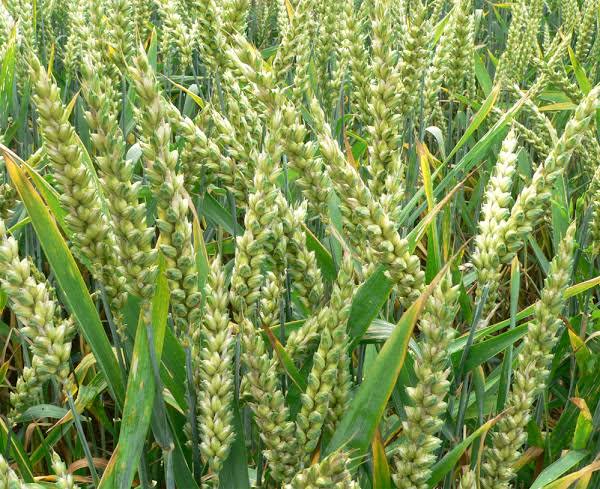
Wheat is a grass widely cultivation for its seed, a cereal gram which is a worldwide staple food.The many species of wheat together make up the genus Triticum.Global demand for wheat is increasing due to the unique viscoelastic and adhesive properties of gluten proteins, which facilitate the production of processed foods.
Wheat is an important source of carbohydrates. it is the leading source of vegetable protein in human food, having a protein content of about 13%, which is relatively high compared to other major cereals. Major breeding objectives include high grain yield, good quality, disease and insect resistance and tolerance to abiotic stresses, including mineral, moisture and heat tolerance.
HISTORY: The cultivation of emmer reached Greece, Cyprus and Indian subcontinent by 6500 BCE, Egypt shortly after 6000 BCE, and Germany and Spain by 5000 BCE. From Asia, wheat continued to spread across Europe. In the British Isles, wheat straw (thatch) was used for roofing. The oldest evidence for hexaploid wheat has been confirmed through DNA analysis of wheat seeds, dating to around 6400-6200 BCE,
More farmers in india cultivates wheat
Yields of pure wheat per unit area increased as methods of crop rotation were applied to long cultivated land, and the use of fertilizers. There are around 30,000 wheat varieties of 14 species grown throughout the world. Of these about 1,000 are commercially significant. In the United States over 500 varieties are available. In Canada different varieties are blended prior to sale.Hexaploid wheats evolved in farmers’ fields. Either domesticated emmer or durum wheat hybridized with yet another wild diploid grass to make the hexaploid wheats, spelt wheat and bread wheat.
Wheat is grown on more than 218,000,000 hectares.Harvested wheat grain that enters trade is classified according to grain properties for the purposes of the commodity markets. Wheat is widely cultivated as a cash crop because it produces a good yield per unit area, grows well in a low rainfall.
It’s the start of a new decade—that means it’s time to come up with new goals, try out new technology, and get up to speed on the latest ed tech trends.We’ve made our predictions in years past. In anticipation of what’s to come in the new year, we’re highlighting six of the 2020 education trends that are sure to be top of mind for teachers, students, parents, and administrators in school districts across the country.
Here are some of the ed tech trends we think will have a big influence on the K-12 space
1: Embedded LTE Chromebooks
We already know that Chromebooks are popular in K-12 (we broke down five reasons why LTE Chromebooks are such an important part of today’s K-12 classrooms back in October), but expect to see LTE Chromebooks become even more popular in 2020.
Chromebooks continue to be game changing for students and teachers alike. Not only are these simple laptops highly affordable, they can also be customized specifically for the learning needs of students. Some LTE Chromebooks come with filtered, CIPA-compliant 4G LTE Internet connectivity and enough data for an entire school year.If you’re thinking about bringing LTE Chromebooks into your classrooms in 2020, here’s a helpful cheat sheet of what they are and how they work.
2: New Roles for Teachers
Just as students have had to adapt to new learning methods and subjects as a result of the rise of technology use in the classroom, so too will teachers have to adapt by embracing new roles and responsibilities.One of those roles: student. As Linda Cartwright notes in a blog post for Touro College, “a teacher is shifting from someone who knows things to someone who is a newbie, like the rest of the class.” The role is now more about guiding students through learning and helping them grow than in years past when the teacher was looked at as the fountain of knowledge in the classroom.
As more and more tools are introduced into everyday classrooms, teachers will have to take on the role of explorer just like their young charges. And this evolution in their role could even lead them to earn certifications that help them perform better in the classroom.
3: More Artificial Intelligence
Artificial intelligence (AI) as a classroom tool has been a big topic in ed tech in recent years, and in 2020 it’s expected to remain one of the chief priorities for forward-thinking schools and educators. According to Cartwright, the use of AI in the classroom is expected to increase by over 47 percent in the next three years.
There are many advantages to the use of AI in the classroom. As a tool, it’s nimble and efficient. It allows for individualized learning with feedback delivered in real-time. Perhaps most importantly, it’s a lot of fun. There’s an abundance of AI-powered apps and programs that can help students more effectively understand and apply concepts in fields essential to STEAM learning (Science, Technology, Engineering, Art, and Math).
This is a kind of online speech or a statement spread over the social media platforms to target a particular person or group of persons on the basis of attributes such as race , custom, religion, recism,origin , gender, disability. Might be a speech is only a thought or a statement for someone but the people whom forget for this,can cause to depression. Social media plays a vital role to promote this hate speech much faster social media tend to promote exposure to hate speech and second exposure to hate speech is associated with the avoidance of political talk this includes hate speech , cyber bullying and increase polorization,these are the side effects of using digital media as the channel for public discourse and opinion exchange. However the processes and reasons behind these symptoms are much deeper than the people misbehaving such digital communication services.
We believe that travelling around the world shouldn’t be hard: it’s actually something everyone should be able to do at least once in their lives. Whether you choose to spend a few years or just a couple months travelling this beautiful planet, it’s important to see what’s out there. It’s up to you to make the dream come true and take the first step. Launch Trip planner to piece together and price your ideal route. Not sure where to start? You can always call one of our travel consultants and get some complimentary advice!
2. Travel opens your eyes.
If you’re open and willing, travel will make you an incredibly better-rounded human being. And that’s really the goal, isn’t it? If you don’t know where to start, check out our Around the World planning guide.
3. Travelling helps you learn who you are.
All the challenges and opportunities travel lays at your feet help you discover who you are in a way that’s only possible on the road.
4. Travel creates meaningful relationships
People you meet while on the road become some of the most valued names on your contact list. They become places on the map to visit later on. These folks give you a glimpse outside your hometown circle of friends, and force you to take in new and refreshing perspectives, and ultimately realize that everyone is the same.
5. Travelling develops skills you didn’t know you had
Sometimes it’s only far from home that you realize you you’ve got skills you’ve never used. It’s travel that brings them to the surface and makes you smile, satisfied to have reached the mountain top, or crossed a gorge or helped a villager clean up after a storm, or even to have successfully ordered a meal at a rural Chinese restaurant.
6. Travel helps you learn new languages
There’s something satisfying about being able to throw around a few words of Greek, knowing how to say thanks in Thai, pulling out that long dormant Spanish to book a room in Santiago, or simply hearing a language you didn’t know existed just a few weeks before.
7. Travel means adventure
Zip-lining over the jungle canopy in Peru, successfully navigating the maze-like streets of Venice, bartering for the best price in the traditional markets of Marrakech, taking a speedboat ride in New Zealand, or hopping in a Land Rover and heading out to watch animals grazing in Tanzania: these are adventures worth having. People are hardwired for the excitement of adventure and travel may just be the best way to tap into it.
8. Travelling gives you perspective
Meeting people from other cultures will teach you that the way you’ve been looking at the world isn’t the way everybody else does. In fact, your point-of-view might have some major blind spots. Seeing the world for yourself will improve your vision and your grip on reality.
9. Travel helps you move forward
If you’re between jobs, schools, kids, or relationships, around the world travel can be a perfect way to move from one of these life stages into your next great adventure. A big trip won’t just ease your transition into the next stage of your life, it’ll give you a chance to reflect on where you’ve been, where you’re going, and where you want to end up.
10. Travel is education
Seeing the world provides an education that’s absolutely impossible get in school. Travel teaches you economy, politics, history, geography, and sociology in an intense, hands-on way no class will. Fortunately, the school of travel is always taking applications, no entrance exam required.
11. Travel challenges you
Getting your daily latte at the same place and staring at your screen at your nine-to-five every day not nearly interesting enough? Even if you choose to work on the road (and keep staring at the screen), you’ll have to find a new place to drink your latte, and depending on your destination, finding coffee, and foamy milk or a good place to sip them could prove to be a sizeable challenge. Travel is full of moments of joy and challenges. Overcoming the challenges gives you some of the greatest joys of all.
12. Travel shakes things up
It sucks to be stuck in a rut. Everyone knows what that’s like. A big trip can be your perfect solution. Fly around the world, stopping over in all of the places you’ve always wanted to visit. Go ahead and plan your ideal route around the world (it’s easier than you think!)
13. Travelling proves that dreams do come true
You imagined it, daydreamed about it, and envisioned it. Guess what? It can be done. Around the world travel is possible, you just have to decide you’re willing to take the first step and start planning your itinerary. What are you waiting for? We’ve put together some specials to inspire you to live your dream.
14. Travel gives you cool stories
Let’s face it. Even for folks who can’t tell a story, just the words “last year in Mongolia” get you instant party points. Even when events seem trivial, nostalgia and distance create an irresistible spin that makes mundane things like getting your laundry done in Zanzibar, entertaining. Just don’t be that person and overdo it!
15. Travel is literally food for thought.
You’ll be constantly surprised at the flavours the world has to offer. The way people in other cultures and countries prepare food, and break bread together (not that all cultures even eat bread) will astound you.
16. Travel gives you a sense of accomplishment
If you’re the kind of person that dreams big, you’re probably one to reach for new challenges. Finishing a trip gives you the satisfaction that you were able make a goal to travel and accomplish what you set out to do–see the world.
COUNTRIES WITH CURRENCY ALMOST EQUIVALENT TO INR
1. Sri Lanka
Named as the top country to visit in 2020 by Lonely Planet, Ravan’s Lanka is famous for its pristine beaches and great food. The picturesque landscapes, flora and fauna, rural lifestyle and archaeological remains are a treat to photographers. Tourists need to purchase a permit to photograph the principal ancient monuments in Sri Lanka. If you’re travelling on a budget, Rs 500-700 should be sufficient for a day. The stay can be as cheap as Rs. 700-1000 per night. And also not to mention, it is one of the cheapest countries to visit from India.
Visa: Can be obtained easily online. Sri Lanka issues an ETA that allows you to enter the country for 30 days.
Distance: Colombo, Sri Lanka is at a distance of 682 km from Chennai and it takes 1 hour, 21 minutes for travel by flight.
How to get there: The easiest and quickest way to reach Sri lanka is to take a flight. The tickets cost Rs. 3000-4000 from Chennai to Colombo.
Number of tourists in the year 2018: Sri Lanka receives 2.3 million tourists
Bhutan, “Thunder Dragon”, is located between India and China. It is known to be the happiest country in the world. Tourists can immerse oneself in the rich culture, mountain monasteries and be a part of colourful Bhutanese festivals. Adventure seekers can explore the wilderness of the country. Prices for stays and food is typically similar to what it would cost in India, depending on the kind of choices. It is one of the cheapest countries to visit from India.
Visa: Not required for Indians (Passports/voter Id’s are sufficient)
Distance: Distance between Bagdogra and Thimphu, Bhutan is 333 kms. Flights from Bagdogra to Paro take about 30 minutes for arrival.
How to get there: The easiest way to reach Bhutan from India is to take a direct flight to Paro. The quickest way is to fly from Bagdogra. The cheapest option is to take a shared taxi from Bagdogra Airport through Nepal border.
Number of tourists in the year 2018: Bhutan received a total of 274,097 visitors
Best time to visit: October to December or January to February.
Currency: 1 Ngultrum = 1 Rupee. Indian currency is accepted for transactions in Bhutan expect for values Rs 500 and above.
3. Nepal
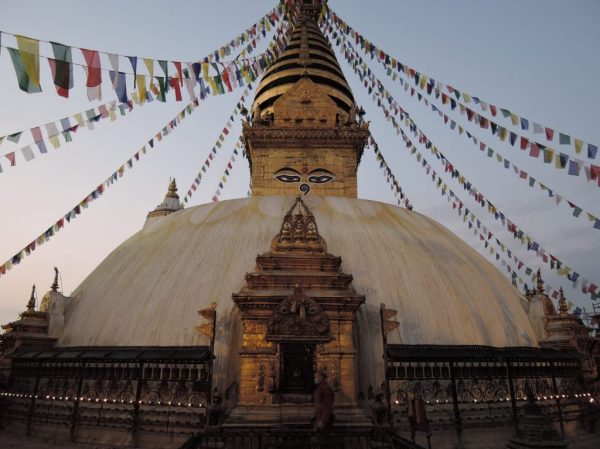
Tucked in between the Himalayas and forests, Nepal is rich in wildlife and spiritual culture. If you want to escape to a land of quiet and peace this is the place for you. Adventure seekers have numerous mountains for trekking and forests to explore and also among the cheapest and nearest countries to visit from India. Average budget in Nepal can be Rs 400-700 per day.
Visa: Not required for Indians (Passports/voter Id’s are sufficient)
Distance: Flight distance between Delhi to Kathmandu is 813 kms. The nonstop flight takes 1 hour 45 minutes for arrival.
How to get there: Cheapest flights to Kathmandu cost just Rs 3900 from Delhi. You can travel to Nepal by road, by train, bus or drive there, but it is a long and tedious affair.
Number of tourists in the year 2018: Nepal received a total of 1.17 million tourists
Best time to visit: October to December
Currency: 1 Nepalese Rupee = 0.62 INR
4. Philippines
Philippines is a dream paradise for beach lovers. With an average of 700 islands, monuments, lush green forests and the fathomless beaches, Philippines is a country one can never miss. Local travel, stay and food are least expensive. Flight tickets are the major expense on a trip to the country. It is extremely affordable for the people looking for cheapest countries to visit from India.
Visa: Indian Nationals with a valid passport can apply for a tourist visa at the Embassy in New Delhi, for trips longer than 21 days.
Distance: The shortest distance between India and the Philippines is 4,631 km. It takes about 5.14 hours to arrive by flight.
How to get there: Flights to Philippines from major cities in India are easily available. You can get cheaper tickets if you opt for off-season travel.
Number of tourists in the year 2018: Philippines received 7.1 million foreign tourists
Best time to visit: December to February
Currency: 1 Philippine peso = 1.39 INR
COUNTRIES WHERE YOU CAN BE RICHIE RICH
5. Cambodia
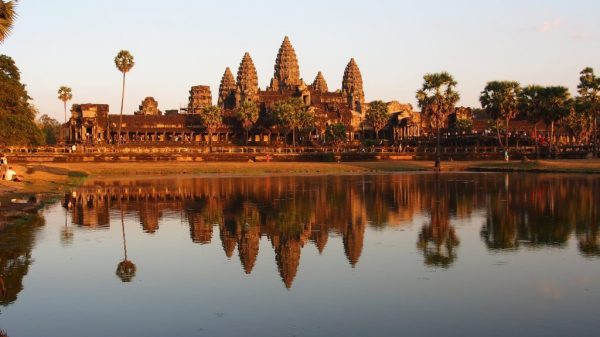
One of the cheapest countries to visit from India in Southeast Asia, Cambodia is known for its rich history, spectacular coastlines and inexpensive delicacies. An average of Rs 800 is sufficient for a day in Cambodia.
Visa: Cambodian visa can be obtained online within 4 days.
Distance: The shortest distance between India and Cambodia is 2,912 km. It takes about 3.23 hours to arrive by flight.
How to get there: Cheapest flights can be availed between March and June, with tickets costing as low as Rs 5600.
Number of tourists in the year 2018: Cambodia received 6 million tourists
Best time to visit: May to October
Currency: 1 INR = 57 Cambodian Riel
6. Indonesia
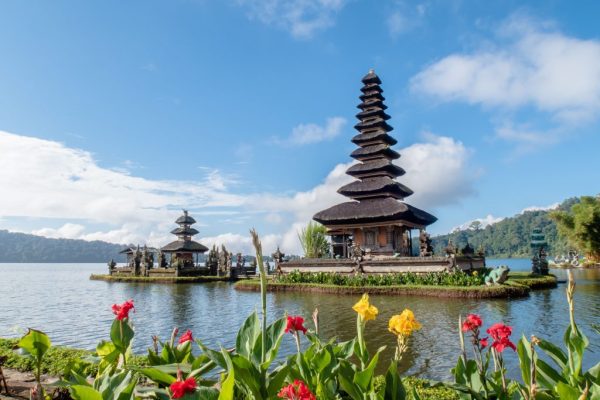
One of the most sought out destination Bali is located in Indonesia, but there’s more to the country than just Bali. It is home to active volcanoes, vast beaches and high mountain ranges. Visiting Indonesia during April and October is a budget friendly option with the accommodation prices going down by 30-60%. An average of Rs 1000-1500 should be sufficient for a day. One of the best thing is that it is one the cheapest countries to visit from India.
Visa: Not required for Indian nationals.
Distance: The shortest distance between Indonesia and India is 4,483 km. It takes around 5 hours to arrive by flight.
How to get there: Flights can be as cheap as Rs 6000 to Jakarta.
Number of tourists in the year 2018: Indonesia received 15.8 million foreign tourists.
Best time to visit: April and October
Currency: 1INR = 190 Indonesian Rupiah
7. Vietnam
One of the gems in Southeast Asia, Vietnam has green mountains, happening cities and pristine beaches. It is famous for its rich history and distinguishing heritage. If you choose to stay in the backpacker’s hostels, your stay can cost you only Rs 1000 per night. You can have a filling large meal in a mid-range restaurant for about Rs 800. If you are on a budget then opting for cheaper options can cost you about Rs 500-700 per day. It is one the most beautiful and budget friendly Countries to visit from India.
Visa: Visa to Vietnam can be obtained through a simple online procedure.
Distance: The shortest distance between India and Vietnam is 3,094.38 km and it takes 4 hours 20 minutes to arrive by flight.
How to get there: You can get the lowest prices for tickets from India in April. Mondays and Wednesdays are the cheapest days to fly to Vietnam.
Number of tourists in the year 2018: Vietnam received 15.5 million international tourists.
Best time to visit: February to April and August to October
Currency: 1 INR = 323 Vietnamese dongs
8. Laos
Laos is a palette of all the shades of green located in Southeast Asia. Dark forests, bright green rice fields, and glistening tea leaves on the mountains, the landscape all make it a treat to the eyes. It is also known for its Buddhist monasteries and French architecture. Dorm rooms are the cheapest option ranging from Rs 400-800 per night. Food is extremely inexpensive whether it is a high restaurant or on the streets, the prices starting from Rs 100-300. You can rent bikes for sightseeing inside the country for just Rs 150-300.
Visa: Indian travellers can get a visa on arrival from any of the international checkpoints or by going to the Embassy in Delhi and completing the visa procedure to avoid last minute queues.
Distance: The distance between India and Laos is 2572 km. The quickest way to get from India to Laos is to fly which takes around 9 hours.
Number of tourists in the year 2018: Laos received 4.1 million tourists
Best time to visit: October to April
Currency: 1 INR = 123 Laotian Kips
9. Myanmar
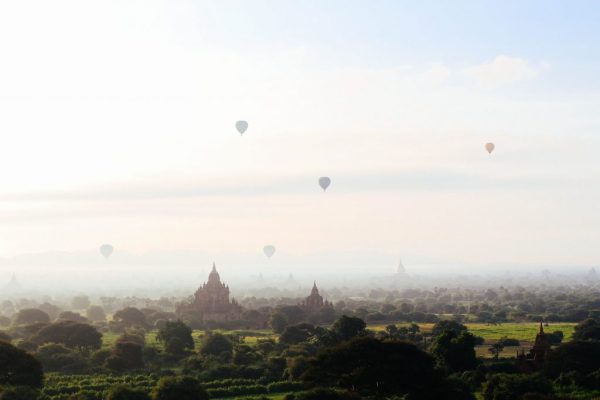
Nature walks, historical tours and hot air balloon rides are a major tourist attraction in Myanmar. Gigantic mountains, pristine beaches, beautiful islands and peaceful lakes are the highlights of the country.
Visa: Indian Nationals with a valid passport can apply for an e-Visa online.
Distance: Flight distance between India to Myanmar is 1,986 km. It takes 3 hours to arrive by flight.
How to get there: You can travel by road to Myanmar through Manipur. Taking a flight is the quickest option.
Number of tourists in the year 2018: Myanmar received 3.55 million tourists
Best time to visit: November to February
Currency: 1 INR = 21 Myanmar Kyats
10. Lebanon
Lebanon is an ancient country with a rich history, diverse culture, and wondrous scenic beauty. It is located in Western Asia, bordering Syria and Israel. A trip to Lebanon is similar to a European city in terms of its cost, approximately Rs 6000 is required for a day in Lebanon including the stay, food and travelling inside the country.
Visa: Indians can apply for a Visa online or at one of the respective Embassies.
Distance: The shortest distance between India and Lebanon is 4,478 km. It takes 5 hours to arrive by flight.
How to get there: Flights from major cities are easily available to Lebanon
Number of tourists in the year 2018: Lebanon received 1,963,917 tourists
Best time to visit: March to June and October to December
Elon Musk‘s mysterious Neuralink startup is working on a brain-computer interface that will allow wearers to stream music directly to their brain, the technology entrepreneur has claimed. Mr. Musk, who also heads SpaceX and Tesla, is set to reveal new information about the mysterious startup next month but has been slowly releasing details over Twitter in recent days. The device that allows the human brain to connect to a computer could be implanted in a person for the first time later this year, announced the founder of Neuralink neurotechnology company, the tycoon Elon Musk. This crazy project of Elon Musk and his startup seems to be going well. Elon Musk said on Twitter that the Neuralink is working on an “awesome” new version of the company’s signature device. “Clearly better than Utah Array,” he said contentedly.
Neuralink’s ambitions are really great! The main purpose of the device is to compensate for entire sections of the brain lost due to a stroke, accident, or congenital disease. The billionaire businessman said that people would soon be able to use the brain chip technology of Neuralink to stream music into their brains without any special efforts. According to Musk, Neuralink chip would also be able to control hormone levels and help with anxiety relief and some other mental issues. The Tesla CEO noted that those who are willing to get Neuralink chip into their brains would go through a process similar to laser eye surgery.
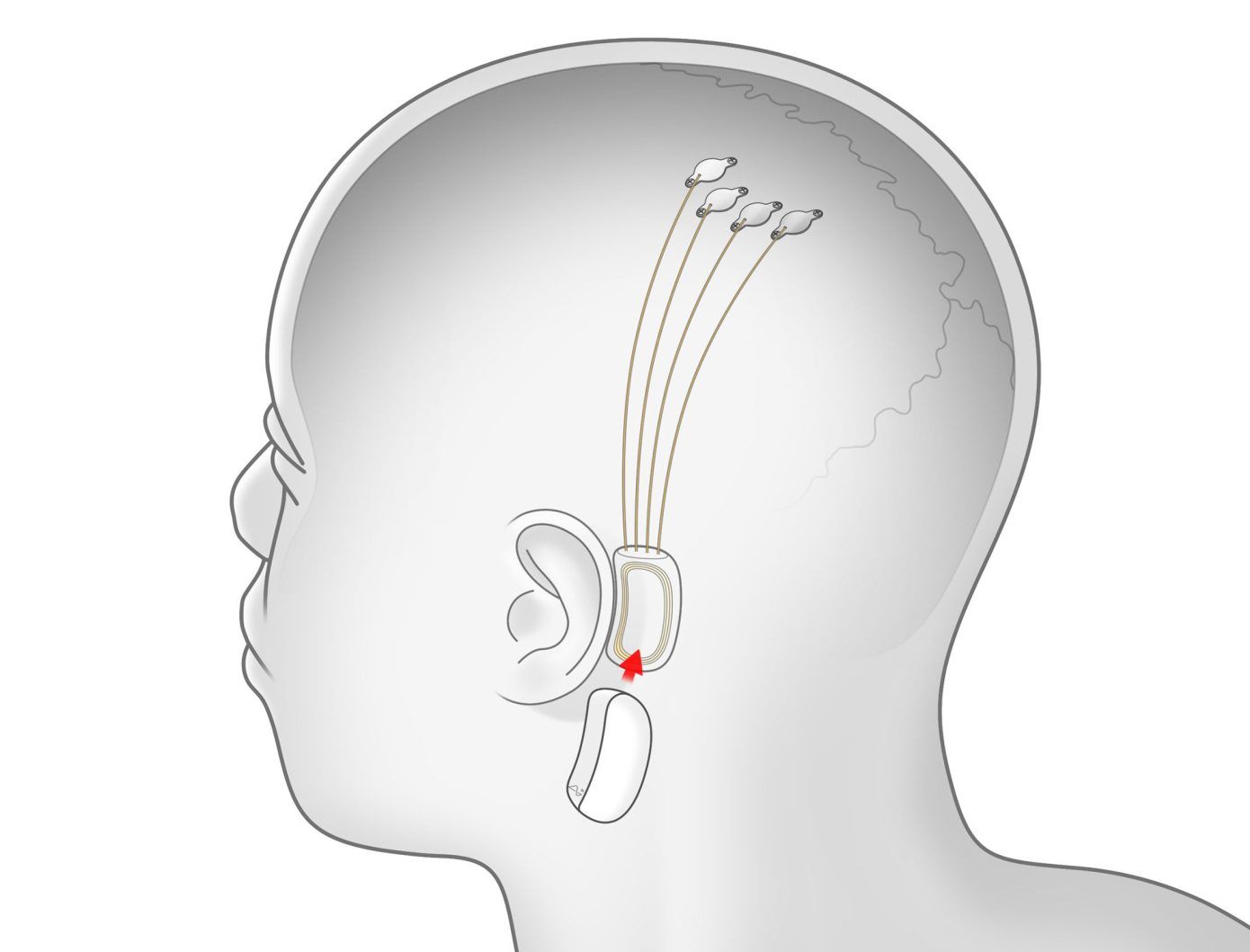
One part of it will involve a neurosurgical robot, which fits flexible “threads” into the brain connected to a tiny implantable computer chip. A research paper detailing the device claims that a single USB-C cable will provide “full-bandwidth data streaming” to the brain. Neuralink has 11 job postings listed on its website, offering roles for a mechanical engineer, a robotics software engineer, and a “histology technician”. Over the weekend, Mr. Musk made a request for people with specific expertise in wearables. Earlier this month, Mr. Musk hinted that Neuralink’s chip will be able to cure depression and addiction by “retraining” the parts of the brain responsible for these afflictions.
Of course, it is not yet clear what the updated concept looks like and whether it will work at all. SpaceX and Tesla chief, however, is full of optimism and enthusiasm. “The potential is truly transformational for restoring brain & motor functions,” he said in his tweet on Monday. If the arrival of the first tests on the human brain is encouraging, the road is long until the actual implantation of Neuralink. In another tweet, he says: “First, we need to make it super safe & easy to use, then determine the greatest utility vs. risk. From initially working to volume production & implantation is a long road.” Though the company is yet to make an announcement over its official plans, Musk recently said that there will be a progress update on August 28.
Neuralink was founded in 2016 and since then the company has only held one public presentation about how the technology will work. In 2019, Musk had said that Neuralink was developing a “sewing machine-like” device that would provide a direct connection between a computer and a chip inserted inside the brain.
“Acknowledging the good that you already have in your life is the foundation for all abundance.” – Ekhart Tolle
Gratitude or gratefulness, is a feeling of appreciation felt by the recipient of kindness, gifts, help, favors, or other types of generosity, towards the giver of such gifts. Gratitude turns what we already have into enough. It gives us a feeling of satisfaction and eternal peace. Gratitude is the best medicine, it heals one’s mind, body, and spirit, and it attracts more things to be grateful for.
Why do we need to practice gratitude?
“The struggle ends where gratitude begins”.
We all are surrounded by beautiful nature, we have our favorite people around us and we have enough food, clothes, and facilities. But, it is quite common that we take these things for granted. When we take things for granted, we are not satisfied with what we have and we strive to get something else, if we get it, then again we want something else, and we are never satisfied. Consider the present situation where we all are sitting at our respective houses. Earlier we could freely roam around, walk-in streets and parks, visit beautiful places, enjoy the fresh air and beauty of nature. But, we used to take all these for granted. We were really not grateful for the places around us, the beauty around us. But, now we realize its importance. The reality is that we always have enough of the resources around us for our survival. But, sadness drives in when we don’t appreciate what we have and take that for granted. Each one of us is living a life that is actually a dream life for a second person. So, just embrace it.
Imagine your life without the people around you, who are always there with you and support you. If you remove them from your life and think deeply, you will realize that they have a big role to play in your life which you never really thought about. The people around you are precious, value them, and be grateful to them that they are with you. Imagine a day without food, clothes, shoes, or air. If you do this exercise, you realize that you have enough of these things. Your desire to eat in a restaurant and to wear stylish clothes was really not that important. You get your food every day, you have clothes and shoes to wear. So, be thankful for what you have. Each and everything we get in our life, each and everything happening to us is very valuable to build us, to build our personality. Everything happens for a good reason. Being thankful for everything we get and for every event we come across gives us a satisfactory feeling, it eliminates negativity and makes our life more pleasurable. Saying thank you to another person pleases them and us too.
What do we get out of it?
A grateful heart is a magnet for miracles. The day you start practicing gratitude, it never ends. The more you express your gratitude for what you have, the more things you will have to express gratitude for. It gives you immense peace, happiness, and satisfaction. It rewires our brain and reduces stress. It boosts our immunity, improves relationships, and makes each day more beautiful. It makes sense of our past, brings peace for today, and creates a vision for tomorrow. Gratitude is the most wonderful feeling. Once you start practicing it, there is no way back.
Learning and enhancing your skills are vital in this technological era. This helps you to prepare yourself for getting the highestpayingjobs in the field of your choice. And if you are a professional already, learning new technologies and tools will take you an inch closer to the promotion you always dreamt of. Widening your arsenal of tools also enhances your value as a professional in your company.Here are some of the latest technologyconcepts that are sure to dominate the IT industry,
1. Artificial Intelligence
Artificial intelligence (AI) is the technology used for equipping computer systems with the ability to make decisions like humans. When AI programs are fed to systems, the aim is to mimic human intelligence for performing complex tasks such as pattern recognition, speech recognition, weather forecast and medical diagnosis.AI is used in navigation based applications like Uber, voice assistants like Siri, video streaming services like Netflix, IoT devices and in search engines like Google and Bing.AI helps in automating tasks such as traffic, scheduling trains, making business predictions and designing driverless cars!
2. Data Science
Next up in the list of latest technology concepts is not surprisingly Data Science. Data Science is the technology that helps to make sense of complicated data. You know that data is produced in a humungous amount every day by companies. This includes business data, sales data, customer profile information, server data, and financial figures. Most of this data is in the form of huge data sets that are unstructured. The role of data scientists is to convert these unstructured data sets into structured datasets. Then, these data sets can be analyzed to identify patterns and trends. These patterns are useful for understanding the company’s business performance, customer retention, and how these areas can be improved.
3. Internet of Things
The IoT (Internet of Things) is a network of devices that are connected to each other. Their devices caninteract and share data with each other. These devices may be connected via WiFi, and they share data about their environments and how they are being used. These devices have a computer chip that facilitates this exchange. IoT not only enables the connection between different devices but also their remote access. For example, you lock doors of your car remotely, preheat your ovens and geysers. The FitBit that you use for tracking the number of calories you burn also runs on IoT technology. IoT chips embedded on machines help businesses to assess the performance of those machines and assist in their maintenance.
4. Blockchain
Blockchain is the foundational technology that powers electronic currencies such as Cryptocurrencies. In simple terms, a Blockchain is an electronic ledger that can be shared among different users. This helps in creating a record of transactions that cannot be altered. Each of these records is time-stamped and linked to the previous one. So every time a new transaction is added to the ledger, it is stored as another block in the chain of transactions – hence the name. Blockchain is updated after the different parties contributing to the ledger agree. After new data is fed into a block, it cannot be erased. This makes technology verifiable and secure.
5. Robotic Process Automation (RPA)
Robotic Process Automation (RPA) is a technology used for automating daily tasks, similar to artificial intelligence. Here, the software is used for automating repetitive tasks such as handling and replying to emails, processing transactions, and handling business data.This technology is used for automating tasks for low-level employees to higher-ranking officials. RPA can automate more than 40% of daily tasks. According to McKinsey, more than 60% of all repetitive tasks can be partially automated using RPA. So, this technology is going to threaten a lot of jobs.
The textile industry(cotton originated) in India traditionally, after agriculture, is the only industry that has generated huge employment for both skilled and unskilled labour in textiles, continues to be the second-largest employment generating sector in India. It offers direct employment to over 35 million in the country. India was ranked as the fourth most promising market for apparel retailers in 2019.
The Textile industry was the major component of economic income in India before the English colonies. India is the second largest producer of fibre in the world and the major fibre produced is cotton.In 2000, the Government of India passed the National Textile Policy. The major functions of the Ministry of Textiles are formulating policy and coordination of man-made fiber, cotton, jute, silk, wool industries.
Cotton industry
COTTON TEXTILE: The cotton textile industry was concentrated in the cotton growing belt of Rajasthan, Maharashtra and Gujarat. There are 1,900 cotton textile mills in India,of which about 18% are in the private sector and the rest in the public and cooperative sector.India exports yarn to Japan, United States, United Kingdom, Russia, France, Nepal, Singapore, Sri Lanka and other countries. India has the second-largest installed capacity of spindles.
Jute Mills
Jute: India is the largest producer of raw jute and jute goods and the third largest exporter after Bangladesh. There were about 80 jute mills in India in 2016-17. The jute industry was supporting 0.37 million workers directly and another 400,000 small and marginal farmers who were engaged in the cultivation of jute
Silk looms in india
Silk in the Indian subcontinent is a luxury good. In India, about 97% of the raw mulberry silk is produced in the five Indian states of Karnataka, Andhra Pradesh, Tamil Nadu, West Bengal and Jammu and Kashmir. India is the largest producer of silk in the world and has long tradition of manufacturing silk textile. (ii) It also make four distinct variety of silk namely mulberry, eri, tasar and munga. India also has its control over yellow munga silk produced from Assam
Wool
With 44% production of wool, Rajasthan leads all states in India. Rajasthan is followed by Jammu & Kashmir(13 percent), Karnataka (12 percent) Gujarat, Uttar Pradesh, Andhra Pradesh, Haryana (23 percent). This is mainly collected from sheep and more labour involved in this textile






















 International Journal of Research (IJR)