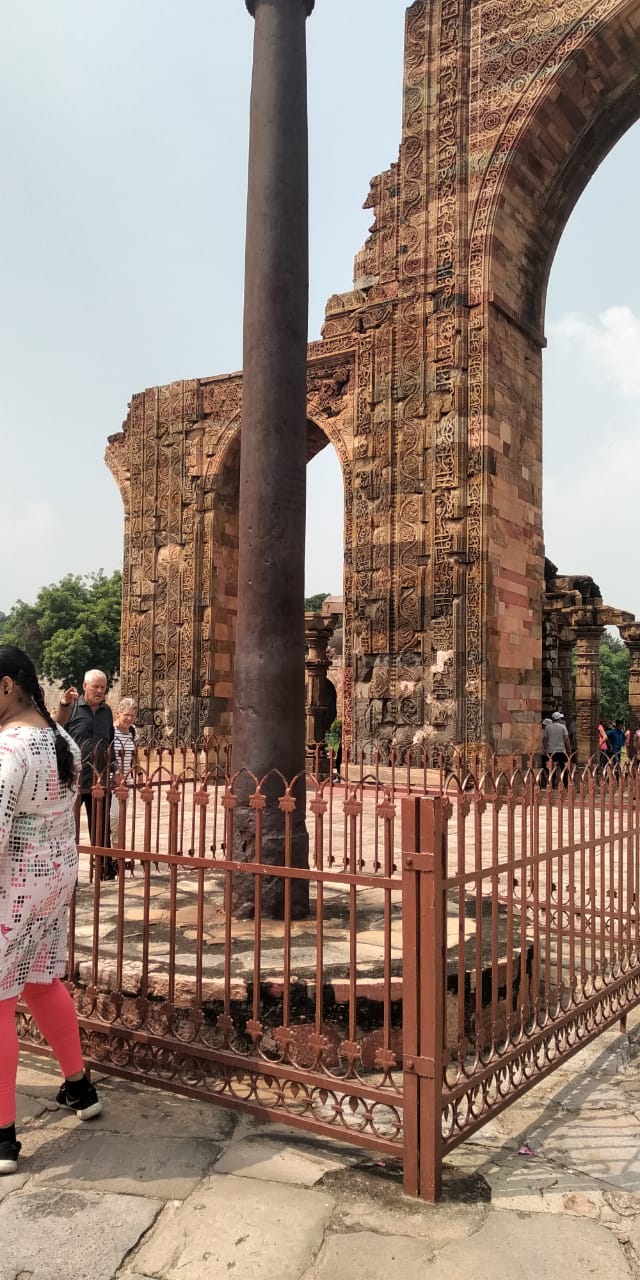
Situated at the center of the Qutub Minar complex in the city of Mehrauli,the Quwwat Ul Islam Mosque is the first ever mosque made in India, during the sultanate period. Today, stand by only it’s walls which represents extravagant yet very minute architecture of the Slave dynasty. It’s marvelous architecture and design makes it an attraction point of the Qutub complex, against which stands the Mehrauli iron pillar. And is added up as UNESCO‘s World Heritage Site. The history of this site is both so interesting and large that makes a huge amount of visitors to pay a visit to this place every year.
The history –
It was in the year 1193 AD, when Qutubud – din Aibak, founder of The Slave dynasty conquered the Quila Rai Pithora of the Chauhans and was eager to leave the imprints of his religion to the new territory. He commissioned the mosque using the ruins of 27 Hindu and Jaina temples. And was built over the site of a large temple located at the center of the citadel. Quwwat ul Islam mosque, also known asJami masjid or the Friday mosque then came to be used for performing the adhan and became one of the best architectures of the sultanate period, that also made a benchmark for the coming sultans to think upon.
Architecture and design –
Archaeological Survey of India states that the mosque was raised over the remains of a temple, and in additio, it was also constructed from materials taken from other demolished temples. Historical records compiled by a Muslim historian Maulana Hakim Saiyid Abdul Hai corroborate to the use of iconoclasm by Qutub ud din Aibak, which was common during his reign. The mosque was further extended by Sultan Iltutamish (1296), who gave a more complexity to its design. The iron pillar of Mehrauli, located on the stone pavement in front of it adds to its beauty and history. The complexity of its design and architecture is what intrigues most of the visitors paying visit to the place. The central arch of the mosque is ogee in shape and the screen is sculpted with religious texts and floral patterns. One of the historians believe that it was not constructed on scientific approach, but in Corbel style as indicated by the variations in the patterns of the arches. The front wall that we see standing still today came to be known as the Western Wall. Though it was a magnificent monument, built with an entrance to the courtyard, and grey colonnades made of greystone.
Quwwat Ul Islam mosque today –
It is a great example of Muslim architecture and establishes a prominent role of the sultans in portraying their power and rule over the city of Delhi. But today it stands in ruins with only it’s front wall remaining with indigenous corbelled arches, floral morifs and geometric patterns, along with other Islamic structures. As per the government data reviewed by ET, Qutub minar complex is the second most visited monument in the country in 2018-19. It is estimated that 2.9 million people visited the place in 2018-19.It’s really a place worth appreciating, and attracts the visitors due to its everlasting beauty. The place is a true example of establishment of the power of Slave dynasty in Delhi and India.
Chennai Super Kings on Wednesday said it has suspended the service of team doctor, Dr. Madhu Thottappillil over his remarks on the death of Indian soldiers in Galwan Valley, Ladakh.
20 Indian Army personnel, including a Commanding Officer, lost their lives in what is termed as one of the worst clashes between the Indian Army and Chinese troops in over 5 decades. Government sources said the Chinese side too suffered ‘proportionate casualties’ but chose not to speculate on the number.
Reacting to the news of the violent scuffle, CSK’s team doctor, Madhu Thottappil had put out a ‘distasteful’ tweet that received quite a bit of flak on social media on Tuesday.
“Just curious if the Coffins will come back with a “PM CARES” sticker on them?” Madhu had said.
Chennai Super Kings said the Indian Premier League franchise regrets the tweet after swiftly taking action over the controversial tweet.
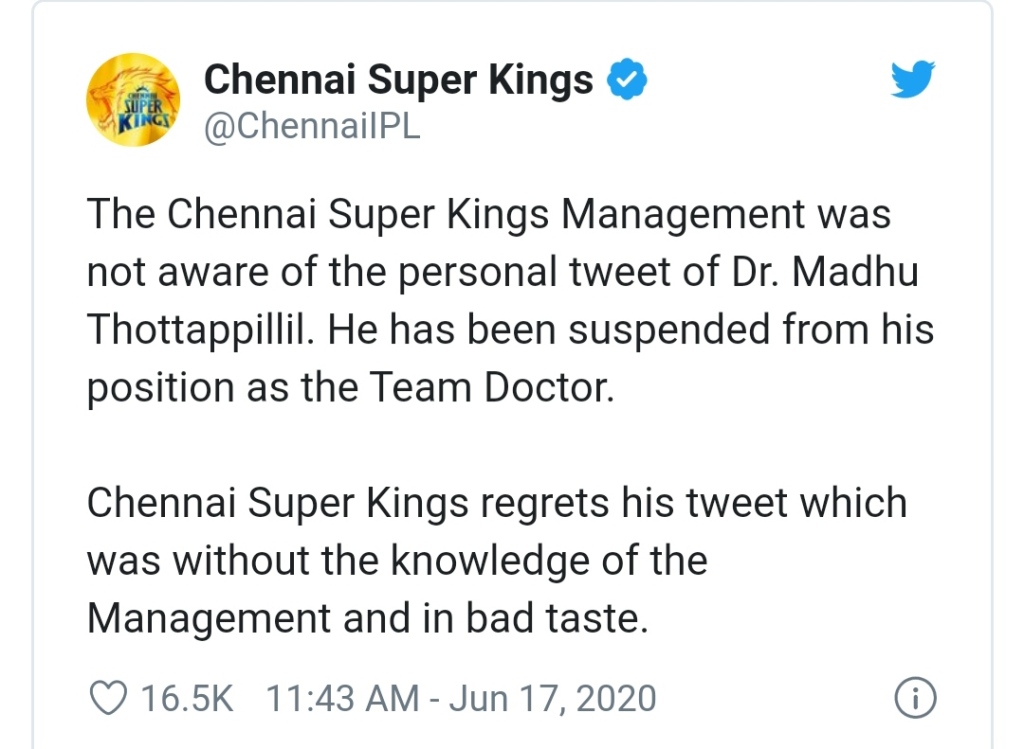
“The Chennai Super Kings Management was not aware of the personal tweet of Dr. Madhu Thottappillil. He has been suspended from his position as the Team Doctor,” the IPL franchise said in a social media post.
“Chennai Super Kings regrets his tweet which was without the knowledge of the Management and in bad taste.”
Earlier in the day, several India cricketers, including captain Virat Kohli, mourned the death of the Indian Army personnel in the bloody lash which has soared the ongoing tension between India and China.
Reactions started pouring in on social media as news of the violent scuffle, that resulted in the deaths of 20 Indian soldiers, broke. The bloody clash which has soared the ongoing tension between India and China has left many in shock.
“Salute and deepest respect to the soldiers who sacrificed their lives to protect our country in the Galwan Valley. NO one is more selfless and brave than a soldier. Sincere condolences to the families. I hope they find peace through our prayers at this difficult time,” Virat Kohli tweeted.
Yuvraj Singh also took to social media to salute the brave Indian soldiers.
“I salute the courage of our Indian soldiers who have been martyred at #GalwanValley. All these atrocities must stop and hope we can have a peaceful world where human life is valued. My thoughts are with the bereaved families, I pray for their strength,” Yuvraj tweeted.
Among the four seasons of India, the one that shows signs of sweltering heat is the Summer Season. Summer Season in India falls between the months of March till May. During this season, most parts of the country face hot winds and beating heat from the Sun. Many parts of the country face Water Scarcity during this season. The temperature easily varies between 35°C to 45°C. The best way to keep ourselves feel better is to keep drinking water frequently throughout the day. Taking fruits like Watermelon, eating light food and drinking tender coconut are effective ways to protect ourselves from getting dehydrated easily.
Summer Season in India starts in the month of March and ends in the month of May. Sometimes, the season prevails till the second week of June before Rainy Season in India. Summer Season in India is tolerable during the month of March. But slowly, as the season continues till the month of May and June, we can experience the roasting sun hitting our places every day from 8 am or 10 am. We can hardly experience a pleasant environment around us.
It is important to keep ourselves from dehydration. Best suggestions to follow during summer season are:
Drinking lots of water everyday minimum 3 liter
Eating lots of fruits with water content (Eg Water Melon)
Drinking Tender Coconut frequently
Avoiding going out unless and until it is very important (to keep yourself from prickly heat and sunburns)
Wearing light clothes to avoid sweating easily and to feel better
Many parts of India suffer due to water scarcity during this season. The temperature shoots up to 45°C which cannot be tolerated by many people. People in many states even die because of the burning summer season. We cannot control nature and its adverse effects, but we can right actions to meet them and keep ourselves safe. We should take initiatives to save water throughout the year for use during times of scarcity in Summer Season. Generally, tourists from other countries do not visit India during Summer Season; it is not advisable too.
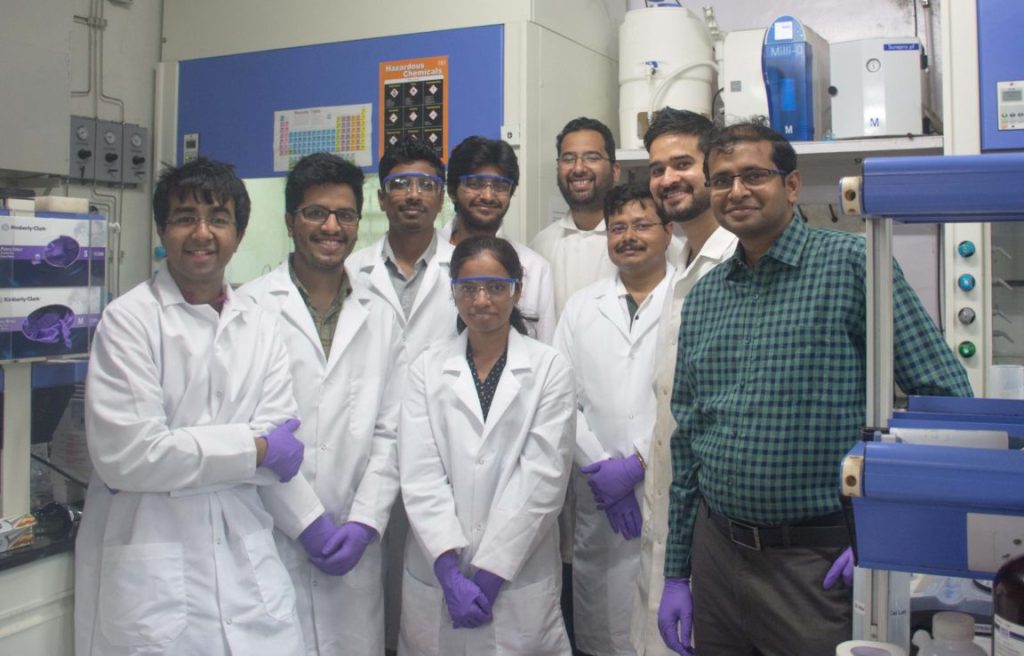
Scientists at the Mumbai-based Tata Institute of Fundamental Research (TIFR) used gold nanoparticles and, by rearranging size and gaps between them, developed a new material which has unique properties like the capacity to absorb light and carbon dioxide.
one of the largest consumers of the precious metal globally. Now Indian scientists have tinkered with the chemistry of the material and turned it into ‘black gold’ which they say has the potential to be used for applications ranging from harvesting solar energy to desalinating seawater.
Scientists at the Mumbai-based Tata Institute of Fundamental Research (TIFR) rearranged the size and gaps between gold nanoparticles to develop a new material which has the unique properties of absorbing light and carbon dioxide. Gold does not have these properties. In appearance the new material is black, hence the name ‘black gold.
While speaking to India Science Wire, Vivek Polshettiwar, who led the research team, explained, “We have not doped gold nanoparticles with any other material or added other materials. We varied inter-particle distance between gold nanoparticles using a cycle-by-cycle growth approach by optimizing the nucleation-growth step, using dendritic fibrous nanosilica whose fibers were used as the deposition site for gold nanoparticles.”
One of the most fascinating properties of the new material is its ability to absorb the entire visible and near-infrared region of solar light. It does so because of inter-particle plasmonic coupling as well as heterogeneity in nanoparticle size. Black gold could also act as a catalyst and could convert carbon dioxide into methane at atmospheric pressure and temperature using solar energy.
“If we develop an artificial tree with leaves made out of black gold, it can perform artificial photosynthesis, capturing carbon dioxide and converting it into fuel and other useful chemicals,” added Prof Polshettiwar. The efficiency of conversion of carbon dioxide into fuel, at present, is low but researchers believe it could be improved in future.
In order to study the new material’s ability to harvest solar energy, researchers dispersed it into water and exposed the solution to light for one hour and the temperature of the solution was measured. The temperature of the solution, with pure silica spheres, rose to 38 degrees while the ones with different concentrations of black gold rose to 67 to 88 degrees. The maximum increase in temperature was attributed to creation of thermal hotspots due to the heterogeneity of the particle sizes as well as optimum inter- particle coupling.
Researchers said the material can be used as a nano-heater to covert seawater into potable water with good efficiency. “Our results indicate the potential application of black gold in purification of seawater to potable water via steam generation using solar energy under atmospheric reaction conditions.”
The research team included Mahak Dhiman, Ayan Maity, Anirban Das, Rajesh Belgamwar, Bhagyashree Chalke and Vivek Polshettiwar (TIFT); Yeonhee Lee, Kyunjong Sim and Jwa-Min Nam (Seoul National University).
The study was funded by the Department of Science and Technology (DST) and the Department of Atomic Energy (DAE).
The subject of empowerment of women has becoming a burning issue all over the world including India since last few decades. Many agencies of United Nations in their reports have emphasized that gender issue is to be given utmost priority. It is held that women now cannot be asked to wait for any more for equality.
Inequalities between men and women and discrimination against women have also been age-old issues all over the world. Thus, women’s quest for equality with man is a universal phenomenon. What exists for men is demanded by women?
They have demanded equality with men in matters of education, employment, inheritance, marriage, politics and recently in the field of religion also to serve as cleric (in Hinduism and Islam). Women want to have for themselves the same strategies of change which menfolk have had over the centuries such as equal pay for equal work. Their quest for equality has given birth to the formation of many women’s associations and launching of movements.
#feminism
The position and status of women all over the world has risen incredibly in the 20th century. We find that it has been very low in 18th and 19th centuries in India and elsewhere when they were treated like ‘objects’ that can be bought and sold. For a long time women in India remained within the four walls of their household. Their dependence on menfolk was total.
A long struggle going back over a century has brought women the property rights, voting rights, an equality in civil rights before the law in matters of marriage and employment (in India women had not to struggle for voting rights as we find in other countries).
In addition to the above rights, in India, the customs of purdha (veil system), female infanticide, child marriage, sati system (self-immolation by the women with their husbands), dowry system and the state of permanent widowhood were either totally removed or checked to an appreciable extent after independence through legislative measures.
#women_empowerment
Two Acts have also been enacted to emancipate women in India. These are: Protection of Women from Domestic Violence Act, 2005 and the Compulsory Registration of Marriage Act, 2006. The Domestic Violence Act recognizes that abuse be physical as well as mental.
Anything that makes a woman feel inferior and takes away her self-respect is abuse. Compulsory Registration of Marriage Act can be beneficial in preventing the abuse of institution of marriage and hindering social justice especially in relation to women.
It would help the innumerable women in the country who get abandoned by their husbands and have no means of proving their marital status. It would also help check child marriages, bigamy and polygamy, enable women to seek maintenance and custody of their children and widows can claim inheritance rights. The Act is applicable on all women irrespective of caste, creed or religion. It would truly empower Indian women to exercise their rights.
To what extent legislative measures have been able to raise the status of women in India? Are women now feel empowered in the sense that they are being equally treated by men in all spheres of life and are able to express one’s true feminine urges and energies? These are the important questions to be investigated with regard to women’s empowerment in India.
Nikon Ambassador and National Geographic magazine photographer Ami Vitale has traveled to more than 100 countries, bearing witness not only to violence and conflict, but also to surreal beauty and the enduring power of the human spirit. Throughout the years, Ami has lived in mud huts and war zones, contracted malaria, and donned a panda suit— keeping true to her belief in the importance of “living the story.” In 2009, after shooting a powerful story on the transport and release of one the world’s last white rhinos, Ami shifted her focus to today’s most compelling wildlife and environmental stories. Instyle Magazine named Ami one of fifty Badass Women, a series celebrating women who show up, speak up and get things done. She appeared alongside a group of incredible women including Jane Goodall, Christiane Amanpour and Ruth Bader Ginsburg. She has been named Magazine photographer of the year in the International Photographer of the Year prize, received the Daniel Pearl Award for Outstanding Reporting and named Magazine Photographer of the Year by the National Press Photographers Association, among others. She is a five-time recipient of WorldPress Photos, including 1st Prize for her 2018 National Geographic magazine story about a community in Kenya protecting elephants. She published a best-selling book, Panda Love, on the secret lives of pandas. She is a featured speaker for the National Geographic LIVE series, and frequently gives talks and workshops throughout the Americas, Europe, and Asia.
Her photographs have been commissioned by nearly every international publication and exhibited around the world in museums and galleries. She is a founding member of Ripple Effect Images, an organization of renowned female scientists, writers, photographers and filmmakers working together to create powerful and persuasive stories that shed light on the hardships women in developing countries face and the programs that can help them. She is also on the Photojournalism Advisory Council for the Alexia Foundation.
Currently based in Montana, Ami Vitale is a contract photographer with National Geographic magazine and frequently gives workshops throughout the Americas, Europe and Asia.
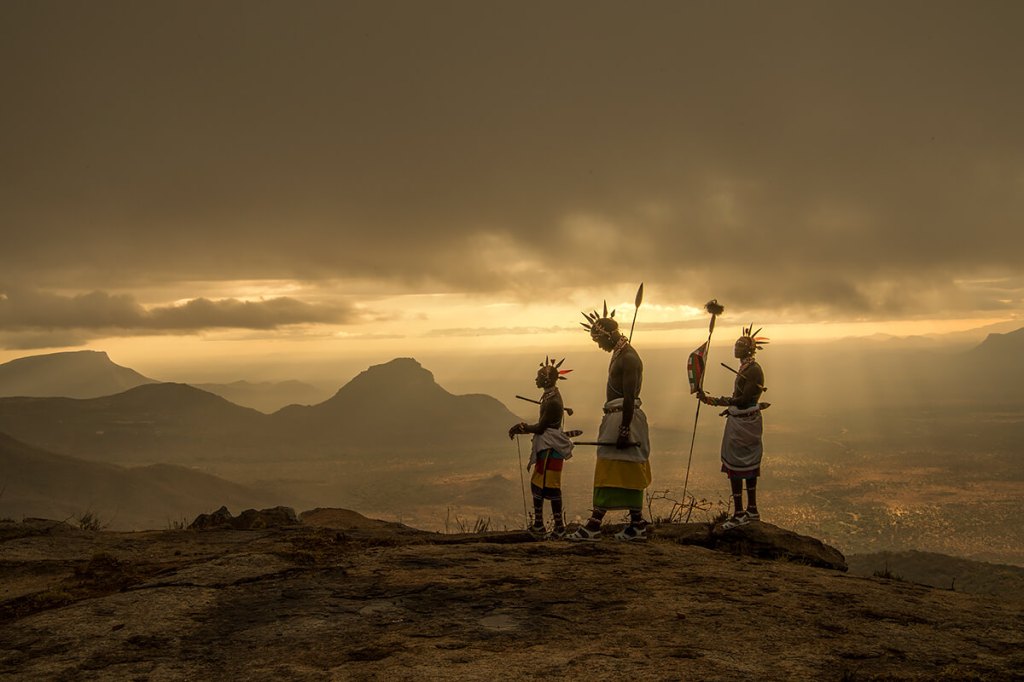
Samburu warriors stand at the top of the northern Kenya’s Mathews Range where the 850,000 acre Namunyak Wildlife Conservancy is situated. The area is home to Africa’s second-largest elephant population. There community-based wildlife keepers, like these Samburu warriors, are working to rehabilitate abandoned and orphaned elephants in order to eventually return them to the nearby wild herds. In many ways, community based conservation is likely to be the only viable alternative for vast tracts of Africa, in the parts beyond agriculture and where big animals and nomadic pastoralists still make their home. This elephant sanctuary is the culmination of a two-decades long process of tipping conservation upon its head, protecting wildlife for, and not just from people. In that sense the sanctuary is as much about people as it’s about elephants.
RANIA MATAR
Rania Matar was born and raised in Lebanon and moved to the U.S. in 1984. As a Lebanese-born American woman and mother, her cross-cultural experience and personal narrative inform her photography.
Matar’s work has been widely published and exhibited in museums worldwide, including the Museum of Fine Arts, Boston, the Carnegie Museum of Art, National Museum of Women in the Arts, and more. A mid-career retrospective of her work was recently on view at the Cleveland Museum of Art, and at the Amon Carter Museum of American Art, in a solo exhibition: In Her Image: Photographs by Rania Matar
She has received several grants and awards including a 2018 Guggenheim Fellowship, 2017 Mellon Foundation artist-in-residency grant at the Gund Gallery at Kenyon College, 2011 Legacy Award at the Griffin Museum of Photography, 2011 and 2007 Massachusetts Cultural Council artist fellowships. In 2008 she was a finalist for the Foster Award at the Institute of Contemporary Art/Boston, with an accompanying solo exhibition.
Her work is in the permanent collections of several museums, institutions and private collections worldwide.
She has published three books: L’Enfant-Femme, 2016; A Girl and Her Room, 2012; Ordinary Lives, 2009.
She is currently associate professor of photography at the Massachusetts College of Art and Design.
GEORGINA GOODWIN
Georgina Goodwin is a documentary photographer and Canon Ambassador born and based in Kenya with a focus on women, refugees, social issues and environment. Known for her award-winning work on Kenya’s post-election violence, cancer in Kenya and Westgate terror attack, and most recently refugee children in Tanzania, Georgina is a contributor to Getty Images and Everyday Climate Change and a member of Women Photograph and African Photojournalism Database, a collaboration of World Press Photo and Everyday Africa. Her work has been published by NY Times, Elle, Vogue, AFP and many others, and has been exhibited in Times Square NYC, Tokyo Japan and The Louvre Paris amongst others. Georgina was a speaker at TEDxKakumaCamp, the first TED talks to be held at a refugee camp, and one of 19 finalist speakers at TEDx Nairobi in 2017.
Amina Suleiman Gas, 45 stands amidst the carcasses of her dead animals, piled for burning outside the compound where she has lived for 10 years in Barwako village 20kms into the desert from Anaibo Town, central Somaliland. She sent most of her livestock west with her neighbor in November 2016 when the drought began to get worse and fears they have not survived, March 2017. Barwako was a village of 100 families but 245 more came in from the surrounding area because of the drought. As a member of the Villlage Savings and Loans Association (VSLA) Amina and her group shared all their savings with the displaced families, leaving them with nothing. At least 6.2 million people, more than half the population, were in need of assistance after four consecutive seasons of failed rains over three years leaving the region depleted of all its resources and experiencing a drought on a scale not seen since 1974 and on the verge of famine.
CIG HARVEY
The photographs and artist books of Cig Harvey have been widely exhibited and remain in the permanent collections of major museums and collections, including the Museum of Fine Arts, Houston, Texas; the Farnsworth Art Museum, Rockland, Maine; and the International Museum of Photography and Film at the George Eastman House, Rochester, New York. Cig began working in a darkroom at thirteen and has been dedicated to photography ever since. She grew up in the deep valleys of Devon in the UK, and came to the States for her MFA in 1999, after years spent living in Barcelona and Bermuda.
Cig Harvey’s first monograph, You Look At Me Like An Emergency (Schilt Publishing, 2012,) is a collection of ten years of pictures and written vignettes. It sold out in all printings and was named one of PDNʼs Best Books of the Year 2012. Cig had her first solo museum show at the Stenersen Museum in Oslo, Norway, in conjunction with the release. The book was well reviewed in a number of publications, including The Independent, Aesthetica, the Boston Globe, Blink, and PDN. Pro Photographer magazine ran an in depth feature, Chance: Cig Harvey’s deceptively simple photographs tap into the universal elements of the human experience: love, loss, longing and belonging. She’s in demand for editorial and commercial work-as well as her for her fine art prints and books.
Cig Harvey’s second monograph, Gardening at Night (Schlit Publishing, 2015,) was published in conjunction with solo shows at Robert Mann Gallery, New York, Robert Klein Gallery, Boston and Paul Kopeiken Gallery, Los Angeles. The book received critical acclaim with features and reviews in Vogue, The Telegraph, the International Wall Street Journal, the International New York Times, and Aesthetica among others. The International Wall Street Journal said of the series, Though the subjects and setting are familiar to us, we cannot help but feel that Cig Harvey has led us through the looking glass to a world of wonder. In the way that twilight is not quite day and not quite night, the photographs of Gardening at Night are stories not yet fully developed, while still capturing the unexpected yet oddly harmonious moments that surround us daily.
Cig Harvey’s work has been displayed at Paris Photo, Art Miami, and AIPAD every year since 2006. She has been a nominee for John Gutmann fellowship and the Santa Fe Prize, and a finalist for the BMW Prize at Paris Photo and for the Prix Virginia, an international photography prize for women.
Cig’s devotion to visual storytelling has lead to innovative international campaigns and features with New York Magazine, Harper’s Bazaar Japan, Kate Spade, and Bloomingdales. Cig teaches workshops and regularly speaks on her work and processes at institutions around the world. She is known for her high energy, sense of humor and creativity. She brings a profound sense of optimism to all that she does.
Cig lives in a farmhouse in the Midcoast of Maine with her husband Doug (who has the profile of an emperor on a Roman coin), their wayward daughter Scout, and Scarlet the dog (the original baby). The slow passing of time and the natural surroundings of her rural home has made her alert to the magic in the mundane.
‘content writer’ is the most searched job in india,says study
The latest study for digital marketing job trends in world’s leading nations conducted by SEMrush, the online visibility management, and content marketing SaaS platform showcased that amongst the most searched digital marketing jobs in different countries, India clearly showed a great share of 73.87 per cent for content writer jobs with a monthly/daily search volume of 26309.
Content writer jobs in other countries contributed with a lower share of 32.24 per cent for Australia, 31.66 per cent for the UK, 30.68 per cent for Canada, and 30.27 per cent for the USA.
A deeper insight from SEMrush revealed that content writing and content marketing jobs gained great prominence.
The study showed that the keywords – ‘how to do content marketing’, why content marketing is important’, ‘what is content marketing strategy’ and other queries regarding content marketing and content writing ranked high in terms of search volume in comparison with other digital marketing jobs.
India showcased vast changes in the priority of content writer jobs in recent years and surpassed other fast-evolving digital marketing jobs like social media managers, SEO analyst, Content marketing manager, etc.
The research conducted in the world’s leading nations highlighted the overall share of content writer jobs to be 47.57 per cent amongst all leading digital marketing jobs.
Edupedia Publications Pvt Ltd is a rapidly growing academic publication in the fields of Sciences and Engineering like Electronics & Communication Engineering, Electrical Engineering, Computer Science Engineering, Information Technology, Mechanical Engineering, Civil Engineering etc. Engineering Research Publication is a registered organization, services to inculcation professionals, especially researchers around world.
The organization aims at undertaking, co- coordinating and promoting research and development. It provides professional and academic guidance in the fields of basic inculcation, Higher inculcation. Engineering Research Publication mission is to Promote and support, High Quality basic, Scientific Research and development in fields of Engineering Technology and Sciences, Generate Public awareness, provide advice to scholar’s researchers and communicate research outcomes.
Kindly inform about Engineering Research Publication to your Friends / Students/ Colleagues / Associates and Fellow Researchers who may utilize this opportunity as a platform for their new research.
Assistant Professors of English, Arignar Anna Govt. Arts College
Abstract
Literary texts are significantly made up of signifiers from the definition of poststructuralist perspective. The author’s literary product is a dynamic, when a reader is making multiple readings. That is to say that a primary reading is not an end. There are multiple readings are in literature. This kind of multiplicity of reading is safely called ‘misreading’
The well-known African American poet is Maya Angelou. She is a civil activist in Arkansas. Arkansas is a place in America, where black people live and were discriminated brutally on the racial issues. She is labelled as postcolonial / subaltern writer. Her most famous poem is ‘My Arkansas’. Generally this poem deals with the poet’s reminiscent of her experience of the poet. As it is well known that this poem is a note of autobiographical. Angelou has brought bitterly out the present and the past experience. From the perspective of post structuralism, a theorist can reread this poem in the aspect of multiplicity of meaning. The surface level of the meaning is defaced and the hidden meaning is unearthed. The constant unearthing activity is the primary act of post structuralism.
Post structuralism has not emerged suddenly. In arts and humanities the theory has been developed from structuralism. Post structuralism has produced a term called ‘deconstruction’. Originally the term deconstruction announced and practised by Jacques Derrida. Derrida was a French philosopher, born in 1930. In his intellectual account, he has written three significant books. Those are: a) Speech and Phenomena b) Writing and Difference and c) Of Grammatology. Derrida is not to the diametrically opposite meaning in a text. Rather, he is to the unread meaning, which is left in a text by a common reader. The term deconstruction is not a new one. It already existed in the 18th century. Derrida says that a literary text is already dismantled by itself. Therefore, he says that the left over meaning with the play of signifiers is reread.
Misreading- A note:
The term deconstruction is derived from old French word. Derrida himself says that deconstruction is not a new term. It better to quote from Julian Wolfreys’ essay ‘Deconstruction, What Remains Unread’:
‘The first known written appearance of the word in English is in 1882’. As with its French predecessor, it has legal connotations: ’a reform the beginnings of which must be a work of deconstruction’ (wolfreys, 117.)
Misreading of a literary text is not the reading of a literary text in a wrong manner, but it is a reading in which the other meaning is exhumed from a literary text. There are two kinds of method of reading, which can be functioned analyse a literary text.
A)Intended meaning (author’s / general /surface meaning)
B) Unintended meaning (reader’s reconstruction/misreading/unread meaning/deconstruction)
The intended meaning defines that the surface level of the meaning in a text which the author wants to convey to readers. And it has a sequential logic at giving the meaning.
The unintended meaning defines that a reader deconstructs a literary text / art not from a reader’s own perspective, but to discover the unread he meaning, which is already dismantled by itself. In a linguistic network the play of signifiers are already tended to be deconstructed.
Deconstructive Analysis of the poem ‘My Arkansas’
Maya Angelou’s ‘My Arkansas’ is a well-known African American poem. Some readers and critics say that the poem deals with the theme of autobiography. Through this poem Angelou has depicted that there is a racial discrimination in her country. This poem is an example for that. In a deconstructive reading all the readings are the provisional. Therefore, in the practice of deconstruction, the term aporiais used.
There is a deep brooding
in Arkansas
old crimes like moss pend
from poplar trees
the poet has utilized the metaphorical and figurative language in the above stanza. The poet says that in Arkansas old crimes are prevalent even now. The words ‘old’ ’crimes ‘make sense that the poet is in dilemma between old crimes and the modern crimes, since the old crimes are emphasized figuratively.
Moreover, the author has used the figurative words comparatively that ‘deep’ ‘brooding’‘moss pend’ and ‘poplar trees’, which have the nature of fast growing. Here the figurative words are representing the crimes committed by people in the Arkansas are culture. The words ‘moss’ and ‘poplar’ are representing ‘nature’. The poet seeks for assistance to bring out culture from ‘nature’. This is what a poststructuralist reading calls a concept of binary opposition. That is nature X culture, man X woman as such. In the poem the signifiers reiterate nature for emphasizing culture. The poet explains that nature of fast growing trees like ‘moss’ and ‘poplar’. The above few lines of the poem have the nature of culture
the sullen earth
Is much too
Red for comfort
The above lines are the environmental concern rather than her autobiographical note. The words ‘sullen earth’ and ‘too red’ are in the metaphorical sense. Again the poet seeks for assistance from nature ‘earth’. The words ‘too red’ might have explained that the earth is destroyed by the crimes. It shows that the earth is being deteriorated into loss of fertility, nature and greenish, because of the man-made violence. It is better termed as anthropocentrism. Therefore, it might to say that the poet has eco-concern
Sunrise seems to hesitate
And in that second
Lose its
incandescent aim, and
dusk no more shadows
than the moon
The above lines are the explanatory of change of whether /climatic condition. The sun is not able to appear and disappear in the proper region /location. The sun loses its brighter light to flash. The line ‘the past is brighter yet’ shows that the line is connected with the ‘old crimes’ like ‘moss pend’. The explanatory note here is the cultural degradation makes more on nature and it has lost ‘values’ and ‘nature’. Again the poet seeks for assistance from natural phenomena like ‘earth, moon’. The poet is so concern about the environmental degradation and is compared with past/old crimes in Arkansas.
Old hates and
Ante-bellum lace, are rent
But not discarded
Today is yet to come
The poet might to say that before the American Civil war the condition was unsatisfactory. This might be a reason that the American civil war could bring peace. The term ‘ante-bellum’ is on par with before the American civil war. Therefore the poet makes importance to the environmental concern rather than her autobiographical note in the poem.
References
Barry, Peter. Beginning Theory:An Introduction to Literary and Cultural Theory.UK: Manchester University Press, 2010. print.




























 International Journal of Research (IJR)