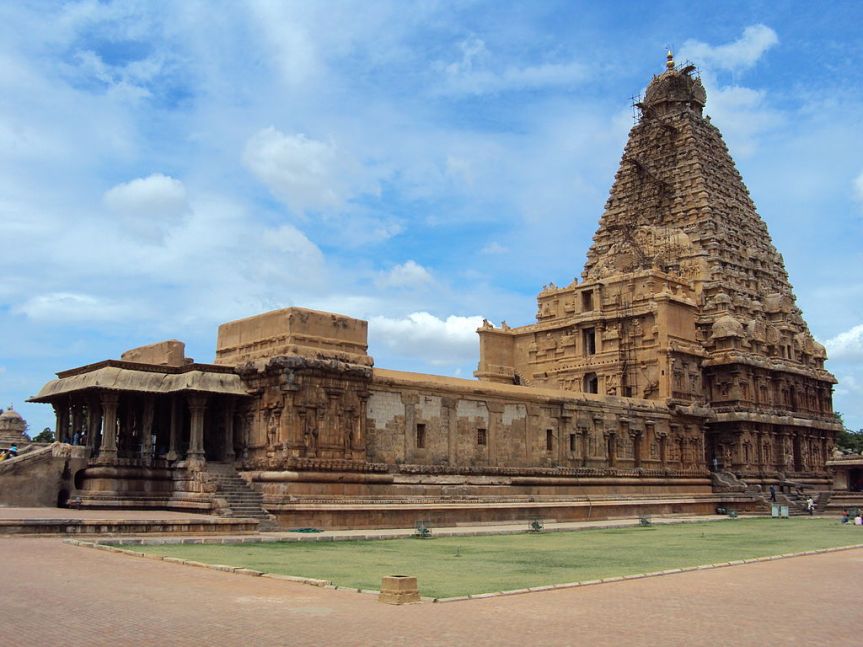
glory of brihadeswara temple

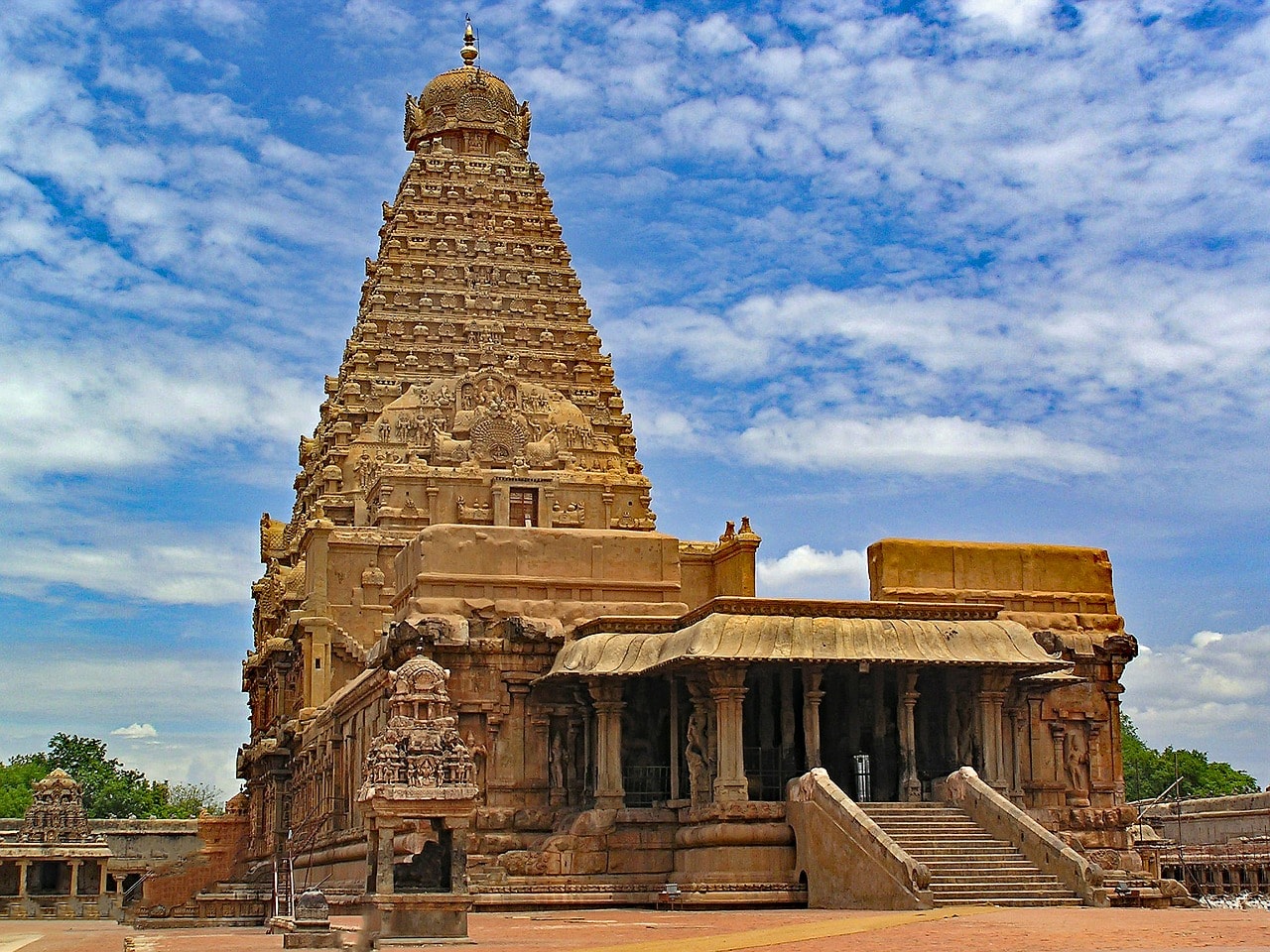
Brihadeswara Temple is temple dedicated to Lord Shiva. It is located in Thanjavur, Tamil Nadu, India. It was built by Raja Raja Chola I, between 1003 and 1010 A.D. It is the part of UNESCO World Heritage site. The temple entrance, or Gopuram as its is locally called, is 30 meters in height. This temple is the largest temple with the brilliant work done by the Indian Architecture. This temple shows the power of Chola rulers that is Raja Raja Chola I.

Architecture-

For the construction of this temple around 1.3 lakh tons of granite was used. With 66 meters high, the temple tower Vimana is the largest towers on the earth. In 11th Century, Tamil People completed its first major irrigation network for movements of goods, to control water flow and for agriculture. It is also said that about 3000 elephants were used to bring these stones from far away. Also inside the temple a figurine structure of bull or Nandi is made up by a single rock carving at the entry of Brihadeswara Temple. No cement, plaster or adhesives were used between the stones. For making up of this temple Tamil people used puzzle technique as one stone is placed on another stone, to lock it.undefined
Comparison And Specialty

London’s Big Ben and the Leaning Tower of Pisa are tilting with time. But the glory of Brihadeswara temple still remains beautiful. This temple stands straight even after 1000 years. The reason behind this is the base of the temple which is very wide. The width of the base has kept the structure straight over the years. Another specialty of this temple is that it was made without digging into the earth which means it was built on a plain land. There were no cranes or power machinery to lift the stone to such a height. Wondering how they manage to place this single stone on the top of the Gopuram? And for that to the top of the temple tower they made a ramp of around 6 kilometers long. With the help of Elephants, horses, bulls and laborer’s who together carried the stone.

Festivals

However, it is also a site of annual dance festivals around the Mahashivratri. Around 10 days artists as well as regional teams performs classical dances at this Brahan Natyanjali festival. The Thanjavur Maratha royal family is currently administering and managing the temple glory. For devotees temple provide free meals and wayfarers on daily basis. Also Brahmins were particularly invited and fed with the meals during the Hindu festivals. Many people are employed in the temple for which they are given wages, roles and names. These people mainly are of priests, lamp lighter, washer man, tailors, jewelers, potters, carpenters, dance guru, dancing girls, both male and female singers, musicians, superintendents of performance artists, accountants. Wages are divided between the land distributions. It is one of the most visited temples by tourists in Tamil Nadu. This fascinating architecture is still appreciated by everyone.

“1000 years, 6 Earthquakes, Still Standing Strong.”

THE E-WAY

Like an endless loop of strings, E-learning opens up multiple avenues for the students to choose from the comfort of their homes. Through E-Learning students in India can do varied courses offered by Harvard University ranging from a programming course such as CS50’s Introduction to Game Development to a social sciences course such as American Government: Constitutional Foundations.
Universities and their invaluable courses continents away can be accessed easily without the unnecessary hassle of the physical presence in the classroom.

E-Learning has brought varied courses around the globe in the comfort of one’s own house. E-learning has been successful in bridging the quality of education that one can access in the developing nations. It is a more economical and appeasing form of education in world crises such as the raging Covid-19 pandemic. It has ensured the unhindered transfer of knowledge when one is unable to be physically present in classrooms.  Schools and colleges have taken up E-Learning to ensure social distancing is not an issue they have to deal with so they can solely focus on the quality of education imparted to the students.

Despite its many perks, E-Learning also has its fair share of drawbacks. It is often difficult to cater to and overlook the progress of the students online which would have been a far easier prospect in the in-classroom mode of education. There are different challenges such as poor internet connectivity in the remote places and often the underprivileged do not have access to proper electronic devices. Some struggle with technology and thus are often unable to have a seamless E-Learning experience.

Though it is not without its fair share of challenges, E-Learning has been successful in the re-moulding the education system for the better. It is undoubtedly the mode of education for the future. It has been successful in providing affordable education to people in the different corners of the Earth. It has enabled some institutes to do without the physical infrastructure and additional costs that come along with maintaining physical classrooms.

There are several applications like Zoom, TeamLink, Google Meet, Duo etc which are being used by teachers and institutes to impart lessons to the students. The dangers of video lessons can be seen in the multiple instances of hacking and misuse of these applications. Data are stolen by hackers of the users of the application who misuse the data to their own fruition. The applications should be secured from hackers for seamless usage and to ensure that the users can operate it without any fear of their account being hacked.

E-Learning may, however, lead to a loss of jobs for a majority of people who used to assist in the seamless functioning of the brick and mortar classrooms. Publishing houses may suffer as learning moves online resulting in a sharp decline of hard copy textbooks. Publishing houses too shall have to adapt and move their publications online. Small publishing houses may fade away with time. The implementation of the proper 5G network would ensure an immersive learning experience. Physical libraries are slowly becoming defunct with even libraries uploading their content online. Information is available to Scholars very easily. Research has become easier than before. Some people have found it hard to cope up with the technological advancements while some have become unemployed with technology replacing manual labour. However, technology has changed the world for the better and made our lives easier. We should embrace technology as an inseparable part of our lives.


Indian culture now v/s then

It’s been seventy three years from the day we got independent on, i. e. 15th August 1947 and we have achieved every heights of success which our leaders and freedom fighters wished for. People have sank into a more humanitarian approach rather than blindly believing into the facts and the follies which their religion has provided them through oral transmissions, and long narrative hyms over a long period of time. Althoug there still exist such a people who do not find it a good idea to leave behind the essence of what our legendary elders and policymakers have left behind.

Indian culture then-

It was in 1500 B.C. when human civilization in India get back on its track and adopted new techniques and the other modes of earning for their livelihood. And it was only back in that period of time when scriptures such as Rigveda,Dharmasutra and Dharmashastra were being written by the literates of this country, and society undergone several changes;they became more concerned fortheir religion and religious practices, followed every path of the Brahmanas who were then the superior of all the four vranas and eventually discovered a perpetual lifestyle for themselves.

Gradually they started worshiping a numerous number of major and local deities, such as Indra, agni, etc. And it all resulted into whole of a superstitious society. But the situation was not tensed back then until the country turned into a secular state.

Indian culture now-

As soon as we (Indians)moved to a more secular state, the feelings of inferiority, superiority also rose to a level that it turned into communal riots and the feeling of disrespect and disbelief in their own religion. Though the article 25 of the Constitution of our country provides us with the feature of –

Freedom of conscience and free profession, practice and propagation of religion.

And therefore there couldn’t have been any complications in following any religion,but the real problem lies within the society itself,they unseeingly follow their religion. And that is the reason people have moved to a humanitarian approach to follow their culture. They try and stick to the core of their religion and are not tricked easily into believing the obnoxious imposture of their own religion and some of the cultural beliefs.

The tough tug and war between the early religious practices and today’s approach towards these practices is endless. And, though most of the people have moved on into thinking their culture and religious beliefs as hoax, there’s something original in those religious books and practices which still binds millions of Indians together, also providing to us a quality of facts that abidingly focus on human progress.

Economic impact of COVID-19 pandemic in India By Debalina Mukherjee.


Covid 19 is something that has shattered the whole world. No body was prepared for it. Corona virus or covid 19 has affected different sectors very badly. When it comes to India’s growth it has gone down to 3.1% according to the ministry of Statistics. According to the World bank along with the rating agencies India’s growth has touched its lowest figures and is in worst state since last three decades.CRISIL has already announced that India is perhaps going to see the worst recession in the coming days since it has got its Independence.
Unemployment is becoming a very big issue in India.Within a month of lockdown the unemployment rates rose from 6.7% to 26% and 14 crore people approximately lost their jobs. The business sector got affected very badly. The supply chains were kept on hold and at first there was a big confusion regarding what is ‘essential’ and what is ‘non essential’. Due to the restrictions made by the government this sector has witnessed a lot of loss as well. In the agricultural field the farmers suffered from fear and anxiety. They were not able to bring their produce for sale to the market. They couldn’t cut their crops as well. Their future became absolutely uncertain. Daily wage workers and private sectors were at high risk of facing loss and have to take special measures like work from home etc. Major companies in India such as Larsen & Toubro, Bharat Forge, UltraTech Cement, Grasim Industries, Aditya Birla Group,BHEL and Tata Motors had to slow down their operations for some days. Due to uncertainty and lack of demand, the stock markets also collapsed. Many companies unwillingly had to cut down the salaries of the employees and many employees were asked to leave. The live event companies had also said that they have suffered a loss of more than 3000 crorers.
The small businesses and small scale industrues suffered a lot.. The airlines,markets hotels, big shopping malls were completely closed and people have witnessed unemployment in these sectirs as well.
The Central and State government, both has taken various steps to cover up the loss. Various measures were taken and many scemes were declared sarting from food security and funds for healthcare for different states. Income tax return dates were extended and Electricity and telephone bill submission dates were also extended. On 26 th may some relief measures were declared for the poor and the most suffering sections of the society. On 12 May the Prime Minister of India announced an overall economic package of ₹20 lakh crore (US$280 billion),10% of India’s GDP, with emphasis on India as a self-reliant nation. (Atmanirbhar). Indian government also announced relief measures in the areas of GST ,Customs & Central Excise, Corporate Affairs, Insolvency &Bankruptcy Code (IBC) Fisheries, Banking Sector and Commerce. About 800 million people are going to get free cereals and cooking gas along with cash through direct transfers for three months.The Prime Minister of India has already told and thought of setting up an Economic Task Force to devise policy measures to tackle the economic challenges .
In conclusion I would like to say that covid 19 has affected the world very bady and though the situation is bad still our governments, both Central and State are working on how to recover from this economic crisis that has arised globally.So this is the time for each one of us to join hands and fight this virus and try to contribute as much as we can. We must believe that we are not alone in this and we shall be able to ovecome this situation very soon. Lets take the pledge to listen to what our governments are saying and try to contribute and maintain the lockdown.

Apple granted ‘synthetic socially distant group selfie’ patent

Apple has awarded with the patent which allows the users to take group selfie maintaining social distancing.

During the time of this pandemic, when social distancing is a necessity Apple has won a patent that would allow different users to take their selfies and combine them with the other selfies of their friends without being at the same place at a time.

This method allows users to rearrange themselves in a single frame of the selfie.

If you are a selfie lover then this news could excite you. This patent discusses a method to allows different users to combine the selfies with that of their friends’ selfies in a single frame.

Social distancing has become a part of our daily lives due to COVID-19. As per the norms of social distancing at least 6 feet distance should be maintained between two persons. We can’t go out during this period with our friends and family for fun. So, we can’t take a group selfie.

But Apple has a solution to this problem of not taking a group selfie. Two years ago a patent has been filed by this Tech giant to ease the process of group selfie.

What is a synthetic group selfie?

A Synthetic selfie is a combination of different users’ selfies taken from different sources, at different places merged in a single frame, by maintaining social distancing.

Still, it is not clear that this feature will be available on iPhone, iPad or both.

participants of this selfie need not be at different places necessarily. Selfies taken at the same place or nearby places can also be combined with this method.

Not only in this situation, but also in general this patent is very useful.

Friends and family members who are at a long distance can take the advantage of this feature.

 By this method- while taking selfies an option of group selfie will appear on the screen of the person who takes a selfie. The user selects that option to take his/her selfie. Then invites the other users to take their selfies or select from the existing one. 

Each person will take a selfie on their phone and send it to one phone on which the selfies will assemble into a group selfie. 

The software then combines the different selfies by adjusting the background to look like it is taken at the same place. The phone will use an AirDrop feature to send photos to the main device.

 The pictures included in the individual selfies can be ” still images, stored videos, or live streaming images.”

The different participants in the group can also adjust their positions, like if someone wants to be at the front or back of the selfie then they can modify once the selfie has been taken and compiled.

This patent is not filed in the response of following the social distancing norms. But this has been filed in July 2018. 

Apple just has been awarded the patent only its implementation is yet to be done. Like other technology companies, Apple also files for many patents but not every patent changes into the software.

FORMATION OF A CONTRACT: SOME BASIC ESSENTIALS

By Kartik Sharma

PC: Rawpixel Ltd, Sodhi Law Group.

INTRODUCTION

The branch of law which binds two or more parties with a legal obligation to perform or not perform an act in place of consideration flowing from all the parties is ‘Law of Contract’.[1] In India, the Indian Contract Act, 1872 governs this branch of law.[2] It defines and explains different aspects of a contract, how an agreement becomes a legit contract, the consequences of a breach of contract, the performance of the consideration and remedies on the violation. Any transaction to be a legally binding contract needs to have three essential elements. Offer flowing from a party, its unqualified and absolute acceptance from the other party and intention to enter into a legally binding contract.[3] Section- 2, which is the interpretation clause of The Indian Contract Act, defines these aspects of a contract. [4] It explains what all things constitute a valid agreement which becomes a contract with the force of law. To better the understanding of the formation of a contract, in this article, the author will analyse a given fact scenario to understand the proper proposal and its acceptance.

FACTS

‘A’ visits a small shop to buy a notebook and a pen. ‘B’ is the shopkeeper. ‘A’ enquires about the price of the pen and the notebook. ‘B’ states that the notebook costs Rs. 50 and the pen costs rupees Rs. 15. ‘A’ agrees to buy the notebook for Rs. 45 and the pen for Rs. 10.

ISSUES

  1. Was ‘B’ by quoting the price of the notebook and the pen proposing an offer?
  2. If so, then, ‘A’ agreeing to purchase the items on a different price an acceptanc?

ANALYSIS

  1. Whether quoting the price of the notebook and pen constitutes a valid offer by ‘B’?

When one person signifies to another his willingness to do or to abstain from doing anything, to obtain the assent of that other to such act or abstinence, he is said to make a proposal or an offer”.[5] As from the facts, it is clear that ‘A’ just enquired the price of the notebook and pen to which ‘B’, the shopkeeper, just quoted the price which does not show his willingness to sell the said items and “when a person proposes an offer it should be sufficient enough to form a contract as soon as it is accepted”.[6] In other words, one must put the offer in such a way that whenever the offeree accepts the offer, a legit contract is formed. In the present case, even if ‘A’ would have agreed to purchase on the said price, it would not have resulted in a valid contract because B’s quotation was merely an answer to an inquiry made by ‘A’. ‘B’ did not quote the price with the view to obtain the assent of ‘A’ and, also, as in the case Harvey v. Facey [7] when the plaintiff (Harvey) telegraphed the defendant (Facey) that will he be selling him ‘Bumper Hall Pen’ and asked Facey to communicate the lowest price, the court held that it was a mere inquiry made by Harvey. This inquiry was just to know whether Facey was willing to sell and, if so, at what price. The price, i.e. £900, quoted by Facey, was not an offer to sell the ‘Bumper Hall Pen’ it was just an answer to the question asked to him by the plaintiff. The same thing happened in the case at hand. It was a statement and not an offer.

  1. ‘A’ agreed to buy items at different price. Whether it is a valid offer? If not, then, what is it?

In the preceding paragraph, we saw how the quotation by ‘B’ is not an offer. Therefore, there cannot be any acceptance by ‘A’ on it. However, ‘A’ did agree to purchase the items at different pricing. This quotation made by ‘A’ can be considered as an offer. As now he quoted the price intending to purchase and get the assent of ‘B’ to make it a valid contract between the two. Section 2(b) of the Indian Contract Act defines acceptance.[8] As per the definition, ‘B’s approval will be a valid acceptance. Such turn of events is in pari materia with facts of the case Harvey v. Facey.[9] When Harvey agreed to buy at a different price, it deemed an offer, if Facey had accepted it, it would have been a valid contract.

CONCLUSION

A valid offer must be addressed to one or more specific persons, be sufficiently definite, and indicate the offeror’s intention to be bound in case of acceptance.[10] From the instant case scenario and analysis of the issues, it is evident that the quotations given by ‘B’ did not constitute an offer; instead, it was a mere statement. Whereas, ‘A’ clearly made an offer, which will, with the absolute and unqualified acceptance by ‘B’, become an agreement”.[11] Hence, the contract is yet not formed in the given case scenario. To conclude, for a valid offer, the offeror must portray the proposal in such a way that if the offeree accepts it, there arises a contract. He should make it in a way to get a yes or no response. However, if the offeree does not accept and quotes different price or puts conditions, then it will not amount to a valid acceptance. It will either be a counter-offer or an unqualified acceptance which is not correct as per the sections in the Act.


[1] J. Beatson, Anson’s law of contract, 1 (28th ed., 2002).

[2] The Indian Contract Act, 1872.

[3] Nilima Bhadbhade, Pollock & Mulla, the Indian contract and special relief act, Vol. 1 37 (14th ed., 2012).

[4] The Indian Contract Act, 1872.

[5] The Indian Contract Act, 1872, §2(a).

[6] Coffee Board Bangalore v. Janab Dada Haji Ibrahim Halari, AIR 1966 Mys 118.

[7] Harvey v. Facey [1893] AC 552.

[8] Indian Contract Act, 1872, §2(b).

[9] Harvey v. Facey, [1893] AC 552.

[10] Larry A. DiMatteo, Lucien Dhooge , et al, Formation: Offer & Acceptance Rules, International Sales Law: A Critical Analysis of CISG Jurisprudence, 51-75, https://doi.org/10.1017/CBO9780511511332 (Last visited on August 20, 2018).

[11] The Indian Contract Act, 1872, §7.

HAMPI

What is Hampi?

Hampi or Hampe (in Kannada) also referred to as the Group of Monuments at Hampi, is a UNESCO World Heritage Site located in east-central Karnataka, India. It became the pilgrimage centre of the Hindu religion. It was the capital of Vijayanagara Empire in the 14th century. Chronicles left by Persian and European travelers, particularly the Portuguese, said that Hampi used to be a prosperous, wealthy and grand city near the Tungabhadra River, with numerous temples, farms and trading markets. By 1500 CE, Hampi-Vijayanagara was the world’s second-largest medieval-era city after Beijing and probably India’s richest at that time, attracting traders from Persia and Portugal. The Vijayanagara Empire was defeated by a coalition of Muslim sultanates; its capital was conquered, pillaged and destroyed by sultanate armies in 1565, after which Hampi remained in ruins.

Located in Karnataka near the modern-era city of Hosapete, Hampi’s ruins are spread over 4,100 hectares (16 sq mi) and it has been described by UNESCO as an “austere, grandiose site” of more than 1,600 surviving remains of the last great Hindu kingdom in South India that includes “forts, riverside features, royal and sacred complexes, temples, shrines, pillared halls, mandapas, memorial structures, water structures and others”. Hampi predates the Vijayanagara Empire; there is evidence of Ashokan epigraphy and it is mentioned in the Ramayana and the Puranas of Hinduism as Pampaa Devi Tirtha Kshetra. Hampi continues to be an important religious centre, housing the Virupaksha Temple, an active Adi Shankara-linked monastery and various monuments belonging to the old city.

Location

Hampi is situated on the banks of the Tungabhadra River in the eastern part of central Karnataka near the state border with Andhra Pradesh. It is 376 kilometers (234 mi) from Bangalore, 385 kilometers (239 mi) from Hyderabad and 165 kilometers (103 mi) from Hubli. The closest railway station is in Hosapete, 13 kilometers away and the closest airport is 32 kilometers at Jindal in Toranagallu which has connectivity to Bangalore and Hyderabad. Overnight buses and trains also connect Hampi with Goa, Secunderabad and Bangalore.  It is 140 kilometers (87 mi) southeast of the Badami and Aihole archaeological sites.

History

A place of such great magnificence and opulence is sure to have a rich cultural heritage to it too. Hampi was a part of the Mauryan Empire back in the third century BC. There has been enough evidence of the fact that the rock edifices found in the Bellary district were a common form of recording relevant information in the times of Ashoka. Hampi was the capital city during the four different dynasties altogether in the Vijayanagar city that came into existence in the year 1336 AD. The Vijayanagara Empire reached unfathomable heights under the guidance of King Krishnadeva Raya of the Tuluva Dynasty. There is a legend associated with the place in relation to Ramayana. It is well known that the epic Ramayana is divided into seven ‘Kaands’ or episodes. One particular episode named ‘Kishkindha Kaand’ which has special significance concerning Hampi. According to the legend, the episode took place when Lord Rama and Lord Lakshman reach the Land of Monkeys. The place where they reach is said to be Hampi, and there are many geographical proofs in relation to that too.

Iconic spots

  • The Lion God Narsimha: Hampi also has a story which related it to Lord Narasimha. There is a temple known as Lakshmi Narasimha Temple which is just a little south of the famous Krishna Temple. Intricately designed pillars here show the different shades of Prahlad’s life, who was an ardent devotee of Lord Vishnu. Lord Narasimha’s destruction of the demon king Hiranyakashyap is displayed here in the form of articulate carvings.
  • Bhima’s Gate: It is said that during the exile of the Pandavas, Draupadi came across a flower named Saugandhika which had a lovely smell. Enchanted, she desired more of these flowers, so Bhima set forth to find its source. After overcoming many obstacles, he found a pond full of the Saugandhika flower. At this point, Lord Hanuman took the form of an old man and lay across on the pathway. When Bheem asked him to move, he said that he is too old and that Bheem should move his tail himself. When repeated attempts by Bheem failed, he realized that he was facing Lord Hanuman. Bheem then fought two demons guarding the pond and returned with the flower for Draupadi.
  • Yantrodharaka Hanuman Temple: Yantrodharaka Hanuman Temple is present at a distance of around 2km from the famous Virupaksha temple. This temple is a part of a cave standing at the peak of a hill and is dedicated to the Hindu deity Lord Hanuman. Also, the Tungabhadra flows through the steps of this hill. Here, you can find Lord Hanuman indulged in a state of deep meditation. Within a distance of five minutes from here, you can find another temple dedicated to Lord Srinivasa. In case you feel hungry, you can approach small stalls nearby selling mangoes, biscuits or cucumbers. It is best if you plan on your itinerary to this place in between October to March.
  • Queen’s Bath: Reckoned as a large bath of Hampi, Queen’s Bath exemplifies the Vijayanagara’s architectural excellence. It lies close to one of the most awful places to visit in Hampi- the Royal Enclosure. Although built around 500 years ago, this magnificent structure still remains intact in its construction. Its simplest exterior perfectly blends with an ornate interior to embrace its overall appearance. It a rectangular building admeasuring around 30 square meters and has a large sunken bath at its center. It may interest you to find arched corridors all around this Royal bath.
  • Prasanna Virupaksha Temple (Underground Temple): Underground Shiva Temple’s every single piece of the structure reflects a perfect blend of mythology and history. This is amongst the only places to visit in Hampi lying under water. The central portion of this ancient shrine always lies immersed in water. According to local beliefs, it is the Tungabhadra which flows through the interior of this temple through canals. There is the main hall, a courtyard, a small hall that leads to the innermost sanctum. All around the temple is a lush green lawn where you can sit and relax for some time.

Reasons why you should visit Hampi

  • Heaps of giant boulders perch precariously over miles of undulating terrain. The Vijayanagara kings chose Hampi/Vijayanagara as their capital because of its location because surrounded by hills on three sides and fronted by the Tungabhadra; it offered enemies a difficult target. Today, the hillside and the river offer tourists some unforgettable natural and archeological splendor. Any visitor to South India should not miss this epitome of Hoysala architecture.
  • Hampi is charismatic even in its ruined state, attracting thousands of visitors every year. Vast stretches of boulder-strewn hills make the backdrop of Hampi unique. Dotted around the hills and valleys are 500 plus monuments. Among them are beautiful temples, basements of palaces, remains of aquatic structures, ancient market streets, royal pavilions, bastions, royal platforms, treasury buildings.., the list is practically endless.
  • Hampi is a backpacker’s paradise, the same way a pilgrim’s delight. Unreal and bewitching, the forlorn ruins of Hampi, around 330km from Goa, make a highly worthwhile and popular, side trip from the coast. They lie scattered over a landscape that leaves you spellbound.
  • Hampi is also famous for its religious history rather than just the architectural beauty of its ruins. There are many well known temples here including the Virupaksha Temple, the Vittala temple and Anjeneyadri. The Tungabhadra, one of the major rivers of Karnataka flows serenely along this town, providing an awe-inspiring natural setting near the ruins.
  • The stone chariot at the Vittala Temple stands as an icon of the rock carving traditions of the Vijayanagara kings, and has been adopted as the emblem of the state’s tourism department.
  • Thought it is not primarily known for climbing, Hampi has a number of places where the bouldering folks camp. There are even some guesthouses who rent out the basic gadgets.

The best time to visit Hampi is during the winters between November and February. Unfortunately quality hotels in Hampi are hard to find. Therefore, if you are looking for better facilities then Hospet is a better option.

Military: a career choice for women!

HISTORY:

In 1918, Loretta Walsh was the first woman to be enlisted in U.S Navy. In 1948, a law was passed which made women a permanent part or military services. The first group of women were admitted into the U.S military in 1976. Esther McGowin Blake was the first woman to serve in the U.S. Air Force.

A woman, a slave near Jefferson City, Missouri, Cathay Williams was the first known African American woman to serve in the United States Army, named as “William Cathay” she hid the fact she was a woman.

Opha May Johnson was the first woman to be enlisted in the U.S Marine Corps. She joined in 1918 during World War I.

Colonel Ruby Bradley, a survivor of two wars, World War II and the Korean War. Her military record included 34 medals.

HISTORY OF WOMEN IN INDIAN MILITARY SERVICES:

Role of women in the Indian Army started in 1888, during British Raj as “Indian Military Nursing Service”.

In 1992, the army, air force, the navy started including women as short-service commission (SSC) officers.

DIFFERENT CAREER PATH IN MILITARY:

1.) Army: Short Service Non-Technical Commission, Short Service Commission Women NCC, Short Service Commission Women Judge Advocate General, Short Service Commission Women Technical Entry Scheme, Military Nursing Services, Army Medical Corps, Army Dental Corps.

2.) Navy: Naval Architecture, Observer, Education, Logistics, Law, Pilot General.

3.) Cyber Army: Associations of Ethical Hackers and Resource Center for National Police Agencies. This is to meet the long term security challenges in the digital arena.

4.) Air Force: Flying Branch, Technical Branch, Ground Duty Branch.

4.) Army Education Corps: An education centre, run by the Indian Army that develops soldiers and officers of all rank.

WHY WOMEN SHOULD JOIN MILITARY?

1.) Opportunities for women are more- the jobs that were available for women in the military were quite limited. But, this now this is changed in the early nineties. Women who are interested in non-traditional career opportunities might consider a military career.

2.) Health Benefits- the military offers full medical coverage from the moment you join. These benefits apply both to officers and their family members. Spouses and children are also eligible for coverage.

3.)Education and Service- the military covers up to 100% of tuition fees while you are serving for the nation and studying together. Army and Navy have community college programs available. Women who take advantage of these opportunities can earn promotions.

4.) Housing Benefits- there are two housing options for members of the military. They can live on base for free or can choose to live off-base and receive housing rent.

5.)Retirement Benefits- Members of the military can retire in as little as 20 years. This means someone enlisting at the age of 18 could retire when they are 38. And after the retirement, the one who served to the nation get benefits for lifelong. They get retirement money, health services and pension as well.

Challenges women have to face in the military:

1.)Physical fitness- women have 60% of the physical strength of men. They are shorter and smaller than men.

2.)Equipment issue– equipment such as body Armour is made to fit men and must be customized to women’s bodies.

3.)Retention- many women leave the military because they perceive that military policies do not support women’s roles as mothers. Women indicated that they were not treated as equal to the male military officers, which made them leave the military.

 4.) Military sexual trauma: MST is used to describe sexual assault or harassment that takes place during military service. in military 23% of women reported sexual assault and 55% reported some form of sexual harassment.

5.)Gender discrimination: women are more likely to face sexual assault, harassment and gender discrimination while serving their country. Women are 20 times more likely than men to be assaulted during their military service.

Law enforcement

Country development is also based on the self-mastery of the people in the country. To create a restraint among the people, the laws and orders are used as a tool. Law and Ordes rise the self-control and also create accountability among the people. The rating of administration of the country is based on the discipline of the people.

Laws are considered as one of the pillars of the country. The law led us in the right way. It defends us from evil and also encourages people to do the right thing. Laws are act as guidelines for the people. It protects people from violent, cheating, and evil actions. The law would give justice for the needed people and also gave a considerable punishment or penalty to the evil-doing people. It would control and regulate the people by specially appointed people like police. As a citizen of the country, we must follow the law and orders of the country.

Some of the common Acts like Rights to educate are the best acts that make everyone literate. From this Act, education became common to all. Many countries like India gives a free education by this Act. We can conclude that the laws were for the welfare of the people. Laws do not only act as a guideline for us and also helps to stand against evil.

There is a no limit to what we as a woman can achieve!![Women empowerment]

Wo-men a big word in itself through which a men came into existence so talking about today’s era where women are playing crucial role in every aspect of life. From the vicious grisp of social, economical, political, business or entrepreneur everywhere women has proven themselves and cset an example for the whole World. As the times evolved women, realised their power since that time the revolution came. A latest trending news New-Zealand prime minister ‘Jacinda Ardin’ has proven herself that women can handle and trackle any situation which is really mesmerizing. Talking about Mother Teresa who work for the social cost and dedicated her life for the welfare of the humanity truly a gem to be remembered. So it’s the time to talk about the F-World in 2020 it’s no about the scarlet letter it’s a time to brand yourself as a feminist. A girl with strong views and will power ‘Malala Yosuafgai became the youngest to win the noble prize laureate now is education advocate.GD Anderson an Australian activist and writer who was a member of American osteopathic association.So to all the girls who are reading this never doubt that you are valuable and powerful you are capable of pursuing every dreams.