Stop Finding Your Happiness IN People!

undefined

Don’t you remember those terrible days when you walked off sad empty sometimes due to other’s fault and sometimes due to your fault. If you have forgotten then it is sad on your part. Remember those betrayals, lies, manipulation and cheating you once suffered. How many times you were used and dumped. I think still you have not taken a lesson. You are still wandering around those selfish people your so called friends and lovers who left you when you badly needed them. Do you still can’t see that they don’t care about you. It is you only you who is expecting love and care from them. So stop now thinking about these selfish people. You were not sent on this planet to just love people either as a lover or as a friend. You have your own life and there has to be a bigger purpose in your life. That purpose was always their in your life but it was hidden in any corner behind your stupid emotional foolish feelings that you always had for people who always cheated you. You definitely knew what you wanted but you always allowed distraction to find you. Shit happens. Yes, it happens with you, with me and everyone else. But you can’t let your whole life become a shit. So wake up!

Stop finding your happiness in other people. For being truly happy you neither need other people nor materialistic things. Your true happiness is inside you only in your dreams and goals. I want you to be selfish now. Yes you heard it right selfish for your own growth and development. Enough of this melodrama crying and waiting for them. And enough of this always favoring other people. You are not only meant to be nice with others. Learn to say no, blunt no. Others need to realise your importance too. They have wasted your precious years by consuming all your love, support and care and these monsters left you when they were full and no more needed you in their life. So it’s time to stay away from every person who isn’t adding a value to your life.

I know I have talked so much about your pain and sufferings but have you changed yourself? If not then please change. Listen your inner voice. Noone matters litteraly noone matters. What matters is you, your inner peace, mental health, success and your happiness. For that you have to change. Please for your own sake change. Let people around you think whatever they want to. They don’t matter. They will leave you one day. But what will not leave is your family and your goals. That is enough for you. Don’t bring in distraction. Focus on your life and your dreams. You are not meant for these small things. You have to achieve something big. Today is not yours but tomorrow definitely future will be yours. So start working on your goals. One day you will definitely achieve a lot of success. That day everyone will be around you. Your all pain and sufferings will vanish and your life will be filled with happiness. Till then don’t tolerate bullshit . Don’t allow blood suckers enter your life. Don’t date snakes. To hell with these people. You have to think only about your life, your own happiness and success because it’s your life. Noone has the power to change your life only you can change . Think about it! That’s it for today!

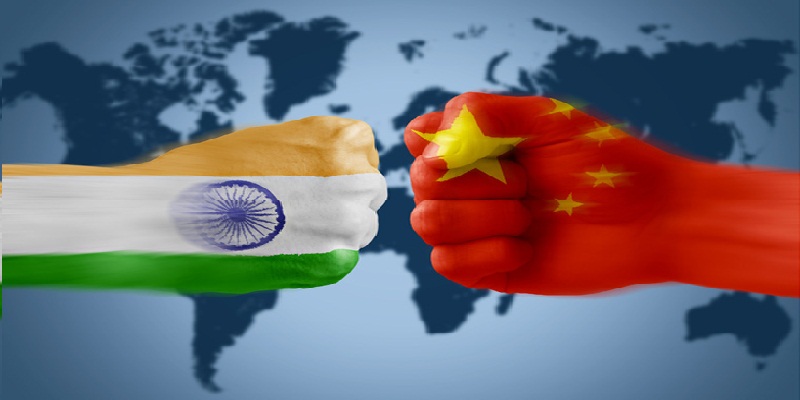
India-China Conflicts and The World

In the recent skirmish on the China-India border, both sides have suffered heavy losses. It has confirmed from the official statement from India that 20 soldiers have martyred and no official data has come from China yet Editor-in-chief of the Chinese government’s news magazine Global Times believes that the Chinese military also suffered casualties. It has been the old attitude of China that whenever there is more loss on its side, it does not share the correct information. We had seen this attitude in the case of Corona also. Although China tries to hide the exact and actual data, somehow it comes out from somewhere.

This incident of the violent skirmish between India and China is extraordinary because such an accident has occurred on the Chinese border the first time after 45 years. Colonel Santosh Babu, who martyred, was leading the Indian contingent during this astonishing incident. According to military sources, this violent skirmish in the Galvan valley started on Monday night due to the changing attitude of Chinese soldiers. The Chinese troops intended to capture L.A.C. through the Galvan valley. But Indian soldiers thwarted the Chinese plan.

The way China has done stabbing behind the back, it proves that China is the most dangerous and vicious enemy for India. All these activities proved that trusting China even more than a century can prove to be the biggest threat for India. In the coming times, there will be unexpected changes in the relationship between India and China. But one thing is clear that a dispute arises on three different boundaries simultaneously, it is a sign of spacious threat. Relations with Pakistan and China are always intense. But Nepal is a neighbouring country whose relationship was not disturbed till date, but by presenting a new map and passed an amendment in the lower house of their Parliament and claiming a small part of India near to the area of Kalapani is the part of Nepal. It is an unfortunate situation for us. Experts of international relations believe that all these concern are interlinked. Chinese Diplomacy transforms from peace to aggression. Their diplomatic policy has changed. If we compare China of the 21st century to the China of the 20th century, we will find an enormous gap between the low profile china diplomacy and leadership china diplomacy. They want all control over the world. China is trying to compete with the United States of America. But the Chinese do not know that they are not like USSR. They could not take the place of the United States of America.

China is a country whose reality was known to the whole world that they do anything to increase its dominance and borders. The way China told the world about the Corona Virus was too late. They hide ambiguous numbers of infected and dead people, revised several bills against it to suppress the violence in Hong Kong and increasing military activities in the South China Sea proves how China is creating an atmosphere of unrest around itself.

A new Journey to the center of the earth

This post is not about the movie, but this is about reality. Whenever you stand on the ground, have you ever wondered what beneath the mud, stones, and soil. Groundwater, fossils? That’s true, but as deep as you go, there’s a lot more to discover until the inner core, which is 6, 371 kilometres equivalent distance from Bali to Amsterdam. But what exactly is present at the center-most point of the Earth.

A globe model in the hand.

We know almost 71% of the Earth is water. The deepest hole on the land is the Kola Super-deep Borehole, which is about 12.2 km deep, which is 0.019 percent till the center of the Earth. At the same time, the scientist of the Soviet Union had a target of 15 km, but the temperature was too high and more than 350 degrees Fahrenheit. The temperature of the core is estimated at up to 10800 Fahrenheit, even if Tungsten was in place for drilling, which has a melting point at 6177 Fahrenheit; still, it will be impossible to reach the core. But even the deepest hole is merely having a diameter on 9 inches.

A comparison to the tallest to the deepest point ever discovered. Courtesy: Pinterest

So, how do researchers predict the information they gather information about the Earth? Recently at the University of Maryland, the researchers used seismic waves to get the inside view of the Earth. But it has a drawback due to weak echo from the unwanted noise as a part of data collection. So, to overcome this, a team of space and earth scientists by analyzing thousands of seismographs from the past 30 years using an algorithm known as Sequencer. After replicating like how bats and dolphins use echolocation, which will help to create new theories to understand more about plate tectonics working in the development of the planet in the early ages of the planet Earth.

The new inner earth map after the research.

The geophysicists are progressively engaged underneath the Pacific Ocean bowl for the particular waveforms of seismic wave echoes traveling. The data gathered is backed the advancement in the computer sector, using Machine Learning, they were able to map the data collected. At the point when the earthquakes create seismic waves pulse, the waves move slow and disperse because of dissimilarities in rock thickness, temperature, and so on. After the movement, time took, and the power of the bouncing back signs as they strike seismometers in various zones set, researchers can make different models about the physical properties of rock under the surface.

The actual method for data collection. Courtesy: University of Michigan

But what is our benefit in the research? We will know more about our planet, but most importantly, we can discover minerals after knowing more about the composition more precisely. Mponeng gold mine in South Africa is the deepest gold mine at almost 4 km; the temperature down reaches up to 140 degrees Fahrenheit. Also, geothermal energy will generate by heating the water to produce steams, saving fossil fuels. Also, there can be new researches if the life of bacteria or microbes can exist at such high temperatures. We can also discover ancient fossil remains if it exists, and many more mysteries are yet to be solved.

ROBOTIC PROCESS AUTOMATION (rpa)

What is Robotic Process Automation (RPA)?

Robotic process automation (or RPA) is a form of business process automation technology based on metaphorical software robots (bots) or on artificial intelligence (AI)/digital workers. It is sometimes referred to as software robotics (not to be confused with robot software).

In traditional workflow automation tools, a software developer produces a list of actions to automate a task and interface to the back-end system using internal application programming interfaces (APIs) or dedicated scripting language. In contrast, RPA systems develop the action list by watching the user perform that task in the application’s graphical user interface (GUI), and then perform the automation by repeating those tasks directly in the GUI. This can lower the barrier to use of automation in products that might not otherwise feature APIs for this purpose.

RPA tools have strong technical similarities to graphical user interface testing tools. These tools also automate interactions with the GUI, and often do so by repeating a set of demonstration actions performed by a user. RPA tools differ from such systems that allow data to be handled in and between multiple applications, for instance, receiving email containing an invoice, extracting the data, and then typing that into a bookkeeping system.

Deployment

The hosting of RPA services also aligns with the metaphor of a software robot, with each robotic instance having its own virtual workstation, much like a human worker. The robot uses keyboard and mouse controls to take actions and execute automations. Normally all of these actions take place in a virtual environment and not on screen; the robot does not need a physical screen to operate, rather it interprets the screen display electronically. The scalability of modern solutions based on architectures such as these owes much to the advent of virtualization technology, without which the scalability of large deployments would be limited by available capacity to manage physical hardware and by the associated costs. The implementation of RPA in business enterprises has shown dramatic cost savings when compared to traditional non-RPA solutions.

There are however several risks with RPA. Criticism include risks of stifling innovation and creating a more complex maintenance environment of existing software that now needs to consider the use of graphical user interfaces in a way they weren’t intended to be used.

Benefits of RPA

RPA provides organizations with the ability to reduce staffing costs and human error. David Schatsky, a managing director at Deloitte LP, points to a bank’s experience with implementing RPA, in which the bank redesigned its claims process by deploying 85 bots to run 13 processes, handling 1.5 million requests per year. The bank added capacity equivalent to more than 200 full-time employees at approximately 30 percent of the cost of recruiting more staff, Schatsky says.

Bots are typically low-cost and easy to implement, requiring no custom software or deep systems integration. Schatsky says such characteristics are crucial as organizations pursue growth without adding significant expenditures or friction among workers. “Companies are trying to get some breathing room so they can serve their business better by automating the low-value tasks,” Schatsky says.

Enterprises can also supercharge their automation efforts by injecting RPA with cognitive technologies such as ML, speech recognition, and natural language processing, automating higher-order tasks that in the past required the perceptual and judgment capabilities of humans.

Such RPA implementations, in which upwards of 15 to 20 steps may be automated, are part of a value chain known as intelligent automation (IA), Viadro says. “If we were to segment all of the major enterprises and ask them what’s on their agenda for 2018, close to 100 percent would say intelligent automation,” Viadro says.

By 2020, automation and artificial intelligence will reduce employee requirements in business shared-service centers by 65 percent, according to Gartner, which says the RPA market will top $1 billion by 2020. By that time, 40 percent of large enterprises will have adopted an RPA software tool, up from less than 10 percent today.

Tips for effective RPA

1. Set and manage expectations: Quick wins are possible with RPA, but propelling RPA to run at scale is a different animal. Dave Kuder, a principal with Deloitte Consulting LLP, says that many RPA hiccups stem from poor expectations management. Bold claims about RPA from vendors and implementation consultants haven’t helped. That’s why it’s crucial for CIOs to go in with a cautiously optimistic mindset. “If you go in with open eyes you’ll be a lot happier with the result,” Kuder says.

2. Consider business impact: RPA is often propped up as a mechanism to bolster return on investment or reduce costs. But Kris Fitzgerald, CTO of NTT Data Services, says more CIOs should use it to improve customer experience. For example, enterprises such as airlines employ thousands of customer service agents, yet customers are still waiting in the queue to have their call fielded. A chatbot, could help alleviate some of that wait. “You put that virtual agent in there and there is no downtime, no out sick and no bad attitude,” Fitzgerald says. “The client experience is the flag to hit.”

3. Involve IT early and often: COOs initially bought RPA and hit a wall during implementation, prompting them to ask IT’s help (and forgiveness), Viadro says. Now “citizen developers” without technical expertise are using cloud software to implement RPA right in their business units, Kuder says. Often, the CIO tends to step in and block them. Kuder and Viadro say that business heads must involve IT from the outset to ensure they get the resources they require.

4. Poor design, change management can wreak havoc: Many implementations fail because design and change are poorly managed, says Sanjay Srivastava, chief digital officer of Genpact. In the rush to get something deployed, some companies overlook communication exchanges, between the various bots, which can break a business process. “Before you implement, you must think about the operating model design,” Srivastava says. “You need to map out how you expect the various bots to work together.” Alternatively, some CIOs will neglect to negotiate the changes new operations will have on an organization’s business processes. CIOs must plan for this well in advance to avoid business disruption.

5. Don’t fall down the data rabbit hole: A bank deploying thousands of bots to automate manual data entry or to monitor software operations generates a ton of data. This can lure CIOs and their business peers into an unfortunate scenario where they are looking to leverage the data. Srivastava says it’s not uncommon for companies to run ML on the data their bots generate, and then throw a chatbot on the front to enable users to more easily query the data. Suddenly, the RPA project has become an ML project that hasn’t been properly scoped as an ML project. “The puck keeps moving,” and CIOs struggle to catch up to it, Srivastava says. He recommends CIOs consider RPA as a long-term arc, rather than as piecemeal projects that evolve into something unwieldy.

Impact on employment

According to Harvard Business Review, most operations groups adopting RPA have promised their employees that automation would not result in layoffs. Instead, workers have been redeployed to do more interesting work. One academic study highlighted that knowledge workers did not feel threatened by automation: they embraced it and viewed the robots as team-mates. The same study highlighted that, rather than resulting in a lower “headcount”, the technology was deployed in such a way as to achieve more work and greater productivity with the same number of people.

Conversely, however, some analysts proffer that RPA represents a threat to the business process outsourcing (BPO) industry. The thesis behind this notion is that RPA will enable enterprises to “repatriate” processes from offshore locations into local data centers, with the benefit of this new technology. The effect, if true, will be to create high-value jobs for skilled process designers in onshore locations (and within the associated supply chain of IT hardware, data center management, etc.) but to decrease the available opportunity to low skilled workers offshore. On the other hand, this discussion appears to be healthy ground for debate as another academic study was at pains to counter the so-called “myth” that RPA will bring back many jobs from offshore.

Impact on society

Academic studies project that RPA, among other technological trends, is expected to drive a new wave of productivity and efficiency gains in the global labour market. Although not directly attributable to RPA alone, Oxford University conjectures that up to 35% of all jobs may have been automated by 2035.

In a TEDx talk hosted by University College London (UCL), entrepreneur David Moss explains that digital labour in the form of RPA is not only likely to revolutionize the cost model of the services industry by driving the price of products and services down, but that it is likely to drive up service levels, quality of outcomes and create increased opportunity for the personalization of services.

In a separate TEDx in 2019 talks, Japanese business executive, and former CIO of Barclays bank, Koichi Hasegawa noted that digital robots can be a positive effect on society if we start using a robot with empathy to help every person. He provides a case study of the Japanese insurance companies – Sompo Japan and Aioi – both of whom deployed bots to speed up the process of insurance pay-outs in past massive disaster incidents.

Meanwhile, Professor Willcocks, author of the LSE paper cited above, speaks of increased job satisfaction and intellectual stimulation, characterising the technology as having the ability to “take the robot out of the human”, a reference to the notion that robots will take over the mundane and repetitive portions of people’s daily workload, leaving them to be redeployed into more interpersonal roles or to concentrate on the remaining, more meaningful, portions of their day.


Perform marketing

Performance marketing is the latest marketing system in the present times. The term may feel unfamiliar and something that boggles your mind, but let us break that down for you. It’s simple, marketing based on performance. It’s a lot different from traditional marketing. 

This article should be a must-read if you are just exploring the field.

What is performance marketing?

Performance marketing is a relatively new term. The marketers doing it have twin objectives: 1) Brand marketing 2) Advertising

While traditional marketing only encompasses advertising, the retailer has no idea about the productivity/ un-productivity of the ad for which (s)he spent some big dollars. 

Performance marketers get paid only when a ‘performance’ is generated by them for the retailer. 

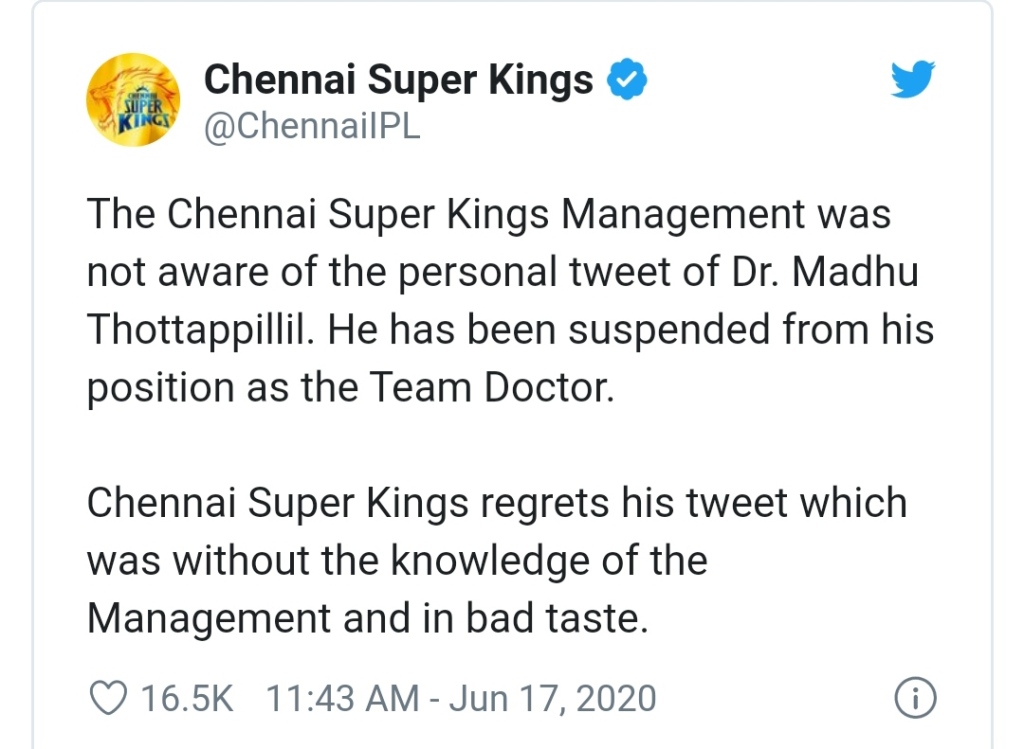
Chennai Super Kings suspend team doctor over insensitive tweet on Indian martyrs in Galwan Valley

Chennai Super Kings on Wednesday said it has suspended the service of team doctor, Dr. Madhu Thottappillil over his remarks on the death of Indian soldiers in Galwan Valley, Ladakh.

20 Indian Army personnel, including a Commanding Officer, lost their lives in what is termed as one of the worst clashes between the Indian Army and Chinese troops in over 5 decades. Government sources said the Chinese side too suffered ‘proportionate casualties’ but chose not to speculate on the number.

Reacting to the news of the violent scuffle, CSK’s team doctor, Madhu Thottappil had put out a ‘distasteful’ tweet that received quite a bit of flak on social media on Tuesday.

“Just curious if the Coffins will come back with a “PM CARES” sticker on them?” Madhu had said.

Chennai Super Kings said the Indian Premier League franchise regrets the tweet after swiftly taking action over the controversial tweet.

“The Chennai Super Kings Management was not aware of the personal tweet of Dr. Madhu Thottappillil. He has been suspended from his position as the Team Doctor,” the IPL franchise said in a social media post.

“Chennai Super Kings regrets his tweet which was without the knowledge of the Management and in bad taste.”

Earlier in the day, several India cricketers, including captain Virat Kohli, mourned the death of the Indian Army personnel in the bloody lash which has soared the ongoing tension between India and China.

Reactions started pouring in on social media as news of the violent scuffle, that resulted in the deaths of 20 Indian soldiers, broke. The bloody clash which has soared the ongoing tension between India and China has left many in shock.

“Salute and deepest respect to the soldiers who sacrificed their lives to protect our country in the Galwan Valley. NO one is more selfless and brave than a soldier. Sincere condolences to the families. I hope they find peace through our prayers at this difficult time,” Virat Kohli tweeted.

Yuvraj Singh also took to social media to salute the brave Indian soldiers.

“I salute the courage of our Indian soldiers who have been martyred at #GalwanValley. All these atrocities must stop and hope we can have a peaceful world where human life is valued. My thoughts are with the bereaved families, I pray for their strength,” Yuvraj tweeted.

@Martin_Christopher

Values of books

A good book is the purest essence of the human soul. Reading books makes our time usefully spent, makes our lives beautifully shaped, and makes our knowledge amazingly rich. Reading one good book will change one’s life altogether different and impressive. Lack of Reading books results in dwarfism in one’s social status and deformity in one’s character. They always help us with valuable information, everlasting joy, and enriched thoughts. Books are always valuable as they give more benefits than anything else in the world. As is the food for the body so is the book for the mind.

There are lots of good books that should have already read or at least began to read. Good books are equal to great teachers. We should always be careful and wise about choosing the book for reading. While buying a book we should be concerned only about its quality, not about its Price. There are several books are available for people as per their age group. Comics and moral books for children, Thriller and Romantic stories for the young readers and family stories and detective stories and books on political, travelogues and biographies of successful persons are available for middle-aged people. Reading books. Is not a good habit but also a great hobby. When we start reading a good book, several bad thoughts are swept out of existence.

“Some books are to be tasted, others to be shallowed, and some few to be chewed and digested”. – Bacon

Architectural Beauties of India

India is one of the oldest civilizations in the world. Among all the known civilizations in India, Indus Valley civilization(2600 BC- 1900 BC)is the oldest one. 

It produced several cities marked by great uniformity within and between sites, including Harappa, Lothal, and the UNESCO World Heritage site MohenjoDaro

After this civilization, many empires have established in India among which architectures of the Maurya Empire and Gupta Empire show magnificent beauties.

The rock pillar of Ashoka shows a variety of influences in its details.

The Buddhist culture was one of the dominating cultures in India. Buddhist monasteries and stupas were built all over India before it eventually spread to other countries.

Ajanta, Elephanta, and Ellora are architectures of respectively Buddhist, Hindu, and mixed including Jain cultural beauties.

In south India Pallavas and Cholas, buildings are also amazing examples of some of the Flamboyant beauties of India.

some of the Architectural Wonders of India are-

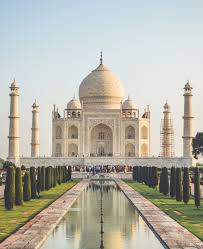
      The Taj Mahal

Magnificient Taj Mahal

TAJ Mahal, the symbol of love was built by the Mughal emperor Shah Jahan in 1653 AD in the memory of his beloved wife Mumtaz. 

It is a combination of Hindu and Indo-Islamic architecture. The white marble was bought in from Makrana in Rajasthan and was transported by elephants.

This one of the seven wonders of the world comprises of a square plinth having a central structure topped by a huge dome and surrounded by four minarets at each corner.

This white marble beauty’s exterior changes colors from a pinkish hue in the dawn to a dull gold at noon and finally, all enduring sparkling white under the moonlight.

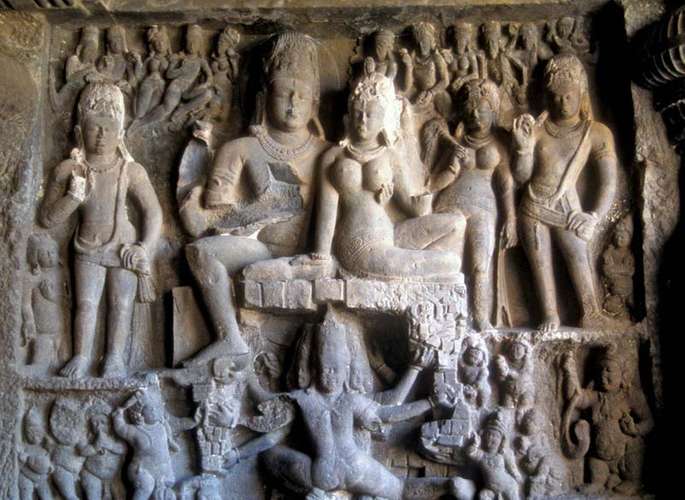
The Ellore Caves

Ellora Caves

Ellora caves are listed by UNESCO as a world heritage site located in Maharastra. It is a combination of Buddism, Jainism, and brahmins cultures.

Ellora served as a group of monasteries (vihara) and temples (chaityas); some of the caves include sleeping cells that were carved for itinerant monks.

The caves consist of series of 34 rock-cut temples. Kailasa temple, Hindu Caves, Buddist Caves, Vishwakarma Caves are some of the caves of the Ellora. Among which Kailasa temple is the largest rock-cut structure anywhere.

The elegance of Dravidian Sikhara, which is a flat-roofed mandapa positioned over sixteen pillars, the gigantic Ravana figure reflecting the strength of this villainous legend as the sculpture here shows him lifting Mt Kailasha is an epitome of the ancient Indian art.

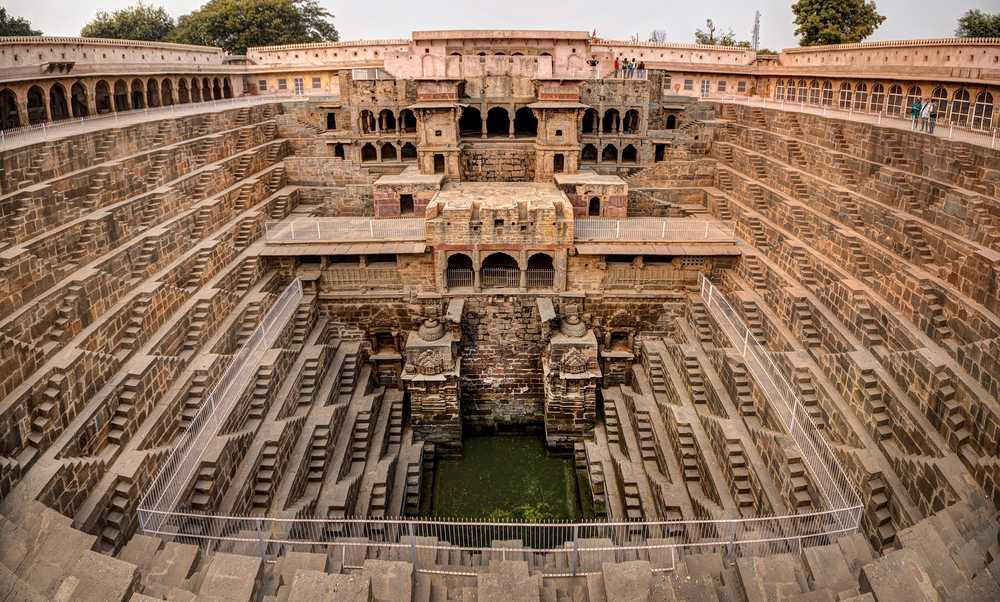
Chand Baori

Chand Baori

It was built in the 9th century by the king Chanda. Chand Baori consists of 3500 steps called Baori or Bawdi, which leads down to the water of the well.

It is about 64 feet deep and India’s largest and deepest stepwell with 13 floors.

The exquisite geometry of the stepwell attracts tourists from all over the world.

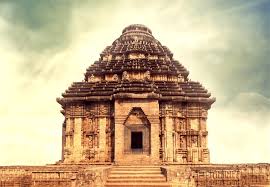
Sun temple KONARK

Sun temple Konark

Dedicated to Hindu God Sun, Sun temple KONARK was built in 13th century CE at Konark about 35 kilometers from Puri on the coastline of Orissa, India.

Temple complex has the appearance of a 100-foot (30 m) high chariot with immense wheels and horses, all carved from stone. 

Lying on the coast of Bay of Bengal, it is considered one of the best examples of Dravidian Architecture. Also known as the Black Pagoda, it is considered as one of the grandest temples in India. Built-in the 13th century, it has a form of a giant chariot with twelve intricately crafted wheels led by seven horses. A true marvel that shows the advanced craftsmanship as well as love and devotion of that era for art.

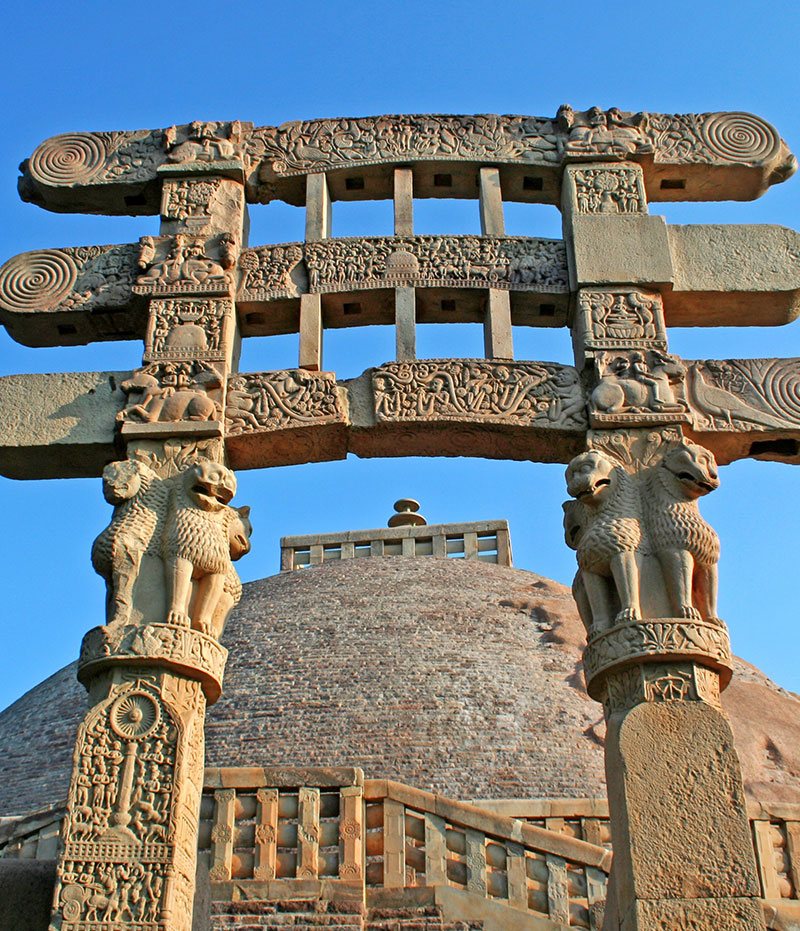
The Sanchi Stupa

Sanchi Stupa

It was built in the 3rd century BC on the order of Emperor Ashoka to spread Buddhist Philosophy.

 A stupa is generally a hemispherical dome structure containing relics of Lord Buddha. In this particular stupa, Lord Buddha has been symbolically represented by footprints, thrones, wheels, etc. and all of them are exquisitely ornamented.

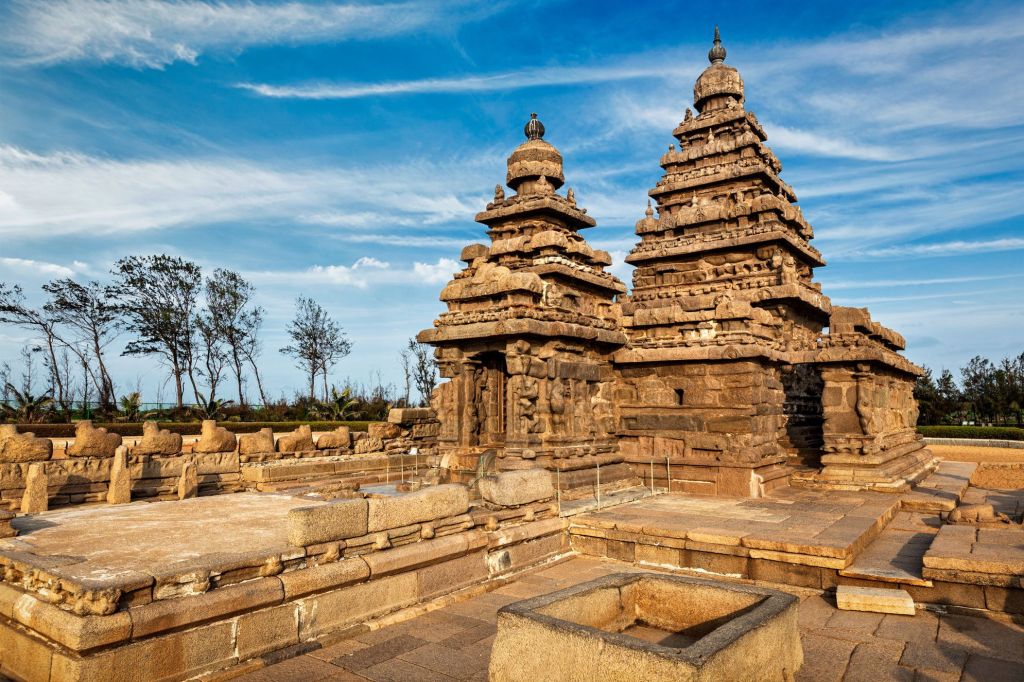
Mahabalipuram Temple

Mahabalipuram Temple

The rock-cut carving of Mahabalipuram depicts the scenes of the great epic Mahabharat.

The temple is most famous for its depictions of the chariots of the warriors of the Mahabharata, called Rathas all of which are in a specifically designated form, some rising to as high as two or three stories. There is another remarkable sculpture that adorns the temple walls which is called the Descent of the Ganges. Depicting the time when Lord Shiva made the River Ganga descend from the heavens to the earth, it uses the natural relief of the rock to emphasize the river and has carvings of various Gods and Goddesses beholding the wonder with their open eyes. The intricacy and ingenuity of the carvings are an example of the skill of the craftsman who constructed these temples way back in the 7th Century!

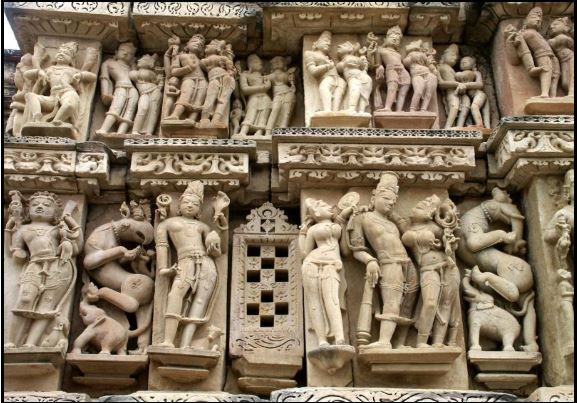
Khajuraho Temple

Khajuraho Temple

Khajuraho temples were built between 950 AD to 1050 AD by the Chandela dynasty. These are a group of Hindu and Jain temple in Chhatarpur district Madhya Pradesh.

These are a group of 85 temples. Falling into ruins, wars, and natural hazards, only 22 out of these remain today and are spread over a stunning area of 6sq.km. 

The temple complex has three distinct types of carvings, the cult icons, the Apsaras (beautiful maidens), and demigods that are supposed to guard the temple. An example of the finest craftsmanship and precision all of the figurines appear in perfect human symmetry, is it a wonder then that it is said that to see all the stages of human life and its activities, one has but to visit these temples and observe the carvings!

How COVID-19 affected SCHOOLs😰

Most governments around the world have temporarily closed educational institutions in an attempt to contain the spread of COVID-19. As of 7 June 2020, approximately 1.725 billion learners are currently affected due to school closures in response to the pandemic. According to UNICEF monitoring, 134 countries are currently implementing nationwide closures and 38 are implementing local closures, impacting about 98.5 percent of the world’s student population. 39 countries’ schools are currently open.

On 23 March 2020, Cambridge International Examinations (CIE) released a statement announcing the cancellation of Cambridge IGCSE, Cambridge O Level, Cambridge International AS & A Level, Cambridge AICE Diploma, and Cambridge Pre-U examinations for the May/June 2020 series across all countries. International Baccalaureate exams have also been cancelled. In addition, Advanced Placement Exams, SAT administrations, and ACT administrations have been moved online and cancelled.

School closures impact not only students, teachers, and families. but have far-reaching economic and societal consequences. School closures in response to the pandemic have shed light on various social and economic issues, including student debt, digital learning, food insecurity, and homelessness, as well as access to childcare, health care, housing,internet, and disability services. The impact was more severe for disadvantaged children and their families, causing interrupted learning, compromised nutrition, childcare problems, and consequent economic cost to families who could not work.

In response to school closures, UNESCO recommended the use of distance learning programs and open educational applications and platforms that schools and teachers can use to reach learners remotely and limit the disruption of education.

Producing food in a sustainable way

Redirecting EU CAP payments to sustainable farming | IUCN

By making great strides in productivity, the industrial food system has managed largely to meet the demands of a growing global population. However, this approach to food production, and the management of food by-products, is endangering biodiversity and human health. It has become clear that this food system is no longer fit for the 21st century and that a new model is required.

The increasingly wasteful way of producing food today, relies on extracting finite resources like phosphorus, potassium, and oil, to grow food in ways that harm the natural systems upon which agriculture depends. The damage also includes the degradation of 12 million hectares of arable land a year and requires almost one-fourth of the forest land. Then, in cities we capture and use an extremely small fraction of the valuable nutrients in discarded food, food by-products and sewage. Air pollution, antibiotic resistance, water contamination and chemical exposure from food production will claim almost five million lives a year by 2050 which is twice as many as the current toll from obesity. Food production also accounts for around one-quarter or 26% of global greenhouse gas emissions.

With cities soon expected to consume 80% of food globally, a new report titled by Cities and Circular Economy for Food released by Ellen McCarthy Foundation lays out a vision of how to harness the power of a city to influence how food is grown and prepared to benefit the economy, human health, and the environment.

To tackle these pressing food issues, the report recommends redesigning the urban food system to incorporate circular economy principles: design out waste and pollution; keep products and materials in use; and regenerate natural systems. But what does a circular economy for food in cities look like?

The research team reached out to businesses from across the food value chain, city governments, waste managers, as well as food system experts such as the SDG2 Advocacy Hub to reach a consensus from the broadest ​set of stakeholders. By the end, over a hundred organizations helped to develop three interconnected ambitions for a more resilient food system:

  1. Source food grown regeneratively, and locally where appropriate: ​food entering cities should be produced in ways that improve natural ecosystems, i.e. builds soil health. Local sourcing is key in supporting this.
  2. Make the most of food: ​surplus edible food should be redistributed where possible; unavoidable food waste should be transformed into new revenue streams, i.e. organic fertilizers, as well as new food products, textiles, structural materials and energy.
  3. Design and market healthy products: ​food designers, processors, and marketing departments, can create and promote innovative food products that enable citizens to make healthy food choices for people and the environment.