AI is reshaping the way musicians and visual artists create and monetize their work, and one of the most compelling developments in this space is the emergence of AI-generated music videos being sold as NFTs. These aren’t just flashy experiments or marketing gimmicks — in the right hands, they’re becoming highly curated, valuable digital art pieces with real collector demand.
According to an article on TheStreet, this new approach allows artists to mint video content with scarcity and purpose, using custom-built tools rather than generic AI solutions. The results can be extraordinary, especially when paired with the right distribution and storytelling strategy.
A notable example is the artist Legio X, who recently released a solo collection of 32 AI music videos through Fellowship’s Daily. Each piece was a unique, one-of-one creation, carefully curated and positioned through a digital art gallery already known to serious collectors. The entire collection sold out swiftly, and a large portion of it was acquired by a decentralized autonomous organization of collectors. This drop didn’t succeed because of hype or chance — it worked because every element was aligned: scarcity, quality, and strategic placement.
What sets these video NFTs apart from typical digital content is their intentionality. Rather than mass-producing clips for social media, artists are creating finely tuned pieces that respond to the structure and rhythm of the music. Tools like Neural Frames offer creators ways to quickly generate rough, audio-reactive drafts for early testing and social sharing. For more detailed work, artists can use frame-by-frame AI animation to control every visual element, from character design to transitions, at 4K resolution. More advanced segments often incorporate models like Kling and Seedance, which enable smooth motion generation tied directly to the song’s structure, making the visuals feel like they were composed rather than assembled.
These tools give artists not only speed but also control, which is crucial in making the final product feel authentic and intentional. When a video responds to the drums, vocals, and tempo of a track in a coherent way, it stops being just an “AI video” and becomes something more — a collectible work of digital art.
Monetization happens primarily through limited edition releases. Artists typically prepare a short-run collection, usually between 10 and 50 one-of-a-kind pieces, and price them in cryptocurrency. These collections are often marketed to a known circle of collectors, sometimes including DAOs. With the right preparation, this type of drop can earn five figures in revenue within a single day. However, the key to success is not volume — it’s curation. Collectors are drawn to intention, consistency, and uniqueness, not abundance.
Secondary sales may provide additional income, but they’re treated more as a bonus than a guaranteed revenue stream. Royalty enforcement across marketplaces is inconsistent, so it’s essential for artists to make their economics work on the primary sale. That said, artists often receive indirect benefits as well. A successful NFT drop can lead to commissions for other visual work — including tour visuals, branded content, or music marketing campaigns — thanks to the visibility and credibility such a release brings.
From a production standpoint, the process involves a blend of artistic vision and technical execution. Artists start by outlining visual themes, color palettes, and narrative structures. They then create reference scenes using animation tools that preserve style and character consistency throughout the video. Motion is added using timeline-based editors that allow syncing visual effects with the musical composition. Every element is crafted to land precisely — lyric reveals, drops, transitions — all guided by the structure of the song. Once completed, the video is upscaled to professional resolution, checked for quality, and minted with appropriate metadata and a curatorial write-up.
To succeed in this space, artists must also avoid common pitfalls. Flooding the market with too many pieces or open editions reduces collector trust. Using too many different AI models without a clear visual direction results in inconsistency that weakens the overall artistic message. And failing to provide clear licensing terms — especially for audio rights — can make even a brilliant drop legally vulnerable. Most importantly, if the visuals don’t reflect the rhythm or structure of the music, the piece risks being dismissed as a novelty rather than appreciated as a thoughtful creation.
As this creative space matures, a new ecosystem is forming. On-chain video is starting to gain recognition from curated portfolios, digital galleries, and even art funds that are treating AI video artists as emerging talent worthy of attention and investment. For creators, the message is clear: treat every release like a gallery opening. Use tools that support both your speed and your standards. Focus on making something not just shareable, but collectible.
You Can’t Live an Indian Life without a saree - 4 different saree you should know about!!
City Of Joy – Kolkata yes we are now talking about the tant saree which is famous in all over West Bengal. It is originally made from Bengal cotton handloom, it is also known as taant, tat, taat . This saree is not only worn by west Bengals but also women in Bangladesh is also fond of tant saree. This saree is has a speciality as it is light as airy texture and very suitable for the warm weather. These saree has a thick border and decorative pallu and is decorated by floral pattern.
BACKGROUND – The word “Tant” indicate the handloom in Bengal that are used weave cotton garments like saree, dhoti and other garments. the background of this saree took place in the 15th century in shantipur. The art gave wave during the Mughal rule 16th – 18th century when it became an extreme favourite among Muslim and jamdani weaving. This beautiful art continued during the British rule and decades before independence. After the partition of Bengal in 1947, many weavers from Bangladesh migrated to India and started living in neighbouring town shantipur, now it became a new home for Tangail weavers of Bangladesh. today both Bengalis and Bangladeshi weaver are well known for the varieties of tant saree.
WEAVING TECHNIQUE –
A massive quantity of cotton threads comes from the mill are first washed to remove any chemicals, dried in the sun, bleached and again dried.
Then they are put in boiling water which contains colour to dye them.
After this, they are then starched and processed some more times to make then stronger and subtler. The threads are wound on bamboo drums for weaving.
Every saree has a design on its border, pallu and body . These design made by the artist on a soft card sheet by perforating them which are then put up from the loom.
The simplest saree takes about 10- 12 hours to weave, and saree which have complex design takes 5-6 days to get complete.
State Of Jewels – Gujarat, which is famous for bandhani work derived from the Hindi/Sanskrit word “ bandhna” and “bandha”, which means tying or to tie. Traditionally in India tie and dye art known as bandhani. According to the design and motifs each pattern has its special significance.
BACKGROUND – It is an ancient practice done by people. People used the technique of picking the cloth with fingernails and tying before dying, this was first found in Indus valley civilization, back to 4000 B.C. even the Buddhist painting, and Ajanta caves have bandhani design in it.
MAKING PROCESS –
Here the selection of cloth plays an important role. The artist starts with the unbleached white fabric.
Then they have block printing design in other words it is senticels for printing on saree they give impressing by designed blocked on saree
Later they grab some amount of cloth and tie with thread tightly, they also use some kinds of pebbles, motis , stones to give design to the saree.
Then they dip the cloth into normal water to soak the saree so that colour can easily stick to the cloth.
After this, they put the saree in the boiling water which contains salt and colour.
Again they put the saree in the cold water and at last they dry the saree. And after untying you will find beautiful designs on saree.
State of Caves – Maharashtra. Every bride in Maharashtra dream to wear paithani saree at her wedding, one of the most beautiful saree in India. Paithani gives the reflection of rich Marathi culture and tradition. Paithani is woven with very fine silk which makes them one of the richest saree in India.
BACKGROUND – Paithani is extracted more than the 2000 year back from statvahana dynasty. it is said that paithani is originated from the city called pratishan now it is known as paithan. At that time paithan was the centre of silk and zari ( gold yarn) and they even exported cotton and silk to the roman empire. So this is how paithani gots its name.
MAKING PROCESS –
At first pallu or padar of paithani is weaved it is either woven either with zari work or silk warp. Traditionally zari work has silver coated with wash gold. Pallu is designed with akruti, asawali, banddimore etc.
Next step is to weave its body. The body has bordered on the edges which are handwoven by gold and silver zari. As the border is made by gold zari body also has floral design and zari work is done.
After all the zari work is done, it is polished with a mixture of water and gum to give saree a stiff texture. They also used methi and jaggery used in the mixture.
They use various colours of bana and tana to get colours of the paithani saree. Tana bana means a mixture of two colours to give a single colour. ex- blue bana and red tana will give a shade of purple. This is how colour is given to paithani. After this, a perfect paithani is made.
State Of Temples – Tamil Nadu, kanjeevaram got its name from a village Kanchipuram. This saree owns thick fabric and dark shades of colours mixed with hints of gold. Women in India love to wear saree during festivals, weddings, occasion and celebrations then kanjeevaram is the best outfit to look classy.
BACKGROUND – The history of kanjeevaram silk saree started from Hindu mythology. It is said that Kanchi silk weaver is descendants of sage Makanda, who was considered to be the best weaver. It is considered that two weaving communities from Andhra Pradesh, the devangas and the saligars came to Kanchipuram. As we know the city is full of temples and weaver cleverly used temples’ architecture in kanjeevaram saree to give details.
MAKING PROCESS –
Mulberry silk is used to weave Kanjeevaram saree and the gold, silver zari which is used in the edges of the saree comes from Gujarat.
Silk threads then dipped into rice water and dried under the sun to make the texture of silk thick and stiff.
This silk thread is interlocked within a thin silver wire and woven with the help of golden thread to complete the process.
To weave this fabric a wrap frame is used which has approx of 60 holes, in which there are 240 threads in the warp and 250 to 3000 threads in the weft.
Saree is popular for vibrant colour and impressive designs which borrowed from designs of temples.
Usually, weaver weaves pallu and body separately and they are pretty different from each other and later than are interlocked by pinti which is a zig-zag pattern where pallu meets the body of the saree. This is how a kanjeevaram saree is made.
In the present times, everything is fast paced, and what might be trendy one day, is kicked to the curb the other. The most common example of this is fashion, specifically fast-fashion. Fast-fashion is used to describe cheap, trendy clothing, which makes the journey from the runway, to your closet and then to the garbage dump, in the blink of an eye. These include brands like, H&M, Forever 21, ASOS, ZARA etc. They pump out new designs regularly to stay relevant amongst the younger generations, and you cannot escape it. Chances are, the clothes you’re wearing right now are from fast-fashion brands.
Now why is this problematic? By putting out new clothes every month or so, and using extremely clever marketing tactics, they’ve convinced the average consumer that their clothes are “outdated” and they need to keep purchasing from them to stay in trend, thereby maximising their profits every single time. But that isn’t even the worst part. To quench their never ending thirst for money, these brands utilise sweatshops for production of their clothing. A sweatshop is a factory where workers are severely underpaid, and the working conditions are inhumane, ranging from excruciatingly long working hours, to unsafe and unhygienic work environments. Sweatshops are usually placed in third world countries like Bangladesh, Cambodia, China etc. where worker’s rights are minimal, where rich brands can get quick, inexpensive labour at the cost of actual human lives.
Since these clothes are mass produced and cheaply made, it is not surprising to know that they go bad after a couple of washes, and are no longer wearable. Each year, the average consumer throws away about 32 kilograms of clothing, adding to the already over filled landfills . It is estimated that the fashion industry is responsible for 10% of all greenhouse gas emissions, which is more than international flights and maritime ships combined. It also takes thousands of gallons of water to produce one cotton shirt and a pair of jeans, as they are made from a water intensive material-cotton. Further, textile dyeing is the second largest polluter of water, leading to the fashion industry being responsible for 20% of the worlds water pollution.
As more and more people get aware of their malpractices, fast fashion brands resort to greenwashing, which is basically presenting a company as more eco friendly than it really is. They make false promises about making their products with organic cotton and recycled polyester. However, they fail to provide sufficient and definitive information, and refuse to specify how much of a garment is made with recycled material. Brands like LuLuLemon and H&M have been recently accused of greenwashing, yet their sales remain high.
It is saddening to see how many people are unaware of these evils, and those who are aware simply turn a blind eye to such issues. How can we prevent this? Our strongest weapon in this war against fast fashion is education. Educate yourself and those around you. Watch documentaries, read books and articles, and convince others around you to quit buying from such brands. Try reducing the number of shopping trips you take in a year. Another thing which can help is mending your old clothes, and wearing them at least 30-40 times to make the most out of them. Remember, every little step counts. Gone are the days when we were blind consumers. Now, the time has come for serious reforms.
Tourism is an important socio-economic activity. It provides enormous scope for economic development of a particular area.
According to Ziffer (1989), “Tourism involves travelling to relatively undisturbed or uncontaminated natural areas with the specific object of studying, admiring and enjoying the scenery and its wild plants and animals, as well as any existing cultural aspects (both past and present) found in these areas.”
In India, temple towns, historical monuments and sea beaches were traditionally sought out as tourist attractions. But now the fabric of tourism is changing rapidly as nature, heritage, and recreational destinations are gaining more importance. In this background, eco-tourism has of late become a top attraction for the tourists.
Tourism growth in India
For a country that is surrounded by the Himalayas to the north, the Indian Ocean to the south, The Bay of Bengal to the east, and the Arabian Sea to the west, India quite hasn’t tapped into the full potential of tourism. Even the tourism industry is the largest service sector in India, the tourism growth in India is something that is still a work in progress.
With 37 UNESCO heritage sites and a land blessed with rich heritage and cultural diversity, each region in India has a unique story to tell. People have different expectations for tourism. Some prefer beaches, while others may like forests, some other people may be into deserts, etc. No matter what the preference, India has different regions to cater to everyone’s expectations.
As per the WTTC (World Travel and Tourism Council), about 9.2 percentage of India’s GDP in the year 2018 came from Tourism. From just over 2 million tourists in 2000 to over 42 million jobs in the Indian travel and tourism industry in 2018, and 10 million foreign tourists visiting the country in the same year, the growth of tourism in India has been steady. Despite these good tourism growth statistics, India has a long way to go to fully exploit this domain.
Tourism Development in India
The growth of tourism in India, although steady, is quite not up to the expectation. For a country with a population of 1.25 billion people, that is a minimum of 1.25 billion tourist visits. India, as a result, is doing great when it comes to domestic tourism with over 1.6 billion tourist visits to other states. However, when it comes to international tourists, this isn’t the case. The FTAs ( Foreign Tourist Arrival) in India is way below other developed countries. With an FTA of just over 10 million, it is almost one-eighth of what France has. Granted that this could be due to the free travel between Schengen countries, but there are several non-Schengen European countries, as well as other nations, such as Mexico, Turkey, Russia, etc that have FTAs more than twice that of India. One of the main reasons for this is the stringent immigration rules in India. Apart from this, other reasons that restricted a full flow of tourism in India were underdeveloped travel infrastructure, poor sanitation, as well as concerns about safety. These are aspects that every tourist look for while visiting a country.
Areas of apprehension
Medical tourism: Indian has been the origin of Ayurvedic therapy, and even after centuries, the country is successful in sustaining its remedial inventions. Over the years, several specialised hospitals are incorporated in India, which are served by many skilled doctors. In addition, the presence of well-equipped medical facilities has also taken the standard of medical dealing of the country to a new feat of success across the globe. The government should understand the need of medical tourism in India and excel on various tourism policies targeting the medical tourism destinations like Kerala, Chennai and Mumbai. Accordingly, various infrastructural initiatives can be put into practice to promote medical tourism in India.
Pilgrimage tourism: Harmony in diversity; this can best be experienced when in India. The country is laid out with plenty of religious destinations creating immense exposure for pilgrimage tourism. It is observed that most of the popular religious Indian sites are visited by thousands of pilgrims on regular basis. In addition, there are certain places as well which are believed to be quite religious but due to lack of promotion and government intrusion, these destinations are out of limelight. Hence, the respective state tourism authority should step forward in promoting pilgrimage tourism in India.
Eco tourism: It is something new in Indian tourism sector, which invites tourist to visit and explore various locations without impacting its fragile ecosystem. Eco tourism in India basically aims to create environment awareness amongst the visitors and service provider. Starting from wildlife reserves to naturally blessed regions, there are plenty of enticing spots in India that are idyllic for eco tourism. Through eco tourism, the rich variety of flora and fauna in the country can be preserved for tourists. Therefore, by bringing in various initiatives pertaining to energy efficiency, water reuse and recycling of waste products, the concept of eco tourism can be made more impactful in the country. And most importantly, the revenue generated from eco tourism can further be utilised for funding various conservation projects and training programs.
Youth tourism: This kind of tourism is specifically targeted for the youth travellers, who not only enjoy exploring new places but very adventure enthusiasts as well. Youth travel and tourism can also be included in the academic excursion wherein, the institute will arrange effective tourism program for the youth students. Besides, the craze of biking and many other rousing activities can equally be encouraged under such tourism schema. Today, youth visitors are considered as the most candid travellers all over the globe. Keeping in mind the volume of youth travellers, youth tourism market can further be segregated into independent youth travel and youth group travel. Independent youth travel may include an individual traveller or a group of independent travellers. On the other hand, independent youth travel includes a group of 6 or more youth (school/non-school group). Under Youth Tourism, government should execute more enticing and academic execution program for the students.
Cultural tourism: One should visit India to witness its cultural diversity. India is full of fiestas and traditional practices all round the calendar making the country one of the worth visiting destinations across the globe. Apart from religious variety, one can also get influenced by the diverse range of cuisines, languages, music tastes and architectures in the country. Considering the cultural affluences in the country, government and tourism authority should join hand in developing awareness program on cultural tourism.
Heritage tourism: The scope of heritage tourism in India is immense. Over the periods, it has been emerged as a major segment in tourism industry and an important source of revenue. Stepping in India will portray you its flourishing history that can still be witnessed in various majestic monuments, imperial fortress, holy shrines and other historic destinations. Indian government should come along various private enterprises in developing and preserving the significance of heritage tourism in India. Based upon the wide scope of heritage tourism in the country, this segment can further be grouped into various segments like industrial heritage, majestic heritage, religious tourism, ethnicity and urban renewal.
Agricultural tourism: Agricultural tourism or agritourism is a rapid growing sector today, which invites travelers to visit and explore various agricultural properties, farms, wineries and ranches. Under agritourism program, traveller can visit the working farms, involve into various activities and buy different agricultural products. In a country like India where majority of the populace is involved in farming and cultivation, agritourism should be promoted at higher level. Government should utilise its farming land by accommodating small gardens, activity areas, relaxation zone where traveller can come and spread its utility to enhance the scope of agricultural tourism in India.
In 1884, Tagore wrote a collection of poems Kori-o-Kamal (Sharp and Flats). He also wrote dramas – Raja-o-Rani ( King and Queen) and Visarjan (Sacrifice). In 1890, Rabindranath Tagore moved to Shilaidaha (now in Bangladesh) to look after the family estate. Between 1893 and 1900 Tagore wrote seven volumes of poetry, which included Sonar Tari (The Golden Boat) and Khanika. In 1901, Rabindranath Tagore became the editor of the magazine Bangadarshan. He Established Bolpur Bramhacharyaashram at Shantiniketan, a school based on the pattern of old Indian Ashrama. In 1902, his wife Mrinalini died. Tagore composed Smaran ( In Memoriam ), a collection of poems, dedicated to his wife.
In 1905, Lord Curzon decided to divide Bengal into two parts. Rabindranath Tagore strongly protested against this decision. Tagore wrote a number of national songs and attended protest meetings. He introduced the Rakhibandhan ceremony , symbolizing the underlying unity of undivided Bengal.
In 1909, Rabindranath Tagore started writing Gitanjali. In 1912, Tagore went to Europe for the second time. On the journey to London he translated some of his poems/songs from Gitanjali to English. He met William Rothenstein, a noted British painter, in London. Rothenstien was impressed by the poems, made copies and gave to Yeats and other English poets. Yeats was enthralled. He later wrote the introduction to Gitanjali when it was published in September 1912 in a limited edition by the India Society in London. Rabindranath Tagore was awarded Nobel Prize for Literature in 1913 for Gitanjali. In 1915 he was knighted by the British King George V.
In 1919, following the Jallianwala Bagh massacre, Tagore renounced his knighthood. He was a supporter of Gandhiji but he stayed out of politics. He was opposed to nationalism and militarism as a matter of principle, and instead promoted spiritual values and the creation of a new world culture founded in multi-culturalism, diversity and tolerance. Unable to gain ideological support to his views, he retired into relative solitude. Between the years 1916 and 1934 he traveled widely.
1n 1921, Rabindranath Tagore established Viswabharati University. He gave all his money from Nobel Prize and royalty money from his books to this University. Tagore was not only a creative genius, he was quite knowledgeable of Western culture, especially Western poetry and science too. Tagore had a good grasp of modern – post-Newtonian – physics, and was well able to hold his own in a debate with Einstein in 1930 on the newly emerging principles of quantum mechanics and chaos. His meetings and tape recorded conversations with his contemporaries such Albert Einstein and H.G. Wells, epitomize his brilliance.
In 1940 Oxford University arranged a special ceremony in Santiniketan and awarded Rabindranath Tagore with Doctorate Of Literature. Gurudev Rabindranath Tagore passed away on August 7, 1941 in his ancestral home in Calcutta.
A country as diverse as India is symbolized by the plurality of its culture. India has one of the world’s largest collections of songs, music, dance, theatre, folk traditions, performing arts, rites and rituals, paintings and writings that are known, as the ‘Intangible Cultural Heritage‘ (ICH) of humanity.
Unity in variety is one of the major characteristics of Indian culture which makes it unique. A synthesis of various cultures came about through the ages to give shape to what is predictable as Indian culture today.
India is characterized by different castes. People of different castes possess different living standard. Even people of dissimilar castes live life with different standards and values. Each caste has its divide rituals and traditions of marriage and other religious ceremonies.
1
History of Rajasthan
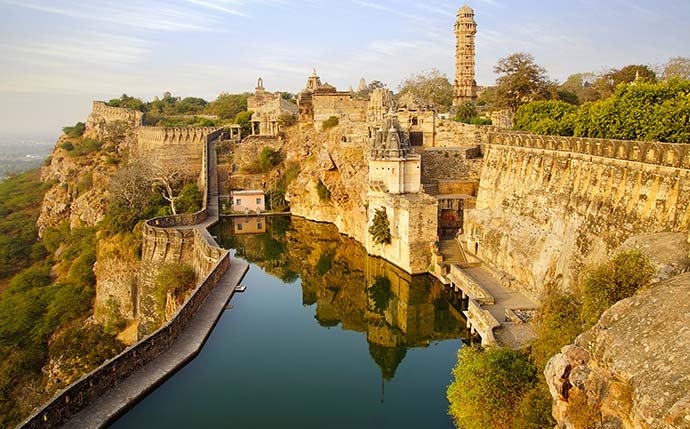
Rajasthan, one of the most sought-after destinations for domestic and international travelers, exudes an aura of royalty, culture and tradition. With varied locales to offer, ranging from hills, golden desert, lakes and forests, Rajasthan is a land of wonder. Home to the erstwhile Indian royalty, the state has many forts which are reminiscent of the rich lives and opulence of the kings and queens. Architectural marvels in themselves, the forts, temples and other historical sites leave the tourists in complete awe.
Rajasthan is known to be atleast 5000 years old with many parts being occupied by Indus Valley Civilization. Kalibunga in northern Rajasthan is one of the famous excavation sites which have revealed ancient human settlement. Rajasthan has witnessed the rule of the kings since the early 11th century upto 19th century when the British rule took over. During these years, many empires flourished in the state, leading to the development of varied architectural styles, traditions, rituals, clothing styles, cuisines and culture. Many temples, mausoleums, dargahs and forts were built during these centuries, each one outdoing the other.
Culture of Rajasthan
Rajasthan has a collective belief in “Atithi Devo Bhava”, meaning that God resides in every guest. The people of this state are warm, indulgent and happy to assist visitors and tourists in every way. With a lot of people involved in hospitality and tourism here, one will not find any problem in travelling here.
From colourful clothes, jewellery, dances and food, it is a delight to be here.
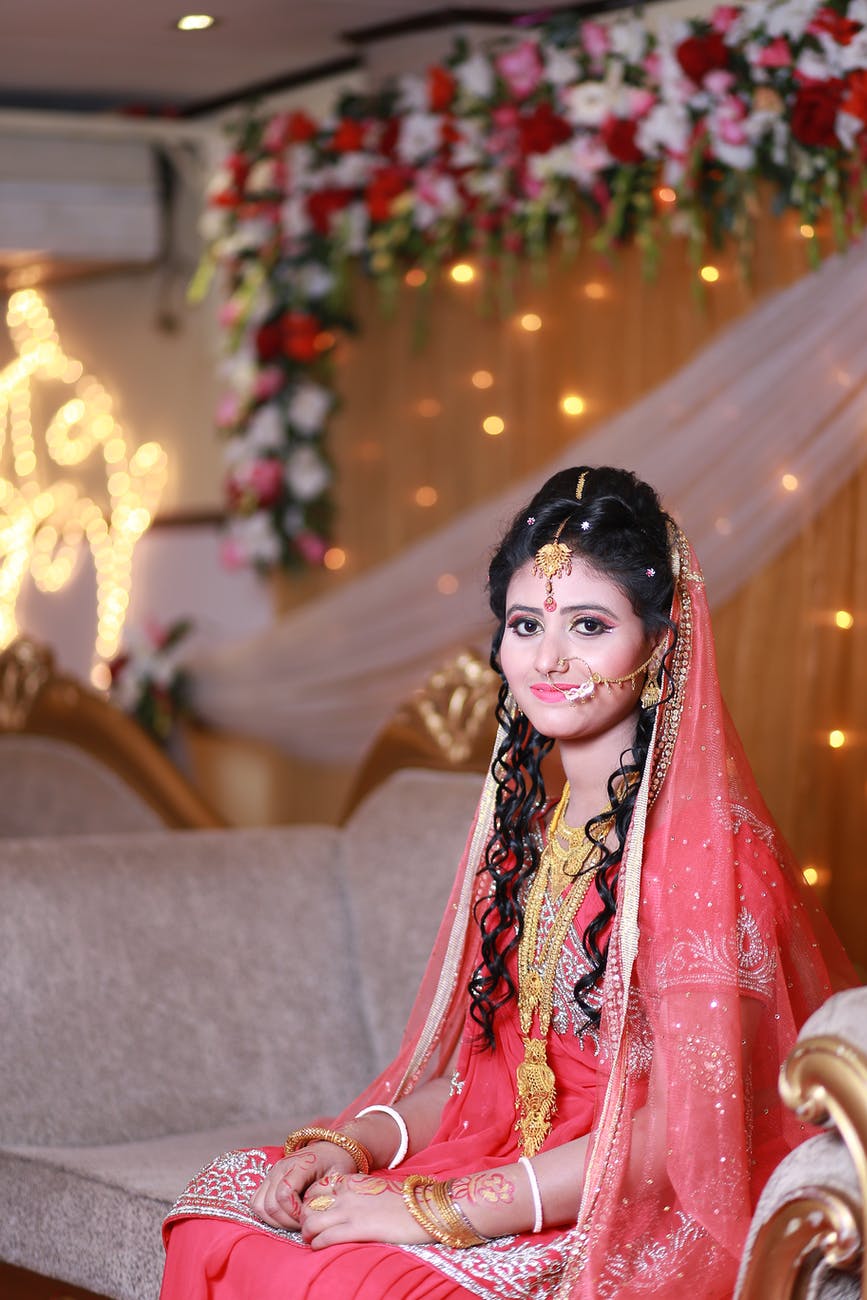
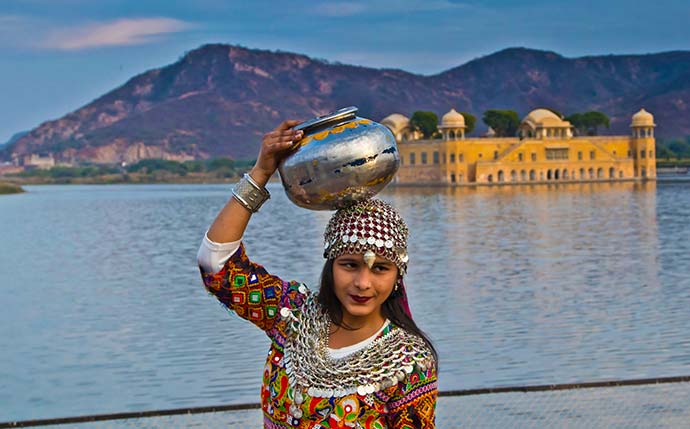
Clothes :Women like to dress in an attire called “odhni” which consists of a dupatta, blouse and a skirt. Available in different colours and materials, the dressing is attractive and vibrant. Men like to dress in kurta and pajama with a headgear called “pagdi”.
Folk music and Dance :Rajasthan has varied forms of folk music and dances. One of the few folk music groups include Manganiyars, Langas, Banjaras, Mirasis and Jogis. These groups are divided because of geographical diversity and follow their own set of beliefs which are reflected in the music and performing styles. Famous dancing styles belonging to this state are Tejali, Ghoomar, Chang, Bhopa and Kathipuli. Most of these performances revolve either around sagas of bravery or love.
Food :Rajasthan is known for its various hot spices and sweets. Famous eating items include dalbati choorma, kachori, ghewar, laal maas and more. These delectable items are traditionally prepared in pure ghee and have their roots in the royal kitchens. Spices are said to ignite the fire in the bodies of royal warriors and sweets are said to calm the mind.
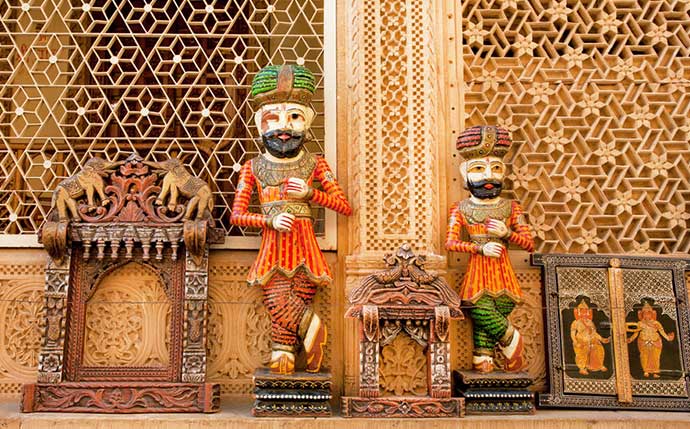
Handicrafts :Unique handicraft items like blue pottery, metal work, marble and stone statues and decoratives are famous in Rajasthan. Mirror work, embroidery, bati work and tie-and-dye are also famous here. These make for lovely souvenirs for tourists coming here.
2
Frescoes of Rajasthan
The Shekhawati region of India lies in the eastern part of the state of Rajasthan. The region is very large and has many buildings which were once where the royals of Rajasthan lived. The buildings, mostly havelis, are either abandoned or rented out to the local people
The Shekhawati region is situated in the middle of the former major trade route or the ‘SILK ROAD’ which connected the modern-day India, Pakistan and China. This benefited the local traders, called the Marwari, who built these havelis as a public show of their wealth. With the decline of the Silk Road, the Marwari’s moved on but left behind the treasure trove of the art and architecture that is their homes.
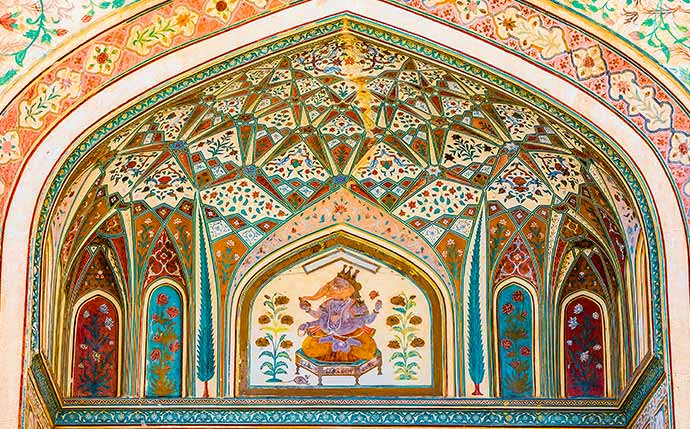
The havelis depict many themes – the daily life of the locals, gods and goddesses, folk mythology and the relatively newer buildings, those of the 19th and 20th century, depict the advent of the British. Each haveli is a piece of splendour and each has its own story to tell. The frescoes in these buildings are made with natural pigment. The oldest frescoes use ochre, red, white lead, lamp black, Indian yellow. The newer ones use synthetic pigments that were imported from Europe.
For the most part, the frescoes depict the god and goddess and folk mythology. The meeting of the gods, the armies and their battles are all depicted in rich colours and few of them gilded in 22 karat gold leaves. The gods Ganesha and Krishna have been depicted several times over. The popular loves stories of Laila -Majnu and Heer-ranjha , the equivalent to Shakespeare’s Romeo and Juliet have been depicted, besides these, Rajasthan’ s most popular romantic tale of Dhola and Maru and also of other lesser known tales are recurrently seen. The murals depicting the Europeans have a funny undertone and are an insight into how they were viewed by the Indians there.
3
Jewellery of Rajasthan
Other than the historical monuments the amazing thing to explore in Rajasthan is the market place. Markets in Rajasthan are glorious. Many different varieties of things can be found in there, people are often amazed to see how beautiful, colourful and variant those markets are.
Let us tell you about the most eye-catching product in these markets, the ethnic jewelleries. First of all, you can see people dressed in colourful ethnic outfits. Women’s mainly wear ‘Lehenga choli’ or ‘Saree’ and these outfits usually come in vibrant colours like red, orange, yellow and green or the bright shades of other colours and to compliment these bright ethnic dresses comes the ethnic jewellery. These jewelleries are not just limited for women but men in Rajasthan also wear some special jewelleries.
4
Leather Embroidery in Rajasthan
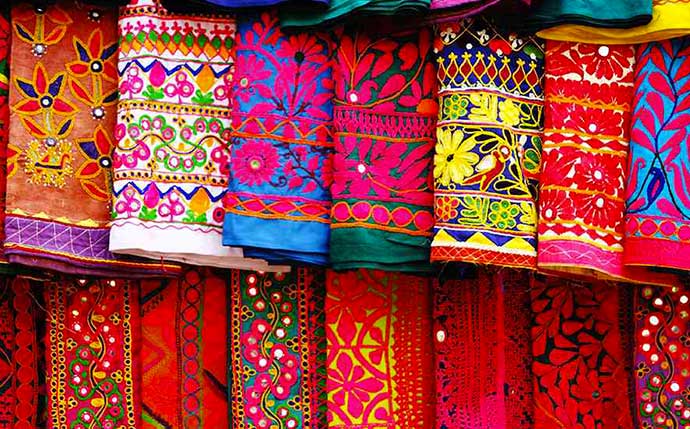
Most of the dresses in Rajasthan are vibrant in colour and have some work done on it like mirror work bandhani work or embroidery. These works are not just limited to fabrics they are also done on jewellery, shoes, hats, bags, containers and other products. Leather embroidery is one of the specialities of this State.
When exploring the markets one can notice that the most common thing in almost every product there is the embroidery. It is like the identity that the product is bought from Rajasthan. Many bright colours are used for the embroideries. There are different types of embroideries and done on different products. Rajasthani Embroidery gives everything an ethnic look and these multi coloured embroidered products matches with almost every outfit.
5.Miniatures of Rajasthan
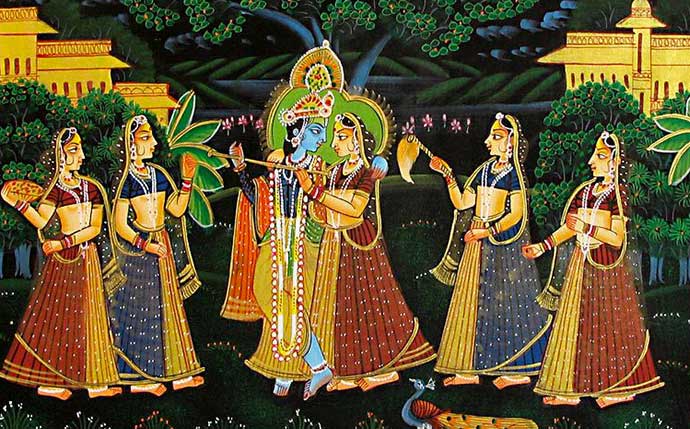
The Miniature painting of Rajasthan is an old art form known for its intricate painting and rich colours. The first evidence of this art form exists in the form of illustration of old Buddhist texts which were executed by the Palas of Northern India. The 16th century painting were presented to the rulers by their partisans as a symbol of a significant event. These were collected by rulers and displayed in their courts.
But the miniature paintings developed mostly in the Mughal period when the emperor Humayun brought Persian artists into India. The next emperor, Akbar set up a National painting school, in which an atelier for the miniature painting, artists from various parts of India trained under the Persian masters. Simultaneously several other school of painting were set up in Mewar (Udaipur), Bundi, Kotah, Marwar (Jodhpur), Bikaner, Jaipur, and Kishangarh.
6
Pottery in Rajasthan
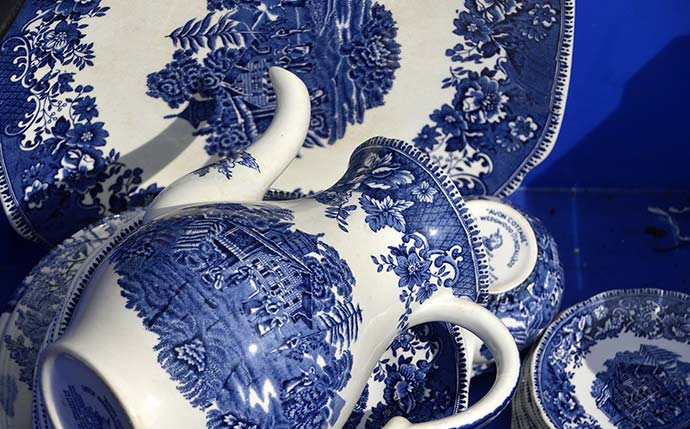
Rajasthan is a state marked by its distinct art and culture. Hand crafted products are a major speciality here and one of those specialities is Pottery. There are varieties in this category too. Some of them are Blue pottery from Jaipur, Black pottery from Sawai Madhopur, Kagzi Pottery from Alwar, Golden Pottery from Bikaner etc.
7
Wood work and Furniture
The existence of jungles in some parts of Rajasthan like Jaipur, Kota and Udaipur is what gave rise to Suthars or the carpenter class of craftsmen. Suthars either belong to the Meghwal community who are known for the cots and camels’ carts or from Barmer, who are known for their intricate craftsmanship
8
Stone Carving in Rajasthan
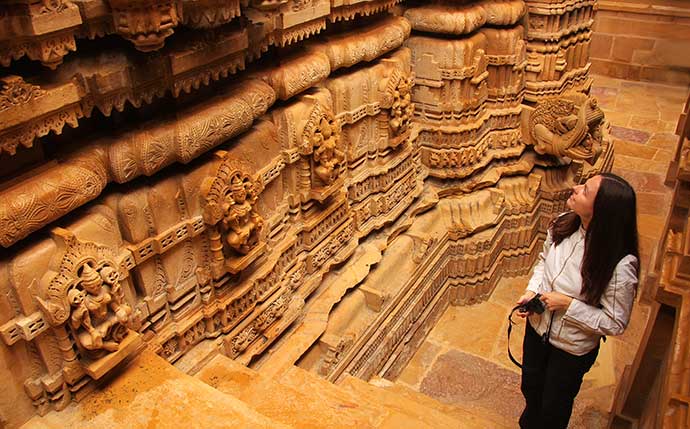
Rajasthan is a land of rich culture. It is famous for its heroes and their valorous deeds and sacrifices. It is also very famous for its architectural monuments made of stone. Rajasthan is home to temples, forts, palaces which have no competition.
The architecture in Jaipur grew under the Rajputs. The marble and the sandstone are used in the City Palace, Jantar Mantar ,Amer Fort, Hawa Mahal and Tripola gate in Jaipur. Jantar Mantar and Amer Fort are world Heritage sites. These architectural master pieces have been instrumental in putting the city in the world map. Jaipur forms part of the golden triangle, consisting of Delhi, Agra and Jaipur. The Golden Triangle is called so because they are three most visited places in India.
Jhodpur is another city with palace like the Ummed Bhawan and Chittar Palace, forts made with red sandstone. The perfect beauty and brilliance of the palaces will be bound to sweep you off your feet.
The city of Jaisalmer is situated in the heart of the Thar Desert is called the ‘The Rose in the Desert’ because of its red stone buildings. Places of interest include the Jaisalmer fort with its massive sandstone walls which turn into a magical honey gold as the sun sets.
9
Rajasthan’s Travelling Temples: Phad Paintings
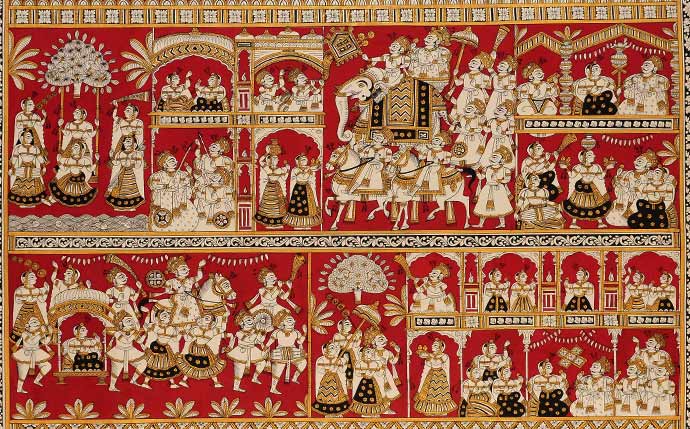
For almost 700 years ago, every evening the Bhopa and Bhopi, the priest and his wife, unroll their scrolls of Phad paintings depicting the deities and performed dramatic renditions of stories from Ramayana and Mahabharata any other mythological tales. The priest and the priestess belong to a nomadic tribe which are a tribe of camel and goat herders Originating from the Bhilwara region of Rajasthan, this tribe realising that there was no one temple they could visit, travel from village to village with their ravanhatta, a two-string instrument, performing their own form of oral worship.
Phad paintings are scroll paintings which are created on hand-woven coarse cloth. It is a complex process which takes a certain level of talent and hard work in equal proportions. The threads of the cloth are made bulkier and is starched and rubbed with moonstone to make a smooth canvas. The colours are derived from flowers and herbs and are mixes with gum which acts as a binding agent.
10
Paper Making Industry
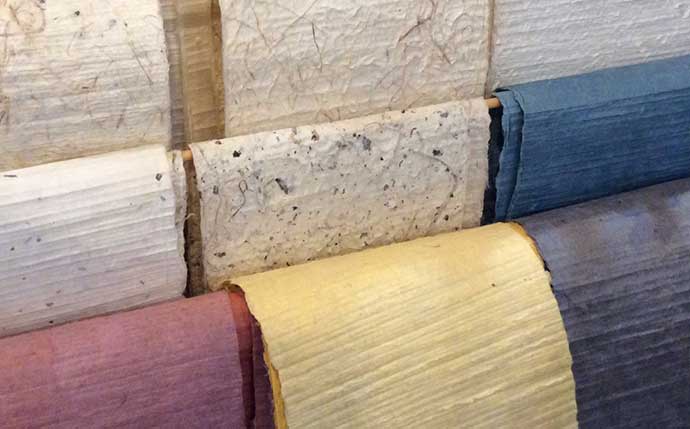
Paper making industry is another interesting thing to know about Rajasthan. The art of making paper was given importance in those areas by the Mughal emperors centuries ago. This paper making industry is quite different from other paper making industries. A lot of factors make it different from others. The prime factor here is that its eco- friendly.
On 12th march 2021, India, the USA, Australia and Japan conducted the first ever summit to discuss regional and global challenges. Till now there were only semi-regular meeting.
What is Quad?
India, Australia, the USA & Japan came together to collaborate in relief efforts after the Indian Ocean earthquake and Tsunami in 2004. This Tsunami core group formed ‘Quadrilateral Security Dialogue (Quad)’ in 2007.
The primary objective of Quad nations is to ensure a free and open Indo-pacific region, which is increasingly being misused by China to its advantage. Quad nations conducted their largest joint naval exercises in 2020.
Quad is informally called ‘Asian NATO‘ since it has the scope to become a powerful coalition just like NATO in Europe and North American countries.
Benefits of Quad:
Collaboration in defence, maritime security, counterterrorism, and information exchange is highly beneficial to all the Quad nations.
Many countries in the world are importing raw materials and goods from China and hence suffered a lot in the pandemic time due to broken supply chains. At present, all the Quad nations have trade relations with China. Quad is a great opportunity to diversify supply chains to reduce dependence on China and to opt for Free Trade Agreements among each other. This kind of economic collaboration is helpful to all the countries involved and also for the global economy.
In order to diversify supply chains, Quad nations may help among themselves with the investments to tap the resources. This is very helpful in getting Foreign Direct Investments (FDI). For example, at present Australia has the world’s sixth-largest reserves of rare-earth minerals, which is essential to manufacture smartphones, EV batteries and high-powered motors. China supplies almost 60% of the world’s rare earth minerals. The positive thing is that most of Australia’s are untapped and needs investment to extract the minerals. And by this, dependence on China for rare earth minerals will be reduced. This cooperation is a great opportunity for all the Quad nations to increase exports and to improve the economy.
Quad meeting in 2020 included New Zealand, South Korea and Vietnam too, which is signalling towards the Quad-plus coalition.
It was announced that financing for Covid vaccines is the top priority for the latest meeting, which is going to be conducted on 12th March 2021. This cooperation is very beneficial to strengthen global health security.
Conclusion:
Quad is a great opportunity to diversify supply chains and to counterbalance China’s aggression. There is a high possibility that some other countries too will take part in it and it may become Quad plus. Quad has the potential to become a strong coalition like NATO in Europe.
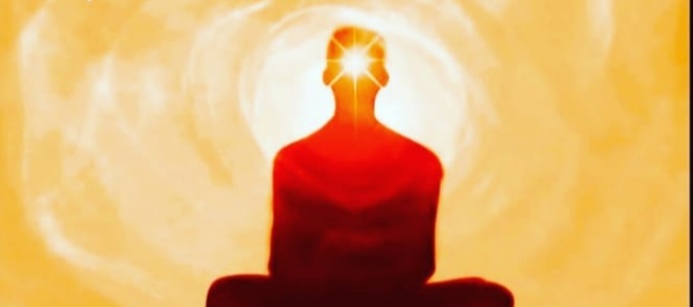
Yoga is something we be in and not something we do. This is because the word yoga comes from the Sanskrit term ‘yog’ which means union. Yoga is a word for the mind.
In fact, our intellect is constantly in union with something or someone. So if we are thinking about someone our intellect is in yoga with them for that time.
The ones we remember the most, our state of mind gets connected to them.
Where is the wire of our thoughts connected majority times? Or a simple question would be what or who am I remembering the most throughout the day?
Thoughts decide feelings. To maintain a constant state of lightness the intellect should not go towards energy depleting things.
In a way, yoga is all about asking the self “what is my mind in union with right now?” and “if it is any good?”.
While doing asanas or any other physical exercise,
simply creating thoughts of peace
will give complete benefit to the body and the mind.
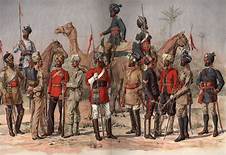
The British rule played an important role in shaping modern India. British ruled over India for more than a century (1757-1947). The British rule in India started with the East India Company, a private company owned by stakeholders. The anti-colonialism movement emerged in response to the “divide and rule” approach used by the British. Gandhi, and his revolutionary methods of protest, played a pivotal role in Indian independence. India gained its independence from Britain on 15 August 1947, after decades of clashes and protesting.
THE BATTLE OF PLASSEY
Britain had been trading in India since about 1600, but it did not begin to seize large sections of land until 1757, after the Battle of Plassey. This battle pitted 3,000 soldiers of the British East India Company against the 50,000-strong army of the young Nawab of Bengal, Siraj ud Daulah, and his French East India Company allies. The Nawab lost at least 500 troops, while Britain lost only 22. Britain seized the modern equivalent of about $5 million from the Bengali treasury and used it to finance further expansion.
THE MUTINY OF INDIA IN 1857
On May 10, 1857, the Indian Revolt began, with Bengali Muslim troops marching to Delhi and pledging their support to the Mughal emperor. After a year-long struggle, the rebels surrendered on June 20, 1858.
WORLD WAR I
During World War I, Britain declared war on Germany on India’s behalf, without consulting Indian leaders. About 1.5 million Indian soldiers and laborers were serving in the British Indian Army by the time of the Armistice. A total of 60,000 Indian soldiers were killed or reported missing. In April 1919, more than 15,000 unarmed protesters gathered at Amritsar, in Punjab. British troops fired on the crowd, killing hundreds of men, women, and children, even though the official death toll of the Amritsar Massacre as reported was 379.
WORLD WAR II
When World War II broke out, India once again contributed hugely to the British war effort. In addition to troops, the princely states donated substantial amounts of cash. By the end of the war, India had an incredible volunteer army of 2.5 million men. About 87,000 Indian soldiers died in combat.
STRUGGLE FOR INDEPENDENCE
Even as World War II raged on, Gandhi and other members of the Indian National Congress (INC) demonstrated against British rule. The 1935 Government of India Act had provided for the establishment of provincial legislatures across the colony. The Act also created a federal government for the provinces and princely states and granted the right to vote to about 10% of India’s male population.
ARRESTS OF GANDHI
Gandhi and the INC did not trust the British envoy and demanded immediate independence in return for their cooperation. When the talks broke down, the INC launched the “Quit India” movement, calling for the immediate withdrawal of Britain from India. In response, the British arrested the INC’s leadership, including Gandhi and his wife. Mass demonstrations were carried out across the country but were crushed by the British Army.
PARTITION
On August 17, 1946, violent fighting broke out between Hindus and Muslims in Calcutta. The trouble quickly spread across India. Meanwhile, cash-strapped Britain announced its decision to withdraw from India by June 1948. Sectarian violence flared again as independence approached. In June 1947, representatives of the Hindus, Muslims, and Sikhs agreed to divide India along sectarian lines. Hindu and Sikh areas remained part of India, while predominantly Muslim areas in the north became the nation of Pakistan. This division of territory was known as the Partition. Millions of refugees flooded across the border in each direction, and up to 2 million people were killed in sectarian violence. Pakistan became independent on August 14, 1947. India followed the next day.
Eid al-Adha, also called Eid Qurban or Bakri-Eid, is the second of two Islamic holidays celebrated worldwide each year. The festive season that starts with the beginning of the monsoon continues and Muslims look forward to Eid al-Adha, also called Bakr Eid or Bakrid in India. Muslims across the world celebrate Eid al -Adha as the ‘festival of sacrifice.’ Bakrid is the second major Eid for the Muslims. While Eid-al-Fitr marks the end of the month-long fasting period of Ramadan, Bakrid is known to conclude the annual Haj pilgrimage. The date of Bakrid, according to the Islamic calendar, is supposed to be on the 10th day of Dhu al-Hijjah or the ‘month of the pilgrimage’. Muslims usually go on pilgrimage on the 8th, 9th, and 10th of the month culminating in the Eid al-Adha. In the Islamic lunar calendar, Eid al-Adha falls on the 10th day of Dhu al-Hijjah and lasts for four days. In the international (Gregorian) calendar, the dates vary from year to year shifting approximately 11 days earlier each year.
Bakr Id/Eid ul-Adha is a public holiday. It is a day off for the general population, and schools and most businesses are closed. National, state and local government offices, post offices and banks are closed on Eid al-Adha. Islamic stores, businesses, and other organizations may be closed or have reduced opening hours. Those wishing to use public transport on the day may need to contact the local transport authorities to check on timetables. Large scale prayer meetings may cause local disruption to traffic. This is particularly true of areas of India with a predominantly Muslim population.
On Eid al-Adha, many Muslims pray and listen to a sermon at a mosque nearby. They also wear new clothes, visit friends and family. Many Muslims symbolically sacrifice a goat or a sheep as an act of Qurbani. Special food is prepared on Eid al-Adha and shared with relatives. A portion of the food is also distributed among the poor and needy. This represents the sheep that God sent to Ibrahim to sacrifice in place of his son. On this day, Muslims sacrifice a goat, a sheep, or any other animal to commemorate the willingness of Ibrahim to surrender his son Ismael to fulfill Allah’s command. Ibrahim was determined to do what Allah wanted him to do. And on the day when he decided to make the supreme sacrifice, Shaitan attempted to dissuade him, but he drove the evil away and proceeded further. Allah was pleased by his devotion, and a message was sent through Jibreel to Ibrahim. And the message granted life to Ismael and Ibrahim was asked to offer a sheep instead. Therefore, on this day, Muslims sacrifice an animal and divide the meat into three equal portions. They keep one for themselves while they give the other two away to relatives and the needy. Fasting on Eid al-Adha and Eid ul-Fitr is strictly forbidden. Eid al-Adha, or Bakrid, celebrations usually last for three days. The festival is celebrated with a lot of fervor among Muslims around the world. Although, the traditions may vary according to the country and its own local customs. The celebrations include visits to mosques and offering of prayers for peace and prosperity, as well as a special feast that mainly contains mutton preparations. Some of the most delicious Bakrid feast dishes include mutton biryani, mutton korma, mutton keema, bhuni kaleji, as well as a range of delectable desserts like sheer khurma and kheer.
Since India celebrates a day after Saudi Arabia, except certain states, this year Eid al-Adha will be celebrated on August 1, a day after Saudi. However, Kerala, like Saudi, will celebrate on July 31. This year however celebrations are likely to be low key amid the coronavirus pandemic. In Ahmedabad, for instance, animal sacrifice in public places or animal processions in the city have been prohibited. Given all the restrictions and safety measures on account of the coronavirus pandemic, Bakrid will only be celebrated with one’s direct family that one lives with, however, you can always wish your near and dear ones from a distance and not breach any safety measures.












 International Journal of Research (IJR)