
Ask ten installers how many batteries a house needs and you’ll get ten answers, because the honest reply is “it depends.” What it depends on is easier to pin down than most people expect: how much electricity the home burns through, how many sunless days it has to carry on its own, and whether it’s cutting the cord for good or just building a cushion against outages. The average American home runs through roughly 29 kilowatt-hours a day, according to the U.S. Energy Information Administration — and that one number is where every sizing decision begins.
Two different problems, two different answers
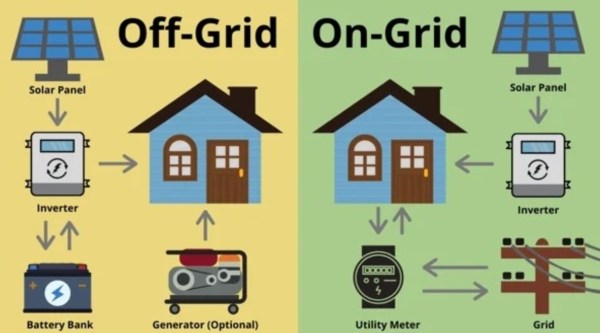
Going off-grid means no utility connection at all. The battery bank, paired with solar, has to supply every kilowatt-hour the household uses, in February as well as July, through whatever stretch of bad weather shows up. A home microgrid, by contrast, is a self-contained system that can run on its own but stays tied to the utility — islanding during an outage, then leaning on the grid the rest of the time.
That distinction drives the battery count more than any spec sheet. An off-grid bank has to survive the worst week of the year; a microgrid only has to bridge the gaps. The same house can need four times the storage under the first scenario as under the second, which is why modular battery systems that stack as needs grow tend to suit both jobs — owners add capacity to match the goal instead of guessing up front.
The one formula that does the work
Battery sizing comes down to a single line: daily use × days of autonomy ÷ depth of discharge = the capacity to install.
“Days of autonomy” is how long the batteries can power the home with zero solar coming in — most off-grid designers plan for two to three. “Depth of discharge” is the share of a battery’s rated capacity that’s safe to actually use; lithium iron phosphate (LFP) chemistry handles around 90 percent, where older lead-acid tops out near half.
Autonomy days exist because sunshine isn’t steady. Production-modeling data from the National Renewable Energy Laboratory shows how sharply solar output can fall between a clear summer afternoon and a gray winter week — the reason an off-grid system has to bank far more than a single day’s worth.
What the numbers look like for a real house
Run the 29-kilowatt-hour home through both scenarios.
| Setup | What it covers | Capacity to install | Approx. modules |
| Fully off-grid | Whole home, ~3 days | ~97 kWh | 10–12 |
| Grid-tied microgrid | Critical loads, ~1 day | ~13 kWh | 2–3 |
Off the grid, three days of full coverage works out to about 97 kWh of installed capacity. With 9-kWh LFP modules — the BAT 9.0 packs in a SigenStor build, for instance — that comes to roughly eleven of them, or two stacks, since a single stack tops out near 54 kWh.
A microgrid is a different story. Most homeowners back up only what matters during an outage: the refrigerator, lights, internet, a well pump, maybe a furnace blower. That’s a fraction of the daily total, so two or three modules on a single stack usually cover it. A unit like the Sigen LoadHub decides which circuits stay live and switches over in milliseconds, so the household barely notices the cutover.
The takeaway is simple: there’s no universal battery count, only the right one for a clearly defined goal. Pinning down daily use and autonomy days first — then choosing solar battery storage sized to match — avoids both the cold, dark mornings of an undersized bank and the wasted money of an oversized one. For anyone weighing the two paths, modeling the load before any hardware gets ordered is the step that pays off most.


