Vijay Shekhar Sharma of Paytm, which has big Chinese investments, says Chinese apps ban is ‘in national interest’

Paytm founder Vijay Shekhar Sharma has made a statement on India banning 59 Chinese apps including popular ones like TikTok, UC Brower, WeChat, Shareit, others saying the move by the Government of India is in the national interest.

Paytm founder Vijay Shekhar Sharma has made a statement on India banning 59 Chinese apps including popular ones like TikTok, UC Brower, WeChat, Shareit, others saying the move by the Government of India is in the national interest.

Paytm which is run by Indian company One97 Communications Ltd — a leading mobile internet company — has investments by Chinese companies. India’s one of the most popular digital payment services and e-commerce app Paytm has major investments from Chinese companies such as Alibaba and Ant Financial.

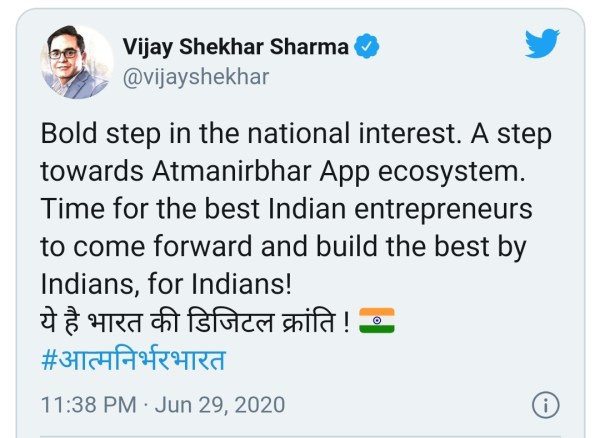
However, giving his reaction on the government banning Chinese apps, Vijay Shekhar Sharma it is a “bold step in the national interest.”

Taking it to Twitter, Paytm boss Vijay Shekhar Sharma wrote, “Bold step in the national interest.

Sharma’s statement is also a far cry from previous years when he touted Alibaba and his relationship with its co-founder Jack Ma as his biggest strengths. Paraphrasing a popular Hindi movie line, he said in 2015, “Mere pass ma hai… Jack Ma”

However, large Chinese investors such as Alibaba hold stakes worth billions in many startups and not just Paytm.

Alibaba itself is an investor in online grocer BigBasket, ecommerce firm Snapdeal, food delivery firm Zomato and logistics firm Xpressbees.

Chinese investors are deeply entrenched in the Indian startup ecosystem.

Virtually every unicorn, from Swiggy to Byju to Ola, has a sizable Chinese backing.

@martin_christopher

The pride Month

Recently, people suddenly came up with the posts on social media, using the hashtags, pride, or pride month, and etc. But, many of us may be wondering with many questions stuck to our minds, why? What is it? Where? When? How?

Although, there is a huge mass of people vocal about such a topic as this, but many still feel bad, or to say embraced in thinking about every aspect of a human being’s physique, which is a great reason to worry. It is not what we expect from the generation of sciences and revolutions, they must be vocal for the issues that are prevailing in the current society, and are making people in their surroundings and even themselves, mentally distressed, which is even worse than any physical tensions.

What is the pride ?

Gay pride or LGBT pride is the promotion of self affirmation, dignity, equality, and increased visibility of lesbian, gay, bisexual and transgender people as a social group. Pride, as opposed to shame and social stigma, is the predominant outlook that blosters most LGBT rights movements.

It is not a recent phenomenon that we are experience through, but has a long history that commemorates a turning point in a country’s LGBT history, for example Moscow Pride in May for the anniversary of Russia’s 1993 decriminalization of homosexuality.

The common symbol of pride are the rainbow or pride flag, the lowercase Greek letter lambda, the pink triangle, and the black triangle.

The history of Pride Month –

LGBT Pride Month occurs in United States to commemorate the Stonewall riots, which occurred at the end of June 1969.As a result, many pride events are held during this month to recognize the impact LGBT people had in the world.

It is because of the struggles of a Bisexual activist Brenda Howard, who is also known as The Mother of Pride,coordinated the first LGBT pride march, and she also originated the idea for a week-long series of events around Pride Day, which then become the genesis of the annual LGBT Pride celebrations that are now held around the world every June. Not only Brenda, the two Presidents of the United States have officially declared a pride month. And Barack Obama even said

I call upon all Americans to observe this month by fighting prejudice and discrimination in their own lives and everywhere it exists. –

Proclamation 8529 by U. S President Barack Obama, May 28,2010

Although,from both outside and inside the LGBT community,there is criticism and protest against pride events. The “Straight Pride” incidents have gained some media attention,especially when they involve government and public institutions.

Pride Month 2020 –

2020 has been a year that has seen several changes happening around all over the world. And celebrating Pride Month, is one such event that has brought a great revolution around the world, people are more attentive towards what one feel, or what a person has to say about their sexuality, neglecting the orthodoxy of the past.

As well as being a month long celebration, Pride Month is also an opportunity to peacefully protest and raise political awareness of current issue facing the community. Parades are the prominent feature of Pride Month, and there are many street parties, community events, public speaking, street festivals and educational sessions all of which are covered by mainstream media and attracting millions of participants. The digital concert which was conducted recently, by the world’s best musicians and activists, is a significant step towards promoting pride and accepting every human being generously and with great respect.

Since, we have jumped into a generation of broad spectrum, where each and every human being has the right to be the way they are. It is definitely a great time to start talking over such issues that hold people behind, and make them feel comfortable and respected in every manner.

https://en.m.wikipedia.org

World Bank enhances support for rejuvenating Ganga, sanctions USD 400 mn

It provides over one-third of India’s surface water, includes the country’s largest irrigated area and is key to India’s water and food security, the statement said. @martin_photography

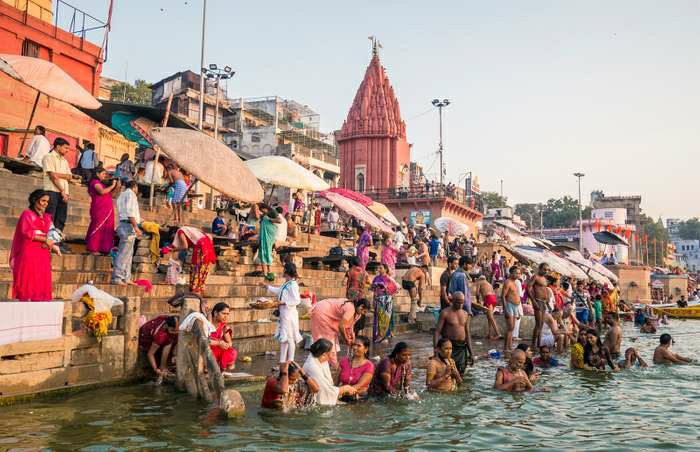
The World Bank on Monday said it has enhanced its support for Government of India’s program to rejuvenate Ganga river with a USD 400 million (about Rs 3,000 crore) assistance that will help stem pollution in the river.
The assistance will help strengthen the management of the river basin which is home to more than 500 million people, the World Bank said in a statement.

“The Second National Ganga River Basin Project (SNGRBP), approved by the World Bank’s Board of Executive Directors on June 25, will support the government’s Namami Gange program and its long-term vision for controlling pollution in the river and restoring its water quality,” it said.

It further said the bank has been supporting the government’s efforts since 2011 through the ongoing National Ganga River Basin Project, which helped set up the National Mission for Clean Ganga (NMCG) as the nodal agency to manage the river, and financed sewage treatment infrastructure in several riverside towns and cities.

“The first World Bank project helped build critical sewage infrastructure in 20 pollution hotspots along the river, and this project will help scale this up to the tributaries,” World Bank Country Director (India) Junaid Ahmad said. “It will also help the government strengthen the institutions needed to manage a river basin as large and complex as the Ganga Basin,” he added.

The Ganga basin covers a quarter of India’s landmass, and is a critical economic and environmental resource for the country. It provides over one-third of India’s surface water, includes the country’s largest irrigated area and is key to India’s water and food security, the statement said.

“Over 40 per cent of India’s GDP is generated in the densely populated basin. But the Ganga river is today is facing pressures from human and economic activity that impact its water quality and flows,” it added.
The Second National Ganga River Basin Project comprises a loan in the amount of USD 381 million and a proposed Guarantee in the amount of up to USD 19 million.

The variable spread loan has a maturity of 18.5 years including a grace period of 5 years, it said.

Meanwhile, the Government of India, the Government of Tamil Nadu and the World Bank on Monday signed legal agreements to help low-income groups in the state get access to affordable housing. The legal agreements were signed for two projects — USD 200 million First Tamil Nadu Housing Sector Strengthening Programme and USD 50 million Tamil Nadu Housing and Habitat Development Project — to strengthen the state’s housing sector policies, institutions, and regulations, the Finance Ministry said in a separate statement.

The loan agreements were signed by Sameer Kumar Khare, Additional Secretary, Department of Economic Affairs on behalf of the Government of India and Country Director (India) on behalf of the World Bank.
Khare said providing safe and affordable housing is a key priority for the state of Tamil Nadu as identified in its vision document.

With the allocation provided under the Pradhan Mantri Awas Yojana (Urban) and the two projects from the World Bank, a large number of urban poor in the state are expected to get access to better housing and, in the process, improve their living conditions, he added. Nearly half of Tamil Nadu’s population is urban, and this is expected to increase to 63 per cent by 2030.

India- land of large physiography

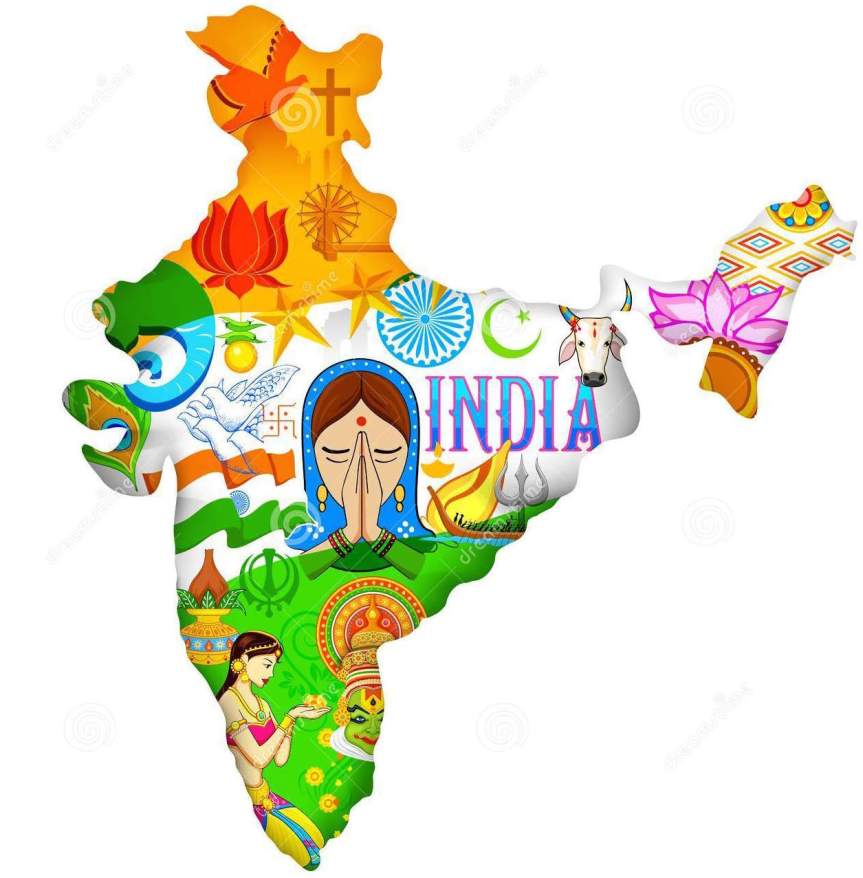
Unity in diversity, So is said about India, is not true only about its people, but it’s physiography, beautiful and insane. Mountain chains, large deserts, beautiful coastlines, beaches, ever flowing rivers, dense forests and the swampy landscapes, all put together to make a divine country, named, India. All these features make India a place worth visiting for, and thereby creating an increase in its rank up on the world stage.

India has been divided into six physiographic zones –

  • Northern and north-eastern mountain
  • Northern plain
  • Peninsular plateau
  • Indian desert
  • Coastal plains
  • Islands

North and north eastern mountains –

Starting right from the Himalayan mountain range, where the heaven on the earth, is one of the most prominent features of Indian physiographic divisions. It not only protects the country from external attacks, but also is responsible for the controlling of the winds flowing in and out of the country. Starting from Hindu Kush mountains in the West, covering all of the Northern India, these get plunge towards the North East, in the states of Arunachal Pradesh and Meghalaya.

Northern plains –

Covering most of the Indian peninsula, the northern plains spread over 2.5-million km sq. Most of the production activities take place over this region, such as, farming, setting up of industrial areas, and other massive activities, also having the most fertile soil to grow crops, i.e. alluvial soil. The region is a way, or the region sustains India’s most of the perennial rivers, like The Ganga, The Yamuna, The Son, etc and etc.

Peninsular plateau –

Peninsular region is the oldest part of the Indian subcontinent. Most of the variations in the land geography, one can find plateaus, fold mountains, ridges, and contains most of the mountain ranges. Peninsular region of India is most famous for its forest areas and diverse range of flaura and fauna.

Desert –

Two type of deserts can be found in India

  • Hot desert
  • Cold desert

Hot desert covers the Western most states of the country, Rajasthan, Gujarat. But the type of deserts still differ from each other, in terms of appearance and salinity. The desert in Gujarat is more saline and is white in appearance, but in the region of Rajasthan, it is alike other deserts found in many of the parts of the world.

Cold desert of India is in the Ladakh region, which is also the coldest and highest regions of the country.

Coastal areas and Islands –

India is bestowed with a large coastline,running from Gujarat towards the South,and ending up in the state of West Bengal. It is because of this large coastal area, most of the economic developments could take place in the country,whether it is fishing, extraction of natural resources,development of ports, and way for exports and imports.

Major islands of the country are Andaman and Nicobar and Lakshadweep,where natural resources are easily available in abundant amount.

This diversity in the physiography of India makes it a beauty of the earth and the presence of natural resources makes the subcontinent into a land which is more favorable for human growth.

Growing level of competition good for youth

A horse never runs so fast as when he has other horses to catch up and outpace.-Ovid

Competition!competition!competition!No matter,if you go to a school,or an higher institution, or you are a job aspirant (government or private),or you own a shop, you work at any sector;a certain level of competition will hang on your head to gear you up at every point of your life. And if you try and escape from the monster, in one way or the other, it comes back to you, to remind your purpose of existence over this earth.But the real question of the hour is, does competition pumps up a person? Or does it make them feel more distressed? We all are surrounded by innmuberable questions, that makes the most intrinsic parts of our lives, but eventually fail to answer them. Who scored the best? Who is this year’s CBSE topper? Who all got the promotion? Why did you not achieve that rank? And etc etc etc. finally making, either the person think upon it, do to better, or sadly making them disheartened over their loss.Living in a society as this, who wants nothing but success, it has now become common phenomenon to see people competing against each other, sometimes winning, and sometimes failing. The extent to which their winning and losing matter, does nothing, stretches the line of demarcation about how good or evil the competition becomes for them. The term, healthy competition, which is getting more and more popularity today, may seem convincing, but it actually does not matter, unless the person understands its literal sense. So, consequently, the question is still the same, directly or indirectly, how good is competition for the youth? Whether you are a youngster, or a child, competition begins right from the day you step out of the womb of your mother. But, for an adult or youngster, it becomes much more difficult to get up and walk along the path that they have choose for themselves. If you are a school pass out, first thing you have to do is try and get the best carrier path for yourself, and the tussle doesn’t end there, to get the right job becomes another duty. But, if you are fighting for a competitive exam, dedication and struggle is all, that you have to do, but if you fail, the responsibility comes upon you, and to kill your motive, “words of the world” are enough. And if you are seeking for a job, you have to be perfect of all. Leading to more and more compitiveness among the youth.Talking about the goodness of competition in youths’ lives, it is totally dependent upon the perception of oneself, so as to be a burden of oneself, or just get pressurised over what hasn’t been well, yet. The term, healthy competition, which has been called upon many a times to motivate people, has worked out for those who really know what it is conveying, but the people who have less dedication towards what they want, and are confused as to what to do, ones they fail, are more likely to be disappointed with their own expectations. Putting all your heart and soul into something and still not getting out the results, and seeing everyone else moving ahead, is like a jerk to the soul. But, still working over it is the indication, that you are progressing in life, cutting through all the rough routes you have been into.


Competition actually pumps any person up to work more and more over something, but giving up on it does not have to be the only option, because once you stop, starting from the scratch remains the only option, eventually seeing others moved far off.

Redmi Note 9 vs Redmi Note 8: Is the Helio G85 really a performance upgrade?

The Redmi Note 8. (Source: Xiaomi)
Is newer better? The Redmi Note 9 was launched months ago debuting with MediaTek’s new Helio G85, but how does it compare to the tried and tested Snapdragon 665 on Xiaomi’s last-gen Redmi Note 8? Well, the results are nuanced.

A while ago, we compared the Redmi Note 8 Pro to the new Redmi Note 9 Pro in an attempt to find out which phone offered better performance across the board. This time out, it’s a fight between the cheaper models⁠—the Redmi Note 8 and the Redmi Note 9. Like with the previous comparison, it’s a MediaTek versus Qualcomm battle, only this time, the newer phone has the MediaTek chip.

Starting out with Geekbench, the Redmi Note 8 and its Snapdragon 665 records a single-core score of 309. The Redmi Note 9 flexes its mucles here, with a score of 357. That’s a powerful showing by the Redmi Note 9, translating into a 13% advantage. In the multi-core test, the Redmi Note 8 earns a score of about 1,312. The new Redmi Note 9 is also on top here, as it comes away with a 1,320 score. The difference is negligible.

Moving on to AnTuTu, the similarities in CPU performance continue. The Redmi Note 8 earns a CPU score of 71,021. The Redmi Note 9 is ahead here, too, with a score of 74,066. That translates into a 4% advantage for the Redmi Note 9 and its MediaTek Helio G85.

It’s in the GPU department that things get interesting, as the Redmi Note 8 manages a score of 32,316 in AnTuTu’s GPU test. The Redmi Note 9 wins handily with a score of 41,644⁠—a significant 29% advantage.

So, what do these numbers imply? Most notably, that the Redmi Note 8 and Redmi Note 9 will offer similar day-to-day performance. The two phones and their respective chipsets deliver similar numbers in the CPU tests, albeit with the Redmi Note 9 slightly edging the Redmi Note 8 by right about 10%. It’s in the gaming department that the newer phone really shines, however, as it appears to have a significant advantage.

Of course, it’d be facetious to ignore the fact that MediaTek has been caught cheating on benchmarks in the past. The company’s response wasn’t particularly encouraging either. In terms of efficiency, the two phones should also be similar. We don’t have perf/watts numbers, but the Helio G85 is built on TSMC’s 12nm node, while the Snapdragon 665 is built on Samsung’s 11 nm LPP node.

Does the Helio G85 on the Redmi Note 9 outperform the Redmi Note 8’s Snapdragon 665? Yes, it does. But it mostly comes down to the GPU, and CPU performance is similar enough that the overall differential isn’t a game-changer⁠—unless you’re a gamer.

Martin Christopher

Tourism : can this be the next big thing for India

Who doesn’t love to travel?

Every body seek to grab every single chance to wander around the world. Some love to travel to hills, while others are pleased to be at the sea side, other proportion of people want to travel to desert areas,and the remaining like to scratch out every corner of the world. An increase in the trend of more and more wanderlust among the people, is the reason for an increase in the trend of tourism industry. No matter where you want to travel, which part of the world you have to discover, just a click on the e-travel site and choose your favourite destination.

In case of the country, such as, India, which is counted as a developing one, it is a fresh opportunity to become the top countries to offer a great traveling experience to those coming to the country in order to observe its beauty. Post pandemic, will be a great opportunity for the government to promote tourism in the country and it will surely create a massive opportunity for the economy to bloom and grow positively. As many of the scholars have claimed that, India’s economy may fall to negative, but, tourism industry is an idom used to drown, that can help the country with incredible increase in the number of tourists.

About 10.89 million foreign tourists visited India in 2019. But, according to the UN World Tourism Organization, 50 million Indians will travel overseas in 2019, which is a big reason to worry regarding the tourism industry in the country. There is a huge gap between people coming and going out of the country which needs to be filled, in order to see India as a huge tourist destination.

It is one of the reasons why tourism can be next big thing for India! We have been privileged to be a part of such a beautiful country as this, where every kind of physiographic divisions could be found, be it Jammu and Kashmir, pure heaven on the earth; or the widespread desert of Rajasthan; backwaters of Kerala;beaches of Mumbai and Goa;historic sites of Central India; beauty of northeast India; and all that enormous beauty that is untouched by most of the travellers.

But, the pandemic has given a jerk to the tourism industry, which has been a great source of income to the country, due to shut down offices of travel companies, tourist destinations, along with, hotel, restaurant chains, along with the suspension of, both, national, as well as international flights, ultimately bearing the loss hit by the pandemic.

The Indian tourism industry is projected to book a revenue loss of Rs. 1.25 trillion, in calendar 2020,which means a 40% decline in revenue over calendar 2019.

But, as it has been righteously said that, the population of any country is its wealth, we as the wealth of our country must only visit the tourist attractions in our own country (post pandemic) in order to give a hike to its economy. This would complete the twin objective

  • One is, to give a boost to the economic conditions of the country.
  • Second is, it will give us a chance to explore the unseen beauty of our own country and people will not underestimate the power of the country.

Bankers in India are more productive working from home

Work from home may remain part of the norm for many in India’s financial industry beyond the end of the world’s biggest lockdown. The reason: elimination of lengthy commutes in the past three months has boosted employee productivity. Take Jefferies’ India team for example. On average, its 60 members have managed to save over an hour every day on commute and 70% of them have seen higher productivity, according to a note from the brokerage, drawing on a survey of its staff.

As banks and asset managers around the world try to figure out how they’ll manage their offices after the coronavirus pandemic, many in Mumbai – India’s finance hub – see the opportunity for permanent change in how they work. The average commute time on the city’s major routes is over an hour, more than twice the averages of SingaporeHong Kong and New York, according to a study by the IDFC Institute, a public policy think-tank.

Neil Parikh, chief executive officer of Parag Parikh Financial Advisory Services, like many others is finding the experience better than expected – so much so that he’s reconsidering plans of adding to the money manager’s offices in India’s top cities. He plans to equip new hires with laptops and high-speed Internet connections instead. “Now there’s no stigma around working from home,” he said. “I can see some from my research team being much more productive. Working from home saves almost 3-to-4 hours everyday in travel time for some people.”

Reliance Securities Ltd. has shelved plans to shift to a new premise. The firm, one of India’s leading retail broking houses, will have half its staff continue to work from home as it implements a rotational program to comply with social distancing norms, according to Chief Human Resource Officer Meenaa Sharma. “Many of our employees are saying that their productivity has gone up, and feedback from clients on research reports is good,” she said.

Second Wave
nullWhile the daily number of virus cases in Mumbai, India’s worst-hit city, has been stable in recent days, concerns over a second wave means businesses have little choice but to operate remotely. With economy set for its first full-year contraction in 40 years, India has begun reopening from the lockdown imposed on March 24 even as the country has the fourth-highest number of infections in the world.

Yet, not everyone in the world of finance is in a position to work remotely on a long-term basis. While banks and stock depositories had been open through the lockdown, designated as ‘essential services’, dealers who execute trades may have to return to office in greater numbers once regulatory relaxations are rolled back. “Businesses like ours where there’s sensitivity of information, at least some part of staff like dealers have to be in the office” said Jinesh Gopani, head of equities at Axis Asset Management Co. “Those parts were allowed at home because it was a crisis. But it is not ideal from the regulator’s point of view in the long term.”

For now, only a fraction of the staff in the financial-services industry is back in office. The unexpected benefits of working remotely mean it’s likely to be a favored option well into the future. “Productivity has improved dramatically because of removing unproductive travel time,” said Gopani. Working from home one or two days a week may become ‘the new normal’.

Boycott China effect? AC-maker Johnson-Hitachi India to halve import, double export

Johnson Controls-Hitachi Air Conditioning India is a 60:40 JV between the American and Japanese companies, respectively, and enjoys 12.5 per cent of the Rs 16,000-crore market in value and 11 per cent of the 65-lakh units domestic AC market as of FY2020.

Leading air-conditioner maker Johnson Controls-Hitachi India is planning to halve its import dependence and at the same time to double its exports over the next one year. The move comes amidst the shrill calls for boycotting Chinese goods following violent skirmishes on the Leh border earlier this month that lead to the killing of 20 Indian soldiers.

The government sees the air-conditioning industry as a priority sector for generating jobs along with furniture, leather and footwear. The domestic AC industry meets almost half of its parts through imports, primarily from China, and turn it to be a key export driver.

The company closed FY2020 with a turnover of Rs 2,300 crore, selling 7.5 lakh units, giving it a market share of over 12.5 per cent, chairman and managing director Gurmeet Singh said. On profit, he said on average they make 8-9 per cent net margin but this year it may slip to 6-7 per cent, as he does not expect to add volume due to the COVID-19 pandemic.

With 12.5 per cent market share, Hitachi is the fourth largest player after Blue Star, Voltas and Daikin overall, and the third largest in window & split segment, he claimed. The company runs a 9-lakh per annum plant (in single shift, and up to 15 lakh in double shifts) at Kadi, on the outskirts of Ahmedabad since 2009 and has made a cumulative investment of over Rs 800 crore.

“We import around 40 per cent parts, of which 50 per cent are China-sourced. The import supply chain suffered due to the pandemic since February and the lockdown since March has left us with huge inventory pile. And I don’t want to have a repeat of either.

“Therefore, my idea is to focus on cutting down imports by half over the next one year and at the same time also to double my exports to 50,000 units or thereabout from the present 25,000-odd units to the middle East and Africa–both of which are under the India,” Singh told PTI over the phone from his New Delhi headquarters.

Singh said on a net basis 70 per cent of the AC market is imported in terms of parts and 30 per cent of the Rs 16,000-crore overall market is fully imported units. Of the remaining Rs 11,200 crore, around 50 per cent parts are again imported, reducing the domestic market pie to just about Rs 8,000 crore.

There are great synergies between India, Africa and the Middle East markets in terms of weather conditions, which demand only minor tweaks in the India made units, Singh explained underlining the scope for exports and noted that while our AC exports are close to nothing, China ships out 4 crore units annually.

“But we can easily do an encore of what we have done in mobile phone manufacturing,” Singh said, adding we can serve Africa, the Middle East, and the SAARC markets. Stating that he does not see an opportunity to grow bigger this year, he said he’d be happy not to lose his people (to the virus) and also market share this year. He said while sales were down 80 per cent in March, the same plunged over 90 per cent in April (he sold 2,000 units to government for COVID hospitals) and June volume is down 65 per cent so far.

@Martin_Christopher

A step towards spreading happiness….

“The best way to cheer yourself is to try to cheer someone else up” – Mark Twain

Happiness : In terms of psychology, we call happiness as positive emotions such as joy, pride, interest, enthusiasm. Happiness has also been said to relate to life satisfaction, appreciation of life, and moments of pleasure that means it has to do with the positive experience of emotions.

Many people think that happiness is having fun at a party, the excitement of new experiences or the delights of a fine meal. These are all wonderful experiences to be cherished and experience but they are not happiness. Happiness is something comes when you feel satisfied and fulfilled. It is a feeling of contentment and satisfaction.

“Happiness is the settling of the soul into its most appropriate spot.”
– Aristotle

It is a fact, “Everybody wants to be happy and everyone loves to feel happy” so try to build positive environment near you to get yourself happy and others.

Being happy and making others happy is a Complex task as everyone has their own sense of comfortable environment. Being happy or unhappy is there’s own choice. People who chose to be unhappy because they think that by being unhappy, they will get something which is wrong. Unhappiness van never lead to your goal of achieving anything.

When we step towards spreading happiness, we tend to forget our own sadness and also we get new ways to deal with difficult situations. When a person fills a part of kindness to other, it comes back with a feeling of love, care and happiness.

“I think happiness is what makes you pretty. Happy people are beautiful.They become like a mirror and they reflect that happiness” – Drew Barrymore

How to be happy and make everyone happy there are several ways-

  • Act of kindness “Give what you Get”- Most of the time people treat you as you treat them. Although, there are some who are ungrateful but you should still have positive feeling no matter what they do.
  • Smile – It is the best way to be happy and speed happiness to others. An act of smile creates positive vibes to yourself and other person.
  • Make an effort to build good thoughts- try to spread good thoughts about anyone, being gossiping negative things make yourself with negative thoughts and the person listening surrounds with off feeling vibrations.
  • Appreciate – Always praise and appreciate to what you like and observe It helps us get in tune with feelings with others. It is a good medium to spread happiness by appreciating worthy.
  • Surprise others- Surprise others with different things they love such as kind words, help, etc.
  • Donate what you can do as charity- Helping the needy gives the person the most sense of self satisfaction. Giving a hand to somebody in crisis is the biggest act of kindness and happiness. Smile on the face of needy gives the full mental satisfaction.
  • Listen to someone who wants your attention- Just be there when someone wants you to be attended. It builds a feeling of that someone is there to support and help.
  • Be thankful to the one who helped you – Move a step to express gratitude for people who helped in your bad times.
  • Deal enemies with a positive note –Even those who do not deserve kindness, treat them with kindness.
  • Do not harm anyone- Keep yourself away form Negative thoughts and acts. Do not harm intentionally any human or animal.

All these activities will make you happy and people surrounding happy. We all need to spread happiness around us to get rid off negative acts of suicide and depression among people. Be communicative to the ones you feel is not feeling well mentally. We have to realise the need of happiness for oneself and the world

“The more you praise and celebrate your life, the more there is in life to celebrate” – Oprah Winfrey