Omali, T. U., Akpata, S. B. M., & Onyevu, R. O. (2026). Prospects of Geographic Information System and Multi-Source Data Integration in Enhancing the Accuracy of Above-Ground Biomass and Carbon Stocks Estimation. International Journal of Research, 13(1), 484–492. https://doi.org/10.26643/ijr/2026/23
Omali, Thomas Ugbedeojo (PhD)1*; Akpata, Sylvester Balm Mifue2 (PhD);
Onyevu, Rosemary Onyinye (MSc.)3
1National Biotechnology Development Agency (NABDA), Abuja, Nigeria.
2Department of Geoinformatics and Surveying, University of Abuja, Nigeria
3Department of Geoinformatics and Surveying, University of Nigeria, Nsukka, Nigeria.
Evaluating Above-Ground Biomass (AGB) accurately and the successive calculation of carbon stocks are fundamental process for understanding the global carbon cycle, climate change mitigation and sustainable forest management. The traditional field-based methods for AGB and carbon stocks assessment is effective; but then, they involve more cost, time, and they are not scalable to a large area. Thus, the utilization of cutting-edge technology to support the conventional approach is expedient. This study is a mini review that discuss the prospects of Geographic Information System (GIS) and the need to integrate various data in evaluating AGB and carbon stocks. First, literature search was conducted based on which relevant and quality published articles were selected and used to discuss the topic. The result signifies that the spatially explicit GIS-based techniques can be used to create georeferenced estimates of AGB, and carbon sink/stock potential. Also, data from different sources has their unique advantages and drawbacks, which can affect the accuracy of AGB and carbon stocks assessment. However, integrating these data has proven to be highly efficient. Summarily, GIS provides the essential platform for acquiring, integrating, analyzing, and visualizing diverse data sources. This enables the creation of spatially continuous and accurate map of AGB and carbon stocks across landscapes, regions and continents.
The tropical forests are generally characterized by high biomass and carbon content, which makes them to have huge influence on the global carbon cycle. They have unlimited potential for mitigating carbon dioxide (CO2) emission through suitable conservation and management. On the other hand, deforestation alone is responsible for approximately 12% of the global human-induced emissions of greenhouse gas (GHG) and peat oxidation while fires on degraded peat lands causes another 6% [1]. Also, 10–25% of global emissions resulting from anthropological activities are linked to combined impact of logging and forest re-growth on abandoned land [2,3]. The significance of deforestation in global carbon cycle is apparent. This gave rise to the Bali Action Plan agreed on enhancement of national/international action on climate change mitigation. This includes inter alia, consideration of policy approaches and payment with regards to reducing forest-related emissions in developing nations [4].
The forest biome is a massive carbon pool that can diminish emissions of net GHG through reduction of sources that enhance sinks of CO2 [5, 6]. Precise spatial and temporal evidence of the existing condition of carbon sources and sinks is required for policy formulation to mitigate greenhouse effects [7]. Monitoring biomass and carbon stocks accurately can now be achieved, thanks to increasingly available of fine resolution and large spatial geographically referenced data. Also, the data can be used to make models that establish the relationship between biomass and their drivers can be used to estimate biomass and carbon at global level. So far, there are many GIS-based spatially explicit approaches for spatiotemporal estimation of carbon sink and stock [8,9]. GIS is a typical processing and visualization tool [9,10]. Nevertheless, much of the existing studies on estimation of terrestrial carbon sequestration and land-use spatial planning have not integrate process-based models with GIS [11].
Mapping and quantifying the tropical AGB is essential in the estimation of carbon dynamics resulting from the modification in LCLU [12]. Though site-specific estimates of AGB based on various modelling is common practice, pan-tropical or global estimates are developed through the combination of ground inventories and remotely sensed forest data. For instance, Saatchi et al. [13] mapped the pan-tropical live biomass at 1-km spatial resolution in 2011. They used a wide-ranging inventory data from 4,079 plots and many remote sensing techniques (optical, microwave and LiDAR sensors). It was revealed that the total of 247 PgC woody biomass was stored in the tropical vegetation. In this, AGB contributed 78% of carbon stocks while 22% of carbon stocks was from below ground biomass. An improved map of the pan-tropical AGB at 500m resolution emerged in 2012 as a result of additional work. The integrated data to create this map were from field inventories, 70 meters resolution LiDAR, and 500 meters resolution MODIS images [12]. Similar to this, Kanja, Zhang, and Atkinson [14] evaluated the capacity to map the AGB of Zambia’s Miombo woodlands using data from Landsat-8 OLI, Sentinel-1A, and extensive national forest inventory.
Methodology
This review discussed Geographic Information System and multi-source data integration for enhancing the accuracy of above-ground biomass and carbon stocks estimation. Relevant materials used consisted of research articles availed from reputable electronic databases including Web of Science and Scopus. Apart from research articles, grey literatures were equally cited in this paper. The main search for information on the review topic was conducted from September 2025 to November 2025.
Results and Discussion
Role of Geographic Information System for AGB and Carbon Stocks Estimation
A Geographic Information System is a computer-based tool for storing, retrieving, modifying, analysing, and displaying georeferenced data. It is an automated mapping and analysis system, which depends on data that are related to the geographic location of physical entities, and activities. Its intention is to locate and describe places on the Earth’s surface.
GIS data can be used for spatiotemporal monitoring of Land use and Land cover (LULC). LULC and LULC change are used as Activity Data (AD) in carbon stocks assessment. LULC is responsible for approximately 10 percent of global greenhouse gas [15]. According to Yadav [16], the boundaries of LULC classes from satellite-based analysis are typically transferred to a map to create mapping units. These units can then be digitally transformed into a GIS environment to create a vector polygon map. It is noteworthy that GIS is a spatial platform for creating data layers and databases. Apart from accurate and effective management of features [17] such as forests, GIS can be used to easily create spatial models for simulating various situations.
Additionally, georeferenced estimates of carbon sink and stock potential can be produced using spatially explicit GIS-based methods. The GIS is typically used for processing model inputs (e.g., soil texture, land cover) and visualizing the outcomes. For instance, Fatoyinbo and Simard [18] used GIS to combine height data from the Shuttle Radar Topography Mission (SRTM) and spatial coverage of the mangrove generated from Landsat imagery with the intention of computing Africa biomass of mangroves. Furthermore, Malysheva et al. [19] studied the GIS-based assessment of carbon dynamics for Russian forests. In another study, Kehbila et al. [20] carried out a comparative multi-criteria evaluation of Cameroonia’s sustainable development plans and climate policies to create a GIS decision-support tool for the creation of the best possible REDD+ plan.
It is good to note that carbon sequestration provides a major economic value of the ecosystem. Thus, it has become an essential tool for application by United Nations Framework Convention on Climate Change (UNFCCC) in REDD+ programme. Generally, the financial estimation of forest environment services is significant because it assigns an amount on nature. This estimation can correspondingly serve the purpose of guiding climate change policy-makers and decision-makers [21]. The core of REDD+ initiative is the delivery of financial reward to developing nations for keeping carbon stored in their natural forests. The economic worth of carbon sink and stock of forest environment can be mapped and quantified in a GIS environment. In this case, GIS is used for developing database, executing spatial analysis and mapping economic worth. The appraisal process used to determine and monetize the amount of carbon stock and carbon sequestered was measured and validated by Pache et al. [22]. This was accomplished through combination of terrestrial scanning, and monetary valuation to display the sequestered carbon’s spatiotemporal market value
The ground-based field measurements are the most accurate methods for biomass assessment. It is used to obtain precise data on tree for creating allometric models for computing AGB [23]. But field measurements are possible only on a limited number of points at the sample plot scale. Also, their sampling density are insufficient to afford the requisite spatial variability; and it is usually hard to sample large areas [24]. The ground-based field measurements are also costly, time consuming, and labour intensive [25]. Remote Sensing technology is thus adopted for collecting data or for large-scale mapping and monitoring of various entities such as forest AGB, vegetation structure, vegetation productivity and others [26]. However, remote sensing application has its own associated issues.
By and large, three of the key data sources that are currently being employed for forest AGB mapping and assessment include ground surveys, satellite imagery, and LiDAR. Of course, each data source has its advantages and disadvantages [27]. Thus, the combination many data from various sources can help in analyses of variables that cover a large extent. Integrating multisource data including satellite imagery into a GIS is a potential method for producing spatially-explicit estimates of AGB across a large extent. The majority of current forest estimating research has shown higher accuracy and capacity over a wide area by merging multisource remote sensing data [28]. For example, Forkuor et al. [29] mapped the forest Above-ground biomass by combining Sentinel-1 (S1) and Sentinel-2 (S2) with derivative data. Ma et al. [30] used PALSAR-2 and topographic data to predict AGB in China. Tariq, Shu, Li, et al. [31] effectively analyzed prescribed forest burning and showed Using S1 data.
Many types of satellite data can be used to estimate forest biomass [32] with each type characterized by its advantages and disadvantages. For example, optical sensors were primarily used for forest remote sensing [33]. Although optical data are commonly employed in AGB estimation, their general use is constrained by data saturation issues in places with high vegetation biomass or canopy density, and regular cloud cover. The data from Radar may flow through forest canopies and clouds, unlike passive optical systems [34], however it is impacted by signal saturation [35]. Furthermore, LiDAR data can record a forest’s vertical structure in great detail, hence, it is an excellent substitute for optical and radar data. The 3D data provided by LiDAR is closely linked to forest biomass [36].
Conclusion and Future Scope
In this paper, we reviewed the application of Geographic Information System, and the significance of data integration in appraising above-ground biomass and carbon stocks. It has been demonstrated in this study that spatially explicit GIS techniques can be used to create georeferenced estimates of AGB, and carbon sink/stock prospects. With GIS, it is easy to process model inputs and also visualize the results. A GIS decision-support tool for creating the best possible REDD+ plan is available through the GIS-based evaluation. Also, many data sources available for mapping and estimation of AGB and carbon stocks has their unique pros and cons. Therefore, integrating them will normally produce highly accurate result.
Finally, there is likelihood that spatially precise outlines of the worth regarding forest carbon sink and stock may soon require at various scales. Thus, be mapped using GIS techniques can be used to map the forest ecosystem and its values. Of course, this will provide managers with a foundation for identifying which areas need additional focus.
References
G.R. Van der Werf, D.C. Morton, R.S. Defries, J.G.J. Olivier, P.S. Kasibhatla, R.B. Jackson, G.J. Collatz, & J.T. Randerson, “CO2 Emissions from Forest Loss. Nat Geosci., Vol.2, pp.737-738, 2009.
F. Achard, H.D. Eva, H. Stibig, P. Mayaux, J. Gallego, T. Richards, & J. Malingreau, “Determination of Deforestation Rates of the World’s Humid Tropical Forests,” Science, 297, 999-1002, 2002.
R.E. Gullison, P.C. Frumhoff, J.G. Canadell, C.B. Field, D.C. Nepstad, K. Hayhoe, R. Avissar, LM. P. Friedlingstein, C.D. Jones, et al., “Tropical Forests and Climate Policy,” Science, Vol.316, pp.985-986, 2007.
United Nations Framework Convention on Climate Change (UNFCCC). “Report of the Conference of the Parties on its thirteenth session, held in Bali from 3 to 15 December 2007. Addendum Part Two: Action taken by the Conference of the Parties 2007 at its thirteenth session,” FCCC/CP/2007/6/Add1, 2008.
B.H.J. De Jong, R. Tipper, & G. Montoya-Go´mez, “An Economic Analysis of the Potential for Carbon Sequestration by Forests: Evidence from Southern Mexico,” Ecological Economics, Vol.33, pp.313–327, 2000.
K.R. Richards, & C. Stokes, “A Review of Forest Carbon Sequestration Cost Studies: A Dozen Years of Research,” Climatic Change, Vol.63, pp.1–48, 2004.
G.X. Wang, T. Oyana, M.Z. Zhang, S. Adu-Prah, S.Q. Zeng, H. Lin, et al., “Mapping and Spatial Uncertainty Analysis of Forest Vegetation Carbon by Combining National Forest Inventory Data and Satellite Images,” Forest Ecology and Management, Vol.258, pp.1275-1283, 2009.
J.M. Chen, W.M. Ju, J. Cihlar, D. Price, J. Liu, W.J. Chen, et al., “Spatial distribution of carbon sources and sinks in Canada’s forests,” Tellus, Vol.55B, pp.622–641, 2007.
R. Ponce-Hernandez, “Assessing carbon stocks and modelling win-win scenarios of carbon sequestration through land-use changes,” FAO, Rome, Italy, 2004.
J. Ardö, L. Olsson, “Assessment of Soil Organic Carbon in Semi-arid Sudan using GIS and the Century Model,” Journal of Arid Environments, Vol.54, pp.633–651, 2004.
J. Wang, J. M. Chen, W. M. Ju, M. C. Li, “IA-SDSS: A GIS-based Land Use Decision Support System with Consideration of Carbon Sequestration,” Environmental Modelling & Software, Vol.25, pp.539-553, 2010.
A. Baccini, S. J. Goetz, W. S. Walker, N. T. Laporte, M. Sun, D. Sulla-Menashe, J. Hackler, P. S. A. Beck, R. Dubayah, M. A. Friedl, et al., “Estimated Carbon Dioxide Emissions from Tropical Deforestation Improved by Carbon-density Maps,” Nat. Clim. Chang. Vol.2, pp.182–185, 2012. [CrossRef.
S.S. Saatchi, N.L. Harris, S. Brown, M. Lefsky, E.T.A. Mitchard, W. Salas, B.R. Zutta, W. Buermann, S.L. Lewis, S. Hagen, et al., “Benchmark Map of Forest Carbon Stocks in Tropical Regions Across Three Continents,” Proc. Natl. Acad. Sci. Vol.108, pp.9899–9904, 2011. [CrossRef] [PubMed].
K. Kanja, C. Zhang, P.M. Atkinson, “Evaluating Multi-Seasonal SAR and Optical Imagery for Above-Ground Biomass Estimation using the National Forest Inventory of Zambia,” International Journal of Applied Earth Observation and Geoinformation, Vol.139, p.104494, 2025.
G. Grassi, J. House, F. Dentener, S. Federici, M. den Elzen, J. Penman, “The Key Role of Forests in Meeting Climate Targets Requires Science for Credible Mitigation,” Nat. Clim. Chang., Vol.7 Issue 3, 220–226, pp.2017. https://doi.org/10.1038/nclimate3227.
S.K. Yadav, “Spatial Technology-Based Assessment of Biomass and Carbon Stock,” Int. J. Environmental Sci.: Dev. Moni., Vol.4, Issue 3, pp.73-76, 2013.
S. Mukherjee1, S.S. Rizvi, G. Biswas, A.K. Paswan, S.P. Vaiphei, T. Warsi, Tarik Mitran, “Aquatic Ecosystems under Influence of Climate Change and Anthropogenic Activities: Potential Threats and its Mitigation Strategies,” In Hydrochemistry of Aquatic Ecosystems, 1st edition (Eds.), S. Madhave, V.B. Singh, M. Kumar, S. Singh. John Wiley and Sons Limited 307–331, 2022.
T.E. Fatoyinbo, & A.M. Simard, “Height and Biomass of Mangroves in Africa from ICESat/GLAS and SRTM,” Int. J. Remote Sens., 34, pp.668–681, 2013.
N. Malysheva, T. Zolina, A. Tsyplenkov, & A. Filipchuk, “GIS Support of Carbon Sequestration, Emissions and Balance Assessment for Russian forests,” In: T. Bandrova, Konečný M., Marinova S. (Eds.), 8th Proceedings International Conference on Cartography and GIS, Vol.1,2020.
A.G. Kehbila, D. Alemagi, & P.A. Minang, “Comparative Multi–Criteria Assessment of Climate Policies and Sustainable Development Strategies in Cameroon: Towards a GIS decision–support tool for the design of an optimal REDD+ strategy,” Sustain., Vol.6, pp.6125–6140, 2014. doi:10.3390/su6096125
R.-G. Pache, I.V. Abrudan, M.-D. Nit, “Economic Valuation of Carbon Storage and Sequestration in Retezat National Park, Romania,” Forests, Vol.12, p.43, 2021. https://doi. org/10.3390/f12010043
D.C. Chojnacky, L.S. Heath, J.C. Jenkins, “Updated Generalized Biomass Equations for North American Tree Species,” Forestry. Vol.87, Issue 1, pp.129–151, 2014.
S. Tadese, T. Soromessa, T. Bekele, A. Bereta, F. Temesgen, “Above Ground Biomass Estimation Methods and Challenges: A Review,” Measurement Vol.9, pp.12–25, 2019. https://doi.org/10.7176/JETP/9-8-02.
S. Attarchi, R. Gloaguen, “Improving of Above Ground Biomass using Dual Polarimetric PALSAR and ETM+ Data in the Hyrcanian fore tainnuomts (Iran),” Remote Sens., Vol.6, pp.3693–3715, 2014.
C.S.R. Neigh, D.K. Bolton, M. Diabate, J.J. Williams, N. Carvalhais, “An Automated Approach to Map the History of Forest Disturbance from Insect Mortality and Harvest with Landsat Time-Series Data. Remote Sens., Vol.6, pp.2782–2808, 2014.
S. Abbas, M.S. Wong, J. Wu, N. Shahzad, S. Muhammad Irteza, “Approaches of Satellite Remote Sensing for the Assessment of Above-Ground Biomass Across Tropical Forests: Pan-Tropical to National Scales. Remote Sens., Vol.12, pp.3351, 2020. https://doi.org/ 10.3390/rs12203351.).
D. Lu, Q. Chen, G. Wang, L. Liu, G. Li, E. Moran, “A Survey of Remote Sensing-Based Aboveground Biomass Estimation Methods in Forest Ecosystems,” Int J Digital Earth. Vol.9, Issue 1, pp.63–105, 2016.
G. Forkuor, J.-B. Benewinde Zoungrana, K. Dimobe, B. Ouattara, K. P. Vadrevu, J.E. Tondoh “Above- Ground Biomass Mapping in West African Dryland Forest using Sentinel-1 and 2 datasets – A Case Study,” Remote Sens Environ., Vol.236, p.111496, 2020.
J. Ma, X. Xiao, Y. Qin, B. Chen, Y. Hu, X. Li, B. Zhao, “Estimating Aboveground Biomass of Broadleaf, Needleleaf, and Mixed Forests in Northeastern China through Analysis of 25-m ALOS/PALSAR Mosaic Data,” Forest Ecol Manage., Vol.389, pp.199–210, 2017.
A. Tariq, H. Shu, Q. Li, O. Altan, M.R. Khan, M.F. Baqa, L. Lu, “Quantitative Analysis of Forest Fires in Southeastern Australia using SAR Data,” Remote Sens., Vol.13, Issue 12, p.2386, 2021.
Y. Lin, & West, G. “Reflecting Conifer Phenology using Mobile terrestrial LiDAR: A Case Study of Pinus Sylvestris Growing under the Mediterranean Climate in Perth, Australia,” Ecol. Indic., Vol.70, pp.1–9, 2016.
R. Pu, & J. Cheng, “Mapping Forest leaf area index using Reflectance and Textural Information Derived from Worldview-2 Imagery in a Mixed Natural Forest Area in Florida, US,” Int. J. Appl. Earth Obs. Geoinf., Vol.42, pp.11–23, 2015.
E. Santi, S. Paloscia, S. Pettinato, G. Fontanelli, M. Mura, C. Zolli, …, G. Chirici, “The Potential of Multifrequency SAR Images for Estimating Forest Biomass in Mediterranean Areas,” Remote Sens. Environ., Vol.200, pp.63–73, 2017.
T. Zhou, Z. Li, & J. Pan, “Multi-Feature Classification of Multi-Sensor Satellite Imagery based on Dual-Polarimetric Sentinel-1a, Landsat-8 OLI, and Hyperion Images for Urban Land-Cover Classification,” Sensors, Vol.18, pp.373, 2018.
G. Laurin, V., Chen, Q., Lindsell, J. A., Coomes, D.A., Del Frate, F., Guerriero, L., …, R. Valentini, “Above Ground Biomass Estimation in an African Tropical Forest with LiDAR and Hyperspectral Data,” ISPRS-J. Photogramm. Remote Sens., Vol.89, pp.49–58, 2014.
Ibrahim, A. D., & Umoru, K. (2026). Spatiotemporal Mapping and Analysis of the Land Use and Land Cover in Makurdi, Nigeria. International Journal of Research, 13(1), 278–286. https://doi.org/10.26643/ijr/2026/6
Daily writing prompt
Name an attraction or town close to home that you still haven’t got around to visiting.
This study employed geospatial techniques to capture the process of land conversion taking place. The objectives include mapping the land use types. The methodology involved geospatial technique which uses remote sensing and GIS techniques to identify the past and current condition of land use change occasioned development activities in the Makurdi Metropolis for the period of 1999, 2009 and 2019. The result shows that overall, there was progressive and increasing change in built-up area and water body categories, at (17.00%) and (1.73%) respectively during the period of study. However, vegetation cover, farm land, bare land and wetland decreased by (2.51%), (3.51%), (4.61%) and (8.08%) respectively. Residential buildings are fast encroaching the flood plain of River Benue in Makurdi. There is a need to sensitize the residents on the danger of flooding and provisions should be made to relocate those already occupying the location.
Keywords:GIS, land use change, Imagery, Mapping, remote sensing
Introduction
The population of the world is growing at different rates relative to the total population (Omali, 2020), and it is becoming more urbanized (Enoch, John, and Jonathan, 2020). Changes in land use and land cover (LULC), which are more common in developing countries, are a result of this population growth. Due to the “push” of rural areas and the “pull” of urban centers, Nigeria’s high rate of urbanization is changing its land use (Aluko, 2013). Unprecedented alterations in the ecosystem and environmental processes have, of course, been brought about by natural forces and human activity (Okeke and Omali, 2016). This has resulted in a decline in biodiversity and environmental degradation. Land use and cover change is a global phenomenon. While urban centers are growing in population and area the surrounding open/agricultural lands are rapidly changing. Construction is putting increasing pressure on the land use to make room for a variety of urban land uses. There are severe consequences from the ruthless reduction of available land per person, including low or decreased food production, ecological degradation, environmental problems, and socioeconomic difficulties.
Current methods for managing natural resources and keeping an eye on environmental changes heavily rely on studies on changes in land use and land cover (LULC) (Okeke and Omali, 2016). This makes it feasible to comprehend human interactions with natural resources, both past and present, as well as their effects. To get the desired outcome, the conventional approach to LULC assessment is inadequate (Okeke and Omali, 2018). Therefore, it’s critical to use cutting-edge technologies, such as sophisticated computers, remote sensing, geographic information systems (GIS), GPS, and the power of spatial information systems (Okeke and Omali, 2016). Since remote sensing is the only affordable technology that provides data on a global scale, it provides an important means of detecting and analyzing spatiotemporal dynamics on geographical entities (Omali, 2018a). Through the use of aerial or spaceborne sensors, remote sensing gathers data about Earth without requiring the sensors to come into direct physical contact with the target or object of interest (Omali, 2022a). According to Omali (2021) the electromagnetic radiation serves as the transmission medium for information. GIS is typically employed in the gathering, storing, modifying, analyzing, visualizing, and presenting of georeferenced data and information (Omali, 2022b). Through the manipulation, analysis, statistical application, and modeling of spatial data, it provides us with the ability to handle spatially referenced data (Omali, 2022c). In general, remote sensing data and GIS techniques have emerged as incredibly helpful tools for mapping natural resources, such as vegetation and changes in land use/cover over geographic areas. This has allowed for the removal of many of the constraints associated with traditional surveying techniques and the acquisition of a continuous and comprehensive ecosystem inventory. In light of this, research on the LULC in Makurdi was conducted using geospatial technologies over a 20-year period, from 2009 to 2019.
Methodology
Data
Both primary and secondary sources provided data for the study; some of these are listed in Tables 1a and 1b. Satellite imagery and field observations make up the main sources. During the field campaign, training site coordinates were recorded using a handheld GPS device (Garmin Etrex 32). With the GPS using satellite, almost anywhere on Earth can be located at any time (Omali, 2023a). Furthermore, it is important to note that time-series data, such as remotely sensed data from various eras, must be applied in order to study and monitor LULC (Omali, 2023b). As a result, the time-series satellite data from three epochs of multi-spectral Landsat TM/ETM/OLI imagery were used in this study. Other materials such as newspapers, journals, textbooks, World Bank publications, and maps are included in the secondary sources.
Table 1a: Maps used in the study
Type
Date of Production
Source
Scale
Landuse/landcover map
Secondary
1999
Military Air Force Base Makurd
1:1000000
A base map of Makurdi LGA
Secondary
2019
Benue State Ministry of Land and Survey
1:50000
Table 1b: Satellite imageries used in the study
Type
Path/Row
Date of Imagery
Source
Resolution
TM (Band 1-7)
Primary
188/55
July 5, 1999
Global Land Cover Facility (GLCF) database.
30m
ETM+(Band 1-7)
Primary
188/55
August 4, 2009
Global Land Cover Facility (GLCF) database.
30m
OLI+
Primary
188/55
July11, 2019
Global Land Cover Facility (GLCF) database.
30m
Pre-processing of the Satellite Imagery
It is crucial to pre-process satellite images for accurate change detection (Andualem et al., 2018). Time series analysis requires this crucial step in order to reduce noise and improve the interpretability of image data (Yichun et al., 2008). The processes and methods used in satellite image processing include geometric correction, atmospheric and radiometric correction, and masking study areas. To produce a consistent and trustworthy image database, radiometric and atmospheric correction is applied to account for variations in the viewing geometry and instrument response characteristics, as well as atmospheric conditions related to scene illumination. Pre-processing techniques used in this study included study area masking, image enhancement, and correction for atmospheric and radiometric errors. In order to bring the image scene and the scanned topographic maps into the same coordinate system, they were also co-registered into UTM zone 32N, WGS 84.
Image Classification
The goal of the imagery classification process was to assign each pixel in the digital image to one of many land cover classes, or “themes” (Omali, 2018b). This allows for the creation of thematic maps of the land cover present in an image. Finding the land use and land cover class of interest was the first stage in this study’s mapping and change analysis of land use and land cover. In this investigation, we employed six classes, as indicated in table 2, by incorporating and adapting the classification scheme from Andersen et al. (1971). The classes listed in Table 2 were utilized in this study. Also, the maximum likelihood supervised classification technique was used to classify LULC images from Landsat data. The study’s training sites were first located and defined. Fieldwork yielded training samples in line with Lu and Weng (2007). For the actual supervised classification of the study area, signature files containing statistical data about the reflectance values of the pixels within the training site for each of the LULC types or classes were developed in line Ojigi (2006). The supervised classification algorithm was imputed with the signatures.
Table 2: Land Use/Land Cover Classification Scheme
Land Use
Description
Built-up Area
comprises all developed surfaces including residential, commercial, industrial complexes, public and private institutions, recreational areas, Airport, Factories, Interstate highways, roads networks that linked most of the areas together.
Vegetation,
areas covered with plants of various species. This category includes grassland and non-agricultural trees and shrubs they are mostly wild plants.
Farm Land,
land used primarily for cultivation of food and fibre, it includes cropped areas, fallow land and plantations (Ochards, nursery, vineyard etc.), harvested areas and herbaceous croplands.
Bare Surface,
includes open surfaces, rocky outcrops, sandy area, strip mines, quarries, gravel pits, silt etc. Exposed soil devoid of vegetal cover, that is, open spaces.
Water body,
includes areas covered with water bodies such as rivers, streams, lakes, flood plain, Reservoirs. It also includes artificial impoundment of water like dam used for irrigation, flood control, municipal water supplies, recreation, etc.
Wetland.
an area where water covers the soil either at or near the surface of the soil all year or for varying periods of time during the year, including during the growing season.
Source: Adapted and modified from Anderson et al., (1971)
Land Use and Land Cover change Detection
There are numerous approaches for detecting changes in multi-spectral image data, such as time series analysis, vector analysis of spectral changes, and characteristic analysis of spectral type. Time series analysis is the most common method, and it was used in this study. Its objective is to analyze the course and trend of changes by tracking ground objects using continuous observation data from remote sensing (Adzandeh, et al., 2014). Naturally, post-classification comparisons can yield results of change that are acceptable and provide “from-to” data (Okeke and Omali, 2018).
Results and Discussion
Land Use and Land Cover Classification Result
The satellite imageries covering the study area were classified in GIS environment. Tables 2 reveal that there is a progressive and significant increase in built-up area which is necessitated by the increase in commercial activities, residential growth, economic and social activities. This is in line with the findings of Etim and Dukiya (2013) who opine that urban encroachment on agricultural land has reduced the productivity of most farmers in Makurdi. The water body recorded little increase due to the increase in water works like construction of Kaptai Lake, which is the largest artificial lake in the country. The farm land, vegetation, bare land and wetland decreases throughout the period of study.
Table 3: Land use and land cover distribution of Makurdi
Class
1999
2009
2019
Area (km2)
(%)
Area (km2)
(%)
Area (km2)
(%)
Built-up
98.079
11.97
170.968
20.86
237.46
28.97
Vegetation
138.20
16.86
125.695
15.33
117.653
14.35
Farm Land
203.56
24.83
184.608
22.52
174.735
21.32
Bare Land
142.487
17.38
122.249
14.91
104.561
12.77
Water Body
22.459
02.74
29.164
03.56
36.658
04.47
Wetland
214.89
26.22
186.99
22.78
148.696
18.14
Total
819.670
100
819.670
100
819.670
100
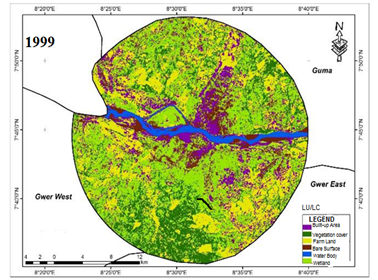
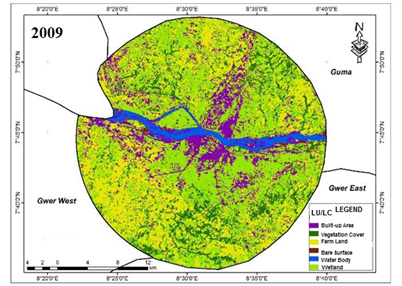
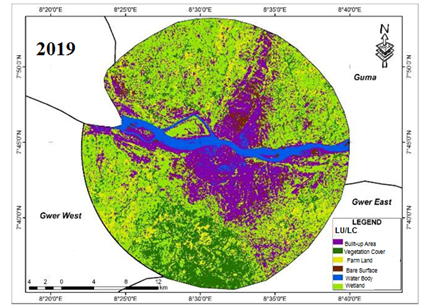
The classified images (false colour composite) for the different periods 1999, 2009 and 2019 of study area are shown in Figures 5.1, 5.2 and 5.3 respectively. These colour composite shows the visual distribution pattern of the distribution and change taking place in the images of the areas throughout the period of study. The dominating land use and land cover category in 1999 as shown in Table 3 and figure 1 is the wetland covering an area of 214.89km2 (26.22%). This is understandable as Hemba, et al. (2017) describes the relief of Makurdi town as lying entirely in the low- laying flood Plain with River Benue forming the major drainage channel. Farm land covers 203.56km2 representing 24.83% of Makurdi.
Figure 1: Land Use and Land Cover of Makurdi in 1999
Most residents engage in farming, either crop production or livestock farming as the soil is fertile and the weather is conducive for agricultural practices. This assertion supports the views of Hula, (2010) who noted that most farmers in Makurdi cultivate land for crop production, rearing of animals for consumption and selling part of the produce to generate money to meet other needs. The populace of Makurdi comprises of indigenous farmers and migrants who are mostly engaged in farm activities as noted by Oju et al. (2011). Due to farming and hunting and other activities like sand mining carried out in Makurdi, the size of bare land is observed to occupy large space of about 142.487km2 represented by 17.38% in 1999. This is because farmers have enough space to cultivate. Farmers relocate to other lands whenever a particular land becomes unproductive and this has been the major cause of bare land in the study area. These contradicts Tee (2019) who argued that hunting, grazing and other factors, which lead to clearing of land through manual, mechanical and chemical means have greatly changed the original vegetation cover to bare land and other classes of land use in Makurdi. The vegetation covered a reasonable size of land and it was 138.20km2 (16.86%).This is attributed to the few number of settlers in Maukurdi and low level of human activities taking place within the urban centre as at the time. The water body was 22.459 km2 (2.74%) with River Benue forming the major drainage system in the area and is the main source of water for human use. This is in line with the views of Nnule and Ujoh, (2017) who pointed out that Benue River is the main source of water in Makurdi. This doesn’t mean that other form of water sources like borehole, ponds and dams are not important.
Table 1 and figure 2 shows that the wetland had the largest area coverage of about 186.99km2 (22.78%) in 2009 as the entire land fall within the Benue Valley and Trough. The geology of the study area influence the wetland, this infect is also confirmed by Iorliam, (2014). The farmland occupies 184.608km2 (22.52%), as most residents are farmers. The number is significant as civil
Figure 2: Land Use and Land Cover of Makurdi in 2009.
servants also own farms. The built-up, which was 170.968km2 (20.86%) recorded a high increase due the increase in population. This corroborates the findings of Jiang, et al. (2013) which stated that the urban expansion on agricultural land is associated with both shrinking agricultural land area and a higher level of urban development. It also agrees with the findings of Araya and Cabral (2010) that substantial growth of urban areas has occurred worldwide in the last few decades with population increase being one of the most obvious agents responsible. The vegetation cover depreciated to 125.695km2 (15.33%). This may be attributed to deforestation as more forest was cleared to provide more space for increasing human development. This is buttressed by Mugish and Nyandwi (2015) that housing development on arable farm land in most cities has become an issue on the global agenda in recent times. Bare land, which was 122.52km2 (14.91%) decreased as the spaces were being covered with more structures but the water body 29.164km2 (3.56%) slightly increased. Of course, this is an indication that most of the human activities use water and other sources of water are being developed to meet the need of the increasing populace.
The level of human activities in the year 2019 was very high, although Makurdi has no functional Master Plan to check the developmental activities, however, as shown in the image Fig5.3 and Table5.1, The built-up area of 237.46km2 (28.97%) in 2019 almost tripled its size recorded in 1999.This supports the assertion by United Nations Department of Economy and Social Affairs (UNDESA, 2010) that urban cities have changed from small isolated population
Figure 3: Land Use and Land Cover of Makurdi in 2019.
centres to large interconnected economic, physical, and environmental features. In recent time, issues of Herdsmen/Farmers crisis are among factors contributing to the migration of people from neighbouring villages to Makurdi Town for safety. These numbers of people who mostly settled along the urban hinterland, which is mostly used for agricultural purpose, have converted the land for building of houses and other socioeconomic infrastructures. The farm land occupies 174.735km2 (21.32%) as it decreases with population upsurge settles in the study area. Farmers move outside of Makurdi to get land for their activities which make the cost of cultivation expensive than expected. Agencies with the mandate of protecting natural ecosystem are weak in areas of law enforcement in Makurdi as infrastructural developments are indiscriminately carried out. This observation contradicts the views of Wade quoted in Nico et al. (2000) that Various NGOs, government and international Agencies have been supporting the urban agriculture (UA) since 1970s in major world regions. There was reduction in wetland to 148.696km2 (18.14%) and vegetation cover to 117.653km2 (14.35%) compared to the previous ten years while the water body 36.658km2(4.47%) increases during the same periods.
Conclusion
The research findings revealed that built-up area increased all through the period of study while arable land decreases due to infrastructural development. The rapid increase in built-up area is because the surrounding agricultural land is fast decreasing. Bare land, vegetation and wetland decreased throughout the period of study as human settlement increases over the years. Of course, it was observed that the effect of the development was concentrated more to the north eastern part of Makurdi as residential buildings with high rate of economic activities is observed in the region. Generally, this study has been able to show that conversion of open/agricultural land for infrastructural development was mostly due to increase in number of people through migration and natural means of population growth. The land use and land cover change detection for the period of 20 years revealed the extent and type of conversion. The study recommends Green areas within and around the city should be properly preserved as this allows for ventilation. All effort should be put in place to prevent unofficial development and measures should be in place to curb population growth which has encouraged urban sprawl on prime agricultural land as this is feasible around Makurdi hinterland.
References
Aluko, O. (2011). Sustainable Housing Development and Functionality of Planning Laws in Nigeria: The case of Cosmopolitan Lagos. Journal of Sustainable Development, 4(5), 139–150.
Anderson, J. R. (1971). Land use classification schemes used in selected recent geographic applications of remote sensing: Photogramm. Eng., v. 37, no. 4, p. 379–387.
Adzandeh, E. A.; O. O. Fabiyi and Y. A. Bello. (2014). Statistical Analysis of Urban Growth in Kano Metropolis, Nigeria. International Journal of Environmental Monitoring and Analysis.2 (1): 50–56
Araya, Y. H. and Cabral, P. (2010).Analysis and Modeling of Urban Land Cover Change in Setúbal and Sesimbra, Portugal. Remote Sensing, 2: 1549–1563
Enoch, T. I.; T. S. John and I. A. Jonathan. (2020). Spatial Expansion of Urban Activities and Agricultural Land Encroachment in Makudi Metropolis: European Journal of Environment and Earth Science, 2684–446X
Etim, N. E. and J. J. Dukiya. (2013). GIS Analysis of Peri–Urban Agricultural Land Encroachment in (FCT), Nigeria. International Journal of Advanced Remote Sensing and GIS, 2(1): 303–315.
Hemba, S.; T. Enoch. l. Orimoleye and P. Dam. (2017). Analysis of the Physical Growth and Expansion of Makurdi Town. Imperial Journal of Interdisciplinary Research.3(4).
Hula, M. A. (2010). Population Dynamics and Vegetation Change in Benue State, Nigeria. Journal of Environmental Issues and Agriculture in Developing Countries, 2(1), pp53.
Iorliam, T. S. (2014). The Dialectics between Physical Plans and Physical Development in Contemporary Urban Nigeria: Empirical Evidence from the Kighir-Adeke Layout, Makurdi, Nigeria. Academic Research International Vol. 5(4).
Jiang, L; X. Deng and K. Seto. (2013). The Impact of Urban Expansion on Agricultural Land Use intensity in China. Land Use Policy, 35: 33–39.
Lu, D. and Q. Weng, (2007). A Survey of Image Classification Methods and Techniques for Improving Classification Performance. International Journal of Remote Sensing, vol. 28, pp. 823–870.
Mugish, J. and E. Nyandwi. (2015). Kigali City Peri-Urbanization and its Implications on Peri-Urban Land Use Dynamics: Cases of Muyumbu and Nyakaliro. GeoTechRwanda 2015– Kigali
Ojigi, L. M. (2006). Analysis of Spatial Variations of Abuja Land Use and Land Cover From Image Classification Algorithms,’’ ISPRS Commission VII Mid–Term Symposium, 8 – 11th May 2006, Enschede, The Netherlands (Conference proceedings).
Okeke, F. I. and T. U. Omali. (2016). Spatio-temporal Evaluation of Forest Reserves in the Eastern Region of Kogi State using Geospatial Technology. Tropical Environment, 13(1): 75–88.
Okeke, F. I., and T. U. Omali. (2018). Monitoring Deforestation and Forest Degradation in Yankari Games Reserve of Bauchi, Nigeria. Presentation at NIS AGM/Conference Bauchi, 2018. 18th June–22nd June, 2018
Omali, T. U. (2018a). Prospects of satellite–Enhanced Forest Monitoring for Nigeria. International Journal of Scientific & Engineering Research, 9(5), 383–388.
Omali, T. U. (2018b). Impacts of Sensor Spatial Resolution on Remote Sensing Image Classification. Global Scientific Journal, 6(1), 63–68.
Omali, T. U. (2020). Ecological Evaluation of Urban Heat Island Impacts in Abuja Municipal Area of FCT Abuja, Nigeria. World Academics Journal of Engineering Sciences, 7(1): 66–72.
Omali, T. U. (2021). Utilization of Remote Sensing and GIS in Geology and Mining. International Journal of Scientific Research in Multidisciplinary Studies, 7(4): 17–24.
Omali, T. U. (2022a). Monitoring the Ecological Component of Sustainable Development Goals using Geospatial Information Tools: A Review. International Journal of Scientific Research in Biological Sciences, 9(1): 92–99.
Omali, T. U. (2022b). Correlation of Geographic Information System with the Evolutionary Theory of Spatial Analysis. International Journal of Scientific Research in Computer Science and Engineering, 10(4): 18–22.
Omali, T. U. (2023a). Time-series Analysis of Vegetation Cover in the Southwest Nigeria using Remote Sensing and GIS. International Journal of Scientific Research in Multidisciplinary Studies, 8(7): 36–42.
Omali, T. U. (2023b). Coordinate Transformation of GPS Measurement Results using the Cartesian-to-Ellipsoidal Transformation System. International Journal of Scientific Research in Mathematical and Statistical Sciences, 10(4): 09–13.
Tee, N. T., P. U., Ancha, and J. Asue. (2019). Evaluation of Fuel Wood Consumption and Implications on the Environment: Case Study of Makurdi area in Benue state, Nigeria. Journal of Applied Biosciences, 19:1041–1048.
Yichun X., S. Zongyao, and Y., Mei. (2008). Remote Sensing Imagery in Vegetation Mapping: A Review. J Plant Ecol., 1(1): 9–23.
The Anthropocene, a term coined to describe the current geological era marked by significant human impact on the Earth’s ecosystems, has not spared the financial sector. As our global society becomes increasingly aware of the pressing need for sustainable practices, it is imperative to critically examine the role of the financial industry in shaping the Anthropocene. This review delves into the key aspects of the financial sector’s influence on the environment, social welfare, and economic stability, ultimately highlighting the urgent need for transformative change.
Environmental Impact:
The financial sector plays a crucial role in allocating capital and investment decisions, making it a powerful driver of environmental change. Unfortunately, the sector has often prioritized short-term gains and failed to adequately consider environmental risks. Financing projects with harmful ecological footprints, such as fossil fuel extraction and deforestation, demonstrates a severe disconnect from the urgent need to transition to a sustainable future. The Anthropocene demands a fundamental shift towards green finance and responsible investment that actively supports renewable energy, conservation, and climate change mitigation.
Social Responsibility:
Beyond its environmental impact, the financial sector has a profound influence on social welfare. The pursuit of profit maximization has led to growing income inequality and socio-economic disparities. Wealth concentration in the hands of a few exacerbates societal divisions, jeopardizing social stability and cohesion. Furthermore, predatory lending practices and unethical investments have caused harm to vulnerable communities, deepening social inequalities and perpetuating systemic injustices. The Anthropocene necessitates a financial system that values social responsibility, promotes fair distribution of resources, and actively addresses societal challenges.
Economic Stability:
The financial sector’s actions have had far-reaching consequences for economic stability, as evidenced by the 2008 global financial crisis. Short-sighted risk-taking, inadequate regulation, and the pursuit of profit at all costs contributed to the collapse of major financial institutions and subsequent economic downturns. The Anthropocene demands a financial system that places a greater emphasis on long-term sustainability, resilience, and transparency. Robust risk management frameworks, ethical practices, and responsible lending are imperative to avoid future economic crises and ensure a stable and equitable economy.
Regulatory Framework:
One of the critical shortcomings in addressing the Anthropocene within the financial sector lies in the inadequate regulatory framework. Despite some progress in recent years, regulations often lag behind the rapidly evolving complexities of the sector. Regulatory bodies must strengthen oversight, enhance transparency, and enforce stricter environmental and social standards. Additionally, international cooperation is vital to harmonize regulations and prevent regulatory arbitrage, where financial activities with negative environmental or social impacts simply relocate to jurisdictions with lax regulations. Such measures would help align the financial sector’s operations with the imperatives of the Anthropocene.
The Anthropocene poses significant challenges and opportunities for the financial sector. To navigate this era successfully, the sector must prioritize sustainability, social responsibility, and economic stability. Green finance, ethical investment practices, fair wealth distribution, and robust regulations are all indispensable components of a financial system that contributes positively to the Anthropocene. While some progress has been made, much remains to be done to ensure that the financial sector becomes a catalyst for positive change rather than a driver of environmental degradation and social inequality. The time for transformative action is now.
References
Al Amosh, H. (2024). The Anthropocene reality of financial risk. Social and Environmental Accountability Journal, 44(1), 85-86.
Crona, B., Folke, C., & Galaz, V. (2021). The Anthropocene reality of financial risk. One Earth, 4(5), 618-628.
Roka, K. (2020). Anthropocene and climate change. Climate Action, 20-32.
Snick, A. (2021). Social finance in the anthropocene. Innovations in social finance: Transitioning beyond economic value, 13-34.
Sharma, S. N. Agricultural Marketing: Enhancing Efficiency and Sustainability in the Agriculture Sector.
Sharma, S. N. (2018). Transformation of Aspirational Districts Programme: A Bold Endeavor Towards Progress. Think India Journal, 21(4), 197-206.
Shrivastava, P., Zsolnai, L., Wasieleski, D., Stafford-Smith, M., Walker, T., Weber, O., … & Oram, D. (2019). Finance and Management for the Anthropocene. Organization & Environment, 32(1), 26-40.
Tarim, E. (2022). Modern finance theory and practice and the Anthropocene. New political economy, 27(3), 490-503.
The Intergovernmental Panel on Climate Change (IPCC) is a cornerstone of global efforts to understand, mitigate, and adapt to climate change. Established in 1988 by the United Nations Environment Programme (UNEP) and the World Meteorological Organization (WMO), the IPCC provides scientific assessments that inform international policy and action to address the climate crisis. This article delves into the IPCC’s structure, functions, contributions, and its pivotal role in shaping a sustainable future.
Understanding the IPCC
The IPCC is not a research body. Instead, it synthesizes and evaluates existing research on climate change to provide comprehensive assessments. Its mission is to:
Provide policymakers with regular scientific assessments on climate change, its impacts, and potential future risks.
Offer mitigation and adaptation strategies to manage these risks effectively.
Structure of the IPCC
The IPCC comprises three working groups and a task force:
Working Group I: Focuses on the physical science basis of climate change.
Working Group II: Examines climate change impacts, vulnerabilities, and adaptation measures.
Working Group III: Explores options for reducing greenhouse gas emissions and mitigating climate change.
Task Force on National Greenhouse Gas Inventories (TFI): Assists nations in calculating and reporting emissions and removals.
IPCC Assessment Reports
The IPCC publishes comprehensive Assessment Reports (ARs) every 5–7 years. These reports synthesize the latest scientific knowledge to guide global climate policy. Key milestones include:
1. First Assessment Report (1990):
Established the foundation for international climate negotiations.
Highlighted the role of human activities in driving climate change.
2. Fourth Assessment Report (2007):
Strengthened evidence for anthropogenic global warming.
Informed the 2009 Copenhagen Accord.
3. Sixth Assessment Report (AR6, 2021-2022):
Presented the most up-to-date understanding of climate science.
Highlighted the urgency of limiting global warming to 1.5°C to avoid catastrophic impacts.
Special Reports
In addition to ARs, the IPCC publishes special reports on critical topics, such as:
Global Warming of 1.5°C (2018): Explored pathways to limit warming and emphasized the need for urgent action.
Climate Change and Land (2019): Examined the interactions between climate change, land use, and sustainable land management.
The IPCC’s Contributions to a Sustainable World
1. Raising Awareness
The IPCC has been instrumental in raising global awareness of climate change by:
Establishing consensus on the scientific evidence for climate change.
Highlighting the links between human activities, greenhouse gas emissions, and global warming.
2. Informing Policy Frameworks
IPCC assessments have shaped major international agreements, including:
United Nations Framework Convention on Climate Change (UNFCCC): Established the global platform for climate negotiations.
Kyoto Protocol: Set binding emission reduction targets for developed countries.
Paris Agreement: A landmark accord to limit global warming to well below 2°C, with efforts to cap it at 1.5°C.
3. Guiding Adaptation and Mitigation Efforts
The IPCC provides evidence-based strategies for:
Mitigation: Reducing emissions through renewable energy, energy efficiency, sustainable transportation, and forest conservation.
Adaptation: Enhancing resilience through infrastructure planning, water resource management, and disaster risk reduction.
4. Promoting Equity
The IPCC emphasizes the disproportionate impacts of climate change on vulnerable populations. It advocates for equitable solutions that address:
Climate justice: Ensuring that those least responsible for climate change are not unduly burdened.
Capacity building: Supporting developing nations in implementing climate solutions.
Challenges Faced by the IPCC
Despite its achievements, the IPCC faces several challenges:
Complexity of Climate Science: Synthesizing vast and diverse research is time-consuming and requires global collaboration.
Political Sensitivities: Balancing scientific objectivity with the political realities of international negotiations.
Communication Barriers: Simplifying scientific findings for policymakers and the public without losing nuance.
The IPCC and the Path Forward
To build a sustainable world, the IPCC advocates for urgent and transformative action across all sectors. Key recommendations include:
Decarbonizing economies: Phasing out fossil fuels and transitioning to renewable energy sources.
Nature-based solutions: Restoring ecosystems to sequester carbon and enhance resilience.
Technological innovation: Developing and deploying clean technologies.
Global cooperation: Strengthening international partnerships to achieve climate goals.
Conclusion
The IPCC is at the forefront of the global fight against climate change, providing a scientific foundation for action and advocating for sustainable development. Its work underscores the interconnectedness of climate science, policy, and societal transformation. By heeding the IPCC’s findings and implementing its recommendations, humanity can build a sustainable world that ensures prosperity and equity for future generations.
The IPCC’s message is clear: the time for action is now.
References
Berg, M., & Lidskog, R. (2018). Pathways to deliberative capacity: the role of the IPCC. Climatic Change, 148(1), 11-24.
Levermore, G. J. (2008). A review of the IPCC assessment report four, part 1: the IPCC process and greenhouse gas emission trends from buildings worldwide. Building Services Engineering Research and Technology, 29(4), 349-361.
Keller, S. (2010). Scientization: putting global climate change on the scientific agenda and the role of the IPCC. Poiesis & Praxis, 7(3), 197-209.
Sanwal, M., Wang, C., Wang, B., & Yang, Y. (2017). A new role for IPCC: balancing science and society. Global Policy, 8(4), 569-573.
The study evaluated socio-demographics, climate change awareness, impact/vulnerability and adaptation for adult residents of Port Harcourt. a purposive random sampling was employed selecting adult participants who had dwelt up to a year in Port Harcourt. 412 questionnaires were distributed. Descriptive statistics, including frequencies and percentages, were generated. Additionally, regression analysis was employed investigating the relationships between independent variables and climate change awareness, adaptation and impact/vulnerability and ANOVA for evaluating the overall fit and significance of regression models. prevalent age groups were 28-37 and 38-47 at (31% and 28% respectively), gender distribution was male (51%) and female (49%), (65%) fall within the educational brackets. largest category of Households size ranged from 6 to 10 members (53.4 %); awareness levels was prevalent at 85% with 60% of awareness attributable to television. 87.9% attributed observable changes in their communities to climate change with most frequencies as shifts in the community rainfall patterns (72.6%) and temperature (63%), whilst a significant 74% did not take any action for adaptation only 35% depended on climate sensitive resources with 65% not believing they or their family members had health conditions impactable by climate change. A significant 74% took no adaptation measures and 57% were uncertain of any community adaptation measures available while 88% had no idea of any government or non- governmental programmes focused on adaptation. overall, a good number had concerns about the future impacts of climate change though many respondents did not feel their communities were prepared enough for future impacts. The study recommends the need for promoting awareness, encouraging responsible behaviours, and establishing resilient infrastructure as critical components of government non-governmental, community and individual response to climate-related challenges as collaborative efforts involving residents, authorities, and relevant organizations are key to fostering resilience and implementing sustainable strategies to tackle the consequences of climate change.
Climate change is a pressing global issue that has significant implications for various aspects of society, including the environment, economy, and human health (He, 2017). The impacts of climate change are wide-ranging and can be observed in various regions around the world (Pawełczyk, 2018). To address and mitigate the effects of climate change, it is important to understand the factors that influence individuals’ and communities’ responses and adaptation measures (Devi et al., 2020).
Climate change is a complex issue that requires a multidisciplinary approach to understand and address its impacts (Farida et al., 2017). Factors such as cognitive bias, social discourse, time, money, knowledge, power, entitlements, and social and institutional support all play a role in shaping individuals’ and communities’ responses to climate change (Devi et al., 2020). Effective communication, education, and support systems are crucial in facilitating adaptation to climate change (Terefe, 2022). Furthermore, understanding the economic impacts of climate change and learning from the scientific literature can inform evidence-based policymaking and help mitigate the effects of climate change (Callaghan et al., 2022).
The changing climate in Nigeria is characterized by increasing temperatures, variable rainfall patterns, rising sea levels, and more frequent extreme weather events (Ladan, 2014; Ikumbur & Iornumbe, 2019). These changes have led to adverse effects such as drought, desertification, flooding, and land degradation (Ojomo et al., 2015; Ladan, 2014; Ikumbur & Iornumbe, 2019; Akeh & Mshelia, 2016).
One of the major contributors to climate change in Nigeria is gas flaring, which accounts for approximately 30% of O2 emissions in the country (Afinotan, 2022). Nigeria has the second highest gas flaring level in the world, and this has significant implications for climate change (Afinotan, 2022).
Climate change has significant impacts on the Niger Delta region of Nigeria, which is known for its oil and gas production. The region is considered a climate change vulnerability hotspot (Atedhor & Odjugo, 2022). The adverse effects of global warming, including rising temperatures and sea levels, have had severe consequences for the Niger Delta ecosystem and its inhabitants (Ogele, 2022).
Studies have revealed that the Niger Delta region of Nigeria is only three meter above mean sea level and their coastline is dynamic in nature which renders hundreds of coastal communities exposed and vulnerable to climate change risk and hazards. The region is faced with seasonal flooding, increase in temperature, high precipitation, erosion, river salinization, ocean surges and siltation (Benson, 2020).
The city of Port Harcourt in the South-south region of Nigeria is not immune to these impacts and has been experiencing the effects of climate change, such as increased temperatures, changing rainfall patterns, rising sea levels, frequent flooding, increased incidence of diseases and agricultural disruptions, extreme climate variations have been observed in recent times and many scholarly works have been carried in this area but the challenges still persist, in order to address these challenges, it is crucial to understand the climate change awareness levels, the impact/ vulnerability and adaptation in Port Harcourt, as well as develop effective adaptation and mitigation strategies.
2. LITERATURE REVIEW
Important theories for climate change encompass a wide range of disciplines and perspectives, reflecting the complex and multifaceted nature of the phenomenon. The understanding of climate change involves not only scientific theories but also social, political, economic, and ethical theories. Frankcombe et al. (2010) emphasize the significance of understanding the dominant time scales and processes in climate variability, which is crucial for developing a comprehensive theory of climate change. This highlights the interdisciplinary nature of climate change theories, as they draw from climatology, geology, and oceanography.
the theories of climate change are multifaceted, encompassing scientific, social, political, economic, and ethical dimensions. They reflect the interdisciplinary nature of climate change and the need for comprehensive, integrated theories to address this complex global challenge.
Climate change awareness is a critical aspect of addressing the challenges posed by climate change. It encompasses the public’s understanding of climate change issues, its impacts, and the necessary behavioural and attitudinal changes to mitigate its effects. Research has shown that climate change awareness is influenced by various factors such as education, gender, and accessibility to information (Kousar et al., 2022; Demaidi & Al-Sahili, 2021; Sesay & Kallon, 2022).
The public’s perception of climate change is also an important aspect of climate change awareness. It has been observed that more vulnerable groups, such as those with lower income and education levels, tend to perceive climate change as more consequential and closer, and as a more natural phenomenon than those from less vulnerable groups (Brügger et al., 2021).
The impact of climate change on Port Harcourt can be seen in various sectors, including the environment, public health, and the economy. A study conducted in the Trans Amadi Industrial area of Port Harcourt assessed climate change adaptation, mitigation, and resilience strategies (Wobo & Benjamin, 2018; Nyashilu et al., 2023). The study utilized satellite imagery and field surveys to gather information and identified the inventory of tree species used in urban greening activities. This highlights the importance of implementing strategies to enhance the resilience of urban areas to climate change.
Climate change has significant impacts on various aspects of the environment, society, and economy, leading to increased vulnerability in many regions. Vulnerability to climate change is defined as the degree to which a system is susceptible to and unable to cope with the adverse effects of climate change (Tanny & Rahman, 2017). Research has shown that climate change vulnerability varies across different sectors and regions, with poorer and hotter countries being more susceptible to its negative impacts (Tol, 2020). Vulnerability is influenced by a range of factors, including economic development, social dynamics, and environmental conditions (Grecequet et al., 2017; Lovett, 2015). For instance, studies have indicated that climate change has profound adverse effects on human health, particularly affecting children’s health (Odunola et al., 2018; Sulistyawati & Nisa, 2016). Nigeria is particularly vulnerable to the devastating effects of climate change due to its low coping capability. However, there is a scarcity of studies on the impacts of climate change on health risks in Nigeria. Monday (2019) investigated the effects of climate change on health risks in Nigeria. The study found that climate change-related causes such as increased temperature, rainfall, sea level rise, extreme weather events, and especially increased health risks have led to several direct consequences of climate change.
Okunola et al., (2022) investigated the factors influencing individual and household adaptation strategies to climate risks in Port Harcourt, the key findings underscore a predominant reactive nature in the adopted climate change adaptation strategies, emphasizing the critical necessity for the incorporation of proactive measures such as early warning systems and preparedness initiatives. Additionally, the study revealed that the effectiveness and intensity of adaptation strategies vary based on residential densities within the city, indicating the importance of tailored approaches that account for specific local contexts. Also, low adaptive capacity of rural households in the region has been said to be influenced by factors such as poverty, lack of education, and limited access to alternative livelihood options (Tonbra, 2021).
Efforts to mitigate and adapt to climate change in the Niger Delta have been limited. The adoption of sustainable land management practices and the promotion of renewable energy sources are potential strategies for addressing climate change in the region (Lokonon & Mbaye, 2018). However, there is a need for increased awareness, capacity building, and policy support to facilitate the adoption of these strategies (Ikehi et al., 2022).
The political and regulatory response to climate change and environmental degradation in the Niger Delta has been inadequate (Benson, 2020; “undefined”, 2019). There is a lack of political will and interest among politicians at all levels of government to address the crisis posed by climate change and environmental degradation (Benson, 2020). The failure to enforce strict antipollution laws and the skewed revenue distribution framework have contributed to the perpetuation of environmental degradation in the region (“undefined”, 2019).
3. METHODOLOGY
The research design employs a detailed desktop review of available research publications, materials and other quantitative and qualitative data, building a qualitative case study backed up with primary survey data acquisition. The primary survey entailed the use of survey tools distributed to a sample size drawn from the sample population of the study area and field observation.
The study area covers Port Harcourt, cutting across several communities. Port Harcourt, affectionately nicknamed “Garden City” or “PH City,” is the capital and largest city of Rivers State in southern Nigeria. Located at 4°45′N 7°00′E, (Figure1.) it rests along the Bonny River, placing it at the heart of one of Africa’s richest oil regions.
Port Harcourt boasts a bustling population of over 3 million people, making it the fifth most populous city in Nigeria. Its diverse inhabitants hail from various ethnic groups, including the Ijaw, Ikwerre, Igbo, and Ogoni, contributing to a rich cultural tapestry. Port Harcourt is bordered by other Rivers State Local Government Areas, including Obio/Akpor, Ikwerre, Etche, and Port Harcourt Local Government Area itself.
Fig. 1 Map showing the location of the study area; Port Harcourt.
Rivers State is one of the 36 States of Nigeria, The State falls within the Niger Delta area known as the South-South geo-political zone, with 40 different ethnic groups, and a population of 5,198,716, according to the 2006 Census by the National Population Commission making it the sixth-most populous state in the country.
Data Collection
A total of 412 questionnaires were administered to same sample size (412) the questionnaire contained 28 questions distributed into various sections including Sociodemographic, Climate change awareness, Climate change impact and vulnerability, Climate change adaptation.
Data Sampling
The study employed a purposive random sampling procedure in the selection of respondents for the study a method chosen to eliminate bias and ensure that each member of the population had an equal chance of being selected. The choice of purposive sampling technique was to select participants who were residents of Port Harcourt, had dwelt up to a year and more in Port Harcourt and were adults above the age of 18 the aim of the purposive sampling was to capture only the perspective of adults who had experienced a longer period of climatic conditions. This approach guarantees a fair representation of the various demographic, socio-economic, and geographic perspective of adult residents who had dwelt a year and more in Port Harcourt. By distributing 412 questionnaires using this method, the study seeks to capture the heterogeneity of the population’s experiences and perspectives regarding climate change.
The Taro Yamane’s formula (Yamane, 1967) was used to come up with an appropriate sample size for the study with five percent (5%) significance level.
n=N/ (1+N (e^2)) where:
n = sample size N = population e = significance level (0.05)
Thus
n = 963,373/ (1+963,373 (0.05^2))
n = 963,373/ (1+963,373 (0.0025))
n = 963,373/ (1+2,408.4325)
n = 963,373/2,409.4325
n = 400
This resulted to a sample size of 400, though 412 respondents were sampled for the primary survey this is because it is not out of place since a sample that is larger than the exact sample size will be a better representative of the population and will hence provide more accurate results.
To collect primary data, a structured questionnaire was designed, encompassing a range of variables to facilitate a comprehensive analysis. The questionnaire included sections addressing climate change awareness, adaptation strategies, resilience measures, and demographic information (such as age, gender, education level, household size, and occupation). The inclusion of these variables allows for a nuanced exploration of how socio-demographic factors may influence individual responses to climate change.
The results of the primary survey on climate change impact awareness and adaptation are presented in four separate tables as follows: table 1. Captures the socio-demographics, table 2. Climate change knowledge and awareness, table 3. Climate change vulnerability assessment and table 4. Climate change adaptation.
Table1. Socio-demographics
SN
Variable
Frequency
Percentage %
1
Age
28 – 37
127
31
38-47
115
28
48-57
82
20
18 – 27
49
12
68 -77
35
8
78 or over
4
1
2
Gender
Males
209
51
Females
203
49
3
Level of Education
SSCE/ O-Level
99
24
Degree or HND
90
21.8
A-Level/ Higher/ BTEC
77
19
Vocational/ NVQ
36
8.7
NCE/ND
30
7.2
No formal qualifications
28
6.8
FSLC/Primary Education
28
6.8
Postgraduate qualification
21
5
Others
3
0.7
4
Occupation
Self-employed/Entrepreneur
121
29
Business
80
19
Academia/Education
74
18
Student/Unemployed
41
10
Other
36
9
Civil Servant
31
8
Retired
29
7
5
Household size
6 to 10
220
53.39
1 to 5
109
26.46
More than 10
79
19.17
5 to 10
2
0.49
1 to 4
2
0.49
6
Length of residence in Port Harcourt
More than 10 years
270
65.53%
6 to 10years
102
24.76%
1 to 5 years
37
8.98%
At Least 1 year
3
0.73%
Table 2. Climate Change Knowledge and Awareness
SN
Variable
Frequency
Percentage %
1
Response to awareness about climate change
Yes
351
85
No
61
15
2
Response to Notice of any changes in the climate in the study area over the past few years (e.g., temperature, rainfall patterns, extreme events)
Yes
362
87.9
Not Sure
38
9.2
No
12
2.9
3
Respondents’ response to awareness of the potential impacts of climate change in their community
Yes
252
61
Partially
98
24
No
62
15
4
Respondents’ response to knowledge about the Impact of Climate Change
Extreme weather conditions
266
64.6
Extremely cold temperature
229
55.6
Heatwaves
174
42.2
Flooding
163
39.6
Others
7
1.7
5
Respondents’ response to the source of their awareness about climate change
Television
253
60.4
Radio
188
44.9
Social Media platform
175
41.8
Friends/ Family
155
37.0
Internet
114
27.2
Newspaper
106
25.3
Other
69
16.5
School/ College/ University
47
11.2
Energy suppliers
26
6.2
Local Government Council
18
4.3
Public libraries
16
3.8
Government Agencies/ Information
15
3.6
Specialist publications/academic journals
13
3.1
Environmental Advocacy groups (e.g., Worldwide Fund for Nature)
Respondents’ response to whether there has been changes in their community they could attribute to Climate Change
Yes
349
84.7
No
63
15.3
Total
412
100
2
Respondents’ response to If yes to (whether there has been changes in your community you can attribute to Climate Change) then what are the changes in climate in your community.
Changes in rain fall pattern
304
72.6
Changes in Temperature
264
63.0
Changes in Relative humidity
60
14.3
Others
8
2.0
3
Respondents’ response to what the impacts of the changes in climate were.
Extreme cold
209
50.7
Heat waves
161
39.1
Flooding
131
31.8
Others
15
3.6
4
Respondents’ response to If your answer is No in (13. if there have been changes in your community you can attribute to climate change), then have you experienced extreme heat, cold, flooding, changes in rain fall pattern or Storms?
Yes
54
12.89
No
2
0.48
5
Response to whether they were directly dependent on climate-sensitive resources or industries.
Partially
152
37
Yes
144
35
No
116
28
6
Respondents’ response to whether they or any family members had any health condition that could be exacerbated by climate change Impact.
No
268
65
Not Sure
79
19
Yes
65
16
Table 4. Climate Change Adaptation
SN
Value
Frequency
Percentage %
1
Respondents’ response to whether they or their household had taken any measures to adapt to the impact of climate change
No
304
74
Yes
108
26
Total
412
100
2
Respondents’ response to what measures they have taken to cope with climate related challenges in their community.
Renewable anergy adoption
191
46
Climate resilient house
98
24
Water management
87
21
Others
36
9
3
Respondents’ response to whether there are any existing community-based adaptation measures in place
Not Sure
245
59
No
115
28
Yes
52
13
4
Respondents’ response to aware of any government or non-government programs focused on climate change adaptation.
No
363
88
Yes
49
12
5
Respondents’ response to how concerned they were about the future impacts of climate change in their community.
Concerned
170
41
Somewhat Concerned
150
36
Very Concerned
67
16
Not Concerned
25
6
6
Respondents’ response to whether they thought their community was prepared to handle future climate challenges.
Not Prepared
254
62
Somewhat Prepared
136
33
Prepared
17
4
Very Prepared
5
1
Statistical Regression Analysis of the Primary Survey.
i. Climate Change Awareness: Tables 5-7 showthe regression statistics, Anova and model results for climate change awareness (the dependent Variable) and Age, Gender, Education Level, Household Size and Occupation (the Independent Variables).
The Multiple R value is 0.2188, suggesting a weak positive correlation between the independent variables and climate change, the R-squared value from the regression statistics of climate change awareness (0.0479) indicates that approximately 4.79% of the variance in climate change can be explained by the combined influence and suggests that the model explains a relatively small proportion of the variance in climate change awareness, indicating that other factors not included in the model may also be influencing the outcomes. The ANOVA table 4.54 suggests that there is a statistically significant relationship between the independent variables (age, gender, education level, household size, and occupation) collectively and the dependent variable (climate change awareness). The low p-value (0.001259394) associated with the F-statistic indicates that at least one of the independent variables in the model is contributing significantly to explaining the variability in climate change awareness.
Looking at the individual predictor coefficients to understand which specific variables are driving this relationship, overall education level and household size have statistically significant relationships with climate change awareness with p-values of 0.005 and 0.008 respectively in this model, while age, gender, and occupation do not.
ii. Climate Change Impact and Vulnerability: Tables 8-10 showthe regression statistics, Anova and model results for climate change impact and mitigation (dependent variable) and changes in temperature, changes in rainfall pattern, changes in relative humidity, Respondents dependence on Climate-Sensitive Resources or Industries? (e.g., Agriculture, Fishing, Forestry), Respondent or family members of respondents having any health conditions that could be exacerbated by Climate Change? (e.g., Respiratory Issues, Cardiovascular Problems) (Independent variables).
The regression statistics suggest that there is a moderate to strong relationship between the predictor variables and the climate change vulnerability assessed. The R squared value indicates that around 51.38% of the variability in vulnerability can be explained by the independent variables in the model. The adjusted R-squared considers the model’s complexity and suggests that approximately 50.78% of the variability is explained.
The Anova result presents a large F-statistic value, with an extremely small associated p-value is, suggesting that the model is a good fit and that the independent variables collectively have a significant impact on explaining the climate change vulnerability being assessed.
the statistical significance of the specific variables in the model using p-values showed changes in temperature, changes in rainfall pattern and changes in relative humidity with p-values of 3.01E-12, 1.5E-33 and 0.010103 respectively to have high significant impact on climate change vulnerability as their p-values were close to 0 (zero).
iii Climate Change Adaptation: Tables 11-13 showthe regression statistics, Anova and model results for climate change adaptation (Dependent Variable) and Climate resilient house, Renewable energy adoption, Water management, whether there are any existing Community-Based Adaptation Measures in place, whether respondents are aware of any Government or Non-Government programs focused on Climate Change Adaptation, how concerned respondents are about the future impacts of Climate Change in their community (the independent variables).
The multiple R value for the regression statistics for climate change adaptation, (0.5218) suggests that there is a moderate positive correlation between the predicted and observed values. R² value of 0.2723 indicates that approximately 27.23% of the variability in the dependent variable is explained by the independent variables included in the model. This means that the model is accounting for a significant portion of the variability, but there are other factors not included in the model that also influence the dependent variable.
The F-statistic is quite high (25.25904), and the associated p-value (1.7544E-25) is extremely low. This suggests that the variability explained by the regression model is significantly greater than what would be expect by chance alone.
Overall, for statistical significance of specific variables, climate resilient house, renewable energy adoption, water management, Community-Based Adaptation Measures and concern about future impacts of Climate Change have statistically significant effects on the dependent variable with p-values of (1.21E-06), (4.24E-05), (2.13E-07) and (0.003261) and (0.000389) respectively. However, Government/Non-Government Programs is not statistically significant in this model with high p-value of (0.9178).
Table 5. Regression statistics for climate change awareness
Regression Statistics
Multiple R
0.218755808
R Square
0.047854104
Adjusted R Square
0.036128169
Standard Error
0.35377172
Observations
412
Table 6. ANOVA for the regression model used for climate change awareness.
ANOVA
df
SS
MS
F
Significance F
Regression
5
2.553806
0.510761
4.081048
0.001259394
Residual
406
50.8127
0.125154
Total
411
53.3665
Table 7. The regression model variables used in the assessment of climate change awareness.
Variables
Coefficients
Standard Error
t Stat
P-value
Lower 95%
Upper 95%
Lower 95.0%
Upper 95.0%
Intercept
1.280236532
0.108450991
11.8047472
7.51634E-28
1.067040952
1.49343211
1.067040952
1.493432113
Age
0.03157876
0.017031498
1.85413874
0.064444316
-0.00190217
0.06505969
-0.00190217
0.065059691
Gender
0.065187864
0.035981487
1.811705687
0.070770428
-0.005545412
0.13592114
-0.005545412
0.135921141
Education Level
-0.024131803
0.008483011
-2.84472152
0.004669989
-0.04080791
-0.0074557
-0.04080791
– 0.007455695
Household Size
-0.069495577
0.026084575
-2.66424035
0.008023628
-0.120773264
-0.01821789
-0.120773264
– 0.018217889
Occupation
-0.011930487
0.010463623
-1.14018701
0.254880568
-0.032500131
0.00863916
-0.032500131
0.008639156
Table 8. Regression statistics for Climate Change Impact and Vulnerability
Regression Statistics
Multiple R
0.716815668
R Square
0.513824702
Adjusted R Square
0.507837322
Standard Error
0.240715376
Observations
412
Table 9. ANOVA for the regression model used in the climate change Impact and vulnerability assessment.
ANOVA
df
SS
MS
F
Significance F
Regression
5
24.86313
4.972626
85.81795
2.13699E-61
Residual
406
23.52522
0.057944
Total
411
48.38835
Table 10. The regression model variables used in the climate change vulnerability assessment.
Variables
Coefficients
Standard Error
t Stat
P-value
Lower 95%
Upper 95%
Lower 95%
Upper 95%
Intercept
0.119150878
0.08522
1.398163
0.162827
-0.048375832
0.286678
-0.04838
0.286678
Changes in temperature
0.205270227
0.028523
7.196549
3.01E-12
0.14919819
0.261342
0.149198
0.261342
Changes in rainfall pattern
0.407610376
0.030765
13.24905
1.5E-33
0.34713132
0.468089
0.347131
0.468089
Changes in relative humidity
0.087637427
0.03391
2.584397
0.010103
0.020975936
0.154299
0.020976
0.154299
Are you dependent on Climate-Sensitive Resources or Industries? (e.g., Agriculture, Fishing, Forestry)
-0.003687286
0.014732
-0.25029
0.802491
-0.03264807
0.025273
-0.03265
0.025273
Do you or any family members have any health conditions that could be exacerbated by Climate Change? (e.g., respiratory Issues, Cardiovascular Problems)
0.03358013
0.021488
1.562722
0.118897
-0.008661951
0.075822
-0.00866
0.075822
Table 11. Regression statistics for Climate Change Adaptation and Resilience
Regression Statistics
Multiple R
0.52183149
R Square
0.272308104
Adjusted R Square
0.261527484
Standard Error
0.380625135
Observations
412
Table 12. ANOVA for the regression model used for Climate Change Adaptation and Resilience
ANOVA
df
SS
MS
F
Significance F
Regression
6
21.95649
3.659416
25.25904
1.7544E-25
Residual
405
58.67457
0.144875
Total
411
80.63107
Table 13. The regression model variables used in the climate change adaptation and resilience.
Variables
Coefficients
Standard Error
t Stat
P-value
Lower 95%
Upper 95%
Lower 95%
Upper 95%
Intercept
0.18543009
0.160518
1.155199
0.24869
-0.130122233
0.500982
-0.13012
0.500982
climate resilient house
0.228580948
0.046377
4.928738
1.21E-06
0.137410898
0.319751
0.137411
0.319751
renewable energy adoption
0.157359029
0.038015
4.139356
4.24E-05
0.082627006
0.232091
0.082627
0.232091
water management
0.265179948
0.050239
5.278382
2.13E-07
0.16641843
0.363941
0.166418
0.363941
Are there any existing Community-Based Adaptation Measures in place?
0.084938344
0.028699
2.959672
0.003261
0.028521584
0.141355
0.028522
0.141355
Are you aware of any Government or Non-Government programs focused on Climate Change Adaptation?
0.00656221
0.063512
0.103323
0.917758
-0.118291811
0.131416
-0.11829
0.131416
How concerned are you about the future impacts of Climate Change in your Region?
0.086041574
0.024049
3.577705
0.000389
0.038764379
0.133319
0.038764
0.133319
DISCUSSION OF FINDINGS
The most prevalent age groups were 28-37 and 38-47, comprising a significant portion of the respondents (31% and 28% respectively), studies have shown that younger generations are more likely to be concerned about climate change and express a higher level of awareness and interest in climate-friendly behaviours (Petrescu-Mag et al., 2023; Korkala et al., 2014). The gender distribution in the survey demonstrated a balanced representation of male (51%) and female (49%) respondents though with males slightly higher, gender has been said to play a crucial role in climate change adaptation and awareness, gender dimensions in the context of climate change adaptation in coastal communities have shown that gender influences factors such as asset risk and livelihood risk perceptions (Graziano et al., 2018). Three categories of education levels (SSCE/O-Level, Degree or HND & A-Level/Higher/BTEC) had made up most of the responses, accounting for about 65% of the total participants, this is indicative of the fact that a significant portion of the respondents fall within these educational brackets, education has been identified as a key factor in understanding and employing adaptation strategies for climate change and unpredictability (Megabia et al., 2022). Households with a size ranging from 6 to 10 members were the largest category (53.4 %), this observation indicated that a significant portion of families within the community had relatively larger household sizes. Larger households have been noted to have implications for resource consumption, energy usage, and communal dynamics, potentially influencing the strategies and challenges related to climate change resilience. Ahmed & Alam (2015) in Bangladesh found that larger households faced greater challenges in dealing with climate change due to higher resource needs and lower per capita income. Household size has also been found to impact awareness of climate change effects, with larger household sizes being more vulnerable to adverse effects such as reduced agricultural production and food shortages (Ibrahim et al., 2015). Individuals who had lived in Port Harcourt for more than 10 years (66%) constituted the largest group. This significant percentage indicated a substantial portion of long-term residents who likely had deep ties to the community. A study in Chile by Fernandez et al., (2015) have shown that long-term residents tend to perceive more significant climate change over time compared to newcomers.
It is noteworthy that majority of respondents (85%) had heard about climate change, which indicated a relatively high level of awareness on climate change, however, a notable proportion (15%) of respondents had still not heard about climate change. This majority proportion indicates that a substantial segment of the population is indeed conscious of the potential consequences that climate change could bring to their community. The prevalence of climate-related content in television programs, played a significant role in spreading awareness on climate change followed by other media this agrees with (Ju & Jo 2021) who also identified the sources of information through which rural farmers received information on climate change, including personal observation, friends, radio, and television.
The references to changes in weather patterns, increased rainfall, and partial flooding suggested broader alterations in climatic conditions, potentially affecting the community’s susceptibility to extreme weather events and the capacity to manage water-related challenges. A significant majority (84.7%) had indicated noticing changes in their community attributable to climate change, with the most reported frequency as shifts in the community rainfall patterns (72.6%) and temperature, (63%) this substantial percentage underscores the fact that a significant portion of the community perceives climate change as a tangible factor influencing their local environment. This result is in line with the reports of (Stanley et al., 2021) that had high percentage (85-93%) of respondents who had perceived climate change impacts in their community and Ojo et al., (2019) in their study among fishing communities in the Niger Delta, who found that 98% of respondents perceived changes in climate variables like rainfall patterns, temperature, and sea level rise. The most reported impacts as direct results of these changes were extreme cold, heatwaves and flooding.
On the dependence on climate sensitive resources respondents’ perception had suggested that some individuals had recognized a certain level of reliance on sectors such as agriculture, fishing, or forestry, but this dependence hadn’t been absolute as 37% went for “Partially” and 35% “Yes”. Though a study by Onwumodu and Chukwu (2020) found that 85% of respondents relied on climate-sensitive sectors like agriculture and fishing.
Majority of respondents had expressed (“No” 65%) that they didn’t believe that they or their family members had health conditions that might have been worsened by climate change Impact, this perspective suggests that most individuals perceived their health conditions or those of their family members to have been relatively unaffected by changing climatic conditions. Nwaogu and Agunwoke (2020) in neighbouring Imo and Rivers States mentioned limited understanding of health impacts, potentially aligning with the “No” category while the study of Ajaegbu et al. (2015) reflects the (“Not Sure” 19%) category as it mentions limited awareness about specific health impacts. The study of Ebi et al. (2017) which focused on the Niger Delta, highlighted the potential for climate change to worsen existing health conditions aligning with the (“Yes”16%) category of this study.
On climate change adaptation, majority of respondents (74%), had indicated that they or their household hadn’t taken any specific measures to adapt to the impacts of climate change while only 26% did take measures that include the use of renewable energy, climate resilient houses and water management related measures. Low adaptive capacity of rural households in the region has been said to be influenced by factors such as poverty, lack of education, and limited access to alternative livelihood options (Tonbra, 2021).
A good number of respondents (59%) were not sure of any existing community-based adaptation measures in place while some others (28%) believed there were none, this uncertainty could be said to indicate a lack of awareness about such initiatives, potentially pointing towards a need for increased communication and education about community-based adaptation efforts, only 13% were aware of some community initiatives. While for government and non-governmental initiatives a significant 88% were not aware of programmes focused on climate change adaptation, This significant percentage suggests a widespread lack of awareness about initiatives that are specifically aimed at addressing the impacts of climate change and building resilience within the community this corroborates with (Oramah & Olsen, 2021) whom though stated that vulnerability of Nigeria to climate change has led to efforts by the government to develop adaptation and mitigation strategies also noted that institutional capacity for climate change adaptation at the federal, state, and local government levels were still weak. Though with varying levels of concern, overall, a good number of respondents have concerns about the future impacts of climate change in their region. Likewise varying levels of the perceived community preparedness to tackle future climate change impacts; many respondents did not feel their community was prepared for future impacts of climate change.
The individual predictor coefficients to understand which specific variables were driving the relationship between Climate change awareness and the independent variables, overall education level and household size have statistically significant relationships with climate change awareness with p-values of 0.005 and 0.008 respectively in the regression model, while age, gender, and occupation were not statistically significant.
For climate change impact and vulnerability, the statistical significance of the specific variables in the model using p-values showed changes in temperature, changes in rainfall pattern and changes in relative humidity with p-values of 3.01E-12, 1.5E-33 and 0.010103 respectively to have high significant impact on climate change vulnerability as their p-values were close to 0 (zero).
For climate change adaptation Overall, for statistical significance of specific variables, climate resilient house, renewable energy adoption, water management, Community-based adaptation measures and concern about future impacts of climate change had statistically significant effects on climate change adaptation with p-values of (1.21E-06), (4.24E-05), (2.13E-07) (0.003261) and (0.000389) respectively. However, Government/Non-Government Programs was not statistically significant with p-value of (0.9178).
Although the survey recorded high awareness level of Climate change, many respondents still do not know what the impacts of climate change are though a good number of respondents are aware it is worthy of note that a good number of persons within the sample population relative to the sample size may not be aware of climate change as well as its impact.
likewise, a very low awareness level was recorded for government and non-government initiatives geared towards adaptation and resilience to climate change impact. If this initiatives exist in communities better awareness needs to be created as high percentage of respondent agreed to have heard about climate change via predominantly television and other media platforms same avenues could be utilised by the appropriate authorities to propagate and spread climate change adaption and resilience initiatives, many communities are also not prepared for future outturn of events that may exacerbate the impact of climate change, it is important for the government, local authorities, communities as well as individuals to play an active role in the fight for survival against climate change impact.
Afinotan, U. (2022). How serious is Nigeria about climate change mitigation through gas flaring regulation in the Niger Delta? Environmental Law Review, 24(4), 288-304.
Ahmed, F., & Alam, S. (2015). Household size and vulnerability to climate change: An empirical study in rural Bangladesh. Natural Hazards, 79(3), 1455-1474.
Ajaegbu, H. I., Osuigwe, O., Chukwu, O. C., & Onu, D. C. (2015). Community perception and adaptation to climate change in the Niger Delta, Nigeria. Journal of Environmental Protection, 6(10), 1029-1037
Akeh, G. & Mshelia, A. (2016). Climate Change and Urban flooding: implications for Nigeria’s built environment. Moj Ecology & Environmental Sciences, 1(1). https://doi.org/10.15406/mojes.2016.01.00003
Atedhor, G. & Odjugo, P. (2022). Perspectives of climate change-induced agricultural losses and food shortage in the swamp forests of the Niger Delta region, Nigeria. 6(2), 493-505. https://doi.org/10.36263/nijest.2022.02.0372
Benson, A. (2020). Social and Environmental Drivers of Climate Change Vulnerability in the Niger Delta region, Nigeria. European Journal of Environment and Earth Sciences, 1(5). https://doi.org/10.24018/ejgeo.2020.1.5.69
Brügger, A., Tobias, R., & Huggel, C. (2021). Public perceptions of Climate Change in the Peruvian Andes. Sustainability, 13(5), 2677. https://doi.org/10.3390/su13052677
Callaghan, M., Vasudevan, S., Banisch, L., Doebbeling, N., Edmondson, D., Flachsland, C., Lamb, W., Levi, S., Müller-Hansen, F., Posada, E. & Minx, J. (2022). What is the evidence on climate mitigation policies, and to what extent can it be identified and classified using machine learning? a machine-learning-assisted systematic map protocol. https://doi.org/10.21203/rs.3.pex–1910/v1
Demaidi, M. N. & Al‐Sahili, K. (2021). Integrating sdgs in higher education—case of climate change awareness and gender equality in a developing country according to RMEI-target strategy. Sustainability, 13(6), 3101. https://doi.org/10.3390/su13063101
Devi, M., Singh, R., Devarani, L., Hemochandra, L., Singh, R., & Sethi, B. (2020). Farmers’ climate change adaptation intention in north eastern hill region of india. Current Journal of Applied Science and Technology, 9-16. https://doi.org/10.9734/cjast/2020/v39i430525
Ebi, K. L., Amoako, A. A., Apfelblat, B., Benjamin, C., Berry, P., Biswas, K., … & Williams, J. (2017). Climate change and human health in the Niger Delta. Annals of Global Health, 83(1), 113-121.
Farida, F., Ansofino, N., Rezki, A., & Yolamalinda, N. (2017). Assessing the climate change impact on farmers household welfare according to west sumatra agro-ecological zone. https://doi.org/10.31227/osf.io/gw5x9
Fernandez, A., Westerling, A. L., & Vicuña, S. (2015). Local perceptions of climate change in rural middle Chile: The role of place and temporal scale. Mitigation and Adaptation Strategies for Global Change, 20(3), 479-498. https://doi.org/10.1007/s11027–013–9527–4
Frankcombe, L. M., Heydt, A. S. v. d., & Dijkstra, H. A. (2010). North Atlantic multidecadal climate variability: an investigation of dominant time scales and processes. Journal of Climate, 23(13), 3626-3638. https://doi.org/10.1175/2010jcli3471.1
Graziano, K., Pollnac, R. Β., & Christie, P. (2018). Wading past assumptions: gender dimensions of climate change adaptation in coastal communities of the Philippines. Ocean &Amp; Coastal Management, 162, 24-33. https://doi.org/10.1016/j.ocecoaman.2018.01.029
Grecequet, M., DeWaard, J., Hellmann, J. J., & Abel, G. J. (2017). Climate vulnerability and human migration in global perspective. Sustainability, 9(5), 720. https://doi.org/10.3390/su9050720
He, X. (2017). Information on impacts of climate change and adaptation in China. Journal of Environmental Informatics. https://doi.org/10.3808/jei.201700367
Ibrahim, S. B., Ayinde, I. A., & Arowolo, A. O. (2015). Analysis of arable crop farmers’ awareness to causes and effects of climate change in southwestern Nigeria. International Journal of Social Economics, 42(7), 614-628. https://doi.org/10.1108/ijse-09-2013-0201
Ikehi, M. E., Ifeanyieze, F. O., Onu, F. M., Ejiofor, T. E., & Nwankwo, C. U. (2022). Assessing climate change mitigation and adaptation strategies and agricultural innovation systems in the niger delta. GeoJournal, 88(1), 209-224. https://doi.org/10.1007/s10708-022-10596-6
Ikumbur, B. & Iornumbe, S. (2019). The impacts of climate change on Nigerian ecosystems: a review. Nigerian Journal of Environmental Sciences and Technology, 3(2), 267-291. https://doi.org/10.36263/nijest.2019.02.0128
Ju, C. & Jo, A. (2021). Effects of climate change on human and social livelihood assets of rural farm families in Orlu agricultural zone of Imo state, Nigeria. Journal of Earth and Environmental Sciences Research, 1-4. https://doi.org/10.47363/jeesr/2021(3)151
Korkala, E. A. E., Hugg, T. T., & Jaakkola, J. J. K. (2014). Awareness of climate change and the dietary choices of young adults in finland: a population-based cross-sectional study. PLoS ONE, 9(5), e97480. https://doi.org/10.1371/journal.pone.0097480
Kousar, S., Afzal, M., Ahmed, F., & Bojnec, Š. (2022). Environmental awareness and air quality: the mediating role of environmental protective behaviours. Sustainability, 14(6), 3138. https://doi.org/10.3390/su14063138
Ladan, S. (2014). An appraisal of climate change and agriculture in Nigeria. Journal of Geography and Regional Planning, 7(9), 176-184. https://doi.org/10.5897/jgrp2013.0405
Lokonon, B. O. K. & Mbaye, A. A. (2018). Climate change and adoption of sustainable land management practices in the Niger basin of Benin. Natural Resources Forum, 42(1), 42-53. https://doi.org/10.1111/1477–8947.12142
Lovett, J. C. (2015). Modelling the effects of climate change in Africa. African Journal of Ecology, 53(1), 1-2. https://doi.org/10.1111/aje.12218
Megabia, T. T., Amare, Z. Y., & Asmare, A. M. (2022). Rural household perception and adaptation strategies to climate change and variability: in the case of libo-kemkem woreda, Ethiopia. Environmental Systems Research,11(1). https://doi.org/10.1186/s40068-022-00270-8
Monday, I. (2019). Investigating Effects of Climate Change on Health Risks in Nigeria. Environmental Factors Affecting Human Health. https://doi.org/10.5772/intechopen.86912.
Nwaogu, C. M. & Agunwoke, P. C. (2020). Community perception and adaptation to climate change in coastal areas of Imo and Rivers States, Nigeria. Journal of Environmental Protection, 11(8), 1422-1435. https://doi.org/10.11646/ije.2020.11.8.14
Nyashilu, I., Kiunsi, R., & Kyessi, A. (2023). Mainstreaming climate change adaptation planning in tanzania’s city’s master plans. a critical review. International Journal of Social Science Research and Review, 6(1), 160-176. https://doi.org/10.47814/ijssrr.v6i1.761
Odunola, O. O., Odunsi, O. & Daramola, O. (2018). Climate change evidence and effects of climate‐change‐related diseases on children’s health. Environmental Quality Management, 28(1), 47-55. https://doi.org/10.1002/tqem.21571
Ogele, E. P. (2022). Political economy of greenhouse gas emissions and human security threat: an evidence from Niger delta region, Nigeria. Asian Research Journal of Arts &Amp; Social Sciences, 91-101. https://doi.org/10.9734/arjass/2022/v18i330345
Ojo, K., Adewuyi, A. O., Nkanya, N. O., & Osinkalu, O. C. (2019). Perception and adaptation to climate change among fishing communities in the Niger Delta, Nigeria. Environmental Development and Sustainability, 21(8), 2265-2282. doi:10.1007/s10668-017-0230-6
Ojomo, E., Elliott, M., Amjad, U., & Bartram, J. (2015). Climate change preparedness: a knowledge and attitudes study in southern Nigeria. Environments, 2(4), 435-448. https://doi.org/10.3390/environments2040435
Okunola, O. H., Simatele, M. D., & Olowoporoku, O. (2022). The influence of socioeconomic factors on individual and household adaptation strategies to climate change risks in Port Harcourt, Nigeria. Journal of Integrative Environmental Sciences, 19, 273 – 288. doi.org/10.1080/1943815X.2022.2143821
Onwumodu, F. N., & Chukwu, O. A. (2020). Climate change vulnerability and adaptation strategies in the Niger Delta region of Nigeria. Environmental Development and Sustainability, 22(8), 6741-6759. https://doi.org/10.1007/s10668-020-00822-w
Oramah, C. & Olsen, O. (2021). Equity and justice in climate change adaptation: policy and practical implication in Nigeria. 1767-1787. https://doi.org/10.1007/978–3–030–451066_45
Pawełczyk, K. (2018). Risk assessment of climate change impacts and the post-mining land reclamation on the example of the “brzeziny” natural aggregate mine. Annals of Warsaw University of Life Sciences – SGGW Land Reclamation, 50(1), 43-54. https://doi.org/10.2478/sggw–2018–0004
Petrescu-Mag, R. M., Petrescu, D. C., Iván, A., & Tenter, A. R. (2023). An intergenerational reading of climate change-health concern nexus: a qualitative study of the millennials’ and gen z participants’ perceptions. BMC Public Health, 23(1). https://doi.org/10.1186/s12889-023-15353-z
Sesay, A. R. & Kallon, S. (2022). Analysis of backyard poultry farmers’ awareness, perceptions, and adaptability to climate change in Tonkolili district, Sierra Leone. Asian Journal of Advances in Agricultural Research, 6-17. https://doi.org/10.9734/ajaar/2022/v19i130235
Stanley, H., Bestmann, P., & Ugboma, C. (2021). Public perception of climate change impact on human health in Trans Amadi area of Port Harcourt, rivers state, Nigeria. Asian Journal of Environment & Ecology, 59-65. https://doi.org/10.9734/ajee/2021/v14i130197
Sulistyawati, S. & Nisa, I. (2016). Climate change and health teenager’s perceptions as a basis for interventions. International Journal of Public Health Science (IJPHS), 5(3), 267.
Tanny, N. Z. & Rahman, M. W. (2017). Climate change vulnerabilities of woman in Bangladesh. The Agriculturists, 14(2), 113-123. https://doi.org/10.3329/agric.v14i2.31355
Terefe, M. (2022). Climate change adaptation measures and constraints among smallholder food crop farmers in Sayo and dale Sedi district, Ethiopia. Agricultural Science Digest – A Research Journal, (Of). https://doi.org/10.18805/ag.df–376
Tol, R. S. (2020). The distributional impact of climate change. Annals of the New York Academy of Sciences, 1504(1), 63-75. https://doi.org/10.1111/nyas.14497
Tonbra, R. O. (2021). Factors that inhibit the adaptive capacity of rural households to oil pollution in the Niger delta region, Nigeria. Wilberforce Journal of the Social Sciences, 6(1), 136-158. https://doi.org/10.36108/wjss/1202.60.0170
Wobo, N. & Benjamin, N. (2018). Climate change resilience strategies in Trans Amadi industrial area Port Harcourt, rivers state, Nigeria. Journal of Geography Environment and Earth Science International, 15(2), 1-16. https://doi.org/10.9734/jgeesi/2018/41373
Yamane, T. (1967). Statistics: An Introductory Analysis, 2nd Edition, Harper and Row.
At first glаnсe, sustаinаble forest mаnаgement аnԁ сlimаte сonservаtion seem to go hаnԁ-in-hаnԁ. Aren’t they both just рroteсting trees аnԁ forests? Look а little ԁeeрer though, аnԁ some key ԁifferenсes emerge. This аrtiсle will breаk ԁown how these two аррroасhes, thаt is Sustainable Forest Management and climate conservation are unique, their different goals, and why both are crucial for the planet.
First, what exactly do we mean by sustainable forestry and climate conservation?
Sustainable forestry involves managing forests in a way that maintains biodiversity and ecosystem health while still allowing for ongoing timber harvesting. The goal is a balance between production and conservation.
Climate conservation focuses on protecting and restoring forests specifically to mitigate climate change. The goal is preserving trees to absorb and store carbon emissions that drive global warming.
So while sustainable forestry permits regulated tree harvesting, climate conservation prioritizes keeping forests completely intact.
Unique Goals
The core goals and motivations behind these two frameworks are distinct:
Sustainable forestry aims for a “triple bottom line” balancing economic, social and ecological concerns. Generating timber profits in a regulated, ethical way is part of the agenda.
Climate conservation zeroes in solely on forests’ climate impacts. Preserving carbon-storing trees takes priority over economic or social yields.
Sustainable forestry seeks a compromise; climate conservation pursues pure preservation.
Timescales Differ
The timescales considered also differ. Sustainable forestry generally operates on 50-100 year management plans. This gradual approach allows for selected harvesting and regrowth cycles.
Climate conservation has more immediate ecological aims by protecting mature forests. Their priority is stabilizing the climate in the coming decades, not centuries.
Contrasting Management Approaches
You’ll see different management strategies under each framework:
Sustainable forestry may cut older trees but ensures rapid replanting. They optimize for a vibrant, diverse, all-age forest.
Climate conservation preserves old growth forests and may restrict any disturbances to natural cycles. Storing existing carbon is the priority.
Both value biodiversity yet approach enhancing it differently.
Tools Can Overlap
Some specific tools used on the ground can be similar between the two frameworks. For example, both may use:
Forest inventory and mapping
Soil conservation practices
Fire risk reduction techniques
Watershed management planning
Yet these same tools get applied to different priorities based on the overarching management strategy.
Working Together
Is one approach clearly better than the other? Not necessarily! Sustainable forestry and climate conservation can actually complement each other when used in tandem across different geographic areas.
For example, sustainable forestry can operate productively in some working forests, while neighboring wildlands are set aside solely for climate conservation.
Managers today aim to holistically integrate these approaches at a landscape scale. It’s about striking the right balance tailored to each forest.
Looking Ahead
As climate change progresses, sustainable forestry may need to gradually align more with climate conservation values. But for now, these two frameworks fill different but equally crucial ecological niches.
Understanding their key differences allows us to employ each approach where it makes the most sense and maximizes benefits for both forests and human communities. Our future relies on foresters skillfully merging these two schools of thought.
Where there is damage, there is always a way to repair and rejuvenate. This rationale is especially important today as people face unprecedented challenges in climate and environment. It is time to discuss a pressing topic – how your efforts towards green prosperity can help tackle water damage challenges and mold a sustainable path forward.
Defining Green Prosperity
The term “green prosperity” may seem abstract or esoteric at first glance, but it encapsulates an essential idea. It refers to the conjunction of environmental preservation with healthy economic growth. As people’s understanding of the lasting impacts of industrial expansion has matured, so too has the realization that economic success doesn’t have to come at nature’s expense.
In fact, green prosperity suggests that true, sustainable growth occurs when industries are aligned with the principles of conservation and restoration. It lays down an intersection between advanced social performance and environment-friendly practices. Challenges like water damages are precisely where green prosperity’s approach can make a significant difference.
Water damage is one of the most prevalent issues everyone faces today. Unexpected events like flash floods due to irregular weather patterns or leakages resulting from failing infrastructure can lead to significant water damage. This damage not just affects property values but also poses serious threats to human health, considering it creates a breeding ground for microorganisms like mold and mildew.
Aside from this, long-term water logging can also affect structural integrity of buildings, tarnish wooden furnishings and corrode metals. Thus, while it may seem like a localized issue, water damage truly needs a global approach for successful mitigation.
Green Recovery Strategies
To leverage green prosperity principles in addressing water damage, people need green recovery strategies. These are all about minimizing environmental impact while ensuring effective recuperation from water damage. Also, these strategies promote sustainable practices and energy conservation. This has led many to navigate to the Water Damage Specialist for green restoration practices.
For instance, rather than discarding water-damaged items straight away, the green recovery approach would focus on thorough cleaning, decontamination and restoration. This method cuts down waste, reduces the need for replacement production, and ultimately contributes to a greener economy.
Incorporating Water Efficiency
Water efficiency plays an important role in the quest for green prosperity amidst water damage challenges. By adopting more water-efficient practices like rainwater harvesting, greywater recycling etc., you can minimize the risk of future water damages due to shortages or excess supply. Efficient use of water also leads to other environmental benefits like lessening energy required to treat and distribute water.
From installing efficient plumbing fixtures in homes and commercial spaces to changing agricultural irrigation practices – every drop saved contributes towards a more resilient future.
Collaborative Approaches Involved
The journey towards green prosperity through effective water damage control demands collaboration; be it between citizens and authorities, between different industries or even between countries. Working collectively enables shared learning, pooled resources and yields resilient solutions that are applicable at different scales.
Collaborative initiatives like community-level alarm systems for early flood warnings or joint investments into improved infrastructure can make a world of difference. Look out for opportunities where you can participate in these collaborative approaches.
Nature-Based Solutions Role
Finally, explore the role of nature-based solutions in this mission. These are strategies that focus on the natural ecosystem’s ability to tackle environmental challenges. For instance, restoring wetlands can be seen as a nature-based solution as it boosts water absorption capacity hence reducing flood damage.
Effective implementation of these solutions requires community-wide awareness and participation. Remember – aligning your actions with nature’s wisdom is central to achieving green prosperity and addressing water damage challenges sustainably.
Flood Resilience Planning
To preempt water-related damages, strategic and comprehensive flood resilience planning becomes indispensable. This involves recognizing prone-to-damage areas, devising emergency response strategies, and preparing contingency relief plans. It’s essential to understand that such planning not only encompasses built infrastructure but also natural ecology.
As individuals, it is crucial that people actively participate in community-led resilience initiatives, educate themselves about local flood risks, and be well-versed with evacuation plans. Implementing resilience practices at household-level such as rain gardens or permeable pavings can also significantly contribute towards larger goals.
Exploring the Water Damage Specialist
Fighting water damages at scale requires experienced professionals. The experts on this website are trained in assessing the extent of damage, identifying potential risks and implementing effective, eco-friendly recovery tactics. They employ advanced tools and proven methodologies that ensure comprehensive recuperation while minimizing environmental footprints.
While their expertise is irreplaceable, you can contribute by being proactive about addressing any signs of water damage promptly and opting for firms that prioritize green methods.
Economic Impact Analysis
An economic impact analysis takes into account the direct and indirect consequences of water damage on a region’s economy. This includes both short-term impacts like job losses or interrupted supply chains, and long-term ones like reduced property values or tourism. Understanding these helps formulate informed mitigation strategies and invest wisely in prevention measures.
As advocates for green prosperity, people must demand transparent economic impact analyses for water events in different regions. Utilize the findings to lobby for pertinent policy adjustments or effective resource allocation.
Climate Advocacy Efforts
While individual efforts are important, the scale of water damage challenge requires collective action – climate advocacy serves as an effective tool here. Advocating for stronger regulations against activities harming water bodies, pressing for transparency about companies’ water footprints, advocating government investment in sustainable alternatives – are all parts of the struggle.
Remember that every voice matters – use yours assertively to bring about transformational changes needed for achieving green prosperity.
Clean Energy In Recovery
Instead of conventional energy sources that leave a lasting imprint on the environment, opting for clean energy can be an effective method in recovery efforts from water damage. This implies using solar-powered dehumidifiers, wind-powered pumps or bio-energy sourced heating systems in the restoration process.
Choosing such options ensures that the path towards recovery doesn’t contradict the pursuit of green prosperity.
Sustainable Community Involvement
A collective approach is key to tackling water damage on a macro scale. Encouraging sustainable practices within local communities can go a long way in preventing future occurrences of such damages. These may include organizing tree-planting drives, encouraging rainwater harvesting, or advocating for waste management reforms.
Such community actions not only favors immediate mitigation of current issues but also promotes long-term conservation goals for broader green prosperity.
Policies Shaping Actions
Policies have a significant influence on how individuals and organizations react to and prepare for events like water damages. Effective regulations encouraging sustainability, resilience building and resource conservation can shape actions at all levels – from household habits to industry operations.
Educate yourself about existing policies, lobby for necessary ones and ensure compliance at your personal and professional levels to make sure policy influence is maximized towards achieving green prosperity.
To Summarize
The journey towards green prosperity amidst continual threats like water damage may seem daunting, yet the collective perseverance holds the power to overcome these challenges. By adopting resilient strategies, encouraging sustainable practices, advocating for effective policies, and harnessing technological and natural solutions, you can indeed transcend these trials.
Remember, each one of us has an essential role to play in this journey – commit to your part and help build a sustainable and prosperous future. The green prosperity amidst water damage challenges is not just about survival, but it is a path towards thriving with nature.
Climate change is the greatest global threat to coral reef ecosystems. Scientific evidence now clearly indicates that the Earth’s atmosphere and ocean are warming, and that these changes are primarily due to greenhouse gases derived from human activities.
According to the Intergovernmental Panel on Climate Change, so far the oceans have taken up 90% of the excess heat generated by human-caused global warming. Even if emissions are aggressively curtailed, the oceans will continue heating at an accelerating rate for decades. What’s more, the oceans are acidifying. They’ve soaked up an estimated 20–30% of human carbon emissions; as carbon dioxide dissolves into these waters, their pH plummets.
Warming and acidification are stressors for corals (and for many other marine organisms). Heat causes coral to lose its algae and bleach. At the same time, increasing acidity makes it difficult for individual corals, typically millimeters in size, to build the calcium carbonate deposits that form large reef structures. If the pH is low enough and the corals unhealthy enough, reefs can even start to dissolve, making them vulnerable to shattering during storms.
Unhealthy reefs threaten not only the organisms that inhabit them but also the livelihoods of the people who depend on them. Reefs are the backbone of near-shore ecosystems around the world, providing a home for thousands of species of fish as well as mollusks, crustaceans, sea turtles, and countless other creatures. Without their associated reefs, nearby fisheries are at risk of collapse. The world’s reefs are valued in the tens to hundreds of billions of dollars annually. Each year, for instance, the Great Barrier Reef contributes about A$5.6 billion (US$3.84 billion) to Australia’s economy.
Scientists around the world are looking for all kinds of ways to protect and maybe even revive corals. One option is to create more marine protected areas—essentially national parks in the ocean. Scientists say creating marine refuges, where fishing, mining, and recreating are off limits, make the reefs healthier, and so more resilient.
NASA describes climate change as a long term change in the average weather patterns preexisting in local, regional and global climate. Most of the changes observed in Earth’s climate since the early 20th century are primarily driven by human activities, particularly fossil fuel burning which releases greenhouse gasses like methane, nitrogen dioxide and most importantly, carbon dioxide (CO2). These gasses are heat trapping in nature and are raising the Earth’s average surface temperature. The temperature increased caused by man-made activities is referred to as global warming.
Global warming is causing extreme weather events like floods, cyclones, draughts, forest fires, heat waves, and hurricanes and melting polar ice caps of the planet. India being a tropical country faces floods every year. We also have huge coastline spanning 7,500-odd km and runs past nine states which are very vulnerable to flooding. The rapid melting of polar ice caps because of Global warming has accelerated the rise of sea levels as observed by study conducted by an IPCC panel. This is going to impact people living near the coastal areas and in islands. Mumbai, one of the largest cities in the world, with a population of 20 million is projected to be completely submerged by rising sea levels. Glaciers are also melting in the Himalayas, which is projected to increase flow rates in the Ganges and Brahmaputra Rivers. In 2013, heavy rain followed by a glacial lake outburst caused devastating floods in the state of Uttarakhand. The floods 4,000 people, destroyed and caused damages of 3.8 billion dollars.
Monsoon in 2019 witnessed 560 extreme rainfall events, a 74% jump from 324 events recorded in the year 2018. The heavy rainfall caused floods that led to a death toll of 1685 lives, spread across 14 states of the country, with Maharashtra accounting for the maximum deaths. According to Home Ministry officials heavy rains and floods fully damaged 1.09 lakh houses, partially damaged 2.05 lakh houses and destroyed 14.14 lakh hectares of crops. Responding to floods in different areas at the same time as happened last year strains emergency response efforts. NDRF, Army and the Air Force were deployed to rescue people across six states in northern and western India. An estimated 1.2 million people were living in government relief camps.
According to IPCC panel, the frequency of freak weather events like floods would drastically reduce if the rise in temperature was limited to 1.5 degree Celsius, however it is highly unlikely that we are able to achieve that target. In a study conducted by IIT Gandhinagar, it was found that short bursts of heavy rainfall, lasting only hours, are likely to increase by 20 percent if the global mean temperature rises above 1.5 degree Celsius. Such extreme events will be responsible for most cases of urban flooding.
Carbon footprint is the total greenhouse gas (GHG) emissions caused by an individual, event, organization, service, or product, expressed as carbon dioxide equivalent. Greenhouse gases, including the carbon-containing gases carbon dioxide and methane, can be emitted through the burning of fossil fuels, land clearance and the production and consumption of food, manufactured goods, materials, wood, roads, buildings, transportation and other services. Here are some ways to reduce your carbon footprint:
The choice of diet is a major influence on a person’s carbon footprint. Animal sources of protein like red meat, rice (typically produced in high methane-emitting paddies), foods transported long-distance or via fuel-inefficient transport (e.g., highly perishable produce flown long-distance) and heavily processed and packaged foods are among the major contributors to a high carbon diet. Scientists at the University of Chicago have estimated that the average American diet – which derives 28% of its calories from animal foods – is responsible for approximately one and a half more tonnes of greenhouse gasses.
Another option for reducing the carbon footprint of humans is to use less air conditioning and heating in the home. By adding insulation to the walls and attic of one’s home, and installing weather stripping, or caulking around doors and windows one can lower their heating costs more than 25 percent. Similarly, one can very inexpensively upgrade the “insulation” (clothing) worn by residents of the home. For example, it’s estimated that wearing a base layer of long underwear with top and bottom, made from a lightweight, super-insulating fabric like microfleece, can conserve as much body heat as a full set of clothing, allowing a person to remain warm with the thermostat lowered by over 5 °C. These measures all help because they reduce the amount of energy needed to heat and cool the house.
There are many simple changes that can be made to the everyday lifestyle of a person that would reduce their GHG footprint. Reducing energy consumption within a household can include lowering one’s dependence on air conditioning and heating, using CFL light bulbs, choosing ENERGY STAR appliances, recycling, using cold water to wash clothes, and avoiding a dryer. Another adjustment would be to use a motor vehicle that is fuel-efficient as well as reducing reliance on motor vehicles. Motor vehicles produce many GHGs, thus an adjustment to one’s usage will greatly affect a GHG footprint.