
“You are a girl”, the idea was again and again reminded like a beeping alarm to the females of our country;but it was uptill the day when one of the revolutionaries of ours, Rajaram Mohan Roy in the early 90s stood up as the voice for lakhs of women who were knowingly and unknowingly the victims of evil practices going in our own country.
Although, we have been so much fortunate to have some of the women figures who were much more independent and fierce, but it was the scanerio of ‘India’ that has been not talked about yet. People speak about strong women participating in debates, fighting on the fields, ruling over large clans, but this picture behind the camera is hidden, hidden beneath the sheets of past. Contrasting from the early events, today the word ‘feminism’ has got a new definition;after the revolution and modernizing into a democracy the idea or one would say ‘the women clan’ has become much more protective towards their rights, whether it right to education or participation, or freedom. Each and every woman seek out one or the other way to get the best out of themselves. We have seen such great examples of women being withstanding men in the fields which were at some point of time considered men centric. Many a woman have rose to the heights equivalent men, if we do count their achievements it would not be easy to finish them up; Malala Usuf, the Nobel Peace Prize winner, could be one such example to be counted following by all the common and famous ladies who have crossed over the bars of patriarchy.  But, but, but, again they seem to ruin everything, as we have seen from the past- there was nothing to do with Dharmasutras, every single dharma was being ruled out a some point or the other. -So is the idea and the motive of “women being equal to men” seems to detoriate; for instance, if a feminist found a old man sitting on the seat reserved for ‘ladies’ the first word the utter is “why are you sitting on this seat”? Regardless of the age of the man! Though the idea of feminism provide them to speak up for the right they’re hindered from, but it is merely a cryptic and forge idea of what they call being ‘feminism’. Isn’t it? But then they again evacuate that it is their ‘right’ which the Constitution of India has provided them. The recent incident of the ‘bois locker room’ which flooded all over the internet is one such ironic picture of the so called ‘feminism’.
  Yet, we have reached at such a point in the society where fake is real sometimes and the real picture of equality and empowerment remains hidden behind scenes which the makeup of “false feminism” fails to bring up. And the society becomes the victim of such faces whose beauty might blind them forever.

Racial Discrimination, another Virus for USA these times…?
Today, the whole world is facing huge crisis of global pandemic Covid-19 due to spreading of novel Corona virus.This virus is said to be evolve in China and China constantly denied it.
All the big economies of the world like USA, Japan, China, India and Russia have been victim of this pandemic.
In such situation USA is meeting an another problem that is Racial discrimination ( Black vs White ).The problem is not new but The extrajudicial killing of George Floyd has sparked days of unrest and protest around the United States. What is less well known but no less important is how this event has sparked massive anti-racism protests around the world, including in Nairobi, Lagos, London, Berlin, Toronto and most recently, Paris.
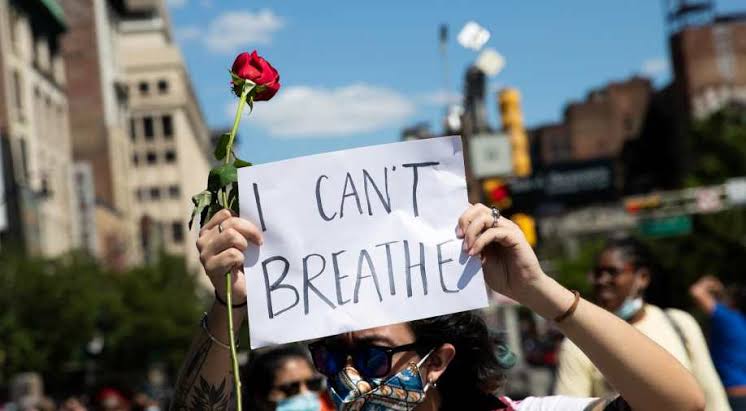
George Floyd, an african american,46, who was pinned under the knee of a white police officer in Minneapolis,was killed by that white officer.Floyd was constantly saying under his knee” I can’t breathe”.This sentence has prompted more than a week of street protests throughout the states,
The sentence”I can’t breathe” is not new for the African Americans .An another matter was introduced earlier in which a black man was killed by police personnels in USA with words ” I can’t breathe ” and this sentence also hold the meanings of all discrimination taking place there in USA.In jobs ,In schools in society everywhere a racial discriminative surrounding is established there where these poor black african americans are living miserably.
In USA, where the data of covid patients releases failure of USA against the well established health system, this racial dispute is showing it’s weakness in administrative fields too.
USA is burning with the fires of discrimination as well as highest cases of covid-19. USA should be more careful nowadays and should not play any political games .USA is failing to pretend to be the World Power whereas China is also being the victim of not spreading awareness of the virus in the world.
In such situation India can emerge like a Vishwa Guru again but we just need to be self relient to hold our country back to the ancient path of being Golden Bird.We Indians are proud to be resident of such a country, where all the posibilities of human lookings are present but besides of these India is United.
Many people want to break our union on behalf of Hindu and Muslim religion but I’m damn sure that they would never succeed.
thanks for reading.
like and comment..
Public

Faculty Development Program (FDP) hosted by Track2Training from June 10 to June 20, 2020
The Faculty Development Program (FDP) hosted by Track2Training from June 10 to June 20, 2020, was an intensive online event aimed at enhancing educators’ skills and competencies in various aspects of teaching and learning. This program was meticulously designed to provide comprehensive training and practical insights into contemporary educational practices. Below is a detailed breakdown of the program’s structure, components, and outcomes:

Program Overview
Event: Faculty Development Program
Dates: June 10 – June 20, 2020
Mode: Online
Organizer: Track2Training
Objective: To empower faculty members with modern teaching methodologies, technological tools, and innovative strategies to enhance educational delivery and engage students effectively.
Core Components
Curriculum and Content
- The FDP encompassed a wide array of topics pertinent to modern educational practices.
- Sessions focused on pedagogical innovations, assessment techniques, curriculum design, and the integration of technology in teaching.
Schedule and Structure
- Spanning over 10 days, the program included daily sessions featuring lectures, workshops, and interactive discussions.
- Each day was divided into multiple segments, including keynotes by industry experts, hands-on training sessions, and Q&A forums.
Learning Management System (LMS)
- The program was delivered through a sophisticated LMS, offering easy access to resources, recorded sessions, and interactive tools.
- Participants could utilize a dashboard to track their progress, submit assignments, and engage with peers and instructors.
Expert Speakers and Facilitators
- The FDP showcased a diverse panel of distinguished speakers and facilitators from both academia and industry.
- These experts provided insights into various educational trends, technological advancements, and effective teaching practices.
Interactive and Practical Approach
- The sessions emphasized active learning through case studies, group activities, and role-playing exercises.
- Participants were encouraged to share their experiences and apply new strategies in simulated classroom settings.
Assessment and Feedback
- Regular assessments were conducted to evaluate participants’ understanding and application of the content.
- Feedback mechanisms were in place to offer constructive criticism and guide participants towards improvement.
Detailed Session Breakdown
Days 1-2: Introduction to Modern Pedagogy
- Overview of current trends in education.
- Focus on student-centered learning.
- Techniques for fostering critical thinking and problem-solving skills.
Days 3-4: Technology Integration in Teaching
- Utilization of digital tools for effective teaching.
- Introduction to e-learning platforms and virtual classrooms.
- Best practices for creating engaging multimedia content.
Days 5-6: Curriculum Development and Assessment
- Principles of curriculum design and alignment with learning outcomes.
- Innovative assessment techniques for evaluating student performance.
- Designing effective rubrics and feedback mechanisms.
Days 7-8: Enhancing Student Engagement
- Strategies for motivating and engaging students.
- Incorporation of gamification and interactive elements in lessons.
- Understanding diverse learning styles and adapting teaching methods accordingly.
Day 9: Research and Innovation in Education
- Encouragement of research-based teaching practices.
- Exploration of opportunities for educational research and publication.
- Introduction to grant writing and research funding opportunities.
Day 10: Reflection and Future Directions
- Reflecting on learning outcomes and personal growth.
- Development of action plans for implementing new strategies.
- Networking and collaboration opportunities with fellow educators.
Outcomes and Benefits
- Enhanced Skill Set: Participants acquired practical skills in curriculum development, technology integration, and student engagement.
- Professional Development: The program significantly contributed to participants’ professional growth, enhancing their teaching effectiveness and career opportunities.
- Networking Opportunities: Attendees had the chance to connect with peers, experts, and industry leaders, fostering collaboration and knowledge exchange.
- Certification: Participants received a certificate of completion, validating their participation and newly acquired competencies.
The Faculty Development Program conducted by Track2Training from June 10 to June 20, 2020, was a transformative initiative that provided educators with essential skills and knowledge to navigate the evolving educational landscape. Through a blend of theoretical insights and practical applications, the program addressed the challenges faced by modern educators and offered a platform for continuous learning and professional advancement.
Public

How to Pick the Best MBA Program?
One of the most sought out courses the MBA, typically also brings a lot of confusion, the most common one being which MBA program is the right one to select. Here you can decide on the one that must be applied?
Now that you’re clear on your goals. You can decide where you’ve got to apply. While selecting an MBA program there are a lot of things you must take care of – the main one being the website, rankings, MBA fairs, blogs through students, print articles along with admission committees, and the days of open campus – just naming a few of these.
Steps for finding the right MBA program
Here you can get all of the essential information for helping you in making the best choices for enrolling in MBA programs. Here some essential steps are listed that provide meaningful information and also help in shaping the best decision.
Checking on the rankings
The most recommended thing to do while looking out for an appropriate MBA program would be to check out the rankings. However, all the clients find that they’ve got a good beginning place. You can’t only rely on a single ranking publication. Here you can also check out various of these as each one can focus on various things and it also offers different points of data – and in almost all the cases it is the data that holds value not only the rankings.
The data is used for evaluating competitiveness such as on-pars, reaches, and possible safety schools. There might be one or two programs that are out of range but it would still be worthwhile to apply for these if you think that these are best suitable according to your needs. And it would be great if there are some good elements present in your personal profile that the business school values enough for overlooking statistical deficit. Also, you need to be realistic at the same time.
Make sure you need to be competitive for the programs that you’re applying to
While you’re in the process of checking the ranking of programs, make sure to look out for specialty rankings. You can lay emphasis on the MBA programs that are under the personal area of interest, especially when you’re not competitive at ranked highly overall but remain competitive at the ranking of programs for the specific set targets.
In order to prepare well for the admission essay writing visit Copycrafter, a professional writing service.
Taking recommendations from others
You can find people having experience in the MBA – friends, mentors, and colleagues – and you can learn about the post MBA career with the MBA experience evaluation. Then it’s best to mix qualitative feedback with research for starting analyzing the appropriate fit.
Weigh the preferences and then fit
You can check out the MBA program websites that fall under your niche of interest and you can also be up to date with the college social media. You can read student blogs and focus on things that are vital for you, like flexibility, curriculum structure, student body placement record, make-up with the extracurricular activities that are related to the professional goals along with personal interests and hobbies, etc. Make sure to acquire both the objective and subjective information and determine accordingly.
Going in the Source
Logging the computer off and then taking part in the MBA fairs while visiting actual campuses. The clients found that nothing would be like speaking with the students and admission staff with professors and noticing how the community interacts for knowing if they fit there or not.
Accreditation for the MBA programs
With proper accreditation it is ensured that the school and program have been trustworthy and certified. The accredited schools strictly follow standards that are articulated through outside learning commissions, so the degree seekers know that they’ve obtained quality education.
Institutional accreditation is mainly available in two forms: national and regional. The regional accreditation is quite a rigorous process and the students with aspirations for attending graduate school and getting certificate and license must only consider enrolling in an institution holding regional accreditation.
The programmatic accreditation focuses on certain degrees for ensuring that the curriculum adequately has prepared all the postgraduates for employment post-college. There are many accreditation institutions for MBA colleges and many colleges are affiliated with these.
You must know about the reputation of the program. The MBA programs have respected professors attracting attention and renowned alumni with the business community knowing the schools that reliably function similar to talent pipelines. Once you’ve got an idea of each program with a fair idea about their competitiveness, you can also visit the schools.
Public

How Higher Education Will Change in 2021
According to the recommendations of the committee set up for draft National Education Policy (NEP), Human Resource Development (MHRD) ministry came up with a decision for modernizing the evaluation process after moving away with the school examinations in the year 2021. The newest module of evaluation would stress on assessments that are class-based and according to an official of the HRD, the schools will follow 5-3-3-4 structure.
All the possibilities are currently being examined by the government for finalizing the National Education Policy towards the month of October 2020, and these policies get implemented from the year 2021. “Also, we would be notifying boards for the recommendations on the new structure of the exam recommended by the committee. After getting suggestions from education experts and boards, the ministry would consider junking out the old format of 10+2, and it will proceed on the proposed process of evaluation from the year 2021,” was stated by the official to Indian Express.
The committee of draft National Education Policy (NEP) during the month of June also recommended the structure of 5-3-3-4 that comprised of five years foundation stage (with 3 years in pre-primary school with one or two classes), three preparatory years (three to five classes), and three middle stages of three years (six to eight classes), and for four years secondary stage (9 to 12 classes).
The committee has also recommended a Rashtriya Shiksha Aayog which would be chaired by the honorable prime minister. The board would also have education minister, Lok Sabha Speaker, and Chief Justice of India along with the country’s top academics. Also, it recommends the HRD ministry to be renamed as the Ministry of Education. The details are broken down by ET.
Changes in Schooling Education
The new structure was proposed by the committee on lines of international schooling based process of evaluation, which also assessed students on the basis of performance that was class-based. The committee also noted that through the present way of board examinations, the students were forced to only concentrate on some subjects without the need of getting any scope for learning an informative manner, which would eventually lead to stress among the students.
“For tracking students” progress was made throughout the experience of school, draft policy also proposed State Census Examinations with the class of three, five, and eight. Also, it further recommended the restructuring of board examinations for only testing skills, core concepts, and capacities of a higher order.
Such board examinations are based on various subjects. Students are free to choose accordingly with their subject of interest, and semester while they wished to take board exams. Final school examinations get replaced by such board examinations,” recommended the committee.
The ministry was also considering extensions of free age learning under the act of Right to Education (RTE) from 14 to 18 years of age. “As it got proposed under the NEP committee draft, the ministry currently is working on including secondary school education and early childhood education under RTE Act ambit. This extends the Act coverage to all the children aged between 3 to 18 years,” as it was said by the official.
Post School Changes
As was suggested under the panel, the higher system of education was brought within a single regulatory authority – National Higher Education Regulatory Authority (NHERA). While the University Grants Commission (UGC) is about to remain purely a grant body. Similarly to All India Council of Technical Education, National Council for Teacher Education, and Medical Council of India, it needs to evolve in Professional education standard-setting authorities, it was suggested by the panel.
The policy also suggested three universities. Universities focused on research, comprehensive teaching, and research universities with the Type 3 that are focused only on teaching. Look up omnipapers.com for more information.
The committee also recommended a four-year bachelor program for liberal arts or a bachelor’s degree in liberal education.
The panel also suggested that all courses in the undergraduate category need to be shifted to three-or-four-year duration with a lot of options for the exit while only allowing advanced diploma in discipline or after completion of two study years or diploma after completion of one year.
Different master’s program designs are proposed from the two-year program with second-year being entirely devoted to research or integrated five-year bachelor’s/master’s program besides having a single year master’s program for everyone who completed the program of four years.
Similarly, all institutes are permitted for offering a Ph.D. with either a master’s degree or four-year bachelor’s degree along with research.
Meanwhile, the states of West Bengal, Odisha, and Gujarat re-introduced the system of pass-fail for their schools.
Public

Dona Juliana: A Forgotten Christian in Mughal Harem
-By Shivam Pathak
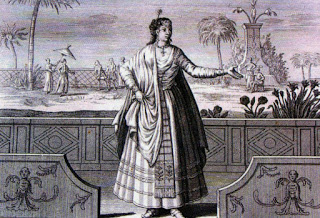
14th Century marked the advent of Portuguese in the Indian Subcontinent. Portuguese trade and commerce were flourishing in India because they were the first among other European nations who first discovered a direct sea route to India. The advent of Portuguese in India also laid the foundation stone of overseas romance in the exuberant peninsular region in south-central Asia. During 17th and 18th century Mughal Empire was started losing hold on the Indian peninsula because of the surging British extension on the landscape. Shah Alam also known as Bahadur Shah First ascended himself on the peacock throne of Delhi Sultanate after a vigorous fight with his father Auranzeb for his succession on the throne. Among the supporters of Shah Alam was a Portuguese Woman named Dona Juliana. She served the future king Shah Alam faithfully when the latter was in captivity after rebelling against his father. When Shah Alam was proclaimed King Juliana becomes his wife and her rank was above all the nobles in the court. It was believed that whenever Juliana would ride, she was escorted by five or six thousand men on foot. According to Italian Jesuit Ippolito Desideri, Juliana’s influence was so extraordinary on Shah Alam that she brought him to the brink of Baptism. The latter would kneel before Jesus in the prayer and send blessings to churches, and it was gossiped that he had become Christian on his deathbed. Her firm presence can be noticed in the Mughal court from one more instance when she persuaded the king to declare Surat a duty free port for the Portuguese because it was an important port in respect of trade and the emperor done so for her.With the course of time she was christened as “Bibi Juliana”. She was also conferred with several other titles such as “Fidavi Bahadur Shah Juliana” (Juliana, loyal servant of Bahadur Shah). Desideri also referred Juliana’s position in the moughal household (Harem) as a significant one. Dona Juliana throughout her life maintained diplomatic relations with Europeans, especially the Estado de Portugal. She can not only be identified as a diplomat, but also as a proxy for the Jesuit spiritual mission in India. It’s very important to observe that her influence wasn’t faded after Shah Alam’s death, but advanced even after his death. According to an Article written by historian William Irvine in the Journal of the Royal Asiatic Society, Bibi Juliana died at the age of 75 in the year 1734. Likewise Moughal sources like “Tarikh-i-Muhammadi”, documented that a firangi woman who was dearest to the Late Bahadur Shah first, died in Delhi in 1734. Consequently Dona Juliana Diaz da Costa was a Portuguese woman whose credentials marked immense accomplishments in terms of enormous power and influence at the court of the Moughal king, Shah Alam. History can never consign to oblivion the memory of Juliana, whose existence was absolute in her own being.
Sources of information used in this article are- Piece of Dr, Taymiya R. Zaman’s writing on the website of the University of San Francisco, Pankaj Vohra’s article “Juliana:The Mughal Princess from Portugal” in the Sunday Guardian and the article “Note on Bibi Juliana and the Christians at Agra” by historian William Irvine, published in the Journal of the Royal Asiatic Society.
Public

Ooty: Queen of Hills
By- Shakti Singh Rathore
The Nilagiri or Blue mountains are home to a beautiful, lush green and attractive town Ooty which rests in its foothills. Ooty (also known as udhagai, udhagamandalam, ootacamud, Queen Of Hills) is a small town located 100kms north from Coimbatore in Tamil Nadu, attracts a huge number of tourists by its serene beauty, lush slopes and unspoiled landscapes. This town of 36 sq.kms and altitude of 2240M above sea level was used to be a summer resort of British Raj and now it’s one of the favorite honeymoon destinations for newlywed couples. Not only tourists but this place also have been attracting filmmakers since it has been discovered, some famous and hit Bollywood movies like Raja Hindustani, Golmaal 4, Kuch Kuch Hota Hai and so many movies have been shot here. Originally occupied by the Toda people, the area came under the rule of the East India Company at the end of the 18th century. The economy is based on tourism and agriculture, along with the manufacture of medicines and photographic film.
MY EXPERIENCE

Ooty, whenever I use to hear this name my mind automatically use to picture winding roads, green mountains, gushing cascades, The two things which excite bike riders the most are speed and curvy roads with a hairpin bend. Ooty is full of them and is one of the favorite places for born to ride a person of South India and I m one of those born to ride persons and my ride to Ooty was extremely exciting and full of surprises. I started my journey from Coimbatore on Monday morning so that I meet less traffic. It was winter season or say in December with a little drizzle of rain. Until Mettupalayam road was good visible but as soon as I reached Mettupalayam the clouds threw a little well and road became dark because of the shape of trees near the road, it was like a tunnel made by trees.
There are two ways to reach Ooty (1.cunoor, 2.kothagiri) I took junior to drive up and kothagiri to drive down. There started the hills, forest and bends. After two or the bends, you might start getting views of Mettupalayam town but unfortunately, midst was all I could see due to weather. Due to the midst, visibility reduced drastically and even road wasn’t visible.
With only that much visibility, my journey came to halt at the very first tea point, I waited for the midst to pass a little bit so that I can drive up. After 30 minutes I started my ride back. Slowly things started appearing and it was very joyful to see those long trees, dark road, dense green forest, monkeys on sidewalls. That chill breeze with the fragrance of wet trees along with the fragrance of flowers and fruits was something a city wearer person should go to a hill station for. The road was very clear then and also in perfect condition and after two hours it (Ooty) was closer and clearer. Three hours straight on the same seat might make one feel disquieting but all those feelings fly away when you see lush green slopes with tea plantation, small houses in those blue mountains with narrow streets, cliffs with long trees, still neat and undamaged ancient architecture, white clear clouds moving fast. In a moment I forgot all my tiredness and started enjoying the views. My accommodation was preplanned in Elk Hill Hotel (a three-star hotel with good views from the balcony). Since my hotel was on the other side of the town I moved to the main city of Ooty. This town was set on a steep hill so it was basically like one street up and the other down. Roads in the city are broad but due to lots of fancy shops, restaurants and hotels, it looks narrow. The one shop you can see throughout this town is the shop which sells chocolate and tea powder (handmade chocolates and fresh tea in this town are famous). Finally, I reached my hotel and my plan was to stay there for three days and explore each and every place and explaining my three days experience will be quite long for readers so I cut short tell places you must visit, do’s and donts and ways to reach
Must visit:
- OOTY:
At a distance of 1 km from Ooty Bus Station & Railway Station, Ooty Lake is an artificial lake situated in the beautiful hill station of Ooty. The lake is surrounded by groves of Eucalyptus trees with a railway line running along one shore. Situated amidst beautiful valleys, Ooty Lake is a major landmark in the town and is the prime attraction in Ooty.
- BOTANICAL GARDEN
At a distance of 3 km from Ooty Bus Station & Railway Station and 4 km from Ooty Lake, Ooty Botanical Gardens is a beautiful garden situated on the foothills of Dodabetta Peak in Ooty. The garden spreads over an area of 22 hectares with more than 650 species of flowers and trees. It houses a thousand species of plants, shrubs, ferns, herbal, bonsai plants, and trees.
- DODDABETTA PEAK:
At a distance of 9 km from Ooty, Doddabetta is the highest point in the Nilgiri Mountains. One can have a magnificent panoramic view of the landscape, beautiful valley, plains of Coimbatore and the flat highlands of Mysore from the peak.
- ROSE GARDEN
At a distance of 2 km from Ooty Bus Station & Railway Station, the Government Rose garden is situated. This garden has been beautifully laid out in terraces with rose tunnels, pergolas and bowers with rose creepers.
- WENLOCK DOWNS:
At a distance of 16 km from Ooty, Wenlock Downs is a vast expanse of grassy meadow located on the way to Pykara in Ooty. The journey from Ooty to Wenlock Downs takes one to the most serene excursions from Ooty. The Wenlock Downs is perfect for walking and hiking amidst this elegant landscape. The peak offers breathtaking views of the Nilgiris and is one of the best places to watch the nature of Ooty.
- PYKARA FALLS:
At a distance of 2 km from Pykara Lake and 23 km from Ooty Bus Stand, Pykara Falls is a majestic waterfall. The waterfall amidst the dense forest is a treat to watch. It is one of the must-visit places for honeymoon couples and nature lovers during their Ooty trip. During the rainy season, the waterfall is in full bloom.
- TOY TRAIN:
You wouldn’t disagree with me if I tell that the Toy train is by far one of the biggest attractions in Ooty. And why not? It summarizes the essence of Nilgiris – lush green tea estates, towering Nilgiri/Eucalyptus trees, beautiful bridges on which the train chugs, countless tunnels where darkness consumes the space and leads to light at the end.
How to reach
Air: Approximately 85 km away, Coimbatore Airport is the aerodrome closest to Ooty that connects this hill station with the rest of the country via an extensive network of flights. Carriers like Air India, IndiGo and SpiceJet have regular flights from New Delhi, Mumbai, Kozhikode, Bangalore, Hyderabad, and Ahmedabad. International travelers can book their tickets till Bangalore (around 310 km away) as Bangalore airport, popularly known as Kempegowda International Airport, is connected with major cities across the globe. Taxis and buses are easily available from both airports for Ooty.
Road: An amazing way of reaching Ooty is by the well-maintained state and national highways. Tamil Nadu State Road Transport Corporation (TNSTC) buses along with some private buses connect Ooty with major neighboring cities like Bangalore, Chennai, and Mysore. NH 209 and NH 275 connect Bangalore with Ooty, and a number of luxury buses operate from Bangalore, which takes around 7 to 8 hours.
Rail: Mettupalayam, 40 km from Ooty, is the nearest railhead serving this hill station. Several trains are available from nearby cities like Chennai, Coimbatore, Mysore and Bangalore for Mettupalyam. Once you reach the railway station, you can hire private cabs or avail bus services to reach Ooty. Another exciting way of getting to Ooty is by boarding the heritage Nilgiri mountain toy train, which takes you uphill, moving through thick forests, down the valleys via dark tunnels. Though this journey is extremely slow and time-consuming, it is a once in a lifetime experience.
Public

Caste System: The sociology of Indian Society
by: Kashish Bohra
Indian society is divided into various sects and classes. This is because of the caste system which is prevalent in the country. The roots of the caste system go back to the ancient Vedas dividing people on the basis of occupation. It has brought many evils in society. The Government is constantly striving to overcome the harms of the system and bring about true equality among the people.
Caste System in India

The caste system is the bane for Indian society. It divides the Indian society into sectarian groups and classes. Even today, it plays a predominant role in our society despite the growth of culture and civilization.
- The terms ‘Scheduled Castes and Scheduled Tribes’ (SC/ST) are the official terms used in government documents to identify former untouchables and tribes. However, in 2008 the National Commission for Scheduled Castes, noticing that the word ‘Dalit’ was used interchangeably with the official term ‘Scheduled Castes’, asked the State Governments to end the use of the word ‘Dalit’ in official documents by calling the term ‘unconstitutional’ and to replace it with the term ‘Scheduled Caste’ instead.
- The roots of the caste system are traced back to the ancient ages. While one view discriminates between the castes as upper and lower castes on the basis of their origin, another view traces the origin of the castes to which classifies the caste system on the basis of their functions. Since then, it was found that undue advantage was taken by the section of people having an upper hand and a say in the community, leading to discrimination and exploitation of the weaker sections of the community.
- The people from Scheduled Castes and Scheduled Tribes, referred to as ‘untouchables’ form one-sixth of India’s population or 160 million; they endure discrimination and segregation.
Evil faces of this system
Untouchability
Many villages are separated by caste and they may not cross the line dividing them from the higher castes. They also may not use the same wells or drink in the same tea stalls as higher castes.
Discrimination
They often do not have the facility to electricity, sanitation facilities, or water pumps in lower caste neighborhoods. Access to better education, housing and medical facilities than that of the higher castes is denied.
Division of labour
They are restricted to certain occupations like sanitation work, plantation work, leather works, cleaning streets, etc.
Slavery
They are subjected to exploitation in the name of debt, tradition, etc., to work as labourers or perform menial tasks for generations together.
Government Initiatives
The Indian Government has enacted laws to remove untouchability and has also brought in many reforms to improve the quality of life for the weaker sections of society. Few among them are:
- Constitutionally guaranteed fundamental human rights
- Abolition of ‘ untouchability’ in 1950
- Scheduled Caste and Scheduled Tribe (Prevention of Atrocities) Act, 1989
- Provision of reservation in places like educational institutions, employment opportunities, etc.
- Establishing social welfare departments and national commissions for the welfare of scheduled castes and tribes
These measures adopted by the government have brought some relief to the weaker sections of society. The urban areas have shown a good amount of impact and some improvement. However, people in rural areas and villages still face extreme discrimination. We indeed have a long way to go in achieving the objectives set to eradicate and abolish discrimination, on the basis of caste and creed. It now depends on our efforts and a change in our mindset is sure to see a perpetual change, bringing about equality for all.
Right to Equality
The fundamental fights are guaranteed to protect the basic human rights of all citizens of India and are put into effect by the courts, subject to some limitations. One of such fundamental rights is the Right to Equality. Right to Equality refers to equality in the eyes of law, discarding any unfairness on grounds of caste, race, religion, place of birth sex. It also includes equality of prospects in matters of employment, the abolition of untouchability, and abolition of titles. Articles 14, 15, 16, 17 and 18 of the Constitution of India highlight the Right to Equality in detail. This fundamental right is the major foundation of all other rights and privileges granted to Indian citizens. It is one of the chief guarantees of the Constitution of India. Thus, it is imperative that every citizen of India has easy access to the courts to exercise his/her Right to Equality.
Various articles under the Right to Equality are explained as follows:
Equality Before Law
Equality before the law is well defined under Article 14 of the Constitution which ensures that every citizen shall be likewise protected by the laws of the country. It means that the State will not distinguish any of the Indian citizens on the basis of their gender, caste, creed, religion or even the place of birth. The state cannot refuse equality before the law and equal defense of the law to any person within the territory of India. In other words, this means that no person or group of people can demand any special privileges. This right not only applies to the citizens of India but also to all the people within the territory of India.
Social Equality and Equal Access to Public Areas
The right of Social Equality and Equal Access to Public Areas is clearly mentioned under Article 15 of the Constitution of India stating that no person shall be shown favoritism on the basis of color, caste, creed language, etc. Every person shall have equal admittance to public places like public wells, bathing Ghats, museums, temples etc. However, the State has the right to make any special arrangement for women and children or for the development of any socially or educationally backward class or scheduled castes or scheduled tribes. This article applies only to citizens of India.
Equality in Matters of Public Employment
Article 16 of the Constitution of India clearly mentions that the State shall treat everyone equally in matters of employment. No citizen shall be discriminated on the basis of race, caste, religion, creed, descent or place of birth in respect of any employment or office under the State. Every citizen of India can apply for government jobs. However, there are some exceptions to this right. The Parliament may pass a law mentioning that specific jobs can only be filled by candidates who are residing in a particular area. This requirement is mainly for those posts that necessitate the knowledge of the locality and language of the area.
Apart from this, the State may also set aside some posts for members of backward classes, scheduled castes or scheduled tribes which are not properly represented in the services under the State to uplift the weaker sections of the society. Also, a law may be passed which may entail that the holder of an office of any religious institution shall also be a person professing that specific religion. Though, this right shall not be granted to the overseas citizens of India as directed by the Citizenship (Amendment) Bill, 2003.
Abolition of Untouchability
Article 17 of the Constitution of India abolishes the practice of untouchability in India. The practice of untouchability is declared as a crime and anyone doing so is punishable by law. The Untouchability Offences Act of 1955 (and now Protection of Civil Rights Act in 1976) states punishments for not allowing a person to enter a place of worship or from taking water from a well or tank.
Abolition of Titles
Article 18 of the Constitution of India prohibits the State from granting any titles. Citizens of India are not allowed to accept titles from a foreign State. Titles like Rai Bahadurs and Khan Bahadurs are given by the British government have also been abolished. Nevertheless, academic and military distinctions can be conferred upon the citizens of India. The awards of ‘Bharat Ratna’ and ‘Padma Vibhushan’ cannot be used by the beneficiary as a title and is not prohibited by the Constitution of India. From 15 December 1995, the Supreme Court has sustained the validity of such awards.
To conclude, the ‘Right to Equality’ should not only remain on papers. This right should be properly exercised; otherwise, it will lose its essence if all the citizens of India, especially the weaker and backward classes do not have equal rights and equality before the law.
Public

Disrespect, not Dress, does it – The increasing rape cases are a serious concern for mankind
By- Ekta Sain
Looking at the current state it looks like after some time we will be living in a country where we won’t be giving birth to a human, we will give birth to a human who is worse than an animal. This nation is becoming unsafe not for only girls but also for boys. Not only streets, roads or workplace but our homes are becoming dangerous for us.
Every year there are many cases of molestation and rape came across. Some are registered, some not. Why are these happening in our country? Why are these molesters or rapists moving freely?
According to the Indian Constitution, the definition of Rape is “when a man forcibly does any sexual activity with women then it is considered as rape.” They never recognized that a man can also be raped.
According to a study conducted by NDTL on an average of 8 women get molested every day in India. But the research of the Centre for Civil Society says that the victims of assault are 57.3% males and 42.7% females. In such cases, family members of female victims avoid disclosure and maintain the confidentiality of the victim and sometimes they complain about the crime. But when it comes to males being a victim for sexual molestation, they don’t get reported for it. It is a myth in our society that boys cannot cry in front of everyone they have to be mentally strong. This myth stops boys from confessing their molestation.
Men believe this myth and feel lots of guilt and shame because they got physically aroused during the abuse. It is important to understand that males can respond to sexual stimulation with an erection or even an orgasm – even in sexual situations that are traumatic or painful. That’s just how male bodies and brains work. Those who sexually use and abuse boys know this. They often attempt to maintain secrecy and to keep the abuse going, by telling the child that his sexual response shows he was a willing participant and complicit in the abuse. “You wanted it. You liked it,” they say.
But that doesn’t make it true. Boys are not seeking to be sexually abused or exploited. They can, however, be manipulated into experiences they do not like, or even understand, at the time
There are many situations where a boy, after being gradually manipulated with attention, affection and gifts, feels like he wants such attention and sexual experiences. In an otherwise lonely life (for example, one lacking in parental attention or affection – even for a brief period), the attention and pleasure of sexual contact from someone the boy admires can feel good.
But in reality, it’s still about a boy who was vulnerable to manipulation. It’s still about a boy who was betrayed by someone who selfishly exploited the boy’s needs for attention and affection to use him sexually
There was a study conducted by a research scholar of Babu Banarsi Das University Lucknow in which she described myths related to rape cases. According to her, “rape myths exist for a number of historical and cultural reasons including gender role expectations, acceptance of violence and misinformation about sexual assault and they are the one reason why victims are shamed into remaining silent.”
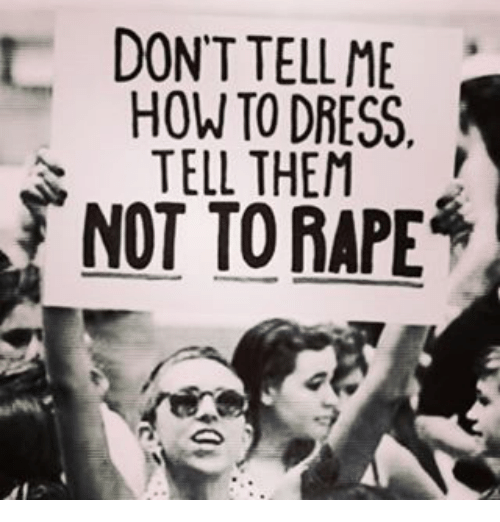
According to this research, the reason why rapes are happening is women are dressing provocatively and that turns out as a problem for her. This is believed by 45% of individuals. Many of them blame the girls who drink. According to them if a girl drinks then she deserves to be raped. Another reason for rape is a girl in the relationship and some blamed the girls who stay outside late at night.
Till when we only ask our girls to hide their beauty and innocence can’t we ask boys to control and behave themselves? If these cases were not taken seriously in our country then it is natural that after some time we won’t find a road where girls will walk freely, it will be hard to find a home where they could live freely.
Public

Cultural heritage of gujrat-patolas
By :- Raaisha Upadhyay
We all know the place Hastinapur and a case of Draupadi(the woman epitome of feminism) the wife of Pandavas and a dice game against Kauravas, which was responsible for Draupadi’s humiliation
The magical dice was rolled by shakuni and Pandavas lose and Draupadi has been won by Kauravas.
And from here technically Kauravas owned Draupadi ,
they order Dushasana to disrobe Draupadi in public and from here a miracle take place.
No matter how much Dushasana tries to take a cloth but never ending cloth continue to cover and protect Draupadi.
The cloth that covered Draupadi was a saree.
This miracle happened just because of Lord Krishna.
The Ancient kingdom of Krishna’s is Dwarka (the home of Krishna is a gateway to heaven and an underwater city)which is located in the state of Gujarat.
Gujarat is also famous for their Patola sarees.
Patola is double ikat woven silk saree once worn only by those belonging to Royal and aristocratic families, as they are very expensive The sarees takes around 6 months to 1 year in manufacturing. one saree due to long process of dying it strand separately. The starting price of Patola sarees is 1lakh to 7 lakh.
Patola usually woven in Surat, Ahmedabad and Patan but velvet Patola style are majorly made in Surat.
Patan, the house of Patola, is 125 kms away from Ahmedabad. The town is also famous for ‘Rani –ki Vav’, a step-well made by a queen in honour of her husband. It is now a UNESCO World Heritage site.
About 900 years ago in 1143 A.D., around 700 craftsmen from the Salvi community hailing from modern day Karnataka and Maharashtra were brought by king Kumarpal of the Solanki dynasty (who then ruled Gujarat, parts of Rajasthan and Malwa) to his court, in his kingdom’s capital, Patan. These craftsmen lived in Jalna, situated in southern Maharashtra, and were considered to be the finest craftsmen of Patola.
Patola in modern day India…
Patola is undoubtedly the epitome of fine craftsmanship. Today, only 2-3 families, the Salvis and Sonis, practise this 900 year old craft in Patan. These families aren’t very open about the process of forging Patola. Only the family members, and in some cases only the male family members, are passed down this knowledge. Nobody from outside the community is admitted into craftsmanship.
However, in the past few years, the Sonis have loosened their boundaries and started passing this craft to people outside of their family who are hardworking, dedicated and passionate towards the craft. This change of attitude is because of the fear of Patola becoming extinct.
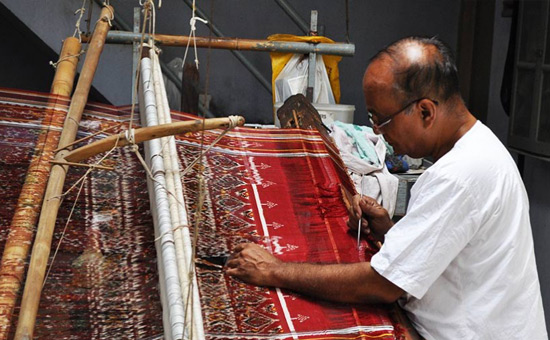
A weaver giving life to a Patola sari.
The current state of this art is alarming. Some Patola weavers have predicted that the art will vanish within the next 20 years or so. Lack of investment, fewer weavers, and dis-interest on the part of the younger generation of weaving families are reasons for such a prediction. Also cheap imitations are capturing the market.

 International Journal of Research (IJR)