Red Planet Day: A Tribute to Mars and the Ongoing Quest for Exploration

Daily writing prompt
Do you ever see wild animals?

Every year, on November 28, the world celebrates Red Planet Day, a day dedicated to one of the most intriguing and captivating celestial bodies in our solar system — Mars, often called the “Red Planet” because of its reddish hue visible to the naked eye. The date holds significant historical importance because it marks the anniversary of a pivotal moment in space exploration: the launch of Mariner 4, the first successful mission to Mars, on November 28, 1964. This spacecraft forever changed our understanding of the Red Planet, sending back the first close-up images of its surface and dispelling many long-held misconceptions.
The Significance of November 28

On November 28, 1964, NASA launched Mariner 4 on a mission to fly by Mars and transmit photographs back to Earth. When the spacecraft finally passed within 9,000 kilometers of Mars in July 1965, it became the first to capture detailed images of the Martian surface, revealing a barren, cratered landscape. These groundbreaking images were a far cry from the visions of a lush, canal-filled Mars imagined by astronomers like Percival Lowell in the late 19th century. The Mariner 4 mission marked the beginning of humanity’s quest to understand Mars — a journey that continues to this day.

Mars: The Red Planet

Mars, the fourth planet from the Sun, has fascinated humans for centuries. Known for its distinctive red color due to iron oxide (rust) covering its surface, Mars has long been the subject of scientific inquiry and popular imagination. Despite its harsh and inhospitable environment, it has sparked hopes of past life, potential for future exploration, and even human colonization.

Mars shares several similarities with Earth:

  • Day Length: A Martian day, known as a sol, is just slightly longer than an Earth day — about 24 hours and 39 minutes.
  • Seasons: Like Earth, Mars experiences seasons due to its axial tilt, though the Martian year is nearly twice as long as Earth’s.
  • Polar Ice Caps: Mars has ice caps made of frozen carbon dioxide (dry ice) and water ice at its poles, which grow and recede with the changing seasons.

However, Mars is also starkly different from Earth:

  • Atmosphere: The Martian atmosphere is incredibly thin and primarily composed of carbon dioxide, with only trace amounts of oxygen. This makes it impossible for humans to breathe without specialized equipment.
  • Temperature: Temperatures on Mars can drop as low as -125°C in the winter at the poles, and the average surface temperature is around -60°C, making it inhospitable for most Earth-based life.
  • Water: While Mars is dry and arid today, evidence suggests that it may have had liquid water in the past. Ancient riverbeds, lake basins, and signs of water erosion indicate that Mars once had a much wetter and possibly warmer environment.

Despite these challenges, the search for signs of past or present life on Mars continues to be one of the central goals of Martian exploration.

The Path to Understanding Mars: A History of Exploration

Humanity’s exploration of Mars has been a slow and steady endeavor, beginning with early telescopic observations and advancing into the space age. Over the years, numerous missions have unlocked key mysteries about Mars. Below are some of the pivotal milestones in the history of Martian exploration:

1. Mariner 4 (1964) – The First Images from Mars

Mariner 4 was the first spacecraft to successfully fly by Mars and send images back to Earth. The images it returned, showing a dry and cratered surface, were a wake-up call to astronomers who had long speculated about a habitable Mars. This mission set the stage for further exploration and dispelled many myths about the planet.

2. Viking Program (1976) – Searching for Life

In 1976, NASA’s Viking 1 and Viking 2 landers touched down on Mars, conducting experiments that sought to detect signs of life. Though no direct evidence of life was found, the Vikings sent back invaluable data about the planet’s atmosphere, surface conditions, and geology, setting the stage for future missions.

3. The Mars Rovers – Moving Beyond Static Observation

Starting with Sojourner in 1997, NASA began sending rovers to Mars. These mobile laboratories were designed to explore the Martian surface, conduct experiments, and analyze soil samples in ways that stationary landers could not. The most famous of these, Spirit and Opportunity, far exceeded their expected lifespans and provided a wealth of data.

In more recent years, Curiosity (2012) and Perseverance (2021) have continued this tradition of exploration. Curiosity helped confirm the presence of ancient water on Mars, while Perseverance is collecting samples that may one day be returned to Earth for analysis. It is also studying the feasibility of producing oxygen from the Martian atmosphere, a key step toward future human exploration.

4. Ingenuity – The First Powered Flight on Mars

In 2021, the Ingenuity helicopter made history by becoming the first aircraft to fly on another planet. Attached to the Perseverance rover, Ingenuity has provided invaluable aerial views of the Martian terrain, assisting in navigation and scouting areas of interest for exploration.

The Importance of Red Planet Day

Red Planet Day serves as an important reminder of the ongoing efforts to explore and understand Mars. It is a day to reflect on humanity’s achievements in space exploration, to recognize the challenges that still lie ahead, and to inspire future generations of scientists, engineers, and explorers.

There are several reasons why Red Planet Day has become a significant observance:

1. Scientific Education and Outreach

Red Planet Day provides an opportunity for space enthusiasts, educators, and scientists to engage with the public. Schools, science museums, and observatories often host events, talks, and workshops to share the latest discoveries about Mars and the broader field of planetary science. It’s a day to spark curiosity about space and encourage young people to pursue careers in science, technology, engineering, and mathematics (STEM).

2. Reflection on Exploration

The day gives us a moment to pause and reflect on the many challenges we’ve overcome in our exploration of Mars. Space missions require significant technological innovation and scientific research. For example, the precision required to land a rover on Mars is staggering, as the Martian atmosphere is too thin to allow parachutes to slow down spacecraft in the same way as on Earth. Red Planet Day reminds us of the achievements of the scientists, engineers, and astronauts who make these missions possible.

3. Inspiration for the Future

Mars is central to humanity’s long-term aspirations for space exploration. Space agencies around the world, including NASA, the European Space Agency (ESA), and private companies like SpaceX, are working toward sending humans to Mars. Red Planet Day serves as an inspiration for this next great leap. It encourages us to think about the possibilities of human life on another planet and what technologies and strategies we must develop to make this a reality.

The Road Ahead: The Future of Mars Exploration

The future of Mars exploration is incredibly exciting. Here are some of the key upcoming milestones:

  • Mars Sample Return Mission: NASA and ESA are collaborating on a mission to bring samples of Martian soil and rock back to Earth, with the first launches expected in the late 2020s.
  • Human Missions to Mars: SpaceX’s Starship program is developing a spacecraft designed to transport humans to Mars. Elon Musk has set ambitious goals for establishing a human settlement on Mars in the coming decades.
  • Technological Innovations: In addition to sending humans, new technologies such as advanced robotics, life support systems, and in-situ resource utilization (e.g., creating oxygen from Mars’ carbon dioxide) will be crucial to making long-term human habitation on Mars feasible.

Conclusion: A Day to Celebrate Curiosity and Exploration

Red Planet Day is not just a commemoration of past achievements, but a reminder of the limitless possibilities ahead. From the first blurry images sent by Mariner 4 to the potential of human colonies on Mars, the exploration of the Red Planet continues to captivate our imaginations and fuel our scientific endeavors. Whether through new missions, technological advancements, or educational outreach, Red Planet Day inspires a sense of wonder, curiosity, and determination to keep exploring the vastness of space. As we look toward Mars’ distant future, one thing is certain: humanity’s relationship with the Red Planet is far from over, and its mysteries will continue to unfold for generations to come.

When NASA found the first ever ‘Ultrahot Neptune’

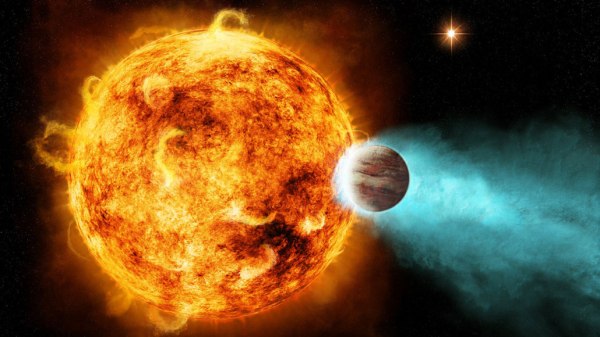
LOSING MY ATMOSPHERE  Astronomers think “hot Jupiter” exoplanets could lose their atmospheres as they draw close to their stars (as shown in this illustration), leaving scorched rocky worlds. The TESS telescope may have caught this transition in the act.

 Astronomers have spotted a new kind of planet: a Neptune-sized world sitting scorchingly close to its star. 

Astronomers have found a very hot planet, has the same size as that of a Planet Neptune.

It could be in the midst of transforming from a hot, puffy gas giant to a naked rocky core, astronomer James Jenkins reported July 29, 2019 at the TESS Science Conference at MIT.

“This planet is amazing. It’s the first of its kind,” says astronomer Elisabeth Adams of the Planetary Science Institute, who is based in Somerville, Mass. Adams studies larger planets that orbit close to their stars but weren’t involved in the discovery.

The planet is named LTT 9779b, orbits a star which is similar to our sun, and it’s about 260 light-years away. It was discovered by NASA’s Transiting Exoplanet Survey Satellite or TESS. The Satellite was launched in April 2018. 

Data collected by TESS show that the planet swings around its star once every 19 hours, putting it in a rare class of planets that orbit incredibly close to their stars.

Most other planets with such close orbits are either Earth-sized or Jupiter-sized and larger, said Jenkins, of the University of Chile in Santiago. But LTT 9779b is 4.6 times Earth’s size and 29.3 times Earth’s mass, placing it right in the middle of those extremes. Its proximity to its star should heat it to about 2000 kelvins (about 1725° Celsius), making it the first known ultrahot Neptune, Jenkins said.

One explanation for how close-in planets get cozy with their stars is that the worlds (Planets) form farther away and migrate closer over time. A planet that had a thick, gaseous atmosphere might lose more and more of that gas the closer it comes to its star, as the heat evaporates the atmosphere or the star’s gravity steals the gas away.

At about 2.5 million kilometers from its star, LTT 9779b may be about the closest a planet can physically get before the star gobbles up all of the atmospheres. If so, it could be a bridge between exoplanets called hot Jupiters, which are gas giants like Jupiter but have many closer-in orbits, and smaller, scorched rocky worlds, Jenkins suggested. The new planet is much smaller than a hot Jupiter, but still has a thick atmosphere that makes up about 9 percent of its mass, he said. 

The next step is to measure how quickly LTT 9779b is losing mass, Adams says. If it’s rapid, that could explain why no other ultrahot Neptunes have been discovered: They shift from gas giant to rocky core too quickly. Finding one mid-transition may have been a stroke of luck.

AI could trick us think that we have found Aliens scientists warn

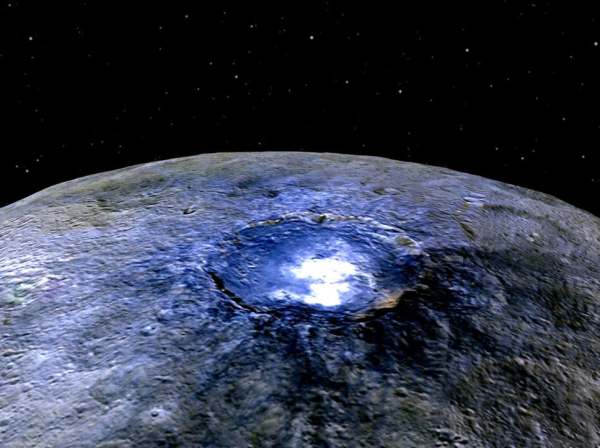
This representation of Ceres’ Occator Crater in false colours shows differences in the surface composition. Scientists use the false colour as a way of examining the way that the surface is composed ( NASA/JPL-Caltech/UCLA/MPS/DLR/IDA )

Artificial Intelligence could make us think that we have found aliens Scientists warn.

This technology means the simulation of human intelligence in a machine that is programmed to think like humans and mimic their actions.

Artificial intelligence is one of the breakthrough technologies in the search for extraterrestrial intelligence, is used to sort through huge amounts of the image in the hopes of spotting “technosignatures”, or indications of alien life.

But the discovery suggests that people could be get excited about potential discoveries spotted by artificial intelligence, only to find that they are meaningless, accidental formations on alien planets.

The study used a particular formation on the dwarf planet Ceres, which excited alien-hunters when it was first discovered. Ceres Ceres is a dwarf planet and the biggest object in the asteroid belt that sits between Mars and Jupiter. For a long time, scientists could only guess at what was causing the areas of brightness — with suggestions including gas, ice, volcanos or something else entirely. Nasa even asked the public for help in identifying the cause of the bright spots.

But the new research finds that the spots are probably salt, reflecting light up and so giving the appearance of a bright area on Ceres’s surface.

The study concludes that the “unusual areas are consistent with hydrated magnesium sulfates mixed with dark background material”, the researchers say. The paper has been published in Nature.

In all, there are more than 130 bright areas, most of which seem to have come from asteroid impacts. When those asteroids landed they likely dislodged the salt that is leading to the bright areas.

“The global nature of Ceres’ bright spots suggests that this world has a subsurface layer that contains briny water-ice,” Nathues said.
This claim has been made after the new images taken from the camera on Dawn.

The planet’s surface includes what appears to be a square structure within a triangle one, and appears to have been intentionally built. The discovery of the crater, named Occator, led some to speculate that it had been constructed by an alien civilisation – though it is most likely just an accident of light and shadow on the surface.

In the new research, conducted by scientists from the University of Cadiz and published in the journal Acta Astronautica, participants were shown one of those mysterious formations on the planet’s surface. They were then asked to describe what they saw, with many people pointing out the unusual formation.

The scientists then did the same with an artificial intelligence system, which had been trained to spot squares and triangles in images. The AI also spotted the formations – and, once it had, it meant that participants also saw them too.

“Both people and artificial intelligence detected a square structure in the images, but the AI also identified a triangle,” said Gabriel G De la Torre, the neuropsychologist who led the study. “And when the triangular option was shown to humans, the percentage of persons claiming to see it also increased significantly.”

The researchers said the study should warn those hunting for alien civilisations that the use of artificial intelligence “could confuse us and tell us that it has detected impossible or false things”. But it might also help us spot structures that would never have been noticed by humanity, he said,

“Manual Landing Mission on Moon and Factors Affecting Their Sudden Drop”

Humans have been challenging their boundaries and bringing every aspect of their dreams to be a realty. With the development in science and technology, men has been able to bring all sorts of comforts, facilities and knowledge to their lives. World war 2 led an important role in development of aerospace and related field. More aircrafts be it passenger or fighter were manufactured and this leads to a whole new phase of possibilities for humans. So humans were able to launch their first satellite in space, followed by the first person in space and then soon after a few years we were even able to land on the moon. Space became a fight between the top countries like the USA and Soviet Union. But initially Soviet Union were way long heading in this fight till the USA didn’t land their mission or manned mission on the moon. 

But the main thing to notice is that humans last landed on the moon in early 70’s.One after another space mission, Helped humans to discover a lot more about space, and each time they land, created history. But what led to the stopping of these missions suddenly. Why did the US stop their successful series of aircraft in outer space? Initially these were very successful missions to space until Apollo-13 which got to space and orbited the moon, but couldn’t land due to lack of oxygen . It was a tough journey back to planet safe, but it really helped NASA especially to look after loophole and prepare best for the next mission. After that, successful 4 missions held. But soon it stopped. The study shows the effect of “Budget for these space agencies as by the government”. In late 50’s as soon as Soviet Union started their missions to space, it put pressure on USA. Soon after they sent their first Cosmonaut to space and ended more pressure on the USA. The US seemed to lose this race to space. So they invested most of their money in developing space technology, research and new ideas to overcome this defeat. This truly resulted  as an advancement for humans and their reach beyond limits which they thought were impossible not. The moon landing and consecutive space flights lead them way long to head to Soviet Union and any other countries, making it the only country to land on the moon. 

But significantly the USA has limited its investment in most space projects and this has significantly called off most of their space missions. After 1973 , investment got less and decreased with time and is still very less as compared to what it used to be. The  reason for this is that they seem themselves as superpowers and no other country has achieved such accomplishment in space. So space travel and especially landing on the moon decreased . 

NASA is planning their next space manned program to land on the moon by 2024 and this might be a beginning of another phase of moon landing with back to back space flights and landing missions on moons. The dream to have a human base may get another lifeline to be fulfilled soon  and we may see other better possibilities, research and hidden secrets on the moon which could help us to better understand it, and we can make a permanent human base on our natural satellites.

Astronomers discover a remarkable Newborn Star

Newborn Neutron Star Swift J1818.0-1607.

NASA’s Neil Gehrels Swift observatory spotted a young object when it released a massive burst of X-rays.

This object is a baby neutron star known as Swift J1818.0-1607.

A new study in the journal Astrophysical Journal Letters estimates that it is only about 240 years old – a veritable newborn by cosmic standards.

When a massive star becomes supernova then it explodes and then a neutron star is born. After Blackhole, Neutron star is the second densest object in the universe. Neutron stars are so dense that a teaspoon of it would weigh 4 billion tons on Earth.

The mass of this newly discovered baby neutron names as Swift J1818.0-1607 is twice the mass of our sun and volume one trillion times smaller.

Swift J1818.0-1607 belongs to a special class of objects called magnetars because it exists with a magnetic field up to 1,000 times stronger than a typical neutron star and about 100 million times stronger than the most powerful magnets made by humans.

Saturn’s Moon Titan is drifting away hundred times faster than previously thought-NASA

“This object is showing us an earlier time in a magnetar’s life than we’ve ever seen before, very shortly after its formation,” said Nanda Rea, a researcher at the Institute of Space Sciences in Barcelona and principal investigator on the observation campaigns by XMM Newton and NuSTAR (short for Nuclear Spectroscopic Telescope Array).

Swift J1818.0-1607 is only about 16,000 light-years away from us located in the constellation Sagittarius.

As light takes time to travel these cosmic distances, we are seeing the light that the neutron star emitted about 16,000 years ago, when it was about 240 years old.

Among 3000 known neutron stars, scientists have identified just 31 confirmed magnetars – including this newest entry. Because their physical properties can’t be re-created on Earth, neutron stars (including magnetars) are natural laboratories for testing our understanding of the physical world.

“Maybe if we understand the formation story of these objects, we’ll understand why there is such a huge difference between the number of magnetars we’ve found and the total number of known neutron stars,” Rea said.

Many scientific models suggest that the physical properties and behaviors of magnetars change as they age and that magnetars may be most active when they are younger. So finding a younger sample close by like this will help refine those models.

Though neutron stars are only about 10 to 20 miles (15 to 30 kilometers) wide, they can emit huge bursts of light on par with those of much larger objects.

Magnetars in particular have been linked to powerful eruptions bright enough to be seen clear across the universe. Considering the extreme physical characteristics of magnetars, scientists think there are multiple ways that they can generate such huge amounts of energy.

Swift J1818.0-1607 was spotted when it began outbursting, its X-ray emission becomes 10 times brighter than normal.

Despite X-rays, magnetars also emit the highest-energy form of light Gamma rays to the lowest energy form radio waves.

“What’s amazing about [magnetars] is they’re quite diverse as a population,” said Victoria Kaspi, director of the McGill Space Institute at McGill University in Montreal and a former member of the NuSTAR team, who was not involved with the study. “Each time you find one it’s telling you a different story. They’re very strange and very rare, and I don’t think we’ve seen the full range of possibilities.”
The new study was led by Paolo Esposito with the School for Advanced Studies (IUSS) in Pavia, Italy.

For more details about Neil Gehrels Swift Observatory visit-

https://swift.gsfc.nasa.gov/