Red Planet Day: A Tribute to Mars and the Ongoing Quest for Exploration

Daily writing prompt
Do you ever see wild animals?

Every year, on November 28, the world celebrates Red Planet Day, a day dedicated to one of the most intriguing and captivating celestial bodies in our solar system — Mars, often called the “Red Planet” because of its reddish hue visible to the naked eye. The date holds significant historical importance because it marks the anniversary of a pivotal moment in space exploration: the launch of Mariner 4, the first successful mission to Mars, on November 28, 1964. This spacecraft forever changed our understanding of the Red Planet, sending back the first close-up images of its surface and dispelling many long-held misconceptions.
The Significance of November 28

On November 28, 1964, NASA launched Mariner 4 on a mission to fly by Mars and transmit photographs back to Earth. When the spacecraft finally passed within 9,000 kilometers of Mars in July 1965, it became the first to capture detailed images of the Martian surface, revealing a barren, cratered landscape. These groundbreaking images were a far cry from the visions of a lush, canal-filled Mars imagined by astronomers like Percival Lowell in the late 19th century. The Mariner 4 mission marked the beginning of humanity’s quest to understand Mars — a journey that continues to this day.

Mars: The Red Planet

Mars, the fourth planet from the Sun, has fascinated humans for centuries. Known for its distinctive red color due to iron oxide (rust) covering its surface, Mars has long been the subject of scientific inquiry and popular imagination. Despite its harsh and inhospitable environment, it has sparked hopes of past life, potential for future exploration, and even human colonization.

Mars shares several similarities with Earth:

  • Day Length: A Martian day, known as a sol, is just slightly longer than an Earth day — about 24 hours and 39 minutes.
  • Seasons: Like Earth, Mars experiences seasons due to its axial tilt, though the Martian year is nearly twice as long as Earth’s.
  • Polar Ice Caps: Mars has ice caps made of frozen carbon dioxide (dry ice) and water ice at its poles, which grow and recede with the changing seasons.

However, Mars is also starkly different from Earth:

  • Atmosphere: The Martian atmosphere is incredibly thin and primarily composed of carbon dioxide, with only trace amounts of oxygen. This makes it impossible for humans to breathe without specialized equipment.
  • Temperature: Temperatures on Mars can drop as low as -125°C in the winter at the poles, and the average surface temperature is around -60°C, making it inhospitable for most Earth-based life.
  • Water: While Mars is dry and arid today, evidence suggests that it may have had liquid water in the past. Ancient riverbeds, lake basins, and signs of water erosion indicate that Mars once had a much wetter and possibly warmer environment.

Despite these challenges, the search for signs of past or present life on Mars continues to be one of the central goals of Martian exploration.

The Path to Understanding Mars: A History of Exploration

Humanity’s exploration of Mars has been a slow and steady endeavor, beginning with early telescopic observations and advancing into the space age. Over the years, numerous missions have unlocked key mysteries about Mars. Below are some of the pivotal milestones in the history of Martian exploration:

1. Mariner 4 (1964) – The First Images from Mars

Mariner 4 was the first spacecraft to successfully fly by Mars and send images back to Earth. The images it returned, showing a dry and cratered surface, were a wake-up call to astronomers who had long speculated about a habitable Mars. This mission set the stage for further exploration and dispelled many myths about the planet.

2. Viking Program (1976) – Searching for Life

In 1976, NASA’s Viking 1 and Viking 2 landers touched down on Mars, conducting experiments that sought to detect signs of life. Though no direct evidence of life was found, the Vikings sent back invaluable data about the planet’s atmosphere, surface conditions, and geology, setting the stage for future missions.

3. The Mars Rovers – Moving Beyond Static Observation

Starting with Sojourner in 1997, NASA began sending rovers to Mars. These mobile laboratories were designed to explore the Martian surface, conduct experiments, and analyze soil samples in ways that stationary landers could not. The most famous of these, Spirit and Opportunity, far exceeded their expected lifespans and provided a wealth of data.

In more recent years, Curiosity (2012) and Perseverance (2021) have continued this tradition of exploration. Curiosity helped confirm the presence of ancient water on Mars, while Perseverance is collecting samples that may one day be returned to Earth for analysis. It is also studying the feasibility of producing oxygen from the Martian atmosphere, a key step toward future human exploration.

4. Ingenuity – The First Powered Flight on Mars

In 2021, the Ingenuity helicopter made history by becoming the first aircraft to fly on another planet. Attached to the Perseverance rover, Ingenuity has provided invaluable aerial views of the Martian terrain, assisting in navigation and scouting areas of interest for exploration.

The Importance of Red Planet Day

Red Planet Day serves as an important reminder of the ongoing efforts to explore and understand Mars. It is a day to reflect on humanity’s achievements in space exploration, to recognize the challenges that still lie ahead, and to inspire future generations of scientists, engineers, and explorers.

There are several reasons why Red Planet Day has become a significant observance:

1. Scientific Education and Outreach

Red Planet Day provides an opportunity for space enthusiasts, educators, and scientists to engage with the public. Schools, science museums, and observatories often host events, talks, and workshops to share the latest discoveries about Mars and the broader field of planetary science. It’s a day to spark curiosity about space and encourage young people to pursue careers in science, technology, engineering, and mathematics (STEM).

2. Reflection on Exploration

The day gives us a moment to pause and reflect on the many challenges we’ve overcome in our exploration of Mars. Space missions require significant technological innovation and scientific research. For example, the precision required to land a rover on Mars is staggering, as the Martian atmosphere is too thin to allow parachutes to slow down spacecraft in the same way as on Earth. Red Planet Day reminds us of the achievements of the scientists, engineers, and astronauts who make these missions possible.

3. Inspiration for the Future

Mars is central to humanity’s long-term aspirations for space exploration. Space agencies around the world, including NASA, the European Space Agency (ESA), and private companies like SpaceX, are working toward sending humans to Mars. Red Planet Day serves as an inspiration for this next great leap. It encourages us to think about the possibilities of human life on another planet and what technologies and strategies we must develop to make this a reality.

The Road Ahead: The Future of Mars Exploration

The future of Mars exploration is incredibly exciting. Here are some of the key upcoming milestones:

  • Mars Sample Return Mission: NASA and ESA are collaborating on a mission to bring samples of Martian soil and rock back to Earth, with the first launches expected in the late 2020s.
  • Human Missions to Mars: SpaceX’s Starship program is developing a spacecraft designed to transport humans to Mars. Elon Musk has set ambitious goals for establishing a human settlement on Mars in the coming decades.
  • Technological Innovations: In addition to sending humans, new technologies such as advanced robotics, life support systems, and in-situ resource utilization (e.g., creating oxygen from Mars’ carbon dioxide) will be crucial to making long-term human habitation on Mars feasible.

Conclusion: A Day to Celebrate Curiosity and Exploration

Red Planet Day is not just a commemoration of past achievements, but a reminder of the limitless possibilities ahead. From the first blurry images sent by Mariner 4 to the potential of human colonies on Mars, the exploration of the Red Planet continues to captivate our imaginations and fuel our scientific endeavors. Whether through new missions, technological advancements, or educational outreach, Red Planet Day inspires a sense of wonder, curiosity, and determination to keep exploring the vastness of space. As we look toward Mars’ distant future, one thing is certain: humanity’s relationship with the Red Planet is far from over, and its mysteries will continue to unfold for generations to come.

Phobos: Reimagining through a new view

3, 2, 1, Liftoff. You may remember the moment when the countdown was going on for the PSLV C25 at 02:36 PM IST to lift from Sriharikota, Andhra Pradesh on November 5, 2013, carrying the other five payloads containing the colour camera which now captured new images of Phobos moon. Let’s have the insights on the Mangalyaan. Mangalyaan or Mars Craft from its Sanskrit root words, the orbiter weighing 3 thousand lbs (1.35 thousand kgs) was a successful mission lately after being criticized for the initial failure. The budget was merely 73 million dollars or 450 crores Indian rupees equivalent to an Indian cinema movie’s box office collection for Ghajini in 2008 as recorded in 2019.

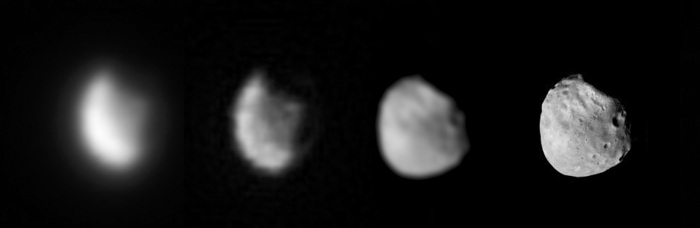
The planet Mars has two moons, namely Phobos and Deimos. The closest and the biggest among the two moons is Phobos. It was picturised as shown above with the color corrected six frames MCC on July 1, 2020, with 210m spatial resolution. The MOM (Mars Orbiter Mission) was 7.2 thousand km away from Mars and 4.2 thousand km from the moon Phobos. It is said that it comprises of carbonaceous chondrite. The giant crater on the surface, namely Stickney, Shklovsky, Roche & Grildrig was noticeable in the picture.

Actual image of the moon Phobos. Courtesy: ISRO

With its fuel efficiency estimated to be only for six months survives till now and achieved success on its first launch itself. On December 1, 2013, it went out of the gravitation field sooner. On September 24, 2014, after a long journey of 300 days makes it enter into the Mars orbit. The subsequent mission by ISRO, MOM 2 or Mangalyaan 2 did fail when the Vikram lander had lost connection after it crashes over the surface. There is no proper evidence of what exactly went wrong in the mission, but it is said that the ALP (Automatic Landing Program) braking thrusters had failed to result in the incidence. There was a big controversy between NASA and ISRO claiming the lander was found, although an Indian scientist spotted it.

Now ISRO with its grand vision is planning for Chandrayaan 3 to send Indian astronauts to space by 2022. This mission is again a cost saver with 35 million dollars for the new equipment and another 51 million dollars for the launcher. India has been already prosperous in launching 104 satellites just in a single mission. Chandrayaan 2 was made only with 141 million dollars budget.

The MOM as described has five instruments onboard:

1) MCC with a 2K×2K area array CMOS sensor for beautiful images of Mars in colourised format.

2) TIS (Thermal Infrared grating spectrometer) houses an infrared detector known as a microbolometer.

3) Methane Sensor for Mars (MSM) by its name is used to measure the presence of methane in the atmosphere, which is a differential radiometer with acute accuracy in parts per billion.

4) Mars Exospheric Neutral Composition Analyzer (MENCA) is a spectrometer to determine the contents in the martian environment

5) Lyman Alpha Photometer (LAP) is a photometer to find abundance in composition to know the actual components on the surface and more.

By these, we can know more about Mars and its moons. Also, you can check out the 3D model of Phobos here: https://solarsystem.nasa.gov/resources/2358/phobos-3d-model/

And also, about NASA’s blog claiming to find clues of the crashed Vikram lander: https://www.nasa.gov/image-feature/goddard/2019/vikram-lander-found

In search of a new life: The Mars planet

Life has been existing over for 3.5 billion years ago. There were significant events in the past, like the extinction of dinosaurs about 66 million years ago. We also know about the start of agriculture, human-made tools used for several purposes. Now in the 21st century, we’ve accomplished a lot of achievements. Still, yes, we are slowly destroying the planet Earth. The nature around us earlier was so satisfying maybe a decade or before that. Suddenly, humanity started constructing buildings, complexes, resorts, artificial reservoirs, etc. This list never ends. They are even cutting down the trees to get more residential areas leading to deforestation. After all, this will all lead to a concrete jungle in the future, there will be no oxygen for survival, the animals will start disappearing, and soon everything will come to an end. This sequence of incidents can be a nightmare for someone, but this can turn into a reality. It’s in our hands to save the planet.

A dinosaur statue.
A dinosaur statue.

On the other side, they’re positive things going around the globe. Scientists and researchers have continuously been looking for existence in life in the other planets. Several space programs have been successfully executed and are still in progress. We know our solar system consisting of eight planets, but we’ve been more interested in the planet Mars. The first mission on Mars on 14th July 1965, Mariner 4, followed by Mariner 9, entered into the orbit. Though the first landing was by Mars 2 but crashed due to a malfunction which later on 2nd December 1971, Mars 3 became the first spacecraft to land on the Mars surface, that too interrupted after 14.5 seconds after its signal transmission failed.

A Mars rover.
An animated Mars rover.

Now in search of water on Mars, there are several types of research claiming that it is in the form of ice caps and many more theories. Still, of these findings, scientists, namely John G. MacDonald, Karien Rodriguez, and Stephen Quirk, developed something unique by which plants can be grown. You heard it right, a polymer through which it can deliver oxygen for the germinating sprout. They claim that regolith has nutrients for plant growth, but not oxygen, the prior requirement of a sapling as 95% of the Martian atmosphere is carbon dioxide. They described two methods of extracting oxygen, either from the metal oxides pre-existing in the regolith and electrolysis, but both processes are time-consuming. The proposed idea is that when the polymer combines with sodium hydroxide and hydrogen peroxide, it becomes an oxygen infused foamed hydrogel. It has the potential to deliver controlled amounts of gaseous oxygen. The foamed matrix, along with regolith, can form the base or be directly coated around the seed to grow plants.

A plant is in a hand.
A person is holding a plant.

The most crucial mission among them was MOM, an interplanetary mission by ISRO, India called Mangalyaan, orbiting since 24th September 2014, becoming the 4th space agency to reach the planet Mars with the lowest cost. This mission has fascinated the kids in India, it got picturised in a movie called “Mission Mangal” in the Hindi language, premiered on 13th August 2019 in theaters. Imagination never ends, everything has a route, and hence it becomes a success, a part of the movie’s storyline. I hope you adhere the same in reality.

For more details about the research, you can visit the site mentioned below:

https://www.liebertpub.com/doi/10.1089/ast.2019.2056

“Earth,Mars and the Human Connection”

Man and technology have evolved as the industrial revolution started. Which not only served the base for new technology and methods in manufacturing but also motivated people to be a part of it by involving in it as scientists, workers and even the buyers by shifting to urban areas to work for their livelihood. This not only changed the world, but also introduced it to a new phase and living of lifestyle. Today we acknowledge different things in our surroundings, including technology in its manufacturing. This technology has helped humans since ages, and to bring up more comfort to his life. The thought every individual had initially was different difficulties, which made them believe it wasn’t possible, but with the essence of togetherness ,we all made it possible. But the biggest and the massive investment and technological advancement was brought up by the idea to go in the space. The dream which every one had in their childhood, became reality, and we humans have been able to do it. 

Advancement in this science and technology and various other gadgets is not limited, rather growing with new ideas pulling every day. But the next big idea which companies especially like Nasa and Spacex are working on, is to colonise Mars, by 2024. With Believes to make this planet a permanent home to live on. This idea was brought by CEO, founder of spacex Elon musk and has been working with Nasa and it’s team on this project. Humans have sent rovers and satellites to Mars to know various geographical and environmental aspects which have helped to know about it’s terrain and major gases in its atmosphere. 

But the main question which arises in the mind of each individual is “How would this be possible and What would these astronauts be doing at the red planet and would be their strategies”? So for this initially Spacex and Nasa would be sending it’s Big Falcon rockets on an unmanned missions which would be setting up the power sources ( the solar panel) and to mine so as to build their automated Propellent system and plant. The main work for this propellant plant would be to process the excess of carbon dioxide and water found in the surface of Mars to make oxygen and methane which would then be used as a propellant on the return back mission to earth. The sabatier process involved the usage of nickel catalyst to interact with hydrogen and carbon dioxide at high temperatures and pressure which results in the production of water and methane. This would be liquified and used fuel to come back .

But the most important thing to do is to set up their base on Mars which could be similar to the Internal Space station with expansions at each side. Talking about the essentials food and water, these astronauts would be carrying with them almost 2 years’ vault of food vacuumed with them like the one used in the International space Station. Nasa has also been working on the travel mode, which would be a rover-like thing being able to carry around 4-5 people on board even in the baddest and toughest areas if land.. 

“It would be a great adventure to see how humans are able to cross this barrier and prove the power of technologies of different aspects. This journey surely will be  filled with adventures, emotions, series of difficulties but with significant hope and the belief to overcome all of them and achieve success”.