Detention For Adults?

To all those who are convinced that the non-detention policy is harming education…

Children’s apparent lack of learning becomes an issue mainly because it is easy to see that they have missed out on something. The fact that at a younger age learning is very fast and that clear milestones are available helps us perceive this – and therefore apply all kinds of expectations, tactics, at times even coercion to ‘ensure’ learning – one such being the detention system which, many believe, is needed in order to maintain ‘quality’. By making children lose a year because we couldn’t ensure their learning (and blaming them for it), we feel we can generate the fear required to make them ‘serious’ and learn.

If we are convinced about this, why should it apply only to school education? What if we could lay out clear benchmarks for adults to learn and grow – in general as well as in the work they do. Certainly it is possible to have a life-long ‘curriculum’ with two-year benchmarks (over their entire careers, and even post retirement) for educationists and curriculum developers, teachers, HMs, government officials, managers, businessmen, fathers and mothers (and grandparents), journalists, artists, municipal staff, auditors, accountants, administrators, intelligence agents and politicians. What if there was a ‘detention system’ (in terms of not being allowed to be promoted or get a pay increase or being sent back to some lower ‘grade’)? Yes, in some government jobs there is an ‘efficiency bar’ and the supposed HR policies and internal competition are expected to sort this out. But do they?

Can we as a nation claim that we have, every year, demonstrated the improvement required to declare ourselves ‘promoted’ to the next level (whatever that is)?

And what happens when police are unable to reduce crimes, leaders are unable to ensure the welfare of the poor, systems are unable to deliver basics such as electricity / water / education / health, or societies are unable to get men to have basic respect for women?

Who should be ‘detained’?

HOW TO DISCUSS NATIONALISM WITH YOUR STUDENTS

Why do it

Whether on the TV or in newspapers or on social media sites – we are today surrounded everywhere by strong views on nationalism. Groups of people are getting angry and upset, calling each other names, being violent. Your students too are caught in this, though they may not fully be aware of it. They will be absorbing views from different sources, all of which may not be reliable. And they may end up adopting strong opinions (or even what you consider misguided ones) without giving them sufficient thoughts. For this reason, we have prepared a discussion guide. It is important that at this crucial time, when they might be making a choice, you, their teacher, reach out to them and help them think things through.

So here are some hints. Use them in the way they work best for you. Drop them or change them or add to them according to your need and situation.

Preliminary – setting the ground

For such a discussion, it would be best to prepare the ground gently rather than rush into it. Here are some questions you could ask.

  1. Have you been hearing or seeing the news or reading the newspapers?
  2. What are some of the big issues being discussed?
  3. What have you read or hear about the ‘nationalism debate’?


Provide background

Briefly give a background to the issue. It is possible many may not have heard it or may not have a clear idea of what happened.

Discuss the  issue

As students the following questions. Make sure you get everyone’s views, especially those who often don’t speak up. [Some hints are given in the brackets.]

  1. So what do you think it means to love your country? [taking care of the environment? Looking after those who are not able to take care of themselves? Singing patriotic songs? Joining the army? Being polite to others? What else? Especially in our daily lives, what do we do (or can do) to show our patriotism?]
  2. What are the best ways to show your love for your country? [you can use the list from the previous question to identify 2-3 of the ‘best’ or ‘most important’ ways and discuss why students think they are the best.]
  3. What are some of the things you would not do if you love your country? [e.g. spitting everywhere as it spreads disease, not dirtying or vandalizing the environment, not jumping a queue or try to take an undue advantage…]
  4. Even in a family everyone is not able to agree on everything? Have you seen any example of this? What happens in such a case?
  5. So if someone does no agree with you, is it a good idea to beat him or her up? Why?
  6. What do you think are the best ways to deal with disagreement?
  7. And what if on the issue of loving your country, someone says something you don’t find pleasant? What should you do?
  8. What are the best ways of finding out more deeply why people think the way they think? And how can you use that to help them see things differently?

Do we even know what we assess when we assess learning?

‘It took me quite some time to get the little girl to let me know what was bothering her,’ said Prof. A. K. Sharma, the former Director of NCERT. The year was 2000 and he was telling me about an incident from a class 2 maths period in the model school in the NCERT campus. The teacher had just completed teaching children subtraction of two-digit numbers with ‘borrowing’, and he had found two children hesitating over the problems they had been given to solve.

The first, a girl, had made a ‘mistake’ as she had failed to borrow from the tens side. Being a grandfatherly and kindly figure, he was able to cajole the girl to speak up. Very softly, looking down and away from him all the while, she said, ‘We learnt in the moral science class that borrowing is bad.’

Reeling from this, he approached the other child, a boy, and discussed why he had not completed his work on the problem. After much exchange, the boy said, ‘But why should I borrow 1? I want to borrow 2.’

Taking part in a recent session on ‘error analysis’, I was reminded of Prof. Sharma’s advice to engage with children to understand their ‘errors’ rather than rely on their work on paper. In numerous assessment experiences since, I’ve seen children who are otherwise very competent falter because of an issue at home or a fight with a friend or because they are being bullied. In open-ended questions in language, teachers are hard put to identify if there really is an ‘error’ or if the child’s view is a valid, logical interpretation. (And asking only close-ended questions is hardly sufficient to understand children’s abilities.) It becomes even more difficult when it comes to children from marginalized backgrounds – as they encounter discrimination and even denigration (of their background, language or culture), they often resist by ‘not-learning’ or do not answer out of fear of being ‘disciplined’.

As the evaluation industry expands in the Indian context with more and more professionals taking in rigorous analysis of children’s responses and analyses of their ‘errors’, the tendency is to interpret these within the framework of the subject for which the test was conducted. But do we know what we really assess when we look closely at children’s responses? What if it’s not a maths or language issue but something else altogether?

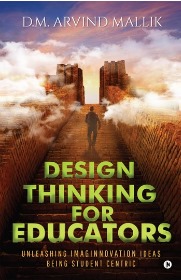
Design Thinking for Educators-Unleashing imaginnovation ideas being student Centric

72975712_10158015243753714_5417108247465164800_nBook Title: Design Thinking for Educators

Author Name: D.M. ArvindMallik-

Publisher- Notion Press

ISBN 978-1-64650-692-7

Year of Publication- Oct,2019

Genre- Education

Price- 199


  • OVERVIEW

“A teacher is never an ordinary person. Construction and destruction can be produced in his lap.” The above given quotation by Chanakya shows the power of teachers and teaching which considered as a noble profession. Revolution in any idea starts with keeping abreast with following latest trends, understanding cutting edge technology and its impact on our world. It’s imperative that the digital generation of today is affectionately called the millennials and generation Z would learn anything at a faster rate as compared to previous generation and educator finds quite challenging in exceeding their expectations. 

Since every best practices in education were once an innovation by itself which was taught once by educator, teaching for the Future in context of the forth Industrial revolution which has just began will see greater progression in the way we comprehend ourselves as over the next few decades there will be great demand for formal education which must inculcate right employability skills. No wonder, todays educators are getting now more and more intrigued about how innovation in their own teaching can be effectively than glorifying their past accomplishment and faces acute challenges where they have been confronted with real, complex, and varied circumstances and as such, they require new perspectives, new tools, and new approaches for solving these perennial issues. 

The problem is however that education is not promoting Creativity in classrooms and schools where as educator themselves caught up with their own explanation of not allowing the student to experience originality, nor they intend to be communicative nor collaborative in solving any problem creatively and I found D.M.ArvindMallik authored Design Thinking for Educators- Unleashing immaginnovation ideas being student centric in Education, a creative methodology will help in designing meaningful creative solution for defined any issues of that sort which help the educator to reinvent their own teaching smartness. This maiden book of author Consist of two parts and they are- 

  1. Part-A (Chapter 1-4) constitute brief outlying about Innovations and its principles and 
  2. Part-B (Chapter 5-8) explains innovative model which was envisioned by author having 4 stages with 8 sub stages revealing new insights about each stage and this process is iterative in nature and then repeated, producing a new idea for each cycle of the model

  • CHAPTERS INTRODUCTION

Part-A

Chapter-1 identifies and explore a wide range of possibilities of introducing Student-Centric Design Thinking in an education environment which itself is an novel concept for any educator who wishes to apply a creative approach to their teaching practices but aren’t sure how to implement at the classroom  It is a brilliant step initiated by author, Dr.ArvindMallik D.M who himself have applied Design Thinking methodology in his Teaching approach and believes by inculcating confidently that in understanding students mindset any educator can be part of creating a more desirable future, and a process to take action when faced with a difficult challenge and enhances existing skills, behaviors, and techniques. 

Chapter 2 details about understanding on how Creativity and Innovation in any organisation yield successive growth and emphasizes on considerate the basic concept on Managing ideas with innovation. Here author goes one step ahead and expects world to change in some aspect and with change occurring so fast, we humans fail to analyze the intensity of emerging problems and their possible effects. Changing technology leads to change in our connections, thought process and our problem solving skills. Modern issues require modern solutions thus old limits fail and new ones emerge continuously with time. But what next? We want to know how we can make a difference in this changing world and make an impact

Chapter. 3 introduces us about Design Thinking.Like the design itself, design Thinking which according to is a human-centric, a holistic approach to problem-solving that employs empathy, ideation, prototyping, and experimentation to solve real-world issues. Design Thinking is a methodology used by designers to solve complex problems, and find desirable solutions for clients by drawing imagination, intuition, and systemic reasoning to explore possibilities of what could be, and to create desired outcomes that benefit the end-user (the customer). This chapter gives us a brief note on how Design Thinking will impact on our learnings and aftermath which us clearly articulated in this book

Chapter 4 focuses on employing Design Thinking Model for Educators in actual terms as in today’s knowledge economy, education becomes even more important for developing next generation of innovators and creative thinkers. 21st Century Teaching and Learning skills are those skills that will be essential for students to possess to thrive in the increasingly complex life and work environments. In this original model developed by Dr. Arvind Mallik D.M, has proposed entirely new demission on how an educator can implement a novel idea which follows systematic methodology on how to develop groundbreaking philosophies and solve problems creatively. The entire process is iterative in nature by making structured development, review it, make design changes and make refinements in the process carried upon until its finished. The new model combines the best of analytical thinking of Left and Right brain with intuitive thinking that instigates imagination, creativity, and innovation. Which can be conceptualized and implemented by any educators who sees innovation in teaching is a transformational tool and make a positive impact on students learning quotient. It has four-stage Seek, Imagine, Prototype and Share 

Part-B

Chapter-5 highlights each step mentioned in the model (4 stages with 8 sub-stages)in detail as this these Phases in the mentioned model is about finding answers to the problems we’ve yet to uncover. The goal here is to generate a wide range of ideas without being hypercritical and how we can influence the needs of the student whom we’re designing a solution. So that we can ultimately arrive at a possible Solution, seamless. Under Seek stage, It has two sub stages, Define and Empathy

Chapter-6, explains about various challenges faced by an educator in every classroom in drawing student’s attention, and conveying ideas effectively to them which itself is atedious task as students learn best when they feel part of any academic community to which they can actively contribute, when their voice also heard. Leaving positive influences on them profoundly, this section looks at the stage at which information is collected to help & generate new insights around Student-centric. Post defining a problem statement and empathizing to a breakthrough in understanding at a deeper level, educators can optimize the available information to search for inner meaning. Under Imagine stage,it has two sub stages, Research and Select

Chapter-7 draws close our attention in testing various chosen ideas which was being selected and will be dictated towards formalizing in prototype stage which is the third stage in the Design Thinking for educators. Prototyping is an integral part of Design Thinking and is a quick and inexpensive way to make your early idea usable, so you can go back to students and get their feedback on those idea being implemented which gives you evidence as good or bad. Author introduces original Two Design Evaluation methods, P-K-V Cycle (Plan- Know- Verify) and PRATTI Model (Predicting Revolutionary Authentic Technique for Testing Ideas). To validate ideas worthy, educator must utilize and apply these 2 methods, without second thought. Under Prototype stage, it has 2 sub stages, Test and Evaluate

Chapter-8 articulates how prototype makes an impact as turning ideas into actual ideas/products/services that are then tested, iterated, refined & evaluated with chosen evaluation methods. Considering all four stages, final stage of the design thinking for educator’s process is Share, is a stage, educator will be upbeat in sharing their chosen idea and knowledge which now turned into a concrete, fully conceived action plan and acknowledges limitations of learning out of idea being talked through by Storytelling, particularly through multimedia, helps to communicated the solution to a diverse set of stakeholders (Students. Faculties, Authorities, Parents, external Service Providers etc ) Internally and externally of the organization. Share stage has 2 sub stages, learn and collaborate

  • EPILOGUE

Author expresses his intention how every educator who wishes to redefine their own teaching method but have become far too attached to their stereotype way of presentation of teaching thoughts and unable to rise up, evolve from old thinking thought process and venture into new perspective of thinking and manage Innovations in teaching effectively is the need of the 21st century, dare to go beyond present.  Design Thinking for Educators is a holistic creative problem- solving approach that focuses on students and their emotional responses with the aid of an educator by introducing breakthrough new teaching methodology. In this book, author reflected on adding value of envisioning on how design thinking philosophy can positively impact on educator’s creative instinct which can be applied to any class level of students, across any verticals/courses/subjects (K-12, Undergraduate, Post Graduate or professional training) for any Educational Institutes/Universities 

To sum it up, once understood, upon reading this book any educator will be able to demonstrate confidently how to set an example over delivering a ground-breaking ideas introducing the best in the world of teaching more effectively by using a structured outline which entails a systematic process in harnessing innovative teaching and learning method ideas for 21st century education. Design Thinking for Educators- Unleashing Imaginovation ideas being student centric, let this book be a guiding force for you to be aware of your own potential and uplift every educator’s inner confidence in leaving their comfort zone and dare not to fear in implementing new thinking by solving any problems creatively and acknowledge innovation in practice as a continuous process which will not only boost your personal growth, be a change maker in education field which leads economic prosperity to my motherland, India

Book Reviewed by 

Dr. AnanthapadhmanabhaAchar

Professor and Dean Corporate Programmes 

Justice K S Hegde Institute of Management 

Nitte,Karkala Taluk

Udupi – 574110 Karnataka

India

Online Privacy for Students in a Digital Age

When I taught Grade 8 English, I always had my students write an autobiography at the beginning of the year to learn more about them. This past year I added a media focus by having students design a digital poster to represent themselves. The software to be used was left wide open – students could use anything from Microsoft Publisher to online digital poster software to simple Paint.

I even gave student the option to publish their work online as visual resume or an About.me page. My intention for this online option was to encourage students to begin building a positive online presence. It was not mandatory, but rather an option and platform for the students to showcase their accomplishments.

See my lesson instructions here:

We spoke as a class about what is and isn’t appropriate to post online.

However, I received mixed reactions from parents and my peers. Was this still too much information for students to post publicly? Should students under a certain age be anonymous on the internet? Should such online behaviours be encouraged by a school?

Where do we draw the line between creating a positive digital footprint and protecting children from the dangers of the internet? 

In a school which introduced a 1:1 laptop program and supports a tech-infused learning community dedicated to the principles of the International Society for Technology in Education (ISTE), these are critical questions to be asked. And it seemed that no one knew the answers.

My classroom project sparked a lively debate among educators at my school concerning what the students should and should not be doing online. On one side, it is important for schools to protect students from the dangers of the internet. On the other side, I think we could all admit that students with their own laptops and a constant wifi connection are visiting whatever sites they wish.

Instead of hiding children from the internet, I feel it’s the role of the school to educate students on safe online behaviours.

We can never teach someone swim from the deck of the pool. We of course shouldn’t push them into the water with no previous guidance, but instead assist them into the water with a suitable knowledge of what to do once in the water and how to react to unfavourable situations.

From my experience, educators often prematurely give students full reign of the internet after deciding technology is a beneficial tool for education. We essentially pushed students into the deep end without the necessary skills needed to stay afloat. Students need to be explicitly taught digital citizenship and have their online actions closely monitored while they are still learning appropriate online behaviour.

See my follow-up lesson on online privacy here:

Please feel free to use any of these resources in your own teaching of online safety.

This Post is Licensed for Noncommercial Reuse..

It is my school’s policy that students and teachers use only copyright-free material. This makes sense hypothetically, but what does it actually mean? Where could this mysterious content be found?

After asking around, it became clear to me that copyright-free material was not understood by many other teachers as well. So how could we possibly teach and model finding such content for our students? Although it was part of my job to ensure students were only using copyright-free material, I knew very little myself about what can and cannot be used nevermind how to monitor this from my students.

However, teaching in a technology-focused school means the students use digital technology to create many of their projects. They take images, video clips, sound bites and more from the internet and to create their own products on a regular basis.

I decided to make it my mission to learn about copyright licensing alongside my students.

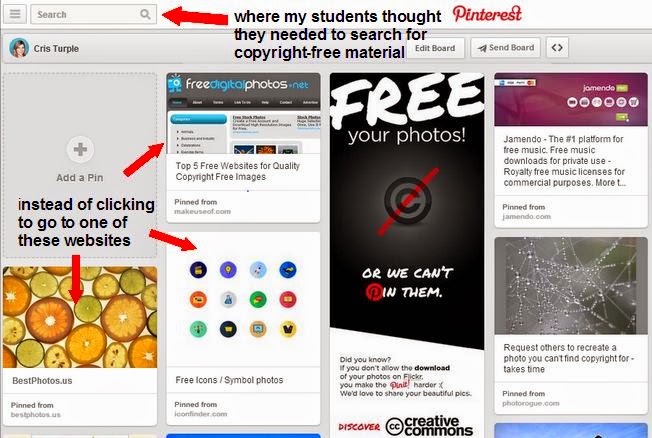
First, I compiled a list of websites with copyright-free material. I sent students to my Pinterest board of copyright-free resources.

However, my students thought Pinterest itself was all copyright-free material which could not be further from the truth. I witness numerous students searching for “copyright-free” content using the search bar of Pinterest!

I can see now why the students were confused.
So next, I modeled finding content using the Creative Commons website. This search engine links to various copyright-free sites. But students still struggled with the specific options on the different websites.
Luckily Creative Commons has a great resource to explain what each of the copyright permissions mean:

Blended Learning: Learning Management Systems

This hybrid method of learning combines traditional classroom and online education. Blended learning has emerged with the advancement of new technologies in an effort to reach and teach students more effectively.

While educators may debate the exact meaning of the term, the gist is that online technology is used not just to supplement, but transform and improve the learning process.

The Ontario Ministry of Education explains the tools used to create Blended learning should help students:

  • learn or review key concepts
  • stay organized
  • communicate with others
  • show what they have learned
  • submit assignments
  • track achievement

The website further states, “Blended learning uses the tools of the provincial learning management system (LMS) to teach and support learning in a face-to-face class.” Thus, technology used to support Blended Learning not just technology tools which can be used in the classroom, but online learning platforms meant to support traditional classroom learning.

The goal is to use technology to build an online learning community that transcends the walls of the classroom so students can continue their learning outside the classroom.

Click here for my comparison of various Learning Management Systems (LMS) to Support Blended Learning


Email ThisBlogThis!Share to TwitterShare to FacebookShare to Pinterest

The Ontario College of Teachers Standards

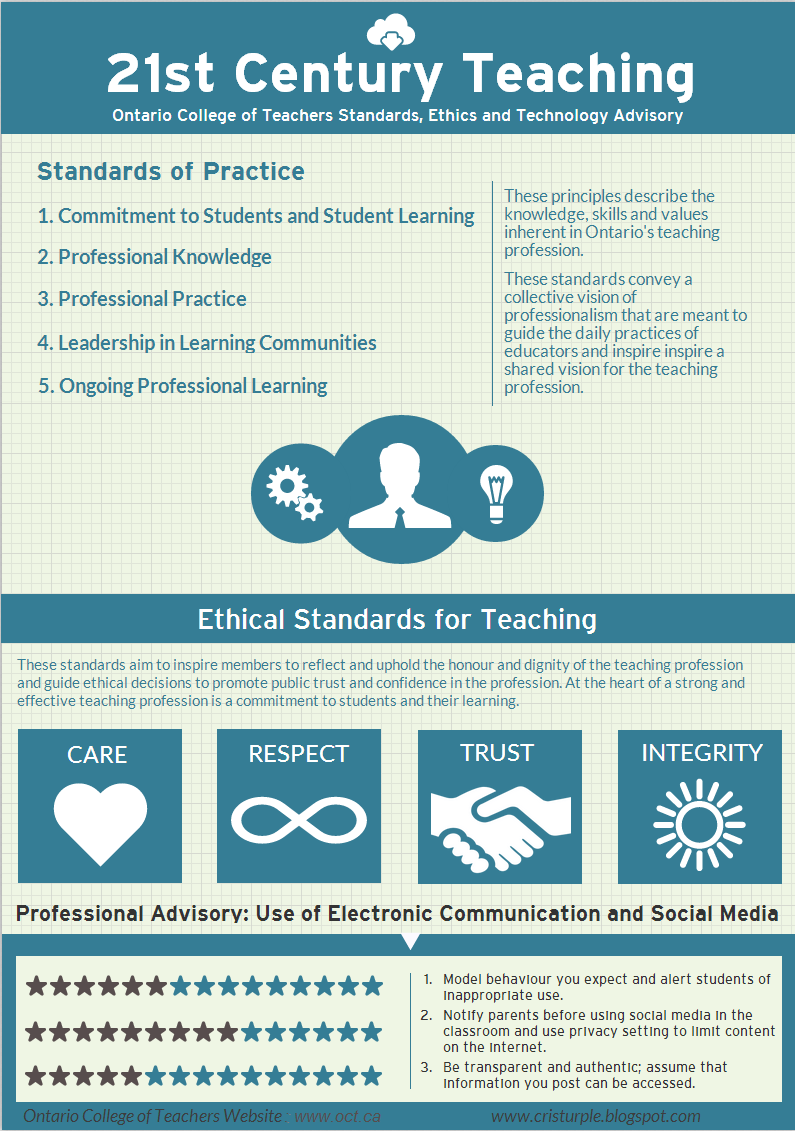
The Ontario College of Teachers has professional guidelines and standards for educators to follow.
See below for my visualization of the standards as well as a summation of the Professional Advisory surrounding electronic communication and social media:

21st Century Tools: The Role of the Teache

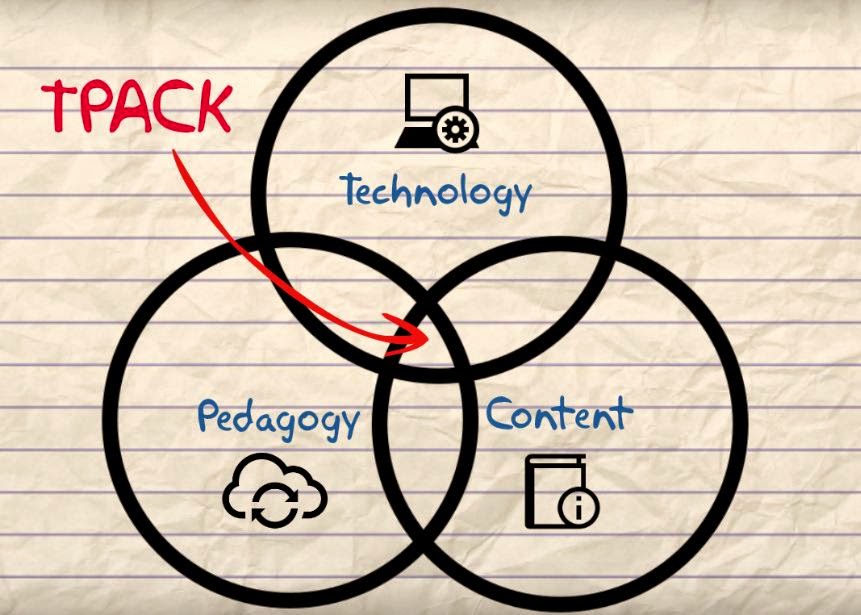
Once again, I refer to Dr. Matthew J. Koehler’s model of TPACK to conceptualize the interconnected and overlapping realms of teacher knowledge. The question posed is concerning the role of the teacher as it pertains to learning and understanding 21st century tools.

The TPACK model shows a breakdown of the areas of expertise teachers are expected to know, including content knowledge, pedagogical knowledge and technological knowledge. According to this model, teachers should strive to reach the middle area where all three realms overlap.

Content Knowledge: this is the information on the subjects we teach.
But I think we can all agree that being an expert in a field does NOT necessarily equate to being a good teacher.

Pedagogical Knowledge: this is ‘the art of teaching’.
It includes such things as taking into consideration learning styles, differentiating instruction, creating a classroom environment and assessment practices. Basically, its your philosophy of education.

Technological Knowledge: this is the tools used to teach.
Today, many people’s immediate thoughts are of modern technologies. However, it can also includes things as simple as a pencil or a calculator.

The overlapping area between content and pedagogy covers the core business of teaching. It is what to teach and the best way to teach it. However, it is often the third realm of technology with its overlapping areas that tends to be the most challenging for teachers.

It’s true, that technology is advancing at exponential rates and there’s no way any one person could keep up with it all.

So how should teachers face the daunting task of learning and teaching with 21st century tools?

First, teachers should remember that technology (including new computer-related software and hardware) are merely tools to use to support student learning. The foundation of teaching still lies in a teacher’s knowledge of the content and their own personal teaching pedagogy. Effective technology integration does not consist of using it as a gimmick or reward for students. Instead, technology should be utilized as a teaching tool for lessons firmly rooted in calculated pedagogy and closely linked to content and curriculum outcomes.

Second, it’s important for teachers to realize that they only need to know enough about new technologies to integrate it into their specific classroom – the same way that we only use teaching practices which fit our pedagogy and content knowledge which relates to our subject. Teachers do not need to be tech experts to effectively use technology in the classroom. Instead, the best 21st century educators know of a tools which fits the context of their teaching, some basic skills of how to use and tool, as well as the courage to try it out!

Third, teachers should remember that a proper education in the 21st century must include teaching and learning with new technology. Educators must equip students with technological skills to be digital citizens and successful in the world. It is the role of the teacher to learn alongside his or her students as technology advances to guide students on their journey and model self-sufficiency when learning about new technologies.

Learning Skills and Work Habits: Tech Tools for Tracking Student Behaviours

The first statement of the Learning Skills section of the Ontario Ministry of Education’s publication Growing Success: Assessment, Evaluation, and Reporting in Ontario Schools states, “The development of learning skills and work habits is an integral part of a student’s learning” (p. 10).

Teachers are expected to report on six categories:
            • Responsibility
            • Organization
            • Independence
            • Collaboration
            • Initiative
            • Self-Regulation
Learning Skills should not be considered in the determination of a student’s grades. Instead, the assessing, evaluating, and reporting on the achievement of curriculum expectations and on the demonstration of learning skills should be done separately.
Though some may identify other skills as being crucial to student success, it is clear that a student’s work habits significantly contribute to their success in school and for life beyond the classroom.
The Definition and Selection of Competencies (DeSeCo) Project, sponsored by the Organisation for Economic Co-operation and Development (OECD), has underlined the importance of identifying and developing key competencies as follows:

Globalisation and modernisation are creating an increasingly diverse and interconnected world. To make sense of and function well in this world, individuals need, for example, to master changing technologies and to make sense of large amounts of available information. They also face collective challenges as societies – such as balancing economic growth with environmental sustainability, and prosperity with social equity. In these contexts, the competencies that individuals need to meet their goals have become more complex, requiring more than the mastery of certain narrowly defined skills.

(OECD, p. 4)

We are preparing students for an information saturated world where they will need to be self-directed learners with the skills to collaborate with others, are organized, have initiative, and set and monitor personal goals. As educators it is our responsibility to foster and help develop these skills in our students.
When it comes time for report card data entry, our tracking should be consistent and accountable to result in accurate reporting of students’ learning skills and work habits.
The following are three simple tools for tracking students behaviours for the reporting of learning skills:

See the slides here.