
The interaction between any device or modern amenity and society is the most significant point. So it is with television. It is an audiovisual electronic device of the modern age. It has invested life with a new charm that can never be dismissed summarily as harmful.
To be very plain no scientific thing is in itself harmful except, of course, the lethal weapons. Television today has become a domestic commodity. Almost every house owns it. It is a source of entertainment in hotels, restaurants, deluxe coaches, planes and whatnot. The cinema caters to the taste of people at limited hours and in limited things. But the TV with its far-flung multiple channels has a wild variety of things and programmes to cate.
The chief issue is how to use television. Ours is a permissive society although still in a considerable section of our globe men live primitive lives. It can be proved that the utility of television lies in its proper use otherwise, like Ms.Shelley’s Frankenstein, it harms the master that operates. Take the case of its commercialization in our society. The channels make a reckless display of nude or semi-nude films, crime and paranoic As a result, the colleges and now even the schools and their hostels teem with cases of sexual violence and the society at large has become arey to the interchange of wives and promiscuity. The west which fell a prey to it now confronts the fatal disease called aids. Doubtless, it, more than the cinema is accountable for it., for it administers the person to the mailing millions day in and out. In consequence of the heavy toll of the disease, the counter in. It is again the tv that comes to the rescue. The global investigations, a conference of doctor, findings and remedies are all disseminated to the public through the tv.
Naturally, it is the ultimate analysis that the role of a man that comes foremost. Tv has a powerful educative value quiz contests, merits of proper child care, intelligent programs to create awareness of family control among the illiterate and many other such educative programs are being done through tv take a good effect.
Tv is usually a vicarious means of entertainment. In general, it shuts our mind out. We see through them-religious, secular and vulgar soth our children unconcerned at how it manipulates against our culture. Another powerful aspect asset of tv is its exposure impact. Sidhi bat or Jana Adalat, interviews of defamed politicians with unforgiving critics like Prabhu Chawla, Nalini Singh invariably have a greater impact. Reading of scandals in the newspapers or heading them on radios do not shame the wrongdoers to that extent as when he is conscious that his scandals and sulking replies are being viewed by millions of viewers in his own country as well as abroad.
To cut the story short tv is an indispensable gift of our age. It is alleged that too much of exposure to the screen is likely to damage our dyes. But a controlled use of it and wholesome practices like splashing the eyes with water after seeing the programme would easily set off the little demerit that it has.

Education system in India
India is a rapidly changing country in which inclusive, high-quality education is of utmost importance for its future prosperity. We all understand that education is crucial in shaping our lives , but at the same time it is a major problem for India . Education is the most powerful instrument for reducing poverty and inequality. Education is a force multiplier that enables self-reliance, boosts economic growth by enhancing skills, and improves people’s lives by opening up opportunities for better livelihoods. It is the key to enhance India’s competitiveness in the global economy. Ensuring access to quality education for all, in particular for the poor and rural population, is central to our economic and social development. Education is, understandably, one of the most important investments a country can make in its people and its future.The existing government institutions are reframing policies to reform the existing education model . Indian Education System has been synonymous with ‘Examinations’, ‘Board Exams’, ‘Entrance Exams’, ‘Marks’, etc.There are different kinds of education system found in India but the most common among the mass is CBSE . But there are still major issues that need to be taken care of such as :
*Rote learning
Many activists today who oppose the Indian Education system are of the opinion that the schools teach the students in learning things by-rote and not to understand things through application.We have been advanced in technology with time but have not yet been able to move away from rote learning . IB schools are changing the education system at their level but not all Indian families can afford IB study . Therefore , the schools must be encouraged to introduce conceptual learning which will avoid students to mug up what they are taught and vomit the exact thing in their exam papers . This will enable them to develop better understanding and retain the concepts for future .
*Evaluation system
Examinations and assignments are encouraged by them as tools to assess the capability of the students. Whether a child was knowledgeable or not depended on the marks he/she scored.In our education system , marks still play the major role in deciding a child’s future and thus it comes up as a burden for students to get good marks in exam and not focus on their interests and skills side by side . The focus of evaluation should be the class participation of students which will foster many skills in them like communication skills , listening skills , and extra-curricular activities .
*Equal respect to all the subjects
It is often said that Science stream tops the stream hierarchy . Subjects like language , communication , etc. Are not given importance and hence neglected . And thus , are pushed towards a subject which parents and school thinks is good for the student . Instead the student must be pushed towards his own interest area and pursue the subject that they like .
*Better training of educators
It is known that children are the budding stars of future and teachers play a very important role in shaping the future of the children as teachers are often considered as second parents . Thus , teachers need to be imparted training as to how skillfully they can motivate a child and make changes in their behaviour .
*Introduction of Technology
Technology can play an important role in addressing the need of an enabling ecosystem with features and facilities like digital content and E-learning, broadcasting classes conducted by experienced teachers, interactive classes through video conferencing, etc. Smart technologies can make learning more inviting and motivate teachers to improve their teaching methods. E-learning has several advantages in a country like India as it allows for the delivery of education or training at an accelerated rate despite geographical distances.Many schools have nowadays introduced the concept of smart learning with the help of smart classes in every classroom but usage of the right technology in the right manner is the need of the hour . Knowledge is not confined only to books , but knowledge is everywhere . Students must be taught about the technology at the right age such that it does not hamper them in their later times . Technology and education should go hand in hand in today’s times .
*Teaching them why education is important ?
It is always taught that education is important to become a big and wealthier person but education also teaches us about moral and ethical values , about humanity .
To conclude , The Government has brought out Draft National Educational Policy 2019 which proposes revision and revamping of all aspects of the education structure, its regulation and governance, to create a new system that is aligned with the aspirational goals of 21st-century education, while remaining consistent with India’s traditions and value systems. The policy seeks to transform India’s higher education system to one of the global best education systems. It is expected to meet the people’s requirement regarding quality education, innovation and research to make this country a knowledge superpower and to attain the level best education system in the world .
Public
Blood – by Kamala Das
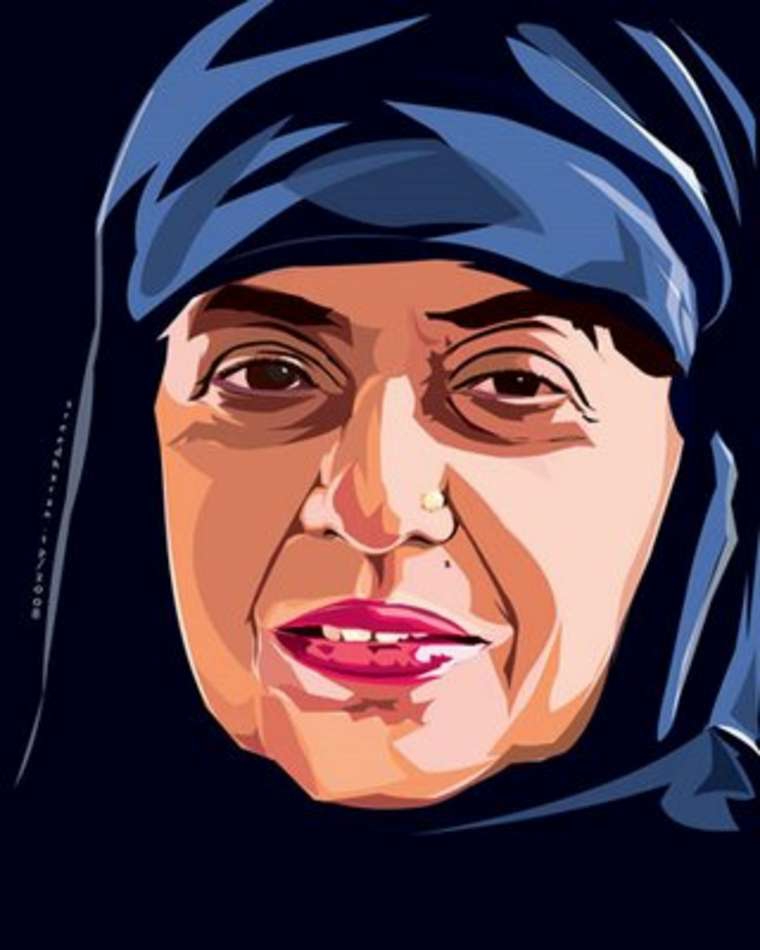
Kamala Das as a poet presents us with a powerful and, yet emotional poem, that plays with the emotional as well as cultural instincts of the reader. It is not merely a work with hundreds of lines, but is connected closely to the poet’s heart, dedicated to her grandmother and a promise that could never be fulfilled. Blood is a poem that promises the readers to think about the promises they make, and their failure to get them fulfilled. Also, reminds them to keep carrying the good qualities and cultural heritage, all along their generations, causing a failure of which can lead to a vas gap between the traditional customs and present generation.
Remembering all the fun and floric days of childhood, spent with her brother, back in the their grandmother’s home. She happily rediscovers – at the beginning of the poem – , that she would play in sand, draw birds and animals. But at the same time, she is envisaged with the ugly memory of her worried grandmother, about her falling home. She told her (the poet), the house is as old as, three hundred years, and now falling to little bits. The grandmother is helpless that she could not do, but repent, since all the things of the house are now cracking, whether Lord Shiva’s temple, or the doors with holes. She cries and worries so much for the house, that even her eyes have got reddend;seeing which, the little Kamala Das promises to repair it some day when she grow old, and very very rich. Hearing this innocent promise, made out of curiosity, her grandmother touches her cheeks and smile.
Further, the laureate speaks up about her grandmother, who was really a simple lady, with least desires in the world. “Fed on God for years”,her only espouse was God, for she had became a widow the next year of her marriage. Her grandmother was a princess, rode on elephant, always went to temple, she had a lot of jewel, and every kind of quality oil, perfume and sandal.
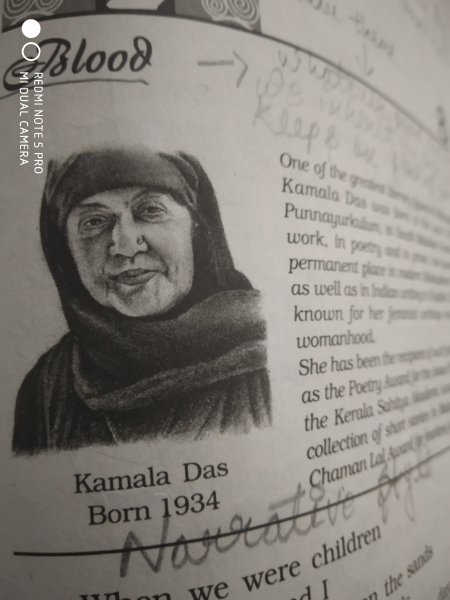
The poet is proud to be born in such a lineage, that “had the oldest blood”, the blood, in terms of heritage and traditional values. Unlike others, who either are new-richmen, or are always poor, having the hunch, “muddy as a ditch”. But, alas! one very poor day, she lay died in her eighty sixth year. The poet remembers her as –
A woman wearied by compromise
Her legs quilted with arthritis
And with only a hard cough
For comfort
She looked deep into her eyes, and prayed for her, that she always grieved for the house. Also, by now the poet herself has learnt how difficult it is to fulfill a promise, compared to making one. And once again, she saw “the house was crouching”, this time because nobody will be there to care of it, the way she used to have.
Here, the use if personification, beautifies the poem, and shovea more liveliness in the whole picture of the house, ruing, regretting, and repenting at the same time. When her grandmother was burnt into ashes, she looked at the house and thought, the house which was once loved a lot by her grandmother, its windows will be shut forever, like the closing of the eyes;pillars will groan;and the rooms sigh. And she set forward towards town, leaving the house, and all the good memories of her childhood.
Assuming the rats running around ever corner of the house, darkened halls, white ants covering the doors, one night, she fret, as the poet moved from one town to another. Since, it was nearest to her heart and grandmother, she felt as if the house is creaking and falling to sherds, also, she now regrets and seek forgiveness from the house, as was not able to fulfill the promise made to her grandmother. She quotes-
I have let you down
Old house,I seek forgiveness
O mother's mother's mother
I have plucked your soul
Like a pip from a fruit
And have flung it into your pyre
She had disappointed her grandmother and has destroyed her dreams. And therefore is asking her to either call her callous, or selfish, but do not blame her traditions and moral values given to her by her ancestors. Finally she assures her dead grandmother, even if she has not kept her promise, but she has not forgotten the good ethics, and morals taught to her by the grandmother.
Public

Major Impact of Social Media IN TODAY’S WORLD
Data and correspondence innovation has changed quickly in the course of recent years with a key improvement being the rise of web-based social networking.
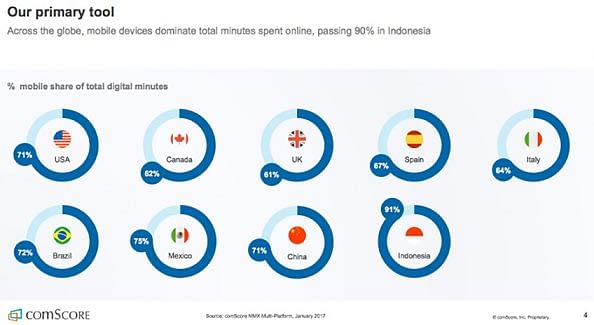
The pace of progress is quickening. For instance, the advancement of portable innovation has assumed a significant job in molding the effect of web-based social networking. Over the globe, cell phones command as far as all out minutes spent on the web.
Why People Share Information
An entrancing report by the New York Times Consumer Insight Group uncovered the inspirations that members refered to for sharing data via web-based networking media. These incorporate a longing to uncover significant and engaging substance to other people; to characterize themselves; to develop and feed connections and to get the word out about brands and causes they like or backing.
These components have made interpersonal organizations advance from being a helpful methods for staying in contact with loved ones to being utilized in manners that really affect society.
Internet based life is being utilized fit as a fiddle governmental issues, business, world culture, instruction, professions, development, and that’s only the tip of the iceberg.
Major Impact of Social Media In brief
Data and correspondence innovation has changed quickly in the course of recent years with a key improvement being the rise of internet based life.
The pace of progress is quickening. For instance, the advancement of versatile innovation has assumed a significant job in molding the effect of internet based life. Over the globe, cell phones command as far as complete minutes spent on the web. This puts the way to associate anyplace, whenever on any gadget in everybody’s grasp.
Why People Share Information
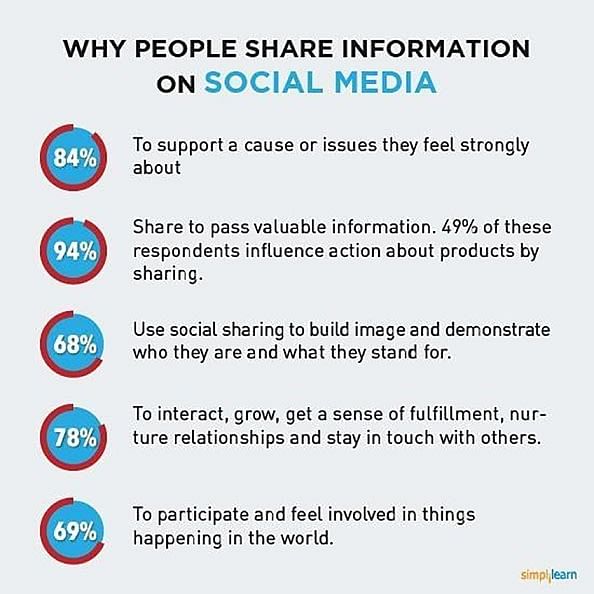
An entrancing report by the New York Times Consumer Insight Group uncovered the inspirations that members refered to for sharing data via web-based networking media. These incorporate a longing to uncover significant and engaging substance to other people; to characterize themselves; to develop and feed connections and to get the word out about brands and causes they like or backing.
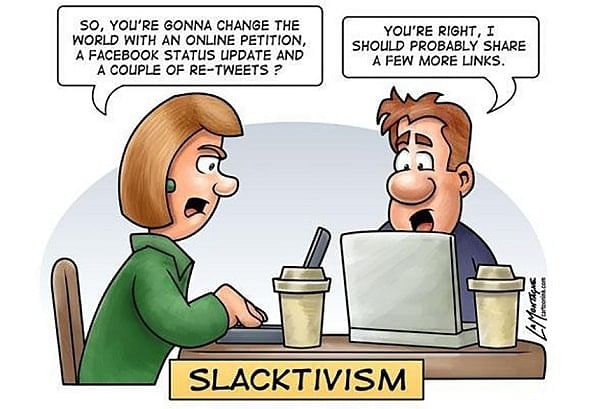
These components have made interpersonal organizations advance from being a helpful methods for staying in contact with loved ones to being utilized in manners that really affect society.
Internet based life is being utilized fit as a fiddle governmental issues, business, world culture, instruction, professions, development, and that’s only the tip of the iceberg.
Data and correspondence innovation has changed quickly in the course of recent years with a key improvement being the development of internet based life.
The pace of progress is quickening. For instance, the improvement of portable innovation has assumed a significant job in forming the effect of online networking. Over the globe, cell phones overwhelm as far as complete minutes spent on the web. This puts the way to interface anyplace, whenever on any gadget in everybody’s grasp.
An entrancing report by the New York Times Consumer Insight Group uncovered the inspirations that members refered to for sharing data via web-based networking media. These incorporate a longing to uncover important and engaging substance to other people; to characterize themselves; to develop and feed connections and to get the word out about brands and causes they like or backing.
These variables have made interpersonal organizations develop from being a convenient methods for staying in contact with loved ones to being utilized in manners that really affect society.
Web based life is being utilized fit as a fiddle governmental issues, business, world culture, training, vocations, advancement, and then some.
Public

IT industy and Covid 19.
COVID-19 – a term that’s making the whole world cringe today. In December 2019, novel coronavirus called SARS-CoV-2, has resulted in the outbreak of a respiratory illness known as COVID-19, which has currently become a global pandemic, killing innumerous people and wrecking homes. Faces hidden behind masks, the hospitals are cramped with patients, the cities are on lockdown, and institutions and workplaces closed. Needless to say, such times are proving hard for every economic sectors, and highly so for the IT sector as well.
According to analysts, as one of the major effects of COVID-19 , there will be a significant impact on the technology sector. There’ll be a striking slowdown in the growth of India’s giant IT sector companies this financial year affecting raw materials supply, disrupting the electronics value chain, and causing an inflationary risk on products. Top software exporters such as Tata Consultancy Services, Infosys and HCL Technologies will be impacted by the reduced technology spending by clients in the US and Europe following lockdowns across the globe.
It is feared that Covid-19 will significantly impact the 180-billion dollars Indian IT sector. This impact may be worse than that of the 2008 global financial crisis (GFC), as the former has dented both demand and supply, whereas the latter had affected only demand. Considering the US and Europe, which together accounts for more than two-thirds of India’s IT exports, are among the worst affected geographies by the pandemic, this assumption holds ground. The total direct GDP impact can be nearly $8 trillion, with all the major sectors hit hard, and the economic loss will in turn affect spending on IT by clients. Accenture has already lowered its growth forecast to 3-6% from 6-8% due to business impact from the Covid-19 impact, and Indian IT firms are expected to follow cue.
As a direct impact, large scale unemployment is snatching livelihoods. Analysts had been warning about the prospect of unemployment ever since the country was put under a lockdown on March 25 to arrest the spread of the coronavirus infections, and people got the opportunity of working from home. Centre for Monitoring Indian Economy shows that unemployment shot up to 23.5% in April from 8.7% in March. In the week ended May 3, it jumped to 27.1%- the highest ever. Those that still managed to save their job, have had their salary recklessly slashed; some even getting paid just 30% of the original amount.
Since the it industies form a back bone of our society,their contribution is huge.In today’ s we cant imagine out life without apps ir smartphones or computers.Software and hardware have transformed our life in a way.It is interesting that if IT industry stop sorking completely then it might happen that our nation will stop in no time.Although most of the officials are working online in other workinds they have switched to eork from home but still situation is not that stable and sound.Home and office atmospheres are completely different so it is a big problem in the current scenario.All developments and research works have been stopped due to covid 19.Companies are worrried abot their progress and their employees as well.
Public
RACISM: A TERMITE TO SOCIETY

While Racism is often thought of a problem that does not exist in today’s world, we forget that Apartheid was only abolished in South Africa in 1994, which was less than 30 years ago.
Slavery was abolished in the US in 1865. Yet, Racism extends beyond slavery and exists in every form of discrimination against a particular Race.
Racism is still very much prevalent in the United States. This led to the rise of the Black Lives Matter or #BLM movement.
While one needs to understand why Racism is still prevalent, it is also important to not confuse this social evil with colourism.
Racism is discrimination against a particular race, while colourism is discrimination based on your skin tone or colour of your skin.
Racism in America is often confused with colourism as the people discriminated against are from the African American community and have darker skin.
When you picture modern-day racism in the States, you picture a person screaming the n-word at an African American. But Racism exists in different forms. It’s there in your head every time you grip your purse tighter while passing by a Black man.
It’s there when white people walk around with semi-automatic rifles, without facing any consequences, but 911 is dialled when 9-year-old Ahmed made a clock that looked “similar” to a time bomb.
It’s there when the police do not take any action against white people protesting against the much-needed lockdown, but shoots rubber bullets at Black people protesting against police brutality.
It’s there when a white man in uniform is allowed to murder a black man in broad daylight by putting his knee down on his neck as he mutters again and again helplessly that he can’t breathe.
Racism exists in the justice system of the USA too.
The CGTN reported that “The U.S. is notorious for putting more people in prison than any other country: its prison population accounts for over 20 per cent of the world’s total, according to the Prison Policy Initiative.
And African Americans are incarcerated at a much higher rate than anyone else.
For every 100,000 black residents, 1,134 were in prison, compared to 218 for whites.”
According to the National Alliance to End Homelessness, about 40% of African Americans are homeless in the US, while they make up roughly 13% of the population.
While I’d love to focus more on the USA and dismantle systemic Racism for you but, unlike what American Sitcoms believe, there are other places in this world besides the United States.
Let’s move to Libya. If you thought slavery was not legal worldwide, you thought wrong. While it has been abolished in almost all countries, it still isn’t criminalised in as many as 94 countries.
In November 2017, a CNN investigation shocked the world, as they exposed actual slave auctions.
In 2016, 1.130% of the Libyan population lived in modern slavery.
According to a report by Time, many refugees attempting to flee war and poverty and reach Europe by sea get caught in Libya and are kept in “horrific” detention centres where they are vulnerable to being beaten, raped, and sold as slave labour.
In the UK, systemic Racism is very much prevalent today.
According to, Police powers and procedures, England and Wales year ending March 2019, Black people were six times more likely to be stopped and searched by the police, than white people.
The Independent reported that “Stop-and-search rates between 2018 and 2019 show that black people are now nearly 10-times more likely to be stopped and searched by the police than white people. This has contributed to far higher arrest rates for black people than for white people.”
The UK’s Annual Population Survey revealed that black people are also paid less on average than white people.
According to a report published by Oxygen, “India is home to the largest number of enslaved people in the world. An estimated 18,354,700 people, or 1.40% of the population, are reportedly living in modern slavery, which includes intergenerational bonded labour, forced child labour, forced marriage, and commercial sexual exploitation, among other forms.”
Free the Slaves reported that poor villagers, in particular, are vulnerable to being enslaved due to debt bondage and bonded labour.
According to Oxygen, “India’s intelligence agency advised Prime Minister Narendra Modi to discredit the September 2017 report by the International Labour Organization (ILO), the International Organization for Migration (IOM) and Australian rights group Walk Free Foundation. The United Nations defended its research, according to Reuters. (Walk Free Foundation published a separate report earlier about India estimates — ILO did not single out countries.) The labour ministry vowed to rescue 18 million bonded labourers by 2030.” Similar problems exist both in Bangladesh and Pakistan.
According to The Wire, despite multiple criticisms, Uttar Pradesh, the state with the highest population in India, is in the process of “promulgating the Uttar Pradesh Temporary Exemption from Certain Labour Laws Ordinance, 2020 that suspends the operation of all labour laws applicable to factories and manufacturing establishments in the state for three years, with the exception of the Bonded Labour System”, in an attempt to lure foreign investors by providing cheap labour, to strengthen the falling economy.
But India’s racism problem extends beyond modern-day slavery. North-East Indians and South Indians often fall prey to this social evil in India. While North East Indians are compared to the Chinese and fall prey to violence whenever International Relations go south with the Chinese government, South Indians are mostly discriminated against for belonging to a complex culture and social background and a darker skin tone.
While to many, Racism presents itself to be the root problem, lurking in its shadows is White Supremacy – The belief that White people are superior to people of other races. Systemic Racism thrives in the US because the system allows it to. The system was designed by White Supremacists, and (surprise-surprise) most of them owned slaves. The system is not broken. It’s working exactly as it was designed. Systemic Racism allows White people to hold power over African Americans, both socially and economically.
The belief that a certain race is superior to others is what leads to discrimination and in many cases genocide.
We see examples of this throughout history, like what happened to Jews in Nazi Germany, or what happens to Bahujans in India.
The Black Lives Matter movement made a great impact only because it threatened to dismantle the very system that allowed George Floyd to be murdered in broad daylight by men in uniform. The protesters made sure they were heard even in the middle of a pandemic. The movement soon spread across the globe and people started demanding accountability from the police and to defund the police.
While the movement did not meet all of its goals, George Floyd’s killers are in prison today and are facing second-degree murder charges.
Someone says that whenever you call out racism, it’s like taking two steps forward and moving one step backwards. And it’s true; many people were injured during the protests.
But isn’t that what they want you to do? To give up? To stop speaking out? To make their jobs easier?
As Detective Santiago in the popular sitcom Brooklyn99 said, “Two steps forward and one step backwards, is still one step forward.”
Public

THE RISING FUEL PRICES
There has been a sharp rise in the prices of diesel and petrol , over the past few days. This is mainly , because of the rebound seen in the global oil prices, and weak rupee-dollar exchange rates. The fear of the oversupply being due is the reason the global crude oil are tanking ,leading to rise in prices. The companies are trying to put the pressure on the ultimate customers, to recover the losses faced.
In order to determine the daily oil prices, the PSUs depends upon the international crude oil prices and rupee-dollar exchange rates. Weak currency notes, along with recent rise in the global oil prices will make India spend much more. Experts say , that this whole situation may give rise to a supply glut. There is a huge probability that the oil market could completely fall, considering the fact that there would not be so much of demand , eventually leading to fall in oil prices once again.
A lot of us, may not be aware of the fact that crude oil is not the end product, instead it’s an intermediary requiring additional refining. First of all, the crude is pumped through a processing facility, from where comes out the crude oil. Hence, the price of the end product is determined by amount of complexity involved in the processing of crude. The reason why diesel tends to be slightly cheaper than petrol all over the world, because it is less volatile, easier to refine than petrol and being heavier than petrol. For India, the trend remains the same as well. Diesel is used for industrial purposes, on the other hand petrol is used in large amounts for personal vehicles .The fact that diesel is not taxed as much as petrol by the Government , seems to be taken a reverse this year. This year on the 24th of June,2020 the prices of diesel were higher than petrol in Delhi.
The rising of fuel prices started from June 7 , for consecutive the next 22 days. This rising of prices came even though, the Indian Crude Basket saw low prices. If the crude oil go low, the consumers doesn’t have to pay for that, but here the case is quite different. As part of excessive fuel taxation by the Government, people in Delhi have to pay the highest tax rates on fuel . The price that people are paying is actually two-thirds of the Central Excise tax and the State Value Added tax.
The fact that the GST revenue have been lower, during this lockdown it took a hard hit on the Union Government and the State Government. This might seem to be a much feasible option to them than actually ,having to take a firm decision on the GST. For the Union Government, this proves out to be of added advantage as it holds of the cess. This is a part which stays with the Union Government, where the State doesn’t have a share in them. However ,chances of inflation is fairly low.
Public
Reading is a good habit for teenagers.
The statement that reading is a good habit is a self-evident truth. Man is not a mere child of instincts. It is intelligence that makes a difference between him and animals. Naturally, a love for books ought to be his natural inclination.
A teenager is basically a student and the period of his teens are the most formative period. Naturally, if a taste for good books can be created in him then it shall contribute substantially to his career. In fact, this truth is apt to be taken up as research. If we trace back the early life of those that have made a mark in life, we shall see that they have sent this period of their life most fruitfully. They may have been poor or may have been away from the seats of culture, yet they must have obtained access to the sources of knowledge during this period.
This period is largely spent in schools and partly in the colleges. It is also seen that in the schools, the syllabus suggests very useful books whether it is framed by the NCERT, the Delhi Board or by the various state educational bodies. They cover a wide range of subjects from language, socio-political cultures, environmental learning, science, moral science and what not. If properly pursued the end- product ought to have been marvellous by now. But if we make a study like random sampling it shall be evident that the net result is not very promising. Have we ever bothered to enquire Why? The guardians spend liberally on their children. The public schools are multiplying every day and still, they do not lack students. The teenaged boys and girls bend under the weight of their school bags. Still, the result is depressing.
In fact, what is lacking ? the involvement of the teachers with their students? The irony seems to be an odd notion of The more in number or in the variety of the subject are the books the more shall be the achievement.
The primary factor in our teaching culture ought to be how we can raise the curiosity of the students. We must remember that the curiosity to know, and hence to learn is a basic human impulse. Even a child that prattles, picks up new things every day and shows strong manifestations of his curiosity. How is it that this inherent bent becomes mute or numbed as he grows in age? Afterall it not so dismally true in the foreign countries.
To induce good reading habits, the reader must be made to feel that what is good in a book. It is easier to improve one’s judgement because it is a question of reason or logic. But it is difficult and a painstaking affair to improve one’s taste because it is a question of feeling. However, merely saying that a good book is really good will not do. One has to involve the reader in healthy debates and discussions. The different aspects of ‘good reading’ have to be discussed freely sith students..The bosses of knowledge must not impose; it may have an adverse effect.If some one likes crome gente he or she must be given books from that genre. Reading books increase the stock of words and enhance vocabulary.
Public
When NASA found the first ever ‘Ultrahot Neptune’

Astronomers have spotted a new kind of planet: a Neptune-sized world sitting scorchingly close to its star.
Astronomers have found a very hot planet, has the same size as that of a Planet Neptune.
It could be in the midst of transforming from a hot, puffy gas giant to a naked rocky core, astronomer James Jenkins reported July 29, 2019 at the TESS Science Conference at MIT.
“This planet is amazing. It’s the first of its kind,” says astronomer Elisabeth Adams of the Planetary Science Institute, who is based in Somerville, Mass. Adams studies larger planets that orbit close to their stars but weren’t involved in the discovery.
The planet is named LTT 9779b, orbits a star which is similar to our sun, and it’s about 260 light-years away. It was discovered by NASA’s Transiting Exoplanet Survey Satellite or TESS. The Satellite was launched in April 2018.
Data collected by TESS show that the planet swings around its star once every 19 hours, putting it in a rare class of planets that orbit incredibly close to their stars.
Most other planets with such close orbits are either Earth-sized or Jupiter-sized and larger, said Jenkins, of the University of Chile in Santiago. But LTT 9779b is 4.6 times Earth’s size and 29.3 times Earth’s mass, placing it right in the middle of those extremes. Its proximity to its star should heat it to about 2000 kelvins (about 1725° Celsius), making it the first known ultrahot Neptune, Jenkins said.
One explanation for how close-in planets get cozy with their stars is that the worlds (Planets) form farther away and migrate closer over time. A planet that had a thick, gaseous atmosphere might lose more and more of that gas the closer it comes to its star, as the heat evaporates the atmosphere or the star’s gravity steals the gas away.
At about 2.5 million kilometers from its star, LTT 9779b may be about the closest a planet can physically get before the star gobbles up all of the atmospheres. If so, it could be a bridge between exoplanets called hot Jupiters, which are gas giants like Jupiter but have many closer-in orbits, and smaller, scorched rocky worlds, Jenkins suggested. The new planet is much smaller than a hot Jupiter, but still has a thick atmosphere that makes up about 9 percent of its mass, he said.
The next step is to measure how quickly LTT 9779b is losing mass, Adams says. If it’s rapid, that could explain why no other ultrahot Neptunes have been discovered: They shift from gas giant to rocky core too quickly. Finding one mid-transition may have been a stroke of luck.
Public

CHINESE APPLICATIONS OUTLAWED

On 29th June 2020, the Indian government issued a ban on 59 Chinese Apps including, TikTok, WeChat, Xender, ShareIt, LIKEE, Helo, and CamScanner among others.
This ban has been implemented after a deadly clash between the militaries of both the countries that left twenty Indian soldiers dead. Satellite images also show that China has built new structures near the border region.
The Ministry Of Information And Technology, has stated that, “ it has received many complaints from various sources including several reports about misuse of some mobile apps… for stealing and surreptitiously transmitting users’ data in an unauthorized manner to servers which have locations outside India.. Since this ultimately impinges upon the sovereignty and integrity of India, is a matter of very deep and immediate concern which requires emergency measures”
But it raises concerns beyond stealing of Users’ data. If Users’ data being safe was the only concern then why didn’t they ban the Zoom App – An app founded by Chinese-American billionaire, Eric Yuan. Despite being accused of stealing data and various privacy concerns, numerous times, all the app has been given are mere warnings. An Article on News18, says that since Zoom is an American company, located in California, it wasn’t banned.
But doesn’t it go against the statements given by the Ministry Of Information and Technology, which basically said, that they banned the apps because users’ data was being ‘misused’ ?
It proves that the ‘ban’ was supposed to be a “fitting” reply to China, as border tensions escalated, and wasn’t just a security concern.
Which brings us to two questions :
- Was India in a position to Ban Chinese Apps?
Most of the apps banned were highly popular in India. Topping the list was TikTok with over 100 million users just in India.
While many “TikTok stars” used the app to earn a living, there were several others who just liked having access to make content.
What made TikTok connect to its users was the fact that how easy it was to handle and to make content, which is why people who couldn’t create content on other platforms like YouTube because of the complications and the investments, could easily create content here.
TikTok really seemed to connect with the Indian Youth because many still are accessing it via VPNs.
While companies like Panda VPN are even advertising the fact that you can access all the banned apps via using them.
Many teens are trying to make apps to access TikTok without VPNs and they are very confidently posting their videos on social media.
The fact that people can still access these apps through VPNs while Chinese investors continue to profit off our people, shows how this ban was nothing more than ”a symbolic ban’.
The ban wouldn’t harm the Chinese as much as it will harm us.
Most of these apps had Indian Creators for whom this was their only source of income. Not to mention, many of these apps have offices and employees in India, whose jobs are at stake.
With the rising unemployment, and the falling GDP, was it really necessary to put thousands of jobs and lives at risk, in the middle of a pandemic? Was symbolism really this important?
- Is banning Chinese Apps enough ? “Tokenism does not change stereotypes of social systems but works to preserve them, since it dulls the revolutionary impulse.”
– Mary Daly
A week ago, we were furious at our government, for the border situation with both China, and Nepal.
And for once, we expected the Modi government to do something. Because isn’t that what they have been flexing about all those years, with the Balakot Airstrike, or the Surgical Strike? A nation with Strong Military strength?
Instead, we were deceived by various media houses, and our government, who mentioned for weeks that there are no border tensions between India and China.
Instead, we were met with disappointment, as the Prime Minister himself turned his back on us, when he released a public statement saying that there has been “no Chinese intrusion” into our territory. That statement was used by the Chinese Government to shake off any responsibility about the death of twenty Indian soldiers.
Soon after receiving heavy backlash, the government released a statement that practically said “The Prime Minister didn’t mean what you thought he meant”. The video which was available on YouTube was of course edited, and the part where Mr. Modi said how there were no Chinese Intrusions was removed. Channels like AajTak, blamed the army, instead of the government.
I wish it stopped here, but it didn’t. Our government said almost 43 Chinese soldiers were killed or injured, to satisfy India’s collective blood-thirst, when no such number was revealed or verified from the other side. Which makes me wonder if soldiers are just numbers for this country?
Like in a game of Chess, you just count the number of pieces you killed of your opponent. And if it’s more than the number of pieces he killed, then you’re satisfied.
I wonder if our soldiers are nothing more than Chess Pieces to us.
I wonder if their death will ever mean something more than ‘revenge’.
The government also said that no Indian Soldiers were captured.
The next day though, China released 10 of our soldiers.
I wonder how the government would have explained the disappearances of these ten soldiers to their families had they not been released by the Chinese Government.
How do we trust a government that has deceived us at every given turn? How do we trust a government that takes the Army’s credit after a Surgical Strike to increase their polling numbers, but blames the Army for their failures?
And after all this, they decided to temporarily ban some Chinese apps.
I wonder why AliBaba wasn’t banned, or PUBG which is backed by Tencent?
As you might already have guessed, AliBaba is one of the biggest investors in the Indian market, and so is Tencent.
The act of banning Chinese Apps was nothing more than Tokenism. But look how well it has worked, no one is blaming the government for literally anything anymore. Not the diesel-petrol price hike. Not even the lack of response to China.
At the end of the day, you just have to ask yourself this, “has this all happened before”?
Have the bans happened before? In a different or similar context? With a different or same nation?

 International Journal of Research (IJR)