Audio books

Whether for escape, enlightenment, or pure joy, books allow us to connect to other places and times. Fortunately for the millions of Americans who have impaired vision or a physical disability, there are braille and talking books from NLS.

NLS is the National Library Service for the Blind and Physically Handicapped, part of the Library of Congress. Established in 1931, the organization’s mission is to enrich the lives of its patrons by offering them books, magazines, music scores, and other materials in audio and braille at no charge. Unlike traditional audiobooks that are provided at public libraries or sold at retail bookstores, audiobooks offered by NLS are unabridged, extensive and diverse, and are designed specifically for people who are unable to read regular print.

NLS provides its services to any U.S. resident or U.S. citizen living abroad who is blind, has low vision, or has a physical disability that makes it difficult to hold a book. Thousands of bestsellers, classics, biographies, nonfiction works, and more can be downloaded from the Internet or ordered for home delivery through a nationwide network of cooperating libraries.

Those with cerebral palsy, multiple sclerosis, loss of the use of their arms or hands, or prolonged weakness can access the NLS collection. So, too, can people with temporary limitations resulting from strokes or accidents.

Now avid readers like San Francisco resident Ivana Kirola, 38, who suffers from cerebral palsy, can continue to satisfy their interests, which for Kirola range from politics, to travel, to music.

“I really appreciate the services from NLS,” Kirola says. “They help me in my daily life, in understanding people and keeping up to date with the news. My favorite part of NLS is the widened horizons that reading audiobooks gives to me.”

Along with her love of books, Kirola attends a yoga class at the San Francisco Library—one of  NLS’s regional partners.

“The thing that has helped me is to remain persistent in what I would like to experience,” says Kirola. “Sometimes what you need is elusive, but it’s important not to give up. There are solutions for everything, but sometimes it takes persistence to find out what they are.”

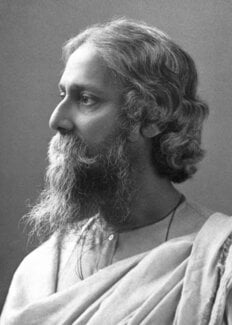
Rabindranath Tagore

Rabindranath Tagore (1861-1941) was the youngest son of Debendranath Tagore, a leader of the Brahmo Samaj, which was a new religious sect in nineteenth-century Bengal and which attempted a revival of the ultimate monistic basis of Hinduism as laid down in the Upanishads. He was educated at home; and although at seventeen he was sent to England for formal schooling, he did not finish his studies there. In his mature years, in addition to his many-sided literary activities, he managed the family estates, a project which brought him into close touch with common humanity and increased his interest in social reforms. He also started an experimental school at Shantiniketan where he tried his Upanishadic ideals of education. From time to time he participated in the Indian nationalist movement, though in his own non-sentimental and visionary way; and Gandhi, the political father of modern India, was his devoted friend. Tagore was knighted by the ruling British Government in 1915, but within a few years he resigned the honour as a protest against British policies in India.

Tagore had early success as a writer in his native Bengal. With his translations of some of his poems he became rapidly known in the West. In fact his fame attained a luminous height, taking him across continents on lecture tours and tours of friendship. For the world he became the voice of India’s spiritual heritage; and for India, especially for Bengal, he became a great living institution.

In 1884, Tagore wrote a collection of poems Kori-o-Kamal (Sharp and Flats). He also wrote dramas – Raja-o-Rani ( King and Queen) and Visarjan (Sacrifice). In 1890, Rabindranath Tagore moved to Shilaidaha (now in Bangladesh) to look after the family estate. Between 1893 and 1900 Tagore wrote seven volumes of poetry, which included Sonar Tari (The Golden Boat) and Khanika. In 1901, Rabindranath Tagore became the editor of the magazine Bangadarshan. He Established Bolpur Bramhacharyaashram at Shantiniketan, a school based on the pattern of old Indian Ashrama. In 1902, his wife Mrinalini died. Tagore composed Smaran ( In Memoriam ), a collection of poems, dedicated to his wife.

In 1905, Lord Curzon decided to divide Bengal into two parts. Rabindranath Tagore strongly protested against this decision. Tagore wrote a number of national songs and attended protest meetings. He introduced the Rakhibandhan ceremony , symbolizing the underlying unity of undivided Bengal.

In 1909, Rabindranath Tagore started writing Gitanjali. In 1912, Tagore went to Europe for the second time. On the journey to London he translated some of his poems/songs from Gitanjali to English. He met William Rothenstein, a noted British painter, in London. Rothenstien was impressed by the poems, made copies and gave to Yeats and other English poets. Yeats was enthralled. He later wrote the introduction to Gitanjali when it was published in September 1912 in a limited edition by the India Society in London. Rabindranath Tagore was awarded Nobel Prize for Literature in 1913 for Gitanjali. In 1915 he was knighted by the British King George V.

In 1919, following the Jallianwala Bagh massacre, Tagore renounced his knighthood. He was a supporter of Gandhiji but he stayed out of politics. He was opposed to nationalism and militarism as a matter of principle, and instead promoted spiritual values and the creation of a new world culture founded in multi-culturalism, diversity and tolerance. Unable to gain ideological support to his views, he retired into relative solitude. Between the years 1916 and 1934 he traveled widely.

1n 1921, Rabindranath Tagore established Viswabharati University. He gave all his money from Nobel Prize and royalty money from his books to this University. Tagore was not only a creative genius, he was quite knowledgeable of Western culture, especially Western poetry and science too. Tagore had a good grasp of modern – post-Newtonian – physics, and was well able to hold his own in a debate with Einstein in 1930 on the newly emerging principles of quantum mechanics and chaos. His meetings and tape recorded conversations with his contemporaries such Albert Einstein and H.G. Wells, epitomize his brilliance.

In 1940 Oxford University arranged a special ceremony in Santiniketan and awarded Rabindranath Tagore with Doctorate Of Literature. Gurudev Rabindranath Tagore passed away on August 7, 1941 in his ancestral home in Calcutta.

Health and wellness

People often use the terms health and wellness interchangeably. Although a person cannot have one and not the other, they are two different concepts that are quite variable, and their meanings are different.

World Health Organization (WHO) defines health as “a state of complete physical, mental, and social well-being and not merely the absence of disease or infirmity (illness).”

WHO defines wellness as “the optimal state of health of individuals and groups,” and wellness is expressed as “a positive approach to living.”

The primary difference between health and wellness is that health is the goal and wellness is the active process of achieving it. You truly cannot have health without first achieving wellness. Wellness has a direct influence on overall health, which is essential for living a robust, happy, and fulfilled life.

Caring for your physical health through proper diet and nutrition

Whether meal preparation is for yourself or your family, focus on making smart, healthy meals. Tips for success include:

  • Make an effort to have more home-cooked meals. This can help encourage healthy eating. Also, it promotes more family time.
  • Let your kids help plan what to eat. Kids love to help make meals and snacks.
  • Keep healthy snacks on hand to help kids make good choices. Have more fresh fruits, vegetables, and whole grains. Have fewer chips and sweets.
  • Teach kids to eat when they’re hungry, not when they’re bored, sad, or angry. Respect their ability to know when they feel full.
  • Breakfast helps jump start the day. It provides fuel for an active lifestyle and gives you and your child the energy to think faster and more clearly.
  • Play “Put the Fork Down” at meals. Put your forks down between bites and take turns sharing your day.
  • Balance. Balance what you eat to meet your need for nutrition and enjoyment.
  • Variety. Enjoy all foods from important food groups (fruits, vegetables, lean sources of protein, low-fat dairy, and whole grains).
  • Moderation. Focus on feeling comfortable instead of being too full after you eat. Use moderation when choosing less nutritious foods.

How many dimensions of wellness are there?

Wellness is more than just physical health; it is holistic and multidimensional. It comprises six dimensions that include physical, intellectual, emotional, environmental, social, and spiritual wellness.

1.Physical wellness

Physical Wellness is listening to and taking care of your body for optimal health and functioning. Taking care of your physical body will help you get through the stress that comes with college.

2.Intellectual wellness

Intellectual wellness refers to active participation in scholastic, cultural, and community activities. It is important to gain and maintain intellectual wellness because it expands knowledge and skills in order to live a stimulating, successful life. In order to improve intellectual wellness, it is important to value creativity, curiosity, and lifelong learning. 

3.Emotional wellness

Emotional wellness is defined as an awareness and acceptance of a wide range of feelings in yourself and others. An emotionally well person understands his/her own limitations and knows how and when to seek support to cope with the challenges life can bring.

4.Environmental wellness

Environmental wellness refers to your sense of safety, comfort, and connection with your physical surroundings. Environmental wellness can be enhanced by living more in harmony with the planet and your community.

5.Social wellness

Social wellness refers to the relationships we have and how we interact with others. … Social wellness involves building healthy, nurturing and supportive relationships as well as fostering a genuine connection with those around you,” according to the University of California, Davis.

6.Spiritual wellness

Spiritual wellness is being connected to something greater than yourself and having a set of values, principles, morals and beliefs that provide a sense of purpose and meaning to life, then using those principles to guide your actions.

8 Online Business Ideas That Generate Sustainable Revenue

With more people trying to make money online, thousands of articles give advice on how you can generate some cash in the digital world. No wonder there are so many online business ideas out there!

1. Self-publish Books  

No one cares whether your book is self-published or published by a traditional publisher. The quality of your book is what matters. One of the most successful books in recent years is Can’t Hurt Me by David Goggins. He received some offers from publishers but decided to publish the book by himself. That way he owns all the rights.

And today, everyone can do that too. You can do the whole process yourself, or you can hire people to do it for you like David Goggins. You can even hire a ghost-writer.

2. Create An App  

Until just a few years ago, it would’ve been unimaginable to sleep in other people’s homes on a regular basis for cheaper accommodation. Yet, as Airbnb has shown in the travel and hospitality market, this concept has now become the norm. All these transactions are done with the app. 

But that doesn’t mean you need to create the next big-time app like Airbnb or Uber. Even without knowing how to code, anyone can build an app. There’s a list of no-code app-makers you can use online to do this.

The most important part of an app is your business model. Too often, we see apps that are great but don’t have a business plan.

3. Sell Other People’s Products  

Don’t want to build your own products? Then sell existing products, also known as affiliate marketing. It sometimes gets a bad rep but it’s a solid business model.

The best platform for this strategy is a website (or multiple sites). 

Once you have a website, you can start creating content that attracts people who are interested in the products you’re offering.

4. Create An Online Course  

I’m a big fan of Peter Drucker’s advice of focusing on your strengths so you can provide more value. This is about leveraging your knowledge, experience, and expertise for the benefit of other people. Maybe you’ve been training for a long time and you’re ready to become a fitness coach. Or you’ve been teaching history, and now can teach people how to adapt well to changes based on historical lessons.

We always want to learn. The popularity of online courses shows that there is great demand. And it’s easier than ever to sell a course. With the right tools, you are able to save time, maximize your efforts, and create courses that students can easily consume.

5. Start A Paid Newsletter  

One of the leading examples of a paid newsletter is Ben Thompson’s “Stratechery.” He popularized this digital product and he’s now generating millions of dollars. 

But you and I don’t need to become the next Ben Thompson. If you can generate a small but loyal following that’s willing to pay, you can make a good living with a newsletter.

In terms of technology, there are many solutions you can use. I’ve seen people using Substack.

6. Build An Online Community  

Most digital entrepreneurs work from home, so they barely interact with new people (often, just clients) on a daily basis. It can be a lonely pursuit.

The Sounding Board—a facilitated community where like-minded people can join, share their goals, insights, and even test their business ideas before implementing them. It’s a safe space for anyone in need of motivation and honest insights. But you can create a community around any topic.

7. Start A Coaching Program  

With the recent global crisis, more people are switching their offline activities (like being coached by a trainer in a gym) into digital programs. Now, you can have your trainer right there with you at home through your smartphone or laptop. 

This isn’t limited to fitness coaches. You can do nearly every type of 1-on-1 coaching over Zoom or Skype. Again, it’s all about what you’re good at. People want to pay for expertise. With enough experience, you can gradually expand to group coaching and booking multiple sessions. 

8. Build A Freelance Practice  

Yes, it’s easy to get on those freelancing sites, but you’re not building anything for yourself. Plus, you’ll be pitching to prospects all the time. You might as well use that time to build your own site, with your own rules.

The problem with freelance sites is that they lock you into a cycle of looking for clients and pitching to them. Many of the jobs offered are also one-time projects that pay lesser. These tactics may get you a handful of small clients at first, but you won’t build a loyal customer-base doing that. 

Building your own site, publishing your own content, and attracting high quality, well-paying clients take much more time. But the pay-off is so much more rewarding and sustainable. 

Now restrict the covid to imact your financial credit

 – Since the beginning of March, COVID-19 has turned millions of Americans’ financial situations upside down.

While the economy is showing signs of recovery, many Americans are still unemployed and having to dip into their savings to cover basic living costs. To that end, the question remains: How do you protect your credit score? Read on for some tips.

• Contact your lender aas soon as possible if you can’t make a payment. On-time payments are the largest factor affecting your credit score. Many lenders continue to offer emergency support such as deferral or forbearance options that may allow you to reduce or suspend payments for a fixed period. However, if those terms are set to expire soon, you should “call your lender to discuss what options are available,” says Rod Griffin, senior director of consumer education and advocacy for the credit reporting agency Experian.

• Look for ways to boost your credit score. If you have limited credit history, building credit can be challenging. Experian’s free tool, Experian Boost, can help raise your FICO score instantly by giving you credit for on-time utility, phone and streaming service payments.

This type of alternative financial data, known as “consumer-permissioned data,” allows you to manage your data with confidence and qualify for better credit. In fact, two out of three Experian Boost users see an increase in their credit score with an average increase of about 12 points. That’s enough to make a significant difference when applying for a loan or any type of credit.

• Consider getting a balance transfer credit card or one with an introductory offer. Handled responsibly, this actually has the potential to increase your credit score while either buying you time to pay off your debts or getting a “welcome bonus” of perhaps hundreds of dollars. If you’re looking for personalized credit card options, tools like Experian CreditMatch can help you get the right card based on your financial profile.

• Pay attention to your utilization ratio. Your credit score is based on your total balance-to-limit ratio (a.k.a. “utilization rate”). Adding a new credit card increases your total available credit. As long as your total credit balance remains the same, you’d be decreasing your utilization rate, which can potentially boost your credit score. Be sure to transfer balances to the card with lower interest and be mindful of temporary low interest rates.

While any balance can cause scores to decline, you should keep your utilization under 30 percent, both overall and on individual accounts. Shooting for a top credit score? “Keep your utilization in the single digits, or even better, pay your credit card balances in full each month,” says Griffin.

• Fight fraud by checking your credit report regularly.According to the Federal Trade Commission., there’s been a huge jump in attempted credit – and debit-card fraud since the pandemic hit; consumers have lost more than $100 million to COVID-19-related fraud

financial planning for future

Financial planning can be complex, so when you seek guidance in planning your financial future, it’s essential to work with someone you can trust.
A CERTIFIED FINANCIAL PLANNERTM professional makes a commitment to CFP Board to act as a fiduciary, which means acting in their clients’ best interests at all times when providing financial advice. You should want a financial adviser who makes this commitment directly to you. Therefore, whomever you choose as your financial professional, including a CFP® professional, you should consider getting a written engagement that requires them to have a fiduciary obligation to you.
Professional standards are important to protect consumers. CFP Board’s Code and Standards sets forth the commitment that all CFP® professionals make to CFP Board. This includes duties to maintain the confidentiality and protect the privacy of client information.
In addition, CFP® professionals commit to CFP Board to disclose any conflicts of interest that might affect the professional relationship and compromise the CFP® professional’s ability to act in their clients’ best interests.
Approximately one year ago, CFP Board updated its Code and Standards to mandate that all CFP® professionals commit to CFP Board to act as fiduciaries for their clients when providing financial advice.
“Simply put, someone acting as a fiduciary should deliver financial advice that is clear, specific, objective and thorough,” says Dan Candura, a CFP Board Emeritus® member and Founder of Candura Group, LLC.
Professionals who follow CFP Board’s Code and Standards commit to fulfilling three key duties as part of their fiduciary duty:
– Duty of Loyalty. This means putting their clients’ interests first.
“Your interests should be placed above the interest of the CFP® professional and the CFP® professional’s firm,” according to CFP Board’s website.
– Duty of Care. This means being careful, acting with prudence and diligence in making recommendations to clients.
For example, if you receive a sudden windfall of money that you want to delay investing, a CFP® professional who abides by a commitment to CFP Board will review the reasonable options and consider factors such as risks and interest rates in making the best recommendation.
– Duty to Follow Client Instructions. This means complying with all objectives, policies, restrictions, and other terms on which you have agreed, and “all reasonable and lawful directions of you, the client,” according to CFP Board.
“Meeting these three duties enables CFP® professionals to honor their commitment to CFP Board to act as a fiduciary, in the client’s best interest. Certainly, that is what every client

health tip in the post covid office

Offices around the country are finally opening back up. According to census.gov, more than a third of Americans are still working from home , but the number of people getting back into their daily commutes-and their work clothes — is growing every day.
In the APA’s Stress in America™ poll conducted in February 2021, 42 percent of Americans reported undesired weight gain during COVID-19 quarantines, lockdowns and work-from-home time. Their average weight gain: 29 pounds.
To get back into a healthier routine once you head into the office, Courtney McCormick, registered dietitian and manager of clinical research & nutrition at Nutrisystem, offers these simple tips.
Pile on the Produce: Even the odds and help yourself stay on track when you clock in. Load up on non-starchy vegetables such as cucumbers, peppers, carrots and more each day because they’re loaded with vitamins, minerals and fiber, but they’re low on calories. The fiber helps you feel full without filling out.
Pack Satisfying Snacks: Healthy snacks may be the most important option you can give yourself at the office. When you start to feel that 3 p.m. slump, it can be so easy to grab one of those coworker-brought bagels or hit the vending machine. Being prepared with satisfying options can help you make food decisions to meet your health goals.
Make Meals Ahead: Meal prepping ahead of time can help you stay on track when it’s time to eat at the office. Pre-portioned meals such as those from Nutrisystem or power bowl recipes are a great healthy lunch meal prep option because they are easy to grab and go, yet heartier than a salad. You can also whip up several servings of chicken in the slow cooker or on the grill to pair with steamed veggies all week long.
Stay in the Know: Once you’ve got your healthy meal prep underway, arm yourself with information. When a coworker invites you to lunch or happy hour, you’re going to want to be there-it’s the first one in more than a year! So give yourself the info to concentrate on the experience without stressing about your order. Look at the menu online before you head out so you can see which options are best for your healthy lifestyle.
To add to your efforts, don’t forget to stay hydrated and active during the workday. Pack a water bottle to refill during the day and plan to meet a co-worker for a lunchtime walk. 

communicate!

Whenever we are stuck in a problem we think that no one will understand our problem. We decide not to discuss it with anyone else because we think it is of no use. We think only we can solve our problems.

But we have to decide that talking really makes any problem easier. When we share exactly how we feel we feel relaxed. Yes! I agree many times our problems don’t get their solution but we feel relaxed and that is really important. By communicating we get hundreds of different perspectives and may be any of it brings something really useful to us.

Keeping things in heart is completely no good. It will depress us and nothing else. When we share we feel light it’s like a big burden has been dropped. So to communicate about anything is really good.

Impact of Covid-19 on global economy

Theme:-

  • COVID-19 (Coronavirus Disease 2019) was first identified in Wuhan city of China in December 2019. On 30th January, the World Health Organization (WHO) declared COVID19 as a Public Health Emergency of International concern (pandemic). As of 16th April 2021, more than 13 crores 90 lakh people were affected by Covid globally and nearly 30 lakh people died due to the virus.
  • Coronaviruses (CoV) are a group of viruses that affects animals and humans. The first coronavirus that can affect humans is discovered in the 1960s. Before COVID-19, this family of viruses caused the SARS outbreak in China in 2002, the MERS outbreak in Saudi Arabia in 2012.
  • COVID-19 is not just affecting the health of the people, but also the economies of many countries. So the topic – ‘Impact of COVID-19 on Global economy‘ is widely discussed.

Impact of COVID-19 on the Global economy:-

  • Many people lost jobs, and the informal sector is badly hit. Unemployment is increasing. This is a huge setback for economies.
  • Due to the consumption slowdown in the world, exports and imports are affected. So, this affects the economies of almost all countries.
  • The International Monetary Fund (IMF) estimated that the global economy shrunk by 4.4% in 2020. This is the worst decline after the 1930’s great depression. Many countries are facing a recession.
  • The health care sector hit hard and the expenditure is a big burden on many countries.
  • The movement of people is restricted due to the fears over the further spread of COVID-19, and hence tourism industry has faced huge losses in the initial months of the pandemic. Tourists spend money in the countries they visit, so the loss of this money is affecting the economies of many countries.
  • Due to the low demand for fuel when several countries imposed lockdowns, crude oil prices have dropped. Low crude oil prices are beneficial to oil-importing countries like India and detrimental to the economies of OPEC (Organization of petroleum exporting countries) countries like Saudi Arabia. Now, crude oil prices are improving.
  • According to the World Trade Organisation (WTO), China is the biggest exporter and second-biggest importer of merchandise as of 2019. Many industries in other countries are depending on China for many raw goods such as pharmaceutical ingredients, automobile components etc. So, coronavirus has hit global supply chains badly. As many factories in China were closed at the start of the pandemic, production has halted for the dependent companies in other countries. Some companies went for alternatives, which is the costlier option. At present, several countries are trying to be self-sufficient. This is resulting in the dominance of nationalism over globalism.
  • Pharmaceutical companies, hygiene products manufacturing companies are benefitting from this situation.
  • Just like past pandemics, Covid too is coming in waves. At the time when countries are recovering from the first wave, several countries are facing a second wave of Covid and thereby weakening their economic recovery.

Conclusion:-

COVID-19 caused severe damage to the global economy. Nations are trying hard to rebuild their economies and to prevent further downfall. Vaccination drive should be at a faster pace to prevent further loss of lives and also the collapse of economies.

stop expecting!

The higher the expectation deeper the disappointment. Keeping expectations from anyone rather than your parents is really not cool. Because when those expectation are not full filled one feel devastated. And the question is why to expect? Why will someone fulfill your expectations. Do you completely fulfill others expectations?

May be you think that a particular person is really close to you. He can do anything for you. He will always have a support to you. But the important thing here is does that person feels same about you? Are you equally important to that person. Every relationship runs hand in hand. And you don’t have to feel bad that person do not consider you same as you consider him. Because here everyone has a right to choose their own relationships as their own choices. You can’t blame anyone for not fulfilling your expectations.

Always remember if you are hurt because your expectations are not fulfilled then you are only one responsible for your pain.