Growing up you solve so many puzzles – picture puzzles, riddles, and word quizzes – so that your mind gets accustomed to questioning everything around you. This develops in you an inquisitive nature and you start to see mysteries in everyday things around you. You try to question the existence of some things and the non-existence of others. In this world full of mysteries, one such mystery is that of the Bermuda Triangle.
Also known as the Devil’s Triangle, the Bermuda Triangle is a section of the Atlantic Ocean, roughly bounded by Miami, Bermuda, and Puerto Rico. Mythical literature revels in the stories of ghost ships, of airplanes disappearing forever, and of instruments going haywire around the Bermuda Triangle. But these are just fanciful theories; there is no solid proof that these types of mysterious disappearances occur less in the other well-traveled sections of the ocean than they do in the Bermuda Triangle. As a matter of fact, there are many people who navigate the Bermuda Triangle on a daily basis without any incident. So why do we still think of Bermuda Triangle as an unsolved mystery?
Covering about 500,000 square miles of the ocean, the area was sailed through by Christopher Columbus on his first voyage. He reported that a great flame of fire crashed into the sea which was probably a meteor. Also, his observations about the erratic compass readings could be explained by the fact that at that time a sliver of the Bermuda Triangle was one of the few places on earth where the true north and the magnetic north aligned together.
Reports of unexplained disappearances started capturing people’s interest around the early twentieth century when the USS Cyclops, a 542-meter long navy ship with 300 men and thousands of ton of manganese onboard, sank somewhere between Barbados and the Chesapeake Bay in 1918. Although they were equipped to do so, the Cyclops never sent an SOS distress call and the extensive search yielded no wreckage.
After that, an alleged pattern started to form when five navy bombers carrying 14 got severely lost in the area in 1945. The nave bombers were forced to ditch at sea when they ran low on fuel. A rescue plane with 13 men also disappeared while searching for them. Even a weeks-long investigation failed to turn up any evidence.
In a 1946 magazine article, author Vincent Gaddis coined the phrase “Bermuda Triangle” for the first time after which it became a sensational legend with reports of planes going down despite having just sent “all’s well” messages. Paranormal writers blamed the triangle’s lethality on everything from aliens and Atlantis to time warps and reverse gravity fields while scientific theories, on the other hand, pointed to magnetic anomalies, waterspouts, and methane gas eruptions from the ocean floor.
In all probability, however, many don’t recognize the Bermuda Triangle as a hazardous place. There is no single theory that solves the mystery but there has been nothing discovered indicating the casualties were a result of anything other than physical harm. No extraordinary factors have ever been identified.
Crime is so destructive that not only the victims suffer, but the life of a criminal also undergoes tribulation, and society bears the disturbing news of witnessing it.
It appeals to think that harsh punishment can reduce crime rates. Some criminals are aware of the penalties, but they feel that they will not get caught. They believe this because our crime fighters are limited in number, so efficient vigilance is not always possible over a territory. They know that we have a delayed justice system, procedures are tedious, and thus it doesn’t inhibit wrong intentions. No lawbreaker looks in the law book for penalty or punishment. For some criminals, getting caught does not matter. Committing that particular crime is the only thing which matters to them at that time. They hear, see, feel nothing and have all their senses attached with the wrong intention. For such people, whose minds are so corrupt that there can be no reversal at all, harsh punishment is the way forward.
Some people commit crimes due to unsatisfactory conditions. If India becomes self-sufficient, these crimes will end. There are crimes which occur out of habit, for example, kleptomaniacs (habitual thieves). Such people need rehabilitation more than punishment to condition their mindset and steer it in the right direction. Still, they will get punished as it is in our system. There is varying nature of crimes, and so it cannot be generalized that only harsh punishments reduce crimes. If the justice system is prompt in serving justice, it will substantially reduce crime as it will instil fear in potential lawbreakers. Hence, possible future crimes could be curb to an extent.
We live in a civilized society, and we have a background of a culture which emphasizes the virtue of forgiveness. This virtue shows that humane methods of punishment do work in some cases. Not always do we need to resort to harsh ones. The people who turn into criminals are a part of society, and the reason to ‘why they become criminals when living in the same society’ is a matter of great concern. There must be a stress on moral education at all levels. If it is there, then perhaps crime will reduce.
Crimes cannot be forgiven, and the guilty must be punished, but it does not mean the same person will always remain a criminal. The rebellious lawbreaker inside that person must be eradicated, and a resolve to live non-violent, law-abiding life must be spurred. We must not hate the person but the filth inside the person that created a criminal. If only the person had an atmosphere where he could re-create himself into a better person, then there would be more hope. We see crimes through the eyes of hatred and often get blinded by it. Nobody is born good or bad; the upbringing, circumstance and mental conditioning make a person good or bad.
Enough has been spoken about reducing crime when we should have been making efforts to wipe out the cause that leads to the generation of the criminal mindset. In a developing country like India, millions are starving to death; many have plenty but lacks the moral sense; many think it is fun to commit a crime’ there are many who do it out of emotional outbreak. Some do it because they are situational criminals. If we believe in God, then we must believe in the law of karma. For every good, we will receive will, and for every bad, we will get the same. If we don’t believe in God, then we must believe in our consciousness; we must not think or do anything which makes us fall in our own eyes. Lastly, the solution may not lie in philosophical or even realistic discussions. But why wait for a crime to happen when we must put our energy and mind in churning out ways that eradicate the generation of thought that leads to crime. In a nutshell, harsher punishment might deter people from committing crime to a certain extent, but it is not the only solution. There are more efficient and effective ways to do so as well.
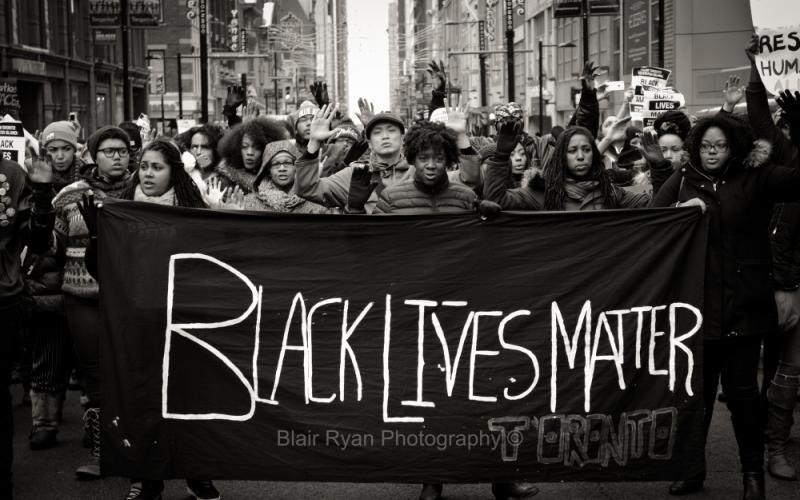
Recently, the accident happened in Minneapolis, the USA which brings this topic into the picture. On May 25, 2020, George Floyd, a 46-year-old black man, was killed in Minneapolis, Minnesota, during an arrest for allegedly using a counterfeit bill. Black Lives Matter Protest began and it broke out all across the USA after the death of George Floyd, an African-American lived in Minneapolis city.
Police have used tear gas and force against demonstrators and President Donald Trump threatened to send the military. Some acts of looting and arson also occurred. President Donald Trump called this movement as riots.
Historical background of slavery
The revolutionary fights for African-American or The Black people’s rights are connected with the historical background of slavery. Many African citizens were brought from Africa to North America for slavery. There were slaves in 13 colonies which called them as “United States.” African people were working as “slave under The White people. It is a traditional activity from last more than three hundred seventy years. From 16th Century onwards slavery carried on unabated for almost 4 centuries. The United States got independence after the War of Independence even though these slaves were deprived of their fundamental rights and independence. But ultimately Civil War took place in 1861-1865 and the reason was only slavery. In the 1860s the slavery was abolished in Northern parts of the USA but still, slavery was common in the Southern part of USA. And this was the reason why the Civil War took place between Northern and Southern America.
Emancipation
Northern America won the Civil War and passed a law which is called as 13th Amendment by United States Congress for abolishing slavery except as a punishment for crime. By this law, 4 million slaves became freeman and freewoman.
Racism in American Policing
The police department was not in existence in past. The institution of police in modern USA Police started with systematic racism and violence in the form of ‘slave patrol’. At that time the slave state created patrols called as “slave patrol” to nip slave revolts and escape from southern part to northern part of USA. The state of South Carolina was the first to create slave patrols in 1704. By the end of the 1700s, every American slave state had slave patrols.
The former southern slave patrol transformed into police departments that technically were different from slave patrols, but were still charged with controlling the freed former slaves. This carried on in the Reconstruction and Jim Crow Laws era for the next 80 years.
Reconstruction Era 1863-1877
Reconstruction era started at the end of the Civil War. The aim was to reconstruct the south and integrate frees black people into society. They put efforts to give some legal rights and economic support to recently freed slaves (The Blacks). But they failed to provide any substantial rights.
For instance, just take the context of voting rights, 15 Amendment incarcerated voting rights discrimination based on race, it left the door open for states to determine the specific qualification for suffrage. Southern state legislatures used qualifications including literacy tests, poll taxes and other discriminatory practices to disenfranchise a majority of black voters in the decades following Reconstruction.
Repeating the History of Racial Segregation
Jim Crow Laws were one of the ways through which racial segregation started against Blacks. Jim Crow laws were state and local laws that enforced racial segregation in the Southern United States. Jim Crow was not the name of any person or place. It was used as a caricature to tease the Blacks. All these laws were enacted in the late 19th and early 20th centuries by white Democratic-dominated state legislatures to disenfranchise and remove political and economic gains made by blacks during the Reconstruction period. The Jim Crow laws were enforced until 1965. This is called Segregation – The Jim Crow Laws. The Jim Crow laws mandated the segregation for whites and blacks in the workplace, public school, public places, public transport, restrooms, restaurants and drinking water points.
Success and The Legal End of Segregation
The Civil Rights Act of 1964 and The Voting Rights Act of 1965 were passed by the Congress and this decisive action towards the ending of Racial Segregation. The Civil Rights Act of 1964 banned segregation in schools and other public places. The Voting Rights Act 1965 banned literacy tests and other methods used to disenfranchise black voters.
#BlackLivesMatter Movement
This movement has past link when George Zimmerman fatally shot an unarmed Trayvon Martin, a 17-year-old African-American high school student. Zimmerman was charged with murder for Martin’s death, but acquitted at trial after claiming self-defence. It was Zimmerman’s acquittal that gave rise to a hashtag and a movement called Black Lives Matter (#Blacklivesmatter).
Many cases and accident apart from George Floyd Case and George Zimmerman Case happened in the USA. Racism always existed in the US Police department. In past, several cases were unregistered or not recorded in the form of pictures and videos but in modern times, nothing can hide from the third eye called cameras. Everything got recorded by cameras. The movement in which thousands and millions of people are getting involved during a time when there is a pandemic named COVID-19 a communicable disease which spread by touching and there is no way to save ourselves except social distancing. Therefore, it shows that the disease of racism is more dangerous than COVID-19 pandemic.
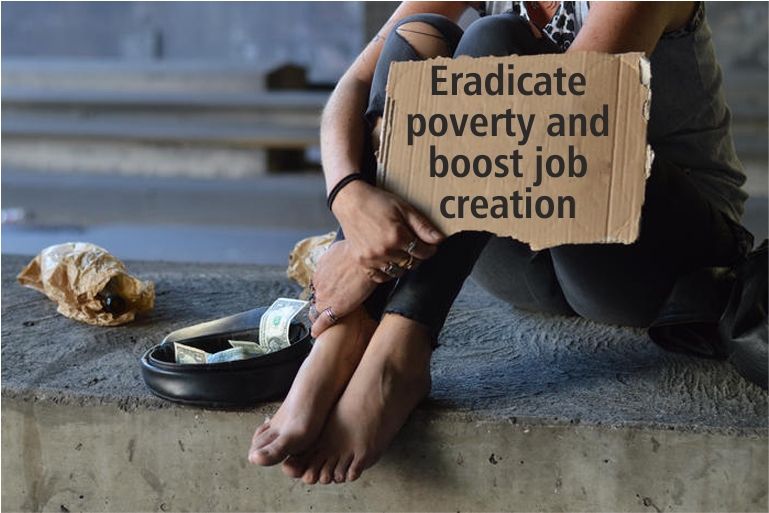
India has one of the most substantial numbers of poor people in the world. According to a UN report, 1/3 of the world’s impoverished population resides in India. There are 400 million poor people in this country, and about a 180-200 million of them sleep with an empty stomach. According to a rapid survey on children, in 2013-14, 30% of children under five were underweight and malnourished. We see elections with poverty removal agenda but have we seen a considerable improvement?
The current government in India is implementing a platform for universal social scrutiny system where everyone will have a bank account. Many benefits will directly reach into the bank accounts of the poor like those of NREGA, pensions, gas and cylinder subsidies. Many states have health insurance, so any benefit of it will reach the poor directly if they have a bank account. The initiatives of Jan Dhan Yojna and Aadhaar will also create jobs along with other programs and will help eradicate poverty. Through MUDRA (Micro Units Development & Refinance Agency), Small and Microenterprise business, people will get loans to start a business. These programs aim to create an ecosystem to create jobs and allocate primary level funds. Once this system covers lengths and breadths of our nation, then India may fight poverty effectively. Amazon, Flipkart, Snapdeal are using MUDRA to help their thousands of ‘bottom of the pyramid’ partners to start operations. It shows that today big businesses are also enabling small businesses to flourish.
According to the Academy of Pediatrics (India), one child dies every minute. The WHO tells that about 6% of children suffer from severe acute malnutrition. India has issues of primary health care, children without education and basic amenities, and not just job creation. Since we have to tackle these issues; therefore, spending on the social sector must increase as current spending isn’t enough or it doesn’t reach the end beneficiary.
Yes, poverty reduction is happening in absolute numbers. The government is operating various policies to relax agricultural norms. However, many of the things that we talk about simply don’t exist at the ground level. Poverty reduction has to address agriculture. Farmer suicides are high in Maharashtra, Telangana, Andhra Pradesh and some other states even though the states now have more autonomy for social fund allocation. Suicide is the endpoint of a long unfolding tragedy; for every one farmer suicide, 99 others reach the brink but do not muster enough mental state to do that. We have grown on infrastructures and other fields, but no significant growth has come in agriculture over the years. The price of a farmer’s product is not rising; the costs of agriculture and other expenses are rapidly increasing. They find themselves in a debt trap, and that is why they consider suicide an easy path. National insurance policy takes premium from farmers, and many farmers don’t know how to get insurance money when their crop fails. So, they are not in a position to avail benefit as they don’t have a required guide near them. We talk about food security, medical coverage, mid-day meals, education but not everybody is getting it. Our agrarian system is in crisis. Monsoon has become very erratic due to global climate change, and the small farmer’s state is becoming miserable.
Unfortunately, there is considerable fear in the minds of these people in India. However, what our government is doing is commendable. We need it to instil confidence and trust in the public. The people, in return, should not waste time worrying. Instead, they should work towards national progress. Once we have dealt with these entrenched issues, then we must think about economic development. Industry sector contributes more to GDP (Gross Domestic Product) of our country. There should be initiatives to transfer people from agriculture to manufacturing, services and other sectors of the economy. Agriculture has a significant number of people; it has improved, but the contribution to GDP from it is not much.
Yes, India can eradicate poverty. Initiatives that are implemented and are in the pipeline are necessary. However, given the condition of people at ground level, this will not happen anytime soon.
Greater female literacy and education is recognized across the world as a powerful contributor to women’s empowerment. India has seen significant increase in the overall literacy rates from 18% in 1950s to about 74% in the last decade. However, there is huge gender disparity in literacy that is prevalent in India. While the literacy rate for men is at 80% it is just at 64% for females. Compared with the rest of the world female literacy rate is just at 60% which is 22% less than the global average.
Low literacy rate hinders women’s participation in the workforce which is an important factor for demographic transition (from high to low mortality and fertility rates). According to a 2017 study, lower infant mortality rates have been directly linked to higher education levels of the mothers as can be seen from a regional breakdown of female literacy rates in India. Kerala, the state with the highest female literacy rate (92%), has the lowest infant mortality rate of 10, whereas Bihar and UP with the lowest female literacy rate of 53% and 59% respectively has a high infant mortality rate, 177.5 and 141.2 respectively.
Female Literacy Rate of poorer countries is much higher than India
Women’s education also had a greater impact on family planning as observed in Bangladesh. Bangladeshi women show high level of awareness of family planning matters and a much higher use of contraceptives than in India. This has led to a dramatic reduction of fertility in a very short period. No comparable changes can be observed in India. This has happened because 88% of women are literate in Bangladesh as compared to 64% in India. The gains in female education has led to an increase participation of women in the workforce whereas in India female employment has gone backwards from 37% in 2005 to 29% in 2009.
If we want to become 5 trillion economy by 2022 we will have to educate our female population and going by the current progress rate, universal literacy can only be achieved by 2060. It is high time that we work collectively to educate our females and not be shy to ask for help from our neighbors who are performing better than us in bringing gender equality.
A person who undoubtedly serves forever is nonetheless a woman who gives spark to a new life, raises, and even works for the betterment of the society. The journey right from a child as a girl grows up to be a mother in the future becomes one of your grandparents and looks after you endlessly. Still, there are several voices raised to support and nourish them; women don’t get equal rights and freedom, fighting for so many decades, and it goes on. What we should be proud of is that a woman has nearly conquered everything in their life. Maybe being the first lady to break some of the achievements, as a leader ruling the nation, and doing every possible job what a man can do. Beyond may it be in the business sector or to the advanced fields of research, and they’ve made their existence, including the space industry.
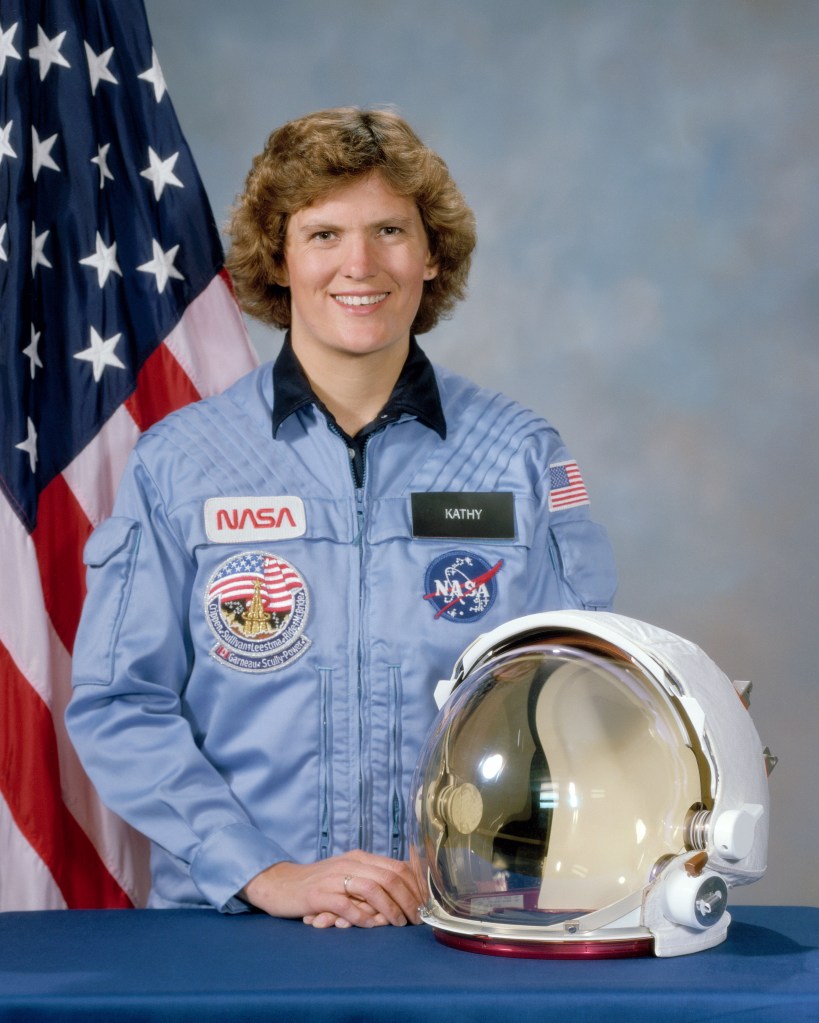
Let me introduce to one of the famous NASA astronauts, Kathryn D. Sullivan. Aged 68, a geologist born in Paterson, New Jersey. In 1973, she pursued her B.Sc. degree for Earth Sciences at the University of California. Furthermore, she achieved her PhD degree in Geology from Dalhousie University in 1973. She served her career as an oceanography officer for the US Naval Reserve in 1988 till 2006 ended up with the captain’s rank. Before that, she was a part of the first astronaut groups to include women for NASA in 1978 who flew for three space missions and left in 1993. She was also a chief scientist for NOAA in the US.
Kathryn D. Sullivan in her astronaut uniform at NASA
She has achieved several great achievements, noteworthy to mention that in 1984, she and the mission specialists performed a 3.5-hour spacewalk in which they operated a system designed to demonstrate that a satellite can refuel while in orbit. On 8th June, World Ocean Day in this year 2020, she went on the mission to the Challenger Deep, one of the deepest points known. She is now the first woman to travel deep in the ocean as well as to space.
She also received several awards recognizing her contributions like the Gold Medal of the Society of Woman Geographers in 1993. In 2004, she made herself appear in the Astronaut Hall of Fame and was on Time 100 list in 2014. In 2019, she released a book “Handprints on Hubble: An Astronaut’s Story of Invention,” sharing her experiences on Hubble Telescope, the largest infrared telescope in space. You can read more about her from official NASA site mentioned below:
A woman is sitting on the window and glancing outwards.
There are many more women in the past as well as in the future to endorse. It will be an endless list. You can set them as your role model and move towards success in your life. Men have equally contributed to society, but women have been slowly growing up and are at the same pace as the men outperform in their field. Now they’re on the news, and we should appreciate them. Another woman, mountaineer by profession, Vanessa O’Brien, is inspired by Kathryn mentioned above, she can be second women to the Challenger Deep. So, take inspiration and keep inspiring others too.
“Let freedom reign. The sun never set on so glorious a human achievement. “
This article consist of:
Introduction
Early life
Politics
Life as a prisoner
President
His writing
Awards
INTRODUCTION:
The leader is a man who comes closest to realizing the norms of a group that values the highest; this conformity gives him his high rank, which attracts people and implies the right to assume control of the group.
Nelson Mandela was a South African anti-apartheid revolutionary, political leader, and philanthropist who served as President of South Africa from 1994 to 1999. He was the country’s first black head of state and the first elected in a fully representative democratic election.
EARLY LIFE:
Nelson Rolihlahla Mandela commonly known as Nelson Mandela was born in 1918 to a tribal chief of Tembu – Henry Mandela. His mother was Nonqaphi Nosekeni and his father was Nkosi Mphakanyiswa Gadla Mandela, principal counsellor to the Acting King of the Thembu people, Jongintaba Dalindyebo. In 1930, when he was 12 years old, his father died and the young Rolihlahla became a ward of Jongintaba at the Great Place in MqhekeMqhekezweni.
Hearing the elders’ stories of his ancestors’ valour during the wars of resistance, he dreamed also of making his own contribution to the freedom struggle of his people. He attended primary school in Qunu where his teacher, Miss Mdingane, gave him the name Nelson, in accordance with the custom of giving all school children “Christian” names.
He completed his Junior Certificate at Clarkebury Boarding Institute and went on to Healdtown, a Wesleyan secondary school of some repute, where he matriculated. Mandela began his studies for a Bachelor of Arts degree at the University College of Fort Hare but did not complete the degree there as he was expelled for joining in a student .Meanwhile, he began studying for an LLB at the University of the Witwatersrand. By his own admission he was a poor student and left the university in 1952 without graduating.
POLITICS:
Mandela, while increasingly politically involved from 1942, only joined the African National Congress in 1944 when he helped to form the ANC Youth League (ANCYL). Mandela rose through the ranks of the ANCYL and through its efforts, the ANC adopted a more radical mass-based policy, the Programme of Action, in 1949. In 1952 he was chosen as the National Volunteer-in-Chief of the Defiance Campaign with Maulvi Cachalia as his deputy. This campaign of civil disobedience against six unjust laws was a joint programme between the ANC and the South African Indian Congress. He and 19 others were charged under the Suppression of Communism Act for their part in the campaign and sentenced to nine months of hard labour, suspended for two years.A two-year diploma in law on top of his BA allowed Mandela to practise law, and in August 1952 he and Oliver Tambo established South Africa’s first black law firm, Mandela & Tambo.
LIFE AS A PRISONER:
During 1940s and 1950s he rose rapidly through the ANC hierarchy, was frequently subject to detention, police harassments, and banning. ANC was outlawed in 1960, that’s when he went underground and a military wing was formed, Umkhonto we Sizwe (Spear of the Nation). In 1962 Mandela was sentenced for five years of imprisonment for travel without valid travel documents whilst leaving South Africa and inciting Africans to strike. Two years later during his detension in 1964, was charged with treason and sentenced him to life imprisonment for giving a four-and-a-half hours of speech criticizing apartheid which is memorable.
Living in a prison had the same meaning as living in the worst place in South Africa: Robben Island. ANC prisoners earned “D” classifications, prisoners who were the most dangerous and had the least rights. They were kept in cells with hay carpets and thin blankets as beds and iron buckets for toilets. The daily menu was a small portion of corn soup with extra vegetable or meat chop for dinner. The prisoners were given thin shirts from khaki and a pair shorts to wear, even during the winter, and were restricted from reading newspapers or magazines. The prisoners spent most of their time in a chalk mine, where they were made to work very hard. Being the leader of the group, Nelson received more harsh treatment than the others. He was kept 23 hours in his cell every day, merely lit by a lamp. Because of which he was unable to sleep or know what the time was. He was only allowed to have one visitor once in six months and he was once not allowed to see his wife (Winnie) for two years. He was allowed to write and receive one letter every six months. The letters he received was screened by the guard, who would cut and remove the parts that were considered unsafe or effectively erasing. Mandela spent 27 consecutive years of his life in detention.His imprisonment improved his political status which resulted in worldwide campaign to release him. During these 27 years that Mandela spent in prison, he was hidden from the world while he quarried limestone and harvested sea-weed; his quiet suffering example was one of the pressures for the government. Mandela’s Public discussion was considered illegal, but as the years passed by, he assumed the mantle of a martyr. Six years of Mandela life was spent in a solitary confinement, during this period he was allowed a weekly 30-minute visit by his wife. He was later in 1984 was offered a conditional freedom, with a condition that he should settle in a black “homeland” that is officially designated in Transkei, Mandela refused the offer affirming his allegiance to the African National Congress. Mandela was hospitalized in 1988 for tuberculosis. After he recovered he was returned to prison with lesser stringent circumstances. 1990, he was released unconditionally to a joyous scenes of celebration at home and abroad.
PRESIDENT:
On 10 May 1994 he was inaugurated as South Africa’s first democratically elected President. On his 80th birthday in 1998 he married Graça Machel, his third wife. True to his promise, Mandela stepped down in 1999 after one term as President. He continued to work with the Nelson Mandela Children’s Fund he set up in 1995 and established the Nelson Mandela Foundation and The Mandela Rhodes Foundation. Nelson Mandela never wavered in his devotion to democracy, equality and learning. Despite terrible provocation, he never answered racism with racism. His life is an inspiration to all who are oppressed and deprived; and to all who are opposed to oppression and deprivation. He died at his home in Johannesburg on 5 December 2013.
HIS WRITING:
Basic Books, 1965, “No Easy Walk to Freedom”. Pathfinder Press, 1986, “The Struggle Is My Life”. Long Walk to Freedom (Autobiography of Nelson Mandela).
AWARDS :
In 1980 Jawaharlal Nehru Award from the government of India for International Understanding; in 1981, Bruno Kreisky Prize for Human Rights from the government of Austria. In 1983, he named as an honorary citizen of Rome; Simon Bolivar International Prize from UNESCO, in 1983. And in 1986 he was honored W. E. B. DuBois Medal; in 1987 he was awarded with “Nobel Peace Prize” and Liberty Medal. The following year (1988) he received the Sakharov Prize, followed by Gaddaff Human Rights Prize in 1989. After 2 year he was awarded with Houphouet Prize in 1991 followed by a Nobel Peace Prize in 1993.
We are growing day by day in the field of technology. Technology is involved everywhere, whether using a button to drive an electric fan or making a huge space vehicle. Similarly, the presence of technology is now taking place in reading news and regularly updating. Gone are the times when people usually wait to get news or watch television or read newspapers. The introduction of the Internet has led to the latest breaking news websites that provide a wide variety of information with an issue. Additionally, online readers have many advantages over offline readers.
There are the following benefits of reading news online.
Less expensive: – Reading online news is less expensive because there is no distribution fee, no printing work which usually makes the newspaper more expensive and the readers have to read more by paying more. If you talk about reading online news, then you can read it using a little bit of your mobile data. It looks accessible as well as less expensive.
Eco-friendly: – In the present scenario, the environmental issue matters a lot. Reading news online is a good step towards saving the environment. Hard copies contain paper, chemical inks that can harm our environment. To use paper, millions of trees are cut in one stroke and the same ink containing chemicals on the paper, which is found in the environment, contaminates it. Instead of reading news from magazines or newspapers, we can read it online, where no paper or chemical-use ink is required.
Instant Edit and Update: – Online news gives information about any event immediately. The same takes time for collection, printing time as well as the distribution of material for offline reading, which is considered to be outdated in the time of this new modern world. As such, we can say how important it is to be updated immediately in the modern era and for which we have to depend on online news instead of reading offline news.
Get a large amount of information: – Digital content requires less space to hold a large amount of information. Therefore, by reading online news, you get more types of news available depending on your interest. Here, along with any current news, you can get the information behind it, which will make it easier to understand.
Easy to carry anywhere: – Carrying a laptop, mobile, tablet or digital watch is not a big task. And all these gadgets help you to access news digitally and instantly. If we want to take away any news printed in a newspaper or any information printed in a magazine, then it is a very difficult task, but you can take the news online anytime, anywhere.
In conclusion, we can strongly suggest that reading online news using your gadget greatly helps to get news, information and knowledge anywhere. In the modern era, the field of competition has become wider, for which it is very important to remain PR updated at all times. For which we will have to move towards online news and it will be necessary for the coming time.
The high school focuses on the textbook education of a child. As a student, you will be provided with insights on the Nazis and the best topography for the coniferous trees. But by the time you graduate from high school, you get so focused on your formal education that you are completely burnt out for the real world. There are still lessons waiting for you out there, many of which you need to learn before you enter your university and get a taste of the real world.
Although most students head directly from the high school to the university courses, it can be healthy to take a break from school and focus on building your character for once. What most people don’t believe is that education can be continued outside a classroom too.
A gap year is the answer for such students who are lost. It will give you the opportunity to take a breath before you dive headlong into university life. You can go to another country and instead of simply reading about the place you get a firsthand experience of its culture, traditions, and people. The change in scenery will aid in your networking and give you a global perspective on life.
The one-year gap is a breather for you to understand what you want to pursue in your life. You will get the experience of making tough decisions and be more independent.
Here are 4 benefits of taking a gap year in a country that is not yours.
Accelerated maturity
You can be a good student easily but there is nothing to support your statement. A gap year allows you to gain quality life experiences. You get to witness different things the world has to offer, from new sites to new foods. You learn about the people and more importantly, about yourself. Living in a place that is not your home allows you to handle things on your own, making you more responsible and self-reliant.
Better performance in college
If you are a student struggling to decide upon your major in college, the bridge year gives you a chance to explore your interests and allows you to make an informed decision regarding your field of study. It also gives you the time to refine the specific skills you feel you are lacking and catch up on them before you begin university.
Boost your job prospects
Since you return to college invigorated with a newly found confidence and perspective, you will have a better chance at any future employment prospects. You will be able to cater to the needs of diverse customers. Your time spent volunteering will be proof of your empathetic side which most employers seek while hiring.
Discover a hidden passion
In one year’s time, you can learn a new language or pursue a new hobby. Maybe you can even hone a previous skill of yours like writing, public speaking, and cooking. These skills will give you an edge in your career or help you in your personal life by making you feel relaxed. Either way, you’ll become a well-rounded person creating positive opportunities along your way and leading a rich and rewarded life.
Homo – sapiens is the word used all over the world, scientifically for the modern human beings and has greatly evolved from the beginning of this human civilization. The story of human civilization marks it’s beginnings million years ago (23 million to 5.3 mya) to the development of tool-based and symbolically structured modern human culture.
Beginning of the human race-
It was 5.6 mya when historians first trace the existence of a creature which resembled the features of present day human beings. A large number of species emerged on this earth and got extinct, it was nearly 160,000 years ago humanbeings resembling us originated over the earth’s surface. And gradually evolved into what we see as present day human beings, sometimes learning how to make tools, or obtaining food, hunting animals and discovering the use of wheel and fire.
The story of human evolution is enormously long, and somewhat complicated. There are many unanswered questions, and new data always come up which ultimately leads to a modification of earlier understandings of the human history.
The story of evolution –
The story of evolution of humans started back between 36 mya (million yearsago)to 24 mya when primates a category of mammals emerged in Asia and Africa. It was by 24 mya when a subgroup of these wild primates emerged, namely, Hominoids, who were primarily Apes.
Again these hominoids evolved into a more advanced category which famously came to be known asHominids (5.6 mya). Now, these primates or “modified primates”, so to say started to make and use tools at the same time. These had a larger brain size as compared to the former and walked upright unlike the hominoids. While hominids included all forms of human beings, they can also be subdivided into branches-
Australopithecus (southern ape)
Homo (man)
2.5 mya, the period when the species of Australopithecus depleted, leaving behind the Homos. It was due to the major climate changes (glaciation) that the former failed to adapt itself, leading to their gradual extinction.
The Homos –
Homo is Latin word, meaning man, although there were women as well! The specie further evolved itself into more modernised being and four types of fossils were found which were then regarded as –
Homo habilis ( discovered at Omo in Ethiopia)
Homo erectus (discovered both in Asia and Africa)
Homo Heidelberg (discovered at Heidelberg in Germany)
Homo Neanderthal (discovered at Neander valley)
All of the above existed between 1 mya -40, 000 years ago.
The story of modernization –
The real step towards modernization started between some 195 mya to 16 mya,when the archaic Homo Sapiens in different regions gradually evolved at different rates into modern humans.
The race towards being modern-
The tools and techniques that we see today is the evolution of the simplest methods that were used by early humans, a large part of our lives is prompted through the use of such substantial art of living that was used million of years ago, be it hunting, cloth making, discovering fire, or finding the way of living.
Talking about the food they collected for themselves, evidences prove that hunting started about 5 mya when hominids were in existence. And this eventually made them use fire in order to grapple the thick meat of animals.
When the earliest humans watched for the need of a fine and peaceful shelter for themselves, they sorted to move from open air or trees to a more safer place, i.e. caves. It is evident from the finds that date between 7 mya to 5 mya. It is possible that places with abundance of food resources were repeatedly chosen to live.
Tool making is again a useful technique which has contributed massively towards human growth. The earliest evidence for the making and use of stone tool makers comes from Australopithecus. About 35,000 years ago, improvements in the techniques were evident along with the language development. It were the Hominids whose language involved hand gestures; spoken language was evolved only by vocal but non -verbal communication, such as singing;human speech probably began with calls like the ones that have been observed among primates.
An overall observation of the evolution of Homo Sapiens makes us come to a conclusion that, it is not merely a thousand years of work and scientific developments that we have reached such a stage when “human is the cruelest animal”, but million of years have been passed to achieve such a degree of unhackeneyed society.