The Predicament of the MSMEs


The declaration of the COVID-19 as a global pandemic gave rise to a state of confusion amongst nations. With people foraging for an answer during these uncertain times, Google reported that “since the first week of February, search interest in coronavirus increased by +260% globally.” The pandemic was successful in not only putting a dent in the health-related sectors but also in the economic sphere. McKinsey and Company revealed that the onset of this pandemic made huge ripples around the globe. The effects of these ripples were further built up with the discovery of the situation of several jobs around the globe. A recent data of the International Labour Organization (ILO) with regards to the impact of COVID-19 pandemic on labour market revealed the ruinous effects it had on workers in the informal economy and on hundreds of millions of enterprises worldwide.
The declaration of COVID-19 as a pandemic in March saw and continues to see a steep surge in unemployment. The sharp drop in work as a result of the outbreak meant that around 1.6 billion workers in the informal economy (approximately 50% of the global workforce) face the danger of levelling of their livelihoods warned the International Labour Organization. “ILO Monitor third edition: COVID-19 and the world of work,” brought to light that the drop in working hours especially in the current quarter of 2020 is expected to be notably worse than anticipated. “Compared to pre-crisis levels (Q4 2019), 10.5 per cent deterioration is now expected, equivalent to 305 million full-time jobs (assuming a 48-hour working week). The previous estimate was for a 6.7 per cent drop, equivalent to 195 million full-time workers. This is due to the prolongation and extension of lockdown measures,” stated a document issued by the International Labour Organization regarding the crisis.
The disturbance in the economic sphere has led to a damage of billions of informal economy workers (representing the most vulnerable in the labour market), out of which a worldwide total of 2 billion and a global workforce of 3.3 billion suffered massive impairment to their livelihood. The ILO revealed that the initial months of the crisis is estimated to have resulted in a drop of 60% in the income of informal workers globally. Statistics divulged that a drop of 81% in Africa and the Americas, 21.6% in Asia and the Pacific, and 70% in Europe and Central Asia was witnessed. The challenge regarding employment has been especially critical for small businesses. Firms with fewer than 100 employees have been seen to be more vulnerable when compared to 40% of the large private-sector employers.
Moody’s Investor Service claimed the downgrading of Indian economy by estimating 0% growth in FY21. The study laid bare that the fiscal measures introduced by the Government were unlikely to offset lower consumption and slow-moving economic activity. Berstein entertained -7% growth, whereas both Goldman Sachs and Normura forecasted a 5% contraction in the Indian economy. The report further stated that although the direct fiscal impact of the policy reforms 1-2% of GDP, it would provide limited impetus to the furtherance of the economy. A strain in the fiscal deficit would contribute to an increase in future debt in debt-to-GDP term reported Moody’s. Moreover, the Investor Service opined that Indian Government’s extension of ‘working capital loans’ to micro, small, and medium enterprises (MSMEs) will not suffice and shield from the economic shock they are facing now as they were already facing financial strain well before the crisis.
The MSME sector which is among the worst-hit, globally, accounts for 33.4% of India’s output along with a whopping 45% of Indian export. These enterprises, since the day of the announcement of the pandemic, have been facing the possibility of extinction. The MSMEs that rely upon daily transaction to stay afloat have been facing serious problems as a result of thee nationwide lockdown. A survey conducted by All India Manufacturers’ Organisation (AIMO) that covered 5000 MSMEs showed how 71% of the small businesses were unable to pay salaries since March. Moreover, the findings of the survey revealed that more than 40% of the businesses would shut shop sooner or later. The CII CEOs snap poll disclosed that almost 54% of company heads predicted job losses irrespective of the sector they are in whereas 45% foresee 15-30% layoffs. For instance, one of the most famous auto-manufacturing company, Maruti Suzuki informed that the production in April was ‘zero’. The predicament has been visible across different manufacturing industries, including textiles, chemicals, etc. TransUnion Cibil discussed that there was a risk of 2.3 lakh crores worth loan might become non-performing. Moreover, with the increase in the demand for cash flow, there will emerge issues that are expected to prevail even with relaxations introduced by the government.
To give a shove to the MSMEs and inject life-blood to this sector:

  1. GOI declared a cut in a policy of repo rate by 75 basis points to 4.4%.
  2. More than 3 lakh crore rupees was injected into the system.
  3. Moreover, it allowed a 3-month moratorium on the payment of instalment with regards to existing loans.
  4. Reserve Bank of India (RBI) opened another window of 50,000 rupees for refinancing. Based on this, post receiving this money, banks will be mandated to invest within one month. RBI also reduced liquidity coverage ratio to 80% whilst providing a special financial scheme to All India Financial Institutions (AIFIs) at repo rate.
  5. Emergency credit lines have been created by several banks.
  6. A low-interest rate of 5% has been declared.
  7. Various business continuity measures have been adopted by the RBI.
    Nitin Gadkari, Minister for Road Transport & Highways, Minister of Shipping and the Minister of Micro, Small and Medium Enterprises, explained that Government of India has been working tirelessly on policies concerning the MSMEs with focus on entrepreneurship development. The sector that accounts for nearly 30% of the economy of Indian nation needs a robust economic plan so that it can get its engine running once again after COVID-19 ceases to exist. The post-pandemic economic scenario would be one that would introduce capital scarcity to the globe. Nations all around need to conclusively come up with a plan that would be mainly concerned with reviving the MSME sector. A comprehensive system that would get back the MSMEs on track is the need of the hour.

EFFECT OF COVID-19 ON RURAL INDIA


COVID-19 took the entire world by tremors. Countries are put under lockdown, economic activities are abandoned, measures are taken as if it’s a war of worlds. People were completely alien to such a health hazard. Every industry faced its consequences. Seventy percent of the Indian population lives in Rural backgrounds, lockdown had a severe impact on this 70% population. People in Rural Areas have completely thrived for Amenities and services and this caused a major disruption in the common working of Agricultural as well as Non-Agricultural livelihoods.
IMPACT ON PEOPLE DEPENDENT ON AGRICULTURE
India is a Nation with a big chunk of its GDP (Gross Domestic Product) belonging to the Agricultural Sector. Rural areas especially are mostly dependent on Agricultural or related activities.
A complete lockdown was announced by Central Government on 25 March which is the end of the Rabi crop season. The season when farmers expect to get gains for their hard toil of one complete cropping season. The timings of lockdown disallowed many to sell their crops at profitable prices, lack of cold storage facilities and transportation resulted in crop failure impacting many. The other major sources of income for people based in the Agriculture sector are dairy and horticulture they were hit the hardest.
Dairy-based livelihoods:-
People who were employed in Dairy product-based services we’re majorly affected by lack of transportation and a big dip in product demand. Dairy products except Ghee do not last long, the need immediate dispersal of products to consumers but lockdown made large voids in the transportation chains resulting in losses to Dairies.
Horticulture-based livelihood:-
India is the second-largest fruit producer in the world, Horticulture output in total is about 313.9 million metric tons. Not every fruit and vegetable grow everywhere, these are extremely area-specific. The closure of the wholesale markets resulted in differences between demand and supply chain. The horticulture sector is majorly dependent on intermediaries, the closing of their shutters lead to a devastating outcome.
Fisheries & Poultries
The same reasons cited above affected fisheries and poultries too. A narrative due to rumored speculation of virus transfer from these products too caused a dent on this sector.
Agricultural based livelihood certainly got disturbed by Lockdown but the points that most of these were placed under essential services, and favoring government policies proved out to be a breather.
• IMPACT ON PEOPLE DEPENDENT ON NON-AGRICULTURAL ACTIVITIES
Non- Agricultural Sector got more severely affected. I need not remind you that most of the Indian population resides in Rural surroundings and majorly contributes to Nations Growth. The non-Agricultural sector comprises about 47% of the Indian Economy. The big portion of Indian workforce hails from Rural backgrounds .We need not look at all of it as number but as real-life individuals and groups who face massive losses. Non-Agricultural Sector majorly comprises of two types.

I. Manufacturing Sector:- This sector faced impacts of closure of international borders as all the imports-exports got affected, closure of domestic markets deepened this wound, all employees were made to rest at home. A high number of individuals we’re terminated from their jobs and it all impacted regular rural and urban households.
II. Services Sector:- All Services except essential, emergency and healthcare services were put to close. This too impacted a humongous number of households. Gyms, Schools, Restaurants, Hotels, Entertainment parks, Theatres, Transportation all these are yet to get the green signal from authorities. Like every other sector, this sector too will take lots of effort to recover.
Logically speaking it is impossible to talk about India excluding rural India. Indian economy took a deep dig, GDP slipped to straight 9% and it will take time and great efforts to recover, and we as Indians are ready to get it back on track.
Among other negatives of this pandemic, one positive for India that shone brightly is self-sufficiency and each capability of each unit to function by itself. Rural India hence sets an example to the world of Indian potential.
By:- Shubham Yadav

Kejriwal Government’s Decision“ A direct opposition of the Constitution”


In 1992, the Hon’ble supreme court made, listed under article 21 categorical:- The State of India is legally bound to ensure access to health as it is an integral part of RIGHT TO LIFE because if any citizen is denied, their life is in jeopardy and so are all other rights.
But Delhi government on 7th June announced to restrict access to health care only to residents of Delhi. Though this move has been blocked by Lt. Governor but let us get into whys and how’s of the decision.
There was a very high rise in the number of cases in the national capital, this caught the authorities napping. The failures in preparedness were put in the public domain. Moves and tricks we’re formulated to divert public attention from the original issue.
• Chief Minister Arvind Kejriwal amid huge controversy over the number of dedicated COVID beds, quoted “In the cabinet meeting today, a decision has taken regarding healthcare facilities. There are 10,000 beds in hospitals of the Delhi government and the same number of beds are available in those hospitals run by Centre. We are opening borders from tomorrow. Delhi hospitals will be available for the people of Delhi only, while hospitals run by the Central government will remain open for all.”

“Anyone can get treatment in hospitals run by the Central government. Private hospitals in Delhi will also be reserved for the people of Delhi. But there are some hospitals which offer surgeries/treatment like neurosurgery which is not available in other parts of the country. Those hospitals will remain open for everyone. I think this is a fine balance to protect the interest of people of Delhi and people from outside Delhi,”
To explain this move a few reasons we’re cited:- Delhi has an International Airport and two of the busiest railway station and all 15 special trains were routed to and fro from Delhi.
Being national capital Delhi has most of the head offices and departmental headquarters. This all contributed to the strict incline of pressure on Delhi healthcare facilities.
Article 21 states that “no person shall be deprived of his life”. This Article is not even “citizen-centric” it is “person-centric” let alone area-specific.
• In 1989, the Hon’ble Supreme Court after referring to the Code of Medical Ethics has termed that “there can be no second opinion that preservation of human life is of paramount importance. That is so on account of the fact that once life is lost, the status quo ante cannot be restored as resurrection is beyond the capacity of man. The patient, whether he be an innocent person or be a criminal liable to punishment under the laws of the society, it is the obligation of those who are in-charge of the health of the community to preserve life so that the innocent may be protected and the guilty may be punished….”.
• In its judgment Supreme Court hold that “Article 21 of the Constitution casts the obligation on the State to preserve life……A doctor at the Government hospital positioned to meet this State obligation is, therefore, duty-bound to extend medical assistance for preserving life. Every doctor whether at a Government hospital or otherwise has the professional obligation to extend his services with due expertise for protecting life. No law or State action can intervene to avoid/delay the discharge of the paramount obligation cast upon members of the medical profession. The obligation being total, absolute and paramount, laws of procedure whether in statutes or otherwise which would interfere with the discharge of this obligation cannot be sustained and must, therefore, give way.”
After being aware of these judgments and constitution this move fail to hold on the moral and legal accounts. Politicians, as always have played their game of dirt and swamp but the poor citizens fell prey to this game. This move dented the integrity of Indians and any such moves must be condemned.

The Unlock 2.0

The state of India has been under restrictions since March 25th. The nation has observed various phases Lockdown 1.0, 2.0, 3.0, 4.0, and then unlock which is scheduled to be a 5 phased issue. Yesterday the Central government announced guidelines for unlock 2.0. A few essential questions emerge, which need to be answered.
Why Unlock? Are the timings to unlock poor?
India has too high a test positivity rate, about 10%. India started easing restrictions at a time when about 10000 cases we’re emerging every day, so the question arises: why unlock then?
The answer to this question can be decoded by the mere fact that GDP ( Gross Domestic Product) prediction of India slipped about a straight 9 percent.
• Many state governments we’re running at the extreme shortage of money.
• Services were facing serious high pressure due to restrictions.
• Government-funded services were made to come at a halt.
• The seriousness of citizens to follow the norms was dipping.
• The psychological reason was that after spending about 2 months in lockdown, naming the next set of restrictions as Unlock gave people a ray of hope.
What will be open?
Next question is that what will be open in Unlock 2.0
In areas other than Containment Zones, all activities will be allowed, except the following:
• Schools, colleges and coaching institutions will remain closed till end of July. Online learning will be encouraged. Training institutions of the Central and State Governments will be allowed to operate from 15 July, 2020, for which Standard Operating Procedure (SOP) will be issued by the Department of Personnel & Training.
• International air travel, except for passengers as permitted by Ministry of Home Affairs.
• Social/ political/ sports/ entertainment/academic/ cultural/ religious functions and other large public gatherings.
• Metro Trains
• Cinema halls, entertainment parks, theatres, gymnasium, swimming pools, auditoriums, assembly halls and similar places.
Date of further changes will be announced as and when required.
Night curfew
Movement of individuals shall remain restricted in between 10.00 pm to 5.00 am, except for essential activities. Local authorities must issue guidelines, in the entire area under their jurisdiction with appropriate provisions of the law such as under section 144 , and ensure strict compliance.
States Government to decide on activities outside Containment Zones
States and UTs, by their observation of the situation, can restrict certain activities outside Containment zones, or impose restrictions as felt necessary. There must be no restriction on inter-State and intra-State movements. No separate permit will be required for such movements.
Lockdown limited to Containment Zones
• Lockdown shall continue to remain in effect in the Containment Zones till 31 July, 2020.
• In the containment zones, perimeter control must be maintained and only essential services allowed.
• Activities in the Containment Zones will be monitored strictly by the authorities, and the guidelines shall be strictly implemented.
• MOHFW will monitor the proper situation handling of Containment Zones and the implementation of the containment norms.
Vulnerable persons, persons above age of 65, persons with disabilities, pregnant women, and children below the age group of 10 years, are advised to stay at home, except when deemed necessary.

The Galwan Valley Faceoff


The Galwan valley faceoff between India and China was a major incident, it shook not only the two nations but the whole dia and China are the top two most populous countries, while China is already an established superpower, India is emerging as a frontrunner to be one soon.
The 20 Martyrs who laid the supreme sacrifice, Initiated a nationwide wave of Nationalism. Indians started boycotting Chinese products and services and Both the nations will suffer a great deal by the aftermath of the Faceoff.
For understanding is further we first need to know what exactly is the issue between The two nations.
• The policy:-
Well, all are very well aware of the Chinese policy to expand and dominate, this policy has victimized many, examples being Chinese Taipei, Hong Kong, Pakistan, Sri Lanka, and lastly In the dia.
The Cause:-
This incident took place amid de-escalation process, India is constructing a Road to connect Northern command of Indian Army to Daulat-Beg-Oldie which is part of Aksai Chin still under Indian Control, This road has major strategic importance as it can serve as a supply road to stop any Chinese Aggression if required, it will also allow India a better and efficient Coverage of the complete Area. China is of the view that this is an inappropriate move and hence Peoples Liberation Army which is the Defense force of China increased its deployment in this region and constructed a new temporary base that is equipped with Artillery Guns and Mechanized Infantry Battalion support. Chinese transgressed to a place near patrol point 14 which is high ground and offers a bird’s eye view of the Indian developments India replied to this Deployment by making mirror deployment, which in general term means putting up an equal number of men and equipment behind our defense lines. The situation kept escalating to that point of pushing and pulling which is sort of a regular exercise on the Line of Actual Control. Watching the fight brew beyond control it was decided to come to a table and discuss matters. A Commander Level Bilateral talk was organized and de-escalation started.
• The incident:-
the talks Chinese Commander promised de-escalation. There is no certified source of information regarding the incident itself, there are many theories floating but the most convincing is that on the due date when the promised mobilization of Chinese troops didn’t occur, Colonel Santosh Babu ( Cobirdspoint accompanied by a patrolling party went to check the matter. The Chinese Troops were prepared and ambushed Indian Soldiers.
The Indian troops called for backup and reinforcements were sent. A Street type Brawl occurred and a high no of casualties was reported. India lost twenty of its guardians but china is yet to confirm the numbers.
No bullets were fired in the clash because of the agreement between the two nations signed in 1996 as Confidence Building Measures; instead, stones and clubs were used. According to reports, the Army men died due to injuries sustained from stone-pelting by the Chinese.
The Resolution
Although high-level efforts (Joint secretary level) are on to defuse the situation, a quick resolution of this standoff at Galway doesn’t seem likely now. Chances are that it could be prolonged impasse, with India unlikely to budge even as China appears unwilling to pull back. China’s state-run newspaper Global Times has already made a false claim that “clashes were triggered by Indian troops as they crossed over to the Chinese side and carried out attacks on Chinese soldiers.”
• The Impacts
It will impact both the nation as economies of both are interdependent to such extent that it is very unlikely that India or China Will thrive without mutual Support. India is now working on improving trade deficit and an increase in import tariffs of Chinese Goods is on cards.
We can just hope the situation reverts back to normal very soon because India already is suffering a great deal from the COVID19 pandemic. But if the question will be raised against Indian integrity, India is well equipped and completely capable of answering.

Are those in power responsible for misery of poor in INDIA

No single reason is upheld for misery for poor in India. Poor suffer daily because of lack of employment, improper medical and educational infrastructure, uncertain implementation of beneficial policies and corruption. If we connect the dots well, all these point to the same culprit the system . System itself is a hierarchy of those in power, consisting of The Rule Makers (Ministers and the political circuit), those responsible for execution (The bureaucracy), and The Guardians of Justice (Judiciary and Police). As soon as we start talking about responsibility among them, stones start flying making indecent curves. Among this pelting of stones the only victims are the poor, who cannot afford to have shields. Shield of money, shield of power, shield of social status.

Let me get down to facts

1. Abhishek Verma arms deals scandal (AgustaWestland)

     In 2006, Abhishek was accused of receiving benefits of approximately $200 million, through a $5 billion Indian military deal involving the Indian government’s acquisition of six Scorpène-class submarines.

2. Wakf Board land scam

This scam most possibly is the biggest land scam in the country till date, the Karnataka Wakf Board land scam involves the alleged misappropriation of land allocation worth Rs 2k billion.


3. Telgi scam

Telgi Appointed 350 fake agents to sell stamp papers to banks, and stock brokerage firms. The scam amount involved was pegged at Rs 200 billion.

4. The ‘Coalgate’ scam

While initially the loss to the exchequer was pegged at Rs 10.7 lakh crore, the final report stated that the scam amounted to Rs 18.6 lakh crore.

5. 2G Spectrum scam

This scam surfaced, it was revealed that the state, in 2008, had undercharged mobile telephone firms for frequency allocation licenses and credentials. The CAG of India stated that “the difference was Rs 1.76 trillion”.

6. Adarsh Housing Society scam (Housing Society)

The episode of Adarsh Co-operative Housing Society reveals how a group of select powerful officials, placed in key posts could subvert rules and regulations in order to grab government land  for personal benefit.

7. Commonwealth Games scam (CwG Scam)

The CwG scam took India by storm in 2010 involving a game of around Rs 70,000 crore. Since its inception, the games were in grip of a maze of corrupt deals. This included unduly contracts, cheating, and forgery.

8. Satyam scam (India’s Enron scandal)

‘India’s Enron scandal’, the 2009 corporate scam shook the Indian shareholders community. Ramalinga Raju, the Chairman of SCS, confessed that he had foul played with the company’s accounts, inflating the revenue and profit. The Scam involved Rs 14,000 crore.

The above mentioned are nothing but example of exploitation of our beloved country by those in power. We are common citizens of this fake civilized society, we as a society too are responsible for those who suffer, but the indifference in our attitude can be identified similarly with those we blame.

So as to conclude, I wish to say that in this game of fixing responsibility, the poor the sufferer is somewhere sidelined, we miss out on the essence of social justice. We should start owning our mess and work in accordance to sort in out. To develop the world we need to help those lagging behind. 

Cobalt v/s Titanium Drill Bits

If discussing power tools Drill bits are an important feature. The most durable drill bits are cobalt and those coated with titanium. There are a few notable differences between cobalt and titanium drill bits. These can make a difference for your project.
It’s important to know for your impact driver what is the right drill bit for the job.


Cobalt Drill Bits
Cobalt drill bits are made to last long. They’re produced by a mixture of cobalt and steel. Drill bits are available with different concentrations of cobalt. An M35 grade cobalt drill bit set contains 5% cobalt. Whereas M42 grade cobalt drill bits contain 8% cobalt. A high amount of cobalt makes drill a bit more brittle, but more heat resistant.
Cobalt drill bits are more expensive, but they offer good value for money. Cobalt bits can be sharpened, which means they can be used extensively. They’re also made tough, meaning they will not quickly fade out. They’re golden in color, making them easy to spot amongst your tools.
They’re also versatile, suitable for commercial use and engineering
As well as for home use. They can be used on materials, such as stainless steel and cast iron.
They can cope with up to 1,100 degrees Fahrenheit. This means it can withstand spinning against other metals without being damaged.
They can be used with softer materials, but with caution. For example, if you’re using cobalt drill bits on wood, you run the risk of splitting the wood. This is because cobalt drill bits do not have a brad (a sharp piece on the end that stops the drill bit from slipping). You can split or damage your project if you use a drill bit that is too tough.
Titanium Drill Bits
Titanium drill bits come in different varieties. They are not actually made of titanium – their core is steel. They’re actually coated in different types of titanium. Titanium Nitride coating (TiN) is durable and tough. It is also able to withstand high temperatures.
Titanium aluminum nitride is another type of coating. TiAIN can extend the life of a tool by four or five times, making it an upgrade from TiN.
TiCN is very tough. It works well in machines that encounter high mechanical stresses. It can be used with adhesive and abrasive materials.
Titanium drill bits are heat resistant up to 1500F. The coating acts as a barrier between other types of metal. They are tough and able to drill into hard materials. The coating makes them heavy-duty, durable, lasting longer than a standard drill bit.
They work well with harder types of wood. They can also be used on plastic and PVC. They work very well on steel, copper, brass, or aluminum materials, too. They work well in metal cutting machines, drilling precise holes.
Yet, they will begin to lose their coating if sharpened, you lose the benefit of the coating over time. This means that, in the long run, you may end up having to replace titanium drill bits much more quickly.
THE DIFFERENCES BETWEEN COBALT AND TITANIUM BITS?
Cobalt and titanium drill bits have various similarities. They can even be used for many of the same applications. But their slight differences are what can make a major impact on your project.
The differences emerge from the way these drill bits are made. Cobalt and titanium don’t behave quite the same. Cobalt and titanium coatings make drill bits behave differently from each other.
Titanium drill bits are generally coated with TiN or TiCN. The coating is to boost the strength of the drill bit, while allowing it to resist wear and tear, even at high speeds.
Cobalt bits do not have a coating. Instead, they’re produced with a mixture of steel alloy and cobalt. The cobalt is used to increase the strength of the bit. It also keeps the bit from getting too hot.
The significant differences between a cobalt and titanium drill bit:
TEMPERATURE
Both cobalt and titanium drill bits do a great job dissipating heat. Both save your materials or bits from damage.
Cobalt dissipates heat over the contact surface. Which allows it to resist heat at high speeds.
Titanium coating works as a barrier between the steel bit and the work surface. Titanium works even better than cobalt at resisting heat if the coating is undamaged.
COST
Prices vary depending on the manufacturers of the bits. You have to pay more for cobalt drill bits than titanium. Cobalt bits are more durable, so you may pay more for them, but you’ll likely get an extended lifespan from them.
COMPATIBLE MATERIALS
Both cobalt and titanium drill bits are capable to work with almost all other materials. Titanium and cobalt both have materials that they work better with than others.
The titanium drill bit is a better choice for soft materials, like soft metals, wood, and plastic. The type of titanium coating also makes a difference. Titanium carbonitride coating can handle tougher materials than titanium nitride coating.
Cobalt drill bits are excellent for tough materials, like cast iron and other metals.

Advantages of using the Cobalt Drill Bit
There are a lot of advantages that make the cobalt drill bit outclass most bits.
· Durability
Cobalt has higher durability than most bits. It allows you to sharpen it plenty of time before it breaks. It is an incredible advantage to avoid investing too much money buying new ones every time.
· Versatility
Using the cobalt drill bits which you can easily get at a Drill Pipe For Sale market, for working on soft materials might be a little bit too much. It is a relief to know you have them available to work through as many materials as possible.
In the end, these bits are high-priced items, and you may as well use it as regularly as possible.
· Higher Resistance
There aren’t many drill bits that can match the cobalt bit’s efficiency while working on hard metals. Dealing with stainless steel or cast iron is not an issue for this type of bits.
Advantages of Using the Titanium Drill Bits
· Lower Price
The titanium drill bits come with a lower price than the cobalt bits. It is an advantage for people who are tight on budget.
The low price makes it possible to dispose of them and get new bits when they do not function properly anymore.
· Excellent Bit for Soft Materials
If you’re working on soft materials, like soft metals or wood, the titanium drill bit is what you need. It may not have resistance to harder materials, but that doesn’t highlight it is not efficient.
The titanium drill bit is capable of piercing through most of the materials.
· Lasts Longer than Regular Bits
Titanium bits may not match the cobalt bit’s longevity, but they’re still better than regular drill bits. When it comes to durability, the titanium bits come in the second-best position.
Disadvantages of Cobalt Drill Bits:-
Not all good comes without bad, and the main disadvantage of the cobalt drill bit is its cost.
The high price keeps the user from using them as regularly. If they get damaged, replacing them may burn a hole in the pocket.
To get the best out of cobalt drill bit, you’ll need to invest in a good sharpening tool. There’s no point in throwing the cobalt bit away once it gets dull. Instead, you must re-sharpen it as much as possible.
Disadvantages of Titanium Drill Bits:-
A Titanium bit is a reliable tool until the coating expires. After the coating wears off, the bit remains another regular high-speed steel tool.
Another disadvantage is that these bits are not good for hard abrasive metals. Stainless steel and cast iron among others will wear off the bit’s coating.
Conclusion
Which drill bit is better for you, depends on what materials you’re going to be drilling shortly? If you will be working with hard metals, like cast iron and stainless steel then cobalt bit is the bit for you. Its superior durability and the ability to sharpen the bit makes it the right choice. If you’re going to be working with softer metals and wood, then you won’t go wrong with a titanium drill bit.
If you’re looking towards durability, you’ll be better off getting a cobalt drill bit. You need to keep in mind that the price of a bit sharpener puts up the price. You can buy titanium drills buts for a far lower price. If a price is an important factor, then titanium drill bits will serve the purpose.

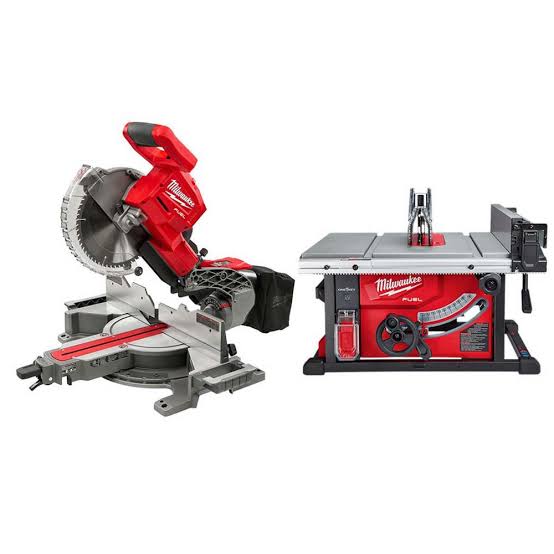
Table Saw v/s Miter saw

When shopping for power tools Is important to know what kinds of projects you’re going to do. Then getting the model that best fits your needs.

Location and ideal features should be taken into account when deciding between a Miter Saw v/s Table Saw. Mobile craftsmen should consider tabletop options or machines that come with wheeled supports. Those working in the same station may focus on Miter saws more features over added mobility. Having the right tool is essential for producing quality work. It is important for both hobbyists and experts to understand. Each specialty power tool is good for particular work.

Table saw is more versatile than a miter saw. For most people, a good table saw should be the first power saw you should invest in. There is hardly a job it can’t do.

Table Saw

A table saw is a very common power tool out there. It has the blade mounted on the underside of a tabletop. The blade protrudes through the highest of the table.

The circular saw blade is held in situ by what’s called an arbor that’s driven by an electric motor. The table surrounding the saw provides a platform to support the item that you are cutting.

By checking how far up or down the blade is, the depth of the cut is adjusted. The blade is moved up and down to make the cut either shallow or deep. Its versatility enables it to be the muse foundation of most workshops. It’s also an excellent saw for beginners and is ideal for those that might not have a large amount of experience. It’s also for those who need to work with large pieces of wood.

There are three different variations on a conventional table saw. In most places, table saws stand on its own legs. It often has wheels for mobility around the workplace. In heavier industries, cabinets replace legs.
Miter Saw

A miter saw is a different sort of saw. The blade of the saw is brought down onto the surface that you are chopping or trimming. Miter saws are easy to control and swift to use. One can usually operate the saw with one hand.

Depending on the angle of cut required, one will have to adjust the saw. A Miter saw is more adjustable, you may want to double-check your settings before making the cut.

Miter saws are designed to create accurate crosscuts and angular cuts. The swing mounted blade can be set to different angles allowing it to create way more precise miter cuts. Miter saw gives the user more control over where they create their cuts. This kind of saw is an excellent choice for those, who have a touch less space to work in. Also for those jobs where you’re crosscutting boards that are but 12 inches wide. Miter Saws are especially a favorite for trim workers who must crown molding to the right angle.

Most miter saws have dust collecting features via a port that exits the rear. This enables one to plug into his dust management system at a store. Or use a special bag for collecting dust and shavings. There are several options available. One can buy sliding models that supply wider cuts and either 10-inch or 12-inch blades.

There are two main sorts of miter saws.

The Basic Miter Saw Every miter saw should allow you to complete two forms of cuts. You ought to be able to use the foremost basic styles to make straight cuts. In which the saw slices through the width of a plank of wood at a 90-degree angle. The fundamental styles also allow you to finish angled cuts. To realize this, you adjust the angle of the blade over your material and pull the blade down the identical way. To get more advanced cuts, you need a compound miter saw.

The Compound Miter Saw These tools work like basic miter saws. They are available with one significant difference. Additionally, to angle cuts, these saws can cut with a bevel. The blade tilts into position and locks at the angle you wish for your cut.

Differences between a Table Saw and a Miter Saw

Though both saws use a circular blade to create their cuts. They’re often used for very different purposes. Miter saws will be used for angle cuts and straight cuts while table saws are for straight cuts.

The miter saw’s blade turns towards the rear of the machine, and thus the blade pivots downwards. This makes it easy to perform one-handed cuts. As long as the saw is about up, it can create a high volume of precise cuts, making it a workhouse on the worksite. Another difference is how these two saws are mounted.

that miter saws are generally easier to maneuver from place to position. If you wish to carry the saw different job locations. You’re best off going for either a mobile table saw (which continues to be heavy and cumbersome) or a miter saw. A miter with a rolling miter saw stand is very portable and would come very handy for professionals.

Yet, on the task site, you see them resting on a level, stable surface (like the bed of a pickup truck). Jobsite tables can work well, also.

This means that it’s more cumbersome for a project that needs you to form an oversized number of small cuts. The sole problem with a miter saw is its narrow width of cut. Sliding compound miter saws provide you with a touch more width.
Table Saw v/s Miter Saw

To find the best table saws and miter saws, there are a few things to consider before you begin. For example, the needs of a large shop differ from the needs of a personal hobbyist. Here are the four aspects to consider while you shop for one that suits you.

· Available workspace: How much space do you have to work with?

· Power: Do you need professional-grade tools?

· Versatility: Will you need to perform more advanced cuts?

The home carpenter who wants to make simple angle cuts doesn’t need a complex piece of machinery. His preferences differ from a woodworker who needs to perform compound cuts. In both situations, the size of the blade also plays a role in the decision. Miter saws with larger blades allow for longer cuts without any extra adjustments. Smaller machines use smaller blades, and the whole setup takes up less space. The best table saws and miter saws suit the size of your project and the size of your workshop.

Which Kind of Saw to Buy?

Many beginning woodworkers wonder how to choose saws for their shops. The answers depend on what they want to do. Your choice in the machine should address a specific challenge. Those who build their shops from the ground up may want to start with a miter saw. These versatile tools complete many of the most common cuts and used for all sorts of projects.

A job-site table saw adds versatility to your setup. It most supports those who need to spend less time carrying materials. Many at-home projects don’t need this level of mobility. Many woodworkers prefer the added power that comes with a stationary saw

Hopefully, this article has helped you figure out which kind is best for you.

A MAJOR EARTHQUAKE ON CARDS IN DELHI- NCR

*As per the collective statement of subject experts  

The occurrence of eleven, low magnitude earthquakes in and around Delhi in the last three months has become a matter of curiosity, and concern, for some, who are inquisitive to know the implications of this sudden change in earth’s behavior.

Experts of IIT Dhanbad have urged the Governments to ensure preventive measures as a major earthquake might shake the national capital and its adjoining areas in upcoming days. PK Khan a professor at applied geophysics department of IIT Dhanbad opined that recurrent tremors of small magnitudes predict a major earthquake. He asserted that time has come for the Centre and Delhi governments to take all required measures of prevention and create awareness.  

Some of the top geologists of the country have said that eleven earthquakes of low to moderate intensity have hit Delhi-NCR in the last 3 months, which indicates that a devastating earthquake may strike the National Capital in near future. Delhi is also close to the Himalayas where several earthquakes of more than magnitude 8 have occurred. There is a possibility of a few major tremors in the Himalayan region which can severely affect Delhi-NCR as shown by studies. 

 From April 12 to June 13, ten earthquakes have been recorded in Delhi-NCR by N.C.S (National Centre for Seismology). Four tremors in Uttarakhand and 6 in Himachal Pradesh were also recorded.  

“We cannot predict exact time, place or exact scale, but do believe that there is a regular seismic activity going around in the NCR region and may trigger in a major earthquake in Delhi,” asserted Dr. Kalachand Sain, Chief at Wadia Institute of Himalayan Geology, an autonomous institute, run under DST (Ministry of Science and Technology).

Dr. AK Shukla, ex-Head of Earthquake Risk Evaluation, Indian Metrology Department said, “Most of these earthquakes were low magnitude earthquakes measuring from 2.3 to 4.5. A series of such earthquakes ostensibly warn of a major earthquake to hit Delhi in the coming days. An obvious reason for increasing numbers of tremors hitting Delhi is the local fault system, which is quite active. Such fault systems around Delhi have the potential of producing an earthquake of magnitude around 6 to 6.5.”

According to reports, most of the buildings constructed in Delhi are not earthquake resistant and may get severely damaged in case of high magnitude tremors.

Why A Major Earthquake Will Be Catastrophic For Delhi

Delhi’s population has seen a rapid growth of 11.5 times in the past 70 years. If an earthquake-like 1720 recurs, the loss to life and property could be humungous in today’s Delhi.

The occurrence of eleven, low magnitude earthquakes in and around Delhi in the past three months has become a matter of concern. The reality is subject experts refrain from making a prediction as to whether the phenomenon is a sort of a trailer for something bigger in-store, or just a swarm of harmless micro-tremors, which would fade away into oblivion with passage of time. It would be reasonable to conduct the issue on scientific lines after rummaging through the existing database of events.

Talking in geological terms, Delhi is situated at the interface of old metamorphic rock sequence and very young alluvial sediments that have been deposited over the Indian lithosphere in response to the tectonic movements of the Himalaya. This region is located on the intersection of two regional sub-surface structures named Delhi-Haridwar Ridge and Delhi-Sargodha Ridge. The former is placed between two faults viz Mahendragarh-Dehradun Subsurface Fault and Great Boundary Fault (GBF) that are 200 km apart.

Understanding the importance of the NCR and its seismic status, it is classed in high damage risk zone IV, The IMD established a seismic telemetry network of sixteen field observatories during 1998-2000. This network has recorded 422 seismic events in the period from 2005 to 2012, the majority being tremors with a magnitude less than 3.0. This recent disturbance in the natural movement of plates is regarded somewhat out of bound for a logical explanation. We will have to wait and watch while taking all the necessary measures. 

DIGITAL MARKETING: A WAY FORWARD

COVID-19 pandemic is a Humongous problem for companies everywhere, and it’s practically impossible to ignore the issue – it has changed the way business is executed everywhere.

Many owners and work managers are failing to shift the regular marketing strategies to a digital marketing (The new normal)

They are overlooking the situation because perhaps they have hope that some sudden turn of events towards normalcy will occur in the times of chaos. 

 Whatever may be the cause but this inability to adapt will cause grave concerns to the economic survival of the company.

Whereas, many organizations that have shown great adaptability by appointing digital marketing.

·       The impact – COVID: 19 on Businesses

There is no business which lies unaffected by the pandemic, worst sufferers are startups that do not have the capital or reserves to keep the struggle on and companies that relied completely on physical interactions, like salons, clothing stores, and yoga studios.

Accustomed to growth incitation by customer referrals and their awesome service reputations, they have experienced a very high revenue loss that their impulse reaction has been to cut marketing costs rather than exploring new and more effective options.

In turn, this unaccustomed reaction has had a detrimental ‘trickle’ effect on larger B2B companies work as providers to these smaller businesses.

Every business, be it your neighborhood departmental store or an enormous multinational firm, can benefit from digital marketing. Customers still need the products and services as much as ever—what these companies need to do is change the way they reach their target audiences. Even if a small enterprise doesn’t have an online page or portal (one in four do not have), it’s not very late to join in the businesses that are thriving online.

  1. Coming to – HOW TO?

It’s time for the affected businesses to make the transition from a fortress store to a digital provider by contacting their customers, reviving unused online assets like websites and social media profiles, and pedaling full speed ahead.


Contacting customers

The first step is to commence a dialogue between business and customers and carrying it forward. For companies that never collected email addresses, created a database, or engaged on a regular basis to their followers, it’s time now to do so.

Announce COVID-19 changes in an existing newsletter. 

Companies with an existing newsletter can convey to its subscribers about any corona virus-related changes in the next edition. Send out a newsletter to let your customers know how your business is reacting to the pandemic 

Boosting the company website Sorting businesses with SEO marketing

Coronavirus is changing the way that consumers shop. Approximately 47% of shoppers have stated that they are avoiding malls and shopping centers.

On the contrary note, SEO is undergoing a strong rise, with many brands reporting a significant hike in their organic search visibility from January to March 2020. 

It is evident it’s time to invest in, not to cut back on, SEO. It is one of the most cost-effective digital marketing strategies, it’s also delivering results.


Shifting daily operations online

There are very few organizations that cannot make the transition of their daily operations. Credit to video conferencing applications like Zoom, Skype, and many other executives and managers can communicate and impart instructions to staff and hold client meetings from anywhere. 

· Sales teams can take orders and reservations and provide services to customers via email, chat, or video. They no longer have to commute; they can even start work early leaving customers with longer support hours.

· Services that were previously delivered in person are surprisingly amenable to video presentations. Clients can pay online and receive a video link to live sessions.

Staff education also plays an important role in a successful transition—and this is time to enhance your team’s skills?

Online courses are highly cost-efficient, and teams can learn new skills that enable them to support each other whenever one department is down or facing issues. Courses on digital marketing are available on how it works and how to make the most out of all the opportunities.

·       The biggest question-What are my business benefits?

Many businesses are cutting costs on their marketing efforts due to COVID-19, but what they should really be doing is grabbing advantage of the new opportunities that are rising.

This emphasis on digital marketing is not something that they’ll want to slow down on once the lockdown ends. Online shopping is going to stop no-time soon, and most companies will find those web-based interactions to be convenient than in-person meetings.

Stores will reopen but alongside newly adopted ways of selling and engaging with customers.

While digital marketing may be regarded right now as an emergency plan, but by the time this is over, everyone will likely realize that it’s more than a temporary measure rather than a sustainable one. So GO DIGITAL AND BE FUTURE READY