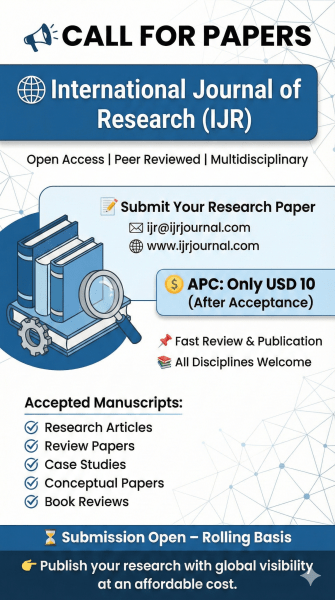
The International Journal of Research (IJR) invites original and high-quality research papers for publication in its upcoming issues. IJR is a peer-reviewed, open-access international journal that provides a global platform for researchers, academicians, professionals, and students to disseminate their scholarly work across a wide range of disciplines.
🌐 Journal Website: https://ijrjournal.com 📧 Paper Submission Email: ijr@ijrjournal.com 💲 Article Processing Charge (APC): Just USD 10 (One-time, after acceptance)
About the Journal
The International Journal of Research (IJR) is committed to promoting accessible, affordable, and ethical scholarly publishing. As an open-access journal, IJR ensures that all published articles are freely available to readers worldwide, thereby enhancing visibility, citation potential, and academic impact.
The journal follows a rigorous peer-review process to maintain academic quality while ensuring a fast and transparent review timeline, making it especially suitable for early-career researchers and scholars from developing regions.
Scope of the Journal
IJR is multidisciplinary in nature and welcomes research contributions from (but not limited to) the following areas:
Social Sciences and Humanities
Education and Pedagogy
Management, Commerce, and Economics
Science and Technology
Engineering and Applied Sciences
Architecture, Planning, and Design
Environmental Studies and Sustainability
Law, Public Policy, and Governance
Health, Psychology, and Allied Sciences
Interdisciplinary and Emerging Research Areas
Both theoretical and empirical studies are encouraged.
Types of Papers Accepted
The journal accepts the following categories of manuscripts:
Original Research Articles
Review Papers
Case Studies
Conceptual Papers
Short Communications
Book Reviews
All submissions must be original, unpublished, and not under consideration by any other journal.
Why Publish with IJR?
✔ Open Access publication ✔ Very low APC – only USD 10 ✔ International editorial and reviewer base ✔ Fast peer-review and publication process ✔ DOI assignment for published articles ✔ Global visibility and readership ✔ Author-friendly submission process
IJR strongly supports inclusive academic publishing, making research publication affordable without compromising scholarly standards.
Submission Guidelines
Authors are requested to submit their manuscripts in MS Word format to: 📧 ijr@ijrjournal.com
The manuscript should include:
Title and author details
Abstract and keywords
Main text with proper references
Declaration of originality
Detailed author guidelines are available on the journal website: 🌐 https://ijrjournal.com
Important Dates
📌 Submission: Open (Rolling submissions accepted) 📌 Review Process: Fast and peer-reviewed 📌 Publication: Immediately after acceptance and APC payment
Invitation to Authors
The editorial board of IJR warmly invites researchers, faculty members, PhD scholars, postgraduate students, and independent researchers to submit their valuable work and become part of a growing international research community.
Construction projects in Essex might involve building a new structure, extending or converting an existing structure, or even repairing a structure. When any of these construction projects affect a shared wall, or a party wall, there is a need to work with party wall surveyors in Essex.
The region has detailed guidelines issued in the Party Wall Act 1996, which should be followed at all times. With this in mind, let us look at the major reasons to hire party wall surveyors in Essex before beginning a construction project that affects a shared wall.
To Ensure the Legal Compliance of the Project
One of the mistakes one can make when carrying out a construction project in Essex is not following legal processes. Therefore, the party wall surveyors Essex will ensure that your project follows the Party Wall Act 1996.
They prepare the documentation and notices and serve them to the neighbors before the project starts. Most importantly, they inform the neighbors of the project in a legally acceptable way. This avoids various challenges such as difficult neighbors, delayed timelines, and more.
Hire Party Wall Surveyors in Essex to Resolve Any Dispute with Neighbors
Construction projects that touch a shared wall can bring about disputes between the owner and a neighbor. Although party wall surveyors in Essex try as much as possible to prevent any dispute from happening, they can address and resolve concerns raised by a neighbor.
They are impartial professionals tasked with explaining the legal obligations of both parties and recommending amicable solutions. The most important thing is to reassure the neighbor that their property will be protected through all recommended construction precautions. Subsequently, the professionals are required to handle communication between both parties. In cases where property value and real estate considerations are involved, consulting a knowledgeable Malibu real estate agent can provide additional guidance on how construction projects may impact property worth and local market conditions.
To Provide an Accurate Work Schedule When Requested
Before the work begins, the party wall surveyors in Essex may be required to provide a work schedule to a neighbor or their legal team. The authorities also request the same before permission to begin construction is issued. Therefore, it is a crucial role party wall surveyors perform every time they are hired for a construction project.
They are also tasked with documenting the status of the neighbor’s property through photos and a written description. Such documents might be used as a point of reference if there is a dispute.
To Help with Permission Application
Some party wall surveyors in Essex also work with architects in the same office and offer permission application assistance as part of the package. Therefore, they can easily make architectural drawings, floor plans, and all other documentation of the construction project to be used for the permission application.
Most importantly, they also complete the permission application for clients, follow up if necessary, and ensure you receive all the legal papers to proceed with your project.
To Protect You from Compensation Awards and Fines
It is the work of professional party wall surveyors in Essex to protect their clients from costly compensation awards and fines. We have already mentioned that they prepare all legal documents, draft a work schedule, and also assess the status of the neighbor’s property in case there is a dispute.
Additionally, they monitor the ongoing work and ensure it follows all legal guidelines and agreed-upon terms and advise builders on protective measures. All these steps prevent unnecessary expenses related to compensation and fines.
Hire Party Wall Surveyors in Essex to Supervise Your Project
The party wall surveyors in Essex will definitely supervise your project once you hire them. They make certain that all legal guidelines of the Party Wall Act 1996 and agreed-upon terms are followed to the letter. Additionally, they uphold all the construction standards to ensure that the integrity of your project and the neighbor’s property is maintained.
Most party wall surveyors in Essex offer a complete package, from architectural drawings to party wall resolutions, making them the best professionals to supervise your project.
To Communicate on Your Behalf
Another major reason to hire professional party wall surveyors in Essex is to communicate on your behalf. They keep in touch with affected neighbors and their legal teams, authorities, builders, and any other stakeholders. This involves holding or attending meetings to represent you.
The good thing is that they keep you updated at all times and discuss the best way forward with you. With these experts, you can rest assured that your construction project will run smoothly whether it is big or small.
To Avoid Any Unnecessary Risks
Lastly, you need to hire party wall surveyors in Essex to avoid any unnecessary risks or unforeseen challenges in your project. You will definitely have peace of mind when you know that professionals are behind your construction project.
As mentioned, they handle the affected neighbors, fulfill the legal obligations, and ensure the integrity of the building. Therefore, there are many reasons to hire these experts.
Conclusion
It is highly recommended that you work with professional party wall surveyors in Essex when you have a construction project that involves a party wall, no matter how small the project is. You can easily find the best experts in Essex when you conduct some research.
Preparing for TELC exams requires a structured approach that addresses language proficiency and familiarity with the exam format. Since TELC assessments focus on practical communication, candidates can benefit from using targeted study materials and interactive practice tools. Several effective preparation methods can help you steadily improve and build confidence before test day:
Official TELC practice tests
These materials mirror the actual exam structure, including listening, reading, writing, and speaking tasks. Working with these tests allows candidates to understand the timing, types of tasks, and scoring expectations. Regular practice also helps identify common patterns, such as text formats, vocabulary themes, and frequently appearing instructions. Taking full tests under timed conditions improves time management and discipline.
Online prep courses
Many language schools https://iisc-institute.de/ and testing centers offer programs focused on the TELC that include structured lessons, grammar reviews, and exam simulations. These courses often incorporate feedback from instructors who are experienced in TELC evaluation standards. With guided instruction, learners can identify and address their weaknesses and adapt to the communication-oriented nature of the exam. Online courses are useful for candidates who prefer flexibility or need to balance preparation with work or studies.
Interactive language-learning platforms
Those that incorporate speaking recognition, vocabulary building, and contextual grammar practice help reinforce daily language usage. Combining these platforms with exam-specific exercises strengthens overall fluency and comprehension. They are effective for maintaining regular practice, especially between more intensive study sessions.
Conversation groups
Such groups, as well as language exchange sessions, are beneficial for improving speaking skills. Since TELC exams emphasize communicative ability, practicing with partners encourages spontaneity, listening comprehension, and natural expression. Real-time conversations provide a more realistic environment than scripted exercises and support the fluency required for the oral component of the exam.
Intensive preparation:
Textbooks and workbooks designed for TELC levels offer structured explanations of grammar, lists of vocabulary, and reading exercises organized by theme. These resources align with the Common European Framework of Reference (CEFR), ensuring the practice material matches the expected linguistic complexity at each level.
For the writing section, guided writing prompts and model text reviews can help you master common formats, such as emails, formal letters, and short reports. Practicing structure, tone, and clarity reduces uncertainty and improves performance on the written section.
Listening skills can be improved through audio materials, podcasts, and recorded dialogues similar to those used in TELC assessments. Exposure to varied accents and speaking speeds helps prepare candidates for typical listening tasks.
Finally, periodically taking mock exams allows candidates to track their progress and adjust their study strategy. These simulations highlight remaining gaps and confirm readiness for the actual exam.
You don’t have to visit the office to order a certified translation of the documents you need. The development of digital technologies has made it much easier to obtain a certified translation, simplifying the procedure for many people who are unable to spend time on it due to their busy schedules, the difficulty of getting to the office, and other reasons. Now, to obtain an official document with the translator’s signature and seal, there is no need to visit the company’s office. You can simply upload scanned documents and place your order online. This is a very convenient option for those who live in another city, work long hours, travel frequently, etc. There is no need to spend time traveling; everything can be done remotely.
Certified translation
Simply put, a certified translation is a translation of a document with confirmation from a specialized translator with the necessary qualifications that the text has been accurately rendered and there are no distortions. Such translations are required by government agencies, such as courts, educational institutions, and other services. It is important to understand that a certified translation cannot be done independently or with the help of text translation programs and services. It is a legal document that becomes such when it acquires legal force after being signed and stamped by the translator, who has verified that the essence of the document has been accurately conveyed and corresponds to the original, and that the paper fully complies with the requirements of the law.
You can order official translation services in Los Angeles online at A to Z Documents. No need to waste extra time, everything can be done quickly from anywhere in the country. All you need is a high-quality image of the document that needs to be certified. This can be a scan made on a printer or simply a photo taken on your phone, but it must be well lit to ensure that the image is completely clear and free of defects and distortions. You upload your file to the A to Z Documents website or simply send it by email to our specialists. Next, a manager will contact you to clarify the details, in particular the language of translation, deadlines, and agree on the cost. As a rule, you can expect the finished results in three business days, and in some cases, the very next day.
Don’t complicate your life; look for opportunities to complete many bureaucratic procedures online and save your time. Atozdocuments.com will take care of certified translations, document apostilles, and many other services online.
⚠️ We are not an attorney and, therefore, cannot give legal advice about immigration or any other legal matters. ⚠️
Author:Ekaterina Zaznova *Artist, researcher, and educator; author of the “Watercolor & Alcohol” method registered with the U.S. Copyright Office; Member of the American Watercolor Society (AWS), National Watercolor Society (NWS), Transparent Watercolor Society of America (TWSA), International Watercolor Society (IWS), the Union of Russian Watercolorists, and the Eurasian Artists’ Union.
Abstract
This article explores isopropyl alcohol not as a secondary technical additive but as an independent medium that transforms the visual language of watercolor. Drawing on years of artistic practice and empirical research, the author proposes a conceptual and structured methodology for integrating alcohol into watercolor painting. Both the visual effects and pedagogical potential of this approach are analyzed, emphasizing its role in developing individual artistic style and creative thinking.
Traditionally, watercolor is associated with transparency, fluidity, and delicate color transitions. However, in the era of artistic experimentation, the boundaries of the medium are increasingly flexible. One of the most compelling directions of this transformation is the use of alcohol in watercolor — not merely as a solvent or a decorative effect, but as a fully independent medium with its own plasticity, logic, and aesthetics. This study presents the stages of developing an authorial methodology where alcohol functions as a means of visual language and artistic cognition, offering a new approach to watercolor as a tool of visual research.
Materials and Methods
The research included:
Years of artistic experimentation on watercolor papers of various densities (190–640 g/m²)
Use of alcohol at different concentrations (30%, 50%, 99%)
Comparative analysis of traditional and experimental watercolor techniques
Engagement of over 1,000 participants in online courses and creative marathons
Aesthetic and pedagogical verification of the resulting visual outcomes
Alcohol as a Medium: Artistic Characteristics
Characteristic
Manifestation with Alcohol Use
Pigment Dynamics
Creates “fractures,” spirals, rings, and highly expressive diffusion effects
Enables asymmetric, multilayered, and “living” forms
Color Behavior
Increases saturation through water displacement; produces unpredictable chromatic shifts
Evaporation Timing Sensitivity
Requires instant compositional response from the artist
Educational Potential
High student engagement through surprise, experimentation, and expressive freedom
From Experiment to System: Methodological Framework
The author developed a step-by-step methodology that includes:
Exploratory Phase: Creation of numerous sketches exploring variable pigment–alcohol reactions.
Analytical Phase: Systematization and classification of observed effects.
Formalization Phase: Compilation of correlation tables between alcohol concentration and resulting effects.
Implementation Phase: Integration into educational programs and online courses.
Pedagogical Adaptation Phase: Development of exercises for beginners and professionals.
Authorial Integration Phase: Establishment of the technique as the foundation of the artist’s personal visual series.
Comparative Analysis: Alcohol vs. Traditional Methods
Parameter
Traditional Watercolor
Alcohol-Based Methodology
Control
High
Limited
Chance Element
Minimal
Built-in structural feature
Surface Texture
Smooth
Dynamic, tactile, relief-like
Visual Impression
Meditative
Impulsive, expressive
Reproducibility
Predictable
Varied and organic
Emotional Effect
Calmness
Awe and fascination
Pedagogical Significance
A central component of this development is its integration into the author’s educational course, where alcohol is presented not as a “trick,” but as a complete artistic system.
Over 3,000 students have mastered the technique between 2022 and 2025.
More than 60% have participated in multiple courses and creative marathons.
The method has become an essential part of the Pro Akvarel educational platform.
The use of alcohol in watercolor helped students overcome the “fear of the blank page,” stimulated creative thinking, and encouraged the formation of unique visual styles.
Conclusion
In watercolor, alcohol ceases to be merely a means of achieving special effects — it becomes an intellectual instrument, a medium that shapes a new visual grammar. Ekaterina Zaznova’s methodology demonstrates how the apparent chaos of chance can be transformed into a structured artistic system — one that simultaneously liberates and disciplines. This synthesis opens new perspectives for contemporary painting, educational research, and rethinking the role of the medium in 21st‑century art.
References
Finley, M. “Alcohol as Agent in Contemporary Watermedia.” Watermedia Journal, 2021.
Zhang, L. “Experimental Media in Fine Art Education.” Visual Pedagogy Review, 2020.
Zaznova, E. “Integrating Alcohol in Watercolor Practice: The Pro Akvarel Experience.” Art Education Review, 2023.
Mitchell, S. “Liquid Boundaries: Mixed Media Art Today.” Contemporary Art Studies, 2019.
Kim, J. “Chemical Reactions in Pigment Dispersion.” Journal of Artistic Chemistry, 2017.
Chukanova, I. “Mixed Techniques in Visual Art.” Actual Artist, 2022.
Pro Akvarel Archive (2022–2025). Online Course Materials and Methodological Notes.
White, C. “Intuitive Control in Unpredictable Mediums.” International Review of Art Therapy, 2020.
Zaznova, E. “Watercolor and Chaos: Developing Artistic Thinking.” Creative Pedagogy, 2024.
National Society of Watercolorists. “Innovation Reports,” 2023.
Situate it within broader literature, themes, or current debates.
Provide a recommendation (whether to read it, and for whom).
2. Before Writing
Read the book carefully: Take notes on themes, arguments, style, and tone.
Research the author: Understanding their background, previous works, and perspective helps contextualize the book.
Identify the genre: Fiction, non-fiction, academic, biography, etc.—the review style will differ slightly.
Know your audience: Academic readers expect critical engagement, while general readers look for clarity, enjoyment, and practical insights.
3. Structure of a Book Review
(A) Bibliographic Information
At the top, provide complete citation details:
Title of the book
Author(s)
Publisher, year of publication
Edition (if relevant)
Number of pages
ISBN (optional for academic settings)
👉 Example: Smith, John. Urban Futures: Planning in the 21st Century. Routledge, 2023, 320 pages.
(B) Introduction
State the book title and author again briefly.
Introduce the central theme or subject matter.
Mention the purpose of the book (why it was written).
Provide context (e.g., field of study, historical/social relevance).
End with your thesis statement (your overall impression or judgment).
(C) Summary of the Book
Present the main arguments, ideas, or storyline.
Outline the structure: Is it divided into sections, themes, or chapters?
Keep the summary concise—avoid retelling the whole book.
Highlight key themes, concepts, or case studies used by the author.
(Tip: Use neutral language here; save your opinion for the evaluation section.)
(D) Critical Evaluation
This is the heart of the review—your analysis. Consider:
Content & Argument
Is the argument convincing, original, or well-supported?
Does the author achieve their stated goals?
Are there gaps, biases, or contradictions?
Style & Readability
Is the book clear, engaging, and accessible?
Is the language academic, technical, or popular?
Evidence & Sources
For non-fiction: Are claims backed by research, data, or credible sources?
For fiction: Are characters, plot, and setting well-developed?
Contribution to the Field
For scholarly works: Does it advance knowledge or challenge existing ideas?
For general works: Does it add value to readers’ understanding?
Strengths and Weaknesses
List specific strengths (e.g., clarity, depth, originality).
List weaknesses (e.g., limited scope, poor editing, lack of balance).
(E) Conclusion
Summarize your key evaluation points.
State whether you recommend the book, and to whom (students, researchers, professionals, general readers).
End with a final thought on the book’s impact or relevance.
4. Writing Style Tips
Be objective: Balance praise with criticism.
Be concise: Usually 800–1200 words for academic reviews, 500–800 for general reviews.
Use evidence: Quote short passages to illustrate points.
Avoid spoilers (for fiction).
Write in clear, accessible language.
5. Checklist Before Submitting
✅ Have you included full bibliographic details? ✅ Does your introduction state the theme and purpose? ✅ Did you summarize briefly without retelling? ✅ Does your evaluation cover content, style, and contribution? ✅ Have you balanced strengths and weaknesses? ✅ Did you provide a recommendation? ✅ Is your review well-structured and free of grammar errors?
6. Common Mistakes to Avoid
❌ Writing only a summary with no evaluation. ❌ Overly praising or dismissing without justification. ❌ Including long quotes instead of analysis. ❌ Ignoring the intended audience of the book. ❌ Making the review longer than the book itself!
7. Sample Closing Lines
“This book is an essential read for scholars of urban studies, though general readers may find its technical language challenging.”
“While the narrative pace is slow in parts, the depth of research makes it a valuable contribution to climate policy debates.”
“Highly recommended for anyone interested in contemporary fiction exploring migration and identity.”
High school students face mounting pressure to stand out in competitive college admissions and job markets. Traditional classroom settings often fall short in developing the advanced communication skills that modern careers demand.
These limitations leave many talented teenagers unprepared for professional environments where clear, confident English communication determines success. By working with an online English tutor, students receive personalized instruction that transforms academic learning into practical career readiness, helping them develop the sophisticated language skills that employers value most.
Essential Career Skills Online English Tutors Develop in High School Students
Advanced Communication Skills for Leadership Roles
Professional presentation techniques form the foundation of effective leadership communication. Tutors help students master the art of structuring persuasive arguments and delivering compelling presentations that capture attention in boardroom settings.
Business writing and email etiquette training prepares teenagers for corporate environments where clarity and professionalism matter. Students learn to craft messages that convey authority while maintaining an appropriate tone for different workplace contexts.
Digital Literacy and Remote Work Preparation
Virtual meeting participation skills have become essential in today’s remote work landscape. Tutors teach students how to contribute meaningfully to online discussions and project a professional presence during video conferences.Online english tutoring for teens includes training on digital collaboration tools that facilitate teamwork across different time zones. These skills prove invaluable as students enter colleges and workplaces that prioritize flexible, tech-enabled communication.
Critical Thinking and Problem-Solving Through English
Analytical essay writing for complex scenarios helps students break down multifaceted problems and present logical solutions. This skill transfers directly to workplace challenges that require methodical analysis and clear documentation.
Debate skills for workplace discussions teach students to advocate for their ideas while respecting opposing viewpoints. These abilities prove crucial during team meetings and strategic planning sessions.
While these core communication competencies form the foundation of career readiness, today’s competitive job market demands specialized expertise that aligns with specific industry requirements and expectations.
Industry-Specific Career Preparation Through Specialized English Tutoring
Benefits of online tutoring include the ability to customize instruction for specific career paths that students want to pursue. Tutors can adapt their teaching methods to address unique language demands across different industries, ensuring students develop relevant competencies.
STEM Career English Enhancement
Technical writing and documentation skills help future engineers and researchers communicate complex concepts to diverse audiences. Students learn to translate scientific jargon into accessible language that non-experts can understand and act upon.
Scientific presentation skills prepare students for conference presentations and research collaborations. Tutors focus on helping students explain methodology and findings with precision while maintaining audience engagement.
Business and Entrepreneurship Track
Marketing copywriting techniques teach students to craft persuasive content that drives action and builds brand awareness. These skills prove valuable whether students launch their own companies or join marketing teams at established organizations.
Contract and legal document understanding helps future business leaders navigate agreements and partnerships with confidence. Students learn to identify key terms and potential issues before signing important documents.
Creative Industries and Media Preparation
Content creation across platforms prepares students for careers in digital marketing, journalism, and entertainment. Tutors help students develop distinct voices that resonate with target audiences across different media channels.
Portfolio presentation skills teach students to showcase their work professionally and articulate their creative process to potential employers or clients. Beyond industry specialization, the personalized nature of online English tutoring creates measurable academic advantages that directly translate into enhanced college readiness and scholarship opportunities.
Benefits of Online Tutoring for Academic Performance and College Readiness
Improving academic performance through targeted English instruction creates a ripple effect that extends far beyond classroom grades. Digital technology use has a positive and direct effect on the English academic performance of EFL students (p < 0.01), demonstrating the measurable impact of technology-enhanced learning approaches. These improvements position students for greater success in college applications and career preparation.
Personalized Learning Pathways for Career Goals
AI-driven curriculum customization allows tutors to align lessons with students’ specific career interests and learning styles. This targeted approach accelerates skill development while maintaining student engagement through relevant, practical applications.
Flexible scheduling around extracurricular activities ensures that students can balance tutoring with sports, volunteer work, and other commitments that strengthen college applications.
College Application and Scholarship Success
Essay writing for competitive applications requires sophisticated narrative skills that many students struggle to develop independently. Tutors help students craft compelling personal statements that distinguish them from thousands of other applicants.
Interview skills for scholarship opportunities teach students to articulate their goals and achievements confidently during high-stakes conversations with selection committees.
These personalized learning benefits are amplified exponentially through cutting-edge educational technologies that create immersive, career growth experiences forinternational school Malaysia students that are impossible in traditional classroom settings.
Technology-Enhanced Learning Methods That Accelerate Career Growth
Modern tutoring platforms integrate advanced technologies that simulate real workplace scenarios and provide immediate feedback on student progress. These innovations create learning experiences that closely mirror professional environments students will encounter after graduation.
AI-Powered Tutoring Platforms and Career Alignment
Machine learning algorithms identify specific skill gaps and recommend targeted exercises that address weaknesses while building on existing strengths. This precision approach maximizes learning efficiency and career preparation effectiveness.
Predictive analytics help students understand which career paths align with their developing competencies, enabling more informed decisions about college majors and professional goals.
Virtual Reality and Immersive Learning Experiences
Simulated workplace communication scenarios allow students to practice important conversations in risk-free environments. These experiences build confidence for future job interviews, client meetings, and team collaborations.
Virtual international business meetings prepare students for global career opportunities by exposing them to different communication styles and cultural expectations. As technology revolutionizes how students learn English for career success, it simultaneously opens doors to international career paths that demand advanced cross-cultural communication skills.
Global Career Opportunities Through English Proficiency
English proficiency serves as the universal key that unlocks international career possibilities for ambitious high school students. Specialized tutoring prepares students for global workforce demands while developing cultural sensitivity essential for cross-border collaboration.
International Remote Work Preparation
Cross-timezone communication strategies help students coordinate projects with team members around the world. These skills become increasingly valuable as remote work continues to expand across industries.
Cultural adaptation communication skills prepare students to work effectively with colleagues from different backgrounds and business cultures.
Multinational Corporation Career Preparation
Corporate culture navigation skills help students understand how communication styles vary between organizations and regions. This knowledge proves essential for students targeting careers with global companies.
International business protocol training covers professional etiquette that differs across countries and cultures, preventing embarrassing mistakes during important business interactions.
With the vast scope of global opportunities available through enhanced English proficiency, establishing clear metrics beomes essential for tracking student progress and ensuring tangible career-focused outcomes.
Common Questions About Online English Tutoring for Career Growth
1. How early should high school students start career-focused English tutoring?
Freshman year provides the optimal starting point, allowing four years to develop sophisticated communication skills while building confidence through consistent practice and feedback.
2. What specific career skills do online tutors focus on?
Professional presentation skills, business writing, cross-cultural communication, digital collaboration, critical analysis, and industry-specific vocabulary that traditional classrooms rarely address comprehensively.
3. Can online tutors help students who already excel in English?
Absolutely. Advanced students benefit from specialized instruction in professional communication, leadership language, and industry-specific terminology that elevates their existing skills to professional levels.
Taking the Next Step Toward Career Success
When students partner with an online english tutor, they receive the personalized instruction and career-focused training that ambitious high school students need to succeed in competitive academic and professional environments. These specialized programs develop communication competencies that extend far beyond classroom requirements, creating genuine advantages in college admissions and early career opportunities. The combination of flexible scheduling, customized curricula, and technology-enhanced learning makes professional English instruction accessible to students who are serious about their future success. Investing in quality tutoring now creates lasting benefits that compound throughout students’ academic and professional journeys.
🌐 Call for Papers – International Journal of Research (IJR) 📖 A Premier Platform for Scholarly Publishing Across Disciplines 📝 Website: www.ijrjournal.com 📧 Email: ijr@ijrjournal.com ISSN (Online): 2348-6848 | ISSN (Print): 2348-795X Impact Factor: 8.2 | Monthly | Peer-Reviewed | Open Access
The International Journal of Research (IJR) is pleased to invite original and high-quality manuscripts for publication in its upcoming issues. With a strong commitment to academic excellence, research integrity, and the promotion of knowledge, IJR offers an inclusive platform for scholars, academicians, professionals, and researchers to share their findings with a global audience.
Established as a multidisciplinary, peer-reviewed, and open-access journal, IJR is recognized for its rigorous editorial process, transparent peer-review system, and global reach. It serves as a forum for the exchange of ideas and advancements across a wide range of fields and disciplines.
🌟 About the Journal
The International Journal of Research (IJR) is published monthly and maintains a strict double-blind peer-review process to ensure the integrity and academic merit of every submission. Our editorial board comprises distinguished scholars, researchers, and professionals from around the world who are committed to maintaining the highest standards in academic publishing.
With an impact factor of 8.2, IJR continues to gain prominence as one of the most reliable, credible, and accessible journals for researchers who wish to reach a wider academic and professional readership.
📚 Areas of Interest
IJR accepts papers from all disciplines, with particular interest in the following areas:
Humanities and Social Sciences – Sociology, Psychology, Political Science, Anthropology, History, Literature, Philosophy
Revisions & Final Decision: 7–10 days (if required)
Online Publication: Between 28th–30th of each month
Print Issue Dispatch: Within 10 days of online publication
🧾 Publication Benefits
Rapid Review and Publishing Process
DOI (Digital Object Identifier) for Every Paper
e-Certificate of Publication for Each Author
High Visibility Through Indexing in Major Databases
Opportunity to Publish Special Issues and Edited Volumes
Support for Early-Career Researchers and Scholars from Developing Countries
Print Copies Available on Request
💵 Article Processing Charges
A nominal fee is charged to cover editorial, peer-review, archiving, DOI registration, and publication costs. Discounts and waivers are available for authors from low-income countries, NGOs, and students. Please write to us for more information.
🔗 How to Submit
We accept submissions via email and through our online portal.
Manuscripts should follow our submission guidelines, which are available on the website. Each manuscript should be accompanied by a declaration of originality and a short bio of the author(s).
📣 Final Note
Publishing in IJR means becoming part of a vibrant community of scholars committed to advancing knowledge, promoting open access, and contributing to meaningful academic and professional dialogue. Whether you are an academic, a postgraduate researcher, or an independent thinker, IJR provides the right platform to amplify your voice and document your insights.
Storytelling is as old as human civilization. From cave paintings to oral traditions, epic poems to digital novels, stories have shaped cultures, preserved history, and connected people across time and place. But writing a story that captivates, resonates, and lingers in the reader’s mind requires more than just a good idea—it demands skill, structure, imagination, and emotional truth. Whether you are an aspiring novelist, a blogger, or someone with tales to tell, understanding how to write stories is a foundational step in your creative journey.
1. Understand Why Stories Matter
Before diving into the mechanics, it’s important to understand why stories matter. Stories do more than entertain—they help us make sense of the world, empathize with others, and imagine new possibilities. A well-told story can inspire action, change minds, or simply offer an escape. Writing stories is an act of connection: it bridges the gap between the writer’s inner world and the reader’s imagination.
2. Start with an Idea or a Premise
Every story begins with a spark—an idea, a character, a conflict, or a question. This doesn’t need to be fully formed, but it should be intriguing enough to motivate you through the writing process. Ask yourself: What if? What would happen if a shy librarian discovered a magical book? What would a soldier do if he returned to a world that no longer recognized him?
Ideas can come from anywhere—dreams, overheard conversations, personal experiences, or the news. Keep a notebook or digital document to record your sparks of inspiration. Over time, one of them might grow into your next great story.
3. Build Believable Characters
Characters are the heart of any story. No matter how exciting your plot is, if readers don’t care about the characters, they won’t be invested in the story. Begin by defining your protagonist—the central character with whom the audience will identify. Give them desires, flaws, and depth. What do they want? What stands in their way? How do they change over the course of the story?
Secondary characters should also feel real. Avoid stereotypes and clichés. Even minor characters deserve a backstory or a unique trait that makes them memorable. Dialogue is a powerful tool for revealing character—use it to show relationships, personality, and tension.
4. Create a Strong Plot Structure
A story without structure is like a house without a frame. It may have all the materials—characters, settings, conflicts—but it won’t hold together. Most stories follow a classic structure known as the narrative arc:
Exposition: Introduce the setting, characters, and the story’s premise.
Rising Action: Build tension through conflicts and complications.
Climax: The turning point where the main conflict reaches its peak.
Falling Action: The aftermath of the climax and the unraveling of events.
Resolution: Loose ends are tied up, and the story concludes.
While you don’t have to follow this structure rigidly, understanding it helps ensure your story has momentum and emotional payoff.
5. Show, Don’t Tell
One of the golden rules of storytelling is “show, don’t tell.” Instead of telling readers what a character feels, show it through actions, reactions, and sensory details. For example, rather than writing “She was scared,” you could write “Her hands trembled as she reached for the doorknob, her breath coming in short, sharp gasps.”
Showing makes scenes more vivid and immersive. Use all five senses—sight, sound, touch, taste, and smell—to draw the reader into your world. Strong imagery and descriptive language help paint a mental picture that sticks.
6. Choose the Right Point of View
The point of view (POV) determines who tells the story and shapes how readers perceive events. Common POVs include:
First-person: “I” narration allows deep emotional access to the narrator’s thoughts but limits the story to what they know.
Third-person limited: “He” or “she” narration focuses on one character’s internal world.
Third-person omniscient: The narrator knows everything about all characters and events.
Second-person: Rare in fiction, this “you” perspective creates a direct, immersive experience.
Pick a POV that best suits the tone, depth, and scope of your story. Be consistent—sudden shifts in perspective can confuse readers unless done intentionally and skillfully.
7. Craft Authentic Dialogue
Dialogue brings characters to life and drives the story forward. Good dialogue sounds natural, reveals personality, and creates tension. Avoid long-winded monologues, and trim unnecessary small talk. People rarely speak in complete sentences—let your characters interrupt, hesitate, or use slang where appropriate.
Also, use dialogue tags (“he said,” “she whispered”) sparingly and effectively. Too many can feel mechanical; too few, and readers might lose track of who’s speaking. You can also use action beats (e.g., “She slammed her fist on the table”) to break up dialogue and show emotion.
8. Set the Scene
Setting is more than a backdrop—it shapes the mood, theme, and tone of your story. Whether it’s a bustling city, a haunted mansion, or a distant planet, your setting should feel alive. Describe details that matter, and let the setting interact with the characters. Does the oppressive heat reflect a character’s rising anger? Does the quiet snowfall echo a moment of grief?
A well-developed setting grounds the reader in the story’s world and can act as a character in its own right.
9. Revise and Edit Ruthlessly
Your first draft is just the beginning. Writing is rewriting. Don’t expect perfection in your initial attempt. Instead, focus on getting the story down. Once you have a draft, revisit it with a critical eye. Look for plot holes, inconsistent character motivations, awkward phrasing, and pacing issues.
Read your story aloud to catch clunky sentences or unnatural dialogue. Ask for feedback from trusted readers or writing groups. Editing is where the magic happens—it transforms a rough idea into a polished narrative.
10. Find Your Voice
Your writing voice is your unique fingerprint—it’s how you tell your story, not just what you say. Voice includes your choice of words, tone, rhythm, and perspective. Don’t try to imitate other writers too closely. Experiment with different styles until you find what feels authentic.
Writing regularly helps you develop your voice. Don’t be afraid to take risks or break rules when necessary. Voice is what makes your story stand out in a crowded literary landscape.
Conclusion: The Art and Craft of Storytelling
Writing stories is both an art and a craft. It requires inspiration and discipline, imagination and technique. Whether you’re writing for fun, healing, fame, or legacy, remember that every great story begins with a blank page and a willingness to explore the unknown.
Be patient with yourself. Writing is a journey of discovery—about your characters, your world, and perhaps most of all, yourself. The more you write, the better you’ll become. So pick up your pen, open that laptop, and begin. Somewhere inside you is a story only you can tell. Let it out.
The evolution of artificial intelligence-enabled content generators has had a profound effect on the world’s education system. Are you wondering if college admissions teams use AI detection software to scan your essays or not? Well, the short answer is yes, they do. Many students around the world agree that gaining admission to universities is one of their biggest worries. Colleges now use advanced AI detectors to identify AI-written content for research and other academic activities. While AI detectors are now widely used by higher learning educational institutions, the tools and detection policies differ between colleges. Human review helps ensure originality, authenticity, and academic integrity.
How to Avoid AI Detection in Your College Academic Writing
Each year, American college admission offices receive thousands of applications from domestic and international students seeking to advance their qualifications. Checking for AI in essays has become a standard in many colleges. A recent survey by Intelligent found that about 50% of higher learning institutions use AI to improve their admission review processes, with an additional 23% planning to use the technology in the near future. The introduction of Open AI’s ChatGPT and other innovative content generators has sparked discussion about the impact of artificial intelligence on academic activities. Finding ways to avoid AI detection is essential if you don’t want your essays to be flagged as robotic text. Here are some actionable strategies students can follow to bypass AI detection.
Use the Best AI Text Detector Software
One of the most effective ways to evade AI detection in your college essays is to use the most advanced AI text humanizing software, such as Walter Writes AI, to improve the originality of your content. Not all AI writing apps are designed to create human-like content. That is why students should consider using the best AI text humanizer to transform their academic writing. Walter AI is a powerful tool for detecting, bypassing, and humanizing all text. Students can leverage this application to ensure authenticity in their essays and other academic submissions. The world’s most sophisticated and trusted AI humanizer can verify if your essays pass all popular AI detectors, including GPTZero and Turnitin.
Understand How to Properly Rephrase and Paraphrase Your Content
Many AI text detectors scan for repetitive phrases, so understanding the best practices to reword entire paragraphs can be of great help in bypassing AI flags. Learning how to properly paraphrase and rephrase your texts is a smart strategy to maintain the key element of your academic writing while transforming the vocabulary and sentence structure. According to research, effectively rephrasing your writing can decrease your risk of AI detection by 15-20%.
Include Personal Experiences and Anecdotes
Another proven way to skip AI detection is to share personal anecdotes and perspectives. Readers love engaging with real-life content written by actual people. You can incorporate a human touch to your AI text by sharing your personal experiences, which is something that existing AI content generators lack.
Humanizing your AI content is more crucial now than ever before. If you are a student who wants to avoid the ramifications that come with using AI to draft your application essays, make sure you apply these tips to improve your content originality.





















 International Journal of Research (IJR)