Phobos: Reimagining through a new view

3, 2, 1, Liftoff. You may remember the moment when the countdown was going on for the PSLV C25 at 02:36 PM IST to lift from Sriharikota, Andhra Pradesh on November 5, 2013, carrying the other five payloads containing the colour camera which now captured new images of Phobos moon. Let’s have the insights on the Mangalyaan. Mangalyaan or Mars Craft from its Sanskrit root words, the orbiter weighing 3 thousand lbs (1.35 thousand kgs) was a successful mission lately after being criticized for the initial failure. The budget was merely 73 million dollars or 450 crores Indian rupees equivalent to an Indian cinema movie’s box office collection for Ghajini in 2008 as recorded in 2019.

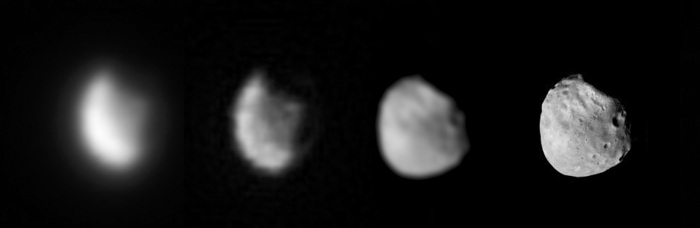
The planet Mars has two moons, namely Phobos and Deimos. The closest and the biggest among the two moons is Phobos. It was picturised as shown above with the color corrected six frames MCC on July 1, 2020, with 210m spatial resolution. The MOM (Mars Orbiter Mission) was 7.2 thousand km away from Mars and 4.2 thousand km from the moon Phobos. It is said that it comprises of carbonaceous chondrite. The giant crater on the surface, namely Stickney, Shklovsky, Roche & Grildrig was noticeable in the picture.

Actual image of the moon Phobos. Courtesy: ISRO

With its fuel efficiency estimated to be only for six months survives till now and achieved success on its first launch itself. On December 1, 2013, it went out of the gravitation field sooner. On September 24, 2014, after a long journey of 300 days makes it enter into the Mars orbit. The subsequent mission by ISRO, MOM 2 or Mangalyaan 2 did fail when the Vikram lander had lost connection after it crashes over the surface. There is no proper evidence of what exactly went wrong in the mission, but it is said that the ALP (Automatic Landing Program) braking thrusters had failed to result in the incidence. There was a big controversy between NASA and ISRO claiming the lander was found, although an Indian scientist spotted it.

Now ISRO with its grand vision is planning for Chandrayaan 3 to send Indian astronauts to space by 2022. This mission is again a cost saver with 35 million dollars for the new equipment and another 51 million dollars for the launcher. India has been already prosperous in launching 104 satellites just in a single mission. Chandrayaan 2 was made only with 141 million dollars budget.

The MOM as described has five instruments onboard:

1) MCC with a 2K×2K area array CMOS sensor for beautiful images of Mars in colourised format.

2) TIS (Thermal Infrared grating spectrometer) houses an infrared detector known as a microbolometer.

3) Methane Sensor for Mars (MSM) by its name is used to measure the presence of methane in the atmosphere, which is a differential radiometer with acute accuracy in parts per billion.

4) Mars Exospheric Neutral Composition Analyzer (MENCA) is a spectrometer to determine the contents in the martian environment

5) Lyman Alpha Photometer (LAP) is a photometer to find abundance in composition to know the actual components on the surface and more.

By these, we can know more about Mars and its moons. Also, you can check out the 3D model of Phobos here: https://solarsystem.nasa.gov/resources/2358/phobos-3d-model/

And also, about NASA’s blog claiming to find clues of the crashed Vikram lander: https://www.nasa.gov/image-feature/goddard/2019/vikram-lander-found

“Unusual Marks On Moon Soil – If not humans ,then ?”

Space missions and experiments have become a field of research as we acknowledge new discoveries with every trip to space . Human advancement in space and related technology in the late 50’s led to sending satellites in space and later in the late 60’s landing on the Moon opened new phases for human understanding of space. Since then humans have achieved new advancement in the technologies and the machine which has opened many of these new operations. Landing on the moon was a great step for humans to understand their ability to travel to different planets too. Spacex is coming up with their idea of sending manned spacecraft to Mars in the early 20’s . It Is expected to carry astronauts by 2024 and are planning a full setup forming base for humans. 

But as we know the last mission which landed on the moon was dated Dec 17 1972 . Various other astronauts have made a moon walk and left their remains as footprints still present on the surface of the moon. Eugene Cernan and Harrison Smitt hold the record to be the last men walking on the moon. This mission accomplished the longest moonwalk and collected more than 500 samples of this lunar soil. They covered a distance of 20 miles with the help of a lunar rover, collecting samples and understanding terrain, while driving around. The remains or the marks of their journey till remains as we see through satellite. Due to absence of winds , there is no phenomenon which could move or distort those marks. NASA high resonance cameras recorded those prints present there after more than 3 and a half decades since the last landing on the moon. In 2009 . 

But some other picture depicting the marks of footprints shocked the scientists as soon as they saw them. These were more than the size of a normal human being and were following a trail depicting a proper moment over the surface. It is just like we leave a trail on the deserts , but due to wind it gets hidden or distorted. But on the moon the scenario is different but the marks remain forever as there is no wind to distort them. It was interesting to notice these movements or marks since they were present about “30 miles from the landing site, while humans have never travelled on the surface of moon for more than 20 miles.” 

But since we do question the existence of life in space , scientists were interested to know what could be the reasons for those if not humans or Aliens. So they came up with the thoughts like :

  1. They could be due to meteors which do hit and Impact the surface of the moon. But still doubted as the occurrence is in a straight line . While meteors and asteroids do hit and make craters which we see, but not a line. 
  2. Other scientists came up with a belief that these could be a tube of lava. We know that there are a number of volcanoes on the surface of moons. Scientists believe that there is still lava present inside the surface and is still running  causing lava tubes to form . We could come up with this observation as is the case on earth and there are various tubes through which lava still flows. 
  3. These tubes are supposed to be as long as several kilometers under the surface of the moon. 

There could be many other beliefs of scientists, but the belief in tubes, if it is there, can be beneficial for humans to set up their base on the moon. It is believed to be strong, tough and resistant from external damage. This could be safe from the radiations and also provide suitable temperatures for humans. Along with those would also save from meteors which do fall frequently on the surface. But it could be an issue of concentration, since we know that lava still flows underground through this tube and we are not sure that these caves are dead or not, so it could be an area of concern if we do reach the moon and set up base in them. 

“The unusual activities or observations do bring out the fascination of humans to know about thee. The major field humans are working on is to find life in space, and observations like these do keep those expectations alive.But if not, we do find out something new every time which could help us in near future, in understanding space. And thus making our future travel and trips more secure . “