Health facilities in life support

There is constant fear among the frontline health workers in India that the system is under severe stress and can crumble anytime in the middle of the covid-19 pandemic. India is a country that spends just over 1% of its GDP in health infrastructure. Hundreds of people lining up from different parts of the country outside hospitals like AIIMS, RML, GTB etc. is testament to our governments failing to provide affordable basic healthcare facilities to people. Even before the pandemic hit the country, there was 82% shortage of specialists and professionals in all government hospitals. Same goes for lab technicians, nurses and pharmacists.

Now, the covid-19 pandemic has tested and even defeated the health facilities of countries that provide the best healthcare in the world. Even in countries like Italy, Spain, United States and France; hospitals were continuously running out of staff, beds, oxygen cylinders, ventilators, medicines and many other essentials. There was a severe shortage of doctors, nurses and other medical staff to attend the admitted patients and then treatment was eventually handed out in priority basis.

Image
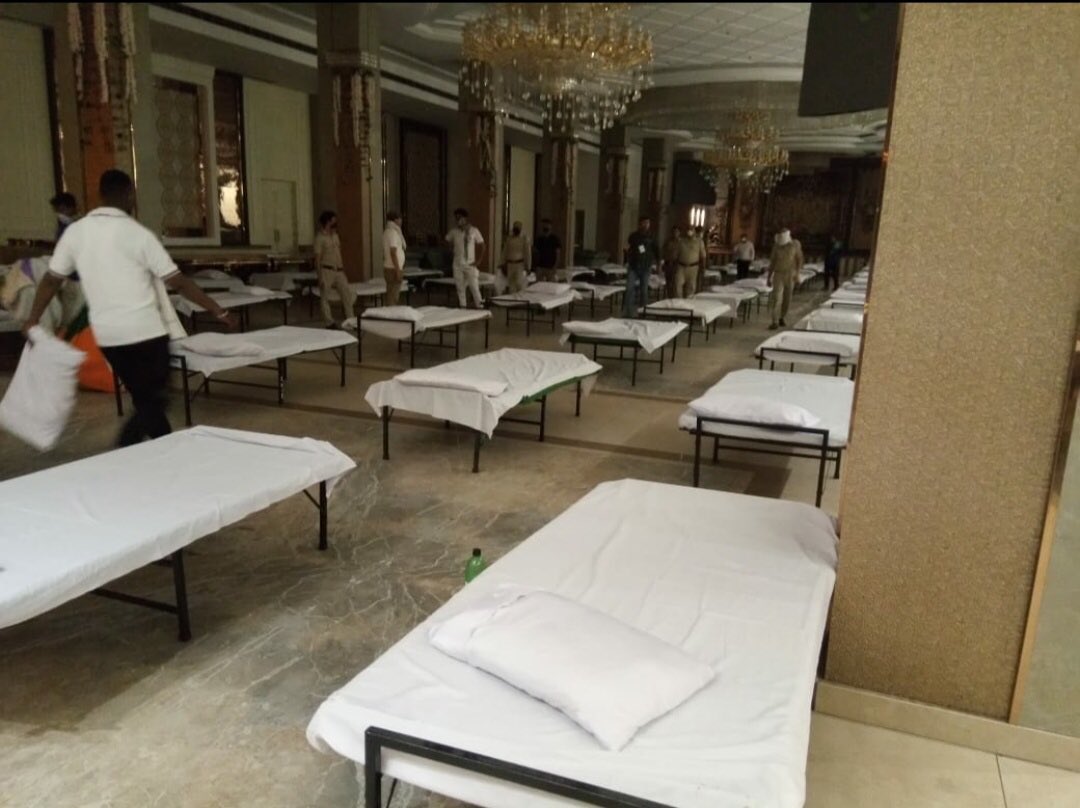
Wedding halls in Delhi being converted into corona isolation wards

Now consider the nightmare scenario India is currently in. Already the number of positive cases are rising exponentially with no signs of slowing down or even flattening. The ICUs and general wards of Delhi and Mumbai hospitals are almost full. Patients are being denied admission and treatment even for the most serious cases.  There are harrowing reports of people struggling to get a hospital bed including many grieving relatives saying that their loved ones died at the doorsteps of hospitals. In some cases, people even visited 6-7 hospitals and were still denied admission citing non availability of beds.

Nearly 70% beds vacant in COVID-19 hospitals run by Delhi govt, private facilities almost full
Patients waiting for their admission in a hospital in Delhi

And the misery persists even after death. Dozens of grieving men and women keep waiting outside hospitals throughout the day to identify the bodies of their loved ones who died due to COVID-19. Bodies are pilling up in hospital wards. There are chilling visuals of dead bodies left unattended by the hospital staff along with the patients. The relatives are handed over wrong bodies and patients are dangling out of their beds. These sights are becoming increasingly common in government hospitals all across the country.

After receiving hundreds of public interest litigations and taking suo moto cognizance after looking at numerous reports of gross violations of human rights, the high courts and the Supreme Court have come down heavily on central and state governments. The Supreme Court said that the situation is “horrendous” with respect to the handling of Covid-19 patients in Delhi, the capital city, and that the patients are being treated “worse than animals”. The court also slammed the Delhi government on mishandling of the situation and asked them why do the patients have to undergo such pathetic conditions in the hospitals. The situation is more or less the same in the rest of the country too. In Maharashtra, the state which has the maximum number of coronavirus cases, the high court had to direct the government to conduct more tests and increase the number of beds. Many doctors and health experts have said that Mumbai, the financial capital of India, has less than 30 ICU beds remaining.

Falling Apart

Our life is never about the destination. Life is a beautiful journey with a lot of stops along the way. We feel if we know what to expect in our future, we will be ready for it. This imagery has become so much a part of our language that we don’t even stop to think about what it actually means for us.

When things don’t go our way, it feels like everything is falling apart. Despite having our bouts of feeling depressed we try to remain in a continual state of happiness. However, this is possible only if we accept the fact that everything is as good or bad as one’s opinion makes it.

Everyone is in a constant state of falling apart. How you deal with it is dictated by your outlook on life. You could, after all, try these few things.

  1. Never hide your emotions

Some people like to cry when they are overwhelmed. Tears are, in fact, a way for your body to get rid of those excess emotions, and if you hold these emotions too long they may corrode your insides. Talk to people – your loved ones, your friends. You will find that every one of them has something difficult going on in their lives.

  1. Be honest

Be true to yourself. If you cannot admit your problem to yourself, you can never openly talk about it which means you will never be able to take the first step towards solving that problem. So much pain mostly comes from not telling the truth. Lying is mostly the reason for things falling apart. After admitting the truth to yourself, make sure you always tell the truth to those around you. It may hurt for a second but eventually, things will fall back into place.

  1. Ask for help

The society inherently and subconsciously teaches us that asking for help is pathetic and a sign of weakness. This makes a person feel trapped and alone, inevitably hurting him and those around him. Accept the fact that everyone struggles at some point in the journey of their life. Instead of acting like it is not universal, start hailing vulnerability for what it actually is – a sign of strength, openness, and hope. Do not be afraid to ask for help.

  1. Have your cheat moments

Just like people have their cheat days from diets, have your cheat moments from the problems you are facing. Do not let your pain entirely rule every aspect of your life. Enjoy some trivial and jovial moments of life guilt-free.

  1. There will be days when you are not okay, and that is okay

The journey of life is a bumpy one. There will be days where the pain and reality of your situation will consume you. Allow yourself to feel helpful on such days. But never forget that tomorrow is a good day and the sun will eventually shine brightly again. When it seems like life is falling apart, it may actually be falling into a place better than expected.

Image Courtesy: Google

hydroxychloroquine doesn’t reduce Mortality

Hydroxychloroquine cloroquina medicine with pills

The RECOVERY trial, in the U.K., has found no clinical benefit from the use of hydroxychloroquine in hospitalized patients with COVID-19. 

The RECOVERY trail which is the large randomized controlled trial in the U.K. began in the march. This trail has enrolled over 11,000 patients.

It is a dynamic trial assessing five candidate drugs and convalescent plasma therapy for treating COVID-19 in patients in U.K. hospitals. 

The trial investigators found that there was no significant benefit in mortality reduction in the intervention group, which was the primary objective.

It then came to light that the drug did not have the desired beneficial effects. 

“We have concluded that there is no beneficial effect of hydroxychloroquine in patients hospitalized with COVID-19. We have therefore decided to stop enrolling participants to the hydroxychloroquine arm of the RECOVERY Trial with immediate effect,” a June 5 press release says.

According to the release, a total of 1,542 patients were randomized to receive hydroxychloroquine for 10 days while 3,132 patients in the control arm received only standard care. 

The researchers found that there was “no significant difference in the primary endpoint of 28-day mortality”. While mortality was 25.7% in the intervention group, 23.5% in the control group, which is not statistically significant.

There was no evidence of beneficial effects in-hospital stay duration and other endpoints, either.

Outcomes measured

The primary outcome was the reduction in all-cause mortality within 28 days of randomization. 

The secondary outcomes measured were to assess any reduction in duration of hospital stay and need for and duration of ventilator or ECMO within 28 days and up to six months after randomization.

“These data convincingly rule out any meaningful mortality benefit of hydroxychloroquine in patients hospitalized with COVID-19,” the release says. The researchers will soon make the results available.

Peter Horby, Professor of Emerging Infectious Diseases and Global Health at the Nuffield Department of Medicine, the University of Oxford, and Chief Investigator for the trial says in the release that “Hydroxychloroquine and chloroquine have received a lot of attention and have been used very widely to treat COVID patients despite the absence of any good evidence. The RECOVERY trial has shown that hydroxychloroquine is not an effective treatment in patients hospitalized with COVID-19,” 

Huge speculation

Deputy Chief Investigator Martin Landray from the University of Oxford says: “There has been huge speculation and uncertainty about the role of hydroxychloroquine as a treatment for COVID-19, but an absence of reliable information from large randomized trials. The preliminary results from the RECOVERY trial are quite clear — hydroxychloroquine does not reduce the risk of death among hospitalized patients with this new disease.”

“The RECOVERY trial, in addition to the signals from other studies we have received so far, is enough to convince me to not offer hydroxychloroquine to hospitalized patients,” Nahid Bhadelia, a physician at Boston Medical Center, told Science. Prof. Landray added to this, saying: “If you, your spouse, your mother gets admitted to hospital and is offered hydroxychloroquine, don’t take it”.

Post-exposure prophylaxis

Another trial found that hydroxychloroquine drug was not effective even as post-exposure prophylaxis in asymptomatic participants who have had high-risk exposure with a confirmed COVID-19 case. Nearly 88% (719 of 821 participants) had such high-risk exposure. The results of the trial published in The New England Journal of Medicine found that the incidence of COVID-19 illness was not statistically significant in the group that received the drug compared with the control group. While 49 of 414 (11.8%) participants who received the drug developed illness, 58 of 407 (14.3%) participants who got the placebo fell ill. Side-effects were more in the intervention group but no serious adverse events were reported.