BOYCOTT CHINA CONTROVERSY

What is Boycott China controversy?

Boycott of Chinese products is a slogan used by Internet campaigns that advocate a boycott of Chinese-made products. Commonly cited reasons for the boycott include the alleged low quality of products, human rights issues, territorial conflicts involving China, support for separatist movements within China, and objection to more specific matters relating to China, such as the eating of dog meat and the Yulin Dog Meat Festival, and more recently, the government’s alleged mismanagement of the COVID-19 pandemic.

Countries including India, Philippines, and Vietnam have called for a boycott of Chinese goods, as have separatist movements in China itself. A full boycott of Chinese products is considered to be difficult to achieve, as the country manufactures a large number of goods that are widely sold and used across the world, and also holds stakes in various non-Chinese companies.

Causes

China is the largest country in the world by population, and the third largest by territory, sharing long borders with several other nations. Border conflicts have occurred many times between China and their neighbors during its history.] At the center of Asia, some Chinese emperors attempted to expand their empires through war. There are also a lot of conflicting national interests and policies between China and other nations, like the disputes between the other nations with China and its allies. As a result of these conflicts, there is dissent against China amongst its bordering nations, and calls for the boycotting of Chinese products originate from residual resentment due to border conflicts.

In 1949, the Communist Party of China won the Chinese Civil War, gaining control of China. Since the 1980s, with the “reform and opening up”, Chinese leaders have made economic development one of their first priorities. Chinese businesses often produce goods tailored to market expectations; therefore, Chinese products generally may lack quality when consumers prefer to pay a low price.

Overpopulation is also considered a possible reason for manufacturing low-quality products; some firms cannot find enough of the needed raw materials to produce goods that serve customer requirements and follow safety standards, instead producing products made with cheaper or low-quality material. Many companies and businesses also lack capital, industry expertise, and marketing power, leading to their manufacturing of counterfeit products. Many companies produce such goods to piggyback on the popularity of legitimate companies such as Apple, Hyatt and Starbucks are copied. However, by looking at the situation in the context of history, it is often argued that this is simply a normal transition in manufacturing, and that a phase of low quality and counterfeit manufacturing is not unique to China alone, as Japan, South Korea, and Taiwan have undergone very similar economic phases. Keeping the aforementioned information in mind, with high quality goods being delivered from Chinese firms such as Huawei and Lenovo in recent years, it can be observed that the state of Chinese manufacturing quality is ostensibly trending upward.

The 2008 Chinese milk scandal was considered a signal of poor food safety, affecting thousands of people, and as a result, many Chinese parents do not trust Chinese milk products. In recent years, however, the Chinese government has taken many actions in order to prevent sales of substandard food.

Technology produced by Chinese companies has also been a subject of scrutiny, especially by the United States; for example, in 2018, Donald Trump, the President of the United States, signed the National Defense Authorization Act for Fiscal Year 2019 into law, containing a provision that banned Huawei and ZTE equipment from being used by the U.S. federal government, citing security concerns.

Some organisations have used the COVID-19 pandemic as part of campaigns against China; for example, the Vishva Hindu Parishad in India has called for a boycott of China in retaliation for China’s allegedly being directly responsible for the Severe acute respiratory syndrome coronavirus 2 virus strain and the subsequent COVID-19 pandemic.

Boycott in India

India and Tibet have called for a joint campaign to boycott Chinese goods in response to border intrusion incidents allegedly perpetrated by China. Rashtriya Swayamsevak Sangh sarsanghchalak (chief) Mohan Bhagwat stated “We speak about self-dependence and standing up to China. The new government seems to be standing up to it. But where will the government draw strength from if we don’t stop buying things from China?”

In 2016, China denied the entry of India to the Nuclear Suppliers Group. Along with this, China is viewed as a major roadblock by Indians towards its permanent seat in the United Nations Security Council, with China having used its veto power repeatedly to keep India out of the UNSC while the US, UK, France and Russia support India. Meanwhile, China provides Pakistan unconditional support in many international stages; despite the fact that many countries including India and the USA claim that Pakistan is a state sponsor of terrorism. Also, China makes a large amount of investments in Pakistan. During the conflict between the India and Pakistan in August–September 2016 after the Uri attack, the supporting stand of China towards Pakistan led to a campaign to boycott Chinese products in India. As a consequence, sales of Chinese products dipped by about 40 percent in the period immediately after the boycott call. Patanjali Ayurved founder Ramdev Baba was among the many people to have spoken of boycotting Chinese goods amid the 2017 Doklam standoff when nationalist sentiments had risen.

In May 2020, in response to the 2020 China–India skirmishes which were allegedly perpetrated by China’s People’s Liberation Army, Indian engineer, educator and innovator Sonam Wangchuk appealed to Indians to “use your wallet power” and boycott Chinese products. He called for India to “stop using Chinese software in a week and hardware in a year”. This appeal was covered by major media houses and supported by various celebrities.

In spite of various campaigns by notable individuals and organisations, Chinese companies still have influence over various markets, especially relating to consumer technology and software. For example, as in March 2020, Xiaomi, Oppo, Realme and Vivo accounted for approximately 73% of smartphone sales in India. On the other hand, Samsung Electronics and Nokia, both companies that once led the market, together accounted for less than 22% of smartphone sales. In spite of the campaigns, retailers have stated that the growing rhetoric is unlikely to sway consumer behaviour, especially due to alleged “value for money” in Chinese products, especially smartphones.

Chinese companies also invest heavily in Indian companies; 18 out of 30 of India’s billion-dollar startups are funded by China. Major Chinese investment firms like Alibaba Group and Tencent hold investments in major companies that are considered to be Indian, like BYJU’S, Zomato, Ola Cabs and Flipkart. In spite of the Indian government recording the origin of foreign direct investment, many Chinese companies exploit loopholes by investing in Indian companies through their non-Chinese subsidiaries; for example, Alibaba’s investment in Paytm was by Alibaba Singapore Holdings Pvt. Ltd. Hence, these investments don’t get recorded in India’s government data as Chinese investments.

In view of these circumstances, various other issues have been pointed out. For example, B. Thiagrajan, managing director of Blue Star Limited, an Indian manufacturer of air conditioners, air purifiers and water coolers said “We are not worried about finished goods. But most players across the globe import key components such as compressors from China,” and added that it would take a long time to set up local supply chains, and that there were few alternatives for certain kinds of imports. Besides, boycotting popular Chinese apps such as TikTok has been suggested as a more effective alternative to boycotting physical goods in terms of value added because there are multiple alternatives

Is it practically possible to boycott China?

It is not practically possible for India to cease the entry of Chinese products altogether. Even if the Government passes a law to stop the official use of Chinese products, then also Chinese products are going to hit the market through unauthorized entry and smuggling. People are all so attracted towards the Chinese products because they are cheap. We all know that India is a third world country or a developing country. So the majority of the population here are lower middle class or lower class. As a result they do not have enough money to spend on costly luxurious things. So they try to settle for a cheap but look-alike substitute by which they can still enjoy some of the benefits of the modern world. This chiefly includes smartphones, smart watches, laptops and other electronic items.

Apart from that, there is a huge annual transaction between India and China. This boosts the economy of both the countries. But as China is the producer of the goods, so even if they are cornered, they can produce their own stuff and carry on their life almost normally. But if the boycott is started by India, then India will not only suffer monetary losses, but also it will not receive the goods needed for the day to day life of its citizens.

So although the hostilities between India and China in recent times is completely unacceptable and also there have been reports that China heavily funds Pakistan, which is renowned all over the world as the hub of terrorist funding, it is not pragmatic for India to completely stop using Chinese hardware, that too in the course of a year. But, of course, if the Indian Government plans to stop the use of Chinese apps and softwares, that is a still practical decision but then Indian companies will have to come up with applications and softwares that would replace the boycotted Chinese apps. In a nutshell, before India plans to make any drastic decision, it should check all grounds to see if this #BoycottChina is a very practical decision or not.


Circular economy and sustainability

Iceclog: Profitable shift to Circular Economy for Manufacturers ...

The industrial revolution and the rise of a capitalistic society have, in a short period of time, changed our planet and our lives. Overconsumption stands at the foundation of modern society and has brought along climate change and its string of environmental hazards and social issues. Overpopulation and growing demand for goods result in mind-boggling volumes of waste as well as air, soil and water pollution with high negative impacts on human and ecosystem health.

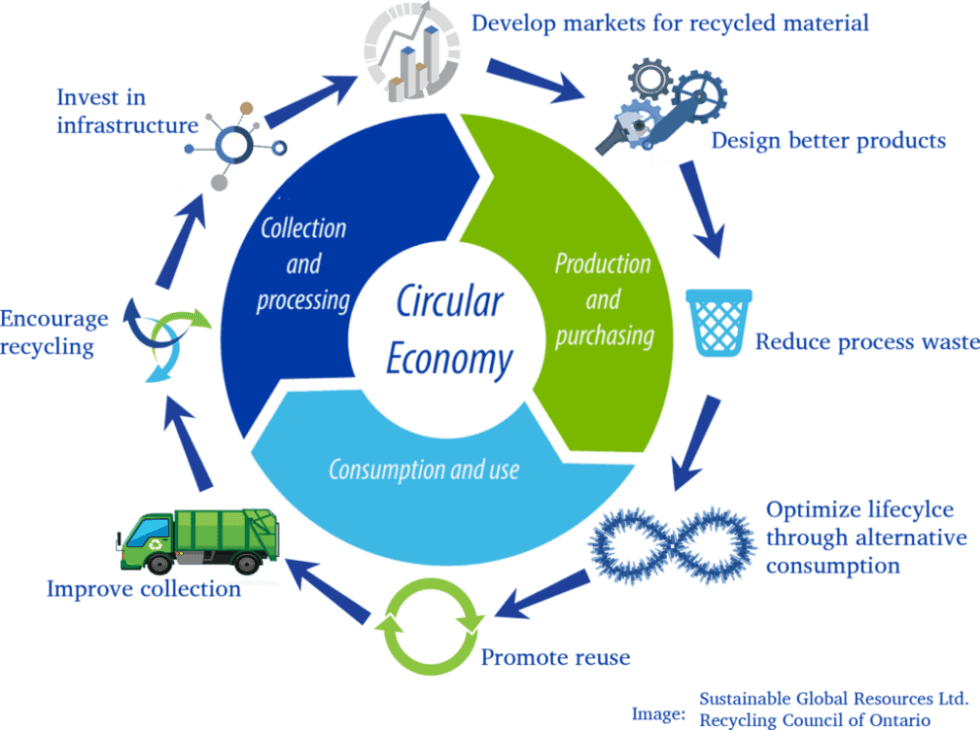
A circular economy works quite differently. Products and services in a circular economy are designed in a way that allows them to be reused, either in the biological or technical cycles. All products are manufactured in a way so they can be disassembled and materials will either be broken down by nature or returned to production. Biological material therefore consists of non-toxic, clean feeds and technical materials are designed to be a resource to be used industrially again. The goal is to throw nothing away and to reduce the need for purchasing new commodities, while production and transportation is best achieved with renewable energy.

The circular economy is a markedly different way to do business, forcing companies to rethink everything from how to design and manufacture products to their relationships with customers. One of the biggest differences is the customer’s role. The focus is no longer on consumption, but instead on the use of a function. This places different demands on the business community to build long-term relationships in their business models. The advantage is that companies benefit from each other’s success in this cascade of different cycles.

It also brings new opportunities in infrastructure, energy and production in their adaption to fit the circular economy model. Some business models are easier than others to begin with, such as the leasing of products instead of buying (everything from jeans to trucks), companies which collect and renovate their own products and then sell them in the store in a separate department or peer-to-peer models. Companies will find new ways to extend the life of products or components, to find value in the waste, or the design of circular use.

In the end it is all about encouraging the next generations to think and design in a sustainable way as well as using circular business systems to build a better future.

DIGITAL MARKETING: A WAY FORWARD

COVID-19 pandemic is a Humongous problem for companies everywhere, and it’s practically impossible to ignore the issue – it has changed the way business is executed everywhere.

Many owners and work managers are failing to shift the regular marketing strategies to a digital marketing (The new normal)

They are overlooking the situation because perhaps they have hope that some sudden turn of events towards normalcy will occur in the times of chaos. 

 Whatever may be the cause but this inability to adapt will cause grave concerns to the economic survival of the company.

Whereas, many organizations that have shown great adaptability by appointing digital marketing.

·       The impact – COVID: 19 on Businesses

There is no business which lies unaffected by the pandemic, worst sufferers are startups that do not have the capital or reserves to keep the struggle on and companies that relied completely on physical interactions, like salons, clothing stores, and yoga studios.

Accustomed to growth incitation by customer referrals and their awesome service reputations, they have experienced a very high revenue loss that their impulse reaction has been to cut marketing costs rather than exploring new and more effective options.

In turn, this unaccustomed reaction has had a detrimental ‘trickle’ effect on larger B2B companies work as providers to these smaller businesses.

Every business, be it your neighborhood departmental store or an enormous multinational firm, can benefit from digital marketing. Customers still need the products and services as much as ever—what these companies need to do is change the way they reach their target audiences. Even if a small enterprise doesn’t have an online page or portal (one in four do not have), it’s not very late to join in the businesses that are thriving online.

  1. Coming to – HOW TO?

It’s time for the affected businesses to make the transition from a fortress store to a digital provider by contacting their customers, reviving unused online assets like websites and social media profiles, and pedaling full speed ahead.


Contacting customers

The first step is to commence a dialogue between business and customers and carrying it forward. For companies that never collected email addresses, created a database, or engaged on a regular basis to their followers, it’s time now to do so.

Announce COVID-19 changes in an existing newsletter. 

Companies with an existing newsletter can convey to its subscribers about any corona virus-related changes in the next edition. Send out a newsletter to let your customers know how your business is reacting to the pandemic 

Boosting the company website Sorting businesses with SEO marketing

Coronavirus is changing the way that consumers shop. Approximately 47% of shoppers have stated that they are avoiding malls and shopping centers.

On the contrary note, SEO is undergoing a strong rise, with many brands reporting a significant hike in their organic search visibility from January to March 2020. 

It is evident it’s time to invest in, not to cut back on, SEO. It is one of the most cost-effective digital marketing strategies, it’s also delivering results.


Shifting daily operations online

There are very few organizations that cannot make the transition of their daily operations. Credit to video conferencing applications like Zoom, Skype, and many other executives and managers can communicate and impart instructions to staff and hold client meetings from anywhere. 

· Sales teams can take orders and reservations and provide services to customers via email, chat, or video. They no longer have to commute; they can even start work early leaving customers with longer support hours.

· Services that were previously delivered in person are surprisingly amenable to video presentations. Clients can pay online and receive a video link to live sessions.

Staff education also plays an important role in a successful transition—and this is time to enhance your team’s skills?

Online courses are highly cost-efficient, and teams can learn new skills that enable them to support each other whenever one department is down or facing issues. Courses on digital marketing are available on how it works and how to make the most out of all the opportunities.

·       The biggest question-What are my business benefits?

Many businesses are cutting costs on their marketing efforts due to COVID-19, but what they should really be doing is grabbing advantage of the new opportunities that are rising.

This emphasis on digital marketing is not something that they’ll want to slow down on once the lockdown ends. Online shopping is going to stop no-time soon, and most companies will find those web-based interactions to be convenient than in-person meetings.

Stores will reopen but alongside newly adopted ways of selling and engaging with customers.

While digital marketing may be regarded right now as an emergency plan, but by the time this is over, everyone will likely realize that it’s more than a temporary measure rather than a sustainable one. So GO DIGITAL AND BE FUTURE READY

RECESSION AFTER CORONA

The global economy will contract by 3% this year as countries around the world shrink at the fastest pace in decades, the International Monetary Fund says. The IMF described the global decline as the worst since the Great Depression of the 1930s. It said the pandemic had plunged the world into a “crisis like no other”. The Fund added that a prolonged outbreak would test the ability of governments and central banks to control the crisis. Gita Gopinath, the IMF’s chief economist, said the crisis could knock $9 trillion (£7.2 trillion) off global GDP over the next two years.

An economic consequence of the ongoing COVID-19 pandemic, the first major sign of the coronavirus recession was the 2020 stock market crash on 20 February. IMF projects suggest that the coronavirus recession will be the most severe global economic downturn since the Great Depression, and that it will be “far worse” than the Great Recession of 2009. The United Nations (UN) predicted in April 2020 that global unemployment will wipe out 6.7 per cent of working hours globally in the second quarter of 2020—equivalent to 195 million full-time workers. In western nations, unemployment is expected to be at around 10%, with more severely affected nations from the COVID-19 pandemic having higher unemployment rates. The developing world is also being affected by a drop in remittances.

The recession saw the collapse of the price of oil triggered by the 2020 Russia–Saudi Arabia oil price war, the collapse of tourism, the hospitality industry, the energy industry and a significant downturn in consumer activity in comparison to the previous decade. Global stock markets crashed around 20 to 30% during late February and March 2020, respectively. During the crash, global stock markets made unprecedented and volatile swings, mainly due to extreme uncertainty in the markets.

2019 Global Economic Slowdown

During 2019, the IMF reported that the world economy was going through a “synchronized slowdown”, which entered into its slowest pace since the Great Financial Crisis. ‘Cracks’ were showing in the consumer market as global markets began to suffer through a ‘sharp deterioration’ of manufacturing activity.  Global growth was believed to have peaked in 2017, when the world’s total industrial output began to start a sustained decline in early 2018. The IMF blamed ‘heightened trade and geopolitical tensions’ as the main reason for the slowdown, citing Brexit and the China–United States trade war as primary reasons for slowdown in 2019, while other economists blamed liquidity issues.

In April 2019, the U.S yield curve inverted, which sparked fears of a 2020 recession across the world. The inverted yield curve and trade war fears prompted a sell-off in global stock markets during March 2019, which prompted more fears that a recession was imminent. Rising debt levels in the European Union and the United States had always been a concern for economists. However, in 2019, that concern was heightened during the economic slowdown, and economists began warning of a ‘debt bomb’ occurring during the next economic crisis. Debt in 2019 was 50% higher than that during the height of the Great Financial Crisis.  Economists have argued that this increased debt is what led to debt defaults in economies and businesses across the world during the recession. The first signs of trouble leading up to the recession occurred in September 2019, when the US Federal Reserve began intervening in the role of investor to provide funds in the repo markets; the overnight repo rate spiked above 6% during that time, which would play a crucial factor in triggering the events that led up to the crash.

Sino-American Trade War

The China–United States trade war occurred during 2018 to early 2020, and caused significant damage across global economies. President Donald Trump in 2018 began setting tariffs and other trade barriers on China with the goal of forcing it to make changes to what the U.S. says are “unfair trade practices”. Among those trade practices and their effects are the growing trade deficit, the alleged theft of intellectual property, and the alleged forced transfer of American technology to China.

In the United States, the trade war brought struggles for farmers and manufacturers and higher prices for consumers, which resulted in the U.S manufacturing industry entering into a ‘mild recession’ during 2019. In other countries it has also caused economic damage, including violent protests in Chile and Ecuador due to transport and energy price surges, though some countries have benefited from increased manufacturing to fill the gaps. It has also led to stock market instability. The governments of several countries, including China and the United States, have taken steps to address some of the damage caused by deterioration in China–United States relations and tit-for-tat tariffs. During the recession, the downturn of consumerism and manufacturing from the trade war is believed to have inflated the economic crisis

Financial Crisis

The global stock market crash began on 20 February 2020. Due to the COVID-19 pandemic, global markets, banks and businesses were all facing crises not seen since the Great Depression in 1929.

From 24 to 28 February, stock markets worldwide reported their largest one-week declines since the 2008 financial crisis, thus entering a correction. Global markets into early March became extremely volatile, with large swings occurring in global markets. On 9 March, most global markets reported severe contractions, mainly in response to the COVID-19 pandemic and oil price war between Russia and the OPEC countries led by Saudi Arabia. This became colloquially known as Black Monday I, and at the time was the worst drop since the Great Recession in 2008.

Three days after Black Monday I there was another drop, Black Thursday, where stocks across Europe and North America fell more than 9%. Wall Street experienced its largest single-day percentage drop since Black Monday in 1987, and the FTSE MIB of the Borsa Italiana fell nearly 17%, becoming the worst-hit market during Black Thursday. Despite a temporary rally on 13 March (with markets posting their best day since 2008), all three Wall Street indexes fell more than 12% when markets re-opened on 16 March. During this time, one benchmark stock market index in all G7 countries and 14 of the G20 countries had been declared to be in Bear markets.

Conclusion

With the lockdown still in hand and the consistent fall in economy, it seems we have a tough time ahead. The recession, as predicted by the various agencies across the word, is going to be very hash upon us. A lot of people are going to lose their jobs with nowhere to go. Companies may go bankrupt and entire nations will be in debts. We all have no choice but to face the crisis.

“This too shall pass.”