TENSION BETWEEN INDIA AND CHINA ESCALATES

India is considering multiple, comprehensive measures to curtail China’s economic dependence on the country, targeting trade , investment, and project services in the wake of hostilities at the border. These are expected to include limits on Chinese firms’ involvement in government contracts and infrastructure programs, higher tariffs on imported Chinese finished goods as well as closer review of free trade arrangements that the country uses to indirectly export goods to India.

According to Economic times, a high-level meeting, likely to be attended by key stakeholder ministers and top officials from the Prime Minister’s Office (PMO), is expected soon to discuss the details and the extent of measures.

“Measures are being examined… All pros and cons of how and when as also their repercussions on Indian businesses will be looked into,” said a government official.

On the trade side, tariff as well as non-tariff measures could be put in place to discourage China’s imports which added up to $70 billion in FY19, which was more than any other country. In FY19, India had a trade deficit of $53 billion with China, and attempts to address it have made little progress. Chinese firms have a significant portion of the cell phone and electronics industries in India. The government should take steps to curtail Chinese imports while at the same time creating an atmosphere for domestic production of these goods.

India will also review its free trade arrangements with other countries to determine whether China is using them to enter the local market. India has already left the Regional Comprehensive Economic Partnership (RCEP) negotiations, which includes China among others, on the grounds that there is no safeguard against a further increase in exports to India from that country. In addition, stringent quality standards and controls could be introduced to contain the country’s goods inflow.

Various options are being examined by the law ministry on the exact contours of the clause to ensure it cannot be challenged and meets international norms. The omnibus clause could cover all countries, the official said, though it is primarily aimed at Chinese companies.

One of the first sectors to introduce the clause could be roads and highways before it is expanded to others and eventually includes public sector units, said the officials. The ministries of road transport and highways and law are already in discussions to finalise the wording of the new clause, one official said.

The government has sought to cancel and rework contracts with state-owned telecommunications firms Bharat Sanchar Nigam Ltd (BSNL) and Mahanagar Telephone Nigam Ltd (MTNL) to keep Chinese vendors out of security issues. Additional criteria could be introduced to ensure Indian suppliers of goods and services secure contracts awarded by the government as well as public sector entities. The Ministry of Law is examining the feasibility of introducing such a clause examining the feasibility of introducing such a clause in contracts in accordance with restrictions or strict conditions imposed by some other countries on Indian firms from contracting.

“These stiff criteria essentially are barriers to ensure that only local companies can participate,” the official said, adding that such restrictions imposed by other countries are also being examined in detail.

The exercise was already underway as part of the Atmanirbhar government’s mission, or self-reliance, and gained importance following changed border circumstances, he said. The cabinet secretary, who also chairs a committee to boost local manufacturing, has had discussions with various ministries dealing with infrastructure projects on how to boost local sourcing of both goods and services.

The lowest bidder is generally accorded prior security clearance but there’s a growing view that a more stringent framework is needed, said the official cited above.

Some bids in which Chinese companies were roped in as partners by an Indian company in the roads sector have been cancelled recently, including one in Nagpur. The government has already reserved supply contracts of up to ₹200 crore for local producers. The government is likely to revisit these criteria to ensure wider participation by domestic companies, another official said.


Source:https://economictimes.indiatimes.com/news/economy/policy/india-set-to-erect-a-great-wall-against-chinese-companies/articleshow/76455684.cms

North and South Korea RELATIONS

North Korea blew up the joint liaison office with South Korea in Kaesong, an industrial area on its side of the border, becoming one of the two countries’ most damaging conflicts without ever going to war. The collapse of the joint liaison office followed a growing breakdown of ties between Pyongyang and Seoul, which came just hours after Pyongyang had threatened with military action at the border with South Korea.

Tensions between the two countries had increased since last week, after Pyongyang took offence to South Korean activists and defectors sending anti-North Korean propaganda leaflets, rice and bibles using ballons across the border into North Korean territory, and cut off communication with Seoul. Experts believe that these movements follow the frustrations of North Korea over the inability of South Korea to revive inter-Korean economic projects that, under US pressure, had benefited Pyongyang, along with UN sanctions.

The liaison office was set up in Kaesong in 2018 to facilitate communication between North Korea and South Korea. Following the demolition of the office, North Korean state media outlet KCNA released a statement saying the office had been “tragically ruined with a terrific explosion”.

South Korea’s President Moon Jae-in called for an urgent national security meeting following the demolition. The country’s Unification Ministry called the incident “a senseless act”, one that had “destroyed the hopes of those who wished for peace on the Korean Peninsula”.The South Korean government said they would “respond strongly” if the situation were to worsen but did not elaborate on how it would retaliate. The demolition occurred just days after North Korean leader Kim Jong Un’s sister Kim Yo Jong had threatened to destroy the liaison office.

North Korea and South Korea jointly established a liaison office in North Korea’s Kaesong, in 2003. The Kaesong Industrial Complex is a joint industrial zone where both North Koreans and South Koreans operate and run  factories. Approximately 120 factories operated in this industrial zone at its height, with more than 50,000 North Korean employees and several hundred managers, according to a BBC report. Pyongyang had threatened to close this liaison office last week and had cut off his lines of communication with Seoul.

Following the demolition of the liaison office, North Korean state media KCNA announced that Pyongyang would be sending troops in demilitarised areas, including in the Kaesong industrial zone. The KCNA added that North Korea would be adding artillery units along the border with South Korea for reinforcement and North Korean police posts that had been withdrawn when relations had improved between the two countries would now be instituted once again.

Observers say North Korea has been the most provocative by doing these actions in the last few years. During the last few years, South Korean President Moon Jae-in has made efforts to improve relations with Pyongyang. Researchers say that such provocations may have happened because Pyongyang aims to compel Seoul to make it more concessions that will be economically favorable to North Korea, which has been hit hard by sanctions. Although it is not clear how COVID-19 has affected North Korea, experts believe it is likely that the country has not escaped unscathed, particularly in the context of how China is the main trading partner for North Korea.

Source:https://indianexpress.com/article/explained/why-north-korea-blew-up-a-joint-liaison-office-and-what-it-means-for-relations-with-seoul-6463170/

europe & us relations turning sour due to pandemic

Historically, major tech investors have shrugged off the challenge from Margrethe Vestager, the competition tzar of the European Commission who wants to reduce the internet domination of US behemoths. Apple, Amazon.com, Facebook and Google controller Alphabet ‘s total market cap has increased more than tripled to $4.4 trillion since the Dane’s first term ended in 2014. Two new Apple probes, launched Tuesday, suggest it’s time to start taking her more seriously.

Vestager is convinced that rivalry is skewed by the rules for Apple’s preponderant app store. Music streaming rival Spotify Technology complained that Apple is levying a 30 per cent “tax” on smartphone user purchases made within apps, while at the same time stopping app developers from steering customers to cheaper options. Apple Pay’s second probe center allows customers to purchase things using an iPhone. Vestager is concerned that Apple makes it difficult for its popular smartphones to work smoothly with competing payment systems. Apple said it was upset that the European Commission is “advancing complaints from a few businesses who just want a free pass.”

But chief executive Tim Cook – and investors from the company – should be concerned about this. The mobile industry is large, and that’s an problem for Apple as it accounts for about half the sales. In the first quarter of 2020, iPhone smartphone revenues dropped 7 per cent. Apple has paid for its entertainment and music offerings by offering additional games, and subscriptions. Thanks to the rapid growth, these services close in on a quarter of all revenue. Citi economists say the app store accounts for 30 percent of all sales from utilities.

That has convinced the market to revalue Apple, as consumers favor recurring revenue from services to one-off hardware purchases. The company’s shares are valued, using data from Refinitiv, at 24 times estimated earnings over the next 12 months. That’s almost twice as high as the multiple from 2015 through to the end of 2018. If Apple is pressured by the commission to slash App Store prices and encourage rival programs to Apple Pay, its sales growth will stall, potentially warrant a lower number, and jeopardize its $1.5 trillion market capitalisation.In other words, Vestager is getting critical – unlike previous probing in Google’s shopping platform and Android operating system , causing no difference to the main business of the firm. Cook ‘s shareholders should be worried, as should those in other tech behemoths.

The Coronavirus has added more tension to the relationship between the United States and the European Union. The decision by President Donald Trump to ban European citizens from the United States and his definition of the virus as “Chinese” has weakened US relations with the European Union. Europeans and the US could not even agree to a joint text by the G7 foreign ministers on attacking the virus.

Nearly European ambassadors said that the relationship between the United States and Europe today was worse than any other modern U.S. administration, including during the Iraq War of 2003. On top of EU-U.S. Economic disagreements — such as on finance, security , climate change and Iran — ambassadors berated the “ideological animosity” of the Trump administration to the EU and NATO. One described the administration as showing “blatant disregard for shared values that have for decades underpinned the transatlantic alliance” and “lack of decorum” by the president when engaging European allies. The President ‘s calling the EU a “foe” and “crime-ridden” European countries was characterized as “violent.”

Source: 1. https://in.reuters.com/article/us-apple-antitrust-breakingviews/breakingviews-europes-latest-apple-bite-is-close-to-the-core-idINKBN23N2H4

2. https://carnegieendowment.org/2020/04/04/u.s.-relations-with-europe-likely-to-remain-strained-regardless-who-wins-november-election-pub-81493

Japan’s economy in turmoil

The Bank of Japan has expanded the total size of its funding packages for cash-strapped companies from about $700 billion reported last month to $1 trillion. While they announced on Tuesday that they would keep monetary conditions stable and hold on to their expectation that the economy would slowly rebound from the coronavirus pandemic on it’s on, suggesting that they have taken ample measures to sustain recovery for now. The BOJ remains focused on steps to ease corporate funding strain.

“Given markets have calmed down and the economy appears to be bottoming out, there’s no reason for the BOJ to take action anytime soon,” said Hiroshi Shiraishi, senior economist at BNP Paribas Securities.

“Fiscal policy will play a main role in responding to the virus fallout, so the central bank will continue to indirectly help the government by keeping borrowing costs low,” he said.

The BOJ kept its yield curve control targets at -0.1 per cent for short-term interest rates and 0 per cent for long-term rates in a widely expected move. The central bank has also made no significant improvements to its programmes to alleviate the pressures of corporate finance, including a loan facility aimed at channeling funds to businesses.

Due to the way it is designed, the amount of money to be pumped out via the programmes will reach 110 trillion yen ($1 trillion) if more loans are taken out via government schemes, the central bank said.That was larger than an estimate of 75 trillion yen made in May, as the government expanded the range of eligible loans under a second stimulus package.

Japan’s economy appears to have hit bottom and is eyeing a recovery from the damage caused by the coronavirus pandemic, its finance minister said, underscoring cautious optimism spreading among policymakers after the relaxation of lockdown measures.

“We’ve succeeded in putting a floor on the economy, which seems to have hit bottom. How strong the recovery will be depends not just on domestic conditions but overseas developments,” Finance Minister Taro Aso told parliament on Friday.

In April, Prime Minister Shinzo Abe proclaimed a state of emergency telling enterprises to shut down and people to remain at home, a development that dealt a serious blow to income and sales by corporations. Although the state of emergency was lifted in late May, economists estimate that in the current year, after falling into recession in January-March, the economy experienced more than a 20 percent annualized contraction.

Last year, Japan was a tourist mecca welcoming 31.9 million foreign visitors. That was a peak after seven consecutive years of growth.But in a sudden turn of events, prolonged coronavirus travel bans have brought Japan’s tourism industry to a standstill, with a 99.9 percent fall in tourists in April, the high time for cherry blossom viewings.The tourism Industry in almost all countries around the world have been devastatingly affected due to the pandemic.

However, the new domestic travel improving initiative from the government — the “Go To” program unveiled last month — has since been delayed after reports of an unsustainable administrative and office expense allocation. The “Go To” program is a collaborative public-private partnership that provides consumers purchasing travel goods from approved distributors in the four groups, tentatively named Go To Ride, Go To Eat, Go To Case, and Go To Shopping Strips, discount vouchers of 50 to 20 percent off. The initiative was dubbed “murky” and “untransparent” by the opposition.

Adding to the controversy is the bidding method the government adopted to attract business contractors. Before the official bidding start date, the Ministry of Economy had interviewed Japanese global advertising giant Dentsu 10 times. But the minister for economy explained that meetings had been held with 50 businesses along with Dentsu and that the 10 interviews with Dentsu had been consultations for reference due to the company’s experience in “implementing projects of unprecedented scale.”

In response to criticisms the government said it would suspend the open recruitment for business contractors and would revise the budget from the ground up to ensure unnecessary expenses are removed. The tourism recovery campaign was expected to launch in July, but to the disappointment of struggling local businesses a new start date has yet to be determined.

Source: 1.https://in.reuters.com/article/us-japan-economy-boj/bank-of-japan-holds-fire-pledges-1-trillion-to-struggling-firms-idINKBN23N0D5

2.https://japantoday.com/category/politics/Japan’s-economy-bottoming-out-says-Aso

3.https://thediplomat.com/2020/06/japans-campaign-to-revive-virus-hit-tourism-sector-postponed-amid-cost-controversy/

Health facilities in life support

There is constant fear among the frontline health workers in India that the system is under severe stress and can crumble anytime in the middle of the covid-19 pandemic. India is a country that spends just over 1% of its GDP in health infrastructure. Hundreds of people lining up from different parts of the country outside hospitals like AIIMS, RML, GTB etc. is testament to our governments failing to provide affordable basic healthcare facilities to people. Even before the pandemic hit the country, there was 82% shortage of specialists and professionals in all government hospitals. Same goes for lab technicians, nurses and pharmacists.

Now, the covid-19 pandemic has tested and even defeated the health facilities of countries that provide the best healthcare in the world. Even in countries like Italy, Spain, United States and France; hospitals were continuously running out of staff, beds, oxygen cylinders, ventilators, medicines and many other essentials. There was a severe shortage of doctors, nurses and other medical staff to attend the admitted patients and then treatment was eventually handed out in priority basis.

Image
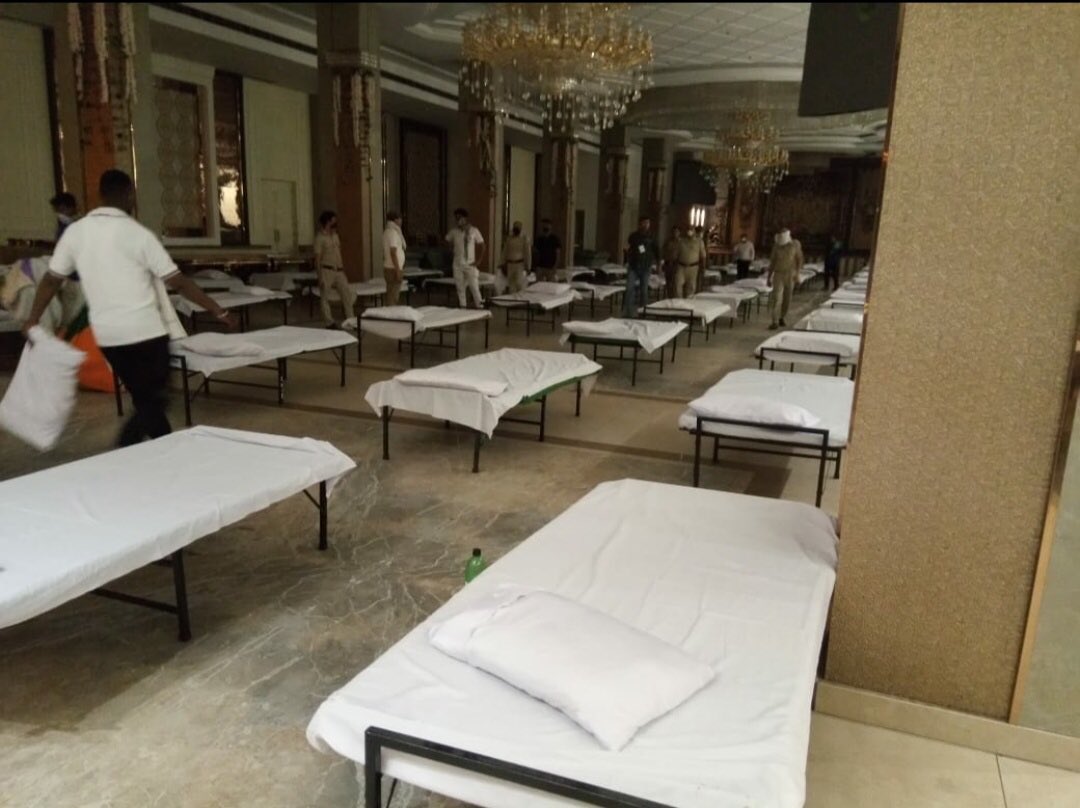
Wedding halls in Delhi being converted into corona isolation wards

Now consider the nightmare scenario India is currently in. Already the number of positive cases are rising exponentially with no signs of slowing down or even flattening. The ICUs and general wards of Delhi and Mumbai hospitals are almost full. Patients are being denied admission and treatment even for the most serious cases.  There are harrowing reports of people struggling to get a hospital bed including many grieving relatives saying that their loved ones died at the doorsteps of hospitals. In some cases, people even visited 6-7 hospitals and were still denied admission citing non availability of beds.

Nearly 70% beds vacant in COVID-19 hospitals run by Delhi govt, private facilities almost full
Patients waiting for their admission in a hospital in Delhi

And the misery persists even after death. Dozens of grieving men and women keep waiting outside hospitals throughout the day to identify the bodies of their loved ones who died due to COVID-19. Bodies are pilling up in hospital wards. There are chilling visuals of dead bodies left unattended by the hospital staff along with the patients. The relatives are handed over wrong bodies and patients are dangling out of their beds. These sights are becoming increasingly common in government hospitals all across the country.

After receiving hundreds of public interest litigations and taking suo moto cognizance after looking at numerous reports of gross violations of human rights, the high courts and the Supreme Court have come down heavily on central and state governments. The Supreme Court said that the situation is “horrendous” with respect to the handling of Covid-19 patients in Delhi, the capital city, and that the patients are being treated “worse than animals”. The court also slammed the Delhi government on mishandling of the situation and asked them why do the patients have to undergo such pathetic conditions in the hospitals. The situation is more or less the same in the rest of the country too. In Maharashtra, the state which has the maximum number of coronavirus cases, the high court had to direct the government to conduct more tests and increase the number of beds. Many doctors and health experts have said that Mumbai, the financial capital of India, has less than 30 ICU beds remaining.

Indian social media app migrates to google cloud

Homegrown social media site, ShareChat, announced Monday the full transition of its technology to Google Cloud that supports more than 60 million active monthly users. The regional platform has made the shift to scale its market, boost productivity, cut costs and enhance the overall success of the app that houses active users in 15 Indian languages.

ShareChat following a host of Indian companies that, during the lockdown, changed or rebalanced their cloud provider mix to scale up to the massive increase in usage and reliance on such services. ShareChat’s IT network was divided between Amazon Web Services and Google Cloud according to the platform ‘s previous privacy policy claim.

Given the high-intensity data , high volume of content and traffic that the platform generates such as posts, likes, views and followers, ShareChat relies heavily on IT infrastructure. A significant proportion of their mobile-application’s subscribers come from cities that come in tier-2 and tier-3, with most of them heavily  depending on 2 G networks. Therefore the it is most critical for such businesses to be able to minimize the impact of mobile bandwidth and providing all users with a great experience, the management said.

Cloud service companies have seen consistent increase in revenue in the first six months of 2020 with multinational technology firms such as Amazon.com, Microsoft Corp, and Google Inc. announcing solid growth in the demand for cloud computing as growing percentages of institutions turned to online connectivity for continued research.

As per the numbers shared by the companies for January-March, Amazon Web Services ( AWS) continues to lead with a global market share of 32 percent followed by Microsoft Azure (17 percent) and Google and Alibaba at around 6 percent each. India is currently a high-priority destination for these companies, with a growing number of established firms, startups and small and medium-sized enterprises (SMBs) looking to embrace cloud and IT technologies in the face of the government’s drive for a stronger digital presence. The pandemic has only added to that urgency.

In April 2020, ShareChat decided to migrate to Google Cloud to successfully scale and achieve its customer service goals.

“We are happy to share that a couple of months down the line we have not only experienced 100% uptime but also we see the cost benefits of our choice much beyond our initial expectations. The scale at which ShareChat is, we wouldn’t have looked beyond the top three providers and Google was the perfect fit for us,” said Venkatesh Ramaswamy, vice president of engineering, ShareChat.

In the middle of the covid-19 crisis, the monumental eight-hour move from ShareChat ‘s predominant cloud network to Google Cloud forced the former to conduct a meticulous review for nearly three months, preparing and conducting a detailed operational and strategic approach to fulfill their market needs.

“60 million users, is among the largest that we have helped migrate in recent times. Because they had a very specific requirement about the timing and method of migration, our people across the professional services, India engineering and cloud teams, APAC and global teams were all on standby to handle any situation that arises,” said Karan Bajwa, managing director (MD), Google Cloud India.

Source:https://www.livemint.com/news/india/sharechat-migrates-60-million-users-to-google-cloud-11592197345377.html

What Will Kill First?

Businesses have been suffering and reeling under the impact of the lockdown enforced due to the Corona Pandemic. Although the Indian Government has announced a 20 lakh crore stimulus package for the Indian economy, the small businesses and the daily wage earners continue to struggle. The majority are left questioning as to what will kill them first, the Coronavirus or hunger?

People are being laid off jobs continually. Businesses are closing down. The underprivileged without savings have been left relying on the substandard government rations and subsidies. The middle class continue to suffer a lot as they are neither eligible for the rations yet they continue to be laid off their jobs. People who are testing positive for corona and recovering are being treated as a social outcast and are being asked to stay away from the office. The economy is stuttering with a record low growth. People in the private sector are being to asked to do the usual job at a fraction of their earlier salary to help the company to recover the losses the company has suffered. Even though the markets are slowly opening up, the customers are staying away from the fear of contracting the deadly virus. The popular markets and malls are recording the lowest footfall they have ever seen.

People are dying and some are traumatised having to stay put in their house month after month. Depression and anxiety are becoming alarmingly common in society. People are only buying essential commodities and luxury items are being shunned. With low and uncertain streams of income, people have stuck to only buying daily essential commodities. The stock market has gone for a toss with record low Sensex and the share price of companies plummeting. The tour and travel industry have been suffocating and will continue to suffer for the years to come. It will take all the industries a lot of time to return back to normalcy.

The educational institutions have been rendered moot with all of them shut with no classes in their institutions possible. The exams are being cancelled and the students and their guardians are finding it extremely difficult to pay off the monthly fees. Some institutions like Don Bosco Liluah, St.John school based in Howrah, a city in West Bengal have made relaxation in the fees structure to assist the parents in this time of financial crisis.  However, the schools are suffering from a paucity of funds. The corona crisis has led to a financial emergency in almost all of the sectors in the country.

No one knows how long it will take for the world economy to recover even if a vaccine for Covid-19 is made available. The devastating impact of Corona has led to the loss of lives, daily livelihood and scarred the 21st-century human civilization for life. The daily wage earners and the migrant labourers are suffering a lot. Some have already lost their lives due to hunger and some have lost their lives in the process of having to travel back to their villages.

Everyone is hoping for the nightmare to end soon and for the world economy to get back on its feet and keep moving ahead. Some people keep stressing on the fact that they would rather die from the virus than die of hunger. Thus they continue to risk their lives of travelling for their jobs to earn their daily bread. The pitiable condition of India is only
deteriorating daily with India climbing to the 4th position in the list of Covid-19 positive cases. As Rahul Gandhi rightly pointed out, India is on its way to winning the “wrong race”.


Telecommunications workers held in Peru over Covid-19 5G cell tower conspiracy theoris

Villagers in rural Peru have detained technicians from broadband provider Gilat Peru over fears they were installing 5G technology, which they claimed was responsible for the coronavirus, police and the company said Friday.

The eight-member maintenance crew have been held since Wednesday by villagers in Acobamba province, more than 500 kilometers (300 miles) southeast of the capital Lima.The incident occurred late Wednesday when workers were sent to maintain an antenna in mountainous Acobamba’s Huancavelica region.

“They have detained eight workers from a telephone company, who maintained the antennas that provide internet to public places such as educational centers, under the pretext that they are 5G antennas that, in some way, cause Covid-19,” regional police chief Alejandro Oviedo told TV Peru.

“They were held when they tried to leave and we had no communication with them since Wednesday night,” said Gilat Peru spokesman Arieh Rohrstoc. “They mistakenly think Covid is transmitted by radio waves, our technology is wireless, and the virus cannot be transmitted by electromagnetic waves,” he said. Farmers from the Huachhua Chopcca community in Acobamba demanded the technicians remove existing antennas as a condition of their release.

“The engineers have not been kidnapped,” community spokesman Lorenzo Escobar told PPP radio, adding that they were free to move around and were given food. He said the men had been held when they entered the area after the start of the nighttime curfew and had broken quarantine rules. Escobar said the community council would hold talks with Gilat Peru representatives on Saturday and the men would be released.

Peru is the second-most afflicted country behind Brazil in Latin America, with more than 214,000 confirmed cases and more than 6,000 deaths. Acobamba province, which rises to just about 4,000 meters above sea level, has one of the country’s lowest infection rates.

Due to spread of misinformation and lack of awareness about the virus, paranoia and hysteria has spread rapidly around the world . As reported by The Hindu in April, mainly people around the world have been tearing down cell phone towers believing especially 5G towers to be linked to the spread of the Corona-virus.

I was reported that in the month of April alone , 50 towers had been damaged in Britain, and 16 in the Netherlands, along with similar reports surfacing from Ireland, Cyprus, and Belgium as well.

Popular beliefs and the conspiracy theories that wireless communications pose a threat have long been around, but the global spread of the virus at the time that countries were rolling out fifth generation wireless technology has seen some of those false narratives amplified.

“I am absolutely outraged, absolutely disgusted, that people would be taking action against the very infrastructure that we need to respond to this emergency,” said Stephen Powis, Medical Director of the National Health Service in England, in early April.

Posting treats of attacking phone masts were received on likes of Facebook.One Anti-Vaccine Group posted in April on Facebook 12 photos of charred phone mast, with quote, “Nobody wants cancer and covid19. Stop trying to make it happen or every pole and mobile store will end up like this one.”

Source: 1.https://www.hindustantimes.com/world-news/telecommunications-workers-held-in-peru-over-covid-19-5g-scare/story-PVu1bSAp7Uo7LwEGjvDOJP.html?utm_campaign=fullarticle&utm_medium=referral&utm_source=inshorts

2. https://www.thehindu.com/news/international/conspiracy-theorists-burn-5g-towers-claiming-link-to-coronavirus/article31395286.ece

The era of artificial intelligence.

With the development of science and technology a great change came in working of human life. The development of artificial intelligence which refers to the simulation of human intelligence in machines that are programmed to think like human and mimic their actions.Nearly 20 years into the 21st century, our World has dramatically reshaped into modern computing and now every company is using Artificial intelligence(AI).The introduction of AI to different technologies such as industrial production, robotic replacing workers, virtual assistant,creating a centralised device for all your information and autonomous vehicles that will see human driving along side.The best known example of (AI) is in the emerging field of autonomous car.Big companies like Google and Tesla their self driving car and Autopilot system respectlly.It is being used in e-commerce business to expand their circullum.It plays a great role in protecting the cyber security.With (AI) and automation is a concern and fear for good reason. A two year study from MC Kinsey global institute suggest that by 2030 robots could replace as much as 30% of the current labour.So the development of (AI) could spell the end of human race it would take of its own re-design itself at increasing rate.

Is Covid-19 really dangerous?

The Novel Coronavirus or Covid-19, has emerged in the year 2019 has become one of the hazardous diseases of the 21st century took away people’s breath and peace and became a pandemic causing whole of the world to stop at once. At the same time it forced people into struggling for their survival;some have to have there in hospitals all the time, others are chained into their own houses, while others are going here and there in search of a better place where they could assure safety for themselves. A lot of lives have been destroyed, people lost their loved ones, some are striving to assure everyone’s wellness. But one question arises in every individual’s mind is How dangerous is this Novel Coronavirus is?

Viruses before Covid-19

  • Plague-

Also known as black death, plague is a rare but serious infection transmitted by fleas. It has been responsible for widespread pandemics throughout the history, causing over 50 million deaths in Europe during the fourteenth century. But today can be easily treated with antibiotics.

  • Spanish flu-

One of the deadliest in the world history, Spanish flu infected an estimated 500 million people worldwide – about one-third of the planet’s population – and slaughtered an estimated 20 million to 50 million victims in 1918 and lasted till 1921, which is certainly a long time until any antibiotic was developed. It was just a strain of influenza that caused the pandemic during that time, but certainty the scientists and world doctors found out the best treatments.

  • SARS-

Though, today SARS (serve acute respiratory syndrome) has become one of the rarest diseases, it appeared in 2002 and spread worldwide in a few months. It is also a disease that spread from human-to-human, but it was in control after 2004.

  • Ebola virus-

Again one of the hazardous diseases that appeared in the year 1976 in 2 simultaneous outbreaks. The years 2014-16 saw the largest Ebola outbreak in West Africa since the virus was first discovered in 1976. It is thought that fruit bats of the Pteropodidae family are natural Ebola virus hosts, and it’s vaccine was out in 2015 after so many years of the outbreak, but surely it also got treated like other viruses and diseases.

Though the viruses mentioned above were all very perilous and people were killed in large numbers, but finally their cure was found out and people came victoriously out of them.

How dangerous is Covid-19?

The epicenter of the virus, Wuhan, first experienced the outbreak in August 2019 and slowly spread throughout the world in the year 2020. Today world’s most powerful countries such as USA, Brazil, Russia, India and UK have not been untouched from the effect of this monstrous virus. But, is the spread of this virus is never ending? Though the scientists all over the world are giving their hearts and souls but people are just freaking out about it so much that it has become a spurious news for all of the human race.

Since, the medical agencies claims that it is less transmissionable if one takes the proper preventive measures, such as wearing masks, using hand sanitizers frequently, avoiding human contact as much as possible and many more. Therefore, one cannot claim that it is inevitable and will curb all of the ephemerality and will surely come to an end some day. It is not likely that it is the only disease that have caused the slaughter of millions of people, then, why are we getting so distressed about it’s occurrence?

Although it is very dangerous and highly infectious, but at the same time we have provided with the preventive measures that can help us out keeping our infection risk low.

Where are we lagging behind?

Although we all are going through this fatal pandemic which will take a long time to be cured and one of the most critical part is we do not have the vaccine yet. Also, the world in which we are living today is kind of ruthless where everyone has to reach the utmost heights and that is why they can’t wait, but strife to work more and more.

But, then, do we only have to repent upon it or just get ourselves stressed out of it? No, the answer is clearly, a No. How long we will just sit back in our houses and wait for the virus to end? It is only our will power that will help end the fear and freight of the virus and we will definitely be able to get the best way out to dive out of the fear of the virus. Back in the 90s also, the vaccine didn’t came out immediately, but people learned the way to tackle with the world crisis. It is also the high time to let go our fears and make a bold move to make ourselves prepare for every pandemic and crisis to come up.