Transforming Financial Research with Real-Time Stock APIs

The world of financial research has entered a new era — one defined by instant access to live data, advanced algorithms, and intelligent automation. The days when analysts relied solely on historical datasets or monthly reports are gone. Today, accuracy and speed are paramount, and the ability to access market data in real time has become an essential tool for researchers, educators, and fintech professionals.

Photo by Pixabay on Pexels.com

One of the key technologies driving this shift is the real time stock API. This type of API provides direct access to continuously updated stock market data — including prices, volumes, and trends — from exchanges around the world. Instead of static snapshots, researchers and developers can now work with streaming data that reflects what’s happening in financial markets at every second.

A New Standard in Academic and Professional Research

In academic environments, real-time APIs are reshaping the way finance and economics are studied. Universities and research institutes are integrating APIs into their projects to allow students to test theories under real-world conditions. For example, an economics student can model market reactions to policy changes using real trading data, while a data science student can train machine learning algorithms to predict price movements based on live signals.

Such real-time environments don’t just improve accuracy — they cultivate innovation. Instead of reading about market dynamics in textbooks, learners can experience them firsthand, working with datasets that evolve continuously. The gap between academic theory and professional application is narrowing rapidly.

Empowering Innovation Beyond Academia

Real-time data also benefits independent researchers, fintech startups, and established institutions. Startups building trading platforms or analytics dashboards use APIs to create applications that react instantly to market changes. Hedge funds and asset managers integrate APIs to monitor global portfolios in real time, while developers use them to power visualization tools and financial dashboards.

Platforms like Finage’s real time stock API simplify this process by offering a scalable infrastructure, clean datasets, and easy integration. Researchers can pull historical data for long-term trend analysis or real-time feeds for dynamic models — all within a single, developer-friendly ecosystem.

Driving Transparency and Better Decision-Making

Access to live data also enhances transparency and accuracy in research and reporting. Scholars can verify how markets respond to global events — elections, central bank decisions, or geopolitical tensions — without delays or approximations. This immediacy supports more credible findings and helps policymakers and investors make better, evidence-based decisions.

Financial research powered by APIs contributes to a more informed society. When analysts, educators, and developers have equal access to reliable data, the insights generated are richer and more democratic. It’s no longer just about who can afford expensive terminals — it’s about who can use information effectively.

The Future of Data-Driven Research

The future of financial research lies in real-time data integration. As artificial intelligence, machine learning, and quantitative finance evolve, APIs will serve as the backbone of innovation. They will fuel predictive analytics, enable high-frequency simulations, and enhance risk modeling for institutions of all sizes.

Ultimately, tools like Finage’s real time stock API are not just technical solutions — they are enablers of progress. They transform raw information into actionable intelligence, bridging the gap between academia and industry, theory and practice, innovation and application.

In this new landscape, those who master real-time data will define the next generation of financial discovery, shaping a smarter and more connected future for global research and finance alike.

Do College Admissions Check for AI?

Daily writing prompt
What’s the most fun way to exercise?

The evolution of artificial intelligence-enabled content generators has had a profound effect on the world’s education system. Are you wondering if college admissions teams use AI detection software to scan your essays or not? Well, the short answer is yes, they do. Many students around the world agree that gaining admission to universities is one of their biggest worries. Colleges now use advanced AI detectors to identify AI-written content for research and other academic activities. While AI detectors are now widely used by higher learning educational institutions, the tools and detection policies differ between colleges. Human review helps ensure originality, authenticity, and academic integrity.

How to Avoid AI Detection in Your College Academic Writing

Each year, American college admission offices receive thousands of applications from domestic and international students seeking to advance their qualifications. Checking for AI in essays has become a standard in many colleges. A recent survey by Intelligent found that about 50% of higher learning institutions use AI to improve their admission review processes, with an additional 23% planning to use the technology in the near future. The introduction of Open AI’s ChatGPT and other innovative content generators has sparked discussion about the impact of artificial intelligence on academic activities. Finding ways to avoid AI detection is essential if you don’t want your essays to be flagged as robotic text. Here are some actionable strategies students can follow to bypass AI detection.

  1. Use the Best AI Text Detector Software

One of the most effective ways to evade AI detection in your college essays is to use the most advanced AI text humanizing software, such as Walter Writes AI, to improve the originality of your content. Not all AI writing apps are designed to create human-like content. That is why students should consider using the best AI text humanizer to transform their academic writing. Walter AI is a powerful tool for detecting, bypassing, and humanizing all text. Students can leverage this application to ensure authenticity in their essays and other academic submissions. The world’s most sophisticated and trusted AI humanizer can verify if your essays pass all popular AI detectors, including GPTZero and Turnitin.

  1. Understand How to Properly Rephrase and Paraphrase Your Content

Many AI text detectors scan for repetitive phrases, so understanding the best practices to reword entire paragraphs can be of great help in bypassing AI flags. Learning how to properly paraphrase and rephrase your texts is a smart strategy to maintain the key element of your academic writing while transforming the vocabulary and sentence structure. According to research, effectively rephrasing your writing can decrease your risk of AI detection by 15-20%.

  1. Include Personal Experiences and Anecdotes

Another proven way to skip AI detection is to share personal anecdotes and perspectives. Readers love engaging with real-life content written by actual people. You can incorporate a human touch to your AI text by sharing your personal experiences, which is something that existing AI content generators lack.

Humanizing your AI content is more crucial now than ever before. If you are a student who wants to avoid the ramifications that come with using AI to draft your application essays, make sure you apply these tips to improve your content originality.

Is there Any Future for ChatGPT

Daily writing prompt
What is the greatest gift someone could give you?

As an AI language model, ChatGPT is a remarkable achievement in the field of natural language processing. It is capable of generating responses that are contextually relevant and syntactically sound, making it an ideal tool for a wide range of applications, from chatbots to language translation. One of the most impressive aspects of ChatGPT is its ability to learn from vast amounts of data and improve over time. This is achieved through a process called unsupervised learning, which allows the model to learn patterns and relationships in the data without being explicitly told what to look for. In terms of its capabilities, ChatGPT is able to understand a wide range of topics and can engage in conversations that are both informative and engaging. It can also generate responses that are humorous or sarcastic, making it a versatile tool for a range of use cases.

That being said, there are some limitations to ChatGPT. One of the biggest challenges with language models like ChatGPT is their tendency to generate biased or offensive content, particularly when they are trained on data that contains bias. This can lead to harmful language being generated, which can be a significant problem in applications like chatbots that are designed to interact with users. Another limitation of ChatGPT is its lack of true understanding of context. While it can generate responses that are contextually relevant, it does not truly understand the nuances of language or the cultural and social contexts in which language is used. This can sometimes lead to responses that are awkward or inappropriate.

Yes, there is a bright future for ChatGPT and other similar AI language models. As the field of natural language processing continues to advance, we can expect to see even more sophisticated language models capable of generating responses that are virtually indistinguishable from human-generated text. One of the key areas of development for ChatGPT and similar models will be improving their ability to understand context and generate responses that are not just contextually relevant, but also culturally and socially appropriate. This will involve training the models on diverse and inclusive data sets, and developing algorithms that can detect and correct for bias. Another area of development for ChatGPT and other language models will be improving their ability to interact with humans in a more human-like way. This will involve incorporating more emotional intelligence into the models, allowing them to recognize and respond to human emotions, as well as developing more sophisticated conversational abilities.

Overall, the future for ChatGPT and similar language models is very promising, and we can expect to see continued growth and development in the field of natural language processing in the years to come. These models have the potential to revolutionize the way we interact with technology and with each other, and to open up new possibilities for communication, learning, and creativity. ChatGPT is an impressive achievement in the field of natural language processing, and it has the potential to be a powerful tool for a range of applications. However, it is important to be aware of its limitations and to use it responsibly in order to avoid generating harmful or offensive content.

Detecting Plagiarism in Thesis Writing – Effective Tools


Plagiarism detection is always considered embarrassing that’s why it is crucial to always check plagiarism in your thesis before submitting it to the teacher or publishing it on the internet. This is because plagiarism in writing has severe consequences including:

  • Rejection of the thesis
  • Loss of grades
  • Expulsion from the institute
  • Facing lawsuits from the original owner

And the list goes on. 

Do you know the only way to check for plagiarism is by utilizing online plagiarism detection tools? In this article, we are going to discuss the best plagiarism-checking tools along with their pros and cons. 

Top 3 Tools That Can Be Used for Detecting Plagiarism in Thesis

Here are the 3 effective plagiarism detection tools that can be used for determining duplication in a thesis or any other type of write-up. 

1.     Editpad 

First of all, we have an Editpad Plagiarism Checker. It is a freemium tool that operates on a diverse set of Artificial Intelligence (AI) algorithms that efficiently compare the given thesis with millions of internet resources to find any kind of plagiarism. 

If any duplicate sources are found, the tool will highlight them along with their matched sources through a red line. Not only this, it also provides the percentage of both unique & plagiarized content. In order to demonstrate all this, we have attached an image below, check it out. 

So, the tool not only provided the percentage of both unique and plagiarized. Now, you will an have efficient idea of how you can efficiently detect plagiarism in your thesis.

The good about this tool is that it has the ability to check writing for plagiarism in 14 different languages. And gives the option to download the scan report that can be used as proof of write-up originality. 

It is available in both free and paid versions. If you are using it for free, then you can check up to 1,000 words at once. Whereas, users with premium subscriptions can check a maximum of 3,000 words at once.

Pros:

  • Simple to understand interface.
  • Highlight copied text with its matched sources. 
  • 1,000 limits for free users. 
  • Supports 14 languages. 
  • Download report option. 

Cons:

  • Contains too many advertisements.

2.     Copyleaks 

Copyleaks is widely known and used for AI content detection. But do you know? it also has a highly credible plagiarism detector. The plagiarism detector is designed on advanced Machine Learning algorithms that efficiently scan the given text to find the smallest instances of plagiarism in it. 

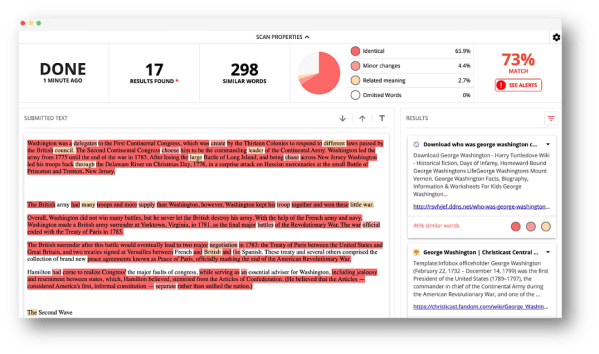
Unlike Editpad, this tool only provides the percentage of matched/plagiarized content. One good thing is that it highlights different types of plagiarism in different colors. For instance, if the given sentence or paragraph is completely matched with an online source, then that part will be highlighted in dark red. 

On the other hand, if a few words are matched, then the tool will highlight them with a light red color, indicating minor changes. 

Remember, in both these cases the tool provides the matched sources so that the user can take the necessary steps to remove them. To illustrate all this in a better way, we have attached an image below, check it out. 

One thing that you need to keep in mind is that the Copyleaks plagiarism checker is not available for free, it’s PAID. Its pricing for plagiarism detection starts from $8.99 per month. 

Pros:

  • AI-based detection.
  • Highlight duplication in different colors. 
  • Highly accurate

Cons:

  • Completely paid. 
  • Only provides the percentage of

3.     Paper Rater 

This is a completely free-to-use plagiarism checker that is widely used by students and teachers to quickly and efficiently scan a thesis for duplication. Just like other tools discussed on this list, this one also compares the input text with different online resources such as blogs, research papers, journals, etc., to find plagiarism. 

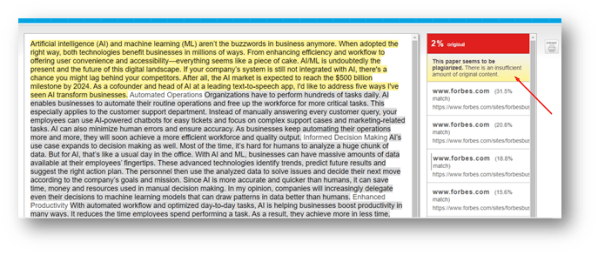
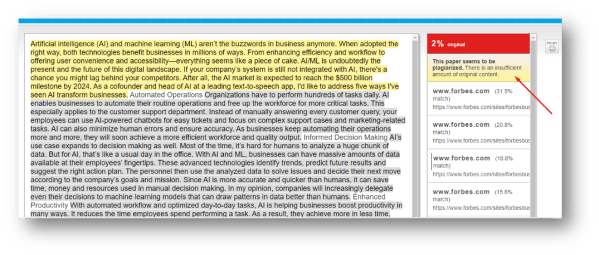
It then provides the percentage of only “Unique” or “Original” content along with a note “This paper seems to be Unique” or “This paper seems to be plagiarized.” Additionally, the tool also provides matched sources and the percentage of matched content for each source. 

To provide you with a better idea about its working, we copied some content from an online article and checked it with PaperRater. The results we got can be seen in the attachment below.

As you can see, the tool has mentioned that the given text is “Plagiarized” which is true since it was copied from an online source. 

One of the amazing things about this tool is that; it allows users to check unlimited words at once for free. 

Pros:

  • Easy & free to use.
  • Unlimited word checking limit. 
  • Provide the percentage of content originality. 

Cons:

  • Does not give the option to download scan results.  

Final Words

Checking your thesis for any kind of plagiarism before submitting or publishing is necessary to avoid severe consequences. In this article, we have explained the 3 best plagiarism detection tools along with the pros and cons that you can use in this regard. 

Importance of PDFs documents for Reading and Transmitting Information to the Global Audience

In a world increasingly reliant on digital information, the ability to efficiently handle documents is pivotal across various domains. Enter PDF Cake, a revolutionary tool designed to cater to the needs of businesses, scholars, educators, and experts alike. This English-language website harnesses the power of AI to swiftly and comprehensively understand PDF documents, catering to a global audience with diverse needs and interests.

Photo by fauxels on Pexels.com

At its core, PDF Cake stands as a beacon of efficiency and convenience in document management. Its AI-powered services are a testament to the transformative potential of technology in simplifying complex tasks. In an era where information overload is a constant challenge, PDF Cake emerges as a valuable ally, offering a suite of services that facilitate quick comprehension and analysis of PDFs.

For scholars and academics, PDF Cake serves as an indispensable tool in conducting research. Its ability to swiftly extract key information, identify critical data points, and summarize lengthy documents streamlines the process of literature review and knowledge synthesis. The AI-powered capabilities significantly reduce the time spent sifting through volumes of information, empowering researchers to focus on analysis and innovation.

Educators also find PDF Cake to be a boon in their quest to disseminate knowledge effectively. From creating concise study guides to preparing lecture materials, the tool’s capacity to distill complex information into easily digestible content aids in enhancing the learning experience. Moreover, the platform’s ability to generate summaries and highlight crucial sections facilitates efficient lesson planning, saving educators valuable time.

In professional settings, efficient document handling is pivotal for productivity. PDF Cake’s AI-driven services enable professionals to swiftly navigate through contracts, reports, and other business documents. The tool’s capacity to extract essential data, identify key points, and generate summaries facilitates informed decision-making and expedites workflow processes.

Furthermore, PDF Cake’s global accessibility ensures that its benefits transcend geographical boundaries. By catering to an international audience, the tool facilitates collaboration and knowledge exchange among professionals, scholars, and businesses worldwide.

The role of AI in document management and productivity enhancement cannot be overstated. AI tools like PDF Cake not only streamline tasks but also augment human capabilities. They serve as force multipliers, empowering individuals and organizations to maximize their efficiency and effectiveness in handling vast amounts of information.

As the integration of AI tools continues to evolve, their potential in revolutionizing document management, academic research, and professional productivity becomes increasingly evident. PDF Cake stands as a testament to the fusion of technology and utility, offering a glimpse into a future where AI-powered solutions redefine how we interact with and comprehend information. In an era characterized by information abundance, tools like PDF Cake pave the way for a more streamlined and productive approach to document management and knowledge acquisition.

Evolution of ChatGPT

The development of ChatGPT is part of a broader history of research and innovation in the field of natural language processing (NLP). Here are some key milestones in the history of ChatGPT:

Photo by Andrew Neel on Pexels.com
  1. Early research on NLP: Research on NLP dates back to the 1950s and 1960s, when computer scientists began exploring ways to enable machines to understand and process human language.
  2. Development of neural networks: In the 1980s and 1990s, researchers began developing neural networks, which are computational models that can learn to recognize patterns and relationships in data.
  3. Emergence of deep learning: In the 2010s, deep learning techniques began to revolutionize the field of NLP, allowing researchers to train large neural networks on vast amounts of text data.
  4. Development of GPT: In 2018, OpenAI introduced the first version of the Generative Pre-trained Transformer (GPT), a deep learning model that can generate human-like text.
  5. Release of GPT-2 and GPT-3: OpenAI released GPT-2 in 2019, which was capable of generating even more sophisticated text than its predecessor. In 2020, OpenAI released GPT-3, which is one of the largest and most sophisticated language models ever developed.
  6. Advancements in ChatGPT: ChatGPT is based on the GPT-3 architecture and represents the latest developments in NLP research. It has the ability to generate natural and human-like language in response to a wide range of prompts and inputs.

Overall, the history of ChatGPT is part of a broader history of research and innovation in the field of natural language processing, which has seen rapid progress in recent years due to advancements in deep learning and large-scale data processing.

ChatGPT, a large language model developed by OpenAI based on the GPT-3.5 architecture. I am designed to generate human-like responses to natural language prompts, and can be used for a wide range of tasks such as answering questions, completing sentences, translating languages, and generating text. I am constantly learning from vast amounts of data and can understand and respond to a variety of topics and subjects.

As a language model, the functions of ChatGPT include:

  1. Language Generation: I can generate human-like text in response to a given prompt or input. This can be in the form of sentences, paragraphs, articles, stories, or even conversations.
  2. Language Translation: I can translate text from one language to another, allowing users to communicate in different languages.
  3. Sentiment Analysis: I can analyze the sentiment of a given text and determine whether it is positive, negative, or neutral.
  4. Question Answering: I can answer a wide range of questions by generating text based on the input question.
  5. Text Summarization: I can summarize long texts by generating a shorter version that captures the main ideas and key points.
  6. Text Completion: I can complete sentences or paragraphs based on the input text.
  7. Personalization: I can personalize text based on user preferences, such as tone, style, and content.

Overall, the main function of ChatGPT is to generate natural and human-like language in response to various inputs and tasks.

Integrating ChatGPT into an application or website involves the following steps:

  1. Choose a platform: There are several platforms available for integrating ChatGPT, such as API.AI, Dialogflow, Botpress, and many more. Choose a platform that best suits your needs and requirements.
  2. Create an account: Once you have selected a platform, create an account and follow the platform’s instructions for creating a new chatbot.
  3. Train the model: Train the ChatGPT model using the platform’s training tools. This involves feeding the model with large amounts of text data so that it can learn how to generate human-like responses.
  4. Define the chatbot’s behavior: Define the chatbot’s behavior by specifying the type of responses it should generate for different types of inputs.
  5. Test the chatbot: Test the chatbot to ensure that it is generating appropriate and accurate responses.
  6. Deploy the chatbot: Once the chatbot has been trained and tested, deploy it to your website or application.
  7. Monitor and update the chatbot: Monitor the chatbot’s performance and update it as needed to ensure that it continues to generate high-quality responses.

Overall, integrating ChatGPT involves selecting a platform, training the model, defining the chatbot’s behavior, testing, deploying, and monitoring and updating the chatbot as needed.