
Modern riders check battery size first. Yet the number on a spec sheet rarely tells the whole story. This guide explains Nominal vs Usable Capacity in clear terms, so you can estimate real range, charge smarter, and ride safer. For orientation across models and classes, browse our site’s Electric Scooters Overviews early in your research.
What “Capacity” Really Means
Battery capacity expresses how much energy a pack can store. Manufacturers use a few related measurements.
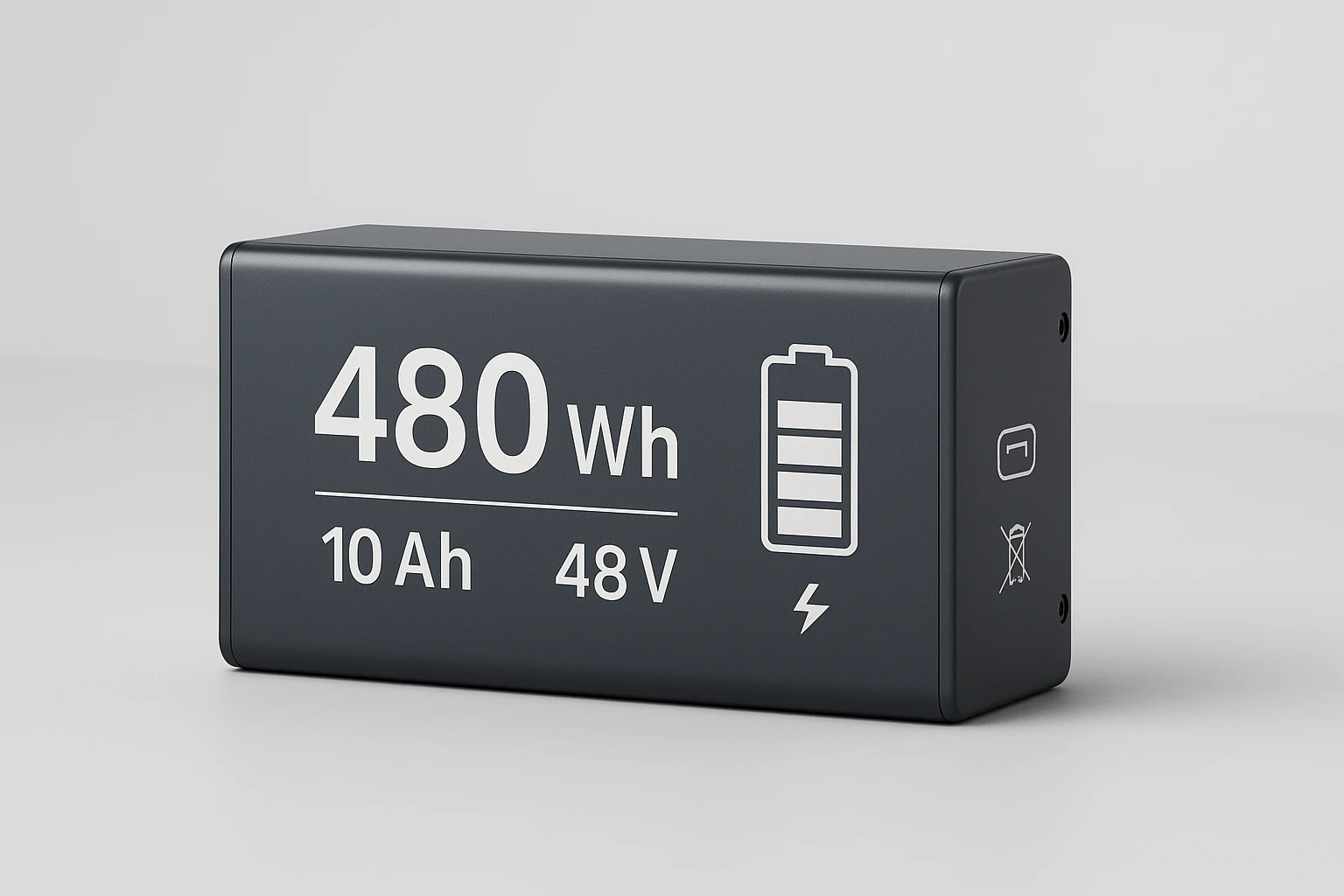
- Watt-hours (Wh): Total energy. It combines voltage and amp-hours.
- Amp-hours (Ah): How many amps the pack can supply for one hour.
- Voltage (V): Electrical “pressure.” Many scooter packs are 36 V, 48 V, or 52 V nominal.
Watt-hours (Wh) = Voltage (V) × Amp-hours (Ah)
Analogy: Picture a water system. Voltage is water pressure. Ah is how much water the tank can deliver. Wh is the total water you can actually use to do work.
Why does Wh matter more than Ah? Because battery Wh vs Ah can be misleading if voltage differs. A 10 Ah pack at 36 V stores far less energy than a 10 Ah pack at 52 V. Therefore, compare Wh first when judging range or performance.
Key point: Wh is the cleanest way to talk about energy. However, real-world range also depends on usable battery capacity, riding style, hills, temperature, and how your Battery Management System behaves.
Nominal Capacity vs Usable Capacity
When you read a label, you’ll usually see a nominal battery capacity number. That’s the rated energy under standard conditions. In practice, you can’t use all of it, because pulling every last drop shortens life and risks damage.
- Nominal capacity: Theoretical or rated energy (often on the box).
- Usable capacity: The energy you can draw in day-to-day riding after safety limits, cut-offs, and buffers.
Why the difference? Manufacturers and BMS designers keep a top buffer (to avoid staying at 100% long) and a bottom buffer (to prevent over-discharge). These buffers protect the pack and improve cycle life.
Two terms clarify this:
- State of Charge (SoC): The percent “full” the pack is now.
- Depth of Discharge (DoD): How much of the pack you’ve used from full.
If your pack uses an 80% DoD window, you’ll access around 80% of nominal in normal conditions. That window varies by chemistry, controller settings, and brand philosophy. Many real scooters effectively give riders ~80–95% of nameplate energy in typical use, though the exact window differs.
What changes “usable” day to day?
Even with the same pack, usable Wh fluctuates.
- Temperature: Cold cells deliver less energy and power. Heat raises stress and increases losses.
- Current draw: Hard launches and steep hills raise voltage sag, pushing the BMS to cut off earlier.
- Aging: As cells cycle, capacity fades. Internal resistance rises, so sag increases and the BMS may trip sooner.
- Speed and aerodynamics: Higher speeds multiply air drag and burn energy quickly.
- Tire pressure and rolling resistance: Soft tires and rough surfaces cost watts.
In short, Nominal vs Usable Capacity isn’t a fixed ratio. It shifts with use, weather, and wear.
The Role of the BMS (Battery Management System)
Your BMS is the battery’s guardian. It measures voltages, monitors temperatures, balances cells, and enforces safe limits. Those protections shape your usable capacity.
Core BMS functions:
- Over-charge protection: Stops charge current near 100% to protect cells.
- Over-discharge protection: Cuts output as voltage nears safe minimums.
- Cell balancing: Keeps series cells at similar voltages to avoid weak links.
- Thermal checks: Reduces or cuts current when cells run too hot or too cold.
- Short-circuit and over-current protection: Prevents dangerous spikes.
Fast charging and high C-rates
Speedy charging raises convenience. However, higher C-rates create heat and increase stress. Consequently, a pack charged and discharged gently often retains more usable energy after a year than one treated aggressively. For daily use, many riders prefer moderate charging and avoid frequent 100% top-offs.
Tip: If your charger has modes, choose a normal or eco setting for daily cycles. Save full 100% top-offs for long trips.
Chemistry Matters (Short & Practical)
Different lithium chemistries behave differently, especially across temperatures and state-of-charge windows.
NMC/NCA (Nickel-rich):
- Pros: High energy density → lighter packs for the same Wh.
- Cons: Narrower comfort zone for temperature and voltage.
- Behavior: Noticeable voltage drop as SoC falls; can reduce perceived usable Wh in cold or under high load.
LFP (Lithium Iron Phosphate):
- Pros: Long cycle life, strong thermal stability, flat voltage curve.
- Cons: Lower energy density → heavier for the same Wh.
- Behavior: Flatter voltage vs SoC; riders sometimes perceive more consistent power delivery through the middle of the pack. Cold performance still drops, but the curve is predictable.
Therefore, two packs with the same nominal Wh but different chemistries may feel different on the road. The flatter LFP curve can keep power steadier in the mid-range, though total energy still rules range.
Estimating Your Real-World Range
You can turn nominal Wh into a practical estimate by accounting for buffers and consumption.
Step 1: Start with nominal Wh.
Step 2: Apply a reasonable buffer. Many riders assume 10–20%.
Step 3: Estimate average consumption. A typical commuter might see 18–22 Wh/mi (≈ 11–14 Wh/km), depending on weight, speed, and terrain.
Step 4: Compute range.
Estimated range = Usable Wh ÷ Average consumption (Wh/mi or Wh/km)
Worked example (generic numbers)
- Nominal capacity: 480 Wh
- Usable assumption: 90% → 432 Wh
- City pace consumption: 18 Wh/mi (≈ 11 Wh/km)
- Mixed route consumption: 22 Wh/mi (≈ 14 Wh/km)
City range: 432 ÷ 18 = 24.0 mi (≈ 38.6 km)
Mixed range: 432 ÷ 22 ≈ 19.6 mi (≈ 31.5 km)
These are estimates, not promises. Headwinds, heavy loads, hills, and low temperatures reduce range. Aggressive riding does the same.
Pro move: Track your own Wh/mi (or Wh/km) for a few commutes. Then, plug your personal number into the formula for tight predictions.
Reading Spec Sheets Without Getting Tricked
Marketing language can stretch truth. Here’s how to read carefully.
Red flags:
- Only Ah is listed, but Voltage is missing. You can’t compute Wh without V.
- Only “peak power” is shown, with no “continuous” rating.
- No stated operating temperature ranges.
- Vague claims like “up to X miles” with no rider weight or speed context.
What to look for:
- Pack Wh and nominal V together.
- Cell chemistry (e.g., NMC or LFP) and configuration (e.g., 13s2p), when available.
- Charge rate and charger output (A, V, or W).
- BMS protections and any thermal cutoffs.
- Operating and charging temperatures (°F/°C). For most packs:
- Storage: about 50–77 °F (10–25 °C)
- Charging: roughly 50–113 °F (10–45 °C)
- Riding: broader, but efficiency drops in cold.
Bonus sanity check: If a product lists huge range but modest Wh, run the math. If the claimed distance requires implausibly low Wh/mi, treat it as a best-case marketing number.
Care, Charging, and Storage for Maximum Usable Capacity
Good habits preserve more energy day to day and slow long-term aging.
Daily charging
- Charge to ~80–90% for routine use when possible.
- Avoid waiting until 0%; recharge around 20–30% SoC.
- Let the pack cool to room temp before charging after a hard ride.
- Use the OEM charger and avoid mismatched third-party units.
Storage
- Store near 40–60% SoC if unused for weeks.
- Keep it in a cool, dry area: about 50–77 °F (10–25 °C).
- Check and top up monthly to maintain the storage window.
Riding and maintenance
- Keep tires properly inflated to reduce rolling losses.
- Smooth throttle inputs reduce voltage sag and heat.
- Keep connectors clean and dry; moisture raises resistance.
- Update firmware where applicable to ensure correct BMS behavior.
Safety first: Charge on a hard, non-flammable surface, away from bedding or clutter. Use a nearby smoke alarm. Never leave charging unattended.
Quick Comparison Table (Example Data)
The following generic table illustrates how nominal Wh translates into estimated usable Wh and range. It assumes a 90% usable window for easy math. Real results vary.
| Example Pack | Nominal Wh | Assumed Usable Wh (90%) | City Range @18 Wh/mi (≈11 Wh/km) | Mixed Range @22 Wh/mi (≈14 Wh/km) |
|---|---|---|---|---|
| Pack A | 360 | 324 | 18.0 mi / 29.0 km | 14.7 mi / 23.7 km |
| Pack B | 480 | 432 | 24.0 mi / 38.6 km | 19.6 mi / 31.5 km |
| Pack C | 561 | 505 | 28.1 mi / 45.2 km | 23.0 mi / 37.0 km |
How to use this: Find your pack’s Wh, apply a buffer (10–20% is common), then divide by your personal Wh/mi or Wh/km. If you ride fast or climb hills, use a higher consumption number.
FAQs
1) Why does my scooter “die” with 10% left?
That bottom buffer protects the pack from over-discharge. Voltage sags under load near empty, so the BMS may shut down early to keep cells safe.
2) Is charging to 100% bad?
Occasional full charges are fine. However, parking at 100% for long periods stresses cells. For daily use, many riders target 80–90%.
3) Do cold temperatures reduce usable capacity?
Yes. Cold slows the chemistry, raises resistance, and increases voltage sag. You’ll see lower usable Wh and shorter range until the pack warms.
4) Wh vs Ah: which matters more?
Wh is better for energy comparisons because it includes voltage. Battery Wh vs Ah debates usually vanish once you compute Wh.
5) Can I unlock more usable capacity through settings or firmware?
Some devices let you adjust behavior slightly. Still, the BMS keeps strict safety limits. Expanding the window risks cycle life and safety.
6) What’s a safe storage charge?
About 40–60% SoC in a cool room. Check monthly and adjust.
7) Does fast charging ruin batteries?
Not immediately. However, higher C-rates increase heat and long-term wear. Use them when needed, not every day.
8) Why does my range shrink over time?
Normal aging reduces capacity and increases internal resistance. Your usable window narrows under load, so range falls gradually.
Glossary (Plain English)
- Wh (Watt-hours): Total stored energy.
- Ah (Amp-hours): How much current the pack can deliver over time.
- Voltage (V): Electrical pressure that pushes current.
- C-rate: Charge or discharge current relative to pack capacity.
- DoD (Depth of Discharge): Portion of the pack you’ve used since full.
- SoC (State of Charge): Current fullness as a percentage.
- BMS (Battery Management System): Electronics that protect and manage the pack.
- Energy density: How much energy fits per unit weight or volume.
- Cycle life: How many charge/discharge cycles before meaningful capacity loss.
- Cell balancing: Keeping cells at similar voltages to avoid weak links.
- Cut-off voltage: The BMS’ stop line to prevent damage.
Final Thoughts
Nominal capacity tells you what’s printed on the label. Usable capacity tells you what actually powers your ride. Because conditions vary, smart riders estimate conservatively, track real consumption, and care for their packs. When you want to see how features translate to road feel, skim hands-on impressions in our Electric Scooter Reviews. Finally, use Wh-based math, dial your speed to match your route, and let good habits stretch both range and battery lifespan.

 International Journal of Research (IJR)