Sachin Ramesh Tendulkar: The Master Blaster

Sachin Ramesh Tendulkar is an Indian cricketer widely considered by many to be one of the greatest batsmen of all time. He is the leading run-scorer and century maker in Test and one-day international cricket. He is the first player to score a double century in ODI cricket.
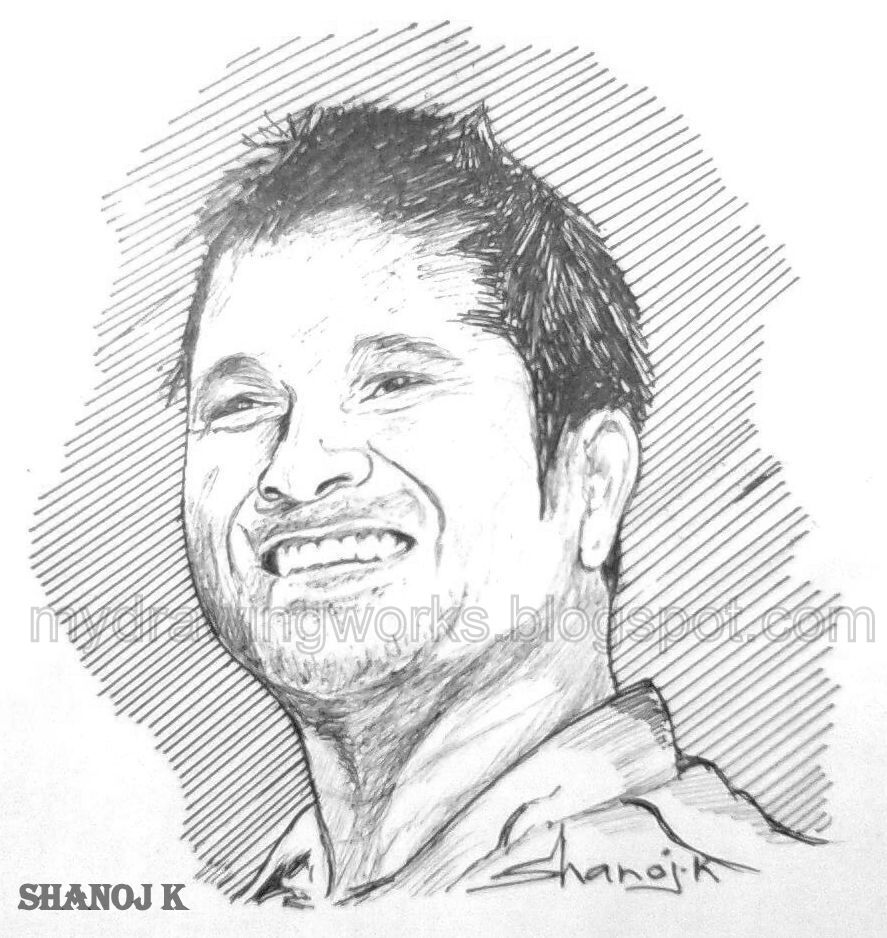
Photo Coutesy: Sanoj K. of mydrawingworks.blogspot.com

Tendulkar is the only cricketer to accomplish the feat of scoring a hundred centuries in international cricket which includes 49 ODI and 51 Test centuries. He is also the only player to score fifty centuries in Test cricket, and the first to score fifty centuries in all international cricket combined. On 17 October 2008, when he surpassed Brian Lara’s record for the most runs scored in Test cricket, he also became the first b 12,000, 13,000, 14,000 and 15,000 runs in that form of the game, having also been the third batsman and first Indian to pass 11,000 runs in Test cricket. He was also the first player to score 10,000 runs in one-day internationals, and also the first player to cross every subsequent 1000-run mark that has been crossed in ODI cricket history.
Tendulkar has been honoured with the Padma Vibhushan award, India’s second highest civilian award, and the Rajiv Gandhi Khel Ratna award, India’s highest sporting honour. Tendulkar became the first sportsperson and the first person without an aviation background to be awarded the honorary rank of Group Captain by the Indian Air Force. He has received honorary doctorates from University of Mysore and Rajiv Gandhi University of Health Sciences. He won the 2010 Sir Garfield Sobers Trophy for cricketer of the year at the ICC awards.
Tendulkar was born into a Rajapur Saraswat Brahmin family, in Bombay (now Mumbai). His mother Rajni worked in the insurance industry, and his father Ramesh Tendulkar, a Marathi novelist, named Tendulkar after his favourite music director, Sachin Dev Burman. Tendulkar’s elder brother Ajit encouraged him to play cricket.
When he was young, Tendulkar would practice for hours on end in the nets. If he became exhausted, Achrekar would put a one-rupee coin on the top of the stumps, and the bowler who dismissed Tendulkar would get the coin. If Tendulkar passed the whole session without being dismissed, the coach would give him the coin. Tendulkar now considers the 13 coins he won then as some of his most prized possessions.
While at school, he developed a reputation as a child prodigy. He had become a common conversation point in Mumbai circles, where there were suggestions already that he would become one of the greats. His season in 1988 was extraordinary, with Tendulkar scoring a century in every innings he played. He was involved in an unbroken 664-run partnership in a Lord Harris Shield inter-school game in 1988 with friend and team mate Vinod Kambli, who would also go on to represent India. The destructive pair reduced one bowler to tears and made the rest of the opposition unwilling to continue the game. Tendulkar scored 326* in this innings and scored over a thousand runs in the tournament.[24] This was a record partnership in any form of cricket until 2006, when it was broken by two under-13 batsmen in a match held at Hyderabad in India.
At 14, Tendulkar was a ball boy for the India versus Zimbabwe game at the Wankhede Stadium during the 1987 World Cup. When he was 14, former Indian batsman Sunil Gavaskar gave him a pair of his own ultra-light pads. “It was the greatest source of encouragement for me,” Tendulkar said nearly 20 years later after surpassing Gavaskar’s world record of 34 Test centuries.
His first double century was for Mumbai while playing against the visiting Australian team at the Brabourne Stadium in 1998.[1] He is the only player to score a century in all three of his Ranji Trophy, Duleep Trophy and Irani Trophy debuts.
Tendulkar’s rise continued when he was the leading run scorer at the 1996 World Cup, scoring two centuries.
Tendulkar scored his much awaited 100th international hundred on 16 March 2012, at Mirpur against Bangladesh in the Asia Cup. He became the first person in history to achieve this feat. Incidentally, it was Tendulkar’s first ODI hundred against Bangladesh.
Former Indian stars exaggerated Tendulkar’s entry into world cricket up and those who had seen him play. Tendulkar’s consistent performances earned him a fan following across the globe, including amongst Australian crowds, where Tendulkar has consistently scored centuries.
In April 2012, Tendulkar accepted the Rajya Sabha nomination proposed by the president. He is the first active sportsperson and cricketer to have been nominated to the Rajya Sabha.
Shashikant Nishant Sharma

Hollywood: The Film City of the West

Hollywood is a district in Los Angeles, California, United States situated west-northwest of downtown Los Angeles. Due to its fame and cultural identity as the historical center of movie studios and movie stars, the word Hollywood is often used as a metonym of American cinema. Today, much of the movie industry has dispersed into surrounding areas such as the Westside neighborhood, and the San Fernando and Santa Clarita Valleys, but significant auxiliary industries, such as editing, effects, props, post-production, and lighting companies remain in Hollywood, as does the backlot of Paramount Pictures.

 Filmmaking in the greater Los Angeles area preceded the establishment of filmmaking in Hollywood. The Biograph Company filmed the short film A Daring Hold-Up in Southern California in Los Angeles in 1906. The first studio in the Los Angeles area was established by the Selig Polyscope Company in Edendale, with construction beginning in August 1909.
Prolific director D. W. Griffith was the first to make a motion picture in Hollywood. His 17-minute short film In Old California, which was released on March 10, 1910, was filmed entirely in the village of Hollywood for the Biograph Company. Although Hollywood banned movie theaters—of which it had none—before annexation that year, Los Angeles had no such restriction. The first film by a Hollywood Studio, Nestor Motion Picture Company, was shot on October 26, 1911. The Whitley home was used as its set, and the unnamed movie was filmed in the middle of their groves on the corner of Whitley Ave and Hollywood Boulevard by directors Al Christie and David and William Horsley.
Various producers and filmmakers moved bases from the east coast to escape punitive licensing from the Motion Picture Patents Company.
The first studio in Hollywood was established by the New Jersey–based Centaur Co., which wanted to make westerns in California. They rented an unused roadhouse at 6121 Sunset Boulevard at the corner of Gower, and converted it into a movie studio in October 1911, calling it Nestor Studio after the name of the western branch of their company. The first feature film made specifically in a Hollywood studio, in 1914, was The Squaw Man, directed by Cecil B. DeMille and Oscar Apfel, and was filmed at the Lasky-DeMille Barn among other area locations.
By 1911, Los Angeles was second only to New York in motion picture production, and by 1915, the majority of American films were being produced in the Los Angeles area.
Four major film companies – Paramount, Warner Bros., RKO and Columbia – had studios in Hollywood, as did several minor companies and rental studios. Hollywood had begun its dramatic transformation from sleepy suburb to movie production capital. The residential and agrarian Hollywood Boulevard of 1910 was virtually unrecognizable by 1920 as the new commercial and retail sector replaced it. The sleepy town was no more, and, to the chagrin of many original residents, the boom town could not be stopped.

Shashikant Nishant Sharma

PRESSURE OF INCREASING COST OF TEXT BOOK OF PRIMARY CLASS

I want to draw attention of our education ministry to solve the problem of poor student who study in the primary class, there is maximum changes in the textbooks every year so that it become very difficult to afford higher rate of textbook, so there should be a panel which regulate minimum cost of text book so that each one can afford the fee of their children education .Our current education system is becoming day by day costlier for poor family. This is creating a big problem in giving a best scholar from weaker section of our society, if problem will not be solved immediately it will create a great problem for country tomorrow. The day will not be far when this section of our society will produce antisocial elements instead of good scholars. The education system should lead to social justice and social equity.


Harish Kumar
Patna-

Harishkr101@gmail.com

repressive orders issued in West Bengal to use newspapers selectively

The repressive orders issued in West Bengal to use newspapers selectively is clear violation of free expression of independent thought and the violation and repression of the right of public libraries to provide all sorts of information so that public is in a position to judge on their on the action and inaction right or wrong. It is really a shocking information that the school textbooks have been rewritten to remove the philosophy of Karl Marx and Friedrich Engels because Ms. Banerjee has so decreed. The recent action against some of the defiant and lampooning persons in West Bengal is by no mean justified. The democratic forces should come forward to take action so that the things do not go from bad to worse. The Central Government being a coalition government running on her Party’s support is unable to take required action but the public should not remain silent. The intelligentsia and the other political and social forces should come forward to halt irrational and irrelevant order.
Shashikant Nishant Sharma


With Regards
SureShot POST
New Delhi, India

Fake Currency in India


The counterfeit currency menace is growing by leaps and bound in India due to the poor vigilance and prompt and coordinated against the fake currency printers and mafia operating in this field. In 2011, the rupee appeared to have emerged as the counterfeiter’s currency of choice internationally.The fact was recently revealed in the report compiled by the Financial Intelligence Unit of the Union Finance Ministry which estimated around 400 per cent increase in counterfeit transactions in India’s financial market.The cross border fake currency dealers are the real threat as they given safe sanctuary there and the government feels what harms it does. But they should know that the same fake currency dealers and printers are printing fake currency for the country which gives them save heaven.The intelligence bureau and the law enforcement agencies should come forward with measures which not only detects the fake currencies but also strong and fool proof measures to teach them a lesson.There should be conscious effort to uproot the fake currency infrastructure existing in the neighbouring counties through diplomatic dialogues and collaboration in tackling the menace of fake currency.Some of the others measures can be improving the quality of paper used in currency printing and new techniques of recording the transactions at the financial institution like banks. The recording will help in tracking down all the link associated with it. It is vital to reach to the sources but the intermediate links must be snapped whenever possible. 
Shashikant Nishant Sharma 
शशिकांत निशांत शर्मा 

With Regards
SureShot POST
New Delhi, India

!function(d,s,id){var js,fjs=d.getElementsByTagName(s)[0];if(!d.getElementById(id)){js=d.createElement(s);js.id=id;js.src=”//platform.twitter.com/widgets.js”;fjs.parentNode.insertBefore(js,fjs);}}(document,”script”,”twitter-wjs”);

Right to Education- Social Inclusion


Right to Education is a ambitious act and its enactment in the true spirit will surely have a good impact on creating a inclusive growth and development. It is a matter of shape that some private educational institutional are more of a economic enterprise and they admit those who can afford high but the poor feel social exclusion in this whole process of commercialization. The poor have equal right to quality education. The private institutions should take the Supreme Court order seriously and they should devise selection suitable criteria for selection of bright students from the underprivileged communities. One suggested criteria can be free admission of wards of the staffs of the institutions who come from those underprivileged communities and areas. Other criteria can be the nearness of the candidate for admission so that other overhead cost of education like travelling is reduced. Talent search can be conducted to select meritorious students among the poor students of nearby area.
from:  Shashikant Nishant Sharma

Source: http://www.thehindu.com/opinion/editorial/article3308066.ece

With Regards
SureShot POST
New Delhi, India

West Bengal Chief Minister: Diktat on selection of Newspapers


The decision taken by West Bengal Chief Minister on selection of newspapers is a clear violation of the citizens’ right to know and is an insult to libraries. She must understand that the actions taken by her in government office affecting the public and public policies must be in conformity with standard or norms set by the Constitution of India which cannot be arbitrary, irrational or irrelevant. She is the Chief Minister not the queen of Bengal and must respect and pay regards to the Constitution of India in true spirit of term. I am surprised to know that very few newspapers and media highlighted this issue which is clear violation of right to equality and freedom of press. The public cannot be prescribed what to read and what to omit. Public money must be spent in a democratic manner and for the benefit of public and common good; in a rational manner taking into account the demand of the economy and people at large; in a relevant manner so as to serve the common need and demand.
from:  Shashikant Nishant Sharma

Strengthening Bilateral Ties between India and Pakistan

The strengthening bilateral relation between the two neighbours India and Pakistan is the only solution to many problems like cross border terrorism, oil pipe line from Iran, untapped trade opportunities and many more to count. The timely and decisive visit of Pakistani Prime Minister Asif Ali Zardari amid the objection by various organisation in home country. This will sure give a strong signal that the relations between the two nations will not be dictated by such organisations. The fruitful and continuous dialogues between the two nations will surely bring a new era of mutual understanding and cooperation in coming future. The tightening vigilance of the international community on Pakistan has left no other ways for Pakistan but to reconcile will the good neigbours like India and China who can help the country tide over the economic and social crisis looming large it.

Shashikant Nishant Sharma
New Delhi

With Regards
SureShot POST
New Delhi, India


20th ASEAN Summit in Combodia, 2012 – New Dimension in Cooperation


The recently concluded 20th summit of the Association of South East 
Asian Nations (ASEAN) has not only consolidated associations aim and 
objectives, but also paved way for its future development prospects. 
ASEAN has established itself not only as a regional groups for 
cooperation and stability but also as a forum to interact with world 
bodies for greater inclusive growth of the Asian countries. The forum 
has been successful in incentivising the trade and political 
cooperation which is visible from the outcome of the recent elections 
in Mayanmar and resolution of South China sea which India has 
persuaded to declare it as a common asset for the south Asian nations. 
The forum can play more robust role in fighting hunger and terrorism. 
A strong trade and commerce can pave path for greater cooperation in 
the field of education, health and infrastructure development in the 
Asian countries. We have good amount of resource and capabilities 
which must be harnessed for mutual development.
from:  Shashikant Nishant Sharma

Source: http://www.thehindu.com/opinion/editorial/article3297582.ece

With Regards
SureShot POST
New Delhi, India

4th BRICS Summit in Delhi- A Mile Stone in World Geo-politics


The BRICS, association of five major economies of the world i.e., 
Brazil, Russia, India, China and South Africa, is a clear signal for 
the re-odering of the world economy and the geo-political power 
balance in the modern world. The dominance of the western countries 
must be checked and an internationally accepted monetary regime free 
from the clutch of a country-specific currency like dollar must be 
developed. The charter of the UN must implemented in true spirit of 
term. The long delaying of the reforms in UN can be compensated by 
BRICS. The sovereignty of many small Asian and African countries are 
at stake at the hand of the two-century-old hegemony of the West over 
the modern world.
from:  Shashikant Nishant Sharma

Source: http://www.thehindu.com/opinion/lead/article3297589.ece

With Regards
SureShot POST
New Delhi, India