
Precision engineering is one of the most demanding fields in modern manufacturing. Whether producing intricate metal components for automotive systems, structural elements for construction, or tight-tolerance parts for industrial machinery, manufacturers must choose the right processing technology—one that offers accuracy, speed, repeatability, and cost efficiency.
Two technologies dominate this landscape: laser cutting and CNC machining. Each has evolved dramatically over the past decade, and both play essential roles in today’s production ecosystems. But how do they compare? Which applications suit each technology best? And how can manufacturers make the right decision for their workflow?
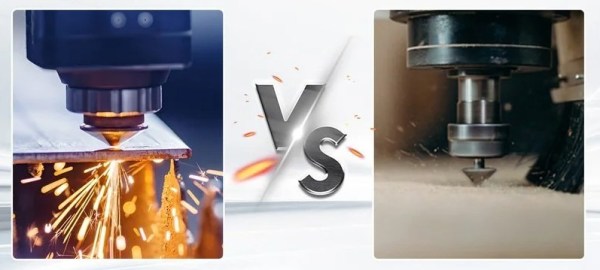
This article provides a clear, data-driven comparison to help businesses, engineers, and technical buyers make informed choices.
1. Understanding the Core Difference
Laser cutting and CNC machining rely on entirely different principles.
Laser Cutting
A high-powered laser beam melts, vaporizes, or burns material to create a clean, narrow cut line. Modern machines—especially fiber laser cutters—are fast, accurate, and optimized for metals like steel, aluminum, copper, and stainless steel.
Laser systems excel in:
- Thin to medium-thickness materials
- Complex shapes
- Smooth edges
- High-speed profiling
For example, manufacturers processing structural steel profiles often use specialized systems such as an H-shaped steel laser cutting machine, which combines accuracy with exceptional productivity.
CNC Machining
CNC machining removes material using mechanical tools such as mills, lathes, or drills. It is a subtractive manufacturing method that offers extremely tight tolerances and can create multi-dimensional features that laser cutting cannot.
CNC systems excel in:
- Deep pockets
- Threads
- Chamfers
- Multi-surface operations
- High-precision 3D forms
Both technologies are powerful, but they shine in different scenarios—let’s explore those distinctions step by step.
2. Accuracy & Tolerance Comparison
Precision engineers focus heavily on tolerance, and this is where the comparison becomes interesting.
Laser Cutting Tolerance Levels
Modern industrial laser cutters typically achieve:
- ±0.1 mm tolerance on sheet metal
- Very consistent repeatability
- Smooth, burr-free edges (often eliminating secondary finishing)
Fiber laser technology also reduces heat-affected zones, improving dimensional stability.
CNC Machining Tolerance Levels
High-end CNC machines can achieve:
- ±0.005 mm or better
- Extremely tight tolerances on small components
- Superior dimensional accuracy for complex geometries
Winner: CNC machining for ultra-high precision, but laser cutting provides more than enough precision for 95% of metal fabrication jobs.
3. Complexity of Geometry
Laser Cutting
A laser beam can move incredibly fast and change direction instantly, making it ideal for:
- Complex outlines
- Patterns and perforations
- Sharp corners
- Custom one-off designs
It’s particularly effective for 2D profiles, signage, metal architecture, and machine components.
CNC Machining
CNC machines can work in:
- 3-axis
- 4-axis
- 5-axis
They can produce 3D shapes, pockets, contours, and internal cavities—features impossible for laser cutting.
Conclusion:
Laser = Best for 2D and high-speed profiling
CNC = Best for 3D forms and multi-surface machining
4. Material Compatibility
Both technologies work with a broad range of metals, but their behavior varies.
Laser Cutting Materials
Ideal for:
- Mild steel
- Stainless steel
- Aluminum
- Copper & brass
- Titanium
Laser cutting struggles only when thickness becomes excessive (typically above 40 mm depending on the laser power).
CNC Machining Materials
Works with:
- Metals (steel, aluminum, brass, titanium)
- Plastics
- Composites
- Wood
CNC machining handles extremely thick or hard materials that lasers cannot efficiently cut.
5. Speed & Workflow Efficiency
Laser Cutting
- Extremely fast, especially on thin–medium materials
- Minimal setup time
- No clamping required in most cases
- Batch production becomes highly efficient
A single operator can manage multiple laser machines at once, which helps factories reduce labor cost.
CNC Machining
- Slower due to tool changes, spindle speeds, and material removal rates
- Requires fixturing and setup
- More operator supervision
- Precision takes time
Winner: Laser cutting for high-volume or fast-turnaround jobs.
6. Surface Quality & Finishing Requirements
Laser Cutting Finish Quality
- Clean edges
- Very minimal burr
- Little or no post-processing
- No tool marks
This is especially valuable for industries where visual appearance matters—architecture, automotive interiors, decorative panels, and more.
CNC Machining Finish Quality
- Excellent surface finish
- Can produce mirror-like surfaces through polishing
- Ideal for precision parts, molds, and engineering components
7. Cost Efficiency Comparison
Cost is often the deciding factor, and here’s how the two processes compare:
Cost Advantages of Laser Cutting
- Faster cycle times
- Lower labor requirement
- Minimal consumables
- Lower maintenance
- High material utilization due to narrow kerf
Laser cutting is the most cost-effective choice for producing sheet metal parts.
Cost Advantages of CNC Machining
- Invaluable for precision parts where dimensional accuracy is critical
- Necessary for 3D forms
- Tooling cost is higher, but the value is justified in complex applications
General Rule:
Laser cutting = Lower cost for flat parts
CNC machining = Higher cost but essential for complex engineering
8. Which Technology Should You Choose?
Choose Laser Cutting If:
- You need fast production
- You work mainly with sheet metals
- Edge quality matters
- Shapes are mostly 2D
- You want minimal finishing work
- Cost efficiency is important
- You require architectural or industrial structural components
Laser cutting also supports specialized industrial needs—factories processing beams, pipes, or profiles rely on advanced laser systems such as those offered by Dowell Laser.
Choose CNC Machining If:
- Your parts need ultra-tight tolerances
- You require pockets, threads, counterbores, or multi-surface details
- You need 3D geometry
- You work with materials that are too thick or hard for laser cutting
Why Many Factories Use Both Technologies
In modern precision engineering, the smartest approach is hybrid production. Many manufacturers use:
- Laser cutting for blanking, profiling, and preparing raw shapes
- CNC machining for final finishing and tight-tolerance features
This combination significantly reduces overall production cost while maintaining high-precision output.
Example workflow:
- Laser cuts the rough profile in seconds
- CNC performs finishing on critical features
- Final product achieves perfect accuracy with minimal waste
This hybrid method is widely used in automotive fabrication, construction steel processing, aerospace components, and machinery manufacturing.
Final Verdict
Laser cutting and CNC machining are not competitors—they are complementary technologies. Laser cutting dominates in speed, cost efficiency, and 2D profiling, while CNC machining excels in precision, 3D geometry, and finishing.
For most metal fabrication businesses, choosing both technologies is the fastest path to higher precision, lower production cost, and improved competitiveness.
If your factory is looking to upgrade production capability, modern high-power laser cutting systems offer one of the highest ROI levels in today’s manufacturing world—and integrating CNC machining afterward creates a complete, high-efficiency workflow.


 International Journal of Research (IJR)