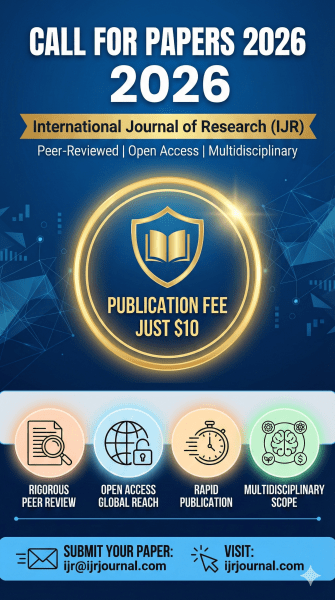
Call for Papers – 2026

πŸ“’ Call for Papers – 2026

International Journal of Research (IJR)

πŸ“§ Submit at: ijr@ijrjournal.com
🌐 Journal Website: https://www.ijrjournal.com

The International Journal of Research (IJR) invites original and high-quality research papers for publication in its 2026 issues. IJR is a peer-reviewed, open-access international journal committed to promoting multidisciplinary research and making scholarly knowledge accessible to researchers, academicians, professionals, and students across the globe.


πŸ” About the Journal

The International Journal of Research (IJR) is a monthly, peer-reviewed academic journal that provides an inclusive platform for publishing original research articles, review papers, case studies, conceptual papers, and short communications. The journal follows a double-blind peer review process to ensure academic rigor, originality, and quality.

IJR strongly supports open-access publishing, allowing published articles to be freely accessible worldwide without subscription barriers.

πŸ“š Scope of the Journal

IJR is multidisciplinary in nature and welcomes submissions from a wide range of academic and professional fields, including but not limited to:

  • Engineering and Technology
  • Architecture and Planning
  • Computer Science and Information Technology
  • Management and Commerce
  • Social Sciences and Humanities
  • Education and Psychology
  • Environmental Studies and Sustainability
  • Life Sciences and Agriculture
  • Health Sciences and Public Policy
  • Economics, Finance, and Development Studies

Interdisciplinary and applied research papers are highly encouraged.


✍️ Types of Papers Accepted

  • Original Research Articles
  • Review Papers
  • Case Studies
  • Conceptual and Theoretical Papers
  • Short Research Communications

All submissions must be original, unpublished, and not under consideration elsewhere.


πŸ’° Publication Fee (APC)

To support affordable and inclusive academic publishing:

βœ… Open Access Publication Fee: Only USD 10
βœ… No submission fee
βœ… No hidden charges

This minimal APC makes IJR one of the most affordable peer-reviewed open-access journals, especially beneficial for students, early-career researchers, and scholars from developing countries.


πŸ§ͺ Peer Review & Ethics

  • Double-blind peer review
  • Plagiarism check before acceptance
  • Ethical publishing standards followed strictly
  • Constructive reviewer feedback provided

IJR aims for a fast yet rigorous review process without compromising publication quality.


πŸ“… Important Dates

  • Submission Open: Ongoing (for 2026 issues)
  • Review Time: Short and efficient
  • Publication: Monthly issues throughout 2026

Early submissions are encouraged for priority review and publication.


πŸ“€ How to Submit

Authors are requested to send their manuscripts via email:

πŸ“§ ijr@ijrjournal.com

Include:

  • Manuscript (MS Word format)
  • Author details and affiliations
  • Declaration of originality

Detailed author guidelines are available on the journal website:
🌐 https://www.ijrjournal.com


🌍 Why Publish with IJR?

βœ” Peer-reviewed international journal
βœ” Open access for global visibility
βœ” Very low APC (USD 10 only)
βœ” Monthly publication
βœ” Multidisciplinary scope
βœ” DOI assignment and proper indexing process
βœ” Supportive editorial team


πŸ“Œ Submit your research and be part of the 2026 scholarly community of IJR.

For queries, feel free to contact: ijr@ijrjournal.com

We look forward to your valuable contributions!

Is there Any Future for ChatGPT

Daily writing prompt
What is the greatest gift someone could give you?

As an AI language model, ChatGPT is a remarkable achievement in the field of natural language processing. It is capable of generating responses that are contextually relevant and syntactically sound, making it an ideal tool for a wide range of applications, from chatbots to language translation. One of the most impressive aspects of ChatGPT is its ability to learn from vast amounts of data and improve over time. This is achieved through a process called unsupervised learning, which allows the model to learn patterns and relationships in the data without being explicitly told what to look for. In terms of its capabilities, ChatGPT is able to understand a wide range of topics and can engage in conversations that are both informative and engaging. It can also generate responses that are humorous or sarcastic, making it a versatile tool for a range of use cases.

That being said, there are some limitations to ChatGPT. One of the biggest challenges with language models like ChatGPT is their tendency to generate biased or offensive content, particularly when they are trained on data that contains bias. This can lead to harmful language being generated, which can be a significant problem in applications like chatbots that are designed to interact with users. Another limitation of ChatGPT is its lack of true understanding of context. While it can generate responses that are contextually relevant, it does not truly understand the nuances of language or the cultural and social contexts in which language is used. This can sometimes lead to responses that are awkward or inappropriate.

Yes, there is a bright future for ChatGPT and other similar AI language models. As the field of natural language processing continues to advance, we can expect to see even more sophisticated language models capable of generating responses that are virtually indistinguishable from human-generated text. One of the key areas of development for ChatGPT and similar models will be improving their ability to understand context and generate responses that are not just contextually relevant, but also culturally and socially appropriate. This will involve training the models on diverse and inclusive data sets, and developing algorithms that can detect and correct for bias. Another area of development for ChatGPT and other language models will be improving their ability to interact with humans in a more human-like way. This will involve incorporating more emotional intelligence into the models, allowing them to recognize and respond to human emotions, as well as developing more sophisticated conversational abilities.

Overall, the future for ChatGPT and similar language models is very promising, and we can expect to see continued growth and development in the field of natural language processing in the years to come. These models have the potential to revolutionize the way we interact with technology and with each other, and to open up new possibilities for communication, learning, and creativity. ChatGPT is an impressive achievement in the field of natural language processing, and it has the potential to be a powerful tool for a range of applications. However, it is important to be aware of its limitations and to use it responsibly in order to avoid generating harmful or offensive content.