In the present times, everything is fast paced, and what might be trendy one day, is kicked to the curb the other. The most common example of this is fashion, specifically fast-fashion. Fast-fashion is used to describe cheap, trendy clothing, which makes the journey from the runway, to your closet and then to the garbage dump, in the blink of an eye. These include brands like, H&M, Forever 21, ASOS, ZARA etc. They pump out new designs regularly to stay relevant amongst the younger generations, and you cannot escape it. Chances are, the clothes you’re wearing right now are from fast-fashion brands.
Now why is this problematic? By putting out new clothes every month or so, and using extremely clever marketing tactics, they’ve convinced the average consumer that their clothes are “outdated” and they need to keep purchasing from them to stay in trend, thereby maximising their profits every single time. But that isn’t even the worst part. To quench their never ending thirst for money, these brands utilise sweatshops for production of their clothing. A sweatshop is a factory where workers are severely underpaid, and the working conditions are inhumane, ranging from excruciatingly long working hours, to unsafe and unhygienic work environments. Sweatshops are usually placed in third world countries like Bangladesh, Cambodia, China etc. where worker’s rights are minimal, where rich brands can get quick, inexpensive labour at the cost of actual human lives.
Since these clothes are mass produced and cheaply made, it is not surprising to know that they go bad after a couple of washes, and are no longer wearable. Each year, the average consumer throws away about 32 kilograms of clothing, adding to the already over filled landfills . It is estimated that the fashion industry is responsible for 10% of all greenhouse gas emissions, which is more than international flights and maritime ships combined. It also takes thousands of gallons of water to produce one cotton shirt and a pair of jeans, as they are made from a water intensive material-cotton. Further, textile dyeing is the second largest polluter of water, leading to the fashion industry being responsible for 20% of the worlds water pollution.
As more and more people get aware of their malpractices, fast fashion brands resort to greenwashing, which is basically presenting a company as more eco friendly than it really is. They make false promises about making their products with organic cotton and recycled polyester. However, they fail to provide sufficient and definitive information, and refuse to specify how much of a garment is made with recycled material. Brands like LuLuLemon and H&M have been recently accused of greenwashing, yet their sales remain high.
It is saddening to see how many people are unaware of these evils, and those who are aware simply turn a blind eye to such issues. How can we prevent this? Our strongest weapon in this war against fast fashion is education. Educate yourself and those around you. Watch documentaries, read books and articles, and convince others around you to quit buying from such brands. Try reducing the number of shopping trips you take in a year. Another thing which can help is mending your old clothes, and wearing them at least 30-40 times to make the most out of them. Remember, every little step counts. Gone are the days when we were blind consumers. Now, the time has come for serious reforms.
The pandemic sweeping the world, COVID-19, has rendered a large proportion of the workforce unable to commute to work, as to mitigate the spread of the virus. This has resulted in both employers and employees seeking alternative work arrangements, especially in a fast-paced metropolitan like Hong Kong. Due to the pandemic, most if not all workers experienced work from home (WFH). Hence WFH has become a policy priority for most governments. In doing so, the policies must be made keeping in mind the practicality for both employers and employees. However, this current situation provides unique insight into how well working from home works, and may play a vital role in future policies that reshape the current structure of working hours, possibly allowing for more flexibility. Using an exploratory framework and a SWOT analysis, this study investigates the continuing experience of the employer and employees face in Hong Kong. A critical insight and related recommendations have been developed for future policy decisions. It will also critically investigate if this work arrangement will remain as a transitory element responding to the exceptional circumstances, or whether it could be a permanent arrangement.
As appealing as remote work is to employees, it wouldn’t be such a strong trend if employers didn’t also recognize benefits from their side of the desk. Companies with work-from-anywhere policies can boost employee productivity, reduce turnover, and lower organizational costs, according to recent research at Harvard Business School.1 Telecommuting workers with very complex jobs who don’t require a lot of collaboration or social support can perform better than their office-based counterparts, according to another study.2 Also, in the event of a natural or manmade disaster, a distributed workforce is in a better position to keep operations running, even if some of the group goes offline.null
KEY TAKEAWAYS
For employers, working from home can boost productivity, reduce turnover, and lower organizational costs, while employees enjoy perks like flexibility and the lack of a commute.
To work effectively from home, you’ll need to make sure you have the technology you require, a separate workspace, internet service that meets your needs, a workable schedule you can stick to, and ways to connect with others.
Top fields for remote work include IT and healthcare; positions include customer service reps, sales reps, project managers, and more.
A variety of top firms, including CVS Health, Dell and Salesforce, offer remote work opportunities, but it’s also important to be aware of scams.
Advantages for Employees:
Travel time to and from the office will be saved.
They can spend more time with family. This is beneficial for many especially for parents of young children.
Even in modern times, women are expected to take care of home and children. With this responsibility, several women are forced to leave their jobs. The rise in WFH culture is a boon for them. With this more women can join in jobs again.
The location will not be a barrier. Employees can get a job, even if the office is located in another city.
If they want to get to know their office and colleagues better, they can attend the office at regular intervals like once a week.
Disadvantages for Employees:
The line between work and home will be blurred. In general, employees leave work tensions at office and come home to relax. But this opportunity will be lost and it may cause anxiety. If work and personal life are not balanced well, work will extend to longer hours. This can create WFH burnout.
Employees have to set up a work environment at home, which will incur extra expense. Even then, some people may not focus on work due to the lack of a professional atmosphere.
Some companies are giving so much work just because their employees are working from home.
Teamwork is a bit difficult while working from home.
Working from home from a long periods of time can hamper social and interpersonal skills.
Continuously staying at home may make some people feel isolated.
For some people, setting up office space at home may not be an option due to lack of extra space in the home.
Some jobs may require employees to be online during work hours and the continuous power supply may not be available to many.
It can be difficult to establish connections with new colleagues because the opportunity to meet and talk with them during coffee breaks will be lost.
Advantages for Companies:
Less expense for office maintenance.
Can hire talented people, even if they reside in another city.
Employees may not ask for much leaves.
Disadvantages for Companies:
Training new staff can be tough with all the employees working from home.
Have to deal with WFH specific challenges like information security and hacking of video calls etc.
It’s difficult to monitor work from home employees.
It’s hard to establish connections among employees.
Conclusion:
Even though work from home culture is on the rise due to COVID-19 situation, work from home opportunities will increase in number to adapt to the changing times. With time, companies and employees will take steps to reduce the disadvantages.
“David Copperfield” is probably the most autobiographical novel by Charles Dickens. He uses many incidents of his childhood and early life to create a considerable fictional achievement.
“David Copperfield” also stands as a midpoint in Dickens’ oeuvre and is at least somewhat indicative of Dickens’ work. This novel contains a complicated plot structure, a concentration on the moral and social worlds, and some of Dickens’ most wonderful comic creations. “David Copperfield” is a broad canvas on which the great master of victorian fiction uses his entire palette. Unlike many of his other novels, however, “David Copperfield” is written from the point of view of its titular character, looking back on the ups and downs of his long life.
Overview
“David Copperfield” traces the life of David, the protagonist, from a happy early childhood through a miserable span of cruel surrogate parents, harsh working conditions, and crushing poverty to an ultimately wiser, contented existence as a happily married adult. Along the way, he meets a memorable cast of characters, some hateful and selfish and others kind and loving.
The main character is modeled closely after Dickens’ life, especially since his hero finds later success as a writer, The story, published as a serial in 1849 and 1850 and as a book in 1850, also serves as Dickens’ critique of the bleak conditions for many children in Victorian England, including its notorious boarding schools.
Story
Copperfield’s father dies before he is born and his mother later remarries the frightful Mr. Murdstone, whose sister soon moves into their house. Copperfield is sent away to boarding school after he bit Murdstone when he was undergoing a beating. At the boarding school, he becomes friends with James Steerforth and Tommy Traddles.
Copperfield doesn’t complete his education because his mother dies and he’s sent to work at a factory. There he boards with the Micawber family. At the factory, Copperfield experiences the hardships of the industrial-urban poor until he escapes and walks to Dover to find his aunt, who adopts him.
After finishing school, he goes to London to seek a career and reconnects with Steerforth, introducing him to his adoptive family. Around this time, he falls in love with young Dora, the daughter of a renowned solicitor. He is reunited with Traddles, who also is boarding with the Micawbers, bringing the delightful but economically useless character back into the story.
In time, Dora’s father dies and she and David marry. Money is tight, however, and Copperfield takes up various jobs to make ends meet, including writing fiction.
Things aren’t well with Mr. Wickfield, with whom Copperfield boarded during school. Wickfield’s business has been taken over by his evil clerk, Uriah Heep, who now has Micawber working for him. However, Micawber and Traddles expose Heep’s misdeeds and finally have him thrown out, returning the business to its rightful owner.
Copperfield can’t savor this triumph because Dora has become ill after losing a child. She dies following a long illness and David travels abroad for many months. While he’s traveling, he realizes that he’s in love with his old friend Agnes, Mr. Wickfield’s daughter. David returns home to marry her and becomes successful writing fiction.
Personal and Societal Themes
“David Copperfield” is a long, sprawling novel.In keeping with its autobiographical genesis, the book reflects the ungainliness and largeness of everyday life. In its early parts, the novel displays the power and resonance of Dickens’ critique of a Victorian society, which provided few safeguards for the poor, particularly in the industrial heartlands.
In the later parts, we find Dickens’ realistic, touching portrait of a young man growing up, coming to terms with the world, and finding his literary gift. Although it portrays Dickens’ comic touch, its serious side isn’t always apparent in Dickens’ other books. The difficulties of becoming an adult, marrying, finding love, and becoming successful feel real, shining from every page of this delightful book.
Full of lively wit and Dickens’ finely tuned prose, “David Copperfield” is an excellent example of the Victorian novel at its height and Dickens as its master. It deserves its sustained reputation into the 21st century
There are four holy shrines in Uttarakhand dedicated to Hindu Gods and holy rivers of India. The four shrines are situated within the Garhwal Region. These are collectively referred as “Char Dhaam of Uttarakhand” . Pilgrims from all over India and abroad visit the shrines as “Char Dhaam Yatra”. In Hindu religion, Char Dhaam Yatra holds has great importance and sanctity. It is believed that every Hindu should undertake Char Dhaam Yatra at least once in a life time to avail the blessings of gods adorning the shrines.
Haridwar is the traditional point to start Char Dhaam Yatra of Uttarakhand. Haridwar is in the plains and easily accessible by Road & Train from other locations of India, including New Delhi. It is also accessible by Road from Dehradun, which has Airport. So, Piligrims can fly to Dehradun from Delhi & other locations in India and then proceed to Haridwar by Road travel.
Haridwar is famous for Ganga Aarthi which takes place in evening daily and through out the year.
From Haridwar, Piligrims can travel by Road to the next stop in Char Dham yatra ie Rishikesh, which is also in plains. Ganga Aarthi takes place in Rishikesh also in the evening daily.
From Rishikesh, Piligrims can travel to Four places of Chaar Dhaam yatra i.e, Badrinath, Kedarnath, Gangotri and Yamunotri. Details are given below.
Yamunotri Dham
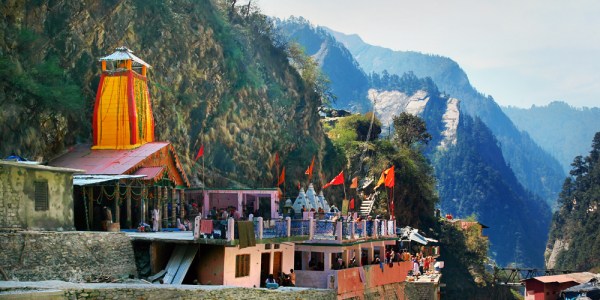
The Shrine of Yamunotri at the source of river Yamuna. Atop is a flank of Bandar Poonch peak (3615 meters). The actual source, a frozen lake of ice and glacier (Champasar Glacier) located on the Kalind Mountain at the height of 4421 m above sea level is about 1 km further up is not easily accessible. Hence the shrine has been located on the foot of the hill. The Temple of divine mother Yamuna was built by Maharaja Pratap Shah of Tehri Garhwal. The tiny Yamuna has icy cold water and its absolute innocence and the infantile purity heightens that deep feeling of reverence, which Yamunotri has for the devout. According to the legend ancient sage Asit Muni had his hermitage here. The trek to Yamunotri is truly spectacular, dominated by a panorama of rugged peaks and dense forests.
The deity or Goddess Yamuna is made of black marble. The temple is dedicated to the river Yamuna, who is represented in the form of a silver idol, bedecked with garlands.
Close to the temple are hot water springs gushing out from the mountain cavities. Suryakund is the most important Kund. Near the Suryakund there is a shila called Divya Shila, which is worshipped before puja is offered to the deity. Pilgrims prepare rice and potatoes to offer at the shrine by dipping them in these hot water springs, tied in muslin cloth. Rice so cooked is taken back home as prasadam.
The pujaris and priests who perform in Yamunotri temple come from the village of Kharsali near Jankichatti.
Gangotri Dham
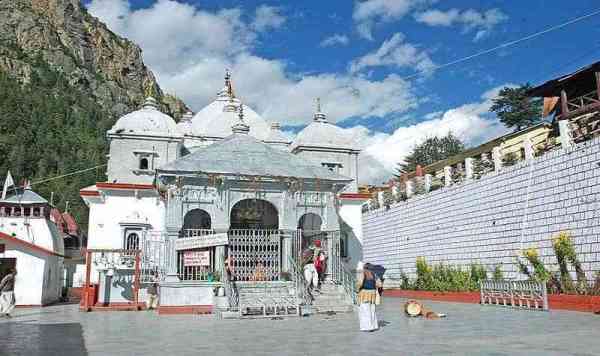
The Gangotri temple was built by the Gorkha General Amar Singh Thapa, in the 18th century and is situated on the left bank of Bhagirathi river. The temple is nested amidst the beautiful surroundings of deodars and pine trees. It lies close to the holy rock or the Bhagirath Shila where King Bhagirath had worshiped Lord Shiva. The Gangotri temple is dedicated to Goddess Ganga.
The Pujaris and Priests who perform in the temple belong to the village of Mukhwa. The water from Gangotri is carried to offer to Lord Shiva. It is believed that this water has nectar in it and will soothe the throat of Shiva who gulps the poison.
Shree Kedarnath Dham
Kedarnath temple is one of the sacred pilgrimage centre in Northern India, located on the bank of Mandakini river at an altitude of 3584 meters above sea level. The historical name of this region is “Kedar Khand”. Kedarnath temple is a part of Char Dhams and Panch Kedar in Uttarakhand and one of the 12 Jyotirlingas of Lord Shiva in India.
There are more than 200 shrines dedicated to Lord Shiva in Chamoli district of Uttarakhand itself, the most important one is Kedarnath. According to legend, the Pandavas after having won over the Kauravas in the Kurukshetra war, felt guilty of having killed their own Kith and Kin and sought blessings of Lord Shiva for redemption. He eluded them repeatedly and while fleeing took refuge at Kedarnath in the form of a bafellow.
On being followed, the Lord dived into the ground, leaving his hump on the surface at Kedarnath. The remaining portions of Lord Shiva appeared at four other places and are worshipped there as his manifestations. The arms of the Lord appeared at Tungnath, the face at Rudranath, the belly at Madmaheshwar and his locks (hair) with head at Kalpeshwar. The Kedarnath and four above mentioned shrines are treated as Panch Kedar (Panch means Five in Sanskrit).
The Temple at Kedarnath presents an imposing sight, standing in middle of a wide plateau surrounded by lofty snow covered peaks. The temple was originally built in 8th century A.D. by Jagad Guru Adi Shankaracharya and stands adjacent to site of an even earlier temple built by the Pandavas. The inner walls of the assembly hall are decorated with figures of various deities and scenes from mythology. Outside the temple door a large statue of the Nandi Bafellow stands as guard.
Dedicated to Lord Shiva, the Kedarnath temple has exquisite architecture Built of extremely large, heavy and evenly cut grey slabs of stones, it evokes wonder as to how these heavy slabs were moved and handled in the earlier centuries. The temple has a Garbha Griha for worship and a Mandap, apt for assemblies of pilgrims and visitors. A conical rock formation inside the temple is worshipped as Lord Shiva in his Sadashiva form.
Shree Badrinath Dham
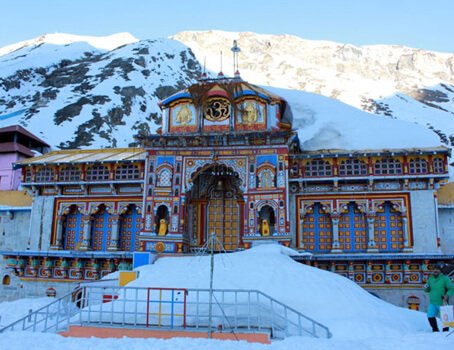
The main entrance gate of Badarinath temple is colourful and imposing popularly known as Singhdwar. The temple is approximately 50 feet tall with a small cupola on top, covered with a gold gilt roof. The Badarinath temple is divided into three parts (a) The Garbha Griha or the sanctum sanctorum (b) The Darshan Mandap where rituals are conducted and (c) The Sabha Mandap where pilgrims assemble.
At the Badarinath Mandir Gate, directly opposite the main Idol of Lord himself, is seated idol of Bird Garud, vehicle / carrier of Lord Badarinarayan. Garud os seen is sitting position and in prayer with his hands folded. The walls and pillars of the mandapa are covered with intricate carvings.
The Garbha Griha portion has its canopy covered with a sheet of gold and houses Lord Badari Narayan, Kuber (God of wealth), Narad rishi, Udhava, Nar and Narayan. The complex has 15 idols. Especially attractive is the one-metre high image of lord Badarinath, finely sculpted in black stone. According to legend Shankara discovered a black stone image of Lord Badarinarayan made of Saligram stone in the Alaknanda River. He originally enshrined it in a cave near the Tapt Kund hot springs. In the sixteenth century, the King of Garhwal moved the murti to the present loction of the temple. It represents Lord Vishnu seated in a meditative pose called Padmasan.
Darshan Mandap: Lord Badari Narayan is armed with Conch and Chakra in two arms in a lifted posture and two arms rested in Yogic Pose. Badarinarayan is seen under the Badari tree, flanked by Kuber and Garuda, Narad, Narayan and Nar. As you look, standing to the right side of Badarinarayana is Uddhava. To the far right side are Nara and Narayana. Narada Muni is kneeling in front on the right side and is difficult to see. On the left side are Kubera-the god of wealth, and a silver Ganesh. Garuda is kneeling in front, to the left of Badarinarayana.
Technology affects people all over the world. Advances in technology have made our countries safer and our lives easier, they have also negatively affected our lives. Technology have brought us online banking, smart cars, smart TVs, lightning fast computers, and the virtual reality. Also there include cyber warfare, hackers, identity theft, cyber stalking, and a host of other bad things.
The society has been changed with the evolution of technology. Life was burdensome and everyday chores consumed too much of our time, before the advent of modern day technology. The access to education, medicine, industry, transportation etc. has been simplified due to development in modern day technology. Due to the convenience and efficiency provided by technology, our lives have improved. Information technology give a new face to traditional libraries that include both digital collections and traditional, fixed media collections. We know that traditional libraries are limited by its storage space, but the digital information requires little space to contain information, so digital libraries have the potential to store more documents. The use of information technology in digital libraries that will increase the number of users and increased the expectations of the users.
Technology has also brought about efficiency and quality in the manufacturing sector. Technological advancement has reduced the risk. Development is closely related with technology and the stage of development the human being has arrived could have been possible without the advancement in technology.
Agriculture, industry, profession, health, education, art, political processes, recreation, religious activities and daily life activities all are under the influence of technology now. There are some modern technological developments that play a major role in making our daily life more effective. Television is also good servant, it’s considered as the cheapest source of information and entertainment nowadays. Technological progress has merely provided us with more efficient means for going whether forwards or backwards as well. It has enable Us to increase our comfort and to achieve efficiency in all sectors of life .We can’t achieve any progress or development, without technology. We can modernize our industry so life becomes easier for us and next generations through the developed technologies.
Including the US, UK, Australia, and Canada, Ireland too has been achieving praise and acclaim as the top-notch study destination for STEM Masters for international students. Data also give credence to this statement as the number of international students in Ireland is expected to reach 176,500 in 2020, according to a report released on Saturday, July 04.
Number of Indian students seem to rise:
The number of students from India opting for Ireland for a master’s degree in the coming years shall soar sky high as the two-year stay back graduate visa rules seem to attract the interest of many,
The cost of MS in Ireland:
Irish colleges have gained maximum popularity in recent times for MS courses. It is now time to take a quick peek at the cost of education in the country. The education for full-time, one-year Masters in Science for the top five colleges in Ireland are mentioned here below:
€ 23,252 – Trinity College Dublin
€ 24800 – University College Dublin
€17,750 – National University of Ireland, Galway
€18,000 – University College of Cork
€17,000 – Dublin City University
Approximately €7,000-17,000 annually depending on the type of area you choose. The cost of living must be calculated along with the tuition fees.
Education Loan Options for MS in Ireland:
Funding an aspirant’s education in Ireland seems much easier when equated to other destinations globally. The sum to which the standard course fee and cost of accommodation however adds to a concrete amount. Education loans and Irish scholarships work wonders and are highly recommended to aid the cost and course in Ireland.
A feather in your hat would be to fund education that covers your program fee and other miscellaneous expenses. The options for educational loans for Ireland offer two beneficial alternatives:
Loan Without a Collateral
Loan with a Collateral
Opting for an education loan without collateral proves beneficial for the student who does not have a financial asset to pledge as collateral against the loan. Please remember while public and private banks only offer unsecured loans for up to INR 7.5 lakhs. NBFCs have a much higher amount to offer which makes them more appropriate for a without collateral loan for Ireland.
Education Loan Without Collateral:
Repayment Period: In the case of NBFC’s, the repayment duration is 10 years. Moreover, the student has the flexibility of customizing their loan that best suits their needs.
Processing Time: The time for loan processing through NBFC’s is hardly 4-5 days. Most NBFC help accelerate the process by permitting you to upload documents online.
Costs covered: 100% of the total expenditures for education loans are covered by NBFC for masters in Ireland.
Income proof of Co-applicant: The co-applicant’s monthly income must be 30k or more. This also depends on the loan amount. With NBFC’s around 50% of the co-applicant’s earnings should be sufficient to withstand the interest on a monthly basis.
CIBIL Score: If the co-applicant has a poor CIBIL rating low income the NBFC might not consider the education loan. In such a scenario consulting a professional counselor who can conduct a comprehensive assessment of your profile is advised. The counselor then takes suitable measures and coordinates with the lender first and is most likely to sanction the loan.
List of Documents: Academic records, admission proof from the university in Ireland. Documents of valid income and KYC documents of the student and the co-applicant.
Make sure to get a standard list of documents from the lender beforehand. This helps gear up and expedites the procedure resulting in almost negligible chances of loan rejection.
Options for Education Loan with Collateral in Ireland:
This option certainly offers a higher loan amount. The simplest reason being the security the student provides the bank against non-repayment. Collateral can be a possession or a financial asset. These are also known as secured education loans, and the interest rates are much lower.
Education Loan for MS – With Collateral:
Repayment Period: In the case of NBFC’s, the repayment duration is 15-20 years. Public banks also offer repayment tenure up to 15 years.
Processing Time: Public banks might take around 13-15 working days whereas private banks would take a couple of days less. NBFC’s take the lead with a quick processing time of 7-8 working days.
Costs covered: 90-100% of the total expenses are covered by the public banks, depending on the bank. Private banks would offer around 80-85% of the total cost and NBFC would vouch for 100% education loans for MS in Ireland.
CIBIL Score: Incomplete documents or a low CIBIL score can be the ruling factors of the loan decline by any lender be it a public or private bank or an NBFC.
List of Documents: Relevant academic records, admission proof from the university in Ireland. KYC documents of the aspirant and the co-applicant. Documents supporting ownership of property etc.
Preferred Education loan for Ireland:
On average the most opted for a loan is a secured loan and is the best option for an education loan for MS in Ireland since the interest rate is considerably low.
But for those who are unable to pledge security for a secured loan then NBFC’s offer lower processing fees than banks and can be approached.
Start early! As soon as the letter of admission is received, the loan application procedure must commence.
Best Education Loan for Ireland:
Consider the following while opting for a loan
Rate of interest
Processing Time and charges
Overheads
Moratorium
Tax Assistance
Loan tenure
Expenditures Covered
Payment terms and conditions
For better consultation, you can get in touch with education loan counselors. They go through your financial profile with a fine-tooth comb and evaluate which lender fits you the best!
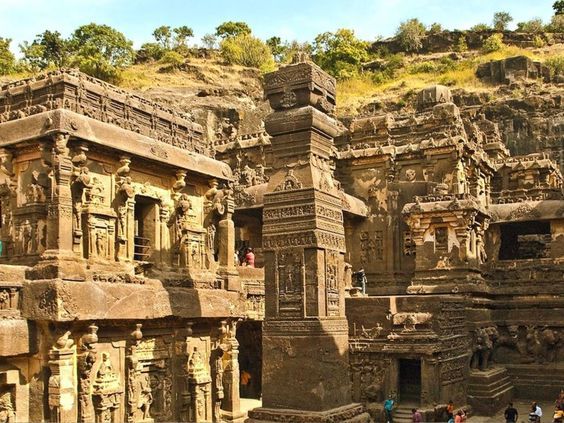
Built during the time period of 2nd century B.C. to 6th century A.D., these caves are the finest examples of rock-cut caves. Honed out of volcanic ballistic formations while existing in a linear pattern, there are 34 caves, containing the remnants of Buddhist, Hindu, and Jain temples. These walls are equipped with engravings showing the life of Lord Buddha. The purpose of these caves was to provide a sanctuary for the monks to meditate. Ellora in particular is famous for the world’s largest monolithic excavation leading to the discovery of the great Kailasa temple.
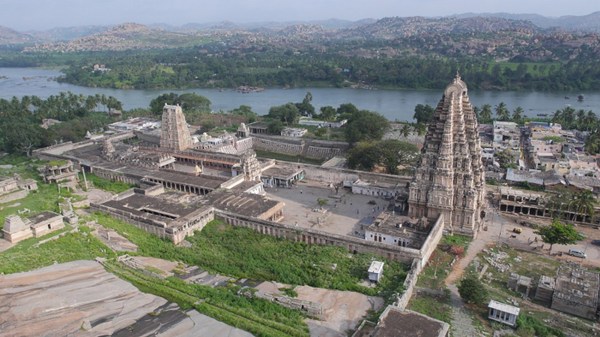
VIRUPAKSHA TEMPLE, KARNATAKA
Located in Hampi, Karnataka, and part of grouped monuments, designated as UNESCO world heritage site. This temple was dedicated to Lord Virupaksha, a form of Shiva. The temple is the main center of Hampi and built by Vijayanagara Empire situated near the Tungabhadra River. If we talk about its architecture, you will find a shrine hall with a number of pillars, and three anti-chambers. There are pillared monasteries, courtyards, a few small shrines, and entrances that surround the temple. This temple has found several engraved inscriptions of Lord Shiva and considered a holistic sacred retreat.
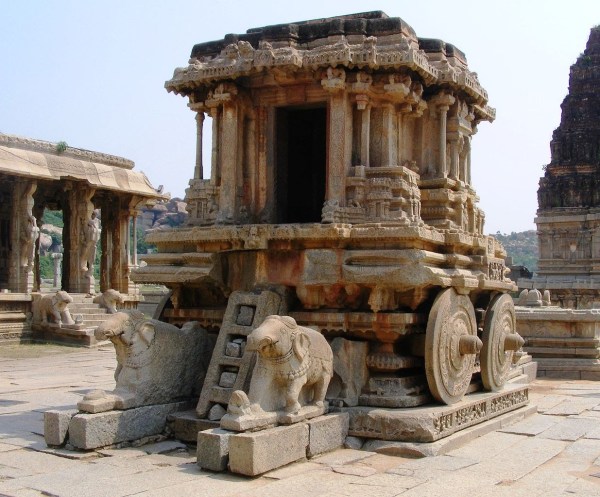
Vittala Temple Complex, Hampi, Karnataka
At its prime, the historic temple town of Hampi was one of the richest and largest cities in the world. Today, it is recognized as a UNESCO World Heritage Site and a key attraction for tourists visiting India. Located within the ruins of Vijayanagara (city of victory), which used to be the capital of the historic Vijayanagara Empire (1336-1646 C.E.). Out of the many building complexes that make up the ruins, the Vittala Temple is particularly well known. Featuring an iconic stone chariot, famous musical pillars, and impressive sculpture work, the temple is a wonder everyone should aim to see at least once.
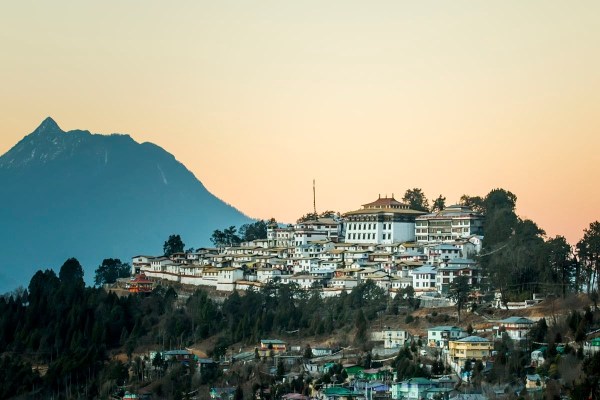
Tawang Monastery, Arunachal Pradesh
The largest monastery in India and the second largest in the world, Tawang Monastery in the state of Arunachal Pradesh was built in 1680-1681 as per the wishes of the 5th Dalai Lama. Located at an elevation of about 10,000 feet, with a remarkable view of the Tawang River valley and nearby mountains, the majestic three-storey-high building features striking and colourful details as well as an 18-foot-high image of the Buddha. The monastery also has an impressive library featuring several rare ancient scriptures.
Hawa Mahal in Jaipur: A Stunning Palace of Breeze
With a history of over 200 years, Hawa Mahal is perhaps the most iconic monument in Jaipur. What makes this palace one of the top attractions in Jaipur for travelers is its unique architecture that comprises 953 windows. If the Pink City of India is next on your list of holiday destinations, keep aside some time to explore this iconic structure once you step out of your hotels in Jaipur.
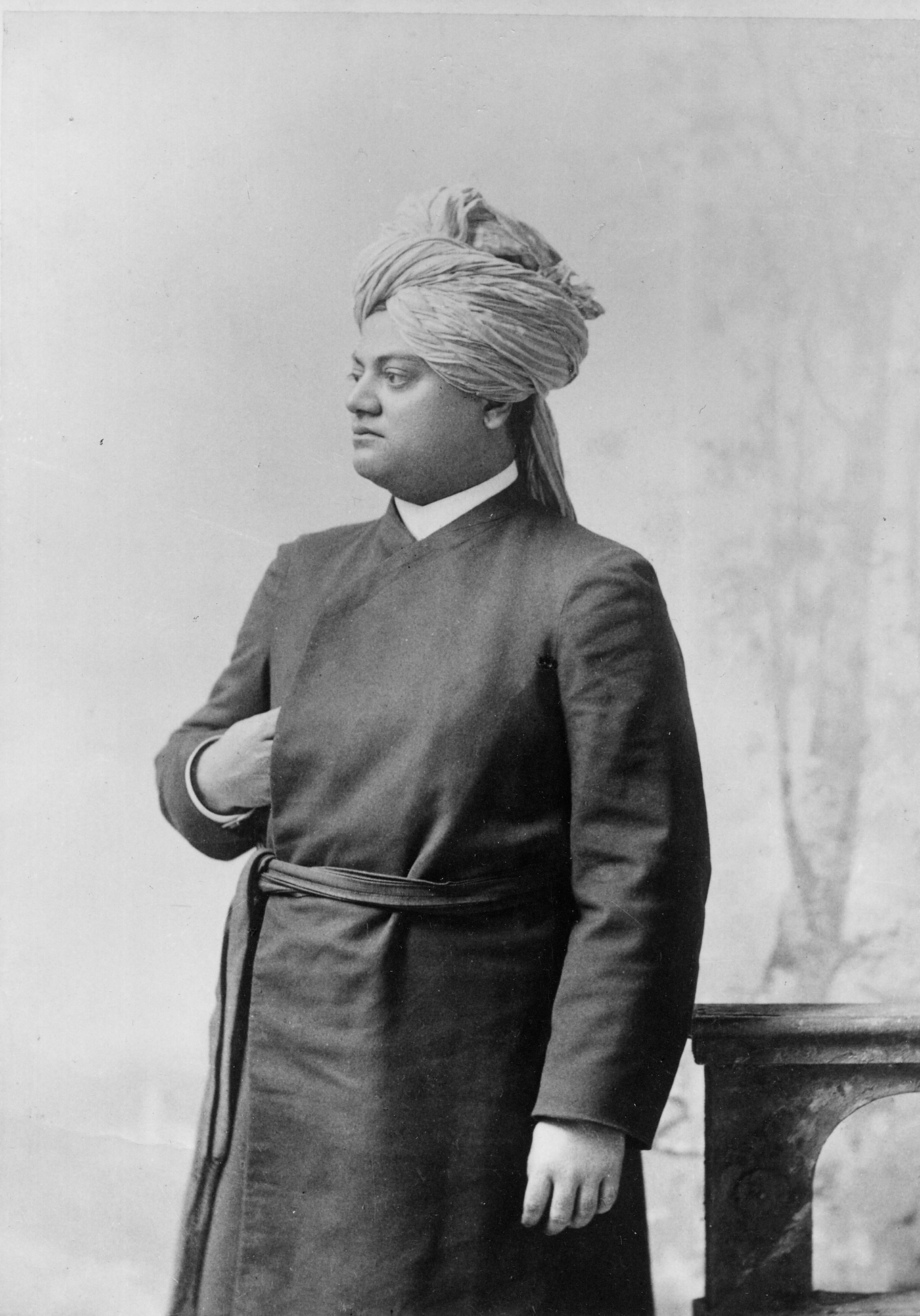
Vivekananda, original name Narendranath Datta, Datta also spelled Dutt, (born January 12, 1863, Calcutta [now Kolkata]—died July 4, 1902, near Calcutta), Hindu spiritual leader and reformer in India who attempted to combine Indian spirituality with Western material progress, maintaining that the two supplemented and complemented one another. His Absolute was a person’s own higher self; to labour for the benefit of humanity was the noblest endeavour.
Swami Vivekananda’s inspiring personality was well known both in India and in America during the last decade of the nineteenth century and the first decade of the twentieth. The unknown monk of India suddenly leapt into fame at the Parliament of Religions held in Chicago in 1893, at which he represented Hinduism. His vast knowledge of Eastern and Western culture as well as his deep spiritual insight, fervid eloquence, brilliant conversation, broad human sympathy, colourful personality, and handsome figure made an irresistible appeal to the many types of Americans who came in contact with him. People who saw or heard Vivekananda even once still cherish his memory after a lapse of more than half a century.
In America Vivekananda’s mission was the interpretation of India’s spiritual culture, especially in its Vedantic setting. He also tried to enrich the religious consciousness of the Americans through the rational and humanistic teachings of the Vedanta philosophy. In America he became India’s spiritual ambassador and pleaded eloquently for better understanding between India and the New World in order to create a healthy synthesis of East and West, of religion and science.
In his own motherland Vivekananda is regarded as the patriot saint of modern India and an inspirer of her dormant national consciousness, To the Hindus he preached the ideal of a strength-giving and man-making religion. Service to man as the visible manifestation of the Godhead was the special form of worship he advocated for the Indians, devoted as they were to the rituals and myths of their ancient faith. Many political leaders of India have publicly acknowledged their indebtedness to Swami Vivekananda.
The Swami’s mission was both national and international. A lover of mankind, he strove to promote peace and human brotherhood on the spiritual foundation of the Vedantic Oneness of existence. A mystic of the highest order, Vivekananda had a direct and intuitive experience of Reality. He derived his ideas from that unfailing source of wisdom and often presented them in the soulstirring language of poetry.
The natural tendency of Vivekananda’s mind, like that of his Master, Ramakrishna, was to soar above the world and forget itself in contemplation of the Absolute. But another part of his personality bled at the sight of human suffering in East and West alike. It might appear that his mind seldom found a point of rest in its oscillation between contemplation of God and service to man. Be that as it may, he chose, in obedience to a higher call, service to man as his mission on earth; and this choice has endeared him to people in the West, Americans in particular.
In the course of a short life of thirty-nine years (1863-1902), of which only ten were devoted to public activities-and those, too, in the midst of acute physical suffering-he left for posterity his four classics: Jnana-Yoga, Bhakti-Yoga, Karma-Yoga, and Raja-Yoga, all of which are outstanding treatises on Hindu philosophy. In addition, he delivered innumerable lectures, wrote inspired letters in his own hand to his many friends and disciples, composed numerous poems, and acted as spiritual guide to the many seekers, who came to him for instruction. He also organized the Ramakrishna Order of monks, which is the most outstanding religious organization of modern India. It is devoted to the propagation of the Hindu spiritual culture not only in the Swami’s native land, but also in America and in other parts of the world.
Swami Vivekananda once spoke of himself as a “condensed India.” His life and teachings are of inestimable value to the West for an understanding of the mind of Asia. William James, the Harvard philosopher, called the Swami the “paragon of Vedantists.” Max Muller and Paul Deussen, the famous Orientalists of the nineteenth century, held him in genuine respect and affection. “His words,” writes Romain Rolland, “are great music, phrases in the style of Beethoven, stirring rhythms like the march of Handel choruses. I cannot touch these sayings of his, scattered as they are through the pages of books, at thirty years’ distance, without receiving a thrill through my body like an electric shock. And what shocks, what transports, must have been produced when in burning words they issued from the lips of the hero!”
Tourism is an important socio-economic activity. It provides enormous scope for economic development of a particular area.
According to Ziffer (1989), “Tourism involves travelling to relatively undisturbed or uncontaminated natural areas with the specific object of studying, admiring and enjoying the scenery and its wild plants and animals, as well as any existing cultural aspects (both past and present) found in these areas.”
In India, temple towns, historical monuments and sea beaches were traditionally sought out as tourist attractions. But now the fabric of tourism is changing rapidly as nature, heritage, and recreational destinations are gaining more importance. In this background, eco-tourism has of late become a top attraction for the tourists.
Tourism growth in India
For a country that is surrounded by the Himalayas to the north, the Indian Ocean to the south, The Bay of Bengal to the east, and the Arabian Sea to the west, India quite hasn’t tapped into the full potential of tourism. Even the tourism industry is the largest service sector in India, the tourism growth in India is something that is still a work in progress.
With 37 UNESCO heritage sites and a land blessed with rich heritage and cultural diversity, each region in India has a unique story to tell. People have different expectations for tourism. Some prefer beaches, while others may like forests, some other people may be into deserts, etc. No matter what the preference, India has different regions to cater to everyone’s expectations.
As per the WTTC (World Travel and Tourism Council), about 9.2 percentage of India’s GDP in the year 2018 came from Tourism. From just over 2 million tourists in 2000 to over 42 million jobs in the Indian travel and tourism industry in 2018, and 10 million foreign tourists visiting the country in the same year, the growth of tourism in India has been steady. Despite these good tourism growth statistics, India has a long way to go to fully exploit this domain.
Tourism Development in India
The growth of tourism in India, although steady, is quite not up to the expectation. For a country with a population of 1.25 billion people, that is a minimum of 1.25 billion tourist visits. India, as a result, is doing great when it comes to domestic tourism with over 1.6 billion tourist visits to other states. However, when it comes to international tourists, this isn’t the case. The FTAs ( Foreign Tourist Arrival) in India is way below other developed countries. With an FTA of just over 10 million, it is almost one-eighth of what France has. Granted that this could be due to the free travel between Schengen countries, but there are several non-Schengen European countries, as well as other nations, such as Mexico, Turkey, Russia, etc that have FTAs more than twice that of India. One of the main reasons for this is the stringent immigration rules in India. Apart from this, other reasons that restricted a full flow of tourism in India were underdeveloped travel infrastructure, poor sanitation, as well as concerns about safety. These are aspects that every tourist look for while visiting a country.
Areas of apprehension
Medical tourism: Indian has been the origin of Ayurvedic therapy, and even after centuries, the country is successful in sustaining its remedial inventions. Over the years, several specialised hospitals are incorporated in India, which are served by many skilled doctors. In addition, the presence of well-equipped medical facilities has also taken the standard of medical dealing of the country to a new feat of success across the globe. The government should understand the need of medical tourism in India and excel on various tourism policies targeting the medical tourism destinations like Kerala, Chennai and Mumbai. Accordingly, various infrastructural initiatives can be put into practice to promote medical tourism in India.
Pilgrimage tourism: Harmony in diversity; this can best be experienced when in India. The country is laid out with plenty of religious destinations creating immense exposure for pilgrimage tourism. It is observed that most of the popular religious Indian sites are visited by thousands of pilgrims on regular basis. In addition, there are certain places as well which are believed to be quite religious but due to lack of promotion and government intrusion, these destinations are out of limelight. Hence, the respective state tourism authority should step forward in promoting pilgrimage tourism in India.
Eco tourism: It is something new in Indian tourism sector, which invites tourist to visit and explore various locations without impacting its fragile ecosystem. Eco tourism in India basically aims to create environment awareness amongst the visitors and service provider. Starting from wildlife reserves to naturally blessed regions, there are plenty of enticing spots in India that are idyllic for eco tourism. Through eco tourism, the rich variety of flora and fauna in the country can be preserved for tourists. Therefore, by bringing in various initiatives pertaining to energy efficiency, water reuse and recycling of waste products, the concept of eco tourism can be made more impactful in the country. And most importantly, the revenue generated from eco tourism can further be utilised for funding various conservation projects and training programs.
Youth tourism: This kind of tourism is specifically targeted for the youth travellers, who not only enjoy exploring new places but very adventure enthusiasts as well. Youth travel and tourism can also be included in the academic excursion wherein, the institute will arrange effective tourism program for the youth students. Besides, the craze of biking and many other rousing activities can equally be encouraged under such tourism schema. Today, youth visitors are considered as the most candid travellers all over the globe. Keeping in mind the volume of youth travellers, youth tourism market can further be segregated into independent youth travel and youth group travel. Independent youth travel may include an individual traveller or a group of independent travellers. On the other hand, independent youth travel includes a group of 6 or more youth (school/non-school group). Under Youth Tourism, government should execute more enticing and academic execution program for the students.
Cultural tourism: One should visit India to witness its cultural diversity. India is full of fiestas and traditional practices all round the calendar making the country one of the worth visiting destinations across the globe. Apart from religious variety, one can also get influenced by the diverse range of cuisines, languages, music tastes and architectures in the country. Considering the cultural affluences in the country, government and tourism authority should join hand in developing awareness program on cultural tourism.
Heritage tourism: The scope of heritage tourism in India is immense. Over the periods, it has been emerged as a major segment in tourism industry and an important source of revenue. Stepping in India will portray you its flourishing history that can still be witnessed in various majestic monuments, imperial fortress, holy shrines and other historic destinations. Indian government should come along various private enterprises in developing and preserving the significance of heritage tourism in India. Based upon the wide scope of heritage tourism in the country, this segment can further be grouped into various segments like industrial heritage, majestic heritage, religious tourism, ethnicity and urban renewal.
Agricultural tourism: Agricultural tourism or agritourism is a rapid growing sector today, which invites travelers to visit and explore various agricultural properties, farms, wineries and ranches. Under agritourism program, traveller can visit the working farms, involve into various activities and buy different agricultural products. In a country like India where majority of the populace is involved in farming and cultivation, agritourism should be promoted at higher level. Government should utilise its farming land by accommodating small gardens, activity areas, relaxation zone where traveller can come and spread its utility to enhance the scope of agricultural tourism in India.
Whether for escape, enlightenment, or pure joy, books allow us to connect to other places and times. Fortunately for the millions of Americans who have impaired vision or a physical disability, there are braille and talking books from NLS.
NLS is the National Library Service for the Blind and Physically Handicapped, part of the Library of Congress. Established in 1931, the organization’s mission is to enrich the lives of its patrons by offering them books, magazines, music scores, and other materials in audio and braille at no charge. Unlike traditional audiobooks that are provided at public libraries or sold at retail bookstores, audiobooks offered by NLS are unabridged, extensive and diverse, and are designed specifically for people who are unable to read regular print.
NLS provides its services to any U.S. resident or U.S. citizen living abroad who is blind, has low vision, or has a physical disability that makes it difficult to hold a book. Thousands of bestsellers, classics, biographies, nonfiction works, and more can be downloaded from the Internet or ordered for home delivery through a nationwide network of cooperating libraries.
Those with cerebral palsy, multiple sclerosis, loss of the use of their arms or hands, or prolonged weakness can access the NLS collection. So, too, can people with temporary limitations resulting from strokes or accidents.
Now avid readers like San Francisco resident Ivana Kirola, 38, who suffers from cerebral palsy, can continue to satisfy their interests, which for Kirola range from politics, to travel, to music.
“I really appreciate the services from NLS,” Kirola says. “They help me in my daily life, in understanding people and keeping up to date with the news. My favorite part of NLS is the widened horizons that reading audiobooks gives to me.”
Along with her love of books, Kirola attends a yoga class at the San Francisco Library—one of NLS’s regional partners.
“The thing that has helped me is to remain persistent in what I would like to experience,” says Kirola. “Sometimes what you need is elusive, but it’s important not to give up. There are solutions for everything, but sometimes it takes persistence to find out what they are.”










 International Journal of Research (IJR)