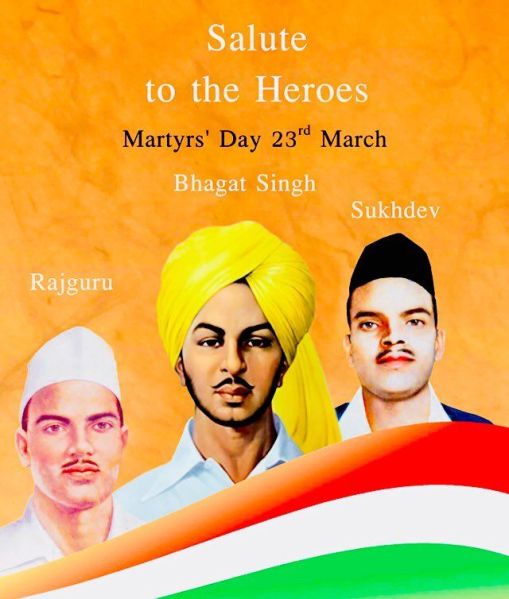
23rd March of every year is marked as Shaheed Diwas or Martyr’s Day. This day commemorates the sacrifices made by freedom fighters Bhagat Singh, Rajguru and Sukhdev for India’s independence. This day marks the death anniversary of these 3 valiant freedom fighters.
Pinterest.com
History of Shaheed Diwas
Lala Lajpat Rai was a pivot figure in Indian Independence Movement. In 1928, Simon Commission, headed by Sir John Simon, was set up to report on the political situation of India. Indian political parties boycotted the commission because it did not include any Indian member. When the commission visited Lahore on 30th October 1928, Lala Lajpat Rai led a non violent protest and gave the slogan “Simon Go Back”. Protestors held black flags and chanted the slogan.
Inspite of the peaceful protest, the superintendent of Lahore police, James Scott ordered the police to lathi charge the protestors. He fatally wounded Lala Lajpat Rai. Lajpat Rai succumbed to his wounds on 17th November 1928.
Aftermath
The British government denied any role in Lajpat Rai’s death. Revolutionary Freedom fighter Bhagat Singh witnessed the horrific incident. He joined hands with Rajguru, Sukhdev and Chandra Shekhar Azad and vowed to avenge the death of Lajpat Rai.
On 17th December 1928, owing to mistaken identity, Rajguru and Bhagat Singh shot the assistant superintendent of Lahore police, John P. Saunders.
In April 1929, in the Central Legislative Assembly in Delhi, Singh and Batukeshwar Dutt blowed two bombs and allowed the authorities to arrest them.
The trial led to the hanging of the trio in 23rd March 1931.
“Bhagat Singh did not become popular because of his act of terrorism but because he seemed to vindicate, for the moment, the honour of Lala Lajpat Rai, and through him of the nation. He became a symbol; the act was forgotten, the symbol remained, and within a few months each town and village of the Punjab, and to a lesser extent in the rest of northern India, resounded with his name.”
Jawaharlal Nehru
Conclusion
The sacrifices made by our national heroes should be remembered at all times. Shaheed Diwas reminds us that we must not forget the martyrs of our great leaders and uphold the dignity and valour of our motherland.
Theatre is defined as a form of performing art in which live performers present real events or fictional events before a live audience in a specific place, often a stage.
“I regard the theatre as the greatest of all art forms, the most immediate way in which a human being can share with another the sense of what it is to be a human being.”
Oscar Wilde
The origin of Indian theatre dates back to 2nd century BC. The earliest form was Sanskrit theatre. Indian theatre was heavily based upon Natyashastra authored by Bharata. It eventually modernized with the advent of British rule.
Indian Theatre can be classified into 3 parts – classical, traditional and modern.
Classical – Some notable playwrights of this era are Kalidasa, Bhasa, Harsha, Shudraka, Vishakhadatta and Bhavabhuti. Classical era plays were based on stories that were already known to the audience such as folk tales, history or epic. This era lasted upto 1000CE.
Traditional – Traditional era mainly consisted of different Hindu religious cult and divinities. It dealt with vice and virtue and thereby was larger than life. This era witnessed the introduction of monologue and soliloquy. Different types of traditional theatres performed throughout the country are Jatra, Rasleela, Bhavai etc.
Modern – Contemporary Indian theatre is rooted in the British era. It was heavily influenced from western dramas. In contrast with the stylized techniques used in traditional Indian theatre, the acting became melodramatic and naturalistic. Not just historical and religious themes, but for the first time social and political themes were enacted. Playwrights likeShambhu Mitra, Vijay Tendulkar, Ibrahim Alkazi, Girish Karnad and Utpal Dutt etc. made new experiments and contributed in developing the theatre form to reach where it is today.
Indian theatre and society
The theatre and society in India have always been interconnected. Even during the colonial era, the plays were heavily based on nationalism and patriotism. The first famous play of this kind, Nil Darpan, was written by Dinabandhu Mitra in Bengali. This play was based on the theme of forced cultivation of indigo inflicted on the native planters by British rulers. Plays like Khadrin Verdri, Desheeya Koti, Bharat Durdasha, Andher Nagri also reflected the plight of then India.
19th century plays condemned the social evils and superstitions like caste system, untouchability, dowry, child marriage, to name a few.
Indians were now introduced to plays of foreign languages. Many plays of Shakespeare were adapted in India.
Indian theatre witnessed many changes in the post-independence era. Cinema posed a challenge to the entertainment theatre and thus, amateur theatre flourished. While entertainment theatre thrilled masses, it was often criticized, particularly by educated people. This opened the door for literary drama and amateur drama. One such notable playwright of literary drama was Rabindranath Tagore.
Conclusion
Indian theatre has played a significant role in spreading awareness among the masses. Street theatre deals with various daily life issues like corruption, domestic violence, child labour, women empowerment etc. In collaboration with various NGOs, theatres also conduct plays in rural areas to spread awareness.
Why K-Pop And K-Drama Are Getting Prominence These Days?
The world is going crazy over the Korean dramas and music. What’s the reason for this sudden upsurge in popularity of K-pop and K-drama?
Hanryu or Hallyu – meaning Korean wave, is evident from the fact that Oxford Dictionary has added 26 Korean words in its vocabulary. Korean boy band BTS’s presence in United Nation’s 76th General Assembly in 2021 has further showed how pre-eminent this wave is.
History of Korean Popular music (K-Pop) and Korean Drama (K-Drama)
Seo Taiji and Boys, the first K-Pop band, debuted in 1992. The band saw huge success and was the groundbreaker in introducing the rap genre in Korean music industry. By integrating dance routine in their performance, it pioneered breakdancing. Seo Taiji and Boys disbanded in 1996 but left behind a legacy which was followed by many upcoming bands.
BTS, EXO, Blackpink, Twice are some of the names that have upheld the Korean popular music and are still spreading their wings internationally.
The first Korean drama was Death Row Prisoner that released in 1956. But Jewel in the Palace (2003) gained massive international recognition. Since then, Korean drama industry never looked back and churned out global hits like:
Guardian: The Lonely And The Great God (2016)
Mr. Sunshine (2018)
Sky Castle (2018)
Crash Landing On You (2020)
Squid Game (2021)
All Of Us Are Dead (2022)
Phew, the list will be endless.
What makes them so popular?
Now coming to this part, let us see why Korean entertainment industry is getting bigger with each passing day.
Catch up a K-drama, watch even a single episode, you will be in awe with its high production value.
Though they have predictable storylines, like rich guy falls for poor girl, teenage romance, college romcom, etc.; the episodes will keep you hooked from beginning till end.
The series have finite episodes, usually 10-16 episodes making it crisp and engaging.
No loud makeup and cheesy lines
Eye pleasing actors.
Korean dramas provide a good glimpse of their food, culture, lifestyle and scenic beauty.
Now let’s see the reasons for popularity of K-Pop :
Just look at the K-Pop idols. They are so charismatic. Isn’t? They present themselves so well.
Their humbleness makes them approachable to their fans. They enjoy a good loyalty from their fans. Take BTS as an example. Their fans call themselves “army”.
They are incredible dancers. They have some spectacular choreography. Years of hard work and training enables them to deliver synchronized performances.
With catchy music and relatable lyrics, K-Pop is gaining massive loyalty from their fans. Have you heard “Even though it’s pitch black in front, run forward” from “Can’t Nobody” song of the girl band 2NE1? The lyrics relate to our daily life.
“You gave me the best of me
So you’ll give you the best of you”
Magic Shop from boyband BTS
Heart touching. Isn’t?
Korean musical bands consistently deliver top notch performances.
Role of OTT platforms
The recent covid pandemic that made people stuck in their homes has increased the viewership of k-dramas. With the OTT platforms offering a plethora of international content, the lockdown period saw a boom in interest in such content, including Korean. Korean content gained popularity as people sought a mental diversion from the stressful times they were living through. As per a report in Hindustan Times, “The viewing for K-dramas on Netflix in India increased more than 370% in 2020 over 2019”. Netflix is already 2X its investment in Korean content. We can hope to see more incredible K-dramas in the future.
Economic impact
The Hallyu wave improved the economy of South Korea. Until 1960s, the country’s GDP primarily depended on its agriculture. According to World Bank, it had a GDP of only $3.985 billion in 1960. Whereas in 2021, the country ranks 11th globally in terms of GDP at a whopping $107.4 trillion. According to HRI’s report published in 2018, BTS accounted for an estimated $3.54 billion of the South Korean GDP. This figure is growing. In 2019, the export value of K-dramas broadcast on program provider channels reached around 159.55 million U.S. dollars. According to a report, three concerts held by the boy group BTS in Seoul in 2019 had a total direct and indirect impact of around 923 billion South Korean won.
Conclusion
During the past 2 decades, the Korean Wave has grown exponentially, and it continues to do so. Korea will have to innovate and harness the massive potential and popularity of the Korean Wave to sustain its global appeal.
We have finally begun exploring the other side of the world.
Non-fungible tokens (NFTs) are cryptographic assets on a blockchain with unique identification codes and metadata that distinguish them from each other. Unlike cryptocurrencies, they cannot be traded or exchanged at equivalency. This differs from fungible tokens like cryptocurrencies, which are identical to each other and, therefore, can serve as a medium for commercial transactions.
NFTs are unique cryptographic tokens that exist on a blockchain and cannot be replicated.
NFTs can represent real-world items like artwork and real estate.
“Tokenizing” these real-world tangible assets makes buying, selling, and trading them more efficient while reducing the probability of fraud.
NFTs can also function to represent individuals’ identities, property rights, and more.
The distinct construction of each NFT has the potential for several use cases. For example, they are an ideal vehicle to digitally represent physical assets like real estate and artwork. Because they are based on blockchains, NFTs can also work to remove intermediaries and connect artists with audiences or for identity management. NFTs can remove intermediaries, simplify transactions, and create new markets.
Much of the current market for NFTs is centered around collectibles, such as digital artwork, sports cards, and rarities. Perhaps the most hyped space is NBA Top Shot, a place to collect non-fungible tokenized NBA moments in digital card form. Some of these cards have sold for millions of dollars. Recently, Twitter’s (TWTR) Jack Dorsey tweeted a link to a tokenized version of the first tweet ever, in which he wrote: “just setting up my twttr.” The NFT version of the first-ever tweet sold for more than $2.9 million.
Understanding NFTs
Like physical money, cryptocurrencies are fungible, meaning that they can be traded or exchanged, one for another. For example, one bitcoin is always equal in value to another bitcoin. Similarly, a single unit of ether is always equal to another unit. This fungibility characteristic makes cryptocurrencies suitable as a secure medium of transaction in the digital economy.
NFTs shift the crypto paradigm by making each token unique and irreplaceable, thereby making it impossible for one non-fungible token to be equal to another. They are digital representations of assets and have been likened to digital passports because each token contains a unique, non-transferable identity to distinguish it from other tokens. They are also extensible, meaning you can combine one NFT with another to “breed” a third, unique NFT.
Just like Bitcoin, NFTs also contain ownership details for easy identification and transfer between token holders. Owners can also add metadata or attributes pertaining to the asset in NFTs. For example, tokens representing coffee beans can be classified as fair trade. Or, artists can sign their digital artwork with their own signature in the metadata. An example of NFT is Holy Bibles NFT
Why Are Non-Fungible Tokens Important?
Non-fungible tokens are an evolution of the relatively simple concept of cryptocurrencies. Modern finance systems consist of sophisticated trading and loan systems for different asset types, ranging from real estate to lending contracts to artwork. By enabling digital representations of physical assets, NFTs are a step forward in the reinvention of this infrastructure.
To be sure, the idea of digital representations of physical assets is not novel nor is the use of unique identification. However, when these concepts are combined with the benefits of a tamper-resistant blockchain of smart contracts, they become a potent force for change.
Perhaps, the most obvious benefit of NFTs is market efficiency. The conversion of a physical asset into a digital one streamlines processes and removes intermediaries. NFTs representing digital or physical artwork on a blockchain remove the need for agents and allow artists to connect directly with their audiences. They can also improve business processes. For example, an NFT for a wine bottle will make it easier for different actors in a supply chain to interact with it and help track its provenance, production, and sale through the entire process. Consulting firm Ernst & Young has already developed such a solution for one of its clients.
Non-fungible tokens are also excellent for identity management. Consider the case of physical passports that need to be produced at every entry and exit point. By converting individual passports into NFTs, each with its own unique identifying characteristics, it is possible to streamline the entry and exit processes for jurisdictions. Expanding this use case, NFTs can serve an identity management purpose within the digital realm as well.
NFTs can also democratize investing by fractionalizing physical assets like real estate. It is much easier to divide a digital real estate asset among multiple owners than a physical one. That tokenization ethic need not be constrained to real estate; it can extend to other assets, such as artwork. Thus, a painting need not always have a single owner. Its digital equivalent can have multiple owners, each responsible for a fraction of the painting. Such arrangements could increase its worth and revenues.
The most exciting possibility for NFTs lies in the creation of new markets and forms of investment. Consider a piece of real estate parceled out into multiple divisions, each of which contains different characteristics and property types. One of the divisions might be next to a beach while another is in an entertainment complex, and yet another is a residential district. Depending on its characteristics, each piece of land is unique, priced differently, and represented with an NFT. Real estate trading, a complex and bureaucratic affair, can be simplified by incorporating relevant metadata into each unique NFT.
India might have to engage more deeply with the Ukrainian war as the conflict deepens
With a convincing majority of 141 of 193 countries, the UN General Assembly voted on Wednesday for a resolution that deplored in the ” strongest terms” Russia’s attack on Ukraine and demanded an immediate withdrawal of Russian troops .The resolution, which was discuss in a rare special emergency session and under the rubric of the “Uniting for peace ” resolution invoked after decades , came as a result of an aborted resolution at the UN security Council, which Russia, as a permanent member,had vetoed . While the UNGA resolution carries little teeth , it does represent a common stand taken by the international public commons , with 96 countries signing up as co-sponsors of the resolution. Russia rejected the outcome as a political vote that came of severe “pressure” from the U.S. and European countries that were the drivers of the resolution, but it seemed clear that it was isolated on the global stage . Belarus, Eritrea, North Korea and Syria voted against the motion, and 35 , including India, abstained. While the resolution also decried the Russian decision to recognise Donetsk and Luhansk as independent states, representatives of member states made it clear that it was the relentless bombing of Ukrainian cities that they could not turn a blind eye to.
India’s abstention, not a surprise, disappointed many western countries that have been lobbying for a shift in the Indian position. In the past week, India has abstained from three votes ( including two procedural ones) at the UNSC where it is an elected member, one at the UN Human Rights Council, and another at the IAEA on resolutions critical of Russia.
While evacuating Indians is an important priority, it cannot be India’s only focus in this crisis, given its aspirations for global leadership and the oft quoted motto of “Vasudhaiva kutumbakam” . It may become necessary for India to engage more deeply with the conflict in Europe, which is now a global concern.
India must pursue schemes for rehabilitation of children orphaned by the pandemic
Numbers can often be hustled to tell many tales; but it is the story that is picked on the basis of the desire to do what is morally right that sets the course for meaningful action. The recent lancet estimates of COVID-19 associated orphanhood , which put the number at over 19 lakh children orphaned as a result of COVID-19, has raised India’s hackles . The Lancet study generated numbers based on modelling, and therefore only estimates and not actual numbers are available. Globally, it estimated that 52 lakh children had been rendered orphans by the pandemic. The study, in its original period, March 1,2020 to April 30,2021 was revised , with updates based on excess mortality and fertility data used to model increases in estimates of COVID-19 associated orphanhood between May 1ans October 31,2021 for 21 countries. Orphanhood was defined as the death of one or both parents ; or the death of one or both custodial grandparents. The authors claimed their findings showed numbers of children orphaned by COVID-19 had almost doubled in six months compared with the data after the first 14 months of the pandemic.
India has objected strongly to the estimate of 19 lakh, terming it as “sophisticated trickery intended to create panic among citizens” . As per data collected by the National Commission for protection of child rights and collated on the Bal Swaraj portal, the number of children orphaned during COVID-19 in India was far lower, at 1.53 lakh.
While the study does include revised estimates for all the nations , the message that it seeks to convey is the absolute urgency with which governments must incorporate childcare into any COVID-19 management programme. The state should proactively draw such children into the umbrella of care to save them from numerous adversities —poverty, violence , destitution, and lack of access to education and health care. The Indian government, to its credit, announced a grand plan of support for children forced into orphanhood by COVID-19.
Well begun is half done , but the centre and the states must expand efforts. The government would do well to allow interventions for children to be informed by a “whole life” care paradigm, and fresh data from time to time , especially in a pandemic that is not only rapidly evolving, but by all accounts, is nowhere near ending.
The time may have come for clarifying the role and functions of Governors
Signs of a confrontation between Raj Bhavan and the elected government in a state are not infrequent in the country. The onus often appears to be on the Chief Ministers to avert a constitutional crisis, as evidenced by Pinrayi Vijayan trying to buy peace with a miffed governor, Arif Mohammad Khan, rather than pursue a confrontational course, over several issues in recent times . One way of seeing these developments is to attribute then to the appointment of those who have been politically active in the recent past as Governors and the partisan role they playas agents of the centre .
However, the problems may have to do with the way they understand their own powers. Constrained by the ‘aid and advice ‘ clause in their routine functioning, some Governors seem to be using the discretionary space available to them to keep regimes on tenterhooks . A constitution bench of the Supreme court laid down in 1974 that the president and governor shall “exercise their formal constitutional powers only upon and in accordance with the advice of their Ministers save in a few well known exceptional situations”—“situations” also iluustratively listed.
Chasing national ambitions while also maintaining TRS supremacy in the state is no easy task
Last week , political strategist Prashant Kishor and actor turned politician Prakash Raj visited Telangana for wide ranging consultations .
The visit came days after Chief Minister K Chandrasekhar Rao visited Mumbai to meet his Maharashtra counterpart Uddhav Thackeray and Nationalist Congress party president Sharad Pawar . Mr. Raj met Mr. Rao at Mumbai airport and was present at the meeting with both the leaders.
If pictures of Mr. Raj receiving Mr. Rao at the airport caught everyone’s imagination, there was more in store when it became known that the actor and Mr. Kishor met Mr. Rao days later. They also visited two reservoirs, a resettlement and rehabilitation colony for project oustees , an integrated vegetarian and non – vegetarian market, an auditorium and a crematorium in Siddipet.
The ruling TRS made light of Mr. Kishor’s visit saying his meeting with Mr. Rao was only part of the tour he was taking of the country to understand the views of leaders on the political situation. A senior leader said Mr. Rao explained to Mr. Kishor the summary of his meeting with Mr. Thackeray. Mr kishor gave a presentation of his work as the founder of the Indian political action committee. ” But our boss is not be swayed so easily”, the leader said , adding that Mr. Raj was present more to discuss political programmes in which he could play a role . The TRS leaders said that Mr. Kishor had been tasked with preparing the blueprint for the party’s prospects in the next assembly elections. His team would be deployed to survey the public pulseand suggest corrective action.
Mr. Rao’s priority is to enter the national stage and handover the baton in Telangana to his son and Minister K.T. Rama Rao. But that would mean engaging the BJP in a healthy contest, keeping the Congress at bay in the state , and entering the national scene all at the same time , which is no easy task.
Latest GDP numbers reflect a faltering recovery even as Ukraine crisis heightens risks
The latest national income estimates for 2021-22 released by the NSO have pared growth hopes from 9.2% to 8.9% , compared to the 6.6% contraction in 2020-21 . GDP growth ( October -December 2021 quarter ) WE is pegged at 5.4% , compared to the 0.7% recorded in the same quarter of 2020, when the economy returned to the growth zone after two quarters of sharp contraction. The headline Q3 growth number was expected to moderate from the 20.3% and 8.5% recorded in the firsts two,but not as much as it has . GVA , projected to rise 8.3% for the full year , compared to the 4.8% contraction in 2020-21 recorded only 4.7% growth in Q3 . The overall trajectory is a tad disheartening, with little comfort to glean even when the numbers are spliced . Construction sector GVA actually contracted 2.8% in Q3 , when infrastructure spending push was expected to be reviving it’s fortunes . Manufacturing recorded a mere 0.2% increase in a quarter that included India’s annual festive boom , possibly indicating that smaller firms remain hobbled. The largely contact-intensive segment of trade , hospitality, transport, communication and services related to broadcasting also continued to languish well below pre-pandemic levels .
That sectors critical for jobs are still in trouble is also reflected in private consumption staying below pre pandemic levels . The resurgence of retail inflation past 6% in January, with the overhang of a sharp retail fuel price spike after the assembly polls , could cripple consumption further. Core sectors’ output growth in in January and persistent manufacturing job losses in February (indicated by the PMI) , suggest these pieces of the recovery puzzle will not be fixed in a hurry . It also means that the 4.8% growth assumption for Q4 , built into the 8.9% growth calculations for this year, may be too optimistic. These portents are far from comforting , even in a business-as-usual scenario for an economy that had recorded several quarters of moderating growth before the COVID-19 pandemic tipped it over. India may have coped better with the Omicron variant, but external risk factors have risen dramatically. Large Central banks moves to tighten liquidity faster than expected, in the face of soaring inflation driven by runaway oil prices , have roiled financial markets .
The uncharted implications arising from the Ukraine crisis only add to the challenge . Apart from gearing up to preempt imported inflation spikes ,the government needs to extend greater policy support , preferably going beyond credit guarantee offers, to sector still in the doldrums . It also needs to exert greater energy to ensure its grand infrastructure spending plans get off the ground faster to have a salutary effect on the economy. The multi -layered uncertainties ahead necessitate that policy makers cut no slack, either in action or reaction.
India must heed the warning of the IPCC report and shore up adaptation measures
Amidst global turmoil , the intergovernmental Panel on Climate change — the largest international consortium of scientists analysing and reviewing the evidence on the present and future man made impacts of climate change –has a message that is predictably fire . The world faces unavoidable multiple climate hazards over the next two decades with global warming of 1.5°C ; even temporarily exceeding this warming level would mean additional severe impacts , some of which will be irreversible. The report points out that the rise in weather and climate extremes has led to some irreversible impacts as natural and human systems are pushed beyond their ability to adapt . Alluding to the conference of the parties (CoP 26) in Glasgow ,in November 2021, the report notes that most of the targets that countries have set for themselves are too far in the future to have an impact on the short term at meaningfully reducing the climate impact.
India will achieve net zero emissions latest by 2070 , that is , there will be no net carbon emissions , Prime Minister Narendra Modi declared at the COP26 summit. By 2030, India would also ensure 50% of its energy willbe from renewable energy sources. However, none of this can help the 1.5°C mark from being breached. A major point of emphasis of the report , particularly for South Asia , is the trend in the ‘wet bulb’ temperature —-an index of the impact of heat and humidity combined .
By the middle of the century, around 35 million of its people could face annual coastal flooding, with 45 million -50 million at risk by the end of the century if emissions are high. Experience has shown that partisan economic calculations Trump climate considerations, but India must shore up its adaptation measures and urgently move to secure futures of its many vulnerable who have the most to lose.




 International Journal of Research (IJR)