Redmi Note 9 vs Redmi Note 8: Is the Helio G85 really a performance upgrade?

The Redmi Note 8. (Source: Xiaomi)
Is newer better? The Redmi Note 9 was launched months ago debuting with MediaTek’s new Helio G85, but how does it compare to the tried and tested Snapdragon 665 on Xiaomi’s last-gen Redmi Note 8? Well, the results are nuanced.

A while ago, we compared the Redmi Note 8 Pro to the new Redmi Note 9 Pro in an attempt to find out which phone offered better performance across the board. This time out, it’s a fight between the cheaper models⁠—the Redmi Note 8 and the Redmi Note 9. Like with the previous comparison, it’s a MediaTek versus Qualcomm battle, only this time, the newer phone has the MediaTek chip.

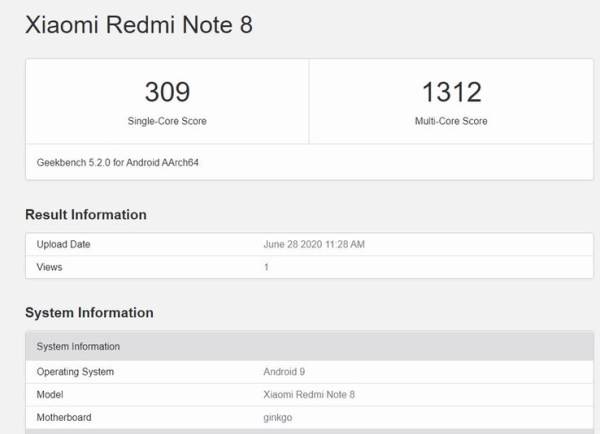
Starting out with Geekbench, the Redmi Note 8 and its Snapdragon 665 records a single-core score of 309. The Redmi Note 9 flexes its mucles here, with a score of 357. That’s a powerful showing by the Redmi Note 9, translating into a 13% advantage. In the multi-core test, the Redmi Note 8 earns a score of about 1,312. The new Redmi Note 9 is also on top here, as it comes away with a 1,320 score. The difference is negligible.

Moving on to AnTuTu, the similarities in CPU performance continue. The Redmi Note 8 earns a CPU score of 71,021. The Redmi Note 9 is ahead here, too, with a score of 74,066. That translates into a 4% advantage for the Redmi Note 9 and its MediaTek Helio G85.

It’s in the GPU department that things get interesting, as the Redmi Note 8 manages a score of 32,316 in AnTuTu’s GPU test. The Redmi Note 9 wins handily with a score of 41,644⁠—a significant 29% advantage.

So, what do these numbers imply? Most notably, that the Redmi Note 8 and Redmi Note 9 will offer similar day-to-day performance. The two phones and their respective chipsets deliver similar numbers in the CPU tests, albeit with the Redmi Note 9 slightly edging the Redmi Note 8 by right about 10%. It’s in the gaming department that the newer phone really shines, however, as it appears to have a significant advantage.

Of course, it’d be facetious to ignore the fact that MediaTek has been caught cheating on benchmarks in the past. The company’s response wasn’t particularly encouraging either. In terms of efficiency, the two phones should also be similar. We don’t have perf/watts numbers, but the Helio G85 is built on TSMC’s 12nm node, while the Snapdragon 665 is built on Samsung’s 11 nm LPP node.

Does the Helio G85 on the Redmi Note 9 outperform the Redmi Note 8’s Snapdragon 665? Yes, it does. But it mostly comes down to the GPU, and CPU performance is similar enough that the overall differential isn’t a game-changer⁠—unless you’re a gamer.

Martin Christopher

XIAOMI HAS TEMPORARILY STOPPED DEVELOPING MIUI 12 FOR ITS DEVICES

Xiaomi has reported on its official forum that the update and distribution of MIUI 12 firmware for all Xiaomi and Redmi smartphones will be temporarily suspended. This time, the case is not because of the Android OS, or with any holes in the firmware itself.

Everything is much simpler. The work on MIUI 12 is suspended due to the holiday – the traditional Chinese Dragon Boat Festival. It will be on June 25. But work-related to MIUI 12 will stop for a week – from June 26 to July 3.

It is worth to mention that recently, Xiaomi rolled out MIUI 12 development version 6.15 update for some users. Sometime after the update, the Xiaomi community forums were filled with complaints of reduction in the speaker volume level after installing the firmware. According to some users, the speaker volume on their phones is lower in comparison to when the smartphones were running version 5.24.

Xiaomi quickly started an investigation to solve the issue. After all, the whole purpose of development builds is to provide feedback. And the company should respond quickly to this feedback. The MIUI engineers contacted the complainants and even paid them a scheduled visit at home to compare the loudness of the affected models with a similar smartphone running the previous version. Curiously, the volumes still the same. The engineers further took the phones to the company’s anechoic room and the results were still the same.

MIUI 12 problems

The company measured the level of each volume block. The two firmware versions were basically identical on the 15th volume levels. The frequency response of the speaker at level 12, 8, and 5 was also measured. As a result, the response curves of the two versions were ascertained to be the same. The MIUI team disclosed that the audio tuning configuration of the development version has not changed since April. For now, these complaints may be just fruit of the user’s perspective/impression of the volume level.

It’s interesting to see this level of software support coming from users. Other companies usually offer a good level of support for hardware issues. However, it’s not common to see the same treatment when the issue involves the software. Of course, Xiaomi isn’t perfect as the issues with Android 10 update for Mi A3, and no update at all for Mi Mix 3 5G are there plaguing owners of these smartphones. Moreover, there is a strange schedule for updating smartphones to recent Android 10 versions. The low-end Redmi 7A just got another Android 10 beta update. While several smartphones that came months later are still rocking Android 9 Pie. Despite these issues, on the whole, the company is still doing a good job by providing software support to MIUI users.

Follow @martin_Christopher