
Plagiarism detection is always considered embarrassing that’s why it is crucial to always check plagiarism in your thesis before submitting it to the teacher or publishing it on the internet. This is because plagiarism in writing has severe consequences including:
- Rejection of the thesis
- Loss of grades
- Expulsion from the institute
- Facing lawsuits from the original owner
And the list goes on.
Do you know the only way to check for plagiarism is by utilizing online plagiarism detection tools? In this article, we are going to discuss the best plagiarism-checking tools along with their pros and cons.
Top 3 Tools That Can Be Used for Detecting Plagiarism in Thesis
Here are the 3 effective plagiarism detection tools that can be used for determining duplication in a thesis or any other type of write-up.
1. Editpad

First of all, we have an Editpad Plagiarism Checker. It is a freemium tool that operates on a diverse set of Artificial Intelligence (AI) algorithms that efficiently compare the given thesis with millions of internet resources to find any kind of plagiarism.
If any duplicate sources are found, the tool will highlight them along with their matched sources through a red line. Not only this, it also provides the percentage of both unique & plagiarized content. In order to demonstrate all this, we have attached an image below, check it out.
So, the tool not only provided the percentage of both unique and plagiarized. Now, you will an have efficient idea of how you can efficiently detect plagiarism in your thesis.
The good about this tool is that it has the ability to check writing for plagiarism in 14 different languages. And gives the option to download the scan report that can be used as proof of write-up originality.
It is available in both free and paid versions. If you are using it for free, then you can check up to 1,000 words at once. Whereas, users with premium subscriptions can check a maximum of 3,000 words at once.
Pros:
- Simple to understand interface.
- Highlight copied text with its matched sources.
- 1,000 limits for free users.
- Supports 14 languages.
- Download report option.
Cons:
- Contains too many advertisements.
2. Copyleaks
Copyleaks is widely known and used for AI content detection. But do you know? it also has a highly credible plagiarism detector. The plagiarism detector is designed on advanced Machine Learning algorithms that efficiently scan the given text to find the smallest instances of plagiarism in it.
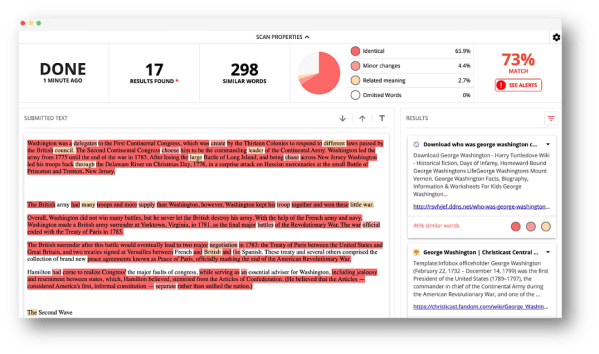
Unlike Editpad, this tool only provides the percentage of matched/plagiarized content. One good thing is that it highlights different types of plagiarism in different colors. For instance, if the given sentence or paragraph is completely matched with an online source, then that part will be highlighted in dark red.
On the other hand, if a few words are matched, then the tool will highlight them with a light red color, indicating minor changes.
Remember, in both these cases the tool provides the matched sources so that the user can take the necessary steps to remove them. To illustrate all this in a better way, we have attached an image below, check it out.
One thing that you need to keep in mind is that the Copyleaks plagiarism checker is not available for free, it’s PAID. Its pricing for plagiarism detection starts from $8.99 per month.
Pros:
- AI-based detection.
- Highlight duplication in different colors.
- Highly accurate
Cons:
- Completely paid.
- Only provides the percentage of
3. Paper Rater
This is a completely free-to-use plagiarism checker that is widely used by students and teachers to quickly and efficiently scan a thesis for duplication. Just like other tools discussed on this list, this one also compares the input text with different online resources such as blogs, research papers, journals, etc., to find plagiarism.
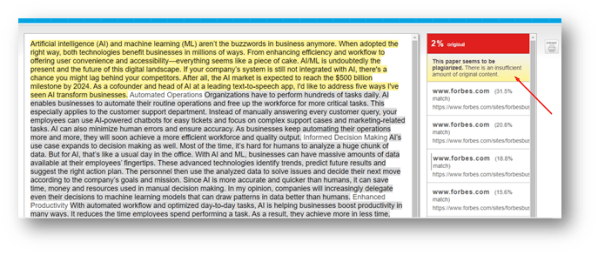
It then provides the percentage of only “Unique” or “Original” content along with a note “This paper seems to be Unique” or “This paper seems to be plagiarized.” Additionally, the tool also provides matched sources and the percentage of matched content for each source.
To provide you with a better idea about its working, we copied some content from an online article and checked it with PaperRater. The results we got can be seen in the attachment below.
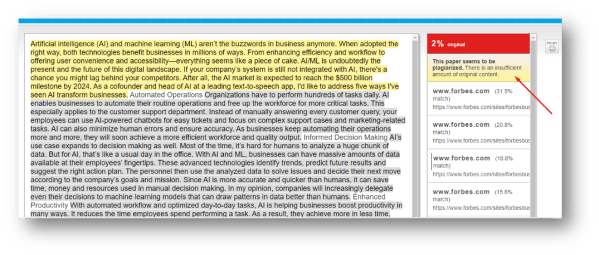
As you can see, the tool has mentioned that the given text is “Plagiarized” which is true since it was copied from an online source.
One of the amazing things about this tool is that; it allows users to check unlimited words at once for free.
Pros:
- Easy & free to use.
- Unlimited word checking limit.
- Provide the percentage of content originality.
Cons:
- Does not give the option to download scan results.
Final Words
Checking your thesis for any kind of plagiarism before submitting or publishing is necessary to avoid severe consequences. In this article, we have explained the 3 best plagiarism detection tools along with the pros and cons that you can use in this regard.

 International Journal of Research (IJR)