Culture capital of India-Rajasthan

A country as diverse as India is symbolized by the plurality of its culture. India has one of the world’s largest collections of songs, music, dance, theatre, folk traditions, performing arts, rites and rituals, paintings and writings that are known, as the ‘Intangible Cultural Heritage‘ (ICH) of humanity.

Unity in variety is one of the major characteristics of Indian culture which makes it unique. A synthesis of various cultures came about through the ages to give shape to what is predictable as Indian culture today.

India is characterized by different castes. People of different castes possess different living standard. Even people of dissimilar castes live life with different standards and values. Each caste has its divide rituals and traditions of marriage and other religious ceremonies.

1

History of Rajasthan

History of Rajasthan

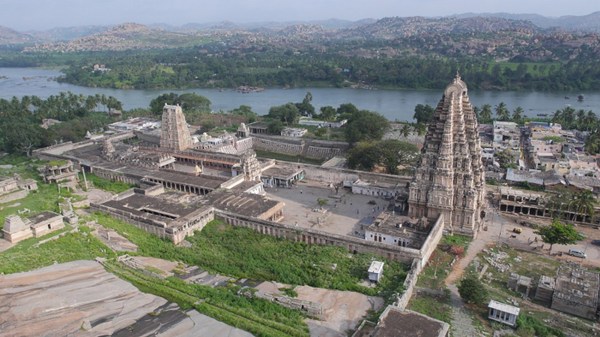
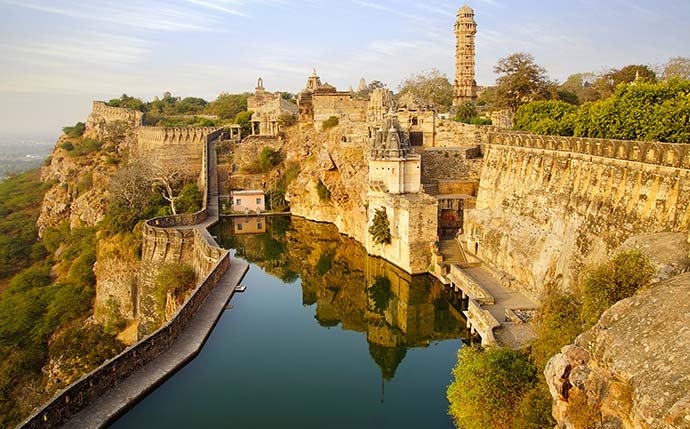
Rajasthan, one of the most sought-after destinations for domestic and international travelers, exudes an aura of royalty, culture and tradition. With varied locales to offer, ranging from hills, golden desert, lakes and forests, Rajasthan is a land of wonder. Home to the erstwhile Indian royalty, the state has many forts which are reminiscent of the rich lives and opulence of the kings and queens. Architectural marvels in themselves, the forts, temples and other historical sites leave the tourists in complete awe.

Rajasthan is known to be atleast 5000 years old with many parts being occupied by Indus Valley Civilization. Kalibunga in northern Rajasthan is one of the famous excavation sites which have revealed ancient human settlement. Rajasthan has witnessed the rule of the kings since the early 11th century upto 19th century when the British rule took over. During these years, many empires flourished in the state, leading to the development of varied architectural styles, traditions, rituals, clothing styles, cuisines and culture. Many temples, mausoleums, dargahs and forts were built during these centuries, each one outdoing the other.

Culture of Rajasthan

Rajasthan has a collective belief in “Atithi Devo Bhava”, meaning that God resides in every guest. The people of this state are warm, indulgent and happy to assist visitors and tourists in every way. With a lot of people involved in hospitality and tourism here, one will not find any problem in travelling here.

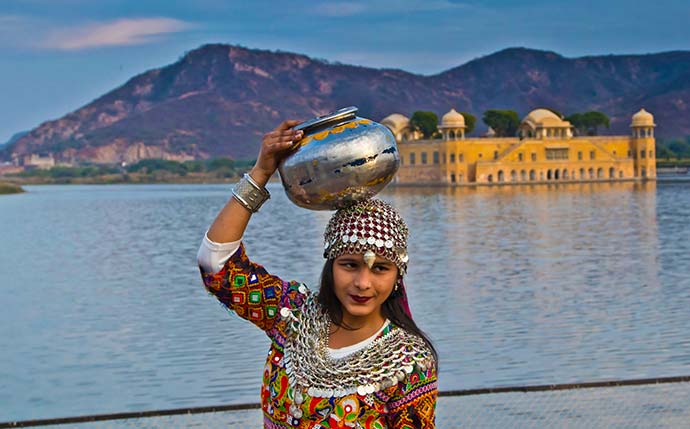
From colourful clothes, jewellery, dances and food, it is a delight to be here.

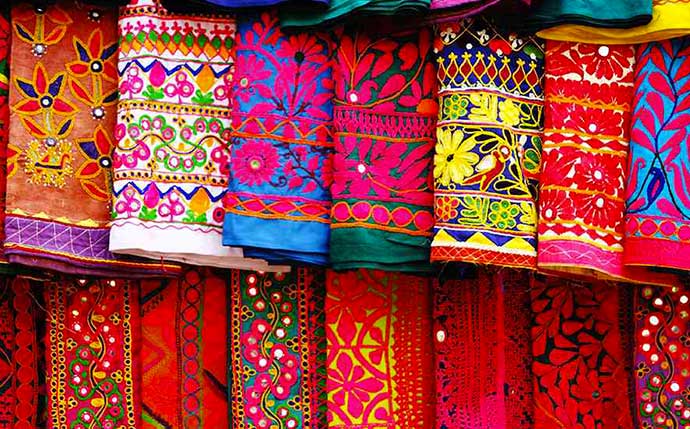
  • Clothes :Women like to dress in an attire called “odhni” which consists of a dupatta, blouse and a skirt. Available in different colours and materials, the dressing is attractive and vibrant. Men like to dress in kurta and pajama with a headgear called “pagdi”.
  • Folk music and Dance :Rajasthan has varied forms of folk music and dances. One of the few folk music groups include Manganiyars, Langas, Banjaras, Mirasis and Jogis. These groups are divided because of geographical diversity and follow their own set of beliefs which are reflected in the music and performing styles. Famous dancing styles belonging to this state are Tejali, Ghoomar, Chang, Bhopa and Kathipuli. Most of these performances revolve either around sagas of bravery or love.
  • Food :Rajasthan is known for its various hot spices and sweets. Famous eating items include dalbati choorma, kachori, ghewar, laal maas and more. These delectable items are traditionally prepared in pure ghee and have their roots in the royal kitchens. Spices are said to ignite the fire in the bodies of royal warriors and sweets are said to calm the mind.
  • Handicrafts :Unique handicraft items like blue pottery, metal work, marble and stone statues and decoratives are famous in Rajasthan. Mirror work, embroidery, bati work and tie-and-dye are also famous here. These make for lovely souvenirs for tourists coming here.

2

Frescoes of Rajasthan

Frescoes of Rajasthan

The Shekhawati region of India lies in the eastern part of the state of Rajasthan. The region is very large and has many buildings which were once where the royals of Rajasthan lived. The buildings, mostly havelis, are either abandoned or rented out to the local people

The Shekhawati region is situated in the middle of the former major trade route or the ‘SILK ROAD’ which connected the modern-day India, Pakistan and China. This benefited the local traders, called the Marwari, who built these havelis as a public show of their wealth. With the decline of the Silk Road, the Marwari’s moved on but left behind the treasure trove of the art and architecture that is their homes.

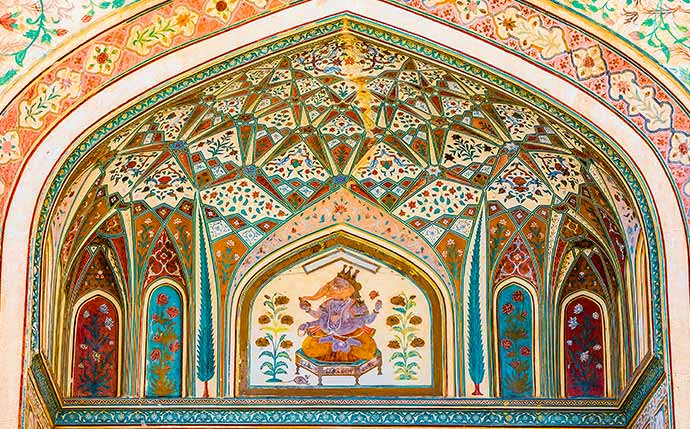
The havelis depict many themes – the daily life of the locals, gods and goddesses, folk mythology and the relatively newer buildings, those of the 19th and 20th century, depict the advent of the British. Each haveli is a piece of splendour and each has its own story to tell. The frescoes in these buildings are made with natural pigment. The oldest frescoes use ochre, red, white lead, lamp black, Indian yellow. The newer ones use synthetic pigments that were imported from Europe.

For the most part, the frescoes depict the god and goddess and folk mythology. The meeting of the gods, the armies and their battles are all depicted in rich colours and few of them gilded in 22 karat gold leaves. The gods Ganesha and Krishna have been depicted several times over. The popular loves stories of Laila -Majnu and Heer-ranjha , the equivalent to Shakespeare’s Romeo and Juliet have been depicted, besides these, Rajasthan’ s most popular romantic tale of Dhola and Maru and also of other lesser known tales are recurrently seen. The murals depicting the Europeans have a funny undertone and are an insight into how they were viewed by the Indians there.

3

Jewellery of Rajasthan

Jewellery of Rajasthan

Other than the historical monuments the amazing thing to explore in Rajasthan is the market place. Markets in Rajasthan are glorious. Many different varieties of things can be found in there, people are often amazed to see how beautiful, colourful and variant those markets are.

Let us tell you about the most eye-catching product in these markets, the ethnic jewelleries. First of all, you can see people dressed in colourful ethnic outfits. Women’s mainly wear ‘Lehenga choli’ or ‘Saree’ and these outfits usually come in vibrant colours like red, orange, yellow and green or the bright shades of other colours and to compliment these bright ethnic dresses comes the ethnic jewellery. These jewelleries are not just limited for women but men in Rajasthan also wear some special jewelleries.

4

Leather Embroidery in Rajasthan

Leather Embroidery in Rajasthan

Most of the dresses in Rajasthan are vibrant in colour and have some work done on it like mirror work bandhani work or embroidery. These works are not just limited to fabrics they are also done on jewellery, shoes, hats, bags, containers and other products. Leather embroidery is one of the specialities of this State.

When exploring the markets one can notice that the most common thing in almost every product there is the embroidery. It is like the identity that the product is bought from Rajasthan. Many bright colours are used for the embroideries. There are different types of embroideries and done on different products. Rajasthani Embroidery gives everything an ethnic look and these multi coloured embroidered products matches with almost every outfit.

5.Miniatures of Rajasthan

Miniatures of Rajasthan

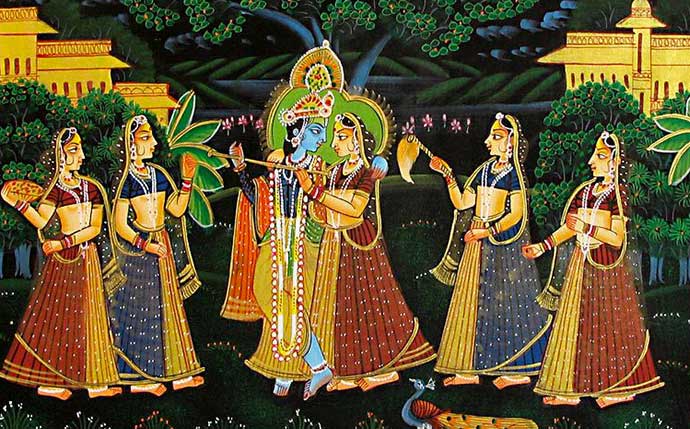
The Miniature painting of Rajasthan is an old art form known for its intricate painting and rich colours. The first evidence of this art form exists in the form of illustration of old Buddhist texts which were executed by the Palas of Northern India. The 16th century painting were presented to the rulers by their partisans as a symbol of a significant event. These were collected by rulers and displayed in their courts.

But the miniature paintings developed mostly in the Mughal period when the emperor Humayun brought Persian artists into India. The next emperor, Akbar set up a National painting school, in which an atelier for the miniature painting, artists from various parts of India trained under the Persian masters. Simultaneously several other school of painting were set up in Mewar (Udaipur), Bundi, Kotah, Marwar (Jodhpur), Bikaner, Jaipur, and Kishangarh.

6

Pottery in Rajasthan

Pottery in Rajasthan

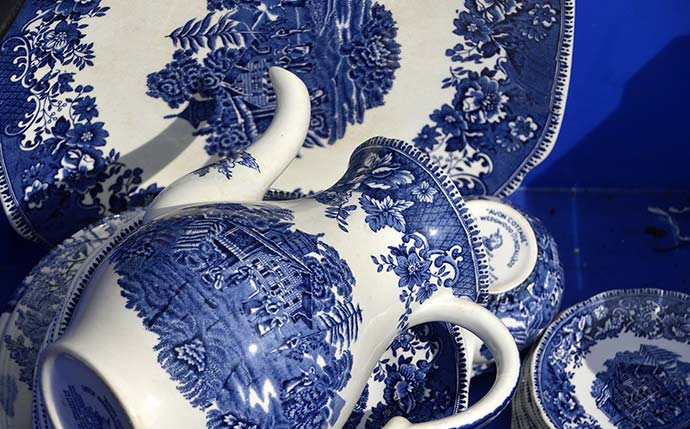
Rajasthan is a state marked by its distinct art and culture. Hand crafted products are a major speciality here and one of those specialities is Pottery. There are varieties in this category too. Some of them are Blue pottery from Jaipur, Black pottery from Sawai Madhopur, Kagzi Pottery from Alwar, Golden Pottery from Bikaner etc.

7

Wood work and Furniture

Wood work and Furniture

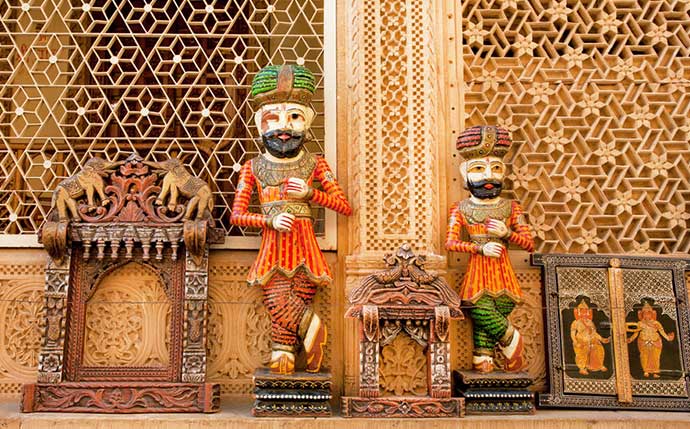
The existence of jungles in some parts of Rajasthan like Jaipur, Kota and Udaipur is what gave rise to Suthars or the carpenter class of craftsmen. Suthars either belong to the Meghwal community who are known for the cots and camels’ carts or from Barmer, who are known for their intricate craftsmanship

8

Stone Carving in Rajasthan

Stone Carving in Rajasthan

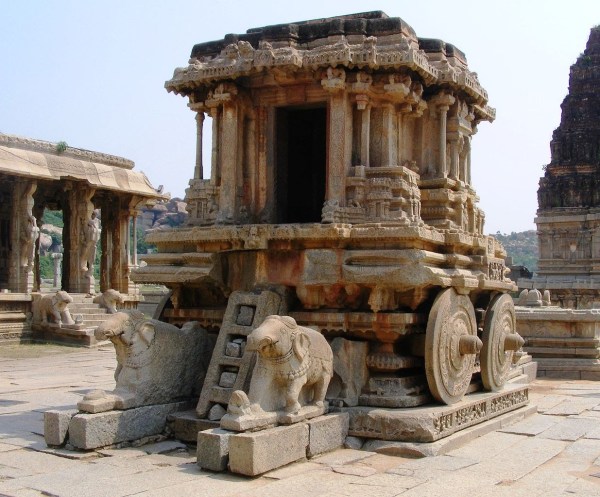
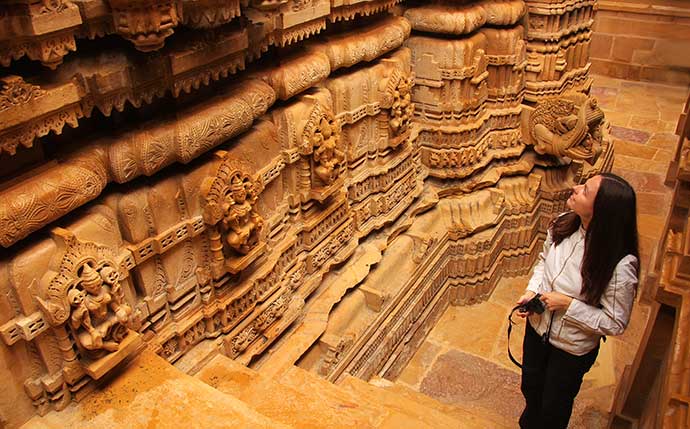
Rajasthan is a land of rich culture. It is famous for its heroes and their valorous deeds and sacrifices. It is also very famous for its architectural monuments made of stone. Rajasthan is home to temples, forts, palaces which have no competition.

The architecture in Jaipur grew under the Rajputs. The marble and the sandstone are used in the City Palace, Jantar Mantar ,Amer Fort, Hawa Mahal and Tripola gate in Jaipur. Jantar Mantar and Amer Fort are world Heritage sites. These architectural master pieces have been instrumental in putting the city in the world map. Jaipur forms part of the golden triangle, consisting of Delhi, Agra and Jaipur. The Golden Triangle is called so because they are three most visited places in India.

Jhodpur is another city with palace like the Ummed Bhawan and Chittar Palace, forts made with red sandstone. The perfect beauty and brilliance of the palaces will be bound to sweep you off your feet.

The city of Jaisalmer is situated in the heart of the Thar Desert is called the ‘The Rose in the Desert’ because of its red stone buildings. Places of interest include the Jaisalmer fort with its massive sandstone walls which turn into a magical honey gold as the sun sets.

9

Rajasthan’s Travelling Temples: Phad Paintings

Rajasthan’s Travelling Temples: Phad Paintings

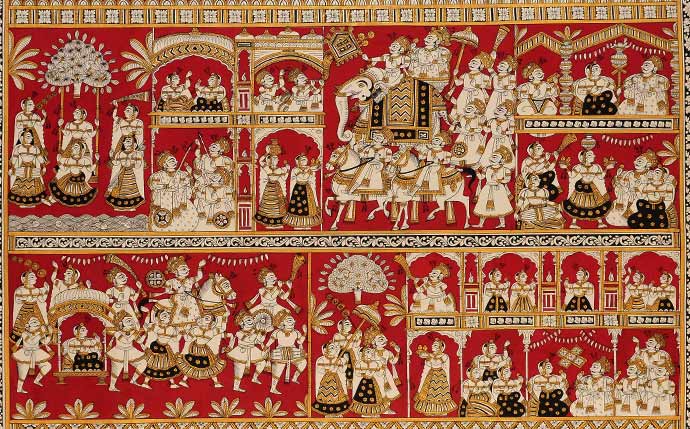
For almost 700 years ago, every evening the Bhopa and Bhopi, the priest and his wife, unroll their scrolls of Phad paintings depicting the deities and performed dramatic renditions of stories from Ramayana and Mahabharata any other mythological tales. The priest and the priestess belong to a nomadic tribe which are a tribe of camel and goat herders Originating from the Bhilwara region of Rajasthan, this tribe realising that there was no one temple they could visit, travel from village to village with their ravanhatta, a two-string instrument, performing their own form of oral worship.

Phad paintings are scroll paintings which are created on hand-woven coarse cloth. It is a complex process which takes a certain level of talent and hard work in equal proportions. The threads of the cloth are made bulkier and is starched and rubbed with moonstone to make a smooth canvas. The colours are derived from flowers and herbs and are mixes with gum which acts as a binding agent.

10

Paper Making Industry

Paper Making Industry

Paper making industry is another interesting thing to know about Rajasthan. The art of making paper was given importance in those areas by the Mughal emperors centuries ago. This paper making industry is quite different from other paper making industries. A lot of factors make it different from others. The prime factor here is that its eco- friendly.

Quad to become Quad plus

Theme

On 12th march 2021, India, the USA, Australia and Japan conducted the first ever summit to discuss regional and global challenges. Till now there were only semi-regular meeting.

What is Quad?

  • India, Australia, the USA & Japan came together to collaborate in relief efforts after the Indian Ocean earthquake and Tsunami in 2004. This Tsunami core group formed ‘Quadrilateral Security Dialogue (Quad)’ in 2007.
  • The primary objective of Quad nations is to ensure a free and open Indo-pacific region, which is increasingly being misused by China to its advantage. Quad nations conducted their largest joint naval exercises in 2020.
  • Quad is informally called ‘Asian NATO‘ since it has the scope to become a powerful coalition just like NATO in Europe and North American countries.

Benefits of Quad:

  • Collaboration in defence, maritime security, counterterrorism, and information exchange is highly beneficial to all the Quad nations.
  • Many countries in the world are importing raw materials and goods from China and hence suffered a lot in the pandemic time due to broken supply chains. At present, all the Quad nations have trade relations with China. Quad is a great opportunity to diversify supply chains to reduce dependence on China and to opt for Free Trade Agreements among each other. This kind of economic collaboration is helpful to all the countries involved and also for the global economy.
  • In order to diversify supply chains, Quad nations may help among themselves with the investments to tap the resources. This is very helpful in getting Foreign Direct Investments (FDI). For example, at present Australia has the world’s sixth-largest reserves of rare-earth minerals, which is essential to manufacture smartphones, EV batteries and high-powered motors. China supplies almost 60% of the world’s rare earth minerals. The positive thing is that most of Australia’s are untapped and needs investment to extract the minerals. And by this, dependence on China for rare earth minerals will be reduced. This cooperation is a great opportunity for all the Quad nations to increase exports and to improve the economy.
  • Quad meeting in 2020 included New Zealand, South Korea and Vietnam too, which is signalling towards the Quad-plus coalition.
  • It was announced that financing for Covid vaccines is the top priority for the latest meeting, which is going to be conducted on 12th March 2021. This cooperation is very beneficial to strengthen global health security.

Conclusion:

Quad is a great opportunity to diversify supply chains and to counterbalance China’s aggression. There is a high possibility that some other countries too will take part in it and it may become Quad plus. Quad has the potential to become a strong coalition like NATO in Europe.

Population control:Need of the hour

It’s a hard fact to digest that the population on the planet earth has bombastically raised to 7.9 billion. As a matter of fact it took 2 million years of human prehistory and history of world’s population to reach 1 billion and this number got multipled so fast that it took just 200 years to grow to 7 billion. India and china alone contribute to 36% in population of the total population of the world. And India is expected to add 273 million people to its population between now and 2050. A UN report said in 2019,forecasting that the country will cross China as the world’s most populous country by 2027.

Population growth in India

In 2019,India has an estimated population of 1.37 billion. But denying the fact the good news is that the fertility rate of women have dropped significantly. It has dropped down from 3.31 children per women in 2000 to 2.2 children per women in 2017.Over the period of time it is nearing the replacement rate of 2.1. In spite of the fact that the population policies, family planning and welfare programs undertaken by the government of India have lead to continuous decrease in fertility rate, yet the actual stabilisation of the population has not been achieved. There is also decline in decadal growth from 21.15% in census 2001 to 17.64% in census 2011.

Causes of overpopulation

1.The decline in death rate- Due to science and technology we have excelled ourselves in field of science and medicine. And as a result we have come up with better treatment facilities of any disease.

2.Agricultural Advancement- Agriculture advancement in 20th century have allowed humans to increase food production using fertilizers, herbicides, pesticides and yield further. This allowed humans with more access to food that leads to subsequent population explosion.

3.Better medical facilities- Technological innovation was perhaps the biggest reason why the balance has been permanently disturbed. Illness that had claimed thousands of lives until now were cured because of the invention of vaccines.

4.More hands to overcome poverty- Families that have been through poverty, natural disaster or are simply in need of more hands to work are a major factor for overpopulation. According to the UN the 48 poorest countries in the world are likely to be the Biggest contributors to population growth.

5.Technological advancement in fertility treatment- with the latest technological advancement and more discoveries in medical science, it has become possible for couples who are unable to concieve to undergo fertility treatment methods and have their own babies.

6.Lack of family planning- most developing nations have a large number of people who are illiterate, live below poverty line and have little or no knowledge about family planning. Those people are unable to understand the harmful effect of overpopulation and lack of quality education prompt them to avoid family planning measures.

7.Poor contraceptive use- Poor family planning on the part of partners can lead to unexpected Progencies. As per statistics 76% of women aged between 19 and 49 in great Britain used at least one form of contraceptive, whereas study by WHO shows that this figure drops to 42% in underdeveloped countries, which leads to higher birth rate.

Effects of overpopulation

1. Uneven relationship between resources and demography- earth can produce only substantial amount of resources like food and water which is falling short for current needs.

2.Degradation of environment- with the overuse of coal, oil, and natural gases, it has started producing some serious effects on our environment.

3.Conficts and wars- conflicts over water are becoming a source of tension between countries which would result in wars. Starvation is a huge issue that the world is facing and the mortality of children is being fuelled by it. Poverty is the biggest hallmark we see when talking about overpopulation.

4.Rise of unemployment- unemployment is a major cause of overpopulation. As there are fewer jobs to support a large number of people. This gives rise to theft, crime as people want to feed their families and provide them with basic amenities.

5.Pandemic and Epidemic- Overpopulation lead to unhygienic living conditions, malnutrition and inaccessible, inadequate or non extant health care for which poor are more likely to be exposed to infectious diseases.

6.Malnutrition, Starvation and famine- when the availability of resources is scarce, starvation, malnutrition along with ill health and disease caused by diet deficiency such as rickets become more likely.

7.Water shortage, sewage treatment, inadequate rainfall- Roughly 1% of the world’s water is fresh and accessible. Overpopulation is a major issue that creates immense pressure on the world’s fresh water supplies.

8.Extinction-the impact of overpopulation on the world’s wildlife is severe. As deemed for land grows, the destruction of natural habitat such as forest, becomes common.

9.Faster climate change- According to 97% scientific community, human activities are changing global temperatures. If more is not done to reduce individual carbon footprint on a large scaleb, large population may spped these changes up.

Solution to overpopulation

1.Better education- the fastest and most efficient way to stabilize the world population is to send girls to school and empower women and to give everyone access to and education on birth control.

2.Making people aware of family planning- we must focus on agressive campaigning to make people aware of the overpopulation and it’s adverse effects on the future generations to come. Public participation campaign is must needed to Make them aware. As a culture we need to emphasize the benefits of having one- child family.

3.Population Stabilization- Delay the age of first marriage but you may shrink the reproductive age by getting people to have their question first child later by spacing out the number of children.

4.Tax benefits or Concession- people having one chilld should be benefited by exemption from paying taxes as this would encourage others to have one child.

5.Knowledge of sex education- It is one thing we people don’t talk about. This should be spoken to people and imparted proper knowledge of the biology of human body.

The Mughal Empire

Indian history and culture are rich and dynamic. The country has been home to some of the worlds greatest empires, including the legendary Mughal Empire. Today let’s take a trip to the past, about 500 years ago, when the founder of the empire came to India and defeated Ibrahim Lodi to form the legendary Mughal Empire.

In 1524 the descendant of Genghis Khan and Timur, Babur came to India on the invitation of Daulat Khan, a rebel of the Lodhi dynasty, to overthrow the king of the dynasty, Ibrahim Lodhi. Many thought that he would leave the country after defeating Lodhi. Little did they know that he had no intention of doing so. Babur defeated Lodhi at the famous First Battle of Panipat in 1526 and established the Mughal Empire. He was opposed by Rana Sanga of Mewar, but the Rana was defeated in the Battle of Khanwa. Thus began the rule of the empire. 

Babur died in 1530 in Agra, where he was buried. Later, his remains were moved to Kabul as per his wishes. He was succeeded by his eldest son, Humayun. Babur had decided to divide the territories his empire between his sons, with Humayun succeeding his father to the throne of Delhi, and his half-brother Kamran Mirza inheriting the northernmost parts of his father’s empire. This was not a common practice in India at the time, but was a common Central Asian practice from the time of Genghis Khan. Many believed that Humayun was an unqualified king as he was only 22, and several of his brothers revolted against him when he came to the throne. 

In 1539, Humayun faced the founder of the Suri empire in India, Sher Shah Suri at the battle of Chausa. Humayun had to escape the battlefield to save his own life, and Suri was crowned the winner.He fled to the refuge of the Safavid Empire in Persia, and with their aid successfully won back his empire. The death of Sher Shah Suri and his successor Islam Shah rendered the Suri empire weak, and Humayun defeated the armies of Sikandar Shah Suri in 1555, re-establishing the Mughal Empire in India. Unfortunately, Humayun died due to an unfortunate accident. During his short time as a ruler, he managed to further expand the empire and was succeeded by his son Akbar.

Akbar was popularly known as Akbar The Great because of the many accomplishments he achieved during his successful rule. He defeated the Hindu king Hemu at the Second Battle of Panipat, which wasn’t far from the site where his grandfather had defeated the Lodhi’s, and occupied Delhi and Agra. After conquering most of Northern India, he sought to take over the Rajputana, and did so by defeating Pratap Singh who was the descendant of Rana Sanga at the legendary battle of Haldighati in 1576. Akbar introduced many social reforms during his time as ruler. He left a rich legacy for the Mughal empire was praised by many. He died in 1605, and was succeeded by his son Jahangir, a lover of literature, architecture and the fine arts. His successor, Shah Jahan is considered one of the greatest Mughal Emperors, and many believe that under his reign, the Mughal Empire reached its peak.Shah Jahan was imprisoned by his son Aurangzeb, who is considered one of India’s most controversial king. After his son Bahadur Shah Zafar died, the Mughal Empire declined significantly. The last ruler of the empire was exiled by the British East India Company in 1868.

The Mughals made several contributions to the culture of India, including the development of the Mughlai cuisine, large scale urbanisation, and the magnificent Taj Mahal. The Empire is considered to be one of the greatest ones in India

online learning

When the COVID-19 pandemic struck, and the number of cases began to rise, the entire country went into lockdown. Educational institutions were the first to be shut down, and the situation was chaotic. Every student in the country was worried about their classes and their grades since they could no longer attend school. But a few weeks later online classes were implemented. Students and teachers could communicate through their devices. The current role that technology plays in education is a huge one. The idea of integrating more technology into our education system has been speculated for years, and it took an actual pandemic for us to see what technology-based learning would look like. The question which now arises is: Is this beneficial, and can we continue with such a technology-dependent system?

There are many advantages to online classes. Firstly, they are much more flexible than traditional ones. The most appealing benefit of online education is that students get to work from any place they want. They can create and manage a schedule which is much more beneficial for them. Many students are intimidated by the idea of speaking in public, and get anxious if they have to talk in front of large groups of people. Online learning makes it much easier for them to speak and present their ideas without having to look at tens and hundreds of faces. 

Some people also think that online classes are cheaper since they don’t have to spend money on books due to the availability of PDFs, and reduced cost of transportation. They have more resources than before, and their learning is not limited to just one textbook. Moreover, online learning allows a student to learn at their own pace. In traditional classes, it was difficult for all the students to understand the lectures and follow the lessons. Now, a student can simply look back at recordings of their lectures if they wish to, and can even clarify doubts through live chats. 

However, every coin has two sides. With the many advantages of online learning, come the disadvantages. In a country like India, where so many of our people are poor, not everyone has the resources to access online classes. Online classes are more favourable to those who can afford a good computer and steady Wi-Fi. Unavailability of devices and network issues can also prove to be a hindrance in the learning of the poor. Online classes tend to increase the communication gap between the students and the teachers, due to lack of any face-to-face interaction. Many teachers and students also find it difficult to familiarise themselves with platforms like Zoom or Microsoft Teams.

Online classes have also lead to a major increase in the screen times of students. Long hours of being glued to your device can have adverse effects on your health like headaches and eyesight issues. Students are also finding it difficult to give examinations, which is why people were against the idea of online exams. There is also a high chance of distractions, and students can easily lose track of their studies.

This transition to online learning was not a smooth one and showed us that we are not ready for our education system to be more technology-based. If we are to adopt such a system in the future, then we have to make sure that each student in this country has access to the resources required for online classes. We also have to ensure that our dependence on technology doesn’t grow more than it needs to. A lot of changes are required before we can successfully integrate technology into our learning system.

Independence day: how far has the golden bird soared

“Long years ago we made a tryst with destiny, and now the time comes when we shall redeem our pledge, not wholly or in full measure, but very substantially. At the stroke of the midnight hour, when the world sleeps, India will awake to life and freedom.”

– Pandit Jawaharlal Nehru, Tryst with Destiny

15 August 1947, a day immortalised as the first independence day of India. This was the very day we gained our independence after almost 200 hundred years of British oppression. The path to independence was not an easy one. It cost us millions of lives, and years of bloodshed to regain something which shouldn’t have been taken from us in the first place. The sacrifices of those who fought for our noble land are honoured and remembered, as we celebrate the 74th Indian Independence Day in 2020. In these past 73 years of freedom, a lot has changed as we have struggled to find our own identity and fix the damages done to us.

Let us look back to what was happening 73 years ago. On 20 February 1947, it was announced by the British Prime Minister Clement Attlee that their government would grant full self-governance to British India by June 1948 at the latest. This was a result of the realisation by the labour party that due to the exhaustion of their resources by the Second World War and lack of international support, they could no longer control restless India. Yet, the day of independence was not all pretty. Communal riots, rampage and bloodshed on both sides of the border led to the loss of between 250,000 to 1,000,000 lives. Amidst all this, the first Prime Minister of independent India, Pandit Jawaharlal Nehru delivered his famous speech, Tryst With Destiny, to commemorate our independence. This speech is considered one of the greatest speeches of the 20th century.

It is an undeniable fact that in the past 73 years we have made a lot of progress. If we look at the economy, we can see that the standards of living and income levels have grown tremendously. The gross domestic product (GDP) increased from Rs 2,939 billion during 1950-51 to an estimated Rs 1,40,776 billion in 2018-19. At the same time, the income of the average Indian worker has gone up to Rs 92,565 during 2018-19 from just around Rs 7,513 during 1950-51. In 1991, the economic liberalisation  of our economic policies was initiated, to make the economy more market- and service-oriented, and expanding the role of private and foreign investment. Our economy is one of the fastest-growing economies of the world. Literacy rates have increased significantly, from 18.3% during the 1950s to 73% in 2011. So much more has been done, which makes one’s chest swell with pride.

Although it is pleasing to see the progress which has been made, our country is not perfect. People are still being discriminated against. Colourism in India which has been fuelled due to events under British colonial rule, where British officials consistently demeaned dark-skinned Indians and favoured light-skinned Indians for jobs is still prevalent. Even though our economy is growing fast, the growth in India is not inclusive enough. The rich are getting richer, while the poor suffer. India is also not very safe for women due to the increasing number of assaults against women. Sexist practices like dowry and female foeticide are still happening in the remote areas of the country, even though they have been banned. The number of lynching cases has also grown up, which is incredibly saddening.

Nobody likes to look at the negatives, yet we cannot ignore the problems with the system. An Indian citizen has to address these problems and work for the betterment of their country. 

This independence day, we stand together for our country, and celebrate and salute the brave and the fearless for the sacrifices made by them to help us achieve our freedom. Jai Hind!

S-400 missile to China

The S-400 Triumf, previously known as the S-300PMU-3, is an anti-aircraft weapon system developed in the 1990s by Russia’s Almaz Central Design Bureau as an upgrade of the S-300 family. It has been in service with the Russian Armed Forces since 2007. Considered to be the most advanced missile defense system in the world, the S-400 ‘Triumf’ system is capable of destroying targets at a distance of up to 400 kilometers and a height of up to 30 kilometers.

In 2017, the S-400 was described by The Economist as “one of the best air-defense systems currently made”, and Siemon Wezeman of Stockholm International Peace Research Institute (SIPRI) said it “is among the most advanced air defense systems available.” China, Saudi Arabia, Turkey, India, and Qatar expressed their appreciation for the S-400 system, and China was the first foreign buyer to make a government-to-government deal with Russia in 2014.

Amid a global uproar against China – coronavirus, a military standoff with India, Hong Kong, Taiwan, and the South China Sea, US – in just the past six months, Moscow has now announced the suspension of S-400 surface-to-air missile systems to Beijing, with the resumption of deliveries yet to be ascertained.

Russia has announced the suspension of S-400 surface-to-air missile systems to China and said the resumption of further deliveries is yet to be ascertained. Citing Chinese newspaper Sohu, UAWire reported, “This time, Russia announced the postponement of the delivery of missiles for the Chinese S-400 system. To a certain extent, we can say that it is for the sake of China. Getting a gun is not as easy as signing an invoice after receiving a weapon.” “They say that the work on delivering these weapons is quite complicated. While China has to send personnel for training, Russia also needs to send a lot of technical personnel to put the weapons into service,” Sohu said.

Post-Russia’s announcement, China has reportedly said that Moscow was forced to make such a decision as it “is worried that the delivery of S-400 missiles at this time will affect the anti-pandemic actions of the People’s Liberation Army and does not want to cause trouble to China.” In 2018, China received the first batch of S-400 missile, a military-diplomatic source told Russia`s TASS news agency. Meanwhile, it should be noted that the suspension comes merely days after Russia had accused China of espionage, despite the two nations sharing considerably good relations over the years. This assertion had come up after Russian authorities had found the president of its St Petersburg Arctic Social Sciences Academy, Valery Mitko handing over classified material to the Chinese intelligence.

Another 250 apps are going to be banned in India

India Government could ban more than 200 other applications in country. Last month, the Indian government banned 59 Chinese apps in India, after that they are planning to banned other 250 also because of users privacy and national security violations. This includes PUBG, zili, allibaba express,Capcut, FaceU, Meitu, LBE Tech, Perfect Corp, Sina Corp, Netease Games and other 250 apps. As per the report these apps are included in the activities that were “prejudicial to sovereignty and integrity of India, defense of India, the security of the state and public order.” Report said, government will follow a proper procedure before such bans, then likely to act on it soon.

Rafael aircraft coming to India from France

The Dassault Rafale is a French twin-engine, canard delta wing, multirole fighter aircraft designed and built by Dassault Aviation. Equipped with a wide range of weapons, the Rafale is intended to perform air supremacy, interdiction, aerial reconnaissance, ground support, in-depth strike, anti-ship strike, and nuclear deterrence missions. Many of the aircraft’s avionics and features, such as direct voice input, the RBE2 AA active electronically scanned array (AESA) radar, were domestically developed and produced for the Rafale program. Originally scheduled to enter service in 1996, the Rafale suffered significant delays due to post-Cold War budget cuts and changes in priorities. The aircraft is available in three main variants: Rafale C single-seat land-based version, Rafale B twin-seat land-based version, and Rafale M single-seat carrier-based version.

The Rafale is being produced for both the French Air Force and for carrier-based operations in the French Navy. The Rafale has been marketed for export to several countries and was selected for purchase by the Indian Air Force, the Egyptian Air Force, and the Qatar Air Force.  Due to its great capabilities, the first batch of 5 raflaes arrives in India in two days.

On the one hand, when there are neighbors like China and on the other hand, when there are neighboring countries like Pakistan, India needs to work on both its army and the Indian Air Force. In such a situation, 5 Rafale aircraft was given to the Indian Army yesterday. These Rafale aircraft flew from France yesterday and reached the UAE airbase Al Dhafra today. Here their maintenance and refueling work will be done. After this, these fighter aircraft will fly and arrive at Ambala Air Force Base tomorrow. With this aircraft joining the Indian Air Force, the morale of the Indian Army will be greatly elevated. However, the condition of the Airforce is not good right now because there is a shortage of squadron. This thing has been told in many reports. But with Rafael joining the Indian Army, it can play a decisive role in winning a war.

“You can call them (Rafale) both beauty and the beast,” said Indian Ambassador to France Jawed Ashraf after interacting with the IAF pilots at the airbase before they set off for India. “Delivery of 10 aircraft has been completed on schedule. Five will stay back in France for a training mission. The delivery of all 36 aircraft will be completed on schedule by the end of 2021,” the Indian embassy in Paris said in a statement. India and France signed a Euro 7.87-billion ( ₹59,000 crores approximately) deal on September 23, 2016, for 36 Rafale jets. The IAF official said the air-to-air refueling of the aircraft will be undertaken with dedicated tanker support from the French Air Force. “Our air force pilots tell us that these are extremely swift, nimble, versatile, and very deadly aircraft,” said Ashraf while congratulating the IAF pilots on becoming the first ones to fly one of the world’s most advanced fighter aircraft. The envoy thanked Dassault Aviation, the manufacturer of the aircraft, for delivering the fleet on time, the French government and the French Air Force for extending all required support.

Google removes 11 apps from Play store infected with Joker malware; uninstall them now

Researchers have said that with small changes to its code the Joker malware to get past the Play store’s security and vetting barriers.

Late last year we saw the Joker malware surface and spread like wildfire. The latest report from Check Point’s researchers has discovered a new variant of the Joker Dropper and Premium Dialer spyware in the Google Play Store. These were found hiding inside of seemingly legitimate applications. This new updated Joker malware can download additional malware to the device, which in turn subscribes the victim to a number of premium services without their consent.

Meantime, Google has removed 11 apps from the Play Store infected with the notorious Joker malware. The applications include include com.imagecompress.android, com.relax.relaxation.androidsms, com.cheery.message.sendsms (two different instances), com.peason.lovinglovemessage, com.contact.withme.texts, com.hmvoice.friendsms, com.file.recovefiles, com.LPlocker.lockapps, com.remindme.alram and com.training.memorygame.

Joker malware: Everything you need to know

The researchers have said that with small changes to its code the Joker malware to get past the Play store’s security and vetting barriers. This time along the Joker malware has adopted an old technique from the conventional PC threat landscape to avoid detection by Google. The newly modified Joker virus uses two main components to subscribe, app users to premium services. These components are: Notification Listener service and dynamic dex file loaded from the C&C server.

To minimize the Joker’s code, the developer hid the code by dynamically loading it onto a dex file, while at the same time, ensuring that it is able to completely load when triggered. The code inside of the dex file is encoded as Base64 encoded strings, that start decoding and loading as soon as the victim opens the affected apps.

The original Joker malware communicated with the C&C, and then downloaded the dynamic dex file, which was loaded as casses.dex. However, the new modified version of the code is embedded in a different zone, with the classes.dex file loading a new payload. The malware is triggered by creating a new object that communicates with the C&C.

@martin_christopher