Love, family, and faith are qualities that make our world better.
More than 8 billion people live on our planet. By various estimates, around 85% of them practice one religion or another, and many are united by faith.
Faith never teaches anything harmful or destructive. At its core there is goodness and love, whether it is Christianity, Buddhism, Judaism, Islam, or any other religion.
The world is moving quickly in an age of technology and AI. New digital platforms and apps are created to help people and improve everyday life.
Today we will talk about Faith Tech, the details that matter, and whether technology can bring us closer to faith.
Most of us turn to faith when we want to pray for those close to us, for the people we love, care about, and worry for. We pray for those who may have remained in our hearts forever, and sometimes for ourselves as well.
Today this has become easier even for those who, for one reason or another, are far from religious life, or for those moments when we were searching for time but could not find it.
Let us talk about one representative of the Faith Tech industry: Praymory.
Praymory App: “Pray for your loved ones, wherever you are.” This is not only Praymory’s slogan, it is a philosophy the world has been missing.
Simple and effortless, with love and remembrance, and with respect for faith, we can now pray for our loved ones wherever we are.
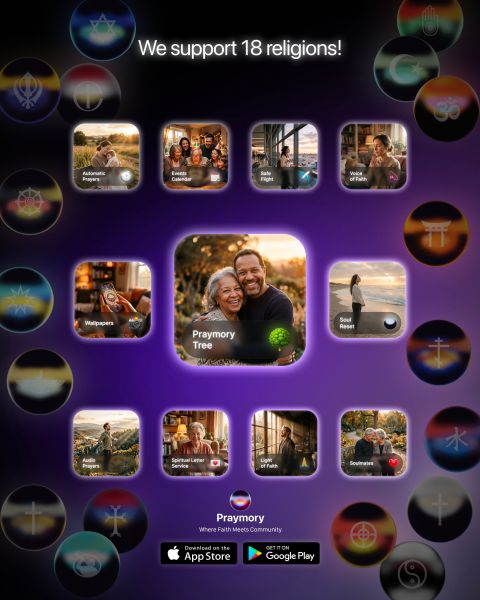
Soulmates is an avatar of a loved one: a mother or father, a relative or a friend, any person you want to pray for. In Praymory there are two Soulmates categories: In Presence and In Memory, for those who will remain in our hearts and memories forever. You create your Soulmates in the app, and they are always near. One tap and the prayer is already playing.
Praymory supports 18 major religions, so you can choose your tradition and stay within its context. The app offers more than 20 prayer topics for different occasions and life events, and it supports more than 15 languages. Real voice talents and beautiful audio prayers help you feel more deeply present in the act of prayer.
Praymory can be compared to a world in miniature: it creates a product for faith, love, and family regardless of which religion we belong to, built on the best human qualities.
Praymory has also made a strong leap in design. The way it conveys Faith Tech Design has rarely been done before. It combines respect for religion with a modern visual language without losing meaning, only highlighting it.
One of the key features is Praymory AI: Voice of Faith. It provides audio and text responses grounded in the traditions of a specific religion. This helps you find support and an answer to an important question, from the most complex to the very simple and personal, such as a prayer for a loved one’s health.
Praymory includes many thoughtful, practical functions. For example, many people feel anxious before flying. The Safe Flight feature allows you to play a pre-flight prayer in the form of an affirmation. You can choose city A and city B, and specify whether it is for yourself or for loved ones. For those who have been looking for a gentle way to ease worry, it can help reduce anxiety and simply pray before a trip.
We do not always manage to say the important words to those who have left us forever. With Praymory, we can pray for those who are no longer with us, keeping love and memory alive.
Praymory also lets you send a prayer or message to your Soulmates. You can share thoughts from the heart and say what you could not say before. This affirmation-based feature is called SLS (Spiritual Letter Service). You can send letters, prayers, and words safely, believing they will be heard. Praymory gives attention to those who truly need it: a small space on your phone where there is only you and your message. There is no reply. We simply believe.
Automatic prayers are another important detail that helps us remember what matters most. By adding Soulmates and setting a schedule, you receive notifications at the dates and times you choose. One tap and the prayer plays automatically in audio format. It is a convenient way to keep regular moments of prayer, for example a weekly prayer for a grandmother or a daily prayer for parents at a certain time.
This is only a small part of what Praymory can do. If the idea resonates, you can explore the app more closely.
Love, family, and faith. The time has come when we can pray for our loved ones, remember and love, support one another, and become better while holding a phone in our hand, thanks to the fast-growing Faith Tech industry and Praymory. Regardless of nationality or religion, love, family, and faith remain in our hearts.
Arun Kolatkar’s Jejuri presents a unique and realistic portrayal of religious experience in modern Indian society by examining the complex relationship between faith and reason. Arun Kolatkar’s Jejuri occupies a significant place in Indian English poetry for its realistic and unconventional treatment of religion and spirituality. The poem Jejuri presents a skeptical and rational view of religious practices through the eyes of a modern pilgrim. Kolatkar depicts the pilgrimage site of Jejuri as a space where devotion coexists with doubt and observation. The poet’s persona neither blindly accepts nor completely rejects religious beliefs; instead, he adopts a balanced perspective that encourages critical reflection. This paper explores the tension between religion and rationality in Jejuri and examines how Kolatkar questions blind faith while appreciating the cultural significance of religious traditions. The study reveals that Arun Kolatkar does not reject religion completely but advocates a balanced approach that harmonizes faith with reason.The study highlights the continued relevance of poet’s vision in an age increasingly shaped by scientific thinking and modern sensibilities.
This paper analyzes how Kolatkar questions mechanical worship and blind faith while recognizing the cultural and emotional significance of religion. It argues that Jejuri promotes a harmonious relationship between religion and rationality, suggesting that true spirituality lies in awareness, inquiry, and human understanding rather than in rigid rituals.
KEYWORDS: Jejuri, traditions, religion, rationality, pilgrim, faith,rituals,unconventional,skepticism, Lord Khandoba,priests.
INTRODUCTION:
Arun Kolatkar (1932–2004) is one of the most prominent figures in modern Indian English poetry. His collection Jejuri (1976) won the Commonwealth Poetry Prize and brought him international recognition. The poem sequence is based on the poet’s visit to Jejuri, a small pilgrimage town in Maharashtra, dedicated to Lord Khandoba. Through a series of short poems, Arun Kolatkar presents his observations of temples, priests, pilgrims, and rituals.Unlike conventional religious poetry that glorifies faith. He presents religion as a lived experience rather than an idealized concept. The poet’s persona in Jejuri is neither a devoted believer nor an outright atheist. Instead, he represents the modern, rational individual who questions traditional beliefs while participating in religious practices.
CONCEPT OF RELIGION AND RATIONALITY:
Religion has traditionally been associated with faith, devotion, and unquestioned belief in divine power. In Indian culture, pilgrimage is seen as a sacred act that strengthens spiritual consciousness. Rationality, on the other hand, emphasizes logic, observation, and critical thinking. A rational individual seeks evidence and clarity rather than accepting beliefs blindly.
In Jejuri, Arun Kolatkar juxtaposes these two forces. The sacred environment of temples and rituals is constantly examined through a rational lens. The poet does not deny the existence of spiritual longing but questions whether religious practices truly fulfill this need. This conflict between belief and reason forms the central theme of Jejuri.
PORTRAYAL OF RELIGION IN JEJURI:
ArunKolatkar presents religion in Jejuri as a mixture of devotion, superstition, and routine. The temples appear old, broken, and neglected, symbolizing the decline of spiritual vitality. In the poem “The Bus,” the journey to Jejuri is depicted in a casual and almost humorous manner, reducing the solemnity usually associated with pilgrimage.
In “The Priest,” the priest is portrayed as mechanically performing rituals without genuine spiritual involvement. His actions appear more professional than devotional. Similarly, in “An Old Woman,” the blind beggar woman symbolizes blind faith. Though physically blind, she possesses unwavering devotion. The poet admires her sincerity but also views her belief with skepticism. This reflects Kolatkar’s balanced attitude toward faith.
RATIONAL OUTLOOK OF THE POET:
The poet’s rationality is evident in his constant questioning and observation. He does not accept religious symbols at face value. In “The Doorstep,” he describes broken stones and discarded idols, suggesting the fragility of religious structures. The sacred is reduced to ordinary material objects.In “Yeshwant Rao,” the poet meets a man who claims to have supernatural powers. Instead of believing him, the poet responds with irony and doubt. This reflects the rational mind that refuses to accept miraculous claims without proof.Kolatkar also uses precise and simple language to maintain an objective tone. His imagery is concrete and realistic, avoiding exaggerated spiritual expressions. This stylistic choice strengthens the rational perspective of the poem.
THE DECLINE OF SACRED AWE:
One of the central concerns of Jejuri is the diminution of the sacred in the face of modern realities. “The roofs are leaking, & the gods are old.”This opening line immediately sets the tone of temporal decay. The temples, once places of awe and wonder, now show signs of neglect. Kolatkar’s god is not timeless; he is aged, almost vulnerable.
The poet’s observation of the landscape intensifies this sense:“The bitter taste of the sun is in the stones.”Here, the natural world around the temple feels harsh and uninviting, as if spirituality itself has been eroded by time and environment.
USE OF IRONY AND SATIRE:
Irony is one of the most powerful tools. Arun Kolatkar uses to expose the gap between religious ideals and actual practice. Many scenes in Jejuri appear humorous but carry serious implications.For example, in “The Bus,” the casual behavior of pilgrims contrasts sharply with the supposed sanctity of the journey. In “Makarand,” the worship of a deity is presented in a manner that highlights human absurdity.Through satire, Arun Kolatkar criticizes blind devotion, hypocrisy, and empty rituals. However, his satire is gentle rather than harsh. He does not insult believers but encourages them to reflect critically on their faith.
Arun Kolatkar’s voice often leans toward irony a technique that allows him to present religious ritual devoid of idealization.“The morning after the festival the village is strewn with coconuts and flowers.”
This image situates the sacred celebration within a very human reality: waste and debris. The aftermath of religious fervor is not transcendental clarity but a messy, littered terrain.Another striking line reveals the poet’s complex attitude toward worship:“Come back next year, Khandoba said.”Here, the anthropomorphized god appears almost bureaucratic, signaling a routine rather than a miraculous intervention.
RELIGION AS CULTURAL EXPERIENCE:
Despite his rational approach, Arun Kolatkar does not dismiss religion completely. He recognizes its cultural and emotional importance. Jejuri is presented as a living space where religion, poverty, history, and human struggle coexist.The poet participates in rituals, observes festivals, and interacts with pilgrims. This shows his involvement with the religious environment. His skepticism does not isolate him from the community. Instead, it allows him to experience religion more honestly.Thus, religion in Jejuri is not merely a spiritual practice but also a social and cultural phenomenon.
RECONCILIATION OF FAITH AND REASON:
One of the most significant aspects of Jejuri is its attempt to reconcile faith and reason. Arun Kolatkar does not advocate complete rejection of religion. Nor does he promote blind belief. He suggests a middle path where faith is guided by intelligence and awareness.The poet respects human devotion but rejects superstition. He values spiritual curiosity but opposes mechanical rituals. This balanced perspective reflects the mindset of modern individuals who seek meaning without abandoning rational thinking.Through this approach, Jejuri becomes a philosophical exploration of belief in the contemporary world.
CONCLUSION:
Arun Kolatkar’s poem Jejuri presents a profound examination of religion and rationality in modern Indian society. By portraying religious practices through a skeptical yet sympathetic lens, the poet challenges blind faith and promotes critical awareness. His use of irony, realistic imagery, and detached narration highlights the tension between tradition and modernity. Through his keen observation and subtle irony, Kolatkar portrays a landscape where faith, tradition, and skepticism coexist in constant tension. Rather than glorifying blind devotion or dismissing belief altogether, the poet adopts a balanced and critical perspective that encourages thoughtful reflection.
Arun Kolatkar neither glorifies nor condemns religion. Instead, he invites readers to reflect on their own beliefs and practices. Jejuri ultimately suggests that true spirituality lies not in rigid rituals but in honest inquiry and human understanding. The poem remains relevant today as it addresses the universal conflict between faith and reason in an increasingly rational world.Arun Kolatkar’s depiction of decaying temples, mechanical rituals, and indifferent priests symbolizes the erosion of unquestioned religious authority in a modern, rational world. At the same time, he acknowledges the emotional and cultural significance of faith in human life. The speaker’s detached yet curious attitude reflects the modern individual’s struggle to reconcile inherited beliefs with logical reasoning and personal experience.
By blending realistic imagery with philosophical insight, Jejuri questions conventional notions of holiness and challenges readers to reconsider the true essence of spirituality. The poem suggests that genuine faith does not lie in rigid practices or superstitions but in self-awareness, moral integrity, and intellectual honesty. Rational inquiry, therefore, becomes not an enemy of religion but a means to deepen understanding.
In conclusion, Jejuri stands as a significant literary work that bridges tradition and modernity, belief and doubt, emotion and reason. Arun Kolatkar successfully highlights the need for a harmonious coexistence between religion and rationality in a rapidly changing world. His poetic vision urges readers to move beyond superficial religiosity and embrace a more reflective, humane, and enlightened approach to spirituality.
Belief alone does not make a disciple. Scripture uses the word “disciple” to describe a learner, yes, but more than that, a follower who rearranges life around a Master. In the Gospels, fishermen left their nets. Tax collectors left tables. Pride, reputation, comfort – laid down on rough pavement. That is the biblical role of a follower of Jesus. Not casual agreement. Costly allegiance.
Not a Fan. A Follower Under Authority
When Jesus said, “Follow Me,” He was not recruiting admirers. He was forming men and women who would submit to His teaching, imitate His character, and carry His mission into hard places. A disciple listens. A disciple obeys. A disciple stays when obedience creates friction at work, tension at home, or misunderstanding among friends.
The word carries weight. It speaks of apprenticeship, discipline, and steady transformation over time. Scripture never presents discipleship as a weekend seminar or a private spiritual hobby. It is a public loyalty. A new center of gravity.
Obedience in the Ordinary Grind
The chasm between Sunday belief and Monday behavior exposes shallow faith. A disciple closes that gap. How money is handled. How anger is restrained. How forgiveness is extended when it feels undeserved. This is where Scripture presses in.
Christ’s teaching shapes speech, sexuality, stewardship, and suffering. The Sermon on the Mount does not float above real life; it digs into it. Discipleship shows up in traffic, in budget meetings, in hospital rooms. In the quiet. In the heat.
This kind of formation requires guidance that is clear and grounded. Through The Mentoring Project ministry, believers are equipped with practical, Scripture-rooted tools designed for daily obedience, not theoretical reflection.
Apprenticeship Requires Tools
A craftsman trains with instruments in hand. A disciple grows with truth applied. That is why the Life Skills guides exist. They address more than 100 everyday struggles, including conflict, anxiety, decision-making, parenting pressure, workplace integrity, and spiritual doubt. Real problems. Real pressure.
Each guide is built to bridge belief and behavior. Short, direct, biblically faithful. Meant to be read, discussed, lived. Those who want steady, gritty growth can discover The Mentoring Project and find resources that move beyond inspiration into formation.
The Fruit of a Lived Faith
A disciple does not aim at image management. The aim is obedience shaped by love for Christ. Over time, that obedience bears fruit: steadiness in trials, humility in success, courage under strain. Not perfection. Direction.
Faith that never alters conduct is hollow. Faith that endures hardship with quiet trust has roots. For those ready to move from agreement to action, visit The Mentoring Project website and read or listen to the free Life Skills guides. Put truth on the pavement. Walk it out.
Danquah, I. O. (2026). Destruction of Surface Water Bodies in Ghana and Theological Implications on Christianity and Christians in Ghana and Worldwide. International Journal of Research, 13(1), 453–466. https://doi.org/10.26643/ijr/2026/19
Water Resources Engineer, Goldrain Mountain Company Limited, Koforidua, Eastern Region, Ghana.
ABSTRACT
The great commission task by Jesus Christ unto his disciples is to go out into the world and spread the good news (gospel). Then for anyone who has believed and accepted the message of salvation is to be baptized with flowing water into the kingdom of God. This is comparable to his baptism by John the Baptist in River Jordan (flowing river). Looking at the destruction and contamination of almost all water bodies in Ghana, what proves that the parameter of baptism in a flowing water is being fulfilled in this current church generation in Ghana? If baptism can even be possible, what proves it’s unto cleanliness, holiness, righteousness and perfection upon the level of contaminated water. Anyone who gets baptized in such a water body or river will be coming out of the water with sands, sediments, waste, and contaminants around the body or clothing used during the process. Still at the point of spiritual ungodliness or spiritual uncleanliness. This is basically the reason for this research work in Ghana. The accomplishment of the great commission objective is in totality when the baptism component is completed. But looking at the rate of illegal gold mining and resultant destruction of surface water bodies makes Christianity for this current generation a problem in Ghana. Baptism should be done with flowing water/river comparable to River Jordan in Jesus days or time but is now done in water baths sited at mission houses and around church buildings. This is coupled with sunflower oil, coconut oil, olive oil etc. anointing parameters resulting in some level of questionable biblical acts. These water bodies’ needs to be treated in order to obtain a clean pure quality surface water body. These will be comparable to the attributes, features and characteristics of River Jordan and of the Holy Ghost for water baptism and Holy Ghost baptism respectively. This is the only means to obtain quality human gold products through Christianity and Christian growth from childhood to the status of a priest or Apostle of the gospel. Because it’s after not looking at the right, left, north or south and upon going through all the torchers of life and the agonies in life. It is also after all the test for stress, strains, standing strong and defending the faith will one be seen well refined like a gold bar or gold material unto honor and greatness in every regard and in the vineyard of God.
From biblical backgrounds and theology, Jesus was baptized in River Jordan which is a flowing River or flowing water. If we Christians are to work in the vineyard of God by obeying all rules, regulations, stipulations and go by the doctrines of the Bible? Then baptism after hearing the message about the good news and accepting Christ as Lord and personal saviour should be in a flowing river or flowing water body. But most current churches in Ghana are embarking on this water baptisms in water baths mounted around church buildings or in mission houses. The book of Luke chapter 3 recounts on the history of water baptism in flowing River Jordan in the Bible and the need for investigations and Justifications. Jesus is the living water and anyone who is thirsty can drink and be filled and have an eternal life. And so it is, where one makes good use of water to quench thirst and have a peace of mind during troubling, bubbling and hustling times. From the Dublin principles (Moriarty et. al., 2000), water as economic good is of great importance unto all mankind on planet earth per the usage and controlling ability of activities in the body. From the Biblical background and creation, there is no way one can substitute a drink or alcohol in the place of water hence the importance of water in the nourishment of the body and as cleansing agent used during baptism unto righteousness, holiness, beauty and perfections in Christianity and in the Christendom. Most baptism in churches in Ghana are done in water baths situated in church mission houses and those mounted around church buildings or vantage points meant for the purpose of baptism. Church leaders does this with associated anointing oils dropped into the water and so on. Is this process of baptism unto righteousness, perfection, holiness, good Christian faith and walk with Christ in water baths really meeting the great commission task by Jesus Christ? Or a new world of Christians and men of God generated to move the world to another level. That is a revolution of a new faith undercover as Christians or a devilish movement purposely with a destruction creating power ability and motive? In all situations or dispensations, water is needed in its finest and purest state to meet a purpose. Either for drinking, irrigation, for washing, hydropower generation, factory operation; water is needed in clean state. Hydropower generation depends solely on water passing through turbines under high speeds and pressure to run turbines and generate electricity. Such water need to pass through turbines in its finest or purest state to meet this purpose. If not and is contaminated, there will be clogging and rusting of turbines and generating of the energy demands will never be met. The movement of turbines under high pressures and speeds will even be a problem and that touch to generate the electricity (energy) will not be fulfilled. It is therefore a requirement that all water to be used needs to be in a clean state to meet daily demands in every regard. But illegal gold mining business in Ghana and its regions has and still destroying water bodies to a greater extent. As the various water bodies and rivers in Ghana were meeting physical demands; for irrigation, drinking, washing, hydropower generation, factory manufacturing, feeding animals, cooking, etc, spiritual demands were also being met through baptism in this water bodies and rivers. And river Birim and Supong at Osino and Nsutam are good examples. But this is not the case or the situation at hand in 2025 as most surface water bodies in Ghana have been destroyed through illegal gold mining activities and businesses in Ghana. The illegal gold mining activities has resulted in the destruction of land resources, forest reserves, vegetation’s, river bodies, vegetation’s, crops, plants and so on. And this is alarming and the need to address all issues associated with the destroyed water bodies towards meeting future water demands both physically and spiritually in Ghana and worldwide.
Desert and wilderness generations begins here when such destruction minded creations are embarked or generated. And this is the situation in the Eastern Region of Ghana where water and a lot of natural resources have been destroyed to a larger extent. And the need to look at it with critical mindset, eagle eyes, motive and worked assiduously on it in order to salvage situation and generate a world that will be beneficial to all mankind and serve future generations. If such a process breaks the hydrological cycle in the southern part of Ghana comparable to what is happening in the northern part of Ghana, then there will be water crises in the Eastern part of Ghana comparable to the northern region during the mean rainfall regimes. This is basically some of the major parameters or points this research work is investigating for answers and justifications. As to whether this process of illegal gold mining and world generation should continue towards desert creation (creation unto destruction) or full rainfall regime creation (creation unto salvation) where there will be water to meet various physical demands and spiritual demands. Creation is unto salvation and destruction is unto extinction and therefore if all surface water bodies are being destroyed at that fast rate. Then there can be a generation that will live in complete wilderness full of suffering and no water to even quench their thirst. Because the hydrological cycle seen as a complete system comprising of connection or linkage between three sources of water will not be there and hence a break in the cycle.
2 RESEARCH AREA
The study area for this research work is the whole of the southern and northern part of Ghana. But the major point of call for better assessment, scenario generation, results, modelling and output identification and justification is at Nsutam in the Eastern Region of Ghana. The people of Nsutam are involved in gold mining, farming and trading activities. Some of the farm products produced includes coconut, cocoa, plantain, yam, cassava, sugar cane and all kinds of vegetables produced during the farming seasons. The huge amount of gold discovered in the community has resulted in all kinds of illegal gold mining activities destroying water bodies, forest reserves and lands. The community has a population of about 7000 (2021 population census) with the majority being immigrants due to the gold mining business. Linda Dor at Bunso and Paradise Tourist rest stops operates in the community. The destroyed lands needs reclamation process in order to restore the infertile lands back as more fertile rich soils which will support plant growth in order to support the hydrological cycle, exchanges of oxygen and carbon dioxide between man and plants. Restoration of the degraded lands will also promote afforestation and wildlife existence for now and future generation. It will also promote tourist attraction when vegetation’s are groomed and protected with the existence of wildlife’s. That will be generation of a natural canopy for various activities such as for weddings, parties and funerals. Such interventions will also lead to the generation of Eco parks and tourist sites like Bunso Eco Park in the Eastern Region of Ghana. Fig 1 below is a view of the study area in the Eastern Region of Ghana where coconut is in mild production to boost livelihoods within the community.
Fig. 1: Map of Fanteakwa south district
3 RESEARCH FOCAL DIMENSIONS
3.1 WATER CONCEPTS FROM PHYSICAL BACKGROUNDS
3.1.1 Surface Water Bodies and their Functionality
The defined three sources of water; water below, water on the land surface and water above the earth are all contributing to the importance of the hydrological cycle and its sustenance. Ghana as a country is benefiting in this regard as all the three sources of water that is surface water, ground water and precipitation from above are contributing to water availability in Ghana all year round. With focus on surface water bodies in Ghana, they are of different types; springs, streams, rivers, wells etc. Some good examples includes river Densu, river Ankobra, Barekese, River Birim, Supong etc and all these rivers are comparable to river Jordan from biblical backgrounds. They are all flowing rivers and water bodies. As all these surface water bodies serves the purpose of meeting water needs both for physical means and spiritual means. Physical demands includes for drinking, irrigation, hydropower generation, washing, cooling, cooking, bathing and so on. For meeting spiritual demands includes for baptism and for embarking on most of the physical demands and needs towards cleanliness in every regard before encounter with the divine God. Before holiness without cleanliness is nothing to talk about and during creation, God did all kinds of groupings and classifications all towards piety, beauty and edification. So it’s of utmost importance that surface water bodies in Ghana gets treated and purified to a higher degree in meeting various kinds of demands. Even though surface water hasn’t been obtained in its finest state of purity to serve Ghana both in meeting physical demands and spiritual demands, that surface water has been used to meet demands in that regard over the years. But the rampant illegal gold mining activities in Ghana has destroyed most of these surface water bodies. The illegal miners have created different kinds of water course of direction for waters downstream after illegal gold mining on water bodies. These newly created course of direction or channels for the water bodies lacks adequate capacity and is very bad. If evaporation becomes high with huge amount of water being loss on daily basis, it will result in the extinction of most of these water bodies. This is a special case on River Birim and River Supong at Nsutam in the Eastern Region of Ghana. It’s this very same water that was meeting daily water demands at Nsutam, Bunso, Osino and its environs for all in the past Fanteakwa district of Ghana with Begoro as the district capital.
3.1.2 Illegal Gold Mining and Impacts on Surface Water Bodies
Gold as a resource is a precious mineral that is being sort for by all towards enrichment and greatness height attainment in Ghana. But gold is based on perception and is view point oriented. International gold mining companies like AngloGold, Newmont, Persus Mines, Bogoso mines, Tarkwa mines etc are constantly making use of standard operating procedures in order to access the resource. While they make use of standard operating procedures to access the mineral gold underground or through surface mining, natural resources (water bodies, forest, land, vegetation’s etc) are protected for the goodwill of mankind in all gold mining communities in Ghana.
This is not same for illegal gold miners who are also fighting for that rich great height in life. They make use of all kinds of means in order to access the mineral gold. This has resulted in the destruction of surface water bodies and is very bad. All kinds of dredging is done in the river leaving rivers like River Birim and River Supong highly polluted and contaminated. This has generated all kinds of high turbid and highly Sediment Rivers high in sand and low in gravels at the bottom of the river. Such a high turbid and sediment river or water body is low in oxygen and does not support aquatic existence and survival. With a lot of stones and gravels in the river, the life span of the river is high compared to a highly sediment river. Once the river is full of sand or sediment and evaporation becomes high during the dry season, the possibility of the river drying up is very high. This is the reason for most dugouts and rivers drying up during the dry season regimes in the northern part of Ghana upon research and investigations. It is therefore necessary for all stakeholders to work collaboratively to save the natural resources for the good will and future of unborn generations to come in Ghana and beyond. Just like was done by forefathers or great men dead and gone through hardwork. If not unto salvation to protect, justify the Bible and propagate the gospel of Christ, then for the United Nations objective of meeting some of the sustainable development goals (SDG’s) and World Bank projects, let’s revive and treat all surface water bodies in Ghana. This will be unto quality, piety and beauty in terms of water resources and its management in Ghana. This is possible same for other African countries and the world at large as water is networking. The networking concept of water is same as participatory approach of operation and management of the natural resource. And this is water flowing from upstream to downstream or flowing from one channel into another.
3.1.3 Hydrological Cycle concepts and Equations
The basic hydrological cycle equation is also known as the water budget equation; . Where is precipitation, is discharge or stormwater runoffs, is evapotranspiration and is the change in storage within a given system over time. The equation is derived from the principle of conservation of mass, stating that the total water input into the system (basically from Precipitation) must be equal to the total water output (runoffs + evapotranspiration) plus any change in the volume of water stored. Precipitation is the total amount of water that falls over a catchment area on the earth’s surface in the form of rain, snow, sleet or hail. This precipitation is generated into runoffs depending on the nature and characteristics of the catchment area (either being pervious, an impervious surface or combinations). The runoffs is the flow water over the catchment surface which includes direct runoffs into drains, streams, rivers, lakes as well as groundwater flows (base flows). Another component that adds to the runoffs on the right hand side (RHS) of the equation above is the evapotranspiration. Evapotranspiration comprises of evaporation and transpirations. The evaporation is movement of water from surface water bodies and any water on the surface of the land (soil). The transpiration component is the water being transpired from plant vegetation’s. It’s is basically the movement of water from leaves surfaces and plants into the atmosphere to form clouds as they move from the gaseous state and gets cooled. The storage , is the net change in the amount of water stored in various underground points of the hydrological cycle such as in springs, reservoirs, aquifers etc.
3.1.4 Destroyed Surface Water Bodies and Hydrological Cycle
The interconnectivity between surface water, water above the land surface and underground is what is keeping the hydrological cycle intact and resultant all year round availability and accessibility to water. Areas or regions on planet earth without this interconnectivity lacks water and by that the Sustainable Development Goal six (SDG 6) unmet yearly. Even though the southern part of Ghana is getting water all year round, there is the need to be concerned about the rampant illegal gold mining activities in the southern part and resultant destruction of water bodies. A lot of water bodies have been destroyed in the focused area and this includes River Birim and River Supong. Surface water bodies like River Pra, Ankobra, River Birim, Supong and others are also contributing into the hydrological cycle just like any other surface water body in Ghana in order to maintain the hydrological cycle. With this high rate of illegal gold mining, there is the likelihood of all surface water bodies in Ghana drying up completely. And if this happens, then it means there is a break in hydrological cycle and hence a new result on the final output of rainfall on planet earth and Ghana as a country. It means there will be no evaporation on the water bodies into the sky to form clouds. Again there will be no infiltration of water into the soil to join underground waters flowing through aquifers. When it happens like that, it means total drying up of the system. The soil will not be moist and loose to support crop production. A best scenario for land surfaces and soil characters in the Upper East Region of Ghana comparable to the rich fertile soil in the southern part of Ghana. Such infertile soils results in low yields during farming seasons even after application of composts and fertilizers.
The hydrological cycle needs to be worked on constantly and maintained to sustain the availability of water in a land, country or region. A good example is the work in Dubai with great engineering works coupled to create and generate a beautiful city and hydrological cycle for future generations. The very moment the hydrological cycle is maintained in the correct shape and order, there is total or abundance in terms of rainfall or precipitation surface water bodies and infiltration of water into aquifers.
3.1.5 Destroyed Hydrological Cycle and Impacts on Surface Water bodies
With the current rate of destruction to water bodies, the poverty level, hunger and thirst level to end poverty in once lives, it seems illegal gold mining in the Southern part and in Ghana will continue. Which means that illegal gold mining in rivers and on water bodies will continue and hence the resultant destruction to all kinds of surface water bodies in Ghana. If this continues without working on the destroyed water bodies, then the final verdict will be extinction of all surface water bodies and aquatic organisms. And the very moment this happens, then there will be a break in chain – hydrological cycle. Surface water will not end up in the sky to form clouds from evaporation of water from water bodies and resultant cooling to form clouds in the sky. Which finally falls to planet earth as precipitation or rainfall. There will be no water infiltrating into the soil to join groundwater. Which can be abstracted upstream from aquifers with pipes to be used in homes to meet water demands. Stakeholders like Water Resources Commission, Ghana Water Company Limited, the Military, the Police, Minerals Commissions, Ministry of Agriculture, Ministry of Finance etc and the president himself needs to join hands and fight the illegal gold mining canker in Ghana for the good will of Ghana and all. But all these boils down to creation motive, intelligence, aims and objectives in governance.
3.2 WATER CONCEPTS FROM SPITIUAL AND BIBLICAL BACKGROUNDS
3.2.1 Water and Baptism
From biblical grounds, Jesus told his disciples that he has been given all authority in heaven and on earth. Therefore they should go and make disciples of every nation, baptizingthem in the name of the Father and the Son and the Holy Spirit. This is the great commission according to the book of Matthew and the task for the disciples to continue the kingdom business. In the same vain, Luke also talks about this same baptism by making use of water. According to Luke, one day when the crowds were being baptized, Jesus himself was baptized. And as he was praying, the heavens opened and the Holy Spirit in a bodily form descended on him like a dove. And a voice from heaven said, you are my dearly loved son, and you bring me great joy. The focal point around, which this baptism was to be done is in a flowing River or flowing water body. And the name of this river is ‘River Jordan’. So it emphatically means that, from the understanding and concept of doctrines, communion and fellowship, the baptism should be around or done in a flowing rivercomparable toRiver Jordan. Basically with the motive of cleansing of sin comparable to upstream to downstream movement of water carrying high rate of impurities and sediments downstream the river. But with this high rate of illegal gold mining and destruction of water bodies or rives in Ghana, what is the faith of the Christian by this doctrines, mentorship, fellowship and walking by the rules, laws and stipulations of the one who has called us into his kingdom. It’s therefore a requirement for all Christians to join hands and fight the new generational church which believes in baptism in water baths situated around church premises and in mission houses.
Illegal gold mining activities, destruction of water bodies and rivers in the western world is highly discouraged. This is avoided in the western world but rather, there is continuous serious hardwork on water bodies on daily basis. Where good quality water bodies are created, operated and managed holistically and on participatory approach for goodwill of all mankind. That is as there is continuous usage of flowing rivers or waters bodies for all kinds’ recreational purposes and meeting daily demands, then there is daily cleansing, baptism, faith building and propagation of the gospel about Christ and living waters. And in finality is the conservation or meeting requirements of the great commission task of the baptism doctrine or philosophy parameter according to the good book.
3.2.2 Water and Christ as Living Water
Jesus Christ promised mankind of living water when he stood before crowds and shouted, anyone who is thirsty may come to me. Anyone who believes in me may come and drink. For the scripture declares, Rivers of living water will flow from his heart. When he said living water, he was speaking of the spirit, who would be given to everyone believing in him. But the spirit had not yet being given, because Jesus had not yet entered into his glory. And who is the spirit. Jesus was talking about the Holy Ghost. By the above assertions, it is clearly justified to say water is a living thing or being which gives life and freedom from all hustles, bubbling issues, tortures in life and thirst. There is a big level of personification with Christ as living water. And is something that guides all into knowing great mysteries and secrets when one drinks or gets baptized with it to be liberated. If from the biblical book that Christ is referring to water as Holy Ghost, then water needs to be obtained and used in its purest state void of all impurities and sediments in life. It is therefore a requirement that obtaining and using water to meet basic demands and needs should come in its finest state as it is an economic good and is a finite resource with value as seen in Dublin’s principles. The four Dublin’s principles are: water is a finite good and vulnerable resources; participatory approach to water management; Central role of women in water management and Economic value of water. Existence on the planet earth from childhood towards adulthood and old age is highly dependent on the usage and manipulation of water on daily basis in once life. That is water serving as living water from childhood to old age in once life. Then again having the Holy Ghost (fresh living water and spirit) as a helper, comforter and advocate to carry you on eagle wings throughout life. From generation of chemical energy in once life, generation of hydropower energy for all kinds of energy demands, in the factories for manufacturing of goods and cooling of systems, for refreshment and washing etc. It simply implies that our existence or living on planet earth is highly dependent on water. This is in the direction of the physical existence.
But when dealing with once spiritual existence, then Christ is seen as a living water. The Holy Ghost as comforter, helper, advocator and counsellor is needed on daily basis for survival in terms of spirituality. For we are not fighting against flesh and blood but against higher beings in higher spiritual realms hence the need for a helper and an advocator. And hence the need for the living water who is the Holy Ghost for daily dealings and interventions. So it’s clearly defined that we need water and Christ (Holy Ghost) as another living water in its holiest finest state for survival on the earth and fight against diseases, illness and higher powers (spirits) in higher spiritual realms or places. This is comparable same in usage when looking at Islamic religion when talking or dealing with water usage. The Moslem does all kinds of spiritual cleansing with water before prayers. And one can count the number of times the Moslem uses water for cleansing before prayers and for even after urination on daily basis. This justifies water usage and the need for it by the Christian and Moslem in Ghana and worldwide. Therefore in all areas where water bodies have been destroyed and contaminated to a higher degree, we need to treat the water resources. Then obtain them in their finest clean quality states as pure water just like the current generation Ghanaian Christian is sorting after the Holy Ghost in its holiest and cleanest state to impact unborn generations. And the moslem also sorting for holy grounds met Allah.
3.2.3 Water Baptism and impacts on quality Human gold production
Gold mining operation in legal mining sites and illegal mining sites are all to be obtained in karat to a higher degree in terms of pure gold void of impurities. A pure gold is obtained after exploration, discovery, harnessing, mining and purification. So it is in the direction of refinement of human lives to obtain pure human gold products from the sociological or Christians background. Paul admonishes Christians to be strong as one goes through troubles, torchers, fights the difficulties in life. But should be happy and heavy hearted and go through it and at the end of the journey will be final refinement into pure human gold products worthy of the suffering for the cross. Comparable to discovery and mining for pure gold, so is the discovery of a saints and the need for water baptism as the second point of call in the great commission task after unbelievers acceptance of Christ as Lord and personal savior’s declarations. After the baptism is the working out of once own salvation with fear and trembling towards justification for heaven on the judgment day. But towards making it in heaven one day is the refinement into a quality human gold product to serve mankind and help propagate the gospel and contribute to great commission task on planet earth. Attainment of that quality human gold product comes with some additions and subtractions comparable to a potter working with clay. And this is obtained from teachings and guidance from the first leader or priest to the common floor member in the church. This is where Christ teaches on the body of Christ with many parts but finally, functioning as one unit body in Christ with different roles all towards edification of the church. A quality human gold product that has been refined and produced becomes the foundation upon which the next generational church is built. And Jesus told Peter, you are Peter and upon you will I build my church and the gates of hell will not overcome it. This was well achieved after taking Peter through great torchers, hustles, training, disappointments and appointment moments in ministry and final refinement into a quality human gold product after discovery on the sea shore. Then the final great commission work to send the gospel message to the ends of the world, passing buttons to Paul, the next generations and to this 21st Century world.
By the principles of the bible and great commission task, baptism is needed for the unbeliever. That is for one who hasn’t believed the message about Jesus Christ and by that not living by principles, rules, regulations and stipulations of the Bible. The Bible is unto salvation of mankind from any tribe, race, black, white or religion. The very moment one is baptized and joins the Christendom or Christian religion, what is left is teachings, guidance, moulding and counselling unto maturity. From the position of drinking milk to the point of chewing bones as stated in the good books. And that is the refinement process of mining for pure gold. At the point of maturity is the level of real mineral gold product or quality human gold product for enrichment in life or to serve mankind and generations worldwide respectively.
3.2.4 Water Refreshment and Refreshment from Baptism
Good quality water is for refreshment in every adventure and so its water baptism in every regard. One does get a renewed body, mind and soul when he/she showers after a long days serious had work. And it’s the same thing when one drinks water to quench thirst and refresh the soul. To be able to obtain this refreshment from pure water, the water should be in its fullest purest state void of all sediments or impurities. When one gets water from the lake or rivers for the purpose of cooking or washing, the water needs to be clean. If not then there is a requirement to treat the water through any kind of means. Some of the treatment process includes purification, filtration, sedimentation, chlorine application, boiling etc. One will be able to obtain a clean water to meet any demands in the homes. But in Ghana for instance, are various institutions like Water Resources Commissions and Ghana Water Company Limited involved in the management of Water Resources in Ghana, the treatment and distribution of this treated water to individual’s homes respectively. So it becomes a worrying situation in a town, city or country when its water resources is under threat through illegal gold mining business or any other activities. If mineral gold products are quantified by human gold products at any point in time, then it becomes a problem when the water resources and its quality are detoriated to a higher degree. This water resources is to help in either ways. Play a role and be used during the mineral gold production and also be used in the human gold production business by human gold products. And if human gold production is also being done from the Christian background where baptism with water is a requirement? Then it’s very important to work on all water (river) bodies in all towns and cities in Ghana through stakeholder participation and collaboration of all institutions.
3.2.4 Impacts of Destroyed Surface Water bodies on River Baptism
Holiness is unto righteousness and unholiest actions and inactions is unto destruction. The bible and creation is unto salvation and creating a beautiful peaceful place for fellowship and friendship relationship with man and wife. And so should be all creation intelligence for people professing to be Christians and willing to carry the cross to follow Christ. Even though the Bible is unto salvation, there exist a destruction ability and component which is unto protection of the creation against destroyers, thieves and crooks. And so it is for the features, attributes and characteristics of the divine God. It therefore does not justify the destruction of water resources in Ghana through illegal gold mining business in Ghana, some countries in Africa and worldwide.
Consider these scenarios with regards to the destruction of these water resources by illegal gold miners for saying, my creation is unto destruction. If a wife is a cheat and always cheating the husband, telling him nonsense and accepts she is a cheat, doesn’t she take or have good sex with another man or someone. Doesn’t she satisfy herself sexually enough with that or another lover? So even though always professing and accepting to be a cheat, it is for the goodwill of another. If a rice or waakye seller at a restaurant is always decreasing the quantity of rice per plate for some people, surely will it be full plate or free plate for someone she knows, loves or even for a lover. So never think the destruction of these water resources or bodies in the southern part of Ghana is not going to be to the advantage of someone else or another region in Ghana or another country to the detriment of another country.
If this illegal gold mining business has destroyed water resources, forest reserves, land surfaces making it infertile to support crop production in the northern part of Ghana based on assessment, research and data during investigations in 2014, then it’s a questionable act in 2025 in the southern part of Ghana. This is not salvation work because it leads to desert creation comparable to the current desert areas in the northern part of Ghana. Which is not supporting plant growth, hydrological cycle, life’s span of water bodies, aquatic lifes, economic growth and human existence justified by high rate of migration to southern part of Ghana yearly.
So if all rivers and streams are destroyed and baptism is now done in water baths, it clearly gives the indication of self-sustenance, individualism and no interconnectivity among rivers. But this interconnectivity among rivers and heading towards the ocean (upstream to downstream) is a clear indication of participatory approach of life and coexistence lifestyle among all mankind with sourcing from possibly one main source. This is comparable to hydrology and drainage engineering both physically and spiritually. All these participatory approach of life and coexistence among mankind is all pointing towards one divine God. So if these water bodies have been destroyed to a higher extent, then there is nothing like baptism in rivers as done for Jesus in River Jordan by John the Baptist.
3.3 SALVATION WORK AND ITS ASSOCIATED DESTRUCTIVE NATURE
3.3.1 Salvation work by Christ and the crucifixion
God created mankind for salvation work in the Garden of Eden. The salvation work was to nurture the garden, tender it and keep it holy and fresh always. But man sinning in the garden negated everything. God should have forgiven man to continue his salvation work but did God do that. God didn’t do that but rather, sacked man out of the Garden of Eden into the wilderness with all kinds of punishment and troubling life. Is this salvation work when man has been generated or recreated newly unto hardwork, suffering before having daily bread, laboring and difficult moments before populating the earth? This is a creation unto destruction but we all know creation unto destruction or hard times is associated with the enemy or Satan. But this was basically for a purpose of protecting God’s hard work and creation (Garden of Eden). So salvation work has a destructive intelligence and ability associated with it.
This is same in Jesus ministry and salvation work on the planet earth to redeem mankind back unto the father. Jesus salvation work took him to the cross where he died and resurrected again to continue the salvation. If a work or project is unto salvation and redeeming mankind back into the kingdom of God, should one end on the cross or in the grave? So know and behold that, there is a destruction factor associated with salvation work or kingdom business. Jesus did all kinds of tender hearted and merciful acts during his ministry and on his way to die on the cross propagating the Gospel message of salvation for all gentiles. But did Jesus approved of all inactions during his ministry and gospel days? He did forgive a prostitute and tasked her to go and sin no more. But I believe Jesus sacking people from the temple for doing business in the house of God which even ended a whole family without food on that particular day when he sacked all sellers out of the temple of God isn’t salvation work. Assuming a trader came with just a goat or sheep for sale or butter trade and lost it on that day. It’s possible the whole family didn’t eat on that particular day. The goat or sheep was to be sold for exchange of goods for possibly that day or a whole week menu chart. If such a sheep or goat was then lost, then by logical reasoning, various scenarios comes into play even though salvation message was been preached or propagated. The same thing is applicable in the life of David, in the lives of all army men and kings of Israel as they go into battles with other nations and kingdoms smashing and killing people and coming back to Israel with treasure.
God was so angry and terminated the lifes of people of Sodom and Gomorrah basically because of bad sexual affairs and motive. But what was God’s concern and mood concerning an act which is so appetizing, enjoyable and appealing in the life and sights of others (Sodom and Gomorrah) if it isn’t having a negative impact on God’s kingdom, creation and ruling. Why will God reign such fire on such a kingdom to abrogate such an act? Were they also not unto salvation work where there is a final output of enrichment, happy moments, enjoyable days and great times? Of course yes from another logical reasoning point of creation intelligence and ruling but it was against God’s holy and righteous creation according to the biblical books. It clearly indicates that salvation work and baptism for kingdom business and operation is subjective and Godly oriented.
3.3.2 Living Water and its destructive Nature
Every adventure which is unto salvation has also a destruction key or factor. In finality, every happy moment has an associated crying times or moment. With the teeth and tongue (T & T) living within the same catchment area which is the mouth, does enjoy all great moments and at the same time, enjoys all difficult moments or days. And that is for better for worse moment in marriage. The mouth does receives all the sweet sugars and honey and at the same time, takes the acid to clear the tongue and teeth from the mouth. So even though living water is unto salvation, quenching of thirst, refreshment and cooling after all difficult moments? The same water is unto destruction even in its finest refreshing state. If one is so thirsty and does not take his/her time in sipping or taking a cup of water! Miscalculation or drinking hurryingly can cause an accident in the esophagus or nose that can end one in the emergency room or even unto death. Making use of this same water for recreational purpose can end one in death during swimming. Where one can be carried away by heavy turbulent water. Didn’t someone who intended to have a nice time by cruising in a ship (Romeo and Juliet Story), sailing in a boat or driving some boat end up in the water and finally die. The initial motive and intelligence was unto salvation but there is a destructive factor associated here. So even though God’s or Jesus kingdom business is unto salvation, there is a destructive nature in there. Where God can even ask David to slaughter a whole nation of Kingdom for a reason best known to him God according to the biblical books. A good example is the Moses and Pharaoh Incidences and scenarios in the books of Moses. A justification for the United Nations work where peace keeping has the associated shutting down of dreams and human gold products even though principal objective is unto salvation. The reason for the peacekeeping is basically unto salvation but comes with destructive keys, factors and repercussions.
4 CONCLUSIONS
Christ is a living water for the believer towards quenching the thirst of hunger, greatness, enrichment attainment and eternal life on earth after death. And so is clean good quality water needed for daily activities of various dimension. Water resulting in floods after precipitation for a given duration is also used to sweep sinful lives (in the days of Noah) and also destroy properties worth Billions of pounds sterling’s. This same water is used for baptism as Christ was also baptized by John in flowing River Jordan towards task, mission and objective accomplishment on earth when talking about salvation of mankind back unto the Father. The accomplishment of the great commission objective is in totality when the baptism component is completed. But looking at the rate of illegal gold mining activities and resultant destruction surface water bodies makes, Christianity for this current generation is a problem and questionable in Ghana. Is there Baptism in flowing water? What is the motive for high rate of borehole sinking and high rate of ground water abstraction? What is the effect and future of the hydrological cycle and its impacts on Christianity? Baptism should be done in and with flowing water comparable to River Jordan in Jesus days or time but is now done in water baths sited at mission houses and around church buildings. Is this biblical or theological nonsense telling intelligence by a new Christian church movement? Or it’s a creation from another religion to battle Christianity? These are all theological intelligence according to the mysteries and secrets of the kingdom.
Based on the illegal gold mining and activities in Ghana, all most all flowing water and river bodies have been destroyed to a higher degree and needs new intervention and treatment. This water bodies needs to be treated in order to obtain a clean pure quality water comparable to the attributes and characteristics of River Jordan and the Holy Ghost for water baptism and Holy Ghost baptism respectively. In life, every question and its appropriate answers to meet demands of marking scheme. Even in a football team, the question paper and answer sheet for a team manager is not the same as for the captain and individual players on a match day. Hence a requirement for water Baptism in clean flowing River or water a necessity for Christians and believers to meet the requirement and demands of the great commission. It’s very important to know that in life, every individual or being created and fashioned in the image and likeness of God has his/her own real life question paper and answer sheet before him/her. And answering it is individualistic even though subject to consultation to an extent since life is about relationship and connectivity. But the final marking scheme for justification and certification against all odds is one marking scheme and for the Christian is the Great Bible. So never try to take someone questions to answer for him/her. Therefore it’s not justified for the Moslem to take a Christians script and answer sheet to answer real life problems and vice versa. Then get creation coded for manipulation and controls towards personal enrichment and gains. From research, I think this is the reason for Ghana seen as Christian country and Moslem country in terms of surface mining and underground mining. This is the justification for the current illegal gold mining business, activities and resultant destruction of all surface water bodies in Ghana.
So salvation work is unto all and so is the destructive nature which is mostly to protect and promote the salvation work. Even though God’s or Jesus kingdom business is unto salvation, there is a destructive nature in there. Where God can even ask David to slaughter a whole nation or Kingdom for reasons best known to him God only according to the biblical books.
Acknowledgement
I am grateful to the almighty God for this master piece paper and Revelational knowledge into the lives of mankind and worldwide. I thank the Danquah family at Nsutam and Darko family at Kukurantumi all in the Eastern Region of Ghana. To my wife, two lovely boys, I say stay blessed and be a blessing to your generation and the world at large. I acknowledge the Church of Pentecost worldwide since Pastor James Mckeown days and the missionary work by the United Kingdom and Scottish to this 21st century world. God bless us all.
References
The Bible (New Living Translation – NLT).
Moriarty P. B., Visscher J. T., Burry P., Postma L., 2000, Water Sanitation and hygiene: Challenges of the Millenium, The Dubline Principles Revisited for Water Supply and Sanitation (WSS), 26th WEDC Conference, Netherlands.
When a crisis is not a sentence but a turning point. And how God speaks through honest conversations.
In today’s world, we often encounter two opposing camps: some say “only faith heals,” while others insist that “only scientific psychology works.”
Ekaterina Fakhrutdinova – a Christian family counselor, soul-care practitioner, certified BMHC Mental Health Coach, member of the Association for Cognitive Behavioral Therapists, leader of a family ministry, and member of the American Association of Christian Counselors (AACC) – breaks this myth. She shows that there is no conflict between soul care and science if the focus remains on the person, their pain, and their hope.
Not fearing pain – that is maturity. When families come to Ekaterina after betrayal, when women bring wounds, teenagers bring anxiety, or pastors come with burnout, she does not look for someone to blame. She listens. She hears. And she gently walks alongside. Not from the position of “I know what’s right,” but as someone who has walked the path, who knows how to be present, and who helps people hear themselves.
Her method – the fruit of 14 years of practice, numerous supervisions, scientific research, and prayer – is built on Aaron Beck’s cognitive-behavioral therapy, Viktor Frankl’s logotherapy, and Jay Adams’ biblical counseling. The method does more than work – it reveals.
“Faith is not a form. It’s when you, even in tears, are not afraid to be real before God. And psychology is not control, but a tool that makes the journey clearer.”
What Ekaterina offers is a unique kind of spiritual care for mental health, where a person receives support in difficult life circumstances. The method helps navigate complex situations when one cannot understand what is happening inside.
It transforms loneliness into the valuable resource of solitude, and chaos into awareness.
Family pain is not the end. It is an invitation to healing. Many couples come to Ekaterina at their hardest moment: after betrayal, abortion, frozen intimacy, or decades of silence. And it is precisely in these situations that her mission becomes clear: to create space for restoration.
The project “From Heart to Heart” has become not just the title of her book, but a true method of accompaniment, where psychological help is grounded in spiritual foundations. Here, words like “prayer,” “sin,” “forgiveness,” and “trauma” are not feared – because it is honesty that restores relationships.
“If a family has at least one living link – faith, empathy, principles, values, or the desire to understand – then there is something to work with.”
Who is this path for? Ekaterina Fakhrutdinova helps:
Christian families who don’t want to destroy, but don’t know how to preserve;
Young people afraid of repeating their parents’ mistakes;
Parents of children with special needs who are exhausted from holding on;
Pastors, ministry leaders, and missionaries who have no safe place to be weak;
Those who have left, lost, grown old, “given up,” despaired – yet still want to believe again.
Not a psychologist for everyone. But a guide for those who want to keep moving forward. Ekaterina is a true companion for those ready not only to be heard, but also to listen – to themselves, to God, to others.
Her style is not about imposing, but supporting. Not about diagnosis, but dialogue. Not about quoting a book, but about living through a story.
The result? Faith becomes alive. Family becomes possible. And pain is not the end – but the entry point to healing.
“Ahe Nila saila Prabala Mata barana mo Arata Nalini banaku Kala dalana Ahe Nila saila”. Nestled on the eastern coast of India neighboring West Bengal lies Odisha the home to Sri Lord Jagannath. Notable for being one of the Char Dham or four abodes, the grandiose Jagannath temple of Puri for ages has heard the devotional songs sung by many great poets and priests. Drawn by the alluring aura of the Great Lord saints like Chaitanya Mahaprabhu and poets like Salabega have also been mesmerized by it. Just like the sweetness of Kanika bhog which is offered to the lord as Mahaprasad, there is an immense sweetness in this story of love and devotion of Salabega. Salabega was the son of the Mughal subedar, Lalbeg, and a young Hindu Brahmin widow who was a devotee of Lord Jagannath, who lived in the first half of the 17th century. As soon as he was sufficiently old, SalaBega took up fighting in his father’s campaigns. It so happened that, in the war where Lalbeg died, SalaBega got badly injured and was battling for life. His mother prayed to her beloved Lord Jagannath for her dear son’s life and her prayers were answered. SalaBega was cured miraculously. His mother told him then that Lord Jagannath was an incarnation of Vishnu, the creator of the universe. This incident made SalaBega convinced about the healing essence of the Lord, thus he ended up becoming Lord Jagannath’s devotee. Feeling greatly indebted to Lord Jagannath, he went to Puri to see Lord Jagannath. However, due to the custom of not allowing non-Hindus to enter the temple, the priests didn’t allow SalaBega to enter the temple. SalaBega didn’t fight or opposed them. He waited for the annual Chariot festival, the Rath Yatra where Lord Jagannath, Goddess Subhadra, and Lord Balabhadra are brought out onto the Bada Danda and travel to the Shri Gundicha Temple, to their maternal aunt’s temple, in huge chariots allowing the public to have darsana. They stay there for nine days and travel back to the Shree Mandira. So every year he kept a watch for the chariot, he built a small hut on that road which is the Mazar now. During the rest of the year, he kept visiting religious places. On a particular year, he got delayed in coming back to his hut from Vrindavana, as on the way he suddenly fell ill. Feeling helpless and realizing that he would not reach Puri in time to see the Ratha yatra festival, he offered prayers to Lord Jagannath pleading him to wait until he arrived at the Rath Yatra. An anxious SalaBega cried out to Lord Jagannath and had a dream in which the Lord promised him that He would wait for him. So when the Nandighosha or the chariot of Lord Jagannath reached near the hut of SalaBega, it refused to move even an inch. People tried to pull it hard but nothing happened. They even got elephants to push the Nandighosha but SalaBega’s utter devotion to the Lord kept the Chariot glued to that exact spot for seven days. By then, the King of Puri and all priests were worried. The head priest got a dream telling him not to worry as the Lord was waiting for his favorite kid. So for 7 days, all rituals of Lord Jagannath, all pujas were done on the Chariot itself. SalaBega came at last. This time, nobody stopped him from going closer to the Lord. He went and had his darshan, and worshipped the Lords. Now it is ritualistic for the Lord’s chariot to stop near his Samadhi every year during Rath Yatra. The Lord’s benevolence is not restricted to just one religion, he sees everyone as his children.
Recently before the commencement of the rath yatra this year, the Supreme court of India passed an order canceling the Rath Yatra citing the growing concern of the pandemic as the reason for which 21 persons moved the court seeking recall of its order staying the historic Lord Jagannath Rath Yatra. Among them was Aftab Hossan, a 19-year-old Muslim student from Odisha’s Nayagarh district. Hossen has said his grandfather had constructed a Trinath (Brahma, Vishnu, and Maheshwar) temple at Itamati in 1960. He said that he has also read several books on Lord Jagannath and developed devotion towards the ‘Lord of the Universe’. This instance shows that faith breaks all the boundaries created by religion uniting people. Continue reading “DEVOTION SEES NO RELIGION”→








 . Where
  is precipitation,
  is discharge or stormwater runoffs,
  is evapotranspiration and
  is the change in storage within a given system over time. The equation is derived from the principle of conservation of mass, stating that the total water input into the system (basically from Precipitation) must be equal to the total water output (runoffs + evapotranspiration) plus any change in the volume of water stored. Precipitation is the total amount of water that falls over a catchment area on the earth’s surface in the form of rain, snow, sleet or hail. This precipitation is generated into runoffs depending on the nature and characteristics of the catchment area (either being pervious, an impervious surface or combinations). The runoffs is the flow water over the catchment surface which includes direct runoffs into drains, streams, rivers, lakes as well as groundwater flows (base flows). Another component that adds to the runoffs on the right hand side (RHS) of the equation above is the evapotranspiration. Evapotranspiration comprises of evaporation and transpirations. The evaporation is movement of water from surface water bodies and any water on the surface of the land (soil). The transpiration component is the water being transpired from plant vegetation’s. It’s is basically the movement of water from leaves surfaces and plants into the atmosphere to form clouds as they move from the gaseous state and gets cooled. The storage
  , is the net change in the amount of water stored in various underground points of the hydrological cycle such as in springs, reservoirs, aquifers etc.

 International Journal of Research (IJR)